Artificial Intelligence-Enhanced Contactless Screening Kiosks: Leveraging Machine Learning for Infectious Disease Detection and Mitigation †


Abstract
1. Introduction
2. Related Works
2.1. Limitations of Manual Screening and the Rise in Automation
2.2. Thermal Imaging and Sensor Fusion
2.3. Digital Contact Tracing and QR-Based Systems
2.4. Lightweight Machine Learning for Edge Deployment
3. Methods
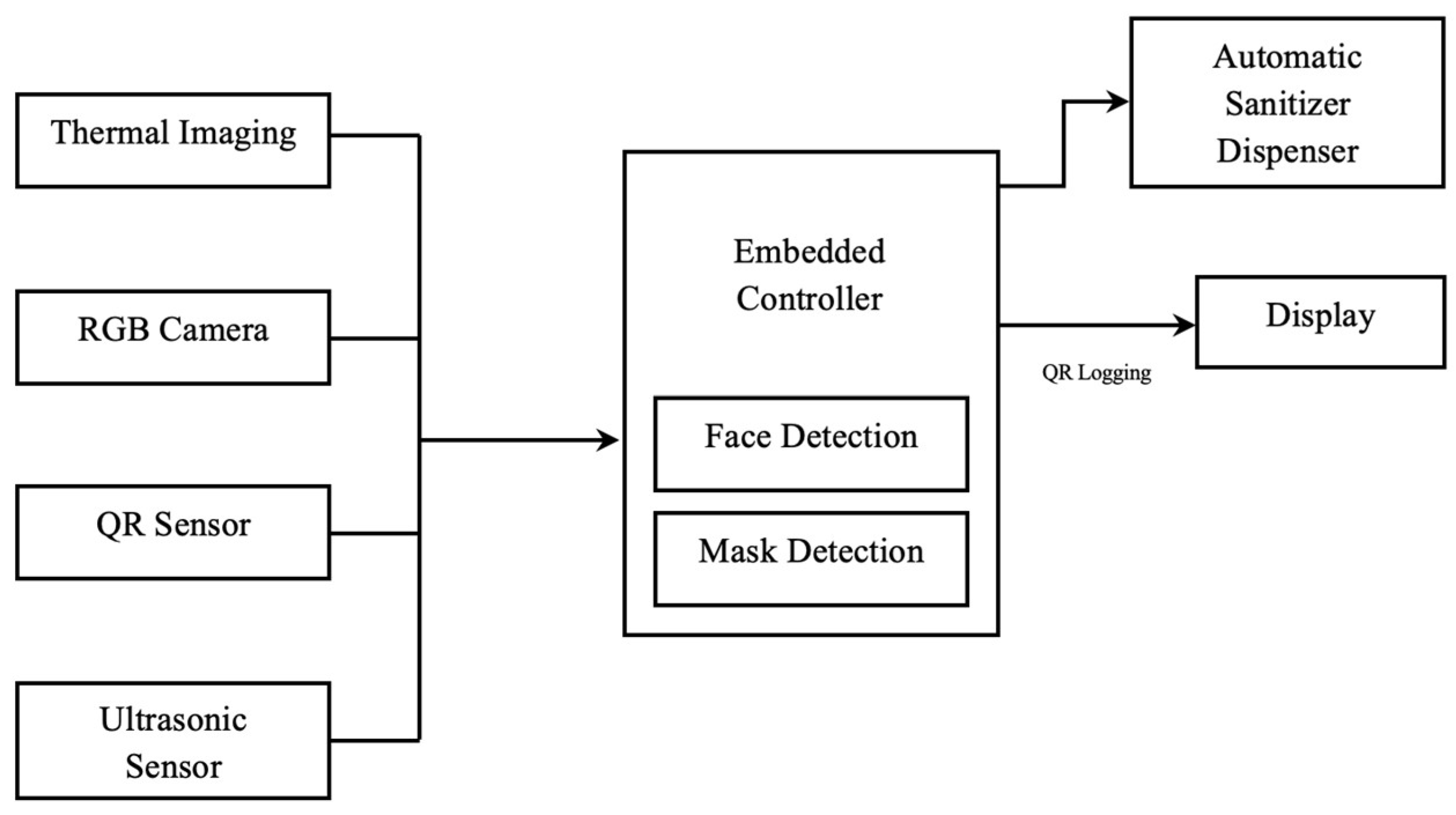
3.1. System Architecture
3.1.1. Embedded Controller and Core Processing
3.1.2. Sensor Subsystems
- Thermal Imaging: An AMG8833 infrared thermal array captures non-contact temperature readings. Although limited to an 8 × 8 grid, interpolation and calibration routines enhance accuracy.
- RGB Camera: A Raspberry Pi Camera Module V2 provides visual input for face localization and QR code scanning.
- Ultrasonic Sensor: An HC SR04 module enforces queue spacing and triggers sanitizer actuation when a user approaches.
- QR Scanner: Implemented via the RGB camera and OpenCV’s zbar library, enabling digital contact tracing through QR tokens.
- These sensors are tightly coupled through the embedded controller, forming a multimodal sensing pipeline that reduces false positives and improves reliability compared to a single modality.
3.1.3. Actuation and Feedback
3.1.4. Software Stack and Machine Learning Integration
- Computer Vision: OpenCV performs face detection, QR decoding, and ROI mapping between RGB and thermal frames.
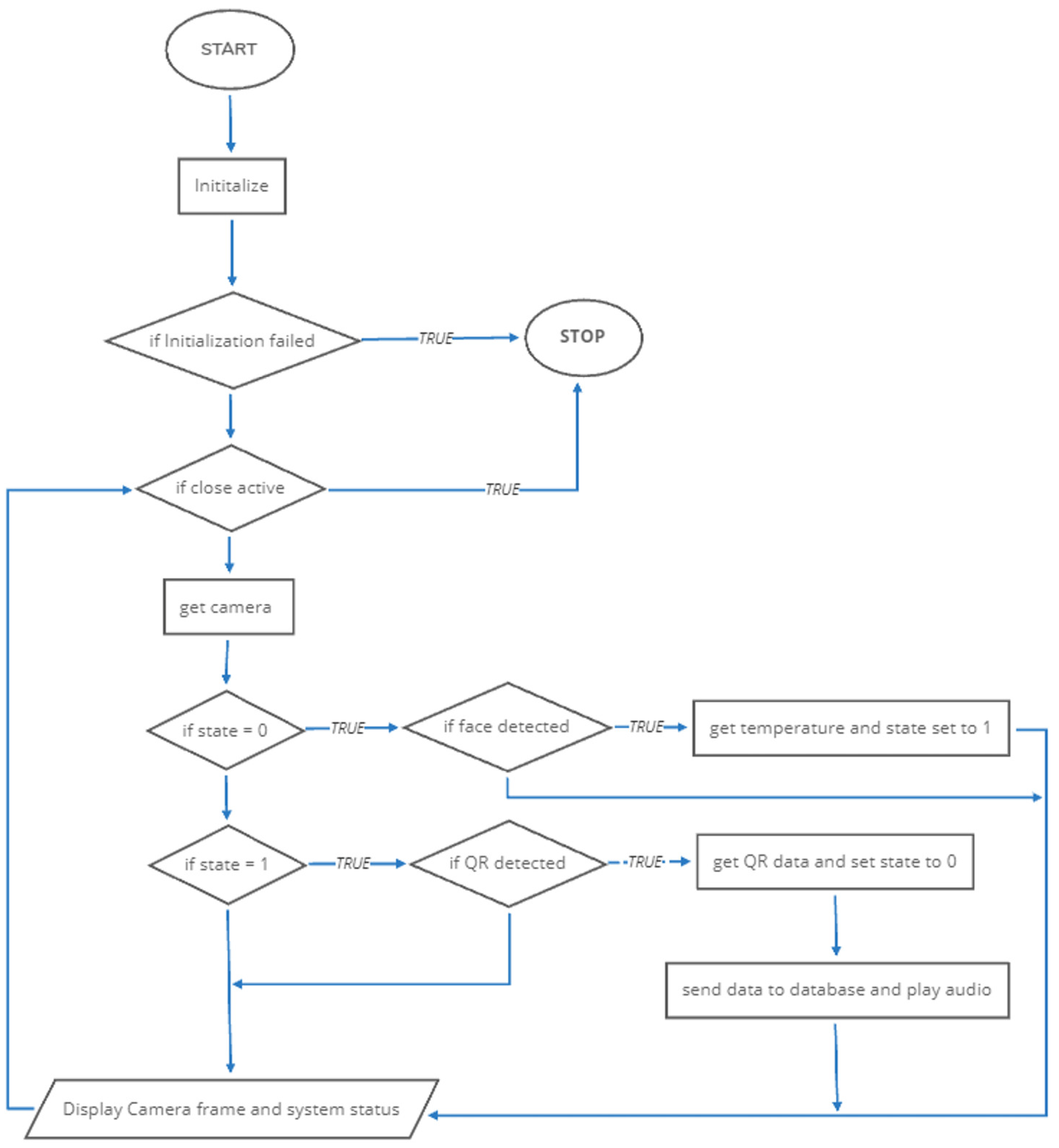
- Control Logic: A finite state machine governs the workflow: idle → approach detection → face localization → thermal capture → QR scan → sanitizer actuation → logging. This deterministic logic ensures low latency and predictable operation.
3.1.5. Web Development
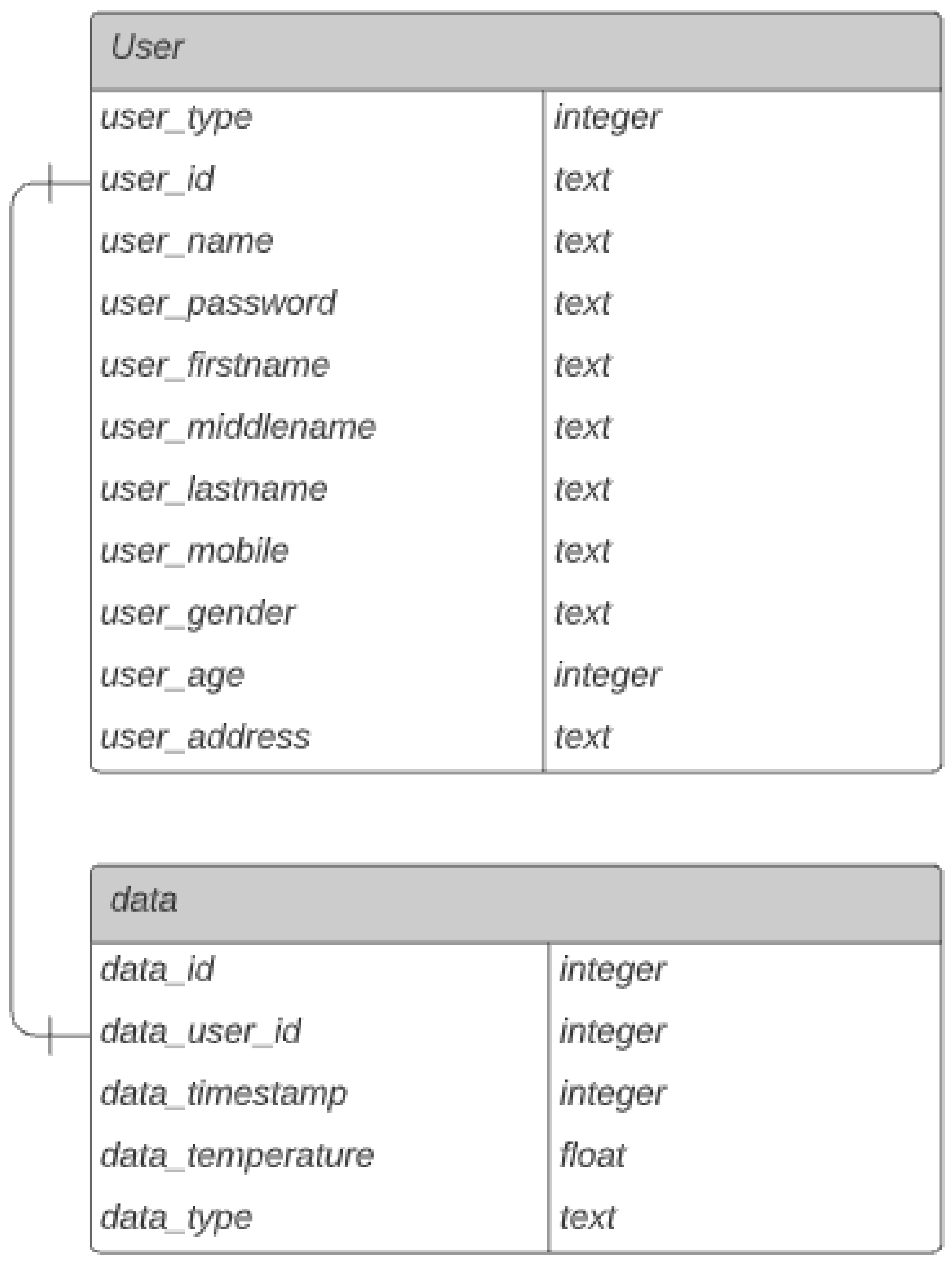
3.1.6. Data Management and Privacy
3.1.7. Operational Workflow
4. Results
4.1. Screening Throughput and End-to-End Transaction Time
4.2. Computational Efficiency of the Embedded Processing Pipeline
4.3. Environmental and User-Dependent Effects on QR Decoding Performance
4.4. Multimodal Reliability and Functional Integration
5. Conclusions
Author Contributions
Funding
Institutional Review Board Statement
Informed Consent Statement
Data Availability Statement
Acknowledgments
Conflicts of Interest
Abbreviations
| AICS-K | Artificial Intelligence-Enhanced Contactless Screening Kiosk |
| AI | Artificial Intelligence |
| AMG8833 | Panasonic infrared thermal array sensor |
| CNN | Convolutional Neural Network |
| ERD | Entity Relationship Diagram |
| GPIO | General Purpose Input/Output |
| HDMI | High-Definition Multimedia Interface |
| I2C | Inter-Integrated Circuit |
| LCD | Liquid Crystal Display |
| PHP | Hypertext Processor |
| QR | Quick Response |
| RGB | Red, Green, Blue |
| ROI | Region of Interest |
| SPI | Serial Peripheral Interface |
| XAMPP | Cross-Platform, Apache, MariaDB/MySQL, PHP, and Perl |
References
- Alvarez, E.; Bielska, I.A.; Hopkins, S.; Belal, A.A.; Goldstein, D.M.; Slick, J.; Pavalagantharajah, S.; Wynfield, A.; Dakey, S.; Gedeon, M.-C.; et al. Limitations of COVID-19 testing and case data for evidence-informed health policy and practice. Health Res. Policy Syst. 2023, 21, 11. [Google Scholar] [CrossRef] [Scilit]
- Kwon, K.T.; Ko, J.-H.; Shin, H.; Sung, M.; Kim, J.Y. Drive-Through Screening Center for COVID-19: A Safe and Efficient Screening System against Massive Community Outbreak. J. Korean Med. Sci. 2020, 35, e123. [Google Scholar] [CrossRef] [Scilit]
- Budd, J.; Miller, B.S.; Manning, E.M.; Lampos, V.; Zhuang, M.; Edelstein, M.; Rees, G.; Emery, V.C.; Stevens, M.M.; Keegan, N.; et al. Digital technologies in the public-health response to COVID-19. Nat. Med. 2020, 8, 1183–1192. [Google Scholar] [CrossRef] [Scilit]
- A Lewnard, J.; Lo, N.C. Scientific and ethical basis for social-distancing interventions against COVID-19. Lancet Infect. Dis. 2020, 20, 631. [Google Scholar] [CrossRef] [Scilit]
- Manigandan, S.; Wu, M.-T.; Ponnusamy, V.K.; Raghavendra, V.B.; Pugazhendhi, A.; Brindhadevi, K. A systematic review on recent trends in transmission, diagnosis, prevention and imaging features of COVID-19. Process Biochem. 2020, 98, 233–240. [Google Scholar] [CrossRef] [Scilit]
- Aggarwal, N.; Garg, M.; Dwarakanathan, V.; Gautam, N.; Kumar, S.S.; Jadon, R.S.; Gupta, M.; Ray, A. Diagnostic accuracy of non-contact infrared thermometers and thermal scanners: A systematic review and meta-analysis. J. Travel Med. 2020, 27, taaa193. [Google Scholar] [CrossRef] [Scilit]
- Khaksari, K.; Nguyen, T.; Hill, B.Y.; Perrault, J.; Gorti, V.; Blick, E.; Cano, T.G.; Shadgan, B.; Quang, T.; Malpani, R.; et al. Review of the efficacy of infrared thermography for screening infectious diseases with applications to COVID-19. J. Med. Imaging 2021, 8, 010901. [Google Scholar] [CrossRef] [Scilit] [PubMed]
- Mathe, S.E.; Kondaveeti, H.K.; Vappangi, S.; Vanambathina, S.D.; Kumaravelu, N.K. A comprehensive review on applications of Raspberry Pi. Comput. Sci. Rev. 2024, 52, 100636. [Google Scholar] [CrossRef] [Scilit]
- Dzien, C.; Halder, W.; Winner, H.; Lechleitner, M. COVID-19 screening: Are forehead temperature measurements during cold outdoor temperatures really helpful? Wien. Klin. Wochenschr. 2020, 133, 331. [Google Scholar] [CrossRef] [Scilit] [PubMed]
- Priest, P.C.; Duncan, A.R.; Jennings, L.C.; Baker, M.G. Thermal Image Scanning for Influenza Border Screening: Results of an Airport Screening Study. PLoS ONE 2011, 6, e14490. [Google Scholar] [CrossRef] [Scilit] [PubMed]
- Zhou, Y.; Ghassemi, P.; Chen, M.; McBride, D.; Casamento, J.P.; Pfefer, T.J.; Wang, Q. Clinical evaluation of fever-screening thermography: Impact of consensus guidelines and facial measurement location. J. Biomed. Opt. 2020, 25, 097002. [Google Scholar] [CrossRef] [Scilit]
- Foster, J.; Lloyd, A.B.; Havenith, G. Non-contact infrared assessment of human body temperature: The journal Temperature toolbox. Temp. Multidiscip. Biomed. J. 2021, 8, 306. [Google Scholar] [CrossRef] [Scilit]
- Sandler, M.; Howard, A.; Zhu, M.; Zhmoginov, A.; Chen, L. MobileNetV2: Inverted Residuals and Linear Bottlenecks. In Proceedings of the IEEE Computer Society Conference on Computer Vision and Pattern Recognition; IEEE: Salt Lake City, UT, USA, 2018; pp. 4510–4520. [Google Scholar] [CrossRef] [Scilit]
- Nakamoto, I.; Wang, S.; Guo, Y.; Zhuang, W. A QR Code-Based Contact Tracing Framework for Sustainable Containment of COVID-19: Evaluation of an Approach to Assist the Return to Normal Activity. JMIR Mhealth Uhealth 2020, 8, e22321. [Google Scholar] [CrossRef] [Scilit]
- Bardus, M.; Al Daccache, M.; Maalouf, N.; Al Sarih, R.; Elhajj, I.H. Data Management and Privacy Policy of COVID-19 Contact-Tracing Apps: Systematic Review and Content Analysis. JMIR Mhealth Uhealth 2022, 10, e35195. [Google Scholar] [CrossRef] [Scilit]
- Akinbi, A.; Forshaw, M.; Blinkhorn, V. Contact tracing apps for the COVID-19 pandemic: A systematic literature review of challenges and future directions for neo-liberal societies. Health Inf. Sci. Syst. 2021, 9, 18. [Google Scholar] [CrossRef] [Scilit]
- Tsvyatkova, D.; Buckley, J.; Beecham, S.; Chochlov, M.; O’kEeffe, I.R.; Razzaq, A.; Rekanar, K.; Richardson, I.; Welsh, T.; Storni, C.; et al. Digital Contact Tracing Apps for COVID-19: Development of a Citizen-Centered Evaluation Framework. JMIR Mhealth Uhealth 2022, 10, e30691. [Google Scholar] [CrossRef] [Scilit] [PubMed]
- 2019 Novel Coronavirus Disease (COVID-19): Detection and Diagnosis System Using IoT Based Smart Glasses. Available online: https://www.researchgate.net/publication/340732271_2019_Novel_Coronavirus_Disease_Covid-19_Detection_and_Diagnosis_System_Using_IoT_Based_Smart_Glasses (accessed on 7 March 2026).
- Ring, E.F.J.; Mcevoy, H.; Jung, A.; Zuber, J.; Machin, G. New standards for devices used for the measurement of human body temperature. J. Med. Eng. Technol. 2010, 34, 249–253. [Google Scholar] [CrossRef] [Scilit] [PubMed]
- Zhao, Y.; Bergmann, J.H.M. Non-Contact Infrared Thermometers and Thermal Scanners for Human Body Temperature Monitoring: A Systematic Review. Sensors 2023, 23, 7439. [Google Scholar] [CrossRef] [Scilit] [PubMed]
- Perpetuini, D.; Filippini, C.; Cardone, D.; Merla, A. An Overview of Thermal Infrared Imaging-Based Screenings during Pandemic Emergencies. Int. J. Environ. Res. Public Health 2021, 18, 3286. [Google Scholar] [CrossRef] [Scilit]
- Chan, P.Y.; Tay, A.; Chen, D.; Vogrin, S.; McNeil, J.; Hopper, I. Comparison of cutaneous facial temperature using infrared thermography to standard temperature measurement in the critical care setting. J. Clin. Monit. Comput. 2021, 36, 1029. [Google Scholar] [CrossRef] [Scilit]
- Antunes, A.C.M.; Aldred, A.; Moreno, G.P.T.; Ribeiro, J.A.d.S.; Brandão, P.E.; Barone, G.T.; Conselheiro, J.d.A.; Goulart, A.C.; Desuó, I.C.; Gomes, G. Potential of using facial thermal imaging in patient triage of flu-like syndrome during the COVID-19 pandemic crisis. PLoS ONE 2023, 18, e0279930. [Google Scholar] [CrossRef] [Scilit]
- Aldred, A.; Ribeiro, J.A.S.; Bezerra, P.M.S.; Antunes, A.C.M.; Goulart, A.C.; Desuó, I.C.; Gomes, G. Application of thermography to estimate respiratory rate in the emergency room: The journal Temperature toolbox. Temperature 2022, 10, 159–165. [Google Scholar] [CrossRef] [Scilit]
- Unim, B.; Zile-Velika, I.; Pavlovska, Z.; Lapao, L.; Peyroteo, M.; Misins, J.; Forjaz, M.J.; Nogueira, P.; Grisetti, T.; Palmieri, L. The role of digital tools and emerging devices in COVID-19 contact tracing during the first 18 months of the pandemic: A systematic review. Eur. J. Public Health 2024, 34, i11–i28. [Google Scholar] [CrossRef] [Scilit]
- Nagrath, P.; Jain, R.; Madan, A.; Arora, R.; Kataria, P.; Hemanth, J. SSDMNV2: A real time DNN-based face mask detection system using single shot multibox detector and MobileNetV2. Sustain. Cities Soc. 2021, 66, 102692. [Google Scholar] [CrossRef] [Scilit]
- Sethi, S.; Kathuria, M.; Kaushik, T. Face mask detection using deep learning: An approach to reduce risk of Coronavirus spread. J. Biomed. Inform. 2021, 120, 103848. [Google Scholar] [CrossRef] [Scilit]
- Ullah, N.; Javed, A.; Ghazanfar, M.A.; Alsufyani, A.; Bourouis, S. A novel DeepMaskNet model for face mask detection and masked facial recognition. J. King Saud Univ. Comput. Inf. Sci. 2022, 34, 9905–9914. [Google Scholar] [CrossRef] [Scilit] [PubMed]
- Schroff, F.; Kalenichenko, D.; Philbin, J. FaceNet: A unified embedding for face recognition and clustering. In Proceedings of the IEEE Computer Society Conference on Computer Vision and Pattern Recognition, Boston, MA, USA, 7–12 June 2015; pp. 815–823. [Google Scholar] [CrossRef] [Scilit]
- Khalifa, A.F.; Badr, E.; Elmahdy, H.N. A survey on human detection surveillance systems for Raspberry Pi. Image Vis. Comput. 2019, 85, 1–13. [Google Scholar] [CrossRef] [Scilit]
- Dubey, P.; Keswani, V.; Dubey, P.; Keswani, G.; Bhagat, D. Innovative IoT-enabled mask detection system: A hybrid deep learning approach for public health applications. MethodsX 2025, 14, 103291. [Google Scholar] [CrossRef] [Scilit] [PubMed]
- Bolima, D.; Huerto, C.A. Contactless logging and disinfection solution with automated face mask detection. Int. J. Electr. Comput. Eng. 2024, 14, 3913–3921. [Google Scholar] [CrossRef] [Scilit]
- Guerrieri, M.; Parla, G. Real-time social distance measurement and face mask detection in public transportation systems during the COVID-19 pandemic and post-pandemic Era: Theoretical approach and case study in Italy. Transp. Res. Interdiscip. Perspect. 2022, 16, 100693. [Google Scholar] [CrossRef] [Scilit]
- Shrimali, S.; Teuscher, C. A Novel Deep Learning-, Camera-, and Sensor-Based System for Enforcing Hand Hygiene Compliance in Healthcare Facilities. IEEE Sens. J. 2023, 23, 13659–13670. [Google Scholar] [CrossRef] [Scilit]
- Buachoom, A.; Thedsakhulwong, A.; Wuttiprom, S. An Arduino board with ultrasonic sensor investigation of simple harmonic motion. J. Phys. Conf. Ser. 2019, 1380, 012098. [Google Scholar] [CrossRef] [Scilit]
- Ashjaei, M.; Khalilzad, N.; Mubeen, S.; Behnam, M.; Sander, I.; Almeida, L.; Nolte, T. Designing end-to-end resource reservations in predictable distributed embedded systems. Real-Time Syst. 2017, 53, 916–956. [Google Scholar] [CrossRef] [Scilit]
- Sciangula, G.; Casini, D.; Biondi, A.; Scordino, C.; Di Natale, M. End-To-end response-time analysis of DDS-based real-time applications. Internet Things 2026, 36, 101853. [Google Scholar] [CrossRef] [Scilit]
- Holtmann, J.; Deantoni, J.; Fockel, M. Early timing analysis based on scenario requirements and platform models. Softw. Syst. Model. 2022, 21, 2171–2211. [Google Scholar] [CrossRef] [Scilit]
- Kim, J.-I.; Gang, H.-S.; Pyun, J.-Y.; Kwon, G.-R. Implementation of QR Code Recognition Technology Using Smartphone Camera for Indoor Positioning. Energies 2021, 14, 2759. [Google Scholar] [CrossRef] [Scilit]
- Karrach, L.; Pivarčiová, E.; Božek, P. Identification of QR Code Perspective Distortion Based on Edge Directions and Edge Projections Analysis. J. Imaging 2020, 6, 67. [Google Scholar] [CrossRef] [Scilit] [PubMed]
- Ahmed, W.; Hasan, O.; Tahar, S. Formalization of Reliability Block Diagrams in Higher-order Logic. J. Appl. Log. 2016, 18, 19–41. [Google Scholar] [CrossRef] [Scilit]
- Moustafa, K.; Hu, Z.; Mourelatos, Z.P.; Baseski, I.; Majcher, M. System reliability analysis using component-level and system-level accelerated life testing. Reliab. Eng. Syst. Saf. 2021, 214, 107755. [Google Scholar] [CrossRef] [Scilit]



| Metric | Result | Basis |
|---|---|---|
| Average full screening time | 14.09 s | Prototype evaluation |
| Manual screening time | 25–30 s | Comparative baseline |
| Estimated throughput | 4.26 persons/min | Computed from Equation (2) |
| Core processing time | <5 s | Runtime analysis |
| Temperature difference vs. commercial device | 0.1–0.2 °C | Calibration result |
| QR decoding success | 11/11 trials | QR validation |
| Dominant runtime variability factor | User device brightness | Tentative analysis |
Disclaimer/Publisher’s Note: The statements, opinions and data contained in all publications are solely those of the individual author(s) and contributor(s) and not of MDPI and/or the editor(s). MDPI and/or the editor(s) disclaim responsibility for any injury to people or property resulting from any ideas, methods, instructions or products referred to in the content. |
© 2026 by the authors. Licensee MDPI, Basel, Switzerland. This article is an open access article distributed under the terms and conditions of the Creative Commons Attribution (CC BY) license.
Share and Cite
Beray, M.J.M.; Arante, R.B.; Batutay, J. Artificial Intelligence-Enhanced Contactless Screening Kiosks: Leveraging Machine Learning for Infectious Disease Detection and Mitigation. Eng. Proc. 2026, 143, 5. https://doi.org/10.3390/engproc2026143005
Beray MJM, Arante RB, Batutay J. Artificial Intelligence-Enhanced Contactless Screening Kiosks: Leveraging Machine Learning for Infectious Disease Detection and Mitigation. Engineering Proceedings. 2026; 143(1):5. https://doi.org/10.3390/engproc2026143005
Chicago/Turabian StyleBeray, Marisol Jane M., Ramil B. Arante, and Jofel Batutay. 2026. "Artificial Intelligence-Enhanced Contactless Screening Kiosks: Leveraging Machine Learning for Infectious Disease Detection and Mitigation" Engineering Proceedings 143, no. 1: 5. https://doi.org/10.3390/engproc2026143005
APA StyleBeray, M. J. M., Arante, R. B., & Batutay, J. (2026). Artificial Intelligence-Enhanced Contactless Screening Kiosks: Leveraging Machine Learning for Infectious Disease Detection and Mitigation. Engineering Proceedings, 143(1), 5. https://doi.org/10.3390/engproc2026143005