


Diffusion of Authentic Assessment in Deep Learning Approaches: The Role of Network Communication and Teacher Opinion Leadership †
Abstract
1. Introduction
2. Review of Related Literature
2.1. The Complexity of Authentic Assessment in Deep Learning
2.2. Diffusion of Innovations (DOI) and Pedagogical Complexity
2.3. Social Network Analysis (SNA) as a Relational Lens
2.4. Opinion Leaders as “Pedagogical Translators” in Indonesia
3. Methodology
3.1. Research Design
3.2. Site and Participants
3.3. Data Collection
3.4. Data Analysis
- (1)
- Macro Level: Calculating network density to examine the compactness of information flow.
- (2)
- Meso Level: Using the Modularity Class algorithm to identify social clusters or groups formed (e.g., based on subject matter).
- (3)
- Micro Level: Calculating individual centrality metrics, specifically In-Degree Centrality (to identify opinion leaders) and Betweenness Centrality (to identify information connectors).
4. Findings and Results
4.1. Quantitative Phase Findings: Communication Network Analysis (SNA)
- (1)
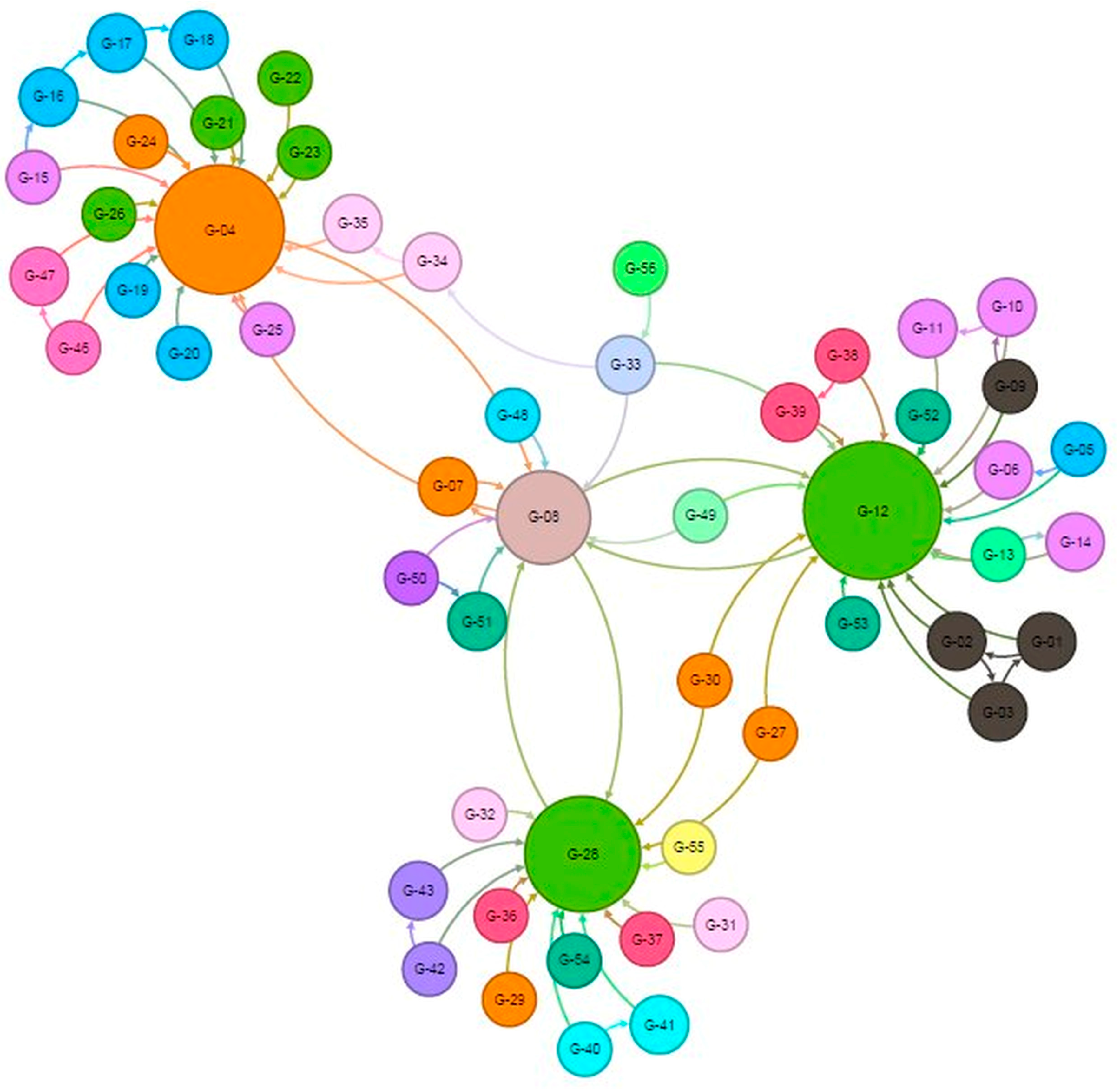
- In-Degree Centrality: Three actors emerged with the highest number of references: Teacher G-12 (score 19), Teacher G-04 (score 16), and Teacher G-28 (score 14). This data indicates the number of colleagues who nominate these three teachers as a reference for consultation.
- (2)
- Betweenness Centrality: The highest score was recorded by Teacher G-08 (145.2). This score indicates the frequency with which this actor lies on the shortest path connecting two other actors in the network.
- (3)
- Community Structure Analysis (Modularity Class): This produced a value of 0.425, forming five main clusters within the network. The graph visualization shows that node grouping tends to follow subject matter clusters (homophily). Furthermore, the data shows no isolated actors (isolates); all teachers in the periphery have at least one active connection to a cluster.
4.2. Qualitative Phase Findings: Interviews with Opinion Leaders and Key Actors
4.3. Network Structure Dynamics in Authentic Assessment Diffusion
4.4. Authentic Assessment as a Complex Pedagogical Innovation
4.5. Implications: Hybrid Diffusion Model
5. Conclusions and Recommendations
5.1. Conclusions
5.2. Recommendations
- Empowerment of Informal Opinion Leaders: School management should strategically identify and empower central teachers who act as opinion leaders. Rather than relying solely on formal top–down instructions, these “pedagogical translators” should be utilized as mentors within learning communities to simplify complex concepts for their peers.
- Strengthening Organic Collaboration Networks: Schools should formalize and support existing informal practices such as rubric-sharing, peer classroom observations, and low-stakes discussion groups. These activities reduce innovation barriers by increasing trialability and observability, allowing teachers to experiment with new assessment methods at a manageable pace.
- Development of Integrated Institutional Support: To ensure sustainability, there must be synergy between structural legitimacy (e.g., formal training and infrastructure) and interpersonal validation. Institutional policies should provide the necessary resources and psychological safety, while interpersonal networks provide the technical know-how required for classroom implementation.
- Focus on Subject-Based Clusters: Since communication patterns often follow subject matter homophily, intervention strategies should be tailored to specific clusters. Professional Learning Communities (PLCs) should be encouraged within these clusters to maintain innovation coherence while addressing the unique technical demands of different disciplines.
- Future Research on Long-Term Sustainability: Further research is recommended to observe the long-term sustainability of these adoption patterns and to explore how digital platforms might further facilitate network communication in the diffusion of pedagogical innovations.
Author Contributions
Funding
Institutional Review Board Statement
Informed Consent Statement
Data Availability Statement
Acknowledgments
Conflicts of Interest
References
- Villarroel, V.; Bloxham, S.; Bruna, D.; Bruna, C.; Herrera-Seda, C. Authentic assessment: Creating a blueprint for course design. Assess. Eval. High. Educ. 2018, 43, 840–854. [Google Scholar] [CrossRef] [Scilit]
- Vlachopoulos, D.; Makri, A. A systematic literature review on authentic assessment in higher education: Best practices for the development of 21st century skills, and policy considerations. Stud. Educ. Eval. 2024, 83, 101425. [Google Scholar] [CrossRef] [Scilit]
- Rogers, E.M. Evolution: Diffusion of Innovations. In International Encyclopedia of the Social & Behavioral Sciences, 2nd ed.; Elsevier: Amsterdam, The Netherlands, 2015; pp. 378–381. [Google Scholar] [CrossRef] [Scilit]
- Wake, S.; Pownall, M.; Harris, R.; Birtill, P. Balancing pedagogical innovation with psychological safety? Assess. Eval. High. Educ. 2024, 49, 511–522. [Google Scholar] [CrossRef] [Scilit]
- Jopp, R. A case study of a technology enhanced learning initiative that supports authentic assessment. Teach. High. Educ. 2020, 25, 942–958. [Google Scholar] [CrossRef] [Scilit]
- Lai, X.; Zhang, W.; Chen, S. How can a single spark kindle a Prairie fire? Diffusion process and mechanism of medical disruptive innovation. Chin. Manag. Stud. 2025, 19, 1200–1224. [Google Scholar] [CrossRef] [Scilit]
- Valente, T.W. Social Networks and Health: Models, Methods, and Applications; Oxford University Press: New York, NY, USA, 2010. [Google Scholar]
- McPherson, M.; Smith-Lovin, L.; Cook, J.M. Birds of a Feather: Homophily in Social Networks. Annu. Rev. Sociol. 2001, 27, 415–444. [Google Scholar] [CrossRef] [Scilit]
- Chen, J.; Andrade, H.L. Authentic Assessment. In Oxford Research Encyclopedia of Education; Oxford University Press: New York, NY, USA, 2017. [Google Scholar] [CrossRef] [Scilit] [PubMed]
- Press, N.; Ashford-Rowe, K.; Huijser, H. Authentic assessment: Opportunities and challenges. In Research Handbook on Innovations in Assessment and Feedback in Higher Education: Implications for Teaching and Learning; Evans, C., Waring, M., Eds.; Edward Elgar Publishing: Cheltenham, UK, 2024; pp. 425–442. [Google Scholar] [CrossRef] [Scilit]
- Oroh, E.Z.; Ali, M.I.; Pelenkahu, N.; Usman, H.; Rorintulus, O. Authentic assessment in higher education to increase critical thinking and develop metacognitive awareness. Stud. Engl. Lang. Educ. 2025, 12, 827–844. [Google Scholar]
- Namatame, A. Diffusion and emergence in social networks. In Intelligent Systems for Automated Learning and Adaptation: Emerging Trends and Applications; IGI Global: Hershey, PA, USA, 2010; pp. 231–247. [Google Scholar] [CrossRef] [Scilit]
- Menzli, L.J.; Smirani, L.K.; Boulahia, J.A.; Hadjouni, M. Investigation of open educational resources adoption in higher education using Rogers’ diffusion of innovation theory. Heliyon 2022, 8, e09885. [Google Scholar] [CrossRef] [Scilit] [PubMed]
- Namatame, A.; Chen, S.H. Agent-Based Modeling and Network Dynamics; Oxford University Press: Oxford, UK, 2016. [Google Scholar]
- Wasserman, S.; Faust, K. Social Network Analysis: Methods and Applications; Cambridge University Press: Cambridge, UK, 1994. [Google Scholar]
- Borgatti, S.P. Centrality and network flow. Soc. Netw. 2005, 27, 55–71. [Google Scholar] [CrossRef] [Scilit]
- Lazega, E. Reviewed Work: Structural Holes: The Social Structure of Competition Ronald S. Burt. Rev. Française Sociol. 1995, 36, 779–781. [Google Scholar] [CrossRef] [Scilit]
- Wang, N.; Xie, W.; Tiberius, V.; Qiu, Y. Accelerating new product diffusion: How lead users serve as opinion leaders in social networks. J. Retail. Consum. Serv. 2023, 72, 103297. [Google Scholar] [CrossRef] [Scilit]
- Vargo, S.L.; Akaka, M.A.; Wieland, H. Rethinking the process of diffusion in innovation: A service-ecosystems and institutional perspective. J. Bus. Res. 2020, 116, 526–534. [Google Scholar] [CrossRef] [Scilit]
- Creswell, J.W.; Plano Clark, V.L. Designing and Conducting Mixed Methods Research, 3rd ed.; Sage Publications: Thousand Oaks, CA, USA, 2018. [Google Scholar]

| Network Metric | Value | Interpretation |
|---|---|---|
| Density | 0.108 | Network connectivity level is 10.8% (high efficiency). |
| Average Degree | 5.4 | On average, teachers have 5–6 intensive discussion partners. |
| Network Diameter | 4 | The farthest distance of information spread between actors. |
| Modularity | 0.425 | High fragmentation level; 5 subject clusters formed. |
| Clustering Coefficient | 0.334 | Strong tendency to form small groups/cliques. |
| Teacher Code | In-Degree (Reference) | Betweenness (Bridge) | Subject Cluster | Role Identification |
|---|---|---|---|---|
| G-12 | 19 | 85.4 | STEM (MIPA) | Primary Opinion Leader |
| G-04 | 16 | 62.1 | Language | Opinion Leader |
| G-28 | 14 | 41.5 | Social Studies | Opinion Leader |
| G-08 | 8 | 145.2 | Technology | Bridge (Connector) |
| G-33 | 6 | 98.7 | Arts | Bridge/Active Actor |
Disclaimer/Publisher’s Note: The statements, opinions and data contained in all publications are solely those of the individual author(s) and contributor(s) and not of MDPI and/or the editor(s). MDPI and/or the editor(s) disclaim responsibility for any injury to people or property resulting from any ideas, methods, instructions or products referred to in the content. |
© 2026 by the authors. Licensee MDPI, Basel, Switzerland. This article is an open access article distributed under the terms and conditions of the Creative Commons Attribution (CC BY) license.
Share and Cite
Karim, S.; Logayah, D.S.; Ruhimat, M. Diffusion of Authentic Assessment in Deep Learning Approaches: The Role of Network Communication and Teacher Opinion Leadership. Eng. Proc. 2026, 143, 28. https://doi.org/10.3390/engproc2026143028
Karim S, Logayah DS, Ruhimat M. Diffusion of Authentic Assessment in Deep Learning Approaches: The Role of Network Communication and Teacher Opinion Leadership. Engineering Proceedings. 2026; 143(1):28. https://doi.org/10.3390/engproc2026143028
Chicago/Turabian StyleKarim, Syahida, Dina Siti Logayah, and Mamat Ruhimat. 2026. "Diffusion of Authentic Assessment in Deep Learning Approaches: The Role of Network Communication and Teacher Opinion Leadership" Engineering Proceedings 143, no. 1: 28. https://doi.org/10.3390/engproc2026143028
APA StyleKarim, S., Logayah, D. S., & Ruhimat, M. (2026). Diffusion of Authentic Assessment in Deep Learning Approaches: The Role of Network Communication and Teacher Opinion Leadership. Engineering Proceedings, 143(1), 28. https://doi.org/10.3390/engproc2026143028

