1. Introduction
The bench vise has long been recognized as an essential tool in workshops and fabrication industries. Developed in the mid-1700s, the device functions as a mechanical clamp mounted on a workbench that securely holds workpieces during operations such as cutting, drilling, grinding, and welding. By stabilizing materials during fabrication tasks, bench vises significantly improve work precision and operator safety, particularly when handling metal bars and pipes during machining processes [
1,
2].
Modern fabrication environments require reliable clamping systems capable of maintaining strong gripping force while ensuring accurate alignment of materials. However, many workshops, particularly in educational institutions and small fabrication facilities, still rely on worn-out or damaged vises that reduce operational efficiency and compromise safety. Inadequate clamping devices can lead to unstable workpieces, reduced cutting precision, and increased risk of injury during welding and fabrication activities [
3].
To address these challenges, the present study developed a Double Jaw Vertical Bench Vise, an innovative work-holding device designed to improve clamping stability, safety, and ease of operation in welding environments. Unlike conventional vises that rely mainly on a single movable jaw and manual screw mechanism, the proposed design incorporates a dual-jaw clamping configuration combined with a hydraulic lifting mechanism. Hydraulic jacks are widely used in mechanical systems to generate large lifting forces with minimal physical effort, making them effective components for improving ergonomic performance in mechanical tools [
4].
The integration of a hydraulic jack into the vise structure allows vertical adjustment of the jaws with reduced manual force while maintaining strong clamping pressure. This feature improves workpiece alignment while minimizing operator fatigue during repetitive fabrication tasks. Previous research has explored improvements in vise design to enhance safety and operational efficiency. For instance, cam-operated machine vises have been developed to reduce manual effort and prevent damage to workpieces during clamping operations [
5]. Other studies have focused on strengthening clamping force and improving structural stability and mobility in bench vise systems used in workshop environments [
6,
7].
Bench vise design has continuously evolved through improvements in materials and fabrication technologies. Modern workshop tools often utilize steel flat bars, bolts, and durable structural components to ensure reliable performance under heavy loads [
8,
9]. In addition, fabrication processes commonly employ cutting and grinding tools such as angle grinders and cutting discs to shape and finish metal components during the construction of mechanical devices [
10,
11]. Protective coatings such as anti-rust spray are also widely applied to prevent corrosion and extend the lifespan of metal tools used in workshop environments [
12].
Building on these technological developments, the Double Jaw Vertical Bench Vise introduced in this study aims to provide a practical and cost-efficient solution for welding and fabrication workshops. The dual-jaw mechanism enables the vise to secure workpieces at multiple contact points, improving stability and reducing the risk of deformation when handling irregular or heavy materials. Furthermore, the vertical orientation of the vise allows better accessibility to the working area and supports a more ergonomic working posture for operators.
By combining a hydraulic lifting mechanism, durable construction materials, and a dual-jaw clamping system, the developed prototype seeks to improve both operational efficiency and safety in welding environments. The study therefore contributes to the advancement of workshop tool design by proposing a practical innovation that can be applied in industrial fabrication facilities as well as technical training institutions.
2. Methodology
This study employed a descriptive developmental research design to develop and evaluate the Double Jaw Vertical Bench Vise. The research was conducted at Caraga State University–Cabadbaran Campus and selected nearby welding and fabrication sites. The respondents were purposively selected based on their technical expertise and experience in welding and metalworking, including welding instructors, industry practitioners, and students from the College of Industrial Technology and Teacher Education. The development of the prototype followed the Input–Process–Output (IPO) framework. In the input phase, the researchers identified and gathered the required materials, tools, and design specifications for constructing the vise. The process phase involved the conceptual design, fabrication, assembly, and testing of the prototype, integrating a dual-jaw clamping mechanism and a hydraulic jack to improve stability and ease of operation. The output phase resulted in the completed Double Jaw Vertical Bench Vise prototype, which was then evaluated using a structured assessment instrument. The evaluation focused on key criteria such as design and construction, functionality, usability, aesthetics, modularity, and ergonomics. The collected data were organized, tallied, and analyzed using descriptive statistical methods, particularly the weighted mean and standard deviation, to interpret the respondents’ assessments and determine the overall performance and effectiveness of the developed prototype.
3. Results and Discussion
The development of the Double Jaw Vertical Bench Vise with Hydraulic Jack Mechanism was undertaken to address the practical challenges commonly encountered in welding and fabrication workshops, particularly the limitations of conventional vises used in educational and small-scale industrial environments. Traditional bench vises typically rely on a single movable jaw operated through manual screw mechanisms. While this design has been widely used for centuries, it often requires significant physical effort during operation and may provide limited stability when handling irregularly shaped or vertically oriented workpieces. The present prototype introduces a dual-jaw configuration combined with a hydraulic lifting mechanism to enhance clamping performance, improve workpiece alignment, and reduce operator fatigue.
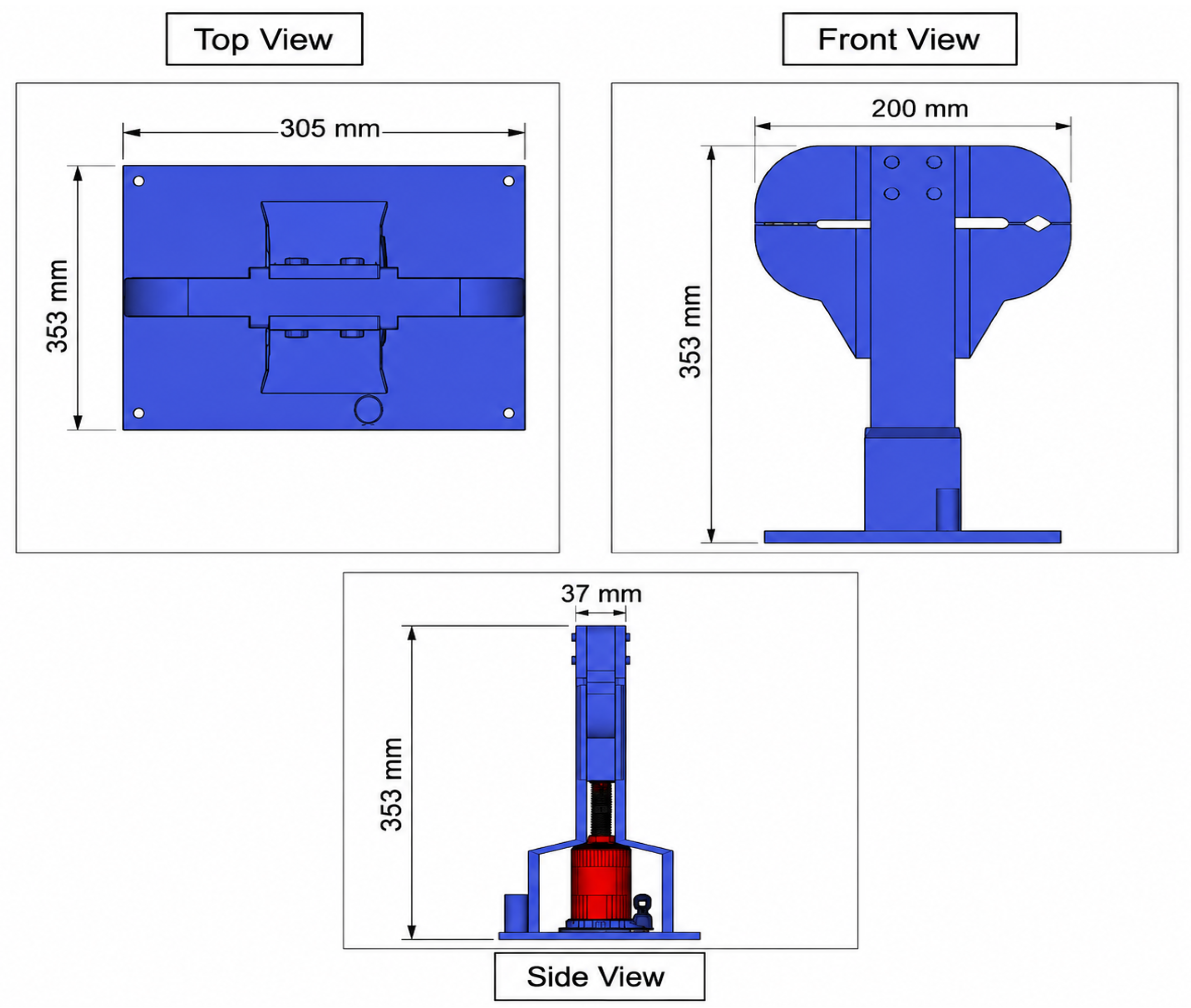
Figure 1 illustrates the structural design of the prototype, including the dual-jaw clamping system and the hydraulic lifting component. The structural design of the prototype integrates a hydraulic jack system that enables vertical adjustment of the clamping jaws. This feature provides a significant advantage compared with conventional bench vises because it allows users to lift and position workpieces with minimal manual force. In welding operations where heavy metal components are frequently manipulated, the reduction of manual effort contributes not only to increased productivity but also to improved workplace safety. The dual-jaw mechanism further enhances stability by distributing clamping pressure across multiple contact points, thereby reducing the risk of workpiece movement or deformation during cutting, grinding, or welding tasks.
Table 1 shows the cost analysis indicated that the total expense required for developing the prototype amounted to ₱14,415.00, including materials and machine costs. This cost remains relatively affordable compared with commercially manufactured industrial vises, suggesting that the prototype could serve as a practical alternative for educational workshops and small fabrication facilities.
Table 2 shows the evaluation of the Dual-Jaw Welding Vise in terms of design, construction, and material availability, the product obtained an overall mean rating of 3.86, indicating that respondents recognized the durability and practicality of the vise’s structural components. The high ratings for durability and portability suggest that the selected materials and fabrication techniques successfully produced a robust yet compact device suitable for workshop environments. Respondents particularly acknowledged the vise’s structural stability and its ability to withstand the mechanical stresses associated with welding and fabrication operations. However, slightly lower scores in the parameter related to technical simplicity suggest that certain aspects of the design could be further optimized to simplify the structure or reduce fabrication complexity. While the dual-jaw system improves clamping performance, it also introduces additional mechanical components that may require careful alignment during assembly. Future improvements could therefore focus on refining the mechanical layout to maintain functionality while simplifying the construction process.
Table 3 shows the evaluation of the Dual-Jaw Welding Vise in terms of functionality. The functionality evaluation yielded an overall mean rating of 3.86, indicating that the prototype successfully performs its intended operational tasks. Respondents emphasized the product’s ability to accommodate multiple fabrication processes while maintaining consistent clamping pressure. The hydraulic lifting mechanism was particularly recognized as a valuable addition, as it allows users to adjust the workpiece position quickly and efficiently without excessive physical exertion. The highest rating within this category was associated with the product’s ability to provide timely response during operation, suggesting that the mechanical system operates smoothly and effectively under typical workshop conditions.
Despite the overall positive evaluation, certain parameters within the functionality assessment received slightly lower ratings. These results suggest that while the prototype performs well in general operations, further enhancements could be implemented to expand its range of applications or improve the precision of specific adjustments. For example, refining the hydraulic control system or incorporating additional locking mechanisms could further enhance the vise’s operational reliability, particularly during heavy-duty fabrication tasks.
Table 4 shows the evaluation of the Dual-Jaw Welding Vise in terms of usability. The evaluation of usability produced an overall mean rating of 3.80, indicating that the device is generally easy to operate and suitable for both professional and instructional settings. Respondents recognized that the vise could serve as an effective learning tool in welding laboratories because it demonstrates modern clamping technology while maintaining a relatively straightforward operational procedure. The hydraulic lifting system significantly contributes to usability by reducing the physical strain associated with manually lifting heavy materials during positioning.
However, the lowest score within the usability category was recorded for the parameter related to users’ ability to easily recognize the proper operation of the device. This finding suggests that some users may initially experience difficulty understanding the correct procedure for adjusting the hydraulic lifting mechanism or positioning the dual jaws. Such challenges are common when introducing new mechanical systems that differ from conventional tools. To address this issue, the prototype could be improved by incorporating instructional markings, operational guides, or safety labels directly on the device. These enhancements would help users quickly understand the proper usage procedures, thereby improving operational efficiency and reducing the likelihood of misuse.
Table 5 shows the evaluation of the Dual-Jaw Welding Vise in terms of Aesthetic. The aesthetic evaluation revealed an overall mean rating of 3.77, reflecting a generally positive perception of the prototype’s visual design and structural arrangement. Respondents agreed that the device maintains appropriate proportions and integrates functional components effectively. In workshop environments, aesthetic considerations may appear secondary to mechanical performance; however, well-organized structural design can significantly influence user perception, confidence, and ease of operation.
The slightly lower ratings related to the visibility of functional components suggest that certain parts of the vise could be made more visually distinct to better communicate their purpose to users. For instance, color-coded mechanical components or clearly visible adjustment points could improve visual clarity and enhance user interaction with the device.
Table 6 shows the evaluation of the Dual-Jaw Welding Vise in terms of modularity. The modularity assessment also produced an overall mean rating of 3.77, indicating that respondents appreciated the product’s ability to allow part replacement, modification, and adaptability to different operational requirements. Modularity is an important feature in mechanical tools because it enables users to repair or upgrade components without replacing the entire system. The evaluation results suggest that the developed vise supports maintenance and adaptability through its detachable components and straightforward mechanical layout.
Nevertheless, respondents indicated that improvements could still be made in terms of maximizing the reuse of existing parts in different operational contexts. Enhancing component compatibility or designing interchangeable modules may further increase the versatility of the device. Such improvements would be particularly beneficial for workshops that require flexible equipment capable of handling a wide variety of fabrication tasks.
Table 7 shows the evaluation of the Dual-Jaw Welding Vise in terms of Ergonomics. The ergonomics evaluation demonstrated an overall mean rating of 3.80, confirming that the device generally supports comfortable user interaction and efficient working conditions. Respondents highlighted the appropriate width and structural dimensions of the vise, which allow operators to position workpieces comfortably while maintaining proper body posture during fabrication tasks. The hydraulic lifting system further contributes to ergonomic performance by minimizing the need for excessive physical force during adjustments.
However, parameters related to fatigue reduction and unnecessary motions received slightly lower ratings compared with other ergonomic indicators. These results suggest that while the device reduces some physical strain, prolonged use may still require users to exert effort when operating certain mechanical components. Future design modifications could therefore focus on improving handle positioning, optimizing the hydraulic control system, or incorporating additional ergonomic features that further minimize user fatigue.
4. Conclusions
The development of the Double Jaw Vertical Bench Vise with Hydraulic Jack Mechanism successfully addresses the need for a safer, more efficient, and versatile work-holding device in welding and fabrication environments. By integrating a dual-jaw clamping system with hydraulic assistance, the prototype improves clamping stability, vertical alignment, and reduces the physical effort required when handling heavy or irregular workpieces. Expert evaluations across design, functionality, usability, aesthetics, modularity, and ergonomics consistently received “Strongly Agree” ratings, confirming the vise’s durability, adaptability, and overall reliability. The dual-jaw design enhances workpiece stability and distributes clamping force evenly, reducing deformation and improving safety, while the hydraulic system minimizes operator fatigue, allowing for smoother and more precise fabrication tasks.
Despite the overall positive performance, certain evaluation parameters scored slightly lower, particularly in user recognition of proper operation, visual clarity of functional components, and reduction of fatigue during prolonged use. These findings indicate areas for improvement, such as enhanced instructional markings, ergonomic refinements, and clearer visual cues for hydraulic and movable parts. Overall, the study demonstrates that the Double Jaw Vertical Bench Vise represents a meaningful advancement over conventional vises, providing a practical, ergonomic, and high-performance solution suitable for technical training institutions, industrial workshops, and fabrication environments.
5. Recommendations
To further enhance the performance and usability of the Double Jaw Vertical Bench Vise, it is recommended to incorporate clear operational instructions, safety labels, and visual cues on moving components to help users recognize the correct handling procedure. Ergonomic adjustments, including improved handle positioning and optimized hydraulic controls, could reduce fatigue and unnecessary motion during prolonged use, ensuring safer and more efficient operation. Additionally, minor aesthetic improvements, such as color-coding key functional parts, could make the device easier to interpret and operate while maintaining professional appearance.
Future development should also explore cost-effective material alternatives to improve affordability, along with extended durability testing under continuous heavy-duty usage to validate long-term performance. Large-scale comparative studies against conventional vises would provide stronger evidence of operational benefits. Finally, pursuing intellectual property protection and potential commercialization can support wider adoption of this innovative tool in educational and industrial workshop settings, maximizing its practical impact in welding and fabrication environments.
Author Contributions
Conceptualization, A.S.J., C.T.T., R.G.E., C.V.R., M.M.Q. and R.C.F., methodology, A.S.J., C.T.T. and R.G.E., validation, and formal analysis, investigation, resources, writing A.S.J., C.T.T. and R.G.E., original draft preparation, A.S.J.; writing—review and editing, A.S.J., C.T.T. and R.G.E., visualization A.S.J., C.T.T. and R.G.E., supervision, A.S.J., C.T.T. and R.G.E., project administration, A.S.J., C.T.T. and R.G.E. All authors have read and agreed to the published version of the manuscript.
Funding
This research received no external funding.
Institutional Review Board Statement
Not applicable.
Informed Consent Statement
Not applicable.
Data Availability Statement
Acknowledgments
The researchers would like to thank the Research Development and Innovation and Extension Office for its financial support and application of its scholarly works.
Conflicts of Interest
The authors declare no conflict of interest.
References
- Rennie, A. Bench Clamp. About Mechanics. 2021. Available online: https://www.aboutmechanics.com/what-is-a-c-clamp.htm (accessed on 20 January 2025).
- Hemanth, M.; Dheeraj, P.R.; Hamritha, S.; Rajesh, B.; Krishna, S.R.V. Design of Work Holding Device for Machining Wheel Hubs. J. Phys. Conf. Ser. 2020, 1706, 012204. [Google Scholar] [CrossRef]
- Hirsch, R. Resistance Welding Machine Pinch Point Safety Sensor (Patent No. CA2640891A1). Espacenet. 2007. Available online: https://worldwide.espacenet.com/patent/search/family/038228796/publication/CA2640891A1?q=CA2640891A1 (accessed on 10 October 2025).
- Sichuan Luzhou Paikesi Hydraulic Machinery Co., Ltd. Hydraulic Jack (Patent No. CN205087855U). Espacenet. 2016. Available online: https://worldwide.espacenet.com/patent/search/family/055478562/publication/CN205087855U?q=CN205087855U (accessed on 20 October 2025).
- Chavan, B.; Logest, B. A Systematic Design, Development and Fabrication of a Safe Cam Operated Machine Vice. Int. J. Res. Eng. Sci. Manag. 2018, 1, 6–9. [Google Scholar]
- Zhuo, Y.; Yang, X. Bench Vise Convenient to Move (Patent No. CN210210063U). Espacenet. 2020. Available online: https://worldwide.espacenet.com/patent/search/family/069932017/publication/CN210210063U?q=CN210210063U (accessed on 20 October 2025).
- Zhao, Y.; Yang, X. Bench Clamp with Strong Clamping Force (Patent No. CN210210058U). Espacenet. 2020. Available online: https://worldwide.espacenet.com/patent/search/family/069931889/publication/CN210210058U?q=CN210210058U (accessed on 20 October 2025).
- Raymond, D.J. Flat Bar (Patent No. US2023038290A1). Espacenet. 2023. Available online: https://worldwide.espacenet.com/patent/search/family/085152244/publication/US2023038290A1?q=US2023038290A1 (accessed on 20 October 2025).
- Oh, S.H. Hard Lock Bolt and Nut (Patent No. KR101229077B1). Espacenet. 2013. Available online: https://worldwide.espacenet.com/patent/search/family/046684254/publication/KR101229077B1?q=KR101229077B1 (accessed on 20 October 2025).
- Nagayama, K.; Sudo, R.; Nakaizumi, T.; Takita, K.; Seki, N.; Shimizu, K.; Shimane, K.; Hiramine, T.; Kubota, S.; Kubota, K.; et al. Disc Grinder (Patent No. JP2023009430A). Espacenet. 2023. Available online: https://worldwide.espacenet.com/patent/search/family/085119011/publication/JP2023009430A?q=pn%3DJP2023009430A (accessed on 20 October 2025).
- Ying, S.; Zhou, J. Angle Grinder (Patent No. WO2015180395A1). Espacenet. 2015. Available online: https://worldwide.espacenet.com/patent/search/family/054698005/publication/WO2015180395A1?q=WO2015180395A1 (accessed on 20 October 2025).
- Deng, L. Anti-Rust Paint Spraying Device (Patent No. CN217747685U). Espacenet. 2022. Available online: https://worldwide.espacenet.com/patent/search/family/083873659/publication/CN217747685U?q=CN217747685U (accessed on 20 October 2025).
| Disclaimer/Publisher’s Note: The statements, opinions and data contained in all publications are solely those of the individual author(s) and contributor(s) and not of MDPI and/or the editor(s). MDPI and/or the editor(s) disclaim responsibility for any injury to people or property resulting from any ideas, methods, instructions or products referred to in the content. |



 ,
,