1. Introduction
Current interest in achieving low carbon footprint to reduce the rapid occurrence of climate change is increasing globally [
1,
2,
3,
4]. Worldwide, it is estimated that buildings use over 40% of energy generated [
5]. In emerging economies such as South Africa, China, and India, there is an expected growth in electricity demand for the year 2023 and beyond.
Electricity demand from China and India was predicted to increase by 5.3% in 2023 and 5.1% in 2024, with an average annual growth rate of 6.5%. In South Africa, the electricity demand was forecasted to increase between 2010 and 2018; however, this never materialized due to factors such as a drop in economic growth and implementation of energy efficiency and management systems by significant energy users as they tried to combat the rapid growth in electricity tariffs (i.e., 446% tariff growth between 2007 and 2009) [
6,
7]. Energy conservation measures (ECMs) are usually implemented to reduce the electricity demand of facilities, thus reducing their contribution to carbon footprint [
5]. This includes implementation of energy efficiency systems and incorporating renewable energy in facilities [
8,
9].
It is thus vital to understand how much energy a facility is currently consuming (before ECMs are implemented) and how much it will consume or is consuming after ECMs are implemented. According to [
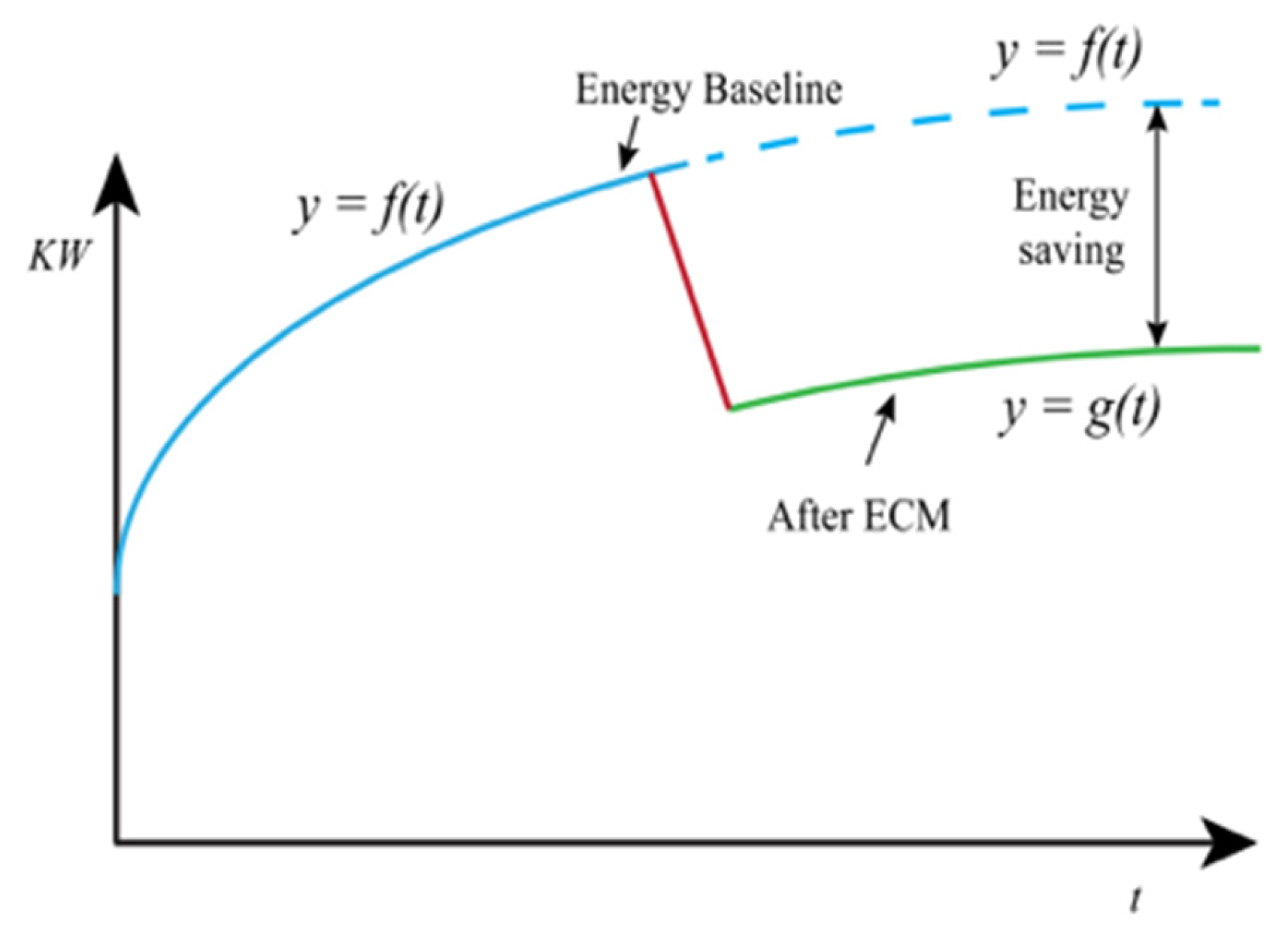
5], energy consumption before the implementation of ECMs is referred to as the energy baseline, and it is used as a reference point with which to understand facilities’ energy consumption trends. The energy baseline model can only be calculated through predictions based on energy-governing factors [
5,
10].
Figure 1 shows the graphical depiction of a baseline.
Energy savings realized from implementation of ECMs, as depicted in
Figure 1, are the difference between the energy baseline function (y = f(t), where y is the energy consumed at the given time t without ECMs (i.e., it is the predicted energy consumption)) and the after ECMs’ implementation function (y = g(t)) in a period of time t. The formula below depicts the energy savings calculation:
When ECMs are implemented, f(t) does not exist and cannot be measured, but it can only be based on predictions [
5].
The purpose of this paper is to assess the energy performance and model the energy consumption baseline model of a quarry located in the Gauteng Province, South Africa. The baseline model’s performance is assessed to measure its accuracy and reliability.
2. Methodology
2.1. Site Description: Understanding the Quarry Process Flow and Electric Energy Use
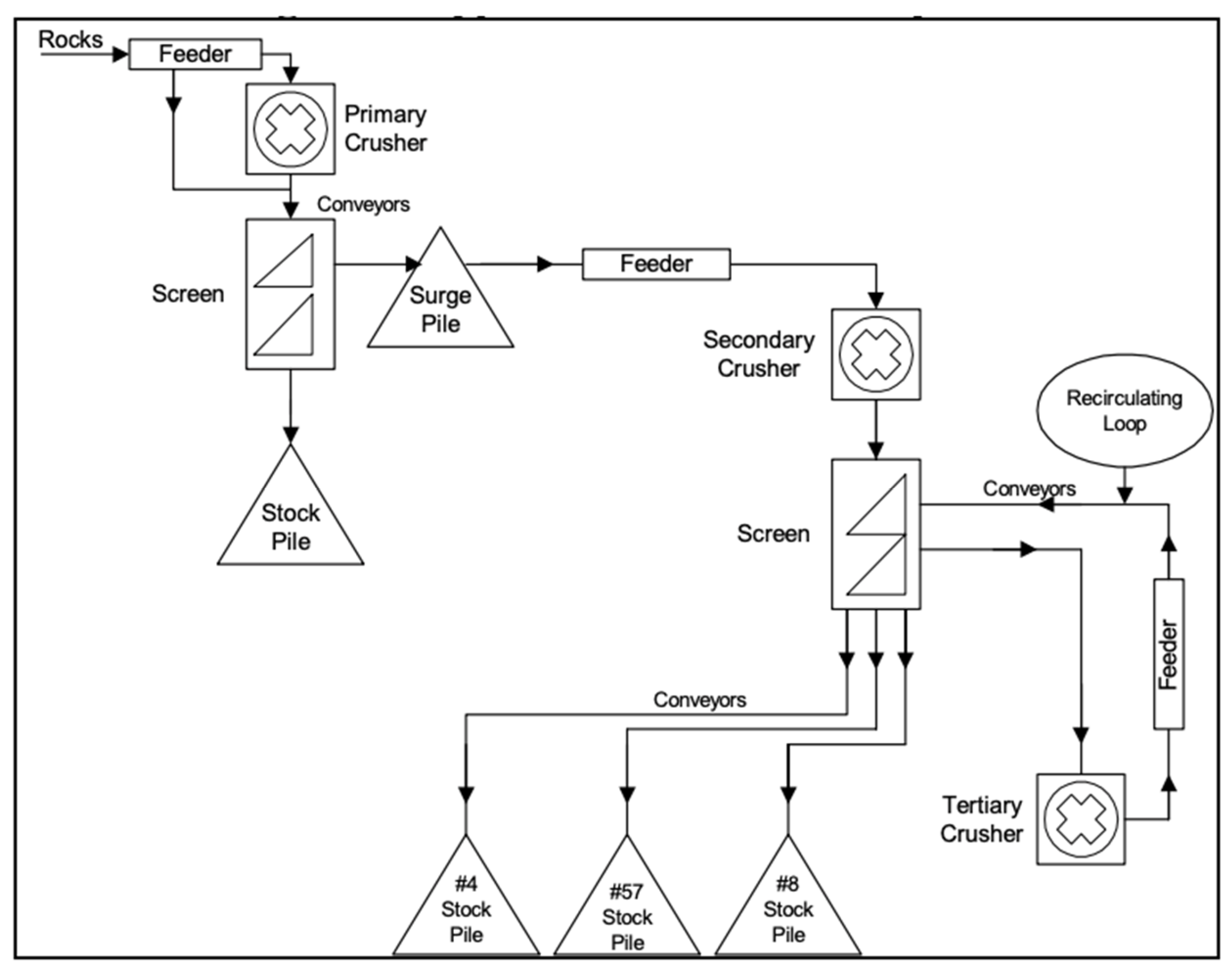
To understand the process flow and energy users of the quarry, a site energy audit was conducted at the quarry located in the Gauteng Province, South Africa. The quarry produces different construction materials such as concrete stone, crusher sand, building sand, subbase material (G1–G8), and super sand. The crushing and screening plant layout is similar to the one shown in
Figure 2.
Electrical energy is primarily used to operate motors for conveyors and feeders, the jaw crusher (primary crusher), screens, compressors, the cone crushers (secondary crusher and tertiary crusher), water pumps, and outdoor and indoor lighting.
The facility is supplied by Eskom, a state-owned utility, from a 11 kV overhead line into two 500 kVA, 11 kV/400 V transformers. There are two bulk smart electricity meters used to meter the entire facility, each covering the secondary side of each transformer. The total consumption of the facility billed by the utility (Eskom) is a combination of both meters.
2.2. Data Collection and Analysis
The aim of this paper is to assess energy performance and model an electric energy consumption baseline of the quarry using a data-driven method; thus, historical data is required. To assess the energy performance of the quarry, the energy use intensity (EUI) is used as per the formula below:
where EUI is the energy use intensity (kWh/ton), TEC is the total energy consumption (kWh) and SP is the saleable product (ton).
Based on the formula above, it can be noted that TEC and SP are vital to assessing the energy performance of the quarry. Furthermore, according to the South African National Standard 50010:2018 (SANS 50010:2018), a baseline model should take into consideration measurement boundaries, measurement period, and an energy-governing factor [
10]. The energy quantities should be determined by direct measurement of energy consumption through utility meters, appropriate calculations, or check meters. Furthermore, the baseline period must cover all operating modes of the facility [
10].
The electricity consumption data was obtained from the utility for a period 24 months (June 2023 to May 2025), and the saleable product produced data was obtained from the quarry’s production report for the same period. Based on this data, the EUI was calculated and is depicted in
Table 1.
There was no missing data during the selected measurement period in
Table 1. The energy consumption takes into consideration the total energy consumption of the facility and not the crushing and screening operations. This data must be processed to narrow it down to only include the energy consumption of the operations (screening and crushing).
This was performed using hourly meter data to analyze the operation dates, times, holidays, and shutdowns. Outliers were then identified using multiple methods such as the interquartile range (IQR) method and Z-score method. Unusual operation months (months without full production periods leading to too-high and too-low EUI) were also removed from the data set as part of processing as they do not represent the normal operation of the facility. All the removed months are highlighted below in
Table 2.
The minimum, maximum, and average EUI having processed the data and omitted outliers are 1.46 kWh/ton, 2.05 kWh/ton and 1.76 kWh/ton, respectively.
Table 3,
Table 4 and
Table 5 show statistical values and an analysis of the relationship between the energy consumption and the tons produced within the processed data.
Based on the statistical values, there is a very strong correlation between the energy consumption of the operations and the tons produced. Furthermore, the Significance F and
p-value are less than 0.05 (6.6534 × 10
−7, as shown in
Table 4); thus, the correlation between the two is very significant, i.e., the independent variable reliably explains the variation in the dependent variable. Moreover, the Coefficient of Determination (
) is well above 90% as shown in
Table 3, and this indicates that more than 90% of dependent variable (energy consumption) observed can be explained by the independent variable (tons produced).
2.3. Energy Performance Assessment and Benchmarking
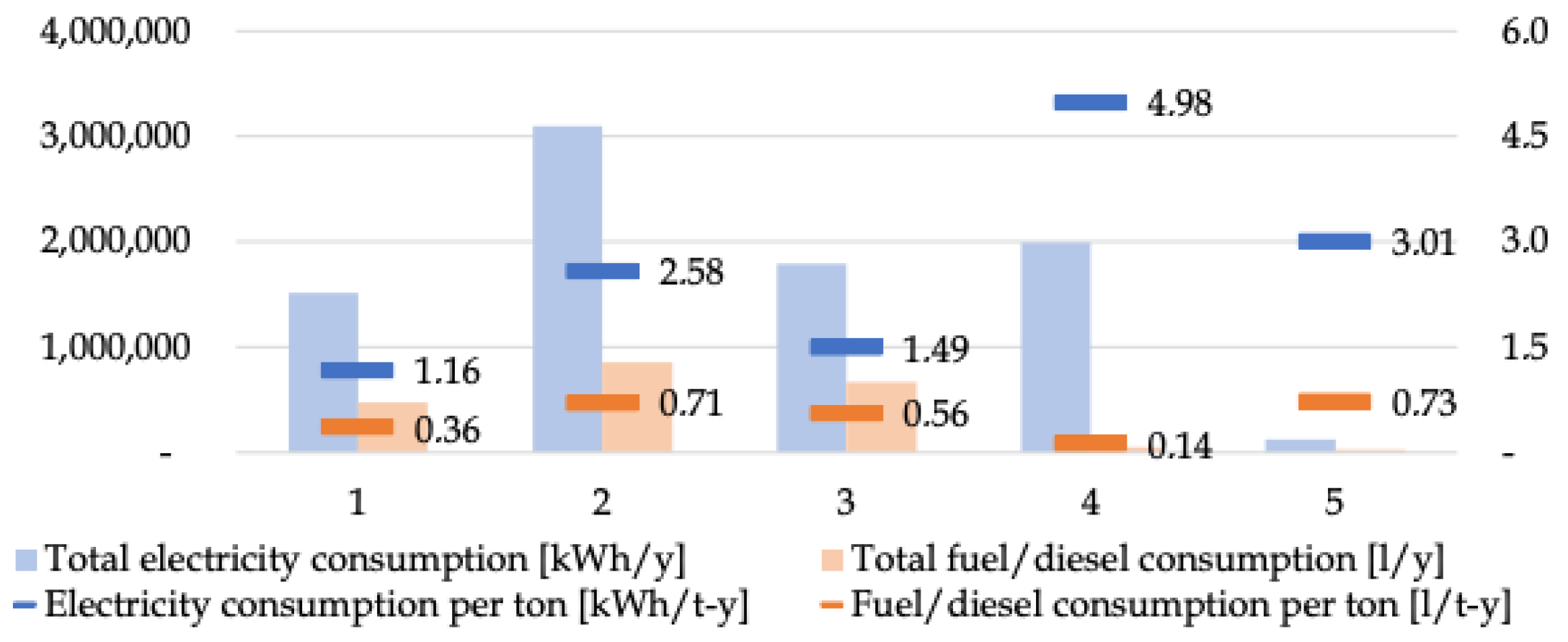
The quarry has not yet implemented any ECMs, and there is no energy management programme in place. To assess whether the quarry is operating efficiently, a comparison with and benchmarking to other similar quarries were conducted using the energy use intensity. A study was conducted in the United States for similar operations, and that quarry had an EUI of 2.09 kWh/ton over a year [
11]. This is higher than the average at the Gauteng quarry. Another quarry in Turkey had an average EUI of 2.72 kWh/ton over a year, which is higher than the Gauteng quarry’s EUI.
Figure 3 below depicts the EUI of other additional five pilot sites studied in [
12].
Based on the average EUI of seven quarries from the existing literature, the Gauteng quarry falls within the better-performing quarries when assessing energy performance. The Gauteng quarry is performing better than five quarries, and only two quarries as shown in
Figure 3 are performing better than the Gauteng quarry.
2.4. Baseline Modelling and Baseline Model Performance Assessment
Based on the data available, the energy consumption baseline was modelled using linear regression as per
Table 5. The modelled baseline equation is as follows:
where PEC is the predicted energy consumption (kWh), TP is the tons produced (Ton), 1.4865 is the gradient of the best fit regression line, and 2744.48 is the y-intercept of the same line, as shown in
Table 5, row 1.
Table 6 depicts the predicted energy and the residual energy from the actual energy.
To measure the performance of the model, the following metrics in
Table 7 were calculated as per [
13].
According to [
10,
13], the coefficient of variation of the root mean squared error (CVRMSE) should be below 20% when the data used is less than 12 months in timespan. The model has a CVRMSE of 9%. Furthermore, the Durbin–Watson value for the model is 2.818, which according to [
13] is acceptable. Lastly, the net determination bias (NDB) should be less than 0.005% according to the ASHRAE Guidelines for Measurement of Energy and Demand Savings. The model’s NDB is well below this value. Based on this, the model seems to be a good fit and is a reliable model to use as a baseline.
3. Conclusions
Based on the energy performance assessment of the quarry, when using the EUI, the quarry can be ranked in third place as compared to the other seven quarries. This performance is not too bad provided that the quarry has not implemented any energy efficiency measures or ECMs since its establishment. There is a strong correlation between the energy consumption and the tons produced. The energy consumption is dependent on the tons produced.
Lastly, the modelled baseline performance was within acceptable ranges based on application of relevant standards and metrics for performance assessment. This model is therefore accurate and reliable and can be useful in predicting energy consumption post implementation of ECMs.
To improve the energy performance of the quarry, ECMs must be implemented together with the adoption of an energy management programme. Furthermore, a change management process must be applied to the operations of the plant to ensure that the plant is not operated under no load. This will reduce the energy use intensity and improve the energy performance of the quarry. Based on the high-level energy audit and analysis, energy savings of approximately 20–30% and monetary savings of approximately 39% can be realized. Furthermore, a 20 to 30% reduction in carbon can be realized.
In the future, more detailed energy audits can be conducted to ensure that all opportunities for energy savings are identified and analyzed for potential implementation.
Author Contributions
Methodology, modelling, validation, writing and partial funding, T.R.; supervision and reviewing, K.A.F. All authors have read and agreed to the published version of the manuscript.
Funding
This research was funded partially by NRF, grant no. CPRR230512105150.
Institutional Review Board Statement
Not applicable.
Informed Consent Statement
Not applicable.
Data Availability Statement
Data is available upon request due to data privacy and confidentiality.
Acknowledgments
Platistone Aggregates Lanseria provided the data for this study. Jeffrey Mulabisana and Lulama Mboweni provided the support and approval to utilize the data for the purpose of this research. Lastly, the quarry personnel were helpful during the site audits and provided information about operational practices. The financial support of NRF is acknowledged.
Conflicts of Interest
The authors declare no conflicts of interest.
References
- International Energy Agency. Electricity Market Report 2023; EIA: Paris, France, 2023. Available online: https://www.iea.org/reports/electricity-market-report-2023 (accessed on 1 November 2025).
- Cevik, S.; Ninomiya, K. Chasing the Sun and Catching the Wind: Energy Transition and Electricity Prices in Europe; IMF Working Papers; International Monetary Fund: Washington, DC, USA, 2022; Volume 2022, Available online: https://www.elibrary.imf.org/view/journals/001/2022/220/001.2022.issue-220-en.xml (accessed on 1 November 2025).
- McMichael, A.J.; Campbell-Lendrum, D.; Kovats, S.; Edwards, S.; Wilkinson, P.; Wilson, T.; Nicholls, R.; Hales, S.; Tanser, F.; Le Sueur, D.; et al. Global climate change. In Comparative Quantification of Health Risks—Chapter 20: Global Climate Change; World Health Organization: Geneva, Switzerland, 2004; Available online: https://www.who.int/docs/default-source/climate-change/publication---global-climate-change-comparative-analysis.pdf (accessed on 3 November 2025).
- National Academy of Sciences; The Royal Society. Climate Change: Evidence and Causes; National Academies Press: Washington, DC, USA, 2014; Available online: https://www.nationalacademies.org/read/18730 (accessed on 11 November 2025).
- Qaisar, I.; Zhao, Q. Energy baseline prediction for buildings: A review. Results Control. Optim. 2022, 7, 100129. [Google Scholar] [CrossRef]
- Department of Mineral Resources and Energy (DMRE). Integrated Resource Plan (IRP2019). 2019. Available online: https://www.gov.za/sites/default/files/gcis_document/201912/42784gon1360.pdf (accessed on 15 May 2025).
- Loewald, C. Special Occasional Bulletin of Economic Notes 23/01 Review of Administered Prices in South Africa: The Electricity Tariff. 2023. Available online: https://www.resbank.co.za/en/home/publications/publication-detail-pages/special-occasional-bulletins/2023/special-occasional-bulletins-of-economic-notes-23-01 (accessed on 11 November 2025).
- Abidin, N.I.A.; Zakaria, R.; Pauzi, N.N.M.; Alqaifi, G.N.; Sahamir, S.R.; Shamsudin, S.M. Energy efficiency initiatives in a campus building. Chem. Eng. Trans. 2017, 56, 1–6. [Google Scholar] [CrossRef]
- Maistry, N.; McKay, T.M. Promoting energy efficiency in a South African university. J. Energy South. Afr. 2016, 27, 1–10. [Google Scholar] [CrossRef]
- SANS 50010; Measurement and Verification of Energy Savings. 2nd ed. South African Bureau of Standards (SABS): Pretoria, South Africa, 2018.
- Moray, S.; Throop, N.; Seryak, J.; Schmidt, C.; Fisher, C.; D’Antonio, M. Energy Efficiency Opportunities in the Stone and Asphalt Industry Overview of the Stone Crushing Industry. Available online: https://www.aceee.org/files/proceedings/2005/data/papers/SS05_Panel03_Paper08.pdf (accessed on 1 November 2025).
- Sánchez, F.; Hartlieb, P. Addressing energy efficiency in quarries—First stage in the development of a holistic approach. In Proceedings of the 10th International Conference on Sustainable Development in the Minerals Industry (SDIMI 2022), Windhoek, Namibia, 15–17 September 2022; pp. 21–23. [Google Scholar]
- Inspection STC Working Group. TG 50-02: Guidelines for Reporting Uncertainty in Measurement and Verification. South African National Accreditation System (SANS). 2017. Available online: https://sanedi12ltax.org.za/assets/images/TG%2050-02%20Guidelines%20for%20Reporting%20Uncertainty%20in%20M&V.pdf (accessed on 10 November 2025).
| Disclaimer/Publisher’s Note: The statements, opinions and data contained in all publications are solely those of the individual author(s) and contributor(s) and not of MDPI and/or the editor(s). MDPI and/or the editor(s) disclaim responsibility for any injury to people or property resulting from any ideas, methods, instructions or products referred to in the content. |