1. Introduction
Data centers play an important role in networks, as they store data and accessible content. The use of data centers faces challenges regarding power efficiency and environmental concerns. The need to enhance data center power efficiency and reduce cooling costs has necessitated the use of alternative locations such as underwater [
1,
2], the stratosphere [
3,
4], and space [
5,
6,
7], which have the benefit of free cooling.
The use of stratospheric and space-based data centers requires a supporting ground segment for information and content delivery to end users. These non-terrestrial data centers do not constitute an additional load to the power grid as they use non-terrestrially located solar panels. They also provide data coverage in locations with unfriendly terrestrial terrain. This is important in scenarios where end users are located in mountainous regions [
8,
9,
10]. In these cases, the use of ground stations and supporting infrastructure is required. Therefore, it is necessary to design a network architecture to provide network coverage. Mini-data centers can be situated in the mountain areas due to the low temperatures [
11,
12,
13].
Mountain areas have unfriendly terrain making it difficult to host conventional terrestrial data centers and computing platforms. Being in remote locations, subscribers in mountain areas engaged in content access experience a significant number of hops leading to high delays. The high number of hops arises because of the numerous gateways through which accessed content traverses. This challenge arises even in the case of green and efficient terrestrial data centers due to the location challenge [
14,
15]. The discussions in [
14], and [
15] note that the paucity of robust and high quality of service networks applies in the context of rural remote regions. The use of non-terrestrial data centers in alternative locations is suited for coastal areas [
1,
2], and harsh non-terrestrial environments [
3,
4,
5,
6,
7]. Accessing content in harsh terrain and remote mountainous areas via data centers in the stratosphere, and space requires a supporting ground segment. The design of the ground segment enabling content access in remote harsh mountainous terrain requires research attention. The use of mountain areas for hosting mini-data centers requires designing co-existence mechanisms. This is necessary due to the important role of mountains in tourism. Mountain tourism is a significant economic enabler [
16,
17,
18,
19,
20]. Mountains are also important in research [
21,
22].
The research proposes using the mountains as a suitable low-temperature sites for hosting mini-data centers. This is motivated by the need to provide free cooling to achieve low data center operational costs. In the network, the mountain-based data center functions as a cache, enabling low-latency content access instead of consistent, repeated recourse to space-based or aerial (stratosphere-based) data centers. The research proposes a co-existence approach for co-hosting networks and tourism in mountainous regions within the mountain computing paradigm (MCP). The contributions are:
This paper proposes siting small-scale data centers and computing platforms in remote mountainous regions. Mountain caves are considered because of their low-temperature environment. The research presents the network architecture alongside its integration with stratosphere-based data centers (STBCs), and space-based data centers (SPBCs). The STBCs and SPBCs provide content access to end users in remote regions. In the MCP, the mountain-based mini-data center (MBMDC) enables low-latency access to internet content. As a cache, it enables subscribers and end users in mountainous regions and near mountainous regions to access content. The inclusion of the cache reduces the number of round trips associated with low latency content access. The research proposes using renewable energy sources and systems for MBMDC operations. This is feasible in areas with low or zero power grid coverage. The research formulates and evaluates how the proposed MCP architecture reduces the number of hops and power consumption associated with data access and transmission.
The remainder of the discussion is organized as follows:
Section 2 presents the MCP and discusses the nascent co-existence paradigm.
Section 3 discusses the network architecture in which the MBMDC is integrated with computing platform networks supported by STBCs and SPBCs.
Section 4 presents and evaluates the model and performance results.
Section 5 is the conclusion.
2. Proposed MCP
The MCP envisions using high-altitude mountain locations as server host sites. It hosts the ground segment for non-terrestrial data centers. The non-terrestrial data centers, which provide multi-media content to remote mountainous locations. The concerned remote locations lack terrestrial network entities. The server (mini-data centers) system in the MCP functions as a forwarding node enabling the realization of ubiquitous communication network coverage.
A challenge associated with the MCP is transporting servers to mountain altitudes. This is addressed via the use of low-cost aerial solutions, such as helicopters, to move servers to high altitudes. Similarly, server crew realize their transport by using low-cost aerial solutions such as helicopters. A small number of servers are required in comparison to terrestrial data centers, as there is a smaller number of subscribers, in comparison to conventional high-density terrestrial subscriber areas. Low-cost aerial solutions are also crucial in high altitude installation of the solar panel power systems required for MCP’s functioning.
The MCP proposes co-existence mechanisms and protocols to accommodate other interests, such as tourism and scientific research in mountains. The mechanism considers that a mountain comprises multiple caves. In the co-existence approach, caves are designated as valuable for tourism and scientific investigations. Caves are allocated a binary identifier. A binary variable signifies the status of a mountain feature. A binary value of 1 and 0 signify that the use of an identified mountain feature is desired and not desired, respectively. The data indicating the identified and mapped features, alongside their usage status, is stored in a repository accessible by the computing platform operator. The computing platform operator deploys server clusters comprising small-scale data centers in the mountain. The repository enabling the required co-existence also considers the duration of mountain feature use for scientific applications alongside the peak periods for tourist visits. The use of this information enables the opportunistic use of identified suitable mountain features for hosting server clusters. The execution of the co-existence mechanism is: (i) # 1 select mountain region for consideration; (ii) # 2 determine mountain region binary value as 1 or 0; (iii) # 3 if the binary value is 1, the tourism application is recognized; (iv) #3.1 the region is not selected for hosting MDCs; (v) # 4 otherwise, the application is inapplicable; and (vi) # 4.1 region is selected and suitable for hosting MDCs.
3. MCP–Enabling Network Architecture
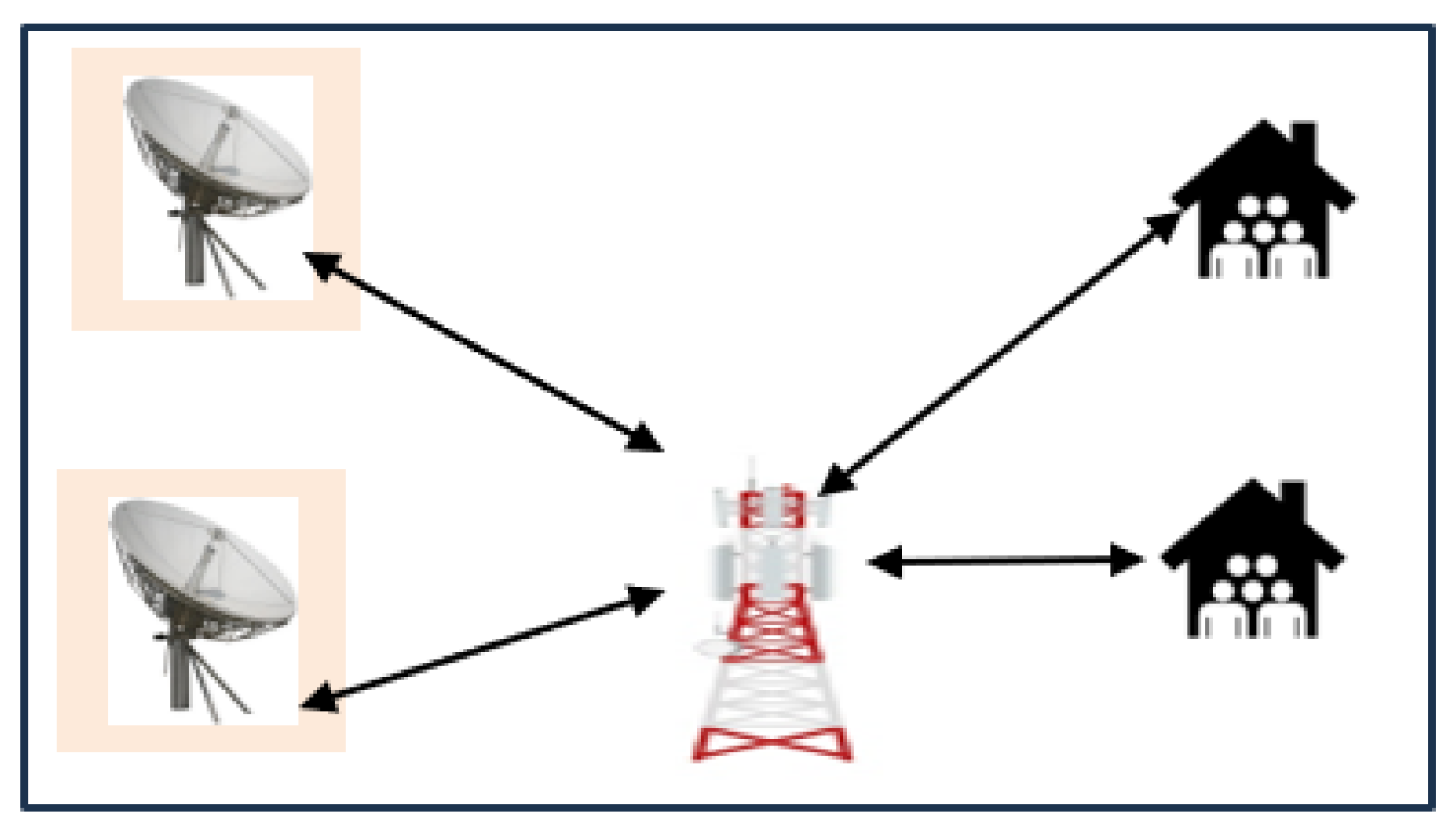
The discussion in this section presents the network architecture enabling data and content access under the MCP. In the MCP, the mountain hosts ground stations that receive data from the aerial and space segments. The space segment comprises space-based data centers (SPBCs) constellations in the low earth orbit (LEO). The ground stations also interact with stratosphere-based data centers (STBCs) in the aerial segment.
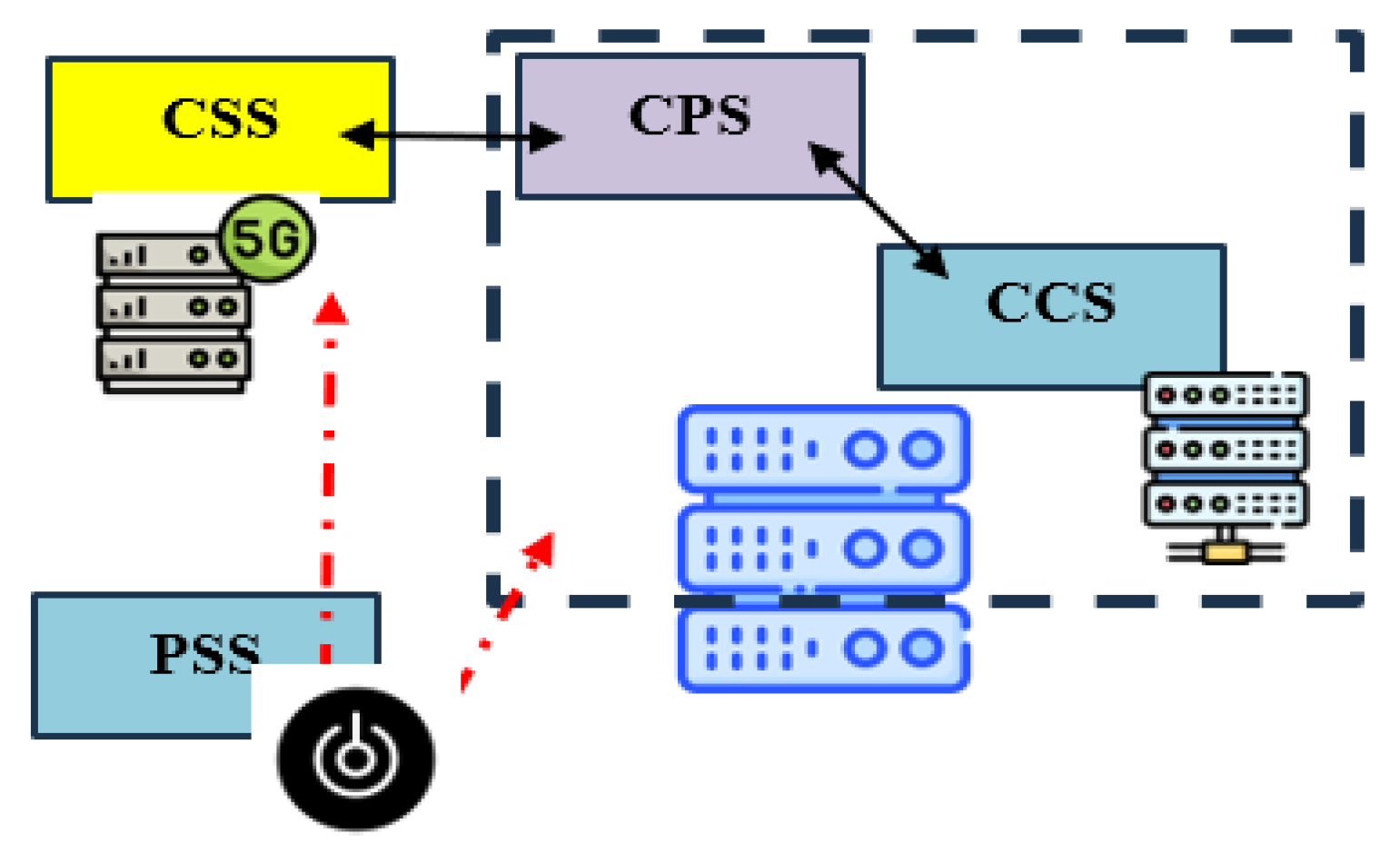
The ground stations are located at the mountain’s lowest part. They are connected to the MBMDC for the transfer, storage and processing of data. Ground stations communicate with orbiting SPBCs and mobile (or stationary) STBCs. The ground stations are connected to a radio tower enabling communication with a base station. The base station enables a direct connection to the subscriber thereby completing the last-mile connection. Different sets of ground stations communicate with the SPBCs and the STBCs. A ground station communicates with the aerial or space segment upon determining that the requested content is not available within the MBMDC cache. The MBMDC comprises a: (i) communication subsystem (CSS), (ii) computing Subsystem, (CPS) (iii) power subsystems (PSS), and (iv) cache subsystem (CCS). Relations between the CSS, CPS, PSS and the CCS are in
Figure 1.
Figure 1 shows the CPS and CCS as being part of a single module. The CPS engages in bi-directional communications with the CSS. The CSS receives subscriber’s content request from the ground station. A request from the CSS is forwarded to the CPS, which checks the CCS for availability of the cache.
The system architecture is presented in
Figure 2. In
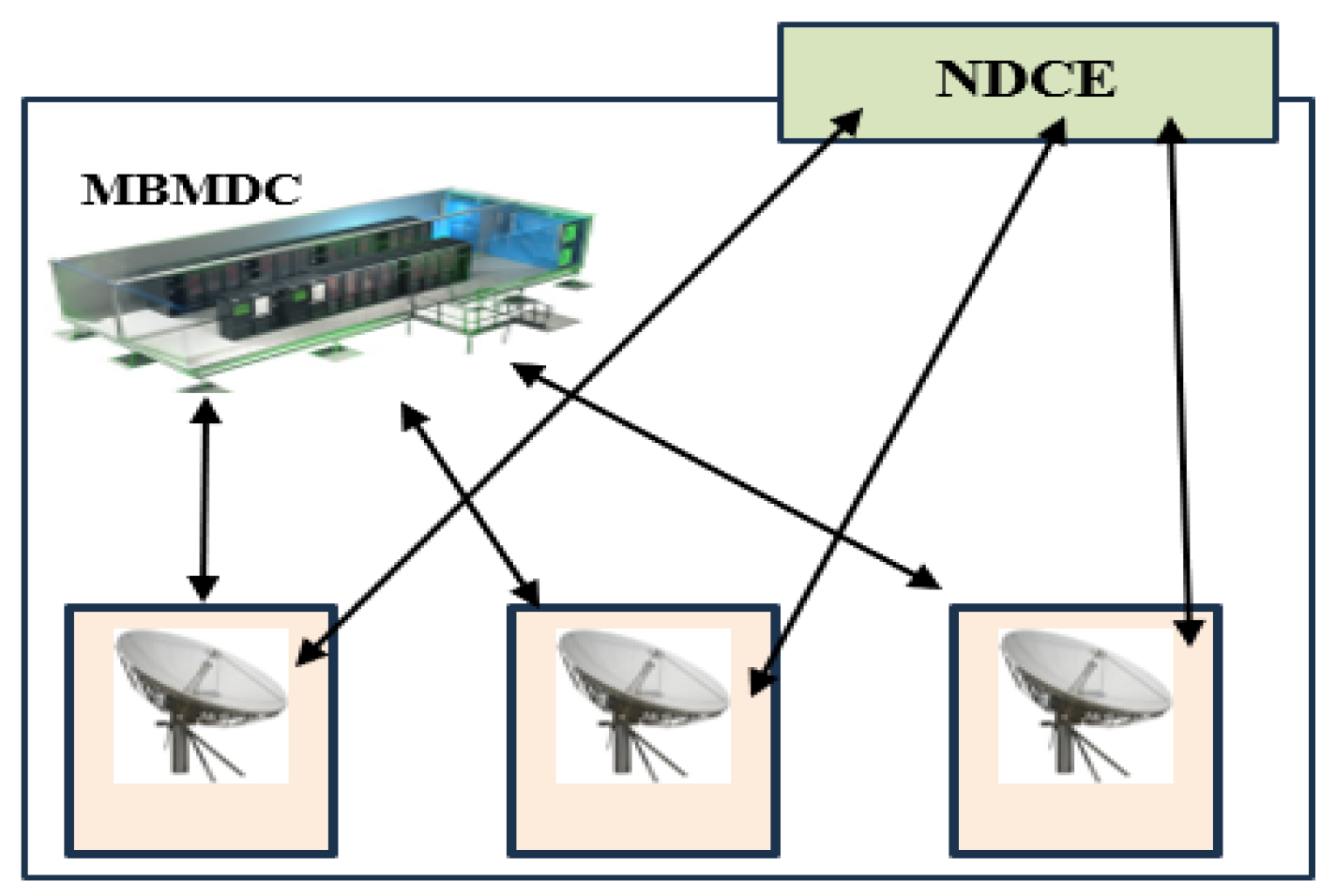
Figure 2, the non-terrestrial data center entity (NDCE) is either an STBC or an SPBC. Each of the ground stations in
Figure 2 is connected to a small-scale base station that provides coverage in the area concerned. In
Figure 2, the NDCE-to-ground-station connection is realized via K-band wireless radio spectrum. The rationale for choosing the K-band is its support for high bandwidth and low latency data transmissions. The ground-station-to-MBMDC connection is realized via high-speed copper cable due to its low cost in comparison with fiber optic cable. The MBMDC cache enables content access without invoking the NDCE functionality.
This reduces the number of hops thereby reducing the associated content access latency. The latency is reduced because the ground-station-to-MBMDC connection is realized via cable connection while ground station to NDCE connection is realized via wireless connection. The relations between the ground stations and the terrestrial network that enables content delivery to the subscriber is shown in
Figure 3. In
Figure 3, the content being delivered to end users can originate from the MBMDC cache or from a recent content download.
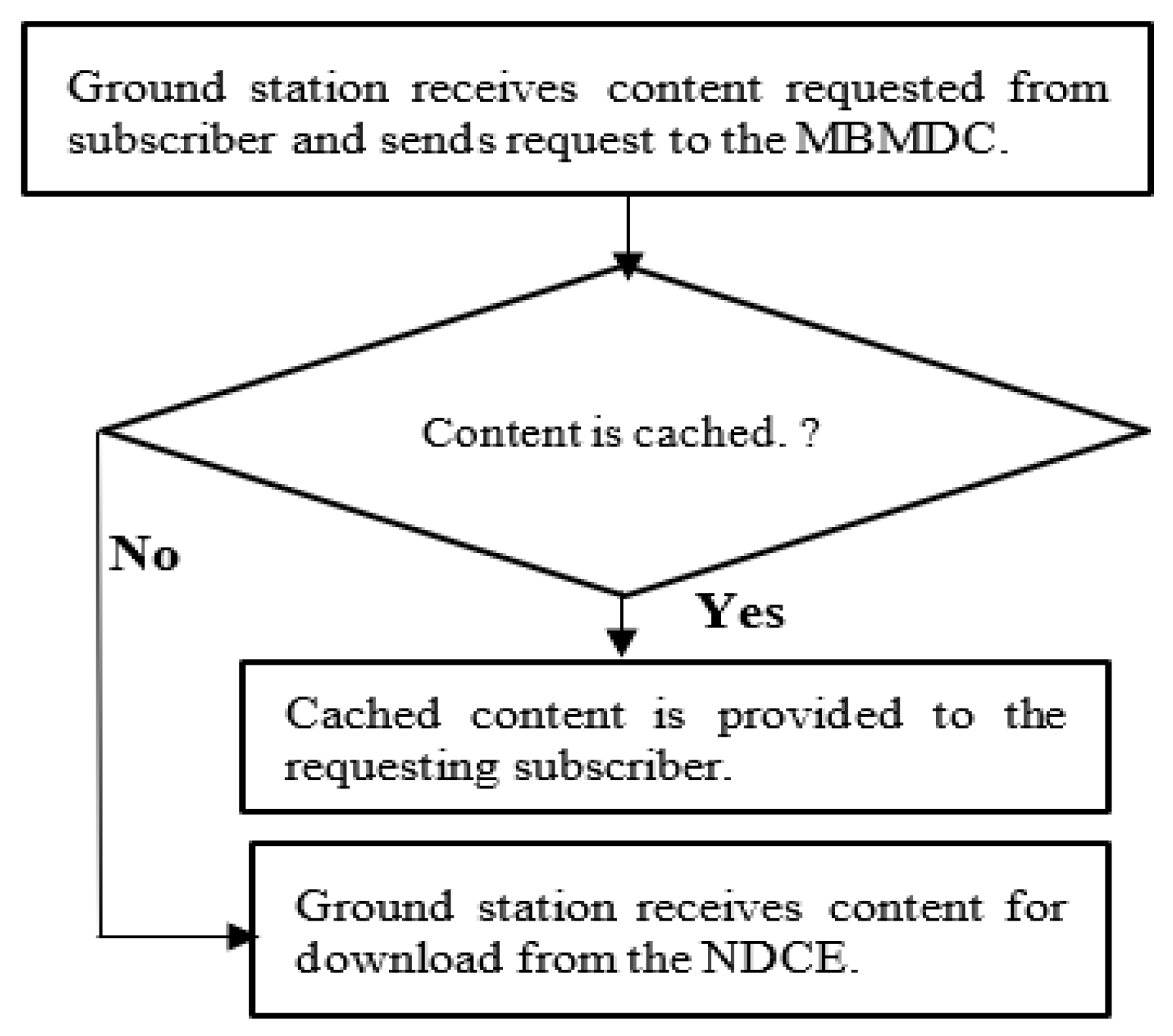
In accessing content, the MBDMDC executes a caching functionality. Caching is initiated when the ground station receives a subscriber content request from the terrestrial network. The flowchart associated with the cache search executed to reduce latency is shown in
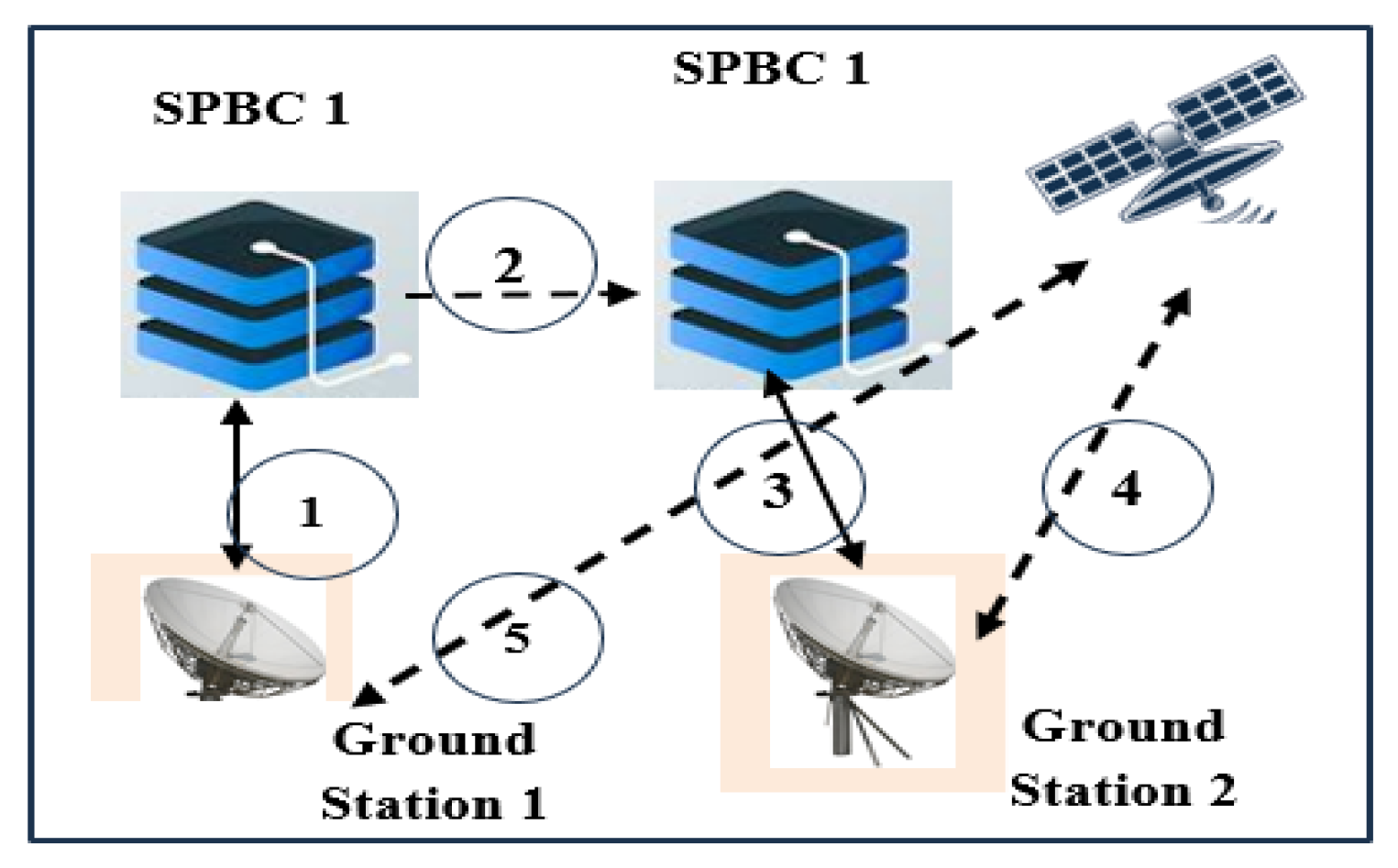
Figure 4. Another challenge to be addressed is ensuring download session continuity. The session continuity challenge arises due to the variable communication windows of LEO SPBCs communicating with ground stations. The non-completion of a given content download session at a given ground station and a given content download session is not completed at a specific ground station, it is continued at another ground station. The ground station enabling the completion of the download receives contextual information in the form of the identifier of the initial ground station. The completing ground station provides the requested and completely downloaded content to the initial requesting ground station. The required communications are realized via satellite-enabled internet. The use of satellite Internet arises due to the absence of communication networks in remote mountainous regions. The communications flow in
Figure 5 considers only one LEO SPBC.
The execution of contextual handovers to ensure access to completely downloaded content is realized by accessing a geostationary communication satellite. In
Figure 5, SPBC 1 hosts the content being downloaded and serves the initial request from ground station 1. SPBC 1 transitions out of the coverage footprint of ground station 1 and it continues the download reaching its completion with ground station 2. Ground station 2 sends the completed download to a geostationary communications satellite. The receiving geostationary satellite sends the requested information to ground station 1. In cases where there is a second SPBC or multiple SPBCs. The handover is executed by the second SPBC via an intersatellite link. This increases the communication duration relative to ground station 1. The need to execute contextual handovers to ensure the completion of content downloads also arises with the use of STBCs. This arises when the high-altitude platform is scheduled for routine maintenance.
In the network architecture, SPBCs and STBCs do not provide coverage concurrently due to cost reasons. It is also important to consider the challenge arising when the cache does not have sufficient computational resources to host content for future access. The occurrence of this challenge implies that subscribers will then seek access to content from either the STBC or the SPBC. In such a scenario, a feasible solution is to deploy additional MBMDCs. However, such a solution is cost-prohibitive for capital-constrained network operators. In addition, the cached content frequency is computed as the ratio of the number of content accesses to a given duration. The duration is uniform for all cached content. The mean cached content access frequency is computed using the cached content frequency. In
Figure 5, session continuity is executed by satellite network-compliant session and transport control protocols. Examples of protocol implementations are mobile internet protocol with mobility extensions for satellite networks.
The mean cached content frequency is computed from the individually computed cached content frequency. Cached content with an access frequency less than half of the mean cached content access frequency is deemed inactive and is deleted from the CSS. The deletion instruction is sent to the CSS from the CPS. Cache deletion is proposed here to ensure the efficient use of computing resources in the CPS and CSS. In the event that all cached content has an access frequency significantly close to the average cached content access frequency, the launch of additional CSSs is proposed. The CPS conducts a cache search for an increasing number of subscribers in the remote mountainous region.
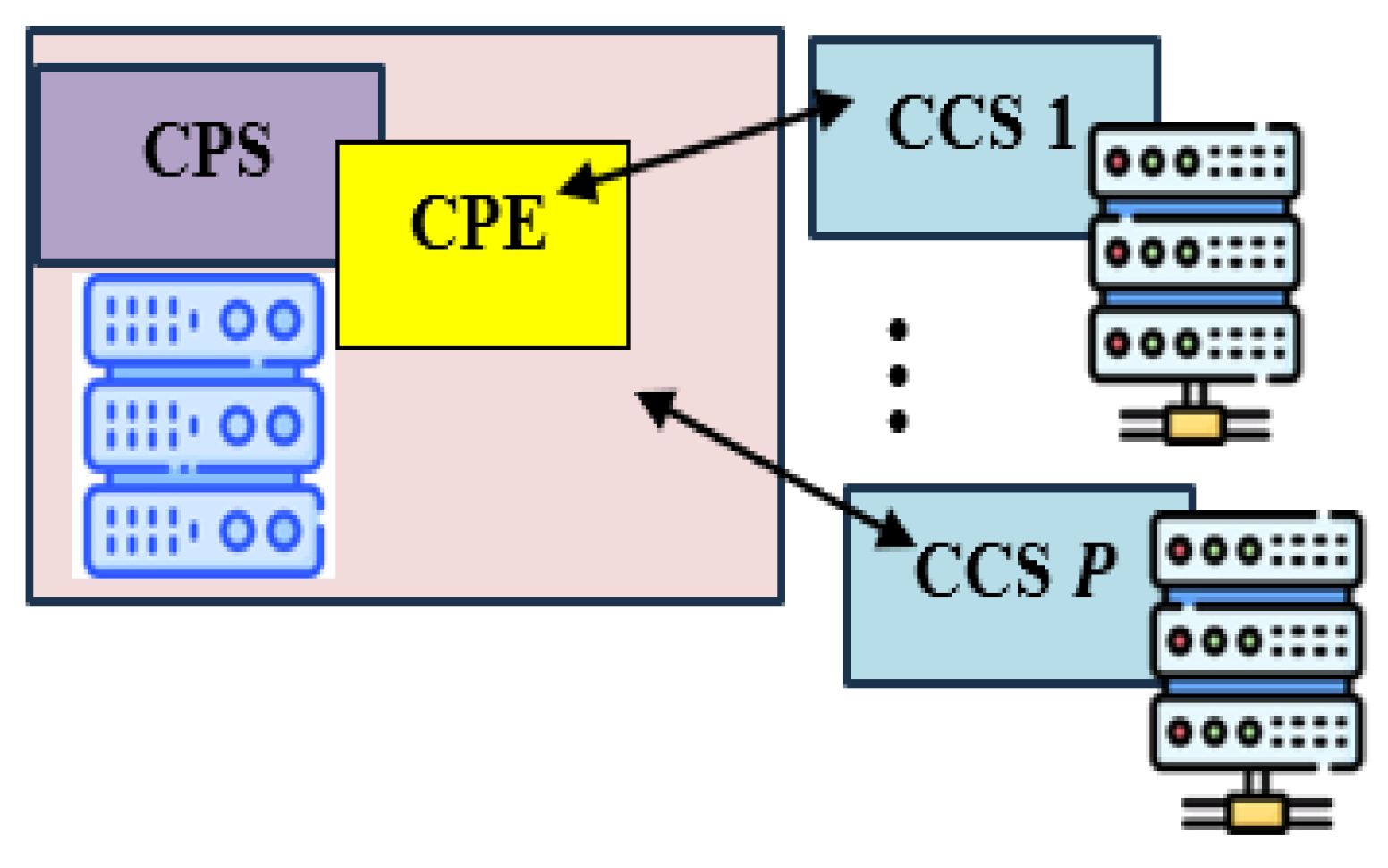
In the case where the CPS hosts the CSS probe entity (CPE) that stores the results of the cache search for a given user request. The CPS, CPE and CSS relationships are shown in
Figure 6.
Figure 6 shows the relations between the CPS (which comprises the CPE), and the CCSs. The CPE stores the search results for each of the CCSs in
Figure 6. The connection between the CCE and each of the CCS is realized via high-speed copper cable and not fiber optics due to cost reasons.
The MCP, alongside its supporting architecture, enables the transformation of the mountain tourism experience for tourists. The presence of a network implies that the safety of mountain tourists can be better guaranteed. It also implies that mountain tourist organizations can provide a live feed of tourists engaged in different activities as content to be viewed across multimedia platforms. The hosting of servers in the mountain region increases the computing resources available for virtual tourist interactions. Virtual tourism is recognized as a significant revenue booster in the tourism industry [
23,
24,
25,
26].
The discussion presents the communication aspects related and network architecture related to the MCP. The MCP provides a supporting ground segment for content access via STBCs and SPBCs. Research in [
26] shows that using non-terrestrial data centers enhances subscriber quality of service. The MBMDC and ground stations also require operational power to execute their intended functionalities. Given that the proposed MBMDC is located in a remote region without or with minimal or no grid coverage. The use of renewable energy sources is proposed. The renewable energy source being considered is solar energy. Solar panels are suitable and can be placed at different positions on the mountain. Solar panels are placed at high altitudes to provide power to the MBMDC.
4. Modeling and Evaluation
The discussion here formulates the performance metrics, specifically the number of hops and conducts investigations via simulation. The number of hops is considered to be a suitable metric as it indicates the level of processing and power consumption associated with all network entities. A high number of hops is associated with high power consumption. A reduced number of hops is associated with lower power consumption. The number of hops is formulated for two scenarios: Scenario 1 and Scenario 2. Scenario 1 formulates the number of hops in the event that there are no re-transmissions. Scenario 2 formulates the number of hops given that packet and information re-transmissions occurs. The number of hops is formulated by considering the number of gateways and their activity status. This is done with relation to the mountain region-based subscriber. In the existing case, the mountain region subscriber accesses information in a network comprising a remote data center network, an internet exchange point, and a final access link. In the proposed architecture, the mountain region-based subscriber accesses information in a network incorporating the mountain data center and a satellite network. The set of gateways is denoted as follows:
is the set of gateways enabling data forwarding from the data center to the forwarding and relay network. The set is the collection of gateways enabling data forwarding from the forwarding and relay network to the subscriber access network. The set is the collection of gateways enabling data forwarding from the access network to the subscriber over the last mile.
The functional status of the gateway
at epoch
is denoted by
. The gateway entity
is functional or non-functional at epoch
when
and
respectively. The number of hops in the existing case,
, and the proposed case
are:
In (6), unity, i.e., 1 is included as there is one gateway associated with last-mile connectivity in the proposed case. In the case where the number of re-transmissions is considered, specifically,
and
associated with
and
, respectively. The number of hops in the existing case,
and proposed case,
are:
The power associated with data transmission is also formulated. The power associated with the gateways
, and
at epoch
is denoted as
,
and
, respectively. The data transfer-associated power in the cases
, and
is denoted by
and
, respectively and given as:
The evaluation uses the parameters in
Table 1 for a scenario with a variable number of gateways enabling data access and forwarding in the cloud-integrated network. A variation in the number of gateways considers the use of adaptive routing to enhance subscriber quality of service. The simulation considers that no retransmissions occur in the last-mile connectivity associated with
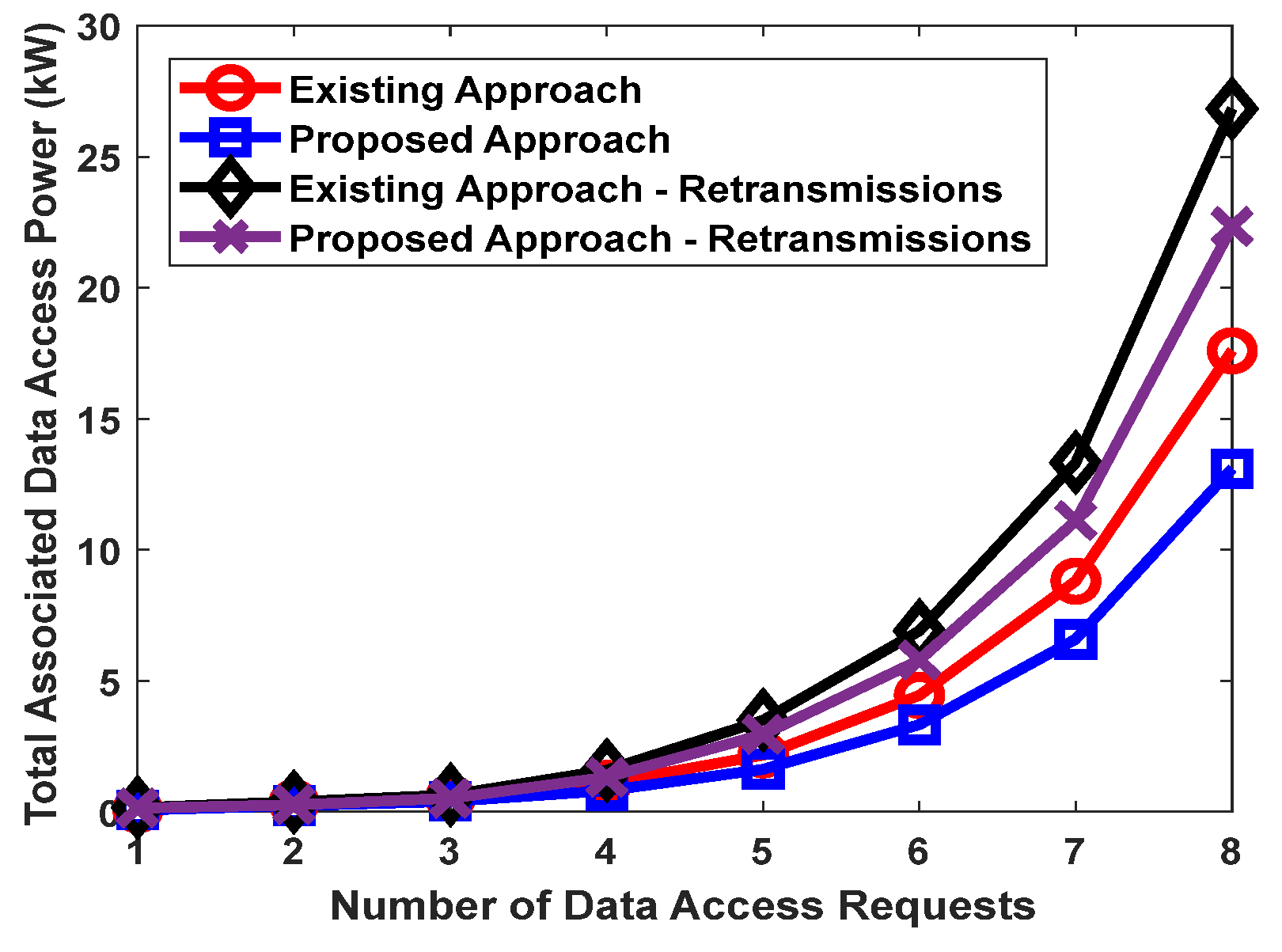
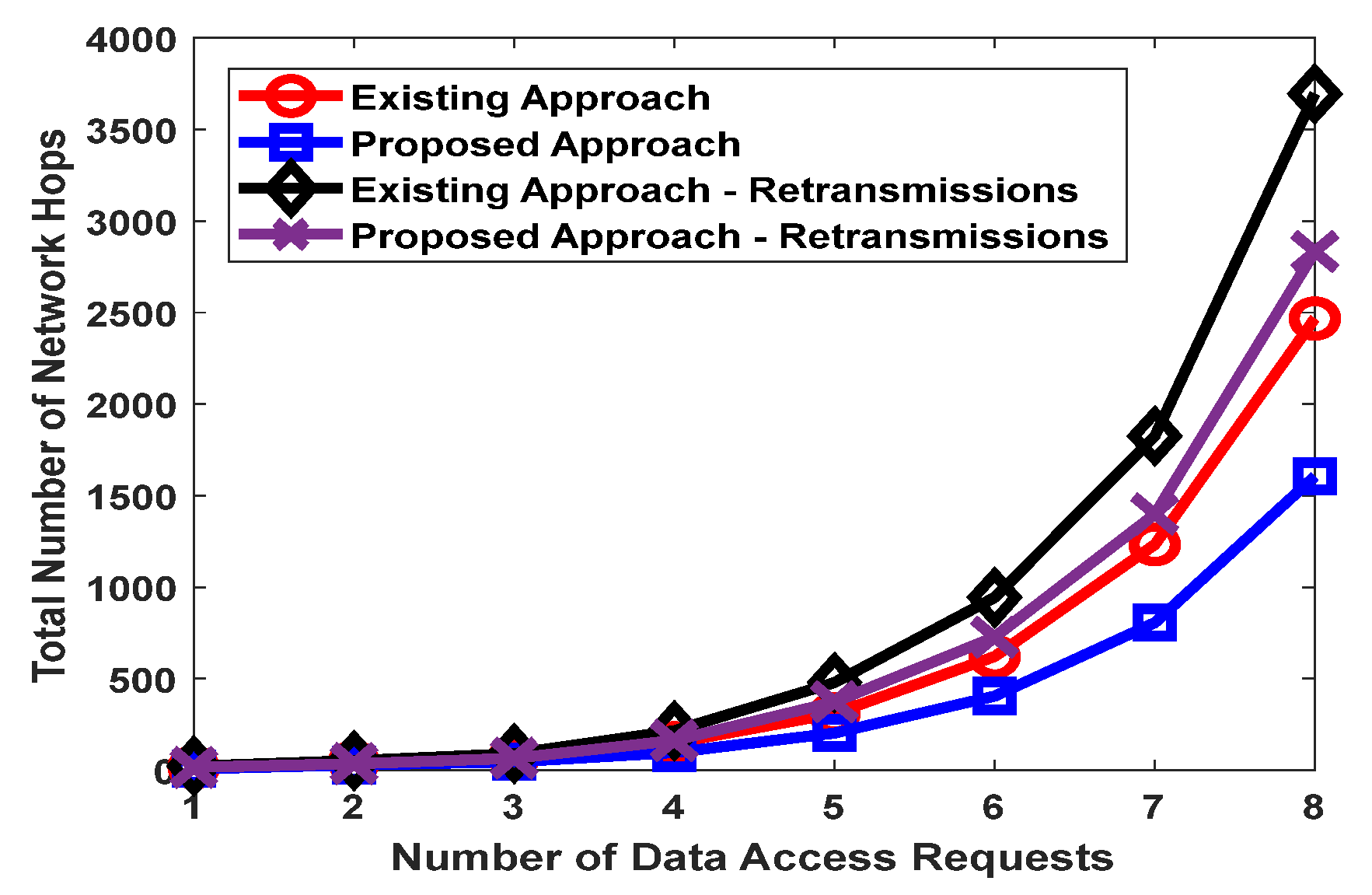
. The results regarding the number of hops and power consumption are shown in
Figure 7 and
Figure 8 respectively.
The number of network hops is reduced by using the proposed approach. Analysis shows that in the absence of a consideration of re-transmission; using the proposed approach reduces the number of network hops by 37% on average. Analysis further shows that using the proposed approach while considering re-transmission reduces the total number of network hops by 26% on average. The use of the proposed approach without and with re-transmission instead of the existing approach reduces power consumption by 25%, and 17%, on average respectively.
The system analyzes power consumption. The impact of the proposed approach on mountain ecology, the impact on mountain site preservation and climate-influenced maintenance of supporting renewable energy systems are not correlated with these results.
5. Conclusions
The research recognizes the role of mountains in hosting future computing platforms acting as content caches in remote mountainous regions. Content access is supported by a cache in the context of latency-insensitive applications. In addition, the proposed network is recognized to be capable of enhancing existing applications such as tourism. Analysis was conducted to investigate the number of hops and how they are reduced via the use of the proposed approach. The use of the proposed architecture reduces the number of hops by an average of (26–37)%. The proposed architecture also reduces the total power consumption. The total power consumption is reduced by an average of (17–25)%. Future work aims to identify a suitable mountainous region to host the proposed co-existence approach. It is recognized that this presentation of the research focuses on the power usage-related aspects of the proposed network architecture. A consideration of the system performance, considering networking related metrics will be the subject of future work.
Author Contributions
Conceptualization, A.A.P. and L.A.A.; methodology, A.A.P. and L.A.A.; software, A.A.P.; validation, L.A.A.; formal analysis, A.A.P.; investigation, A.A.P. and L.A.A.; resources, A.A.P.; data curation, A.A.P. and L.A.A.; writing—original draft preparation, A.A.P.; writing—review and editing, A.A.P. and L.A.A.; visualization, A.A.P. and L.A.A.; supervision, A.A.P.; project administration, A.A.P.; funding acquisition, A.A.P. All authors have read and agreed to the published version of the manuscript.
Funding
This research received no external funding.
Institutional Review Board Statement
Not applicable.
Informed Consent Statement
Not applicable.
Data Availability Statement
Data is contained within the article.
Acknowledgments
The authors acknowledge their indebtedness to the Department of Electrical, Electronic and Computer Engineering (for the financial support), and French South Africa Institute of Technology of the Cape Peninsula University of Technology, Centre for Augmented Intelligence and Data Science (CAIDS) Computer Science Department, School of Computing, University of South Africa and Department of Electronic and Computer Engineering, Faculty of Engineering, Lagos State University, Epe Campus, Lagos, Nigeria.
Conflicts of Interest
The authors declare no conflict of interest.
References
- Sheldon, J.; Zhu, W.; Abdullah, A.; Bhupathiraju, S.H.V.; Sugawara, T.; Butler, K.R.; Islam, M.J.; Rampazzi, S. AquaSonic: Acoustic Manipulation of Underwater Data Center Operations and Resource Management. In 2024 IEEE Symposium on Security and Privacy (SP); IEEE: Piscataway, NJ, USA, 2024; pp. 331–349. [Google Scholar] [CrossRef] [Scilit]
- Ura, Y.; Yoshida, I.; Kanemitsu, T.; Ko, D. Current Status of Underwater Space Utilization and Challenges to Contribute to a Sustainable Society; Lecture Notes in Civil Engineering; Springer Nature: Singapore, 2024; pp. 171–182. [Google Scholar] [CrossRef] [Scilit]
- Abderrahim, W.; Amin, O.; Shihada, B. Data Center-Enabled High Altitude Platforms: A Green Computing Alternative. IEEE Trans. Mob. Comput. 2024, 23, 6149–6162. [Google Scholar] [CrossRef] [Scilit]
- Periola, A.A. Power Usage Effectiveness in Stratosphere Based Computing Platforms: Re-evaluation and Need to Re-establish Performance Benefits via an Intelligent Light Server Selection Architecture. Wirel. Pers. Commun. 2023, 132, 1577–1591. [Google Scholar] [CrossRef] [Scilit]
- Bleier, N.; Mubarik, M.H.; Swenson, G.R.; Kumar, R. Space Microdatacenters. In Proceedings of the 56th Annual IEEE/ACM International Symposium on Microarchitecture; Association for Computing Machinery: New York, NY, USA, 2023. [Google Scholar] [CrossRef] [Scilit]
- Aili, A.; Choi, J.; Ong, Y.S.; Wen, Y. The development of carbon-neutral data centres in space. Nat. Electron. 2025, 8, 1016–1026. [Google Scholar] [CrossRef] [Scilit]
- Lofstrom, K. Server sky—Computation and power in orbit. In Proceedings of the 2013 1st IEEE Conference on Technologies for Sustainability (SusTech), Portland, OR, USA, 1–2 August 2013; pp. 126–133. [Google Scholar] [CrossRef] [Scilit]
- Wyss, R.; Luthe, T.; Pedoth, L.; Schneiderbauer, S.; Adler, C.; Apple, M.; Acosta, E.E.; Fitzpatrick, H.; Haider, J.; Gözde Ikizer, G.; et al. Mountain Resilience: A Systematic Literature Review and Paths to the Future. Mt. Res. Dev. 2022, 42, A23–A36. [Google Scholar] [CrossRef] [Scilit]
- Thornton, J.M.; Snethlage, M.A.; Sayre, R.; Urbach, D.R.; Viviroli, D.; Ehrlich, D.; Muccione, V.; Wester, P.; Insarov, G.; Adler, C. Human populations in the world’s mountains: Spatio-temporal patterns and potential controls. PLoS ONE 2022, 17, e0271466. [Google Scholar] [CrossRef] [Scilit] [PubMed]
- Pepin, N.C.; Arnone, E.; Gobiet, A.; Haslinger, K.; Kotlarski, S.; Notarnicola, C.; Palazzi, E.; Seibert, P.; Serafin, S.; Schöner, W.; et al. Climate Changes and Their Elevational Patterns in the Mountains of the World. Rev. Geophys. 2022, 60, e2020RG000730. [Google Scholar] [CrossRef] [Scilit]
- Data Centers. Green Mountain Data Center. 18 October 2023. Available online: https://greenmountain.no/data-centers/ (accessed on 21 February 2025).
- Norway’s Green Mountain Plans Data Center Campus in Kalberg. Datacenterdynamics.com. 9 October 2023. Available online: https://www.datacenterdynamics.com/en/news/norways-green-mountain-plans-data-center-campus-in-kalberg/ (accessed on 21 February 2025).
- Tanase, M.O.; Nicodim, L. Mountain Tourism at the Beginning of the 21st Century; Advances in Hospitality, Tourism and the Services Industry (AHTSI) Book Series; IGI Global Scientific Publishing: Hershey, PA, USA, 2019; pp. 94–107. [Google Scholar] [CrossRef] [Scilit]
- Hameed, A.; Mian, A.N.; Qadir, J. Low-cost sustainable wireless Internet service for rural areas. Wirel. Netw. 2016, 24, 1439–1450. [Google Scholar] [CrossRef] [Scilit]
- Junod, A.N.; Scally, C.P. Expanding Digital Opportunity in Rural Communities; Urban Institute: Washington, DC, USA, 2025; pp. 1–8. [Google Scholar]
- Duglio, S.; Beltramo, R. Mountain tourism in Europe. Eur. J. Tour. Res. 2019, 22, 129. [Google Scholar] [CrossRef] [Scilit]
- Dhungana, B.R. Tourism Policy for Sustainable Mountain Tourism: A Systematic Literature Review. J. Tour. Himal. Adventures 2024, 6, 45–57. [Google Scholar] [CrossRef] [Scilit]
- Jeelani, P.; Shah, S.A.; Dar, S.N.; Rashid, H. Sustainability constructs of mountain tourism development: The evaluation of stakeholders’ perception using SUS-TAS. Environ. Dev. Sustain. 2022, 25, 8299–8317. [Google Scholar] [CrossRef] [Scilit] [PubMed]
- Li, F.; Liao, X.; Liu, J.; Jiang, L.; Wang, M.; Liu, J. Investigating the tourism image of mountain scenic spots in China through the lens of tourist perception. J. Mt. Sci. 2023, 20, 2298–2314. [Google Scholar] [CrossRef] [Scilit]
- Home-African Mountain Research Foundation. African Mountain Research Foundation. 7 February 2025. Available online: https://africanmountainresearch.com/ (accessed on 21 February 2025).
- Palau, A.Z.; Claramunt-López, B. Mountain research for sustainability: Where are we and where to go? Sustain. Sci. 2024, 19, 1693–1707. [Google Scholar] [CrossRef] [Scilit]
- Portal, C. The Artificial Mountain: A New Form of ‘Artialization’ of Nature? J. Alp. Res.|Rev. De Géographie Alp. 2017, 1–37. [Google Scholar] [CrossRef] [Scilit]
- Bilynets, I.; Trkman, P.; Knežević Cvelbar, L. Virtual tourism experiences: Adoption factors, participation and readiness to pay. Curr. Issues Tour. 2023, 27, 3658–3675. [Google Scholar] [CrossRef] [Scilit]
- Beck, J.; Rainoldi, M.; Egger, R. Virtual reality in tourism: A state-of-the-art review. Tour. Rev. 2019, 74, 586–612. [Google Scholar] [CrossRef] [Scilit]
- Gibson, A.; O’Rawe, M. Virtual Reality as a Travel Promotional Tool: Insights from a Consumer Travel Fair. In Augmented Reality and Virtual Reality; Springer: Cham, Switzerland, 2017; pp. 93–107. [Google Scholar] [CrossRef] [Scilit]
- Periola, A.A. Stratospheric platform applications: Reduced cognitive load for multimedia and education. Wirel. Netw. 2024, 30, 1833–1856. [Google Scholar] [CrossRef] [Scilit]
| Disclaimer/Publisher’s Note: The statements, opinions and data contained in all publications are solely those of the individual author(s) and contributor(s) and not of MDPI and/or the editor(s). MDPI and/or the editor(s) disclaim responsibility for any injury to people or property resulting from any ideas, methods, instructions or products referred to in the content. |