1. Circular Materials as Solution to Lower the Embodied Energy in Buildings and Products
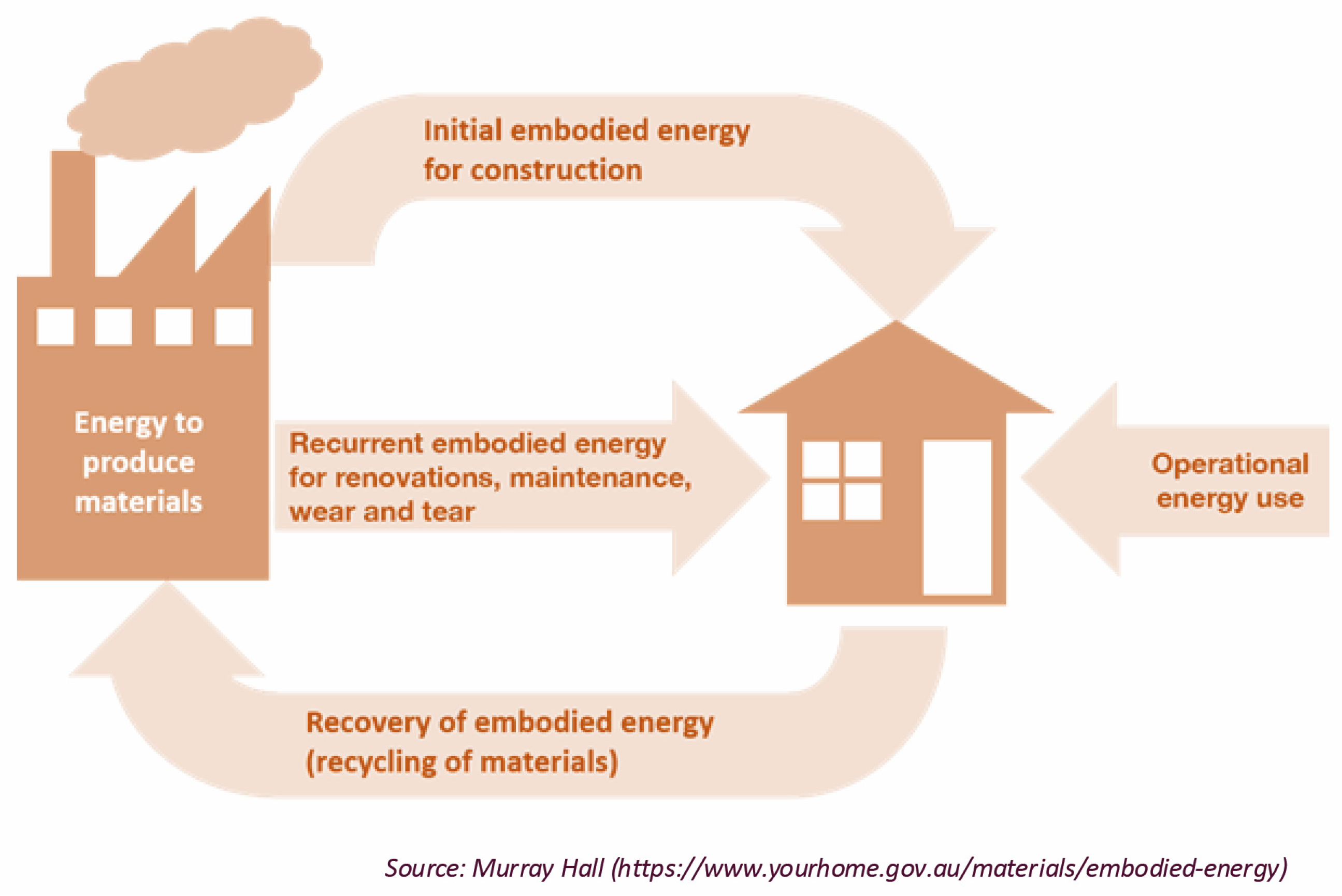
As the operational energy performance of buildings has improved substantially over recent decades—driven by progressively stringent low-energy and nearly zero-energy building (nZEB) standards—embodied energy (EE) has grown in relative significance within the total lifecycle energy balance of the built environment. EE encompasses all energy consumed across the full production chain of a material or product, from raw material extraction and manufacturing to transportation and installation (
Figure 1). While operational energy savings have been achieved through envelope improvements and mechanical system efficiency, the energy embedded in building materials has increasingly come to represent a disproportionate share of lifecycle impacts. In the case of zero-energy buildings (ZEBs), where operational energy demand approaches zero, EE can account for the entirety of a building’s lifetime energy use [
1,
2,
3]. Furthermore, EE, in combination with embodied carbon, is now widely recognized as a key parameter in evaluating overall building performance in the context of climate change mitigation [
4,
5,
6].
In this context, the choice of building materials emerges as a decisive lever for reducing the environmental impact of construction. A comparison between the EE of conventional virgin materials and their circular counterparts illustrates the scale of potential savings: for instance, the production of primary aluminum requires approximately 192 GJ/t of energy, compared to just 12.7 GJ/t for recycled aluminum, reflecting a reduction of over 93% [
7]. In addition to recycled materials, reused components and natural-based materials offer further pathways toward decarbonization, aligning with the EU’s climate targets and the broader transition to a circular construction economy. While there is great interest in the bioeconomy and new renewable materials, the use of recycled materials remains one of the key environmental strategies, including in European policies, as it allows an increase in the resource efficiency level of existing resources, also considering the expected demand growth in the coming years and the related growing pressure on raw materials, especially critical ones. However, in the Ecodesign Regulation (2024) [
8], the EU Commission points out that current product design approaches often fall short in supporting sustainability across the entire lifecycle, resulting in premature replacements, excessive energy and resource consumption, underutilized opportunities for value retention, weak demand for secondary materials, and limited uptake of circular business models [
8]. In fact, despite its recognized potential, the adoption of circular materials in the built environment, both in the construction and in the related value chains, remains constrained by a structural gap: the key obstacle, identified by the EU Commission, is the limited access to relevant information about products’ sustainability, which is valid for both economic operators and consumers [
8]. In fact, the absence of accessible, interoperable digital infrastructure to support the identification, exchange and traceability of secondary resources across supply chains limits the opportunities to select circular materials in the design phase.
Among the value chains connected to the built environment, this is particularly true for the furniture sector: beyond the heavy reliance on primary raw materials, the sector is characterized by energy-intensive processes—such as the polymerization of plastics—and the widespread application of adhesives, dyes and coatings, which generate volatile organic compounds (VOCs) and toxic substances, severely limiting the recyclability of many materials [
9]. As a result, approximately 80–90% of furniture waste—whether pre- or post-consumer—ends up in landfill or is incinerated across the EU, with only 10% being recycled [
10]. While both furniture and construction sectors share the fundamental goal of increasing the use of circular materials, they differ significantly in terms of scale, regulatory frameworks, supply chain structure, and material typologies: the construction sector deals with large volumes of materials governed by stringent building regulations and long lifecycles, whereas the furniture sector operates with shorter product lifecycles, a greater variety of materials and components, and a stronger influence of design-driven decision-making in material selection. However, the two sectors share the need to train designers and professionals in the supply chain on circularity and sustainability related to their specific tasks: this could be facilitated by creating customized tools to promote knowledge and technical information tailored to the different stakeholders [
11].
In this context, based on the increasing costs of raw materials and energy, and on the pressing need of relying on circularity in order to contribute to climate change mitigation and resource conservation, research is increasingly looking at digital technologies to support the upscaling of circular economy processes in the built environment, and artificial intelligence (AI) is increasingly being integrated into digital tools supporting circular design, driven by the need to process and interpret the growing volume and complexity of sustainability-related data—including lifecycle assessment results, environmental certifications, and recycled content documentation—that designers and manufacturers are required to handle. In fact, the role of AI in advancing the circular economy is becoming increasingly acknowledged, with its adoption across relevant applications growing at a steady pace [
12]. In particular, industrial practitioners can be guided through the transition to the circular economy by means of AI-based decision support systems that help to prioritize circular design strategies [
13]. AI-powered features such as automated data extraction, intelligent recommendation systems and natural language interfaces can significantly reduce the time and expertise needed to navigate this information, lowering the knowledge barrier for stakeholders with limited technical backgrounds and enabling more informed, data-driven material choices at the early stages of the design process. A relevant example in this sense is the Horizon EU Project SNUG (innovative methodology based in circular economy and artificial intelligence to foster the transition to sustainable and very-high-energy-performance buildings at a cost-optimal level), which combines AI simulations, an insulation material database, sustainable insulation solutions and smart materials and a digital building logbook to track performance over time [
14].
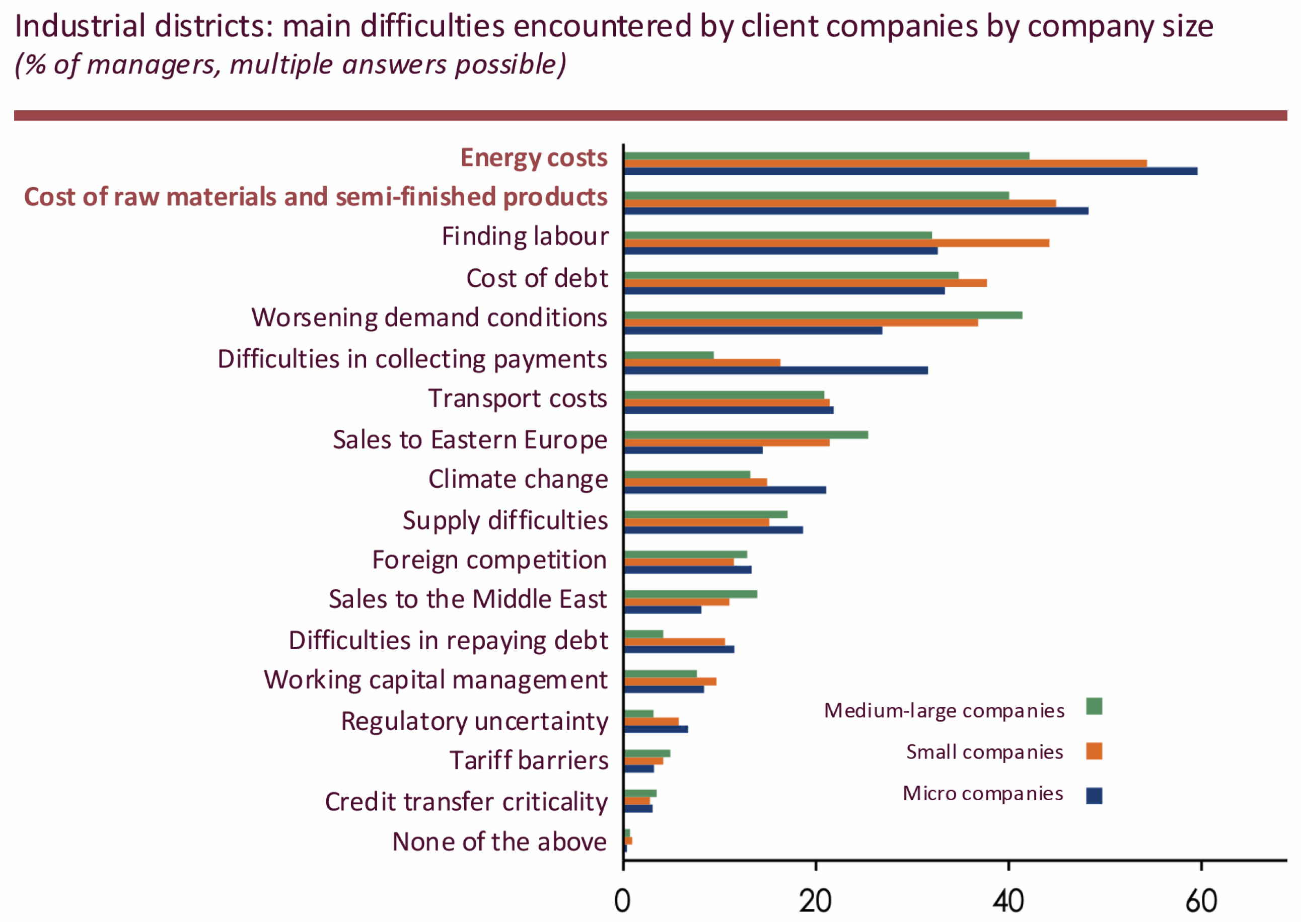
In this scenario, if we look at the condition of Italian manufacturing industries (
Figure 2), energy costs represent the primary challenge for companies of all sizes, both within industrial districts and elsewhere, but they particularly affect micro and small businesses, which constitute the very core of the Italian industrial landscape in both the construction and furniture sectors. It is therefore clear that it is not only necessary but also beneficial to work on reducing energy consumption in the production of materials, components and products, especially through the use of secondary materials, a strategy already adopted by 20% of companies [
15].
In order to promote these strategies and support Italian manufacturing companies in the transition to circular production models, multi-stakeholder platforms can play a key role in promoting the engagement and collaboration of different actors who, based on shared values, are willing to work together to increase their knowledge and skill systems for collective progress [
16].
In this process of change, multi-stakeholder digital platforms in particular can enable players involved in the various supply chains to access relevant information about circular materials, to help them tackle the main challenges including rising energy and raw material costs and the need to ensure energy- and resource-efficient solutions [
16]. Addressing this gap, the present paper proposes a digital tool—informed by AI—designed to facilitate the exchange of materials and data among actors across the different value chains connected to the built environment, and in particular for the furniture industry and related supply chains. The tool is developed within a research framework that positions circular design not merely as an environmental aspiration, but as an operational strategy with a measurable impact on EE reduction at the material and product scale.
3. Methodology
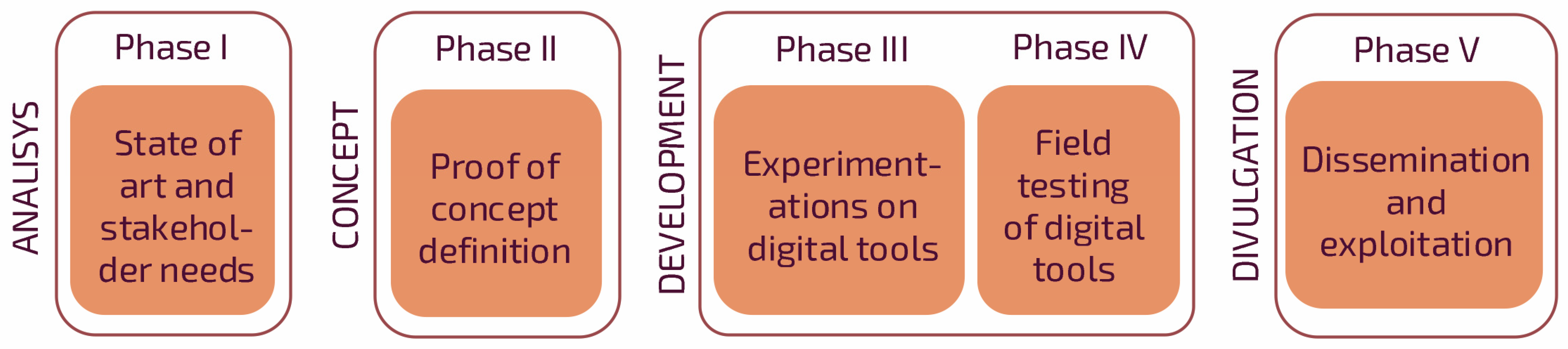
Figure 3 illustrates the research methodology adopted for the development of a digital platform designed to facilitate the exchange of recycled and secondary materials within Italy’s furniture and construction value chain. The framework is organized into five sequential phases, grouped under four overarching macro-stages: analysis, concept, development and divulgation.
The research started with Phase I “State of the art and stakeholder needs”, an analytical phase aimed at mapping the existing context of circular material use in the Italian furniture and construction sectors. This stage involved analyzing recycled material databases, regulatory frameworks and material flows and reviewing current platforms, while simultaneously engaging key stakeholders—manufacturers, designers, consultants, contractors and waste operators belonging to the furniture sector or to companies and organizations with cross-cutting interests across the value chains of the built environment—to identify unmet needs, barriers to exchange and expectations for a digital solution. This evidence base ensured the tool is grounded in real sector dynamics. At this stage, it emerged that the tool could have cross-sectoral relevance spanning both the furniture and construction industries, given that the information, certifications, and types of data to be mapped are common to materials applicable to both furniture and architectural contexts.
Drawing on the findings of Phase I, in Phase II “Proof of concept definition” the research transitioned into the conceptual design of the digital tool. This phase involved defining the functional architecture of the platform—its logic of material classification, matching mechanisms between supply and demand and the user interface requirements for different actors in the value chain. The proof of concept served as a testable blueprint that translates stakeholder needs into a concrete design proposition before full development begins.
In Phase III “Experimentations on digital tools”, the development stage began with iterative experimentation. A prototype of the digital tool was built and tested internally, exploring different technological approaches to cataloging recycled materials, enabling traceability and supporting material-related information access by producers and potential buyers of secondary resources. This phase was iterative, allowing refinements based on technical performance and usability feedback. This activity included AI training.
The refined prototype was then deployed in Phase IV through field testing involving different types of stakeholders—material suppliers, design studios or consultants specialized in recycled material certification processes—to evaluate the tool’s effectiveness in facilitating exchanges of recycled materials. Data gathered in this phase informed final adjustments to the platform.
The final phase (V, “Dissemination and exploitation”) shifted focus from development to impact. The results, methodological insights and operational platform were disseminated to the broader community through publications and a final conference, involving trade associations of material producers and waste recovery operators, as well as foundations and companies interested in future collaboration with the research group to develop a management and business model aimed at making the digital tool fully operational.
Taken together, the methodology follows a research-through-design approach, moving from contextual analysis to conceptual proposition, technical development, empirical validation, and knowledge transfer.
4. Results
The results of the research presented in the following paragraphs focus on Phases I and III. A broader description of the full research results has been provided in other publications [
17,
18].
4.1. Recycled Materials Databases Analysis
Phase I of the research reviewed databases of certified furniture materials, components and products, including EU Ecolabel, the C2C certified products catalog [
19], ReMade in Italy [
20], Plastica Seconda Vita and EPDItaly, to map certified items using recycled materials.
In particular, the ReMade catalog of certified products was selected for an in-depth analysis of its database both for its national relevance and compliance with Italian national legislation (such as the Green Public Procurement Minimum Environmental Criteria for furniture and buildings), and for the indicators taken into consideration in the certification label. In addition to the percentage of recycled content, the label considers the reduction in energy consumption resulting from recycling (EE) and the reduction in climate-altering emissions resulting from recycling (embodied carbon), highlighting how the use of second-life materials can help to reduce energy consumption.
The database, consulted in March 2024, listed almost 200 furniture products from more than 15 companies, and 49% of the products listed contained more than 60% recycled or recovered material.
ReMade, as a platform showcasing certified circular materials, was also analyzed as a digital tool, observing the relationship between users and technicians during the data upload and download phases.
4.2. Digital Tools Comparison for Benchmarking
The next step within Phase I was the mapping of specific categories of digital tools selected for benchmarking purposes. The research examined different existing digital tools supporting circular material design and exchange, including Concular [
21], Oogstkaart [
22], RE-sign [
23], WasteOutlet [
24], WasteTrade [
25], Rotor DC online shop [
26] and Madaster [
27]. Their comparative analysis was carried out in order to conceptualize the different types of platforms, depending on the characteristics of how the tool is used, the different figures that interact with the platform during the data input and output phases and the positioning of the tool within the broader lifecycle and product design cycle.
For example, Concular has a system based on an AI-driven platform that matches buyers’ demand for construction material with suppliers’ circular materials in order to disrupt the construction industry by developing a circular process for material flow. Material demands from construction projects can be uploaded onto the platform by a counselor, while circular materials from demolition projects can be recorded using a digital material passport.
This process was carried out in order to identify the requirements for the new tool and define the model, selecting the most relevant and pertinent features for the purposes of the project from the various tools analyzed.
4.3. Tool Development and AI Training
Based on the analysis of different operational models, it was possible to design the structure of the digital tool, understanding its role within the material and data flows related to the circular project. The tool was therefore configured as a manufacturer-to-designer platform and plug-in software, connected to the production phases of materials and components in the Italian furniture industry, but also directly connected to the design cycle as the first moment in which to evaluate and intervene with the product in order to reduce its energy and environmental impacts.
As mentioned, the tool consists of a web platform for the exchange of circular, second-life or natural-based materials and components, and a software plug-in for CAD, specifically Rhinoceros, which was only conceptualized and is still under development. The correlation between the two parts and the real-time updating of the project based on the materials chosen for the project is the core of the tool and is supported by AI.
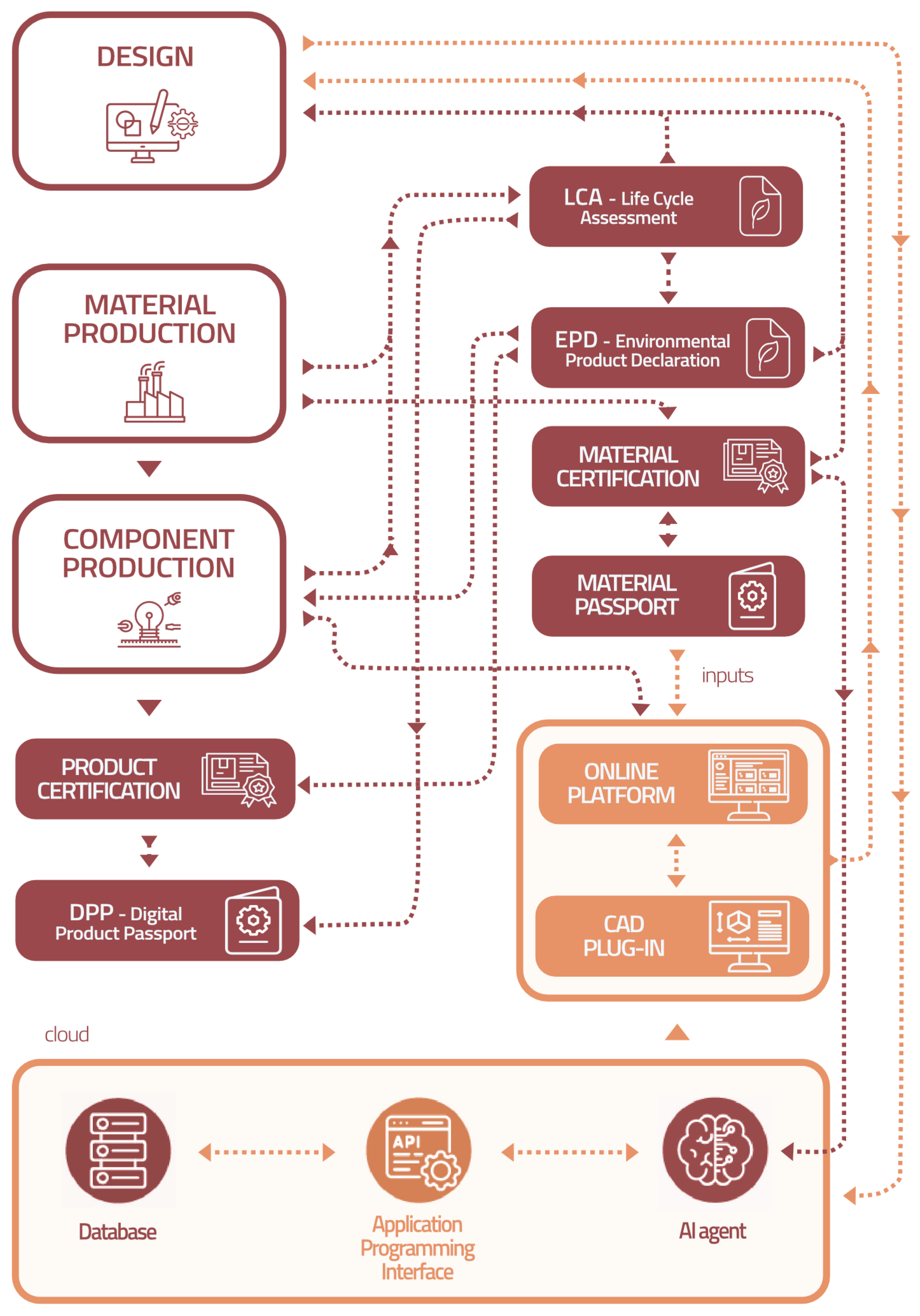
Figure 4 illustrates, through a flow diagram, the role of AI within the data flows enabled by the digital tool developed in the research. Through the consultation of Environmental Product Declarations, Material Certifications and Material Passports, the platform returns information on available materials covering not only their physical characteristics, but also the processes linked to the lifecycle and circularity level of the material or semifinished product. In the context of the design process, the tool therefore enables an understanding of the environmental impacts related to the materials used, thanks to its connection with CAD software and the support provided by AI in the extraction and interpretation of complex, multi-layered data linked to the certificates and documentation associated with the materials. The three main functions performed by AI within the tool are described below.
The first function of AI within the tool is in the data upload. AI can support the manufacturers and material producers in entering data relating to materials present on the platform, through the reading and interpretation of technical data sheets and environmental certifications and subsequent critical extrapolation of the information required by the system. By continuing training, with the support of LCA experts, artificial intelligence could interpret complex documents such as EPD certifications, extracting the information needed to guide sustainable and circular design towards a reduction in the energy and carbon incorporated into products, as increasingly required by national and international regulations.
The second function involving AI is the material search: AI, trained through scenario-based learning with stakeholder participation during platform use, can offer support in searching for materials available on the platform, by understanding the designer’s needs through conversation with the chatbot assistant, and then quickly comparing the available alternatives.
The third function of AI is in the comparison of scenarios: its integration with the software plug-in provides feedback to the designer concerning crucial positive and negative aspects for each design scenario, based on the characteristics and peculiarities of the chosen material.
Therefore, overall, AI supports designers in researching and sourcing recycled/reused materials, as well as in data processing.
Through real-time feedback, designers can understand the consequences of their design choices in terms of environmental and energy impact. With the support of AI, they can then review certain choices and steer the project towards a more sustainable and circular model.
A testing phase was conducted with the stakeholders involved in the initial phase of the project through interviews, in order to understand whether the prototype developed met the needs identified. Thanks to the iterative research testing of the tool, users gave positive feedback overall. While acknowledging its limitations due to ongoing development, users appreciated the platform navigation experience and AI support, emphasizing how the data entry support function significantly speeds up the process of interfacing with the tool.
5. Discussion and Conclusions
In the transition towards a more circular built environment at all levels of design, digital support tools are needed to ensure an effective material-related data exchange in order to enable a reduction in embodied energy in both products and buildings. The research results show how AI can provide effective support within digital tools oriented to support designers towards circular material choices. As experimented with during the testing phase of the digital tool prototype, by continuing training with the support of LCA experts, AI could interpret complex documents such as Environmental Product Declarations, extracting the information needed to guide design towards the selection of circular, low-embodied-energy materials and products as increasingly required by international regulations.
Currently, the MICS Project plans to release the prototype of the digital tool within an open-source platform [
28] including the full portfolio of digital tools developed with the Extended Partnership research projects. However, the exploitation strategy by the research group addresses how the tool can be scaled, maintained and integrated into existing circular economy ecosystems in Italy, ensuring continuity beyond the research project. Moreover, the tool holds significant potential for application in the construction sector as well. This broader applicability was actively highlighted by the stakeholders who participated in the research and tested the tool at different stages of its development, providing direct evidence of its relevance beyond the furniture industry.
Although one limit of the research is the fact that the software plug-in remains in the embryonic prototype stage, this component of the tool was met with enthusiasm by the stakeholders involved in the testing phase. Therefore, the research perspectives include the full development of this part of the digital tool.
Furthermore, continuing the research, through collaboration with external certification bodies, will enable the development of a comprehensive and effective AI-based tool to reduce the impacts of the furniture sector in terms of embodied carbon and embodied energy.