Proceeding Paper

Modelling and MATLAB-Based Optimisation of Carbon Dioxide Adsorption Using Zn-MOF-5 †

by
Shonisani Salvation Muthubi
*,
Dorcas Museme Mabulay
and
Pascal Kilunji Mwenge
Department of Chemical and Metallurgical Engineering, Vaal University of Technology, Private Bag X021, Vanderbijlpark 1900, South Africa
*
Author to whom correspondence should be addressed.
Presented at the 1st International Online Conference on Designs (Designs 2026), 9–10 February 2026; Available online: https://sciforum.net/event/Designs2026.
Eng. Proc. 2026, 138(1), 6; https://doi.org/10.3390/engproc2026138006 (registering DOI)

Published: 22 May 2026

Abstract

The growing concern over greenhouse gas emissions has prompted the need for efficient carbon dioxide (CO2) capture technologies. This study focuses on simulating CO2 adsorption using a zinc-based metal–organic framework (Zn-MOF-5). The primary aim is to develop and refine a robust MATLAB-based approach for equilibrium and kinetic modelling using the Linear Driving Force (LDF) model and Langmuir isotherm, capable of accurately predicting CO2 adsorption performance under varying operational conditions. By employing advanced computational methods, this research seeks to streamline the process design and enhance the feasibility of sustainable CO2 capture solutions. Excel was used for statistical analysis and validation, while MATLAB R2025a was utilised for equilibrium and kinetic modelling using the LDF model and the Langmuir isotherm. The independent effects of temperature, pressure, and flow rate were evaluated using the variable effect method. The study found a significant negative association between temperature and CO2 uptake, consistent with the exothermic nature of the adsorption process. Pressure had a significant impact on adsorption, whereas flow rate had little effect within the investigated range. The simulated CO2 uptake (21.196 mmol/g) closely matched the experimental data (21.07 mmol/g) with a 0.59% variance, validating the model’s trustworthiness. The research shows that Zn-MOF-5 has a strong adsorption potential and that simulation tools can significantly minimise experimental costs and time. Furthermore, it underscores the potential of simulation tools to significantly reduce experimental costs and time, paving the way for more efficient and effective carbon capture solutions. This initiative not only contributes to optimising process design but also promotes sustainable practices in addressing global CO2 emissions. By contributing to process optimisation, this study aligns with the United Nations Sustainable Development Goal (SDG) 13: Climate Action, which emphasises the urgent need for innovative solutions to combat climate change and its impacts. Furthermore, it promotes sustainable practices to address global CO2 emissions, thereby supporting broader efforts for environmental sustainability.

1. Introduction

Environmental damage caused by pollution of land, water, and air have been colossal since the Industrial Revolution. Its most observable impact is air pollution, which has glaciers [1]. Atmospheric carbon dioxide (CO2) concentrations have increased steadily over the past decades due to anthropogenic emissions [2]. Recent global measurements indicate that atmospheric CO2 levels exceeded 422 ppm in 2024, with seasonal peaks approaching 430 ppm, representing the highest concentrations recorded in the modern observational record. Projections suggest that, without significant emission reductions, atmospheric CO2 concentrations could exceed 550–600 ppm by 2100 [1], highlighting the urgent need for effective carbon mitigation strategies.
Traditional CO2 capture from power plants relies on amine absorption, particularly monoethanolamine (MEA). Although effective, this process is energy-intensive and costly [2,3]. As a result, adsorption-based methods such as pressure swing adsorption (PSA), vacuum swing adsorption (VSA), and temperature swing adsorption (TSA) are being explored due to their lower energy requirements. However, their efficiency largely depends on the performance of the adsorbent material [4]. Captured CO2 can be utilised as a carbon feedstock to produce fine chemicals, transportation fuels, polymers, pharmaceuticals, beverages, and various inorganic compounds [1,5,6].
Metal–organic frameworks (MOFs) have attracted significant attention for CO2 capture and catalytic conversion due to their high surface areas and tunable structures [4]. These materials exhibit promising adsorption properties for CO2 at moderate temperatures, with structural features such as pore size and shape controlled by the choice of metal ions and organic ligands [1]. Among them, Zn-MOF-5 is particularly notable for CO2 adsorption, with performance strongly dependent on synthesis conditions, activation, and handling, which affect surface area, pore volume, and adsorption behaviour [7]. Accurate modelling of Zn-MOF-5 adsorption is therefore essential for assessing its potential in scalable CO2 capture systems [1,8].
Experimental investigation of CO2 adsorption under varying operating conditions is often time-consuming, costly, and limited in its ability to systematically evaluate multiple interacting variables. Computational and modelling approaches are increasingly employed to understand adsorption mechanisms and predict adsorption performance under different operating conditions. For instance, Abdi et al. [9] used machine-learning algorithms such as XGBoost, CatBoost, LightGBM, and Random Forest to model CO2 uptake based on parameters including temperature, pressure, surface area, and pore volume. Similarly, Choudhury et al. [7] investigated CO2 adsorption in MOF-5, ZIF-8, and UiO-66 using Grand Canonical Monte Carlo (GCMC) simulations and showed that MOF-5 exhibits superior adsorption performance at higher pressures. Although these models showed strong predictive capability, they mainly focus on equilibrium capacity prediction and provide limited insight into adsorption kinetics and mass-transfer behaviour. Rupa et al. [10] found that the LDF model accurately represents adsorption kinetics in porous adsorbents by simplifying intraparticle diffusion effects.
Although significant progress has been made in modelling CO2 adsorption in MOFs, many studies focus primarily on machine learning predictions or equilibrium simulations. Dynamic adsorption modelling approaches, such as the LDF model coupled with adsorption isotherms, remain less explored for MOF systems, particularly Zn-based MOFs such as MOF-5. Therefore, integrating the Langmuir isotherm with the LDF kinetic model in a MATLAB framework can provide improved prediction of adsorption behaviour and support the design of efficient CO2 capture processes.
This study addresses this gap by developing and validating a MATLAB–Excel simulation framework to model CO2 adsorption on Zn-MOF-5 and to quantitatively evaluate the influence of key operating parameters on adsorption performance.

2. Methodology

2.1. System Definition and Objectives

This study focuses on the modelling and simulation of CO2 adsorption using Zn-MOF-5 as the adsorbent material. The objective is to evaluate the influence of key operating parameters, namely temperature, pressure, and flow rate, on the adsorption performance of Zn-MOF-5. Equilibrium and kinetic adsorption behaviour were analysed using the Langmuir isotherm and the LDF model, respectively. MATLAB–Excel simulation tools were employed to quantify adsorption capacity and assess system performance under varying operating conditions. MATLAB version 2025a was used in the simulation process.
It is to be noted that this study is entirely simulation-based; no physical synthesis or laboratory characterisation of Zn-MOF-5 was carried out. The material properties used as model inputs were based on established experimental literature (Table S1). Qasem et al. [11] validated the structural and thermodynamic parameters for DEF-synthesized MOF-5, including a BET surface area of 2449 m2/g, pore volume of 1.39 cm3/g, maximum adsorption capacity qm = 23 mmol/g, enthalpic factor α = 20 J/mol, entropic factor β = 37.8 J/mol·K, and isotherm constant n = 7. The Langmuir saturation capacity (qsat = 21.2 mmol/g) and adsorption constant (b = 150 bar−1) were taken from [12].

2.2. Simulation Framework and Modelling Approach

This study investigated CO2 adsorption on MOF-5 using Langmuir (equilibrium) and LDF (kinetic) modelling approaches. The effects of temperature, pressure, and flow rate were analysed using a one-factor-at-a-time (OFAT) approach. The experimental ranges evaluated for the simulation included 280 to 320 K for temperature, 1 to 10 bar for pressure, and 10 to 100 kmol/h for flow rate. To assess the impact of these operating parameters on CO2 adsorption, a variable-evaluation approach was employed. This method is both straightforward and effective in isolating the individual effects of temperature, pressure, and flow rate. The system inputs were primarily derived from literature data reported by Qasem et al. [11]. The MOF-5 parameters used in the simulation included a maximum adsorption capacity of qm = 23 mmol/g, an enthalpic factor α = 20 J/mol, an entropic factor β = 37.8 J/mol·K, an isotherm constant n = 7 and the reference pressure (P0) was 72.14 × 10⁶ Pa. The universal gas constant (R) was used as 8.314 J/mol·K. These parameters were adopted from Qasem et al. [11].
For the Langmuir isotherm model, a saturation capacity (qsat) of 21.2 mmol/g and an adsorption constant b = 150 bar−1 were adopted from Costa et al. [12]. The LDF mass transfer coefficient (kL) was fixed at 0.025 s−1, as reported by Qasem et al. [11]. The temperature dependence of adsorption was represented using an adsorption enthalpy change of ΔH = −3000 J/mol. The LDF mass transfer coefficient was fixed at kLDF = 0.01 s−1 as reported by Qasem et al. [11], and a time range of 0–1000 s was applied for kinetic analysis. The flue gas composition was assumed constant throughout the simulations and consisted of 82% N2, 12% CO2, 5.5% O2, 0.38% SO2, and 0.12% NO2.
The simulation framework employed MATLAB for equilibrium and kinetic calculations, while Excel was used for regression analysis and statistical validation. MATLAB was used to solve the Langmuir isotherm and LDF kinetic equations using iterative numerical loops.
The Langmuir isotherm equation used to describe equilibrium adsorption capacity is given by:
q e = q s a t b P 1 + b P
where q e is the equilibrium adsorption capacity of CO2 (mmol g−1), q s a t is the saturation adsorption capacity (mmol g−1), b is the Langmuir adsorption constant (bar−1), and P is the gas pressure (bar). The LDF kinetic model was used to describe the rate of CO2 diffusion within the adsorbent, implemented via iterative loops to generate the adsorption data. The Langmuir isotherm was solved simultaneously across the temperature-pressure grid, and the resulting values were stored as CO2 adsorption data. The LDF solution was approximated using Equations (2) and (3):
d q t d t = k L D F ( q e q t )
With the integrated form:
q t = q e ( 1 e k L D F t )
where KLDF is the LDF mass transfer coefficient (s−1), and q t is the adsorption capacity at time t (mmol g−1). These equations were coded into MATLAB, enabling estimation of the transient approach to equilibrium.

2.3. Statistical Validation

Data from MATLAB outputs were exported to Excel, enabling systematic evaluation of parameter significance using analysis of variance (ANOVA) and the calculation of metrics such as R2, F-value, and p-value statistics. Adsorption capacity for each simulation was calculated in MATLAB using the Langmuir isotherm for equilibrium and the LDF model for kinetic analysis. Model validation was performed by comparing simulated results with experimental data from the literature, whereas verification involved comparing the equilibrium adsorption values obtained in Excel with the input parameters for the LDF model in MATLAB.

3. Results and Discussion

3.1. Equilibrium Behaviour (Langmuir Isotherm)

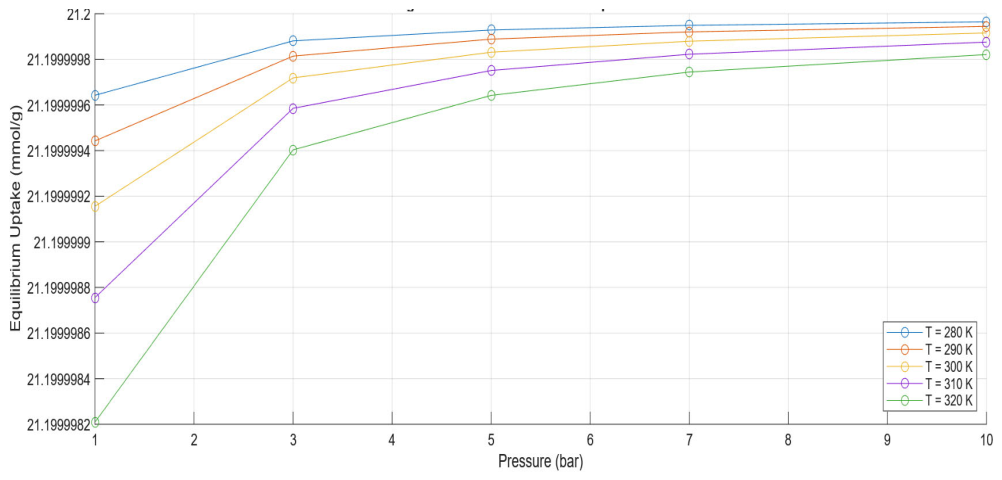
Figure 1 displays the Langmuir isotherms obtained from simulated data, demonstrating how CO2 uptake varies with pressure and temperature.
Uptake decreases as temperature rises due to a drop in the Langmuir equilibrium constant of b = 150 bar−1. Increased heat energy eliminates van der Waals connections, leading to fewer adsorbed CO2 molecules. This tendency is consistent with literature data on CO2-MOF-5 systems [13].
The Langmuir isotherm shows CO2 uptake increases with pressure, reaching about 21.19 mmol/g at 10 bar. Uptake rises sharply from 1 to 3 bar due to high-energy sites, then plateaus beyond 8 bar, indicating saturation and monolayer coverage. This behaviour is consistent at constant temperature: an increase in temperature decreases adsorption, confirming its exothermic nature [9]. The trends shown in Figure 1 validate the Langmuir model’s suitability for CO2 adsorption on MOF-5 and align with the literature [1].

3.2. Effect of Process Variables

Flow rate, pressure, and temperature were evaluated in the fixed-bed system, with their respective statistics presented in Tables S2, S3 and S4.
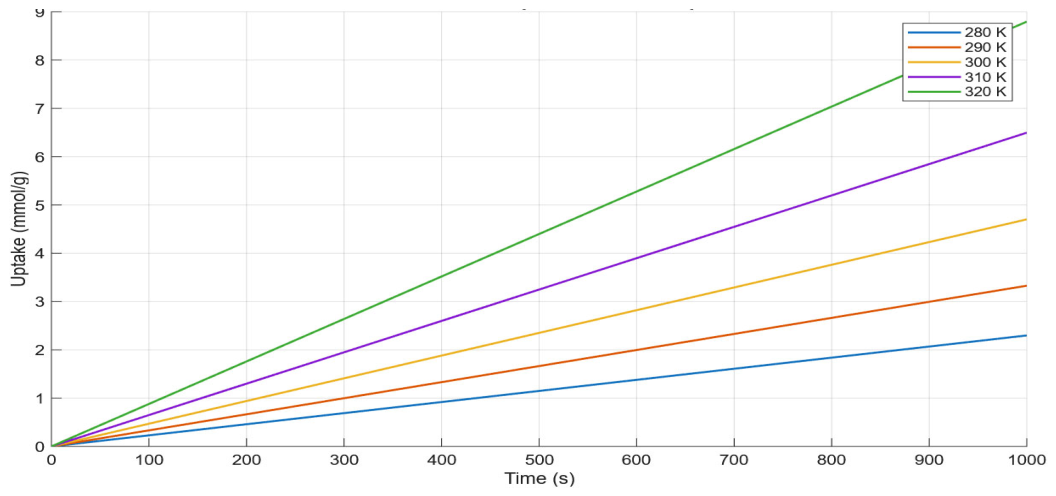
Figure 2 depicts the effect of temperature on CO2 uptake. The uptake increased as the temperature rose from 280 K to 320 K, contrary to thermodynamic expectations. CO2 adsorption on MOFs is an exothermic process; higher temperatures reduce adsorption capacity [9,14] by increasing desorption and decreasing adsorbate-adsorbent interaction [4,15]. The observed increase in CO2 uptake with temperature is attributed to kinetic effects rather than thermodynamic behaviour. While adsorption is exothermic, higher temperatures enhance diffusion and reduce mass transfer resistance, leading to faster adsorption rates under dynamic conditions. This results in higher apparent uptake within a finite time, particularly in kinetically controlled systems [10,16]. In kinetically controlled systems or short-cycle adsorption processes, higher temperatures can enhance gas diffusion and mass transfer, even as equilibrium adsorption capacity decreases. Therefore, an observed increase in uptake might result from faster mass transfer in the reactor rather than improved adsorption affinity. This emphasises the need to distinguish between equilibrium-controlled and rate-controlled adsorption when analysing simulation results [16].
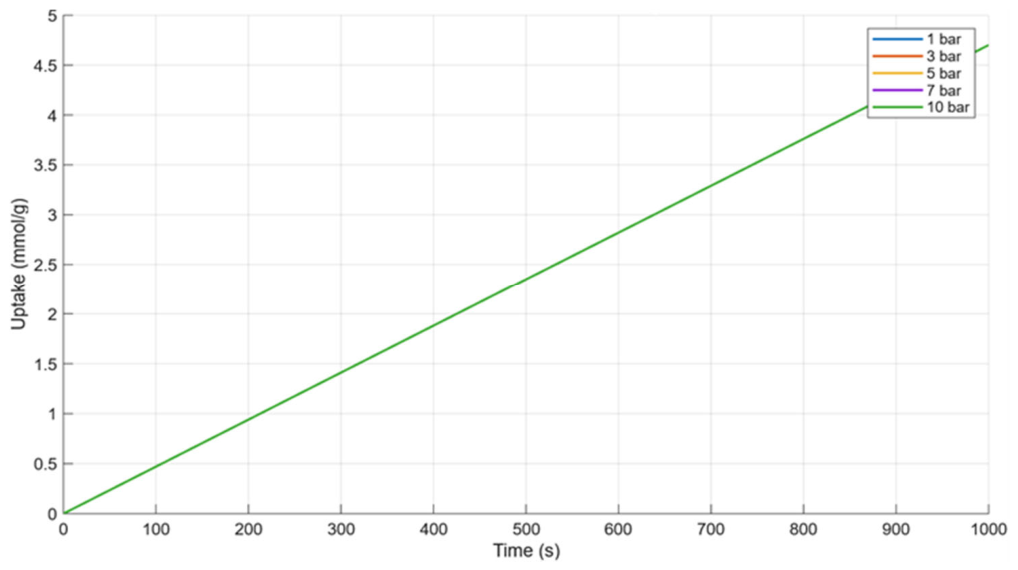
Figure 3 shows overlapping adsorption curves across the pressure range of 1–10 bar, indicating that CO2 uptake remained practically constant under the simulated conditions (Table S5). This suggests that the adsorption process was not highly pressure-sensitive within this pressure range. The minimal change in adsorption observed in this study suggests that the process was limited by kinetic factors rather than equilibrium conditions. The overlapping curves suggest that CO2 uptake remained consistent across the pressure range, indicating that adsorption was probably governed by internal diffusion within the MOF-5 structure rather than pressure-driven effects. In contrast to this study, Villarroel-Rocha et al. [17] reported a slight increase in CO2 uptake of 2.5–7.8 mmol/g as pressure increases. The tests were conducted under static conditions, which restricted gas diffusion into the pores of MOF-5. A rate-based model for dynamic simulation was applied in this study, which enhanced mass transfer and enabled faster, more complete CO2 adsorption, resulting in higher uptake values (18–21 mmol/g). Generally, an increase in partial pressure increases the driving force for CO2 molecules to penetrate the porous structure and occupy available adsorption sites, thereby increasing adsorption. Metal–organic frameworks, such as MOF-5, typically exhibit a monotonic increase in CO2 adsorption capacity with increasing pressure until the pores become saturated [7,11]. When high-energy adsorption sites were fully saturated, the process reached near-equilibrium, where increasing pressure had little influence on CO2 uptake [9].
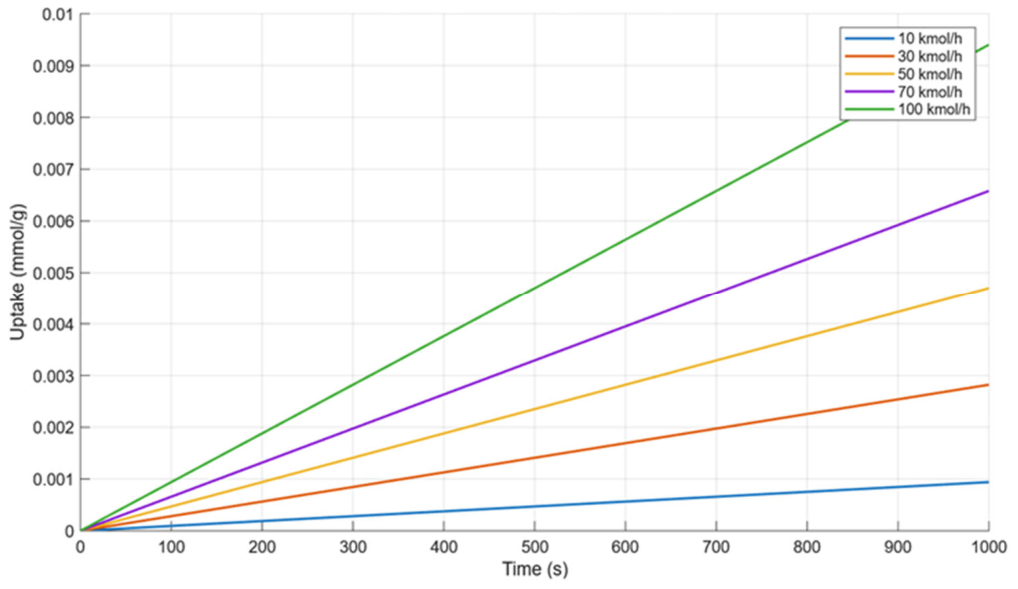
In Figure 4, a proportional increase in CO2 adsorption is observed with increasing gas flow rate within the range of 10 to 100 kmol/h. At moderate flow rates, enhanced mass transfer leads to increased CO2 absorption. However, excessively high flow rates can diminish contact time, ultimately reducing overall adsorption efficiency. Higher flow rates introduce more CO2 into the system, thereby increasing mass transfer and adsorption rates [18]. Overall, the results indicate that within the measured range, flow rate had a small effect on the final CO2 absorption capacity. The adsorption process was mainly controlled by surface diffusion and the number of active sites on the MOF, rather than by external mass-transfer limitations [19].

3.3. Kinetic Uptake (LDF Model)

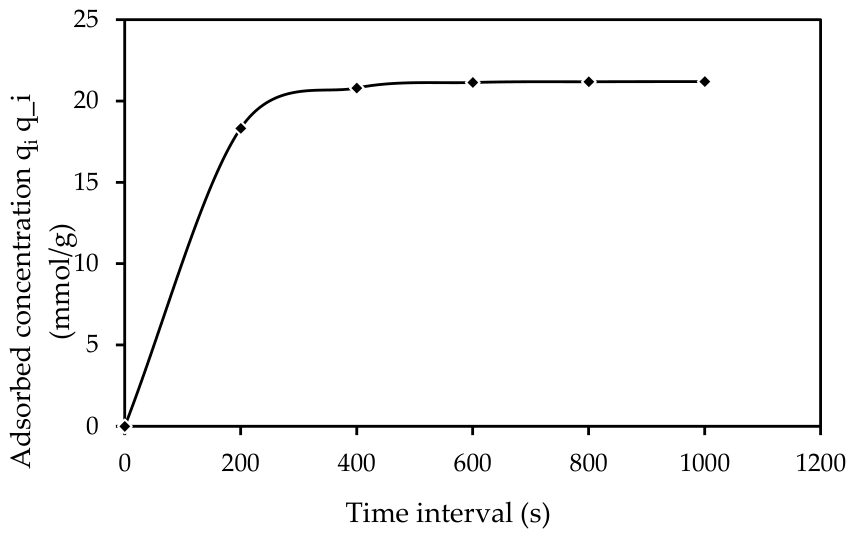
After analysing the evaluation of process variables, the adsorption kinetics were examined using the LDF model. LDF kinetics are presented in Figure 5.
Studying the kinetic uptake profile of CO2 on MOF-5 using the LDF equation revealed three distinct adsorption stages. In the first 200 s, there was a significant increase in adsorbed concentration (qi), indicating a rapid adsorption phase with many active sites accessible for CO2 molecules. Between 400 and 600 s, the adsorption rate gradually slowed, signalling a shift towards equilibrium as the high-energy sites became increasingly occupied [10,16]. Beyond 600 s, the uptake curve plateaued at around 21.19 mmol/g, indicating MOF-5′s equilibrium and optimal adsorption capacity under the examined conditions (10 bar, 300 K). This equilibrium indicates that the surface was fully saturated and that mass transfer resistance dominated the adsorption process. Such behaviour is consistent with the LDF model’s theory that the adsorption rate is proportionate to the driving force differential between equilibrium and real loadings [20].

3.4. Statistical Results

Data analysis was performed in Excel to examine how flow rate, pressure, and temperature affect CO2 adsorption with MOF-5. The regression results showed a poor association between flow rate and adsorption capacity (R2 = 0.6683, p-value = 0.90), as evidenced by an F-value of 0.0157, suggesting that flow rate did not significantly influence adsorption performance within the investigated range. This observation is consistent with findings from CO2 fixed-bed adsorption studies, where operating parameters such as temperature and concentration often dominate adsorption behaviour, while flow rate primarily influences breakthrough characteristics rather than equilibrium capacity [14]. Pressure had a moderate correlation with adsorption capacity (R2 = 0.6683). The regression coefficient for pressure was positive, indicating that greater pressures boosted CO2 uptake. As shown in Table 1, temperature had the greatest effect, with the highest F-value of 12,173.08598, a significant p-value < 0.001 and a strong correlation (R2 = 0.9997). The very low regression coefficient indicates that CO2 adsorption decreases with increasing temperature, consistent with the exothermic character of physical adsorption processes [7,10]. This finding identifies temperature as the most important factor affecting adsorption, followed by pressure (F-value of 6.0451 and p-value of 0.091), while flow rate had no significant effect. The high R2 values and low standard errors observed in the regression analysis indicate strong model consistency and minimal deviation within the investigated parameter range. These statistical results serve as an indirect error analysis, confirming the reliability of the simulation outcomes.
The ANOVA analysis evaluated the impact of flow rate, pressure, and temperature on CO2 adsorption performance, which is presented in Table 2. The F-value (0.016) and the corresponding p-value (0.9002) indicated that flow rate had no statistically significant effect on adsorption capacity within the tested range. This suggests that variations in flow rate between 10 and 100 kmol/h did not notably influence the equilibrium uptake, as the adsorption system had already reached mass-transfer stability. Previous studies have also reported that gas flow rate primarily affects residence time, breakthrough time, and mass transfer behaviour rather than significantly altering the equilibrium adsorption capacity in packed-bed adsorption systems [10]. In comparison, pressure yielded an F-value of 6.05 with a p-value of 0.091, indicating a moderate effect on adsorption performance. This aligns with the physical behaviour of CO2 adsorption, where increasing pressure enhances adsorption capacity due to higher CO2 concentration and a stronger driving force for gas–solid interactions within porous adsorbents [21].
Table 3 compares the MATLAB–Excel LDF–Langmuir framework against CFD coupled with GCMC simulations [7,11] and an LDF kinetic model [10] using data drawn from literature and this study’s simulation outputs. Furthermore, the results in this study were compared with experimental data as shown in Table S6.

4. Conclusions

The developed simulation model successfully reproduced the CO2 adsorption behaviour on Zn-MOF-5, demonstrating the capability of computational modelling to accurately represent experimental adsorption performance. The model’s reliability was confirmed by the predicted CO2 uptake of 21.196 mmol g−1, which deviated by only 0.59% from the experimental value of 21.07 mmol g−1. By integrating the Langmuir isotherm with the LDF kinetic model, the simulation effectively captured both equilibrium and mass-transfer behaviour during adsorption. The analysis further showed that temperature had the greatest influence on CO2 adsorption, followed by pressure, while flow rate had minimal impact, which is consistent with the thermodynamics and kinetics of exothermic adsorption processes. Overall, the results demonstrate that Zn-MOF-5 is a promising adsorbent for CO2 capture, and that MATLAB-based modelling, combined with Excel validation, provides an efficient and cost-effective approach for simulating adsorption systems.

Supplementary Materials

The following supporting information can be downloaded at: https://www.mdpi.com/article/10.3390/engproc2026138006/s1, Table S1: Properties used in the simulation; Table S2: statistics of the effect of flow rate on adsorption; Table S3: statistics of the effect of pressure on adsorption; Table S4: statistics of the effect of temperature on adsorption; Table S5: Kinetic uptake (mmol/g) at different times and pressures for MOF-5; Table S6: Experimental vs simulation data.

Author Contributions

Conceptualisation, S.S.M., D.M.M. and P.K.M.; methodology, S.S.M., D.M.M. and P.K.M.; software, S.S.M.; D.M.M. and P.K.M.; validation, S.S.M.; D.M.M. and P.K.M.; formal analysis, S.S.M. and D.M.M.; investigation, S.S.M. and D.M.M.; resources, P.K.M. and S.S.M.; data curation, S.S.M. and P.K.M.; writing—original draft preparation, S.S.M., D.M.M. and P.K.M.; writing—review and editing, S.S.M. and P.K.M.; visualisation, S.S.M., P.K.M. and D.M.M.; project administration, S.S.M. and P.K.M. All authors have read and agreed to the published version of the manuscript.

Funding

This research received no external funding.

Institutional Review Board Statement

Not applicable.

Informed Consent Statement

Not applicable.

Data Availability Statement

The data supporting the findings of this study are available within the article and its Supplementary Materials.

Acknowledgments

The authors thank the Department of Chemical and Metallurgical Engineering of the Vaal University of Technology for providing research facilities.

Conflicts of Interest

The authors declare no conflicts of interest.

References

  1. Lei, Y.; Xiao, Y.; Chen, X.; Zhang, W.; Yang, X.; Yang, H.; Fang, D. Research Progress on CO2 Capture and Catalytic Conversion of Metal-Organic Frameworks Materials. Catalysts 2025, 15, 421. [Google Scholar] [CrossRef]
  2. Hanson, E.; Nwakile, C.; Hammed, V.O. Carbon Capture, Utilization, and Storage (Ccus) Technologies: Evaluating the Effectiveness of Advanced CCUS Solutions for Reducing CO2 Emissions. Results Surf. Interfaces 2025, 18, 100381. [Google Scholar] [CrossRef]
  3. Altintas, C.; Erucar, I.; Keskin, S. High-Throughput Computational Screening of the Metal Organic Framework Database for CH4/H2 Separations. ACS Appl. Mater. Interfaces 2018, 10, 3668–3679. [Google Scholar] [CrossRef] [PubMed]
  4. Wang, Z.; Zhou, T. Computer-Aided Metal–Organic Framework Screening and Design Approaches Toward Efficient Carbon Capture Processes. Mol. Syst. Des. Eng. 2025, 10, 1005–1023. [Google Scholar] [CrossRef]
  5. Nwabueze, Q.A.; Leggett, S. Advancements in the Application of CO2 Capture and Utilization Technologies—A Comprehensive Review. Fuels 2024, 5, 508–532. [Google Scholar] [CrossRef]
  6. Emmanuel, O.; Rozina; Ezeji, T.C. Advances in Carbon Dioxide Capture and Conversion Technologies: Industrial Integration for Sustainable Chemical Production. Next Sustain. 2025, 6, 100108. [Google Scholar] [CrossRef]
  7. Choudhury, S.; Shit, S.P.; Bose, E.; Pal, S. Microscopic Adsorption of CO2 in Metal Organic Frameworks (MOF-5, ZIF-8 and UiO-66) by Grand Canonical Monte Carlo Simulation: A Comparative Analysis. Adsorption 2026, 32, 2. [Google Scholar] [CrossRef]
  8. Wang, Y.; Xu, J.; Lin, X.; Wang, B.; Zhang, Z.; Xu, Y.; Suo, Y. Facile Synthesis of MOF-5-Derived Porous Carbon With Adjustable Pore Size for CO2 Capture. J. Solid State Chem. 2023, 322, 123984. [Google Scholar] [CrossRef]
  9. Abdi, J.; Hadavimoghaddam, F.; Hadipoor, M.; Hemmati-Sarapardeh, A. Modeling of CO2 Adsorption Capacity by Porous Metal-Organic Frameworks Using Advanced Decision Tree-Based Models. Sci. Rep. 2021, 11, 24468. [Google Scholar] [CrossRef]
  10. Rupa, M.J.; Pal, A.; Mitra, S.; Saha, B.B. Time Adapted Linear Driving Force Model for Gas Adsorption onto Solids. Chem. Eng. J. 2021, 420, 129785. [Google Scholar] [CrossRef]
  11. Qasem, N.A.A.; Ben-Mansour, R.; Habib, M.A. An Efficient CO2 Adsorptive Storage Using MOF-5 and MOF-177. Appl. Energy 2018, 210, 317–326. [Google Scholar] [CrossRef]
  12. Costa, N.E.G.; Patrício, P.C.P.; Ferreira, R.V.; Vianna Neto, M.R.; Cardoso, M. Simulation and Analysis of A Hydrogen Generation Unit. Braz. J. Pet. Gas 2018, 12, 159–168. [Google Scholar] [CrossRef]
  13. Wang, J.; Huang, L.; Yang, R.; Zhang, Z.; Wu, J.; Gao, Y.; Wang, Q.; O’Hare, D.; Zhong, Z. Recent Advances in Solid Sorbents for CO2 Capture and New Development Trends. Energy Environ. Sci. 2014, 7, 3478–3518. [Google Scholar] [CrossRef]
  14. Mesfer, M.K.A.; Danish, M.; Khan, M.I.; Ali, I.H.; Hasan, M.; Jery, A.E. Continuous Fixed Bed CO2 Adsorption: Breakthrough, Column Efficiency, Mass Transfer Zone. Processes 2020, 8, 1233. [Google Scholar] [CrossRef]
  15. Choi, S.; Drese, J.H.; Jones, C.W. Adsorbent Materials for Carbon Dioxide Capture from Large Anthropogenic Point Sources. ChemSusChem 2009, 2, 796–854. [Google Scholar] [CrossRef] [PubMed]
  16. Liao, Q.; Zhou, J.; Zheng, Y.; Xian, X.; Deng, G.; Zhang, C.; Duan, X.; Wu, Z.; Li, S. Adsorption Kinetics of CH4 and CO2 on Shale: Implication for CO2 Sequestration. Sep. Purif. Technol. 2024, 337, 126427. [Google Scholar] [CrossRef]
  17. Villarroel-Rocha, D.; Bernini, M.C.; Arroyo-Gómez, J.J.; Villarroel-Rocha, J.; Sapag, K. Synthesis of MOF-5 Using Terephthalic Acid as A Ligand Obtained from Polyethylene Terephthalate (PET) Waste and Its Test in CO2 Adsorption. Braz. J. Chem. Eng. 2022, 39, 949–959. [Google Scholar] [CrossRef]
  18. Akpasi, S.O.; Isa, Y.M. Effect of Operating Variables on CO2 Adsorption Capacity of Activated Carbon, Kaolinite, and Activated Carbon—Kaolinite Composite Adsorbent. Water-Energy Nexus 2022, 5, 21–28. [Google Scholar] [CrossRef]
  19. Sumida, K.; Rogow, D.L.; Mason, J.A.; McDonald, T.M.; Bloch, E.D.; Herm, Z.R.; Bae, T.-H.; Long, J.R. Carbon Dioxide Capture in Metal–Organic Frameworks. Chem. Rev. 2012, 112, 724–781. [Google Scholar] [CrossRef]
  20. Preißler-Kurzhöfer, H.; Kolesnikov, A.; Lange, M.; Möllmer, J.; Erhart, O.; Kobalz, M.; Hwang, S.; Chmelik, C.; Krautscheid, H.; Gläser, R. Hydrocarbon Sorption in Flexible MOFs—Part II: Understanding Adsorption Kinetics. Nanomaterials 2023, 13, 601. [Google Scholar] [CrossRef]
  21. Raganati, F.; Miccio, F.; Ammendola, P. Adsorption of Carbon Dioxide for Post-combustion Capture: A Review. Energy Fuels 2021, 35, 12845–12868. [Google Scholar] [CrossRef]
Figure 1. Langmuir isotherm for CO2 uptake on MOF-5 at different temperatures.
Engproc 138 00006 g001
Figure 2. Temperature effect on CO2 adsorption.
Engproc 138 00006 g002
Figure 3. Effect of pressure on CO2 adsorption.
Engproc 138 00006 g003
Figure 4. Effect of flow rate.
Engproc 138 00006 g004
Figure 5. LDF evaluation of CO2 adsorption using MOF-5.
Engproc 138 00006 g005
Table 1. Regression analysis of parameters.
TemperatureFlowratePressure
R20.99970.66830.6683
Adjusted R20.99970.55780.5578
Standard Error4.87 × 10−60.01040.0104
Observations555
Table 2. Analysis of Variance (ANOVA) results.
Flow Rate
dfSSMSFp-Value
Regression11.4382472541.4382472540.0157372540.9002
Residual35132,078.328191.39124815
Total35232,079.76635
Pressure
Regression10.0006585310.0006585316.0450858530.091
Residual30.000326810.000108937
Total40.00098534
Temperature
Regression12.89515 × 10−72.89515 × 10−712,173.085981.6415 × 10−6
Residual37.13497 × 10−112.37832 × 10⁻¹¹
Total42.89587 × 10−7
Table 3. CO2 adsorption modelling and comparison.
MethodAdsorbentCO2 Uptake (mmol/g)AccuracyKey Limitation
CFD + GCMC-informed parameters [11]MOF-5, MOF-17721.07 mmol/g at 30 bar (MOF-5 experimental benchmark)Experimentally validated 2D/3D CFDRequires ANSYS Fluent; high complexity; focused on storage (5–50 bar) [11]
LDF (time-adapted) [10]General porous adsorbentsNot reported for CO2–MOF-5 specificallyValidated against general porous solid dataNot coupled with Langmuir isotherm for MOF-5; no equilibrium capacity for CO2 reported
LDF–Langmuir (MATLAB + Excel) (this study)Zn-MOF-518.3–21.196 mmol/g (1–10 bar); plateau at ~21.19 mmol/g beyond 8 bar0.59% deviation from Qasem et al. [11]Simulation only; no experimental synthesis; single-cycle; no multi-component validation
Disclaimer/Publisher’s Note: The statements, opinions and data contained in all publications are solely those of the individual author(s) and contributor(s) and not of MDPI and/or the editor(s). MDPI and/or the editor(s) disclaim responsibility for any injury to people or property resulting from any ideas, methods, instructions or products referred to in the content.