Enhancing Manufacturing Efficiency Through an Integrated Lean Six Sigma and TRIZ Framework: A Case Study in Noodle Production †
 , and
, and 
Abstract
1. Introduction
2. Methodology
2.1. Define
2.2. Measure
2.3. Analyze
2.4. Improve
3. Result and Discussion
3.1. Noodle Production
3.2. Minimizing Waste with Lean Six Sigma-TRIZ Method
3.2.1. Define
3.2.2. Measure
3.2.3. Analyze
3.2.4. Improve
4. Conclusions
Author Contributions
Funding
Institutional Review Board Statement
Informed Consent Statement
Data Availability Statement
Conflicts of Interest
References
- Sucipto; Susilowati, E.; Effendi, U. Reducing waste on wheat flour packaging: An analysis of Lean Six Sigma. IOP Conf. Ser. Earth Environ. Sci. 2020, 475, 012002. [Google Scholar] [CrossRef] [Scilit]
- Widiwati, I.T.B.; Liman, S.D.; Nurprihatin, F. The implementation of Lean Six Sigma approach to minimize waste at a food manufacturing industry. J. Eng. Res. 2024, 13, 611–626. [Google Scholar] [CrossRef] [Scilit]
- Haq, H.S.; Pulansari, F.; Suryadi, A. Analisis keseimbangan lintasan menggunakan metode Largest Candidate Rule, Killbridge and Western Method, Ranked Positional Weights. JUMINTEN 2020, 1, 13–24. [Google Scholar] [CrossRef] [Scilit]
- Tahasin, T.A.; Gupta, H.S.; Tuli, N.T. Analyzing the impact of 5S implementation in the manufacturing department: A case study. Int. J. Res. Ind. Eng. 2021, 10, 286–294. [Google Scholar] [CrossRef]
- Jebbor, I.; Benmamoun, Z.; Hachimi, H. Optimizing Manufacturing Cycles to Improve Production: Application in the Traditional Shipyard Industry. Processes 2023, 11, 3136. [Google Scholar] [CrossRef] [Scilit]
- Arango, D.L.; Sokolov, A.; Raut, S.; Hossain, N.U.I. Leveraging Lean Six Sigma to Optimize the U.S. Air Force Safety Reporting Process. Eng. Proc. 2024, 76, 70. [Google Scholar] [CrossRef] [Scilit]
- Costa, L.B.M.; Filho, M.G.; Fredendall, L.D.; Ganga, G.M.D. Lean six sigma in the food industry: Construct development and measurement validation. Int. J. Prod. Econ. 2021, 231, 107843. [Google Scholar] [CrossRef] [Scilit]
- Habib, M.A.; Rizvan, R.; Ahmed, S. Implementing lean manufacturing for improvement of operational performance in a labeling and packaging plant: A case study in Bangladesh. Results Eng. 2022, 17, 100818. [Google Scholar] [CrossRef] [Scilit]
- van Assen, M.F. Lean, process improvement and customer-focused performance. The moderating effect of perceived organisational context. Total Qual. Manag. Bus. Excell. 2018, 32, 57–75. [Google Scholar] [CrossRef] [Scilit]
- Purnomo, D.H.; Lukman, M. Reduce Waste using Integration of Lean Six Sigma and TRIZ Method: A Case Study in Wood Industry. J. Tek. Ind. 2020, 21, 139–152. [Google Scholar] [CrossRef] [Scilit]
- Quinino, R.C.; Cruz, F.R.; Quinino, V.B. Control chart for process mean monitoring combining variable and attribute inspections. Comput. Ind. Eng. 2021, 152, 106996. [Google Scholar] [CrossRef] [Scilit]
- Hia, S.W.; Situmeang, F.T.H. Reveal Six Sigma implementations in Indonesian manufacturing industries. In Proceedings of the 3rd Asia Pacific International Conference on Industrial Engineering and Operations Management, Johor Bahru, Malaysia, 13 September 2022. [Google Scholar]
- Batwara, A.; Kediya, S.; Kayande, R.A. An analytical framework for optimizing supply chain operations with lean practices. Supply Chain Anal. 2025, 11, 100145. [Google Scholar] [CrossRef] [Scilit]
- Suhardi, B.; Hermas Putri K.S., M.; Jauhari, W.A. Implementation of value stream mapping to reduce waste in a textile products industry. Cogent Eng. 2020, 7, 1842148. [Google Scholar] [CrossRef] [Scilit]
- Dara, H.M.; Raut, A.; Adamu, M.; Ibrahim, Y.E.; Ingle, P.V. Reducing non-value added (NVA) activities through lean tools for the precast industry. Heliyon 2024, 10, e29148. [Google Scholar] [CrossRef] [Scilit] [PubMed]
- Kholil, M. Implementation of Lean Manufacturing to Reduce Hold Types of Mission Case Products using DMAIC and KAIZEN Approach. Int. J. Sci. Acad. Res. 2023, 03, 34–43. [Google Scholar] [CrossRef] [Scilit]
- Indrawati, S.; ‘aZzam, A.; Adrianto, E.; Miranda, S.; Prabaswari, A.D. Lean concept development in fast food industry using integration of Six Sigma and TRIZ method. IOP Conf. Ser. Mater. Sci. Eng. 2020, 722, 012044. [Google Scholar] [CrossRef] [Scilit]



| Workstation | Current State Map (CSM) | ||
|---|---|---|---|
| Before Improvement | |||
| VA | NNVA | NVA | |
| Preparation of ingredients | 0 | 6532 | 0 |
| Mixing | 2289 | 62 | 0 |
| Pressing | 1197 | 14 | 0 |
| Steaming | 894 | 61 | 0 |
| Weighing | 1576 | 21 | 212 |
| Drying | 4415 | 32 | 0 |
| Cooling | 873 | 14 | 0 |
| Quality checking | 211 | 410 | 0 |
| Packaging | 255 | 0 | 0 |
| TOTAL | 19,068 | ||
| No. | Wastes | Weight | Detailed Mapping Tools | ||||||
|---|---|---|---|---|---|---|---|---|---|
| PAM | SCRM | PVF | QFM | DAM | DPA | PSM | |||
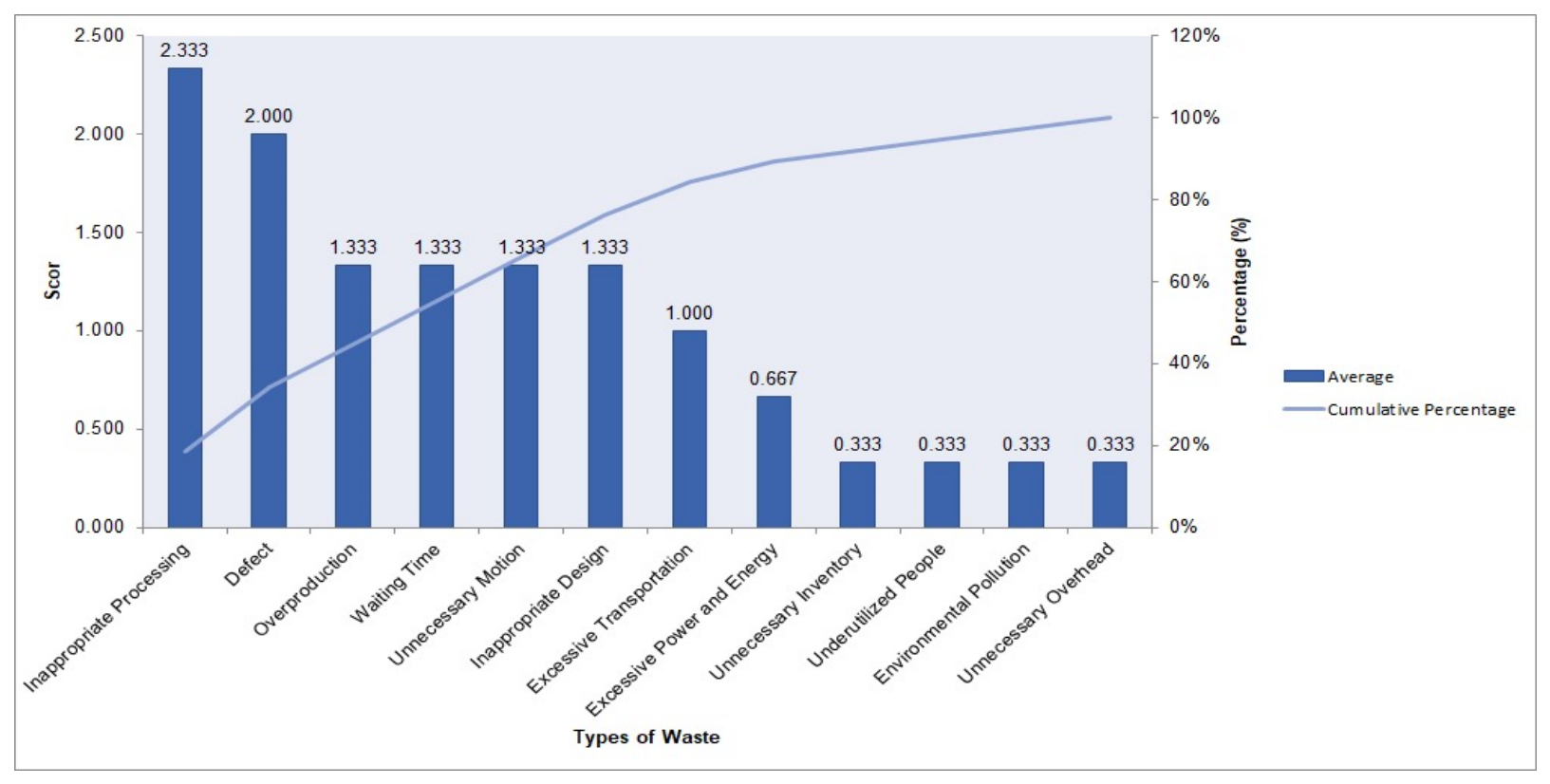
| 1 | Overproduction | 1.333 | 1.33 | 4.00 | - | 1.33 | 4.00 | 4.00 | - |
| 2 | Waiting Time | 1.333 | 12.00 | 12.00 | 1.33 | - | 4.00 | 4.00 | - |
| 3 | Unnecessary Motion | 1.333 | 12.00 | 1.33 | - | - | - | - | 1.33 |
| 4 | Unnecessary Inventory | 0.333 | 1.00 | 3.00 | 1.00 | - | 3.00 | 1.00 | 0.33 |
| 5 | Defect | 2 | 2.00 | - | - | 18.00 | - | - | - |
| 6 | Inappropriate Processing | 2.333 | 21.00 | - | 7.00 | 2.33 | - | 2.33 | 7.00 |
| 7 | Excessive Transportation | 1 | 9.00 | - | - | - | - | - | 1.00 |
| 8 | Excessive Power and Energy | 0.666 | 0.67 | - | - | - | - | - | 0.67 |
| 9 | Underutilized People | 0.333 | 1.00 | - | - | - | - | 0.33 | - |
| 10 | Environmental Pollution | 0.333 | 0.33 | - | - | 3.00 | - | 0.33 | 0.33 |
| 11 | Unnecessary Overhead | 0.333 | 1.00 | 0.33 | 0.33 | - | 0.33 | 0.33 | 0.33 |
| 12 | Inappropriate Design | 1.333 | 4.00 | 4.00 | 1.33 | 1.33 | 4.00 | 12.00 | 12.00 |
| Total | 65.33 | 24.67 | 11.00 | 26.00 | 15.33 | 24.33 | 23.00 | ||
| Ranking | 1 | 3 | 7 | 2 | 6 | 4 | 5 | ||
| No | Activity Types | Number of Activities | Time (Second) | Percentage (%) |
|---|---|---|---|---|
| 1 | Operation (O) | 16 | 11,710 | 61.41 |
| 2 | Transportation (T) | 7 | 172 | 0.90 |
| 3 | Inspection (I) | 1 | 321 | 1.68 |
| 4 | Delay (D) | 9 | 686 | 36.00 |
| 5 | Storage (S) | 0 | 0 | 0.00 |
| Total | 33 | 19,068 | 100 | |
| Workstation | Current State Map (CSM) | Future State Map (FSM) | ||||
|---|---|---|---|---|---|---|
| Before Improvement | After Improvement | |||||
| VA | NNVA | NVA | VA | NNVA | NVA | |
| Preparation of ingredients | 0 | 6532 | 0 | 0 | 18 | 0 |
| Mixing | 2289 | 62 | 0 | 2289 | 38 | 0 |
| Pressing | 1197 | 14 | 0 | 1197 | 7 | 0 |
| Steaming | 894 | 61 | 0 | 894 | 50 | 0 |
| Weighing | 1576 | 21 | 212 | 1395 | 21 | 0 |
| Drying | 4415 | 32 | 0 | 3228 | 18 | 0 |
| Cooling | 873 | 14 | 0 | 500 | 14 | 0 |
| Quality checking | 211 | 410 | 0 | 170 | 295 | 0 |
| Packaging | 255 | 0 | 0 | 210 | 0 | 0 |
| TOTAL | 19,068 | 10,345 | ||||
| No. | Activity Type | Number of Activities | Time (Seconds) | Percentage (%) | |||
|---|---|---|---|---|---|---|---|
| Before | After | Before | After | Before | After | ||
| 1 | Value Added Activity (VA) | 16 | 16 | 11,710 | 9884 | 61.41 | 95.54 |
| 2 | Necessary Non-Value-Added Activity (NNVA) | 16 | 14 | 7146 | 461 | 37.48 | 4.46 |
| 3 | Non-Value-Added Activity (NVA) | 1 | 0 | 212 | 0 | 1.11 | 0 |
| Total | 33 | 30 | 19,068 | 10,345 | 100 | 100 | |
| Dominant Waste | Root Cause Identified | Technical Contradiction | TRIZ Principles Applied | Causal Mechanism | Expected Measurable Impact |
|---|---|---|---|---|---|
| Defects & Rework | Inaccurate weighing, inconsistent steaming/cooling, and operator variability | Improving precision vs. increasing operator burden or cycle time | 10 (Preliminary Action), 13 (The Other Way Around), 22 (Blessing in Disguise), 32 (Color Change) | Pre-calibration of scales and reversed workflow sequencing reduce operator dependence; improved environmental indicators stabilize cooking conditions; visual cues enhance detection of abnormal states. | Lower defect rate; fewer rework loops; reduced NNVA inspection time; smoother downstream flow. |
| Inappropriate Processing | Lack of standardized procedures; irregular break patterns; inconsistent machine condition | Stability vs. increased supervision effort | 20 (Continuous Action), 24 (Intermediary) | Preventive maintenance and continuous monitoring remove machine instability as a source of variation; checklists and intermediaries ensure consistent work pacing. | Reduced cycle time variation; more predictable WIP levels; fewer quality deviations. |
| Waiting Time | Operator delays, equipment downtime, and lack of real-time status visibility | Faster flow vs. requires more coordination | 10 (Preliminary Action), 33 (Homogeneity), 8 (Anti-weight) | Attendance control, machine readiness verification, and ergonomic improvements pre-empt idle periods; homogenizing tasks decreases disruptive variability. | Reduction of 686 s of delay; smoother workstation transitions; shorter lead time. |
| Unnecessary Motion | Non-ergonomic layout; repeated manual steps; dispersed tools | Ergonomic efficiency vs. increased layout redesign cost/effort | 17 (Another Dimension), 14 (Curvature), 28 (Mechanics Substitution) | Layout restructuring shortens operator travel paths, while replacing manual scales with digital devices eliminates redundant motion. Curved workstation paths also reduce reaching/turning. | Lower operator motion time, decreased fatigue, and faster task completion. |
| Overproduction | Poor synchronization between production, sales, and inventory; rework inflates demand | Higher output leads to an inventory excess | 6 (Universality), 25 (Self-Service), 5 (Merging) | Integrating planning systems consolidates data streams, automated feedback loops align production volume with real demand, and merging scheduling functions reduces anticipation errors. | Reduced DPS accumulation; more accurate planning; lower finished-goods buildup. |
| Inappropriate Design | Product inconsistencies; inefficiencies in drying and packaging | Increasing uniformity vs. increasing process complexity | 1 (Segmentation), 15 (Dynamicity) | Segmented design reviews identify micro-improvements; adaptive drying methods accommodate product variability while maintaining uniformity. | Reduced variation in output quality; smoother packaging operations. |
| Excessive Transportation | Long travel distances; unclear material pathways | Transport reduction vs. requires layout restructuring | 2 (Taking Out), 4 (Asymmetry) | Removing unnecessary movements and introducing asymmetric pathways shortens travel distances; pathway marking guides efficient flow. | Shorter internal logistics distance; reduced WIP handling time. |
Disclaimer/Publisher’s Note: The statements, opinions and data contained in all publications are solely those of the individual author(s) and contributor(s) and not of MDPI and/or the editor(s). MDPI and/or the editor(s) disclaim responsibility for any injury to people or property resulting from any ideas, methods, instructions or products referred to in the content. |
© 2026 by the authors. Licensee MDPI, Basel, Switzerland. This article is an open access article distributed under the terms and conditions of the Creative Commons Attribution (CC BY) license.
Share and Cite
Rohmah, W.G.; Sulistyono, A.R.P.; Septifani, R.; Jou, Y.-T. Enhancing Manufacturing Efficiency Through an Integrated Lean Six Sigma and TRIZ Framework: A Case Study in Noodle Production. Eng. Proc. 2026, 137, 6. https://doi.org/10.3390/engproc2026137006
Rohmah WG, Sulistyono ARP, Septifani R, Jou Y-T. Enhancing Manufacturing Efficiency Through an Integrated Lean Six Sigma and TRIZ Framework: A Case Study in Noodle Production. Engineering Proceedings. 2026; 137(1):6. https://doi.org/10.3390/engproc2026137006
Chicago/Turabian StyleRohmah, Wendra Gandhatyasri, Anindya Revanestika Putri Sulistyono, Riska Septifani, and Yung-Tsan Jou. 2026. "Enhancing Manufacturing Efficiency Through an Integrated Lean Six Sigma and TRIZ Framework: A Case Study in Noodle Production" Engineering Proceedings 137, no. 1: 6. https://doi.org/10.3390/engproc2026137006
APA StyleRohmah, W. G., Sulistyono, A. R. P., Septifani, R., & Jou, Y.-T. (2026). Enhancing Manufacturing Efficiency Through an Integrated Lean Six Sigma and TRIZ Framework: A Case Study in Noodle Production. Engineering Proceedings, 137(1), 6. https://doi.org/10.3390/engproc2026137006