Proceeding Paper

Solutions for CSO Reduction and Impact Mitigation †
by
Martina Gambadori
1,*,
Anna Laura Eusebi
2,
Francesco Fatone
2,
Lorenzo Tombolini
3,
Cristiana Bollettini
4,
Claudio Bernardo Carini
4,
Fabrizio Marcozzi
4 and
Giovanna Darvini
1
1
Dipartimento di Ingegneria Civile Edile e Architettura, Università Politecnica Delle Marche, 60131 Ancona, Italy
2
Dipartimento di Scienze ed Ingegneria Della Materia, dell’Ambiente ed Urbanistica Facoltà di Ingegneria, Università Politecnica Delle Marche, 60131 Ancona, Italy
3
Dipartimento di Ingegneria Industriale-DII, Università di Padova, Via 8 Febbraio, 35122 Padova, Italy
4
CIIP Cicli Integrati Impianti Primari, Viale della Repubblica, 24, 63100 Ascoli Piceno, Italy
*
Author to whom correspondence should be addressed.
Presented at II International Conference on Challenges and Perspectives in Urban Water Management Systems (CSDU-CSSI DAYS 25), Trieste, Italy, 18–19 November 2025.
Eng. Proc. 2026, 135(1), 26; https://doi.org/10.3390/engproc2026135026

Published: 21 May 2026

Abstract

This study concerns the assessment and comparison of several scenarios for minimizing the hydraulic and environmental impact of Combined Sewer Overflows (CSOs) in the coastal city of Cupra Marittima (AP) in Italy, managed by CIIP S.p.A. The quantity and the quality of the water flowing in the sewerage network were analyzed using SWMM 5.2.0 software, calibrated for the dry and rainfall periods on the basis of a specific measurement campaign. The simulations led to the identification of the most critical spills in terms of flow rate and selected pollutant loads and to understanding their contribution to the deterioration of the coastal bathing water quality. On the basis of the simulations, possible solutions to mitigate the CSO impact on the receiving water body were tested and compared with each other in order to identify the optimal solution for the CSO control.

1. Introduction

In combined sewer systems, municipal wastewater and rainwater are collected and carried to a wastewater treatment plant (WWTP) in a single network. In the event of intense precipitation, the flow might exceed the capacity of the sewer system and consequently the excess flow, called CSO, is directly discharged into water bodies. Despite being diluted, the water discharged by CSOs has a significant impact on receiving water bodies due to the presence of suspended solids, organic compounds, pathogens, and nutrients, as well as heavy metals. Particular attention is paid to first flush runoff, as it can be rich in pollutants due to runoff from roads and buildings [1]. The minimization of the environmental risks of CSO events represents a great challenge for public utilities due to the high number of CSOs in urban catchments and it is particularly noticeable in coastal towns with the specific vocation of bathing tourism due to the possible limitation of bathing activity after intense precipitation events (2006/7/EC). This study aims to analyze the hydraulic and ecological impact of CSOs of the sewerage network of Cupra Marittima, which is located in the province of Ascoli Piceno in the Marche Region, managed by CIIP S.p.A., and to identify the optimal solution that preserves seawater quality by comparing more alternative scenarios.

2. Materials and Methods

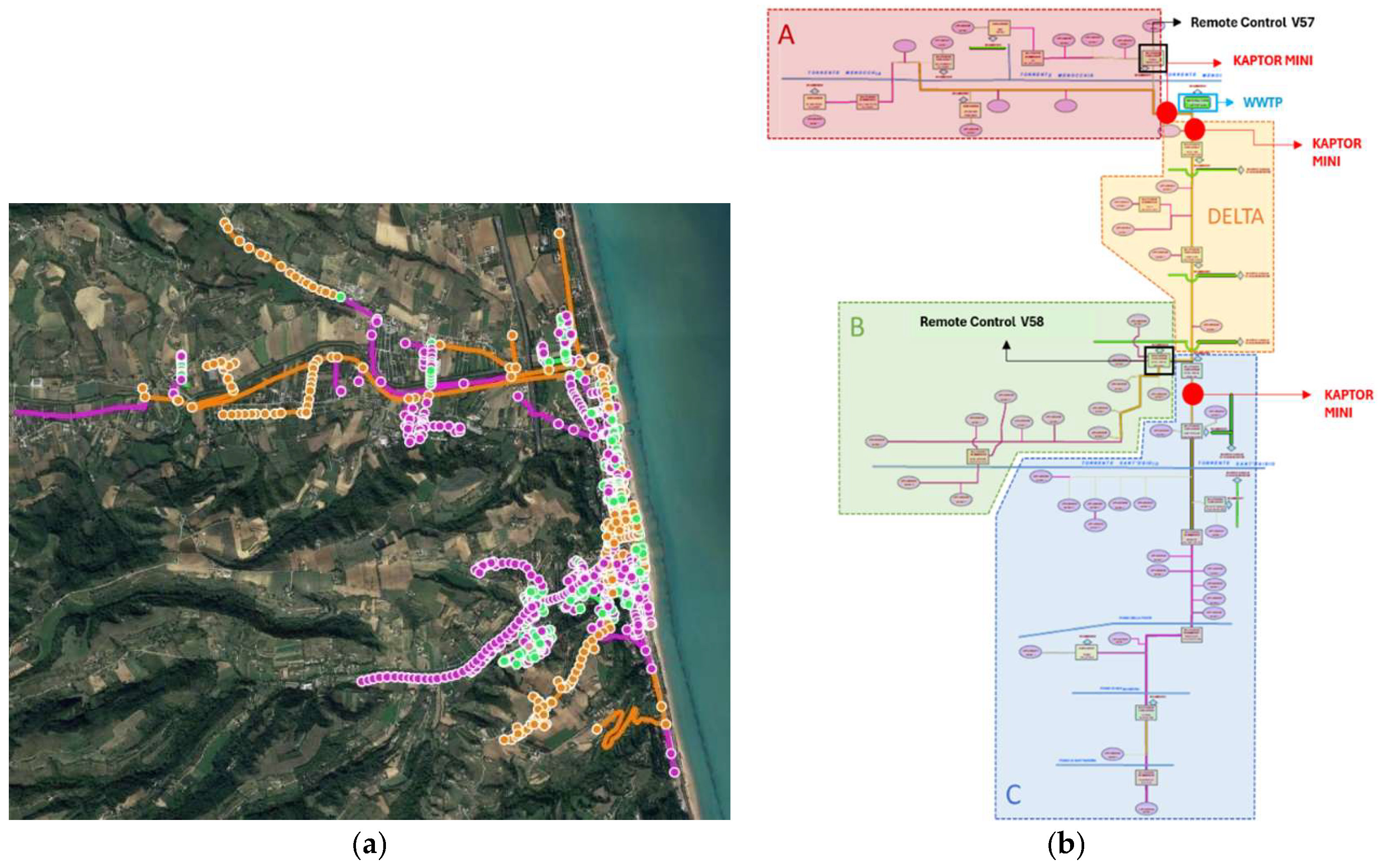
The sewer system of Cupra Marittima is shown in Figure 1a. The main characteristics of the network are summarized in Table 1; further details can be found in [2].
There are 20 overflow structures along the combined sewer system: 4 inline CSOs, 9 CSOs serving pumping stations, and 7 emergency outlets.
The characteristics of the network were entered into the numerical model developed with SWMM. Several simulations were carried out, varying both the weather conditions and the quality characteristics of the runoff water. In detail, with regard to precipitation events, three return periods of 1, 5, and 10 years are considered. Moreover, a typical year is simulated and the seasonal variability is accounted for by running all simulations both in summer and winter periods separately. Finally, a specific analysis was carried out for first flush waters to assess their contribution to the impacts associated with CSOs.
The SWMM model was calibrated by matching the flow rates and mass loads derived from the modeling with those obtained from a sampling campaign carried out on the network. Calibration was implemented during both wet and dry periods, and both situations were tested for both the summer and winter seasons.

3. Results

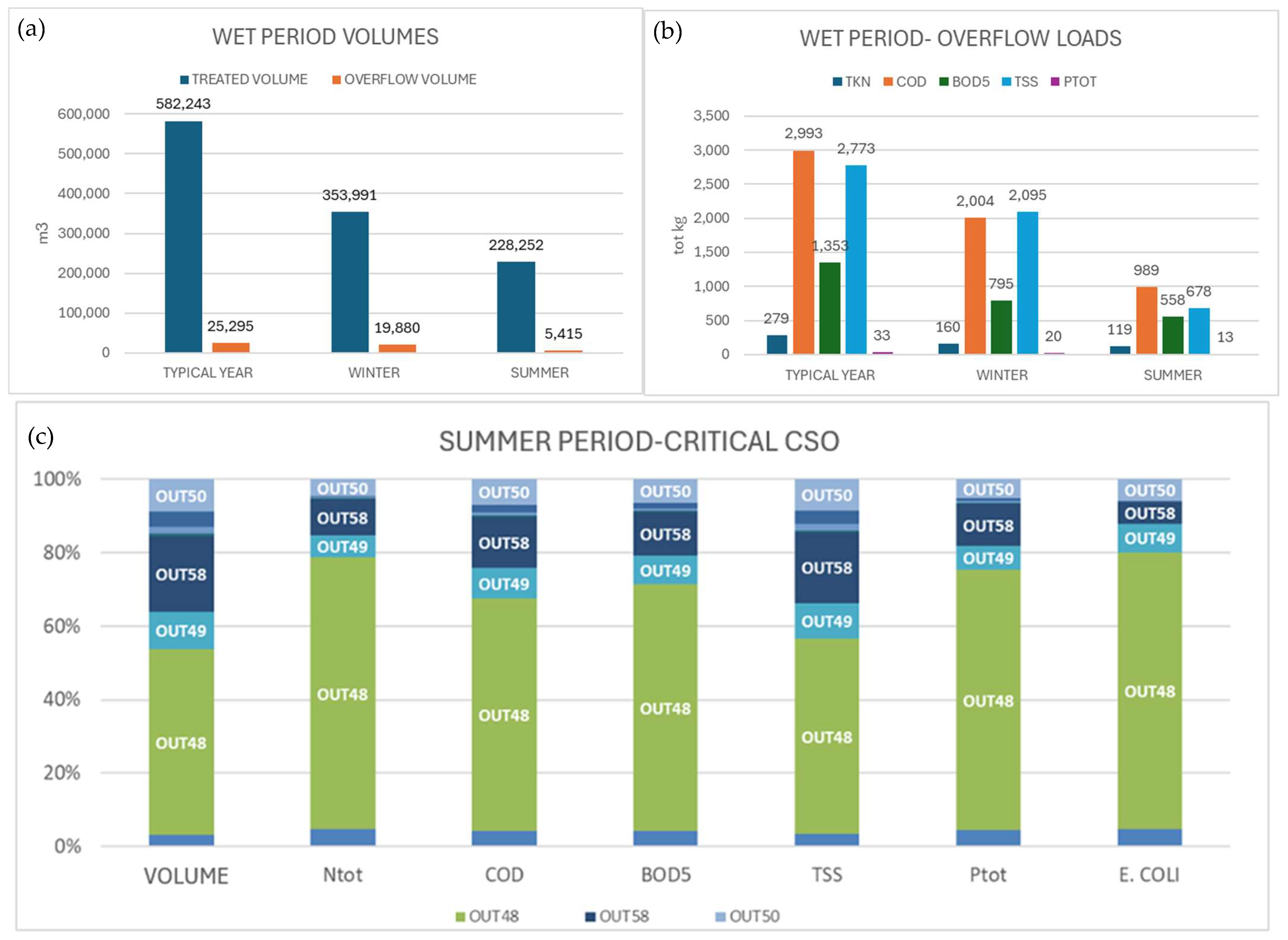
The results obtained from the simulations during a typical year in a wet period are shown below: Figure 2a shows the comparison between overflow volume and that of water destined for treatment; in Figure 2b, the overflow pollutant loads are reported, while Figure 2c shows percentage contributions of the volumes and mass loads discharged by each individual CSO relative to the total. The most critical issue is represented by V48 (incidence of the flow discharged from this tank on the total > 35%). It should be noted, however, that this flow is strongly influenced by the electromechanical management of the V47 downstream pumping station.

4. Discussion

Once the main critical issues associated with CSOs along the Cupra Marittima sewer network had been identified, three specific proposals were identified, with different implementation timescales and costs.
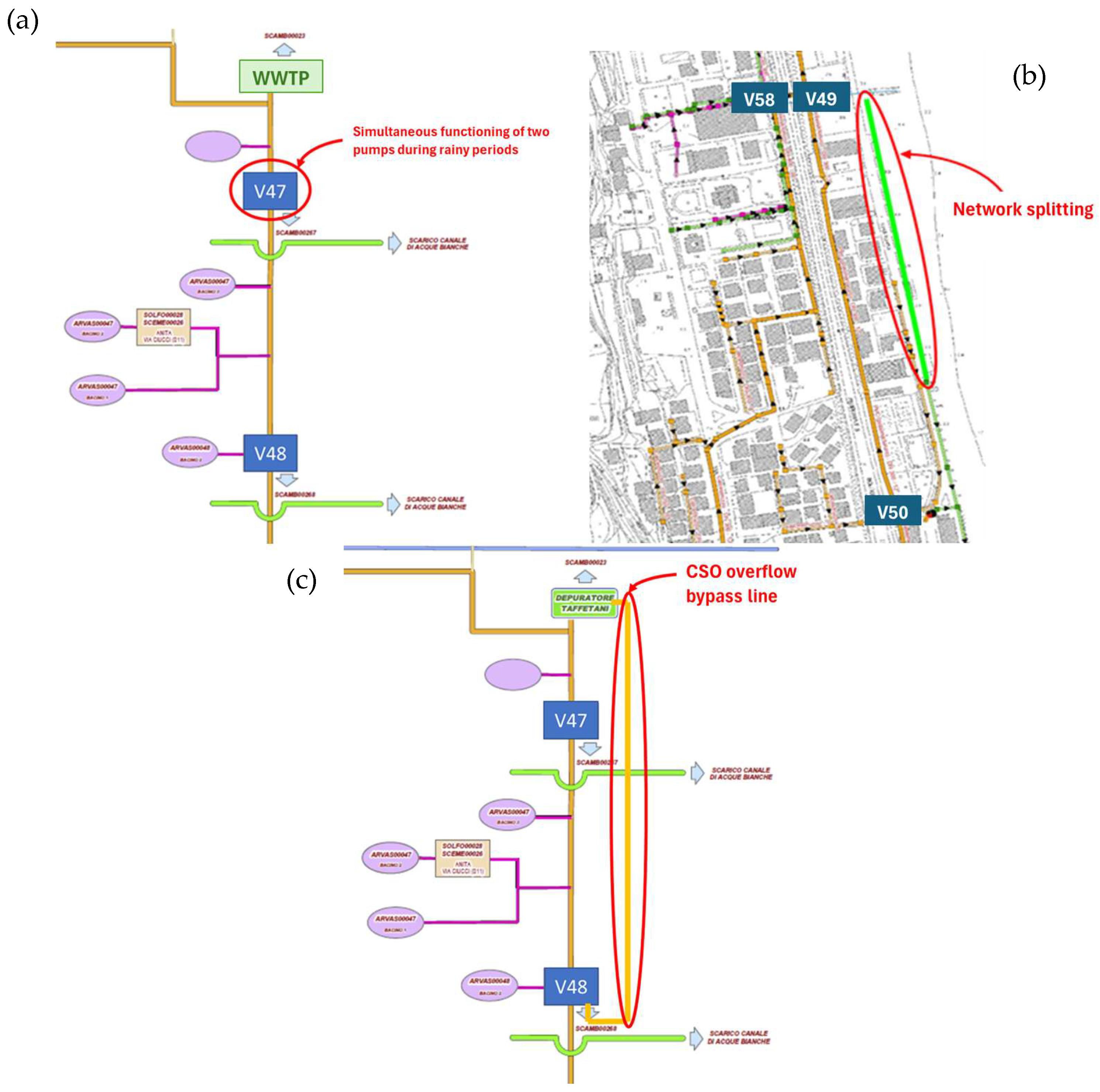
  • Scenario 1: The first scenario involves the pumping station V47 (the tank before the treatment plant, as shown in Figure 3a), ensuring the functionality of both pumps, even simultaneously. This aspect increases the flow destined for treatment, reducing the overload in the upstream area (where V48 is located) and, consequently, the overflow rate of V48. This alternative is easily implementable and involves limited costs.
  • Scenario 2: The second scenario consists of the separation of a reach of the existing combined sewer system (Figure 3b). Two conditions were considered, depending on whether the separation was total (complete separation of rainfall water from wastewater) or partial (separation of rainfall water from roads only). This solution is a structural alternative with higher costs and longer implementation times.
  • Scenario 3: The last mitigation scenario consists of collecting the overflow rate from V48 to the WWTP through a bypass line (Figure 3c). In this case, two possible scenarios were considered: In the first case, it was evaluated whether the flow could be sent directly to the plant’s water line; the effect associated with the increase in flows was assessed both in terms of process sustainability and in terms of final effluent through the calibration of a BioWin model of the WWTP. In the second hypothesis, it was investigated whether the existing equalization tank could be used to accumulate the overflow rate from V48 and redirect it to the plant during periods of minimum flow.
Table 2 shows the percentage reduction in terms of overflow volumes and pollutants that can be achieved with each scenario analyzed. The proposed improvements show a maximum reduction in discharged volumes of 30–50%, achieved both by optimizing the management of the V47 pumping station (Scenario 1) and by treating the overflow from V48 in the plant (Scenario 3.1). These two scenarios also achieved the maximum percentage reductions in discharged pollutant loads. The separation of the networks for the most critical section of the seafront (Scenarios 2.1 and 2.2) did not show significant benefits, with maximum reduction percentages of 24% in quantitative terms and 16–35% in qualitative terms.

Author Contributions

Conceptualization, G.D. and A.L.E.; methodology, M.G.; software, L.T.; validation, G.D. and A.L.E.; formal analysis, M.G. and L.T.; investigation, M.G. and L.T.; resources, C.B.C., C.B. and F.M.; data curation, M.G., G.D. and F.M.; writing—original draft preparation, M.G.; writing—review and editing, G.D. and A.L.E.; visualization, M.G.; supervision, G.D. and A.L.E.; project administration, A.L.E. and F.F.; funding acquisition, F.F. All authors have read and agreed to the published version of the manuscript.

Funding

No funding information is available.

Institutional Review Board Statement

Not applicable.

Informed Consent Statement

Not applicable.

Data Availability Statement

No additional data are available beyond those reported in this paper.

Acknowledgments

The authors gratefully acknowledge the water utility CIIP S.p.A. for technical support. They also acknowledge the Horizon Europe project WATERUN, “Innovative methodology to prevent and mitigate diffuse pollution from urban water runoff” (Grant Agreement No. 101060922).

Conflicts of Interest

Authors Cristiana Bollettini, Claudio Bernardo Carini and Fabrizio Marcozzi were employed by the company CIIP. The remaining authors declare that the research was conducted in the absence of any commercial or financial relationships that could be construed as a potential conflict of interest.

References

  1. Regione Marche. Piano di Tutela della Acque, Direttiva Regionale n° 145/2010. 2010. (In Italian) Available online: https://www.regione.marche.it/Entra-in-Regione/Temi-Attualita/Ambiente-e-territorio/Acqua (accessed on 24 April 2026).
  2. Crocetti, P.; Eusebi, A.L.; Bruni, C.; Marinelli, E.; Darvini, G.; Carini, C.B.; Bollettini, C.; Recanati, V.; Akyol, Ç.; Fatone, F. Catchment-wide validated assessment of combined sewer overflows (CSOs) in a mediterranean coastal area and possible disinfection methods to mitigate microbial contamination. Environ. Res. 2021, 196, 110367. [Google Scholar] [CrossRef] [PubMed]
Figure 1. (a) Layout of Cupra Marittima sewer network in GIS format; (b) SWMM scheme.
Engproc 135 00026 g001
Figure 2. Results from the SWMM model in the wet period: (a) Overflow volume and treatment volume for the entire year and for the summer and winter periods; (b) overflow pollutant load for the entire year and for the summer and winter periods, and (c) percentage impact of spillways on the total during the summer period.
Engproc 135 00026 g002
Figure 3. Impact minimization scenarios. (a) Scenario 1, (b) Scenario 2 (c) Scenario 3.
Engproc 135 00026 g003
Table 1. Main sewer system features.
Sewer Networku.m.Value
Total areakm22.15
Total network lengthkm50.42
Storm sewer network lengthkm9.50
Combined sewer network lengthkm18.77
Blackwater sewer networkkm22.16
Table 2. The reduction percentage achievable with the different scenarios.
Scenario Volume
Reduction (%)
TKN
Reduction (%)
COD
Reduction (%)
BOD5
Reduction (%)
TSS
Reduction (%)
PTOT
Reduction (%)
E. coli
Reduction (%)
130–50 63–76 40–66 46–67 33–56 55–73 63–78
2.120–24 28–35 22–28 22–28 22–28 28–35 28–35
2.214–17 21–24 16–20 16–20 16–20 21–24 21–24
3.140705259466472
3.222433135253972
Disclaimer/Publisher’s Note: The statements, opinions and data contained in all publications are solely those of the individual author(s) and contributor(s) and not of MDPI and/or the editor(s). MDPI and/or the editor(s) disclaim responsibility for any injury to people or property resulting from any ideas, methods, instructions or products referred to in the content.