Proceeding Paper

Laying Hens Behavior Recognition Using Computer Vision and Deep Learning †
by
Heidee Soliman-Cuevas
1,2 and
Jocelyn F. Villaverde
3,*
1
Department of Computer Engineering, College of Engineering, Western Mindanao State University, Zamboanga 7000, Philippines
2
School of Graduate Studies, Mapua University, Manila 1002, Philippines
3
School of Electrical, Electronics, and Computer Engineering, Mapua University, Manila 1002, Philippines
*
Author to whom correspondence should be addressed.
Presented at the 7th Eurasia Conference on IoT, Communication and Engineering 2025 (ECICE 2025), Yunlin, Taiwan, 14–16 November 2025.
Eng. Proc. 2026, 134(1), 93; https://doi.org/10.3390/engproc2026134093
Published: 8 May 2026

Abstract

Native chicken production in the Philippines is increasing, accounting for nearly half of the total population of raised chickens. Health-conscious consumers prefer native chicken due to its lower fat content. To support this growth, the government established a breeding facility featuring 10 pens, each housing 2 to 6 laying hens and a rooster, which began operation in November 2023. In recent months, staff observed a decline in laying performance in some pens. Because chicken behavior is a key indicator of growth and production performance, this study aims to implement a real-time laying hen activity recognition system using You Only Look Once Version 11 (YOLOv11) to classify hen behaviors into multiple categories. These include active behaviors (walking, eating, drinking, pecking, dust bathing, and preening), inactive behaviors (resting or inactivity), and environmental objects (feeders and water cans). A dataset of 464 images was collected from the breeding facility in Zamboanga City, Philippines. To capture hen behavior, a TP-Link Tapo C510W outdoor WiFi camera was mounted on the ceiling at a height of 80 cm above the ground. The model demonstrated excellent performance in detecting static objects such as feeders and water cans. Among behaviors, pecking and walking were identified as the most common, while drinking and dust bathing were relatively rare. The YOLOv11-based activity recognition system successfully achieved real-time classification of hen behaviors with strong performance across most activity classes. The system reached 95% mAP50, with particularly high accuracy in detecting static objects and distinctive behaviors, thereby providing a solid foundation for future improvements in recognizing more complex or challenging behaviors.

1. Introduction

Poultry is the second most-consumed meat worldwide. Health-conscious consumers prefer indigenous chicken (locally bred chicken with lower fat content) to broiler chicken (commercially raised chicken for meat production), as it is perceived to be healthier due to reduced fat levels. In 2023, the total chicken population in the Philippines was 202.82 million birds, of which 43% were indigenous chickens (87.21 million) [1]. Raising native chickens is primarily carried out in small backyard farms as a source of supplementary income. To support backyard farmers, the government has given the industry proper attention and has exerted efforts to improve native chicken farming because of its important role in the economy. This includes providing additional income to small farmers, meeting the growing demand for indigenous chicken in the local market, and offering health benefits associated with its meat [2].
The Philippine Council for Agriculture, Aquatic and Natural Resources Research and Development (PCAARRD), a council under the Department of Science and Technology (DOST), established the Zamboanga Peninsula (ZamPen) indigenous chicken breeding facility to increase population size and improve egg production and growth performance. This initiative was developed in collaboration with Western Mindanao State University (WMSU) [3]. The new breeding facility was inaugurated in November 2023 and consists of ten pens, each housing two to six laying hens and a rooster.
In the current setup, the behavior of the laying hens is not systematically observed, and baseline data for measuring breeder performance are lacking. Poultry behavior is a critical indicator of welfare, health, and production performance [4]. Behavior is widely recognized as an important parameter in animal welfare assessments and can be evaluated across multiple dimensions, including affective state, health, and animal needs [5].
The use of computer vision (automated image analysis systems) and deep learning (advanced neural network-based algorithms) reduces the tedious work of manual observation of breeders. Machine vision (computerized image recognition systems) and deep learning are emerging as transformative solutions for modern poultry farm management, with significant potential to enhance productivity, animal welfare, and operational efficiency [6].
In Ref. [7], different deep learning behavior recognition models were applied to classify four broiler behaviors (feeding, drinking, standing, and resting) at 2, 9, 16, and 23 days of age. However, limited studies have been conducted on laying hen behavior and its impact on health and productivity. In Ref. [8], laying hen behaviors were categorized into four groups: static behavior (resting and standing), ingestive behavior (feeding and drinking), walking, and jumping, using onboard spatial behavioral identification techniques. Li G. et al. [9] employed You Only Look Once version 11x (YOLOv11x) to improve the consistency and efficiency of tracking multiple broiler chickens in group settings.
The developed real-time laying hen activity recognition system using YOLOv11 classifies laying hen behaviors into multiple activity categories. These categories include active behaviors (walking, eating, drinking, pecking, dust bathing, and preening), inactive behaviors (resting or inactivity), and environmental objects (chicken feeder and water can), as illustrated in Table 1.

2. Materials and Methods

2.1. Data Preparation

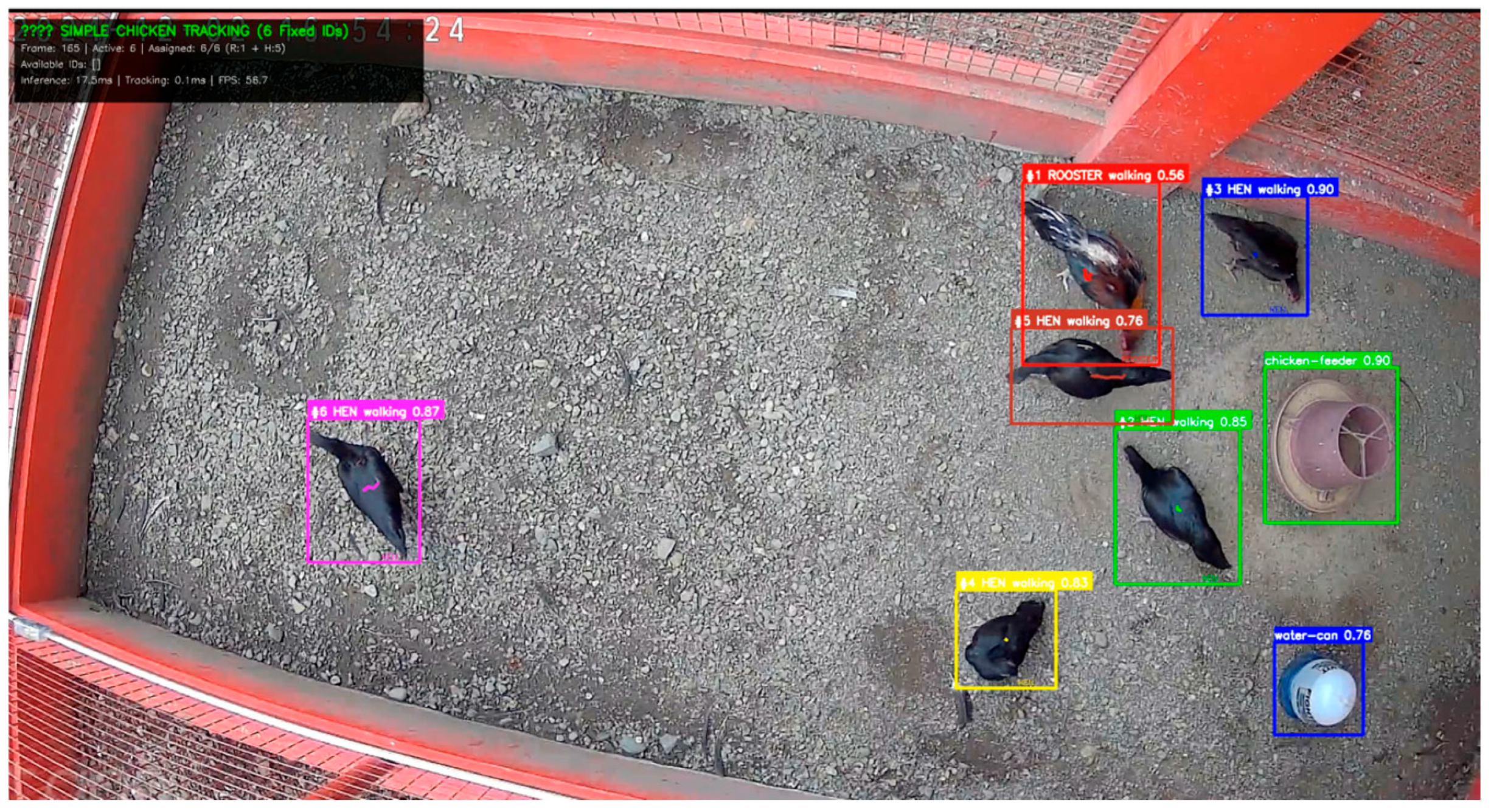
The image collection was conducted in a pen with five laying hens and a rooster on the ZamPen breeding research center at Western Mindanao State University, Zamboanga City, Philippines. An outdoor Wi-Fi camera was mounted on the ceiling 80 cm above the ground to capture video for laying hens. Figure 1 shows an example of laying hen behaviors.
The system processes chicken behavior data through multiple stages, such as video frame extraction, Roboflow annotation, data augmentation, and format export. The dataset was annotated using Roboflow, a comprehensive computer vision platform that provides a web-based annotation interface, collaborative annotation tools, quality control features, and automatic format conversion to YOLOv11.

2.2. Data Augmentation

To obtain sufficient activity features, advanced code-based augmentation, Hue-Saturation-Value color space transformations for lightning variations, geometric transformation, advanced composition techniques, and regularization methods were implemented. During preprocessing, the images were auto-oriented to normalize their orientation and resized to 640 × 640 pixels using a stretch transformation. The dataset consists of 464 images, of which 71% (328 images) were allocated to the training set, 19% (89 images) to the validation set, and 10% (47 images) to the test set. All datasets were annotated with bounding boxes in the YOLO format. Based on the validation results, the dataset includes the classes presented in Table 2.

2.3. Yolo Hen Model

The distinctive feature of YOLO is that it performs a single forward pass over the network, which enables real-time image processing and has been demonstrated to achieve state-of-the-art performance while remaining computationally efficient [12]. The YOLOv11 object detection model integrates a backbone network for feature extraction from input images, a neck network that incorporates a feature pyramid structure for multi-scale detection, and a head network responsible for producing detection and classification outputs. For advanced training, the YOLOv11m (medium) variant was employed to achieve higher accuracy.
As a baseline strategy, the system utilized transfer learning from pre-trained YOLOv11 weights. The foundation model was pre-trained on the COCO dataset, and the transfer learning approach involved fine-tuning the entire network on the laying hen behavior dataset with weight initialization. During adaptation, the final classification layer was modified to accommodate nine laying hen behavior classes.

2.4. Parameters Setting

All comparison models were trained and tested on a graphics processing unit (GPU) that is Compute Unified Device Architecture (CUDA)-compatible. The models were implemented using the Python 3.10.8 programming language and developed based on the Ultralytics YOLOv11 deep learning framework. The detailed equipment configuration used in the experiments is presented in Table 3.

3. Results and Discussion

Model Performance of YOLOv11

In this research, with an intersection over union and confidence threshold of 0.5, the experimental results yielded a mean average precision at 50% of 95%. The class-specific performance of the YOLO model for the laying hen dataset, based on precision–recall curves, is presented in Table 4.
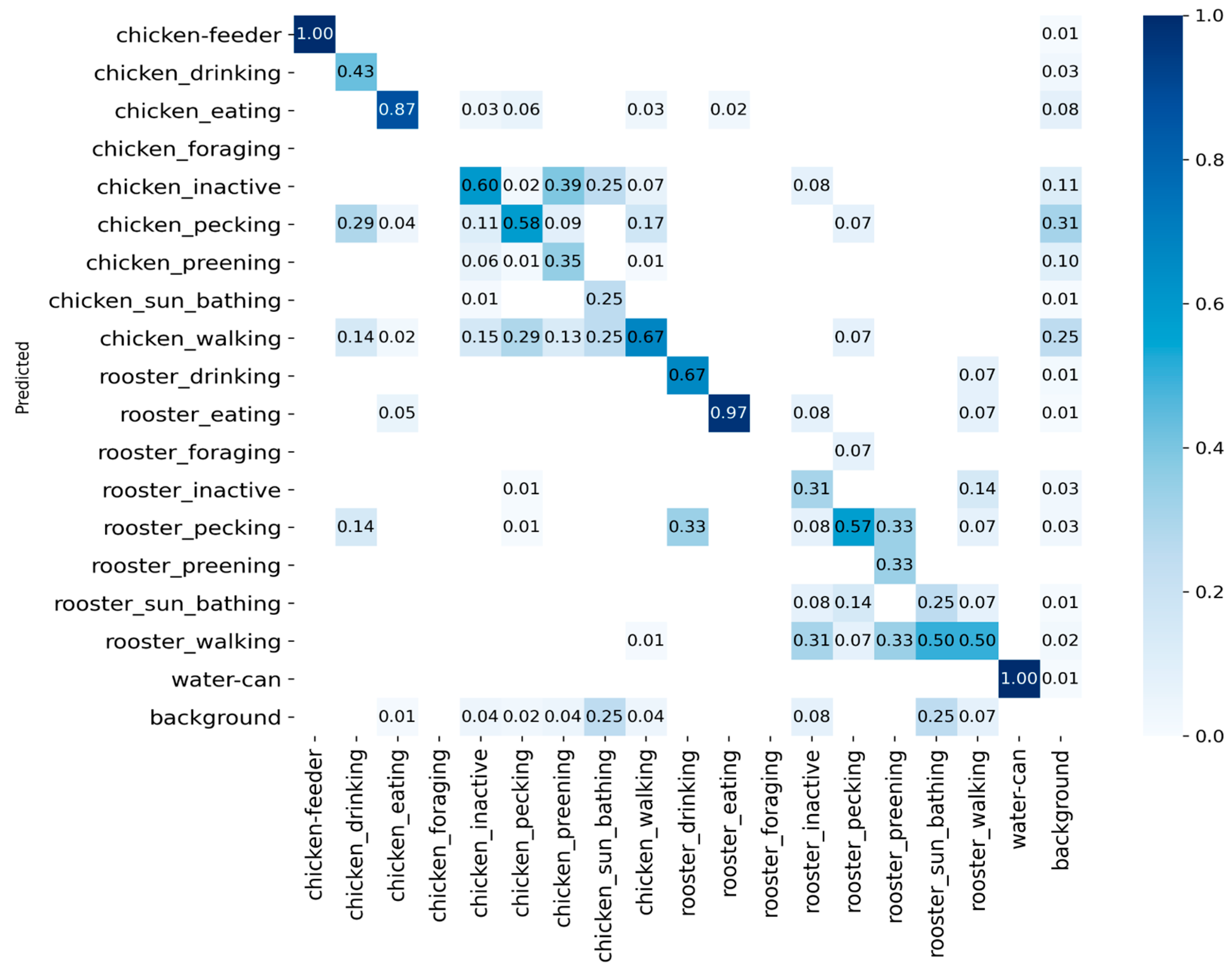
To evaluate the model’s performance in laying hen activity recognition, the confusion matrix shown in Figure 2 highlights strong diagonal elements, indicating good class separation. Some confusion was observed between similar behaviors, particularly inactive states versus other categories; however, the model demonstrated excellent performance in object detection, particularly for feeders and water cans. Performance was also excellent for static objects and drinking behavior, moderate for common behaviors such as eating, walking, and pecking, and more challenging for inactive states and complex poses such as preening and dust bathing.
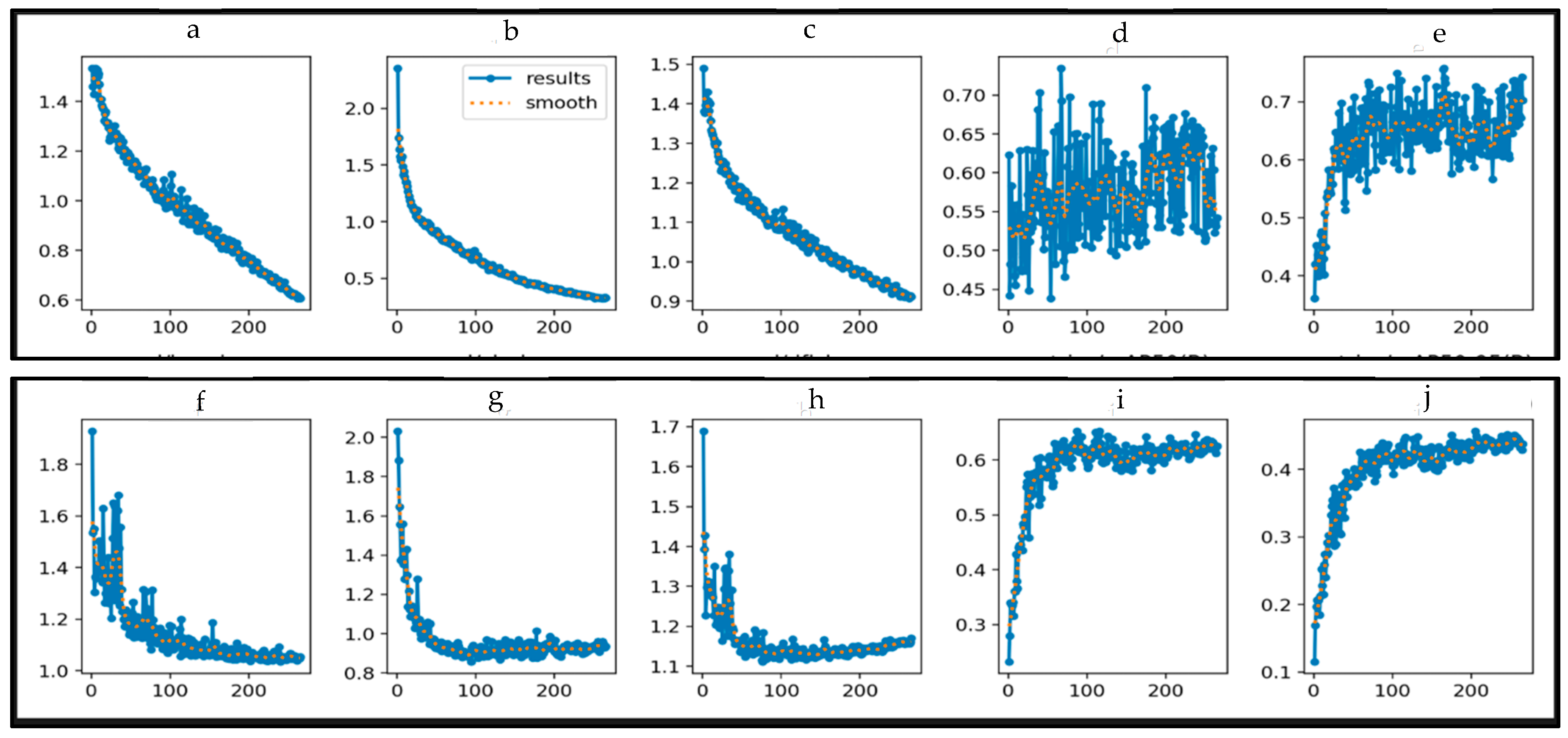
The performance metrics for the training and validation datasets are shown in Figure 3. Training results revealed a consistent reduction in loss across all components, while precision and recall steadily improved. Validation performance indicated good generalization without evidence of overfitting. Detection accuracy reached 99% precision at a confidence threshold of 1.0, 95% recall at an optimal confidence level, and 72% accuracy at a confidence threshold of 0.462.

4. Conclusions and Recommendation

The YOLOv11-based chicken activity recognition system demonstrated real-time behavior classification with strong performance across most activity classes. The system achieved a 95% mAP50, with excellent detection of static objects and distinctive behaviors, while establishing a foundation for future improvements in recognizing more complex behaviors. The implementation provides a complete pipeline from training to deployment, with comprehensive monitoring and evaluation capabilities, making it suitable for agricultural research and farm management applications.

Author Contributions

Conceptualization, H.S.-C. and J.F.V.; methodology, H.S.-C.; software, H.S.-C.; validation, H.S.-C. and J.F.V.; formal analysis, H.S.-C.; investigation, H.S.-C.; resources, H.S.-C.; data curation, H.S.-C.; writing—original draft preparation, H.S.-C.; writing—review and editing, H.S.-C.; visualization, H.S.-C.; supervision, H.S.-C.; project administration, H.S.-C.; funding acquisition, H.S.-C. All authors have read and agreed to the published version of the manuscript.

Funding

This research received no external funding.

Institutional Review Board Statement

Not applicable.

Informed Consent Statement

Not applicable.

Data Availability Statement

The data are contained within the article.

Conflicts of Interest

The authors declare no conflict of interest.

Abbreviations

The following abbreviations are used in this manuscript:
PCAARRDPhilippine Council for Agriculture, Aquatic and Natural Resources Research and Development
DOST Department of Science and Technology
ZAMPENZamboanga Peninsula
WMSUWestern Mindanao State University
YOLOYou Only Look Once

References

  1. Development of Breeder Farms of Philippine Native Chicken for Meat and Egg Production. Available online: https://www.youtube.com/watch?v=Jb-zKMM8S2M (accessed on 13 September 2025).
  2. Native Chicken Farming. Available online: https://agriculture.com.ph/2018/11/21/native-chicken-farming/ (accessed on 13 September 2025).
  3. Establishment of ZamPen Native Chicken Breeding Population with Improved Egg Production and Growth Performance. Available online: https://ispweb.pcaarrd.dost.gov.ph/establishment-of-zampen-native-chicken-breeding-population-with-improved-egg-production-and-growth-performance/ (accessed on 13 September 2025).
  4. Yang, X.; Bist, R.; Subedi, S.; Wu, Z.; Liu, T.; Chai, L. An automatic classifier for monitoring applied behaviors of cage-free laying hens with deep learning. Eng. Appl. Artif. Intel. 2023, 123, 106377. [Google Scholar] [CrossRef]
  5. Li, N.; Ren, Z.; Li, D.; Zeng, L. Review: Automated techniques for monitoring the behaviour and welfare of broilers and laying hens: Towards the goal of precision livestock farming. Animal 2020, 14, 617–625. [Google Scholar] [CrossRef] [PubMed]
  6. Natho, P.; Boonying, S.; Bonguleaum, P.; Tantidontanet, N.; Chamuthai, L. An enhanced machine vision system for smart poultry farms using deep learning. Smart Agric. Technol. 2025, 12, 101083. [Google Scholar] [CrossRef]
  7. Guo, Y.; Aggrey, S.E.; Wang, P.; Oladeinde, A.; Chai, L. Monitoring Behaviors of Broiler Chickens at Different Ages with Deep Learning. Animals 2022, 12, 3390. [Google Scholar] [CrossRef] [PubMed]
  8. Yang, X.; Hu, Q.; Nie, L.; Wang, C. Energy-aware feature and classifier for behaviour recognition of laying hens in an aviary system. Animal 2025, 19, 101377. [Google Scholar] [CrossRef] [PubMed]
  9. Li, G.; Kota, S.A.R.; Liu, T.; Oso, O.M.; Bodempudi, V.U.C.; Saeidifar, M.; Asali, E.; Mandiga, A.; Lu, J.; Yuan, G.; et al. Enhancing consistency and efficiency of tracking multiple individual broiler chickens in group settings. Smart Agric. Technol. 2025, 12, 101408. [Google Scholar] [CrossRef]
  10. Daigle, C.L.; Banerjee, D.; Montgomery, R.A.; Biswas, S.; Siegford, J.M. Moving GIS research indoors: Spatiotemporal analysis of agricultural animals. PLoS ONE 2014, 9, e104002. [Google Scholar] [CrossRef] [PubMed]
  11. Murillo, A.C.; Abdoli, A.; Blatchford, R.A.; Keogh, E.J.; Gerry, A.C. Low levels of chicken body louse (Menacanthus stramineus) infestations affect chicken welfare in a cage-free housing system. Parasites Vectors 2024, 17, 221. [Google Scholar] [CrossRef] [PubMed]
  12. Mohialdin, A.M.; Elbarrany, A.M.; Atia, A. Chicken Behavior Analysis for Surveillance in Poultry Farms. Int. J. Adv. Comput. Sci. Appl. 2023, 14, 935–942. [Google Scholar] [CrossRef]
Figure 1. An example of laying hen behaviors.
Engproc 134 00093 g001
Figure 2. Confusion matrix.
Engproc 134 00093 g002
Figure 3. (a) train/box_loss, (b) train/cls_loss, (c) train/dfl_loss, (d) metrics/precesion(B), (e) metrics/recall(B), (f) val/box_loss, (g) val/cls_loss, (h) val/dfl_loss, (i) metrics/mAP50(B), (j) metrics/mAP50-95(B).
Engproc 134 00093 g003
Table 1. Description of the activity/behavior classes recognized.
Activity/BehaviorDescriptionReference
WalkingThe hen walks more than 3 steps in succession with the head up.[10]
EatingThe hen pecks at feed in the feeder[10]
DrinkingThe head is turned upwards towards the water source, and the hen uses its beak to peck to drink water.[10]
PeckingThe hen brings the beak to the ground, striking at the ground.[11]
Dust bathingThe hen is in a sitting or lying position with feathers raised in a vertical wing-shake, including feather-ruffling and shaking.[11]
PreeningThe hen manipulates, rearranges, pulls or smooths body feathers by the beak.[11]
Table 2. Dataset class distribution.
ClassCategoryNumber of ImagesNumber of InstancesBox
Precision
RecallMean Average Precision at 50%Mean Average Precision at 50–95%
chicken-feederObject87870.9721.00.9790.805
chicken_drinkingBehavior240.8731.00.9950.671
chicken_dust_bathingBehavior790.480.4440.4620.276
chicken_eatingBehavior50860.820.9530.8610.565
chicken_inactiveBehavior44750.5370.4270.5380.384
chicken_peckingBehavior521450.7180.6830.7440.496
chicken_preeningBehavior21240.5750.3750.3620.258
chicken_walkingBehavior601190.5680.5510.6290.439
water-canObject74740.981.00.9850.829
Table 3. Hardware and software systems used in this study.
Configuration Value
GPUCUDA Compatible (8 gigabytes (GB) + Virtual RAM)
Operating systemWindows 11
Random access memory16 GB
Table 4. Result based on the precision-recall curves.
ClassAverage Precision
chicken-feeder0.979
chicken_drinking0.995
chicken_dust_bathing0.462
chicken_eating0.861
chicken_inactive0.539
chicken_pecking0.744
chicken_preening0.362
chicken_walking0.629
water-can0.985
Disclaimer/Publisher’s Note: The statements, opinions and data contained in all publications are solely those of the individual author(s) and contributor(s) and not of MDPI and/or the editor(s). MDPI and/or the editor(s) disclaim responsibility for any injury to people or property resulting from any ideas, methods, instructions or products referred to in the content.