

Proceeding Paper

Efficiency Improvement of Wireless Power Supply Track System †

Department of Aeronautical Engineering, National Formosa University, Yunlin 632, Taiwan
*
Author to whom correspondence should be addressed.
Presented at the 7th Eurasia Conference on IoT, Communication and Engineering 2025 (ECICE 2025), Yunlin, Taiwan, 14–16 November 2025.
Eng. Proc. 2026, 134(1), 18; https://doi.org/10.3390/engproc2026134018
Published: 30 March 2026

Abstract

We investigated a wireless power supply track system for automated guided vehicles. Due to the inherent limitations of wireless power transfer, its transmission efficiency is lower than that of contact-based power supply methods. To meet energy conservation and carbon reduction requirements, we proposed methods to improve the overall system efficiency. Different from the traditional design of adding inductor or capacitor filter circuits after the rectifier circuit, this paper proposed an improved circuit structure for the pick-up end. Through theoretical analysis and discussion using two methods, valley-fill filter circuits or directly removing the filter circuits, hardware experiments have verified the feasibility of the proposed method.

1. Introduction

Wireless power transfer (WPT) is a contactless method of transmitting electrical energy with significant application potential in consumer electronics, medical devices, transportation, and industrial automation [1,2,3]. In industrial automation, the use of WPT technology in automated guided vehicles (AGVs) is particularly noteworthy [4]. Traditional AGVs rely on batteries or wired power systems, which increase charging time and maintenance costs while reducing operational efficiency due to battery lifespan limitations. AGVs equipped with WPT technology can continuously receive stable power during operation, avoiding downtime caused by frequent charging and reducing battery usage, thereby lowering environmental impacts during production and disposal processes. The WPT systems include a filter circuit composed of inductors or capacitors after the rectifier circuit to convert electrical energy into stable DC power for the load [5,6]. However, the induced voltage or current waveform at the pick-up end becomes a square wave after passing through the filter circuit, affecting the overall system efficiency. To address the problem, we developed a power supply track system in which the pick-up end structure is changed to improve the overall system efficiency. Finally, the feasibility of the methods is verified through implementation.

2. System Coupling Structure

The wireless power supply track system is shown in Figure 1. It comprises a wireless power transmission end and a wireless power pick-up end. The system adopts the wireless power supply track to generate a magnetic field to provide energy for the pick-up coil. The pick-up coil obtains energy by inducing the magnetic field generated by the power supply track. The selection of the core for the pick-up coil is also important, with E-type and U-type cores being the most common. E-type cores outperform U-type cores in terms of capturing the magnetic flux [7,8]. Therefore, E-type cores are adopted as the material for the pick-up coils in this paper.

3. Improvement of Transmission Efficiency

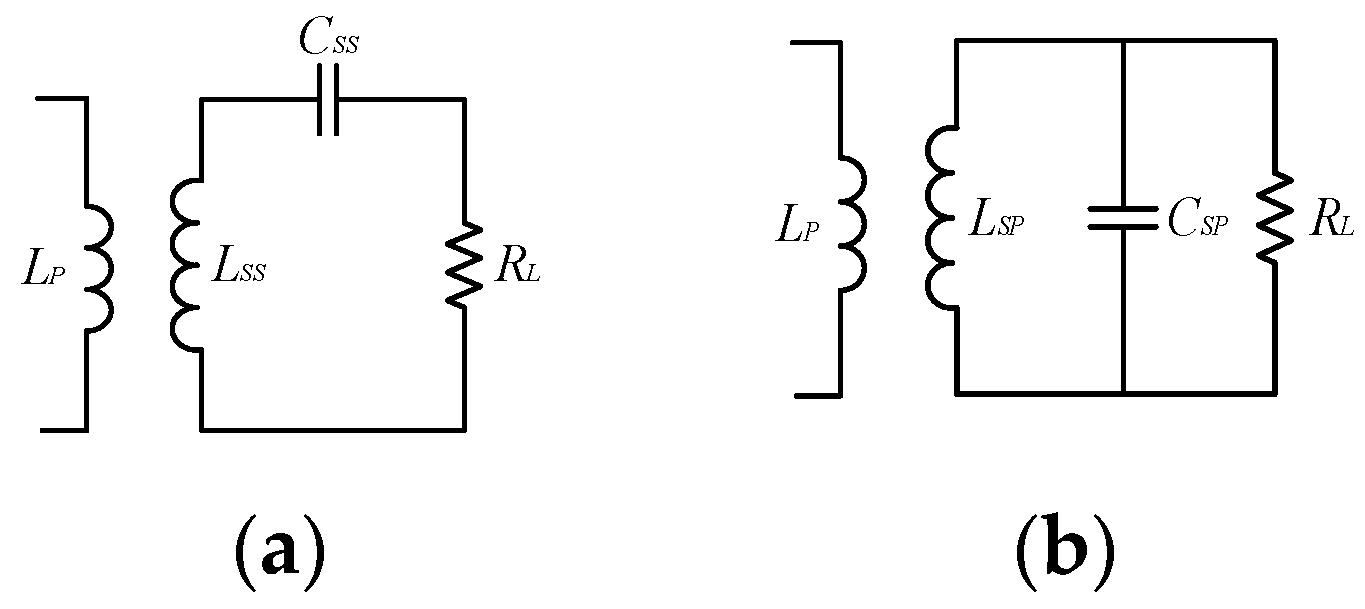
The compensation topology of the pick-up end of wireless power transfer is divided into series type and parallel type (Figure 2). The main purpose of increasing the compensation capacitor is to offset the inductance of the pick-up coil, thereby improving the power transmission efficiency of the system. The output of series compensation is current type, while the output of parallel compensation is voltage type. According to system requirements, the appropriate compensation topology and output type can be selected to ensure system stability and efficiency [9].
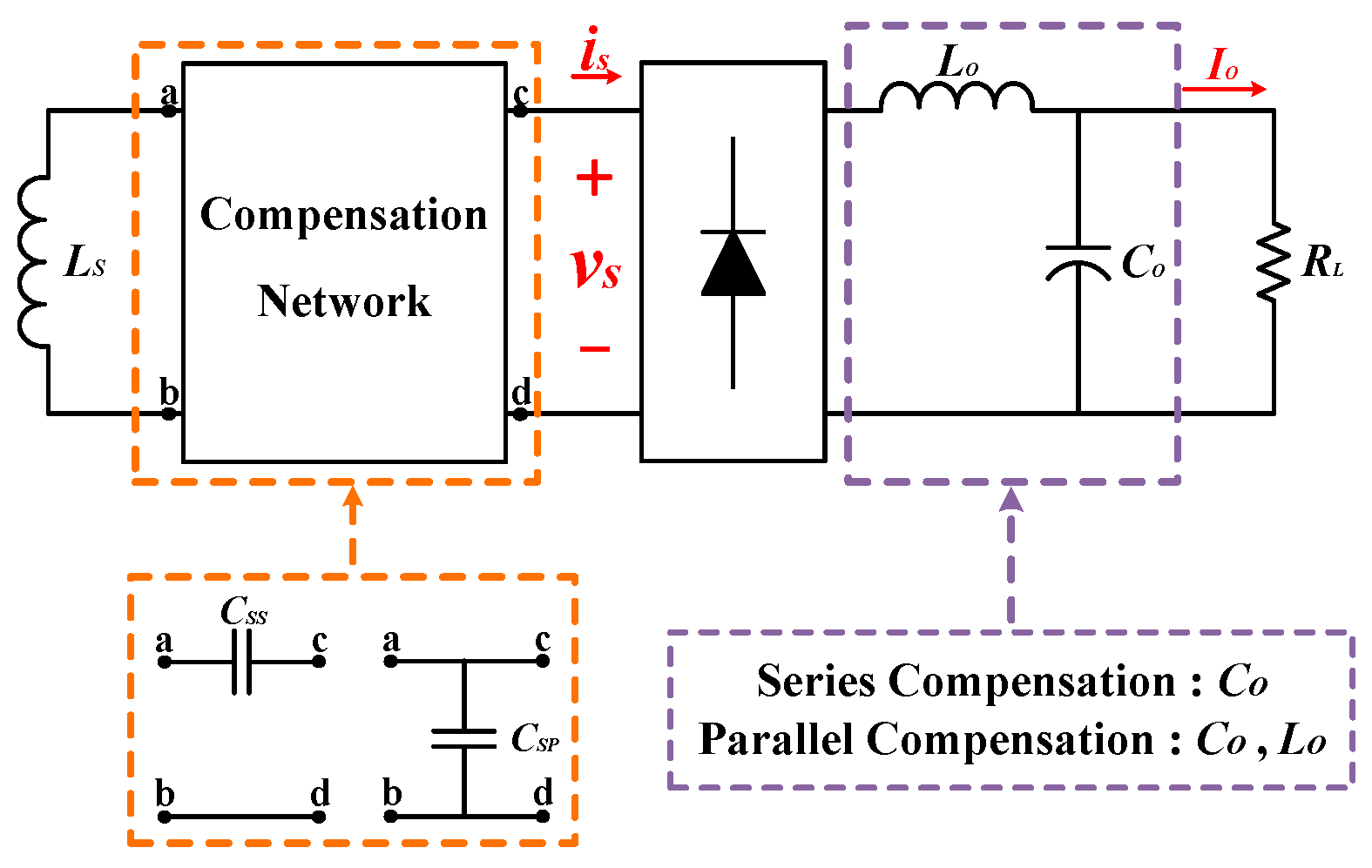
The pick-up end of the wireless power transmission system converts the picked-up energy through a resonant compensation circuit and transmits it to the downstream load. Since the induced power is high-frequency AC power, a rectifier and filter circuit are connected after the compensation circuit to avoid power supply voltage fluctuations and ensure a stable supply of power required by the load. Figure 3 shows a schematic diagram of the pick-up end with a rectifier and a filter circuit [10].

3.1. Current Output Type

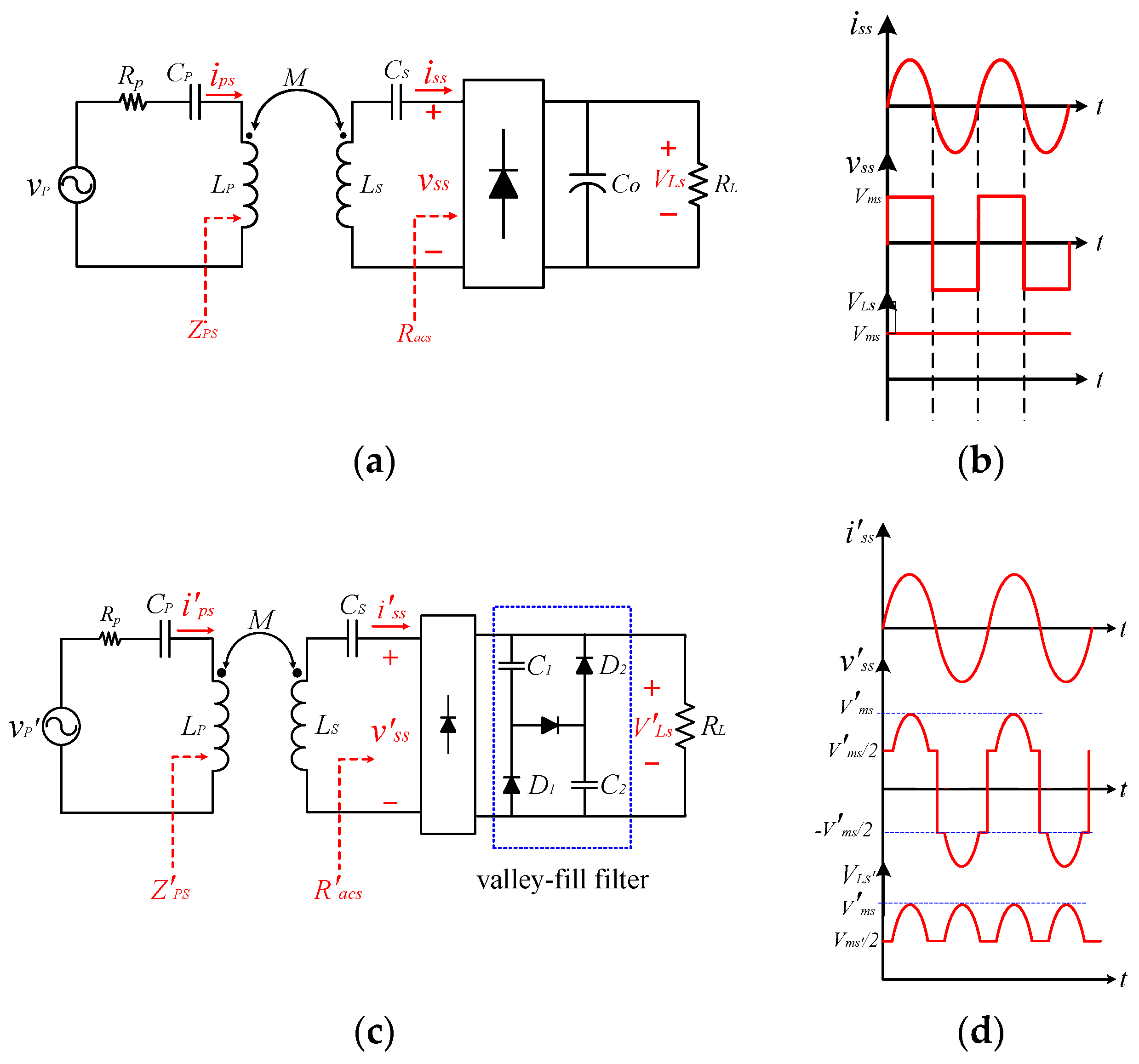
The current output type structure is usually filtered by an electrolytic capacitor after the rectifier circuit to provide stable power to the load, as shown in Figure 4a. However, the induced voltage at the pick-up end can be distorted. The waveforms are shown in Figure 4b. We improved the waveform before rectification by replacing the traditional filter with a valley-fill filter to make the voltage waveform close to a sine wave voltage, thereby improving the power factor. Figure 4c shows the valley-fill filter diagram. The voltage and current waveforms are shown in Figure 4d [11].
The root mean square value and average value of the voltage before rectification in a valley-fill filter can be derived from the operating principle and waveform, as shown in Equations (1) and (2).
v s s ( r m s ) = 0.727 V m s
v s s ( a v ) = 0.718 V m s
where V m s is the peak voltage of v s s . Then, the relationship between the traditional filter and the valley-fill filter, and the overall transmission efficiency of the system is derived.
By assuming that the output power is the same, P o = P o and the rectifier diode has no loss can be obtained Equations (3) and (4).
P o = ( i s s r m s ) 2 · R a c s = v s s ( r m s ) · i s s ( r m s ) = V m s 2 R L
P o = ( i s s ( r m s ) ) 2 · R a c s = v s s ( r m s ) · i s s ( r m s ) = ( 0.718 V m s ) 2 R L
where R a c s is the equivalent resistance before rectification in the circuit with the electrolytic capacitor filter, R a c s is the equivalent resistance before rectification in the circuit with the valley-fill filter, Po is the output power of the system using the traditional filter, and P o is the output power of the system using the valley-fill filter. From Equations (3) and (4), the following is obtained.
R a c s = 0.79 R a c s
According to the wireless transmission principle, the reflection impedance of the system with a traditional filter and the system with a valley-fill filter is determined from the following.
Z r s = ( ω M ) 2 R a c s
Z r s = ( ω M ) 2 R a c s = 0.79 Z r s
If both systems operate at the resonant frequency, the input power of the two systems is given as Equations (8) and (9).
P i s = Z r s R p + Z r s 2 v p 2
P i s = Z r s R p + Z r s 2 v p 2 = 0.79 Z r s R p + 0.79 Z r s 2 v p 2

3.2. Voltage Output Type

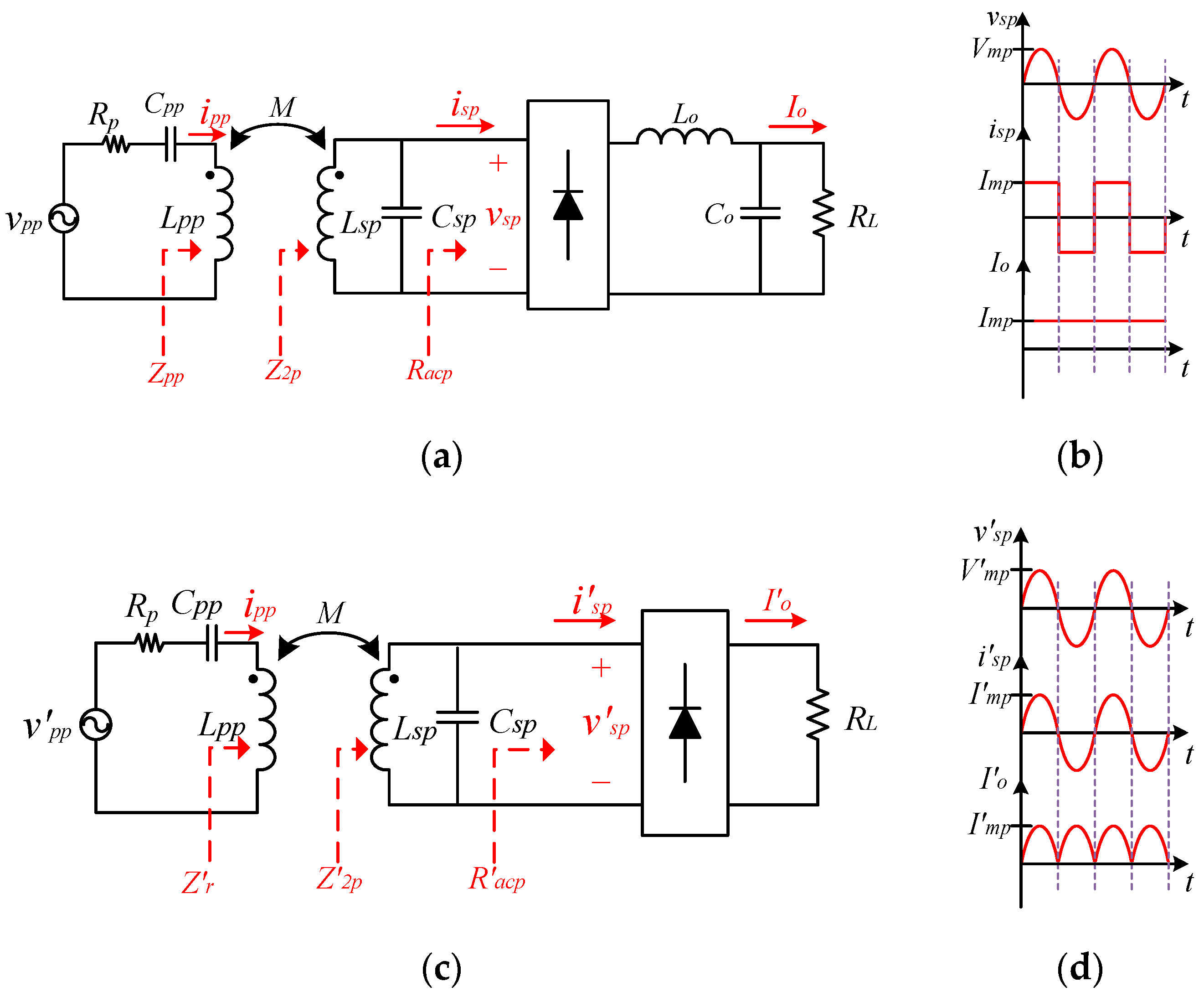
The voltage output type structure includes a filter circuit composed of inductors and capacitors after the rectifier circuit, as shown in Figure 5a. After passing through the LC filter circuit, the current waveform at the pick-up end is transformed into a square wave due to the rectification process. The waveforms are shown in Figure 5b. In order to improve the above problem, we removed the LC filter circuit after rectification, as shown in Figure 5c. This makes the current waveform at the pick-up end close to a sine current. The waveforms are shown in Figure 5d [12].
By assuming that the output power of the two systems is the same, and that the pick-up end circuit has no internal resistance, the inductance current is a smooth DC without ripple. The rectifier diode has no loss. Therefore, the output power is expressed as follows.
P o = v s p ( r m s ) 2 R a c p = v s p ( r m s ) · i s p r m s = I m p 2 · R L
P o = v s p ( r m s ) 2 R a c p = v s p ( r m s ) · i s p r m s = 2 π I m p 2 · R L
where R a c p is the equivalent resistance before rectification in the circuit with an LC filter, R a c p is the equivalent resistance before rectification in the circuit without a filter, I m p is the peak current of i s p , and I m p is the peak current of i s p . From Equations (10) and (11), the following is derived.
8 π 2 R a c p = R a c p
If both systems operate at the resonant frequency, Z r p and Z r p are the reflection impedance of the system with filter and system without filter, as shown in Equations (13) and (14).
Z r p = M 2 R a c L s 2
Z r p = M 2 R a c L s 2 = 8 M 2 R a c π 2 L s 2 = 0.81 Z r p
The input power of the two systems is estimated using Equations (15) and (16).
P i p = Z r p R p + Z r p 2 v p 2
P i p = Z r p R p + Z r p 2 v p 2 = 0.81 Z r p R p + 0.81 Z r p 2 v p 2
From Equations (6), (7), (15) and (16), under the same output power, the developed methods show better system efficiency. However, due to non-ideal factors including line impedance and parasitic effects, actual efficiency improvement is less than ideal conditions.

4. Results

4.1. Current Output Type

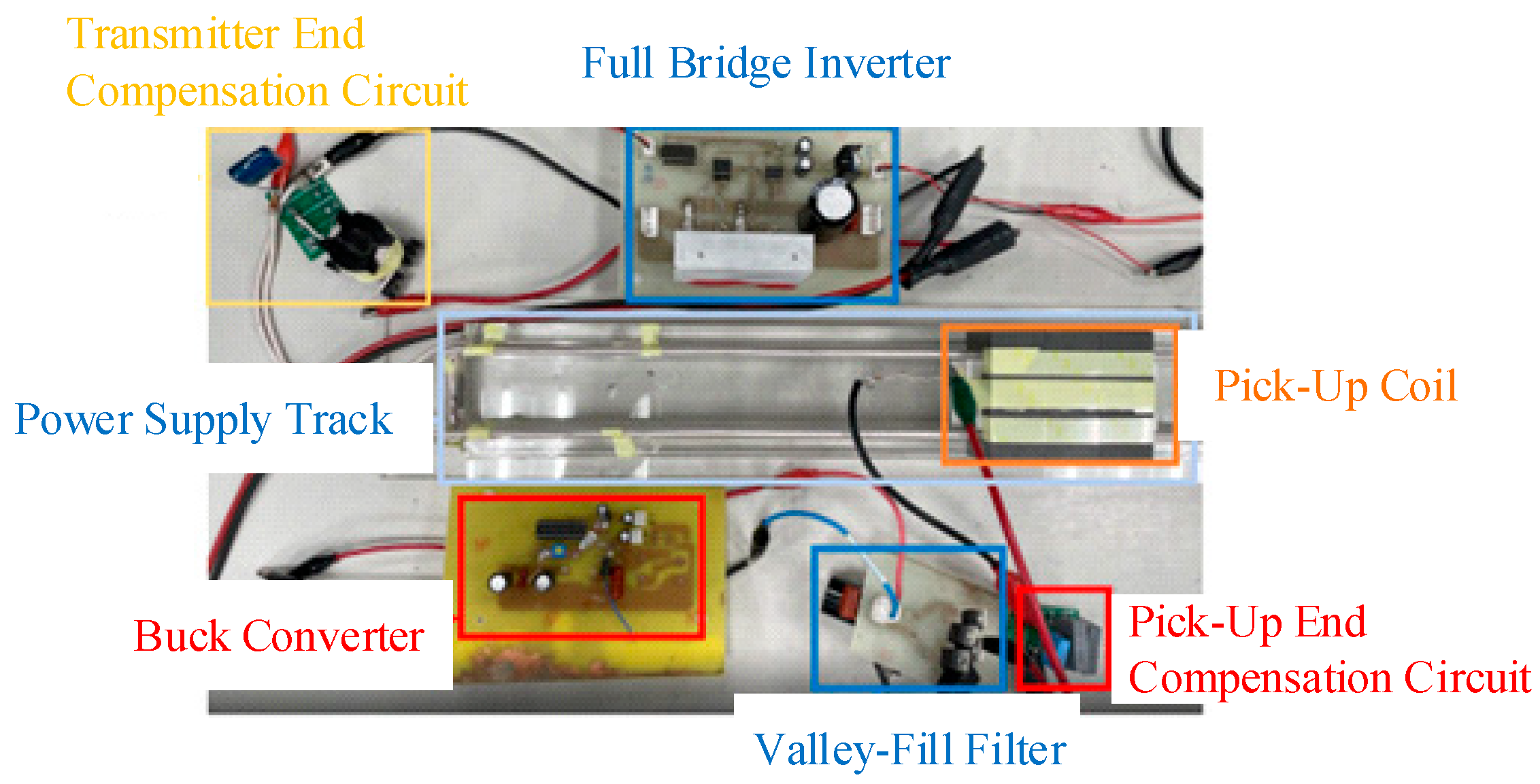
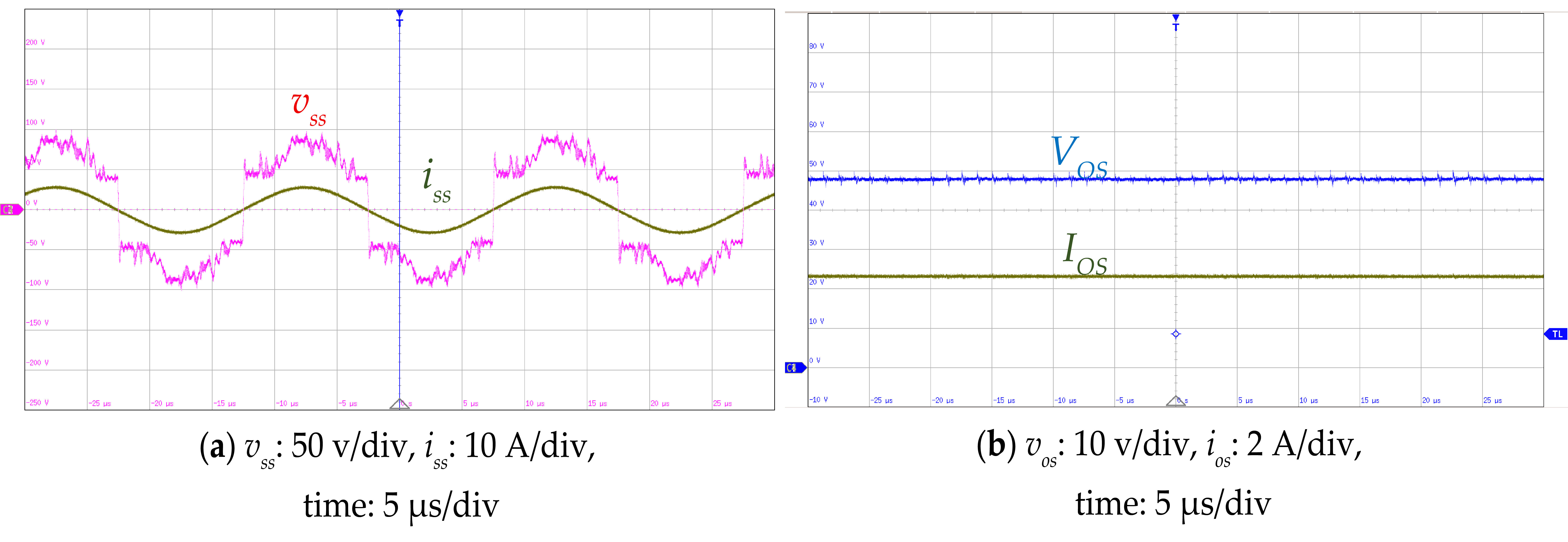
In the current output type, the wireless power transfer structure adopted the series compensation topology and connected a buck converter to the pick-up end stage to provide stable power to the load (Figure 6) [13]. The test environment is shown in Figure 6. The system’s maximum output power is 222 W.
Figure 7 shows the measured waveforms for the system with a valley-fill filter and the output power of 222 W. Table 1 and Table 2 show the efficiency of the system with a traditional filter and the system with a valley-fill filter.

4.2. Voltage Output Type

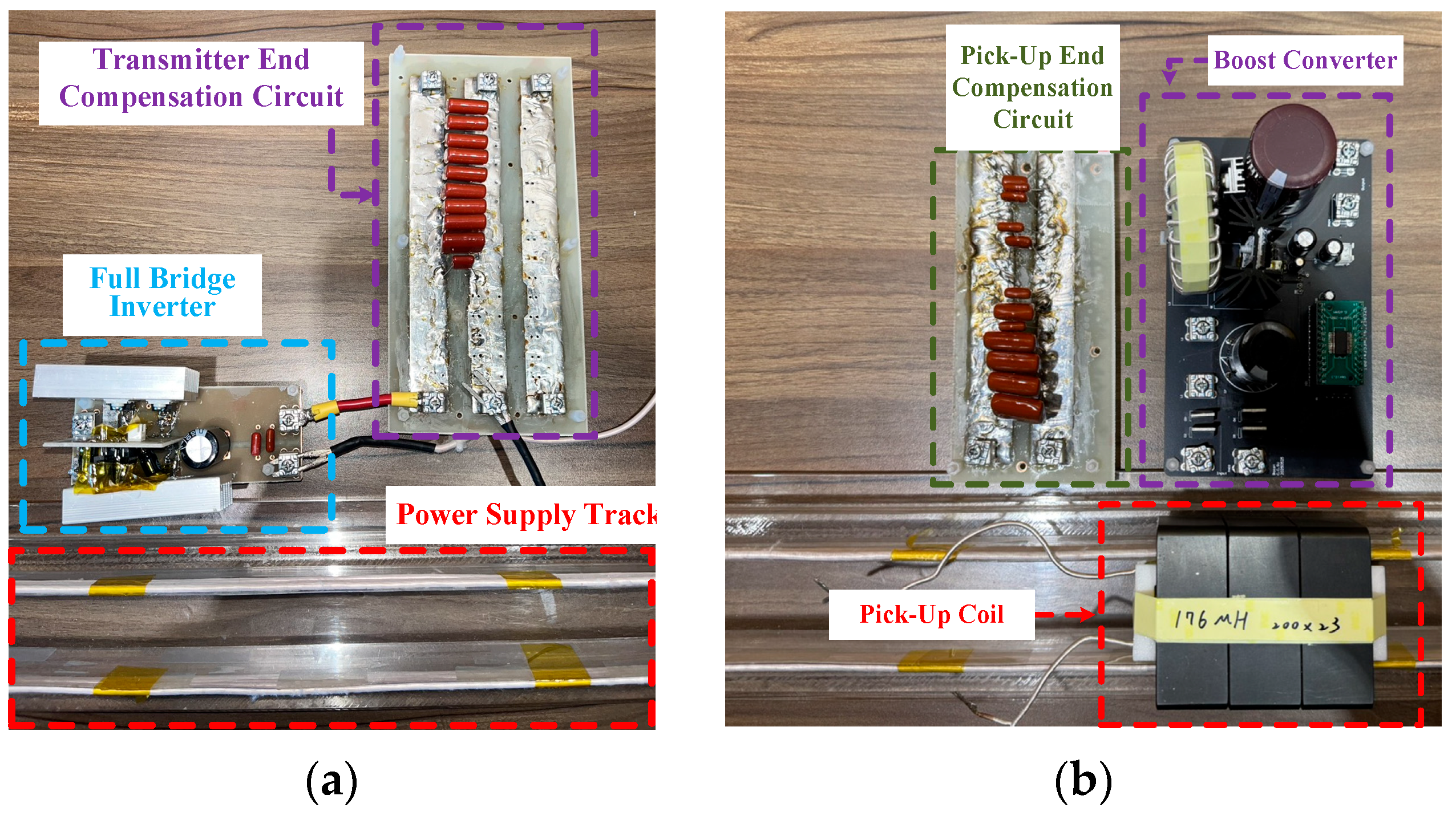
In the voltage output type, the wireless power transfer structure adopted a parallel compensation topology and connected a boost converter to the pick-up end stage to provide stable power to the load. The test environment is shown in Figure 8. The maximum output power of the system is 500 W.
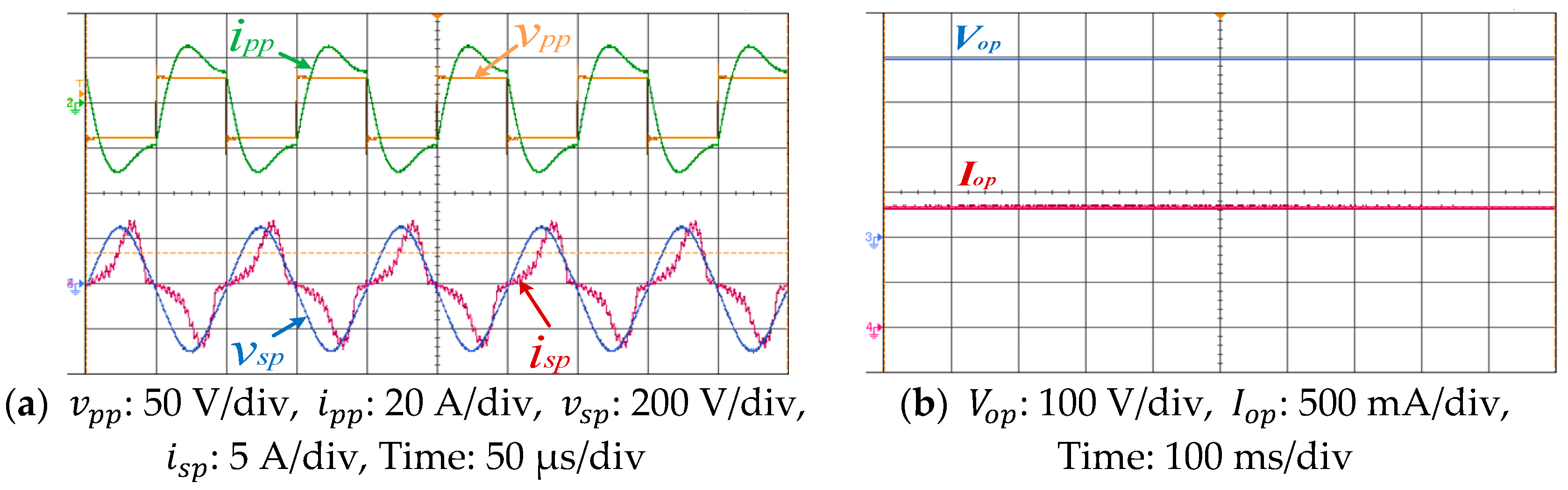
Figure 9 shows the measured waveforms of the system without a filter. The output power of the system is 500 W. Table 3 and Table 4 show the overall efficiency of the system with LC filter and without filter.

5. Conclusions

We improved the overall efficiency of the wireless power supply track system by improving the waveform before rectification at the pick-up end. The circuit structure of the pick-up end of the wireless power transfer system was modified by using a valley-fill filter or directly removing the LC filter. Such a modification improves the transmission efficiency of the system. Finally, the system performance was verified through hardware experiments. In the current output type, by replacing the electrolytic capacitor-based filter with a valley-fill filter, the system efficiency was improved by 4.1% at an output power of 149W. In the voltage output type, after removing the LC filter, the overall system efficiency was enhanced by 3.42% at an output power of 100 W.

Author Contributions

Conceptualization, Y.-C.W.; methodology, Y.-C.W.; software, C.-C.S. and C.-L.C.; validation, Y.-C.W., C.-C.S. and C.-L.C.; formal analysis, Y.-C.W., C.-C.S. and C.-L.C.; investigation, C.-C.S. and C.-L.C.; resources, Y.-C.W.; data curation, C.-C.S. and C.-L.C.; writing—original draft preparation, C.-C.S. and C.-L.C.; writing—review and editing, Y.-C.W., C.-C.S. and C.-L.C.; visualization, C.-C.S. and C.-L.C.; supervision, Y.-C.W.; project administration, Y.-C.W.; funding acquisition, Y.-C.W. All authors have read and agreed to the published version of the manuscript.

Funding

This research received no external funding.

Institutional Review Board Statement

Not Applicable.

Informed Consent Statement

Not Applicable.

Data Availability Statement

The data presented in this study are available upon request from the corresponding author.

Conflicts of Interest

The authors declare no conflict of interest.

References

  1. Mayordomo, I.; Dräger, T.; Spies, P.; Bernhard, J.; Pflaum, A. An Overview of Technical Challenges and Advances of Inductive Wireless Power Transmission. Proc. IEEE 2013, 101, 1302–1311. [Google Scholar] [CrossRef]
  2. Jiang, J.; Zhu, C.; Song, K.; Wei, G.; Zhang, Q. Novel power receiver for dynamic wireless power transfer system. In Proceedings of the IECON 2015—41st Annual Conference of the IEEE Industrial Electronics Society, Yokohama, Japan, 9–12 November 2015; IEEE: Piscataway, NJ, USA, 2016; pp. 002247–002251. [Google Scholar] [CrossRef]
  3. Luo, B.; Long, T.; Guo, L.; Dai, R.; Mai, R.; He, Z. Analysis and Design of Inductive and Capacitive Hybrid Wireless Power Transfer System for Railway Application. IEEE Trans. Ind. Appl. 2020, 56, 3034–3042. [Google Scholar] [CrossRef]
  4. Mi, C.C.; Buja, G.; Choi, S.Y.; Rim, C.T. Modern Advances in Wireless Power Transfer Systems for Roadway Powered Electric Vehicles. IEEE Trans. Ind. Electron. 2016, 63, 6533–6545. [Google Scholar] [CrossRef]
  5. Song, K.; Li, Z.; Jiang, J.; Zhu, C. Constant Current/Voltage Charging Operation for Series–Series and Series–Parallel Compensated Wireless Power Transfer Systems Employing Primary-Side Controller. IEEE Trans. Power Electron. 2018, 33, 8065–8080. [Google Scholar] [CrossRef]
  6. Ishihara, M.; Umetani, K.; Hiraki, E. Elucidation of quasi-duality between series-series and series-parallel topologies of resonant inductive coupling wireless power transfer systems. In Proceedings of the 2017 IEEE 12th International Conference on Power Electronics and Drive Systems (PEDS), Honolulu, HI, USA, 12–15 December 2017; IEEE: Piscataway, NJ, USA, 2018; pp. 674–679. [Google Scholar] [CrossRef]
  7. Patil, D.; McDonough, M.K.; Miller, J.M.; Fahimi, B.; Balsara, P.T. Wireless Power Transfer for Vehicular Applications: Overview and Challenges. IEEE Trans. Transp. Electrif. 2018, 4, 3–37. [Google Scholar] [CrossRef]
  8. Elliott, G.A.J.; Covic, G.A.; Kacprzak, D.; Boys, J.T. A New Concept: Asymmetrical Pick-Ups for Inductively Coupled Power Transfer Monorail Systems. IEEE Trans. Magn. 2006, 42, 3389–3391. [Google Scholar] [CrossRef]
  9. Singh, M.; Samanta, S.; Das, S.P. A Generalized Method of Determining Coil and Compensation Circuit Parameters of Basic WPT Topologies. In Proceedings of the 2021 National Power Electronics Conference (NPEC), Bhubaneswar, India, 15–17 December 2021; IEEE: Piscataway, NJ, USA, 2022; pp. 1–6. [Google Scholar] [CrossRef]
  10. Kiratipongvoot, S.; Yang, Z.; Lee, C.K.; Ho, S.S. Design a high-frequency-fed unity power-factor AC-DC power converter for wireless power transfer application. In Proceedings of the 2015 IEEE Energy Conversion Congress and Exposition (ECCE), Montreal, QC, Canada, 20–24 September 2015; IEEE: Piscataway, NJ, USA, 2015; pp. 599–606. [Google Scholar] [CrossRef]
  11. Chung, C.-L. Study on Improving Transmission Efficiency of Contactless Power Supply Track System. Master’s Thesis, National Formosa University, Huwei, Taiwan, 2024. [Google Scholar]
  12. Su, C.-C. Improving the Efficiency of Series-Parallel Wireless Power Transfer System. Master’s Thesis, National Formosa University, Huwei, Taiwan, 2025. [Google Scholar]
  13. Namiki, H.; Imura, T.; Hori, Y. Magnetic Field Resonant Coupling in Wireless Power Transfer Comparison of Multiple Circuits Using LCL. In Proceedings of the 2022 IEEE 7th Southern Power Electronics Conference (SPEC), Nadi, Fiji, 5–8 December 2022; IEEE: Piscataway, NJ, USA, 2023; pp. 1–6. [Google Scholar] [CrossRef]
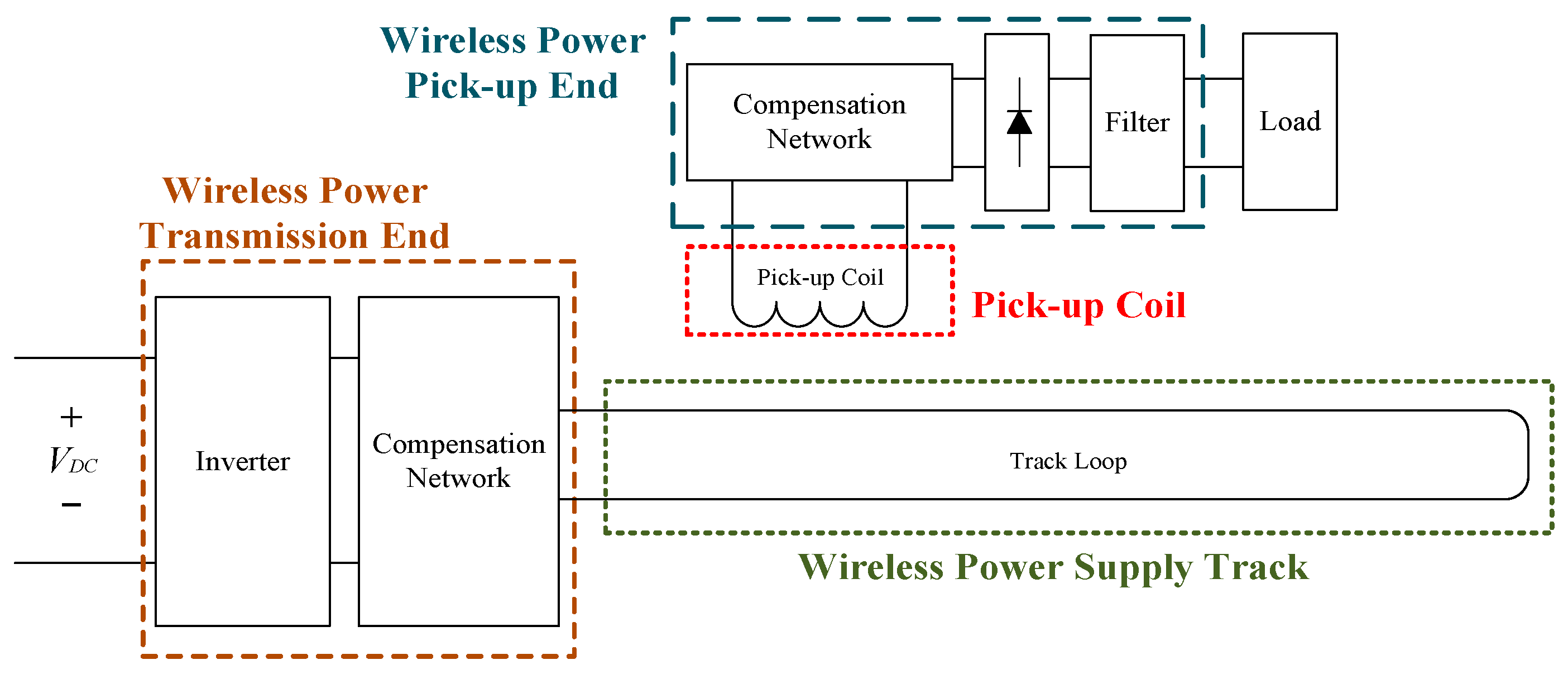
Figure 1. Wireless power transfer system structure.
Engproc 134 00018 g001
Figure 2. Pick-up end compensation topologies: (a) series type; (b) parallel type (LP is the equivalent inductance of the track, LS is the equivalent inductance of the pick-up coil, and CS is the compensation capacitor in the pick-up end).
Engproc 134 00018 g002
Figure 3. Schematic diagram of the pick-up end with a rectifier and filter circuit.
Engproc 134 00018 g003
Figure 4. Current output type, pick-up end circuit, and waveform diagram: (a) system with electrolytic capacitor filter; (b) voltage and current waveforms by electrolytic capacitor filter; (c) system with valley-fill filter; (d) voltage and current waveforms by valley-fill filter.
Engproc 134 00018 g004
Figure 5. Voltage output type pick-up, end circuit, and waveform diagram: (a) system with an LC filter; (b) voltage and current waveforms of the system with an LC filter; (c) system without filter; (d) voltage and current waveforms of the system without filter.
Engproc 134 00018 g005
Figure 6. Current output type system test environment.
Engproc 134 00018 g006
Figure 7. Test results of the system with a valley-fill filter: (a) measured waveforms of pick-up end voltage and current; (b) measured waveforms of buck converter output voltage and current.
Engproc 134 00018 g007
Figure 8. Voltage output type system test environment: (a) transmitter end; (b) pick-up end.
Engproc 134 00018 g008
Figure 9. Measured waveforms of the system without a filter: (a) transmitter output voltage, current, and pick-up end voltage, current; (b) boost converter output voltage and current (where v_pp and i_pp are the inverter output voltage and current, v_sp and i_sp are the pick-up end induced voltage and current, and V_op and I_op are the boost converter output voltage and current).
Engproc 134 00018 g009
Table 1. Overall system efficiency of the system with a traditional filter.
P i n (W) V o (V) P o (W)η (%)
58.147.984679.17
148.64811074.6
203.24814973.3
31048.0922271.6
Table 2. Overall system efficiency of the system with a valley-fill filter.
P i n (W) V o (V) P o (W)η (%)
56.347.954681.7
141.247.9811077.9
192.548.0314977.4
29547.9722275.5
Table 3. Overall system efficiency of system with LC filter.
P i n (W) V o (V) P o (W)η (%)
156.91400.9102.7565.49
267.90401202.5975.62
381.06400.9303.2079.57
493.70400.7402.7081.57
Table 4. Overall system efficiency of system without filter.
P i n (W) V o (V) P o (W)η (%)
149.58401.1103.0868.91
258.05400.5202.0178.28
368.16399.8302.7782.24
485.34400.6405.6583.58
Disclaimer/Publisher’s Note: The statements, opinions and data contained in all publications are solely those of the individual author(s) and contributor(s) and not of MDPI and/or the editor(s). MDPI and/or the editor(s) disclaim responsibility for any injury to people or property resulting from any ideas, methods, instructions or products referred to in the content.