Proceeding Paper

Design Aspects of 80-Seats 1000 km Range Hybrid Regional Aircraft †
ANTONOV Company, 1, Mrii Str., 03062 Kyiv, Ukraine
*
Authors to whom correspondence should be addressed.
Presented at the 15th EASN International Conference, Madrid, Spain, 14–17 October 2025.
Eng. Proc. 2026, 133(1), 66; https://doi.org/10.3390/engproc2026133066
Published: 5 May 2026

Abstract

One of the most future-focused approaches to cleaner regional air transport is to introduce advanced propulsion concepts based on hybrid-electric systems. This study presents an initial design concept for a regional passenger aircraft, providing a detailed justification for the chosen configuration.

1. Introduction

Modern aircraft measurably contribute to global pollution. This applies to all types of flight, from intercontinental to regional, and highlights the growing need for cleaner propulsion technologies.
One of the most promising ways to reduce aviation’s environmental impact is to introduce a power plant that operates using liquid hydrogen. This requires a comprehensive aircraft design, incorporating aerodynamics, functionality, airframe design, onboard systems, and the integration of cryogenic fuel storage and supply into the overall structure.

2. Baseline Parameters

Table 1 summarizes the baseline design requirements used for conceptual sizing of the hybrid regional aircraft.
The selected baseline requirements correspond to the upper segment of the regional turboprop market and are representative of aircraft operating on short-to-medium routes with a high passenger density. The design range of 1000 km was selected as a typical mission, enabling hybrid propulsion benefits while limiting hydrogen storage volume.
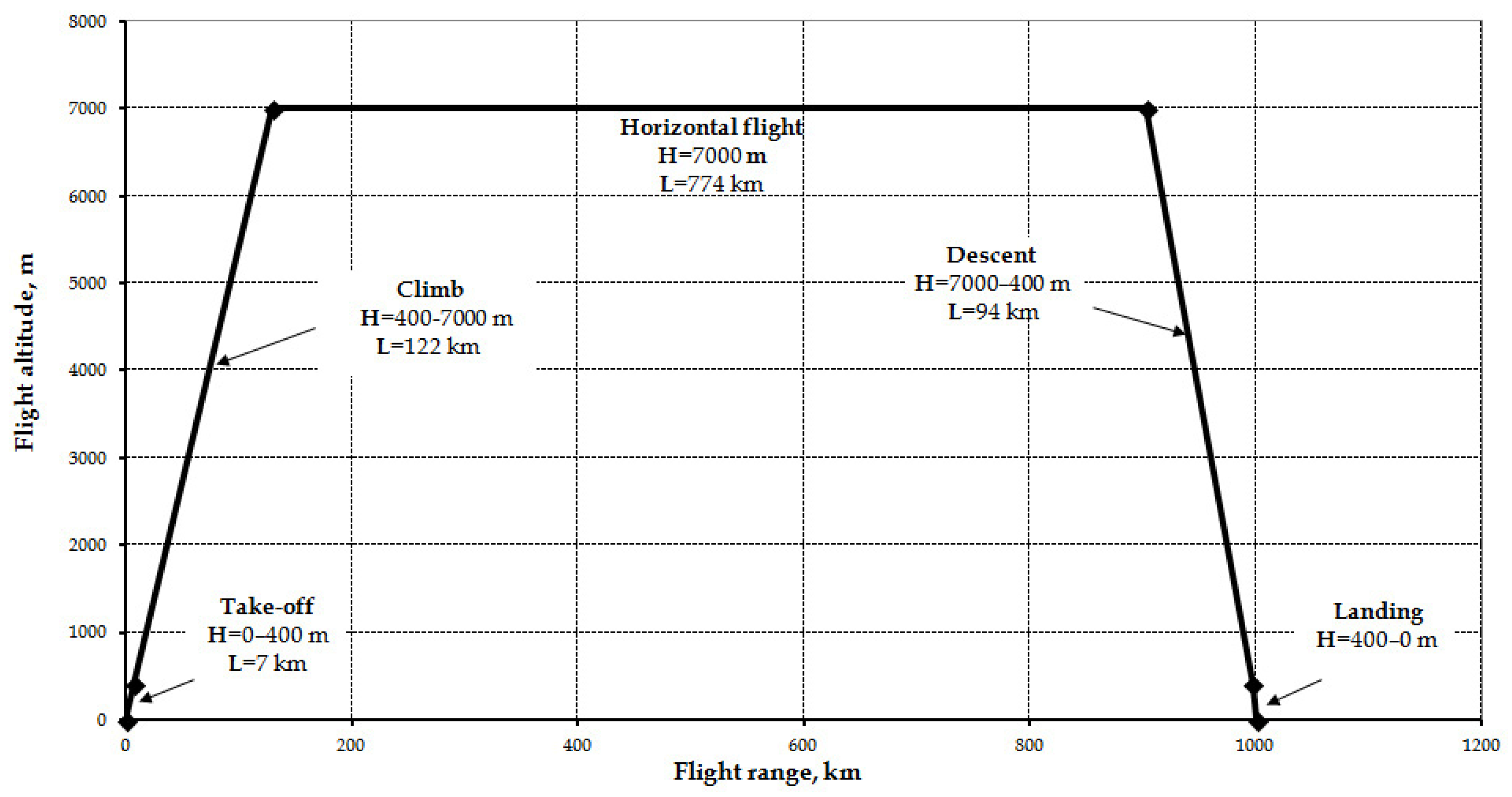
The reference mission profile shown in Figure 1 was defined to represent a typical regional operation and was used as a basis for propulsion sizing, fuel estimation, and performance assessment.

3. Mass and Energy Sizing

The concept aircraft is powered by two hybrid power plants. Each power plant consists of a gas turbine engine (GTE), running on kerosene, and an electric engine (EE), powered by a fuel cell (FC). These engines transmit torque to the propeller via a common gearbox. Hybrid propulsion provides the required thrust for all flight modes, including takeoff, climb, and cruising flight.
The main differences between the aircraft concept and the reference ATR72-600 aircraft are the following:
  • Use of hybrid turbo-electrical propulsion;
  • Use of promising technologies and materials according to assumptions for 2035;
  • Increased number of passengers—up to 80;
  • Increased maximum cruise speed—up to 520 km/h;
  • Increased cruise flight altitude—up to 7000 m;
  • Increased power-to-weight ratio;
  • Seating layout—3 + 2 seats in a row;
  • Practical range is reduced to 1000 km.

3.1. Aircraft OEW in the First Approximation

The maximum takeoff weight (MTOW) was determined using the classical mass balance relation [1,2]:
MTOW = OEW + maximum fuel weight + maximum payload.
Use of advanced materials and technologies in 2035 could reduce the weight of the aircraft structure by around 8%. It is also expected that the level of aircraft aerodynamics Cl/Cd on Cl cruise will increase by 5–8% [2,3,4,5]. Otherwise, the implementation of hybrid propulsion on the aircraft with additional EE, gearboxes, liquid hydrogen tanks, FC, electrical devices, cables, etc., will increase the weight of the aircraft. The OEW of the aircraft will increase due to the increased passenger seating capacity compared with the reference ATR 72-600 aircraft.
We obtain OEW in the first approximation using the formulas for component weight calculation, weight statistics of the ATR 72-600 and AN-148 aircraft [6], weight perfection of fuel cells and liquid hydrogen fuel tanks, as well as promising structural materials and technologies (Table 2).

3.2. MTOW in the First Approximation

MTOW = OEW + 0.8 × Mfuel + MPL
MPL consists of the passenger’s weight with baggage and additional cargo. For our concept aircraft, one passenger’s weight with baggage—95 kg and additional cargo—500 kg:
MPL = 80 × 95 + 500 = 8100 (kg)
Mfuel—fuel weight—is determined using statistical data of existing regional aircraft, as well as assuming that 20% of the hybrid propulsion power is provided by liquid hydrogen, whose energy density per weight is approximately three times higher than that of kerosene. Therefore, it can be assumed that the fuel consumption (kg/km) will be approximately 10% less than the reference ATR 72-600 aircraft, 1.4 kg/km on a 1000 km route.
Taking into account fuel reserve for 45 min and a distance of 185 km to the alternate airfield, the maximum fuel reserve (kerosene plus hydrogen) required for a range of 1000 km is about 1900 kg. MTOW, in first approximation, is 24,100 kg (Table 3).

3.3. Required Hybrid Propulsion Power in the First Approximation

Our concept, compared to the reference ATR 72-600 aircraft, is about 8% heavier (for the same 1000 km range flight with a maximum number of passengers). In addition, even with the 2035 forecast of aircraft aerodynamic drag reduction, concept aerodynamic drag will not decrease due to the larger fuselage size, increased passenger capacity, additional volumes for the tanks with LH2, FC, etc.
All of this will require increasing the available power propulsion capacity by ~10%. Finally, it is planned to improve performance—climb rate and operation in hot and high mountain conditions compared to the reference ATR 72-600. Thus, the total power of the hybrid propulsion should be ~20% more than that of the ATR72-600 with two PW127XT-M engines with a capacity of 2750 hp (2000 kW) each on emergency mode.
So, the hybrid propulsion should consist of two conventional engines with the thrust ratio of the PW127XT-M engines, plus two EE engines with a capacity of 400 kW each.
The next stage is to determine the mass-dimensional characteristics of the electric propulsion with a total capacity of 800 kW powered by FC.
The electric power is supplied to the electric engine, which converts it into mechanical energy transmitted to the propeller through a common gearbox with the gas turbine engine. At certain stages of the flight, electricity from fuel cells can also be supplied to charge the batteries included in the aircraft’s electrical system.
The required amount of hydrogen for FC, in the first approximation, is determined on the following condition: the total power of the electric propulsion should be 2 × 400 kW = 800 kW.
Block fuel of reference ATR 72-600 aircraft on a 1000 km flight is approximately 1500 kg, the block time is about 145 min, and the specific kerosene consumption on the cruise is 762 kg/h.
Taking into account the assumption that the fuel efficiency of the GTE will be improved by 12% in 2035, hourly consumption will decrease to 670 kg/h, and block fuel for flight will decrease to 1320 kg. It can be assumed that the hourly fuel consumption for an aircraft with propulsion more powerful by 20% will also increase by 20%, to 800 kg/h. Accordingly, the required amount of kerosene for a 1000 km range flight will increase to 1.2 × 1320 kg = 1584 kg, resulting in an increase of 264 kg.
Now we find the required amount of hydrogen for FC [7,8], which can replace 264 kg of kerosene in terms of energy equivalence, which provides a 20% increase in thrust. If we assume that the efficiency of FC is about 0.55–0.6 in 2035, we will need about 61 kg of hydrogen. The required amount of fuel (kerosene + hydrogen) for a 1000 km range flight is 1584 − 264 + 61 = 1381 kg. In this case, the weight of the hydrogen in the fuel is 61/1381 = 0.044, i.e., 4.4%.
If we compare the obtained hybrid propulsion characteristics of our concept with the corresponding propulsion characteristics of the reference ATR 72-600 aircraft, we can note the following:
  • Thrust ratio increased by 20%;
  • Fuel consumption on the route (kerosene + hydrogen) was reduced by 8% (1381/1500 = 0.92).
Coefficients Ct = 1.2 for thrust ratio and CFC = 0.92 for hourly consumption are used to edit the matrix of reference engine performance in order to calculate aircraft flight performance with a hybrid propulsion.
At the same time, the fuel weight for a 1000 km range should be increased in order to:
  • Perform 45 min of flight plus 185 km to the alternate airfield;
  • Cover an additional 200–300 km with a reduced number of passengers.
Maximum fuel weight should be about 2200 kg: 2100 kg of kerosene plus 100 kg (4.6%) of hydrogen.
To accommodate 100 kg of liquid hydrogen with a temperature below −253 °C (at an internal pressure of 1 atm.), fuel tanks with thermally insulated walls will be required. With the specific gravity of LH2 γ = 0.07 kg/dm3, gravimetric hmtank = 0.6 and volumetric hvtank = 0.77 efficiencies of the fuel tanks [6], additional volume for gaseous hydrogen generation will be required: two tanks with external diameters of Ø 1.44 m and Ø 1.1 m and a total construction weight of 67 kg.
It is assumed that each propeller-driven engine group will have its own FC stack, i.e., there will be two, 400 kW each (in total, they will provide an additional 20% to the takeoff power of reference engines). The weight of one FC stack will be 148 kg, based on the assumption for 2035 FC level of gravimetric efficiency—2.7 kW/kg. Taking into account the updated data on the weight of hybrid propulsion units, it is possible to clarify the aircraft’s OEW (Table 4):

4. Flight Performance

Aerodynamic drag polar
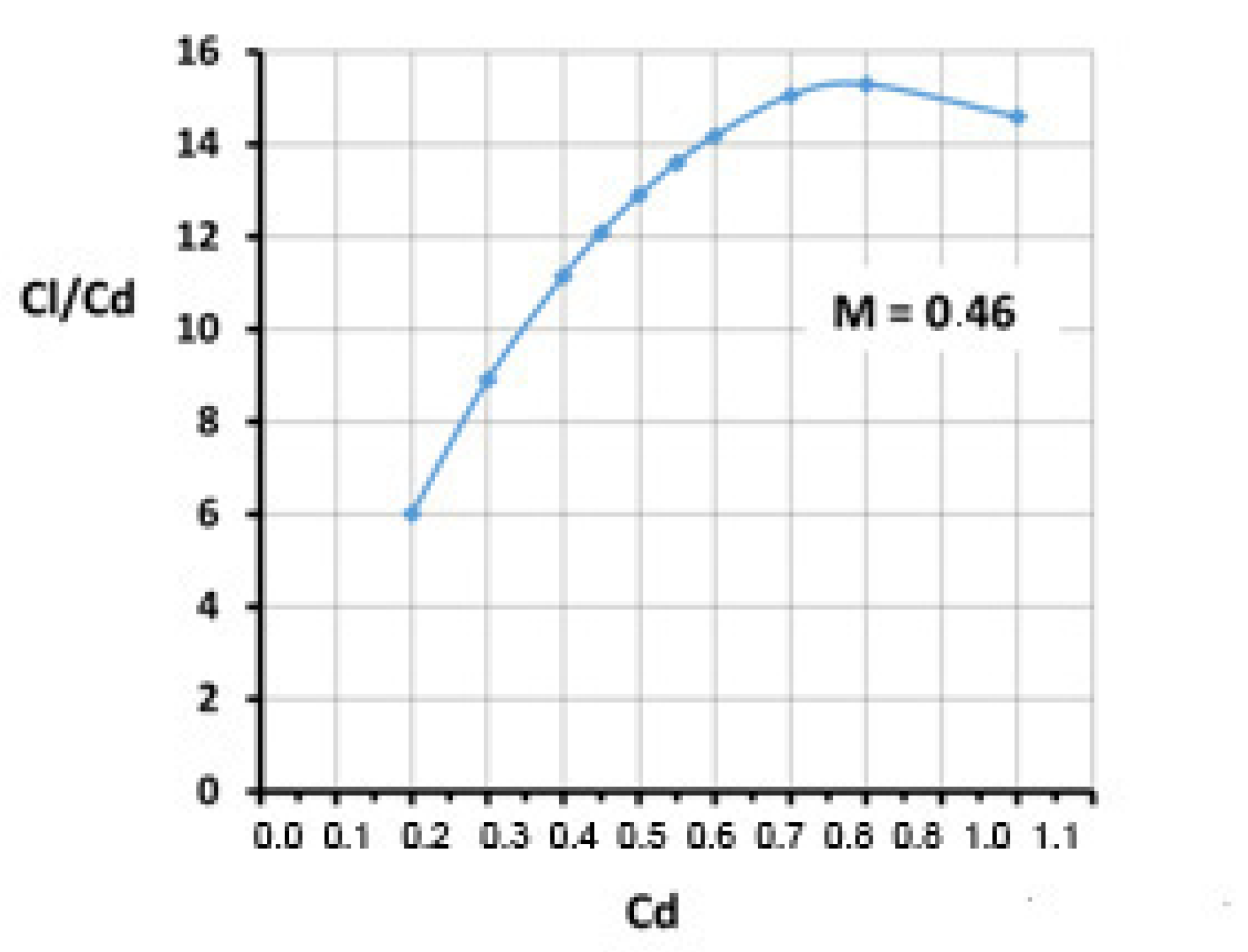
The polar curve of the aircraft was obtained by recalculating the indicators based on the main characteristics of the ATR72-600 using the polar curve model. Changes to the engine nacelle, as well as the additional drag caused by the heat exchanger radiator (which we estimate will account for up to 2% of the aircraft’s total drag at Cl cruise), were taken into account when creating the polar curve.
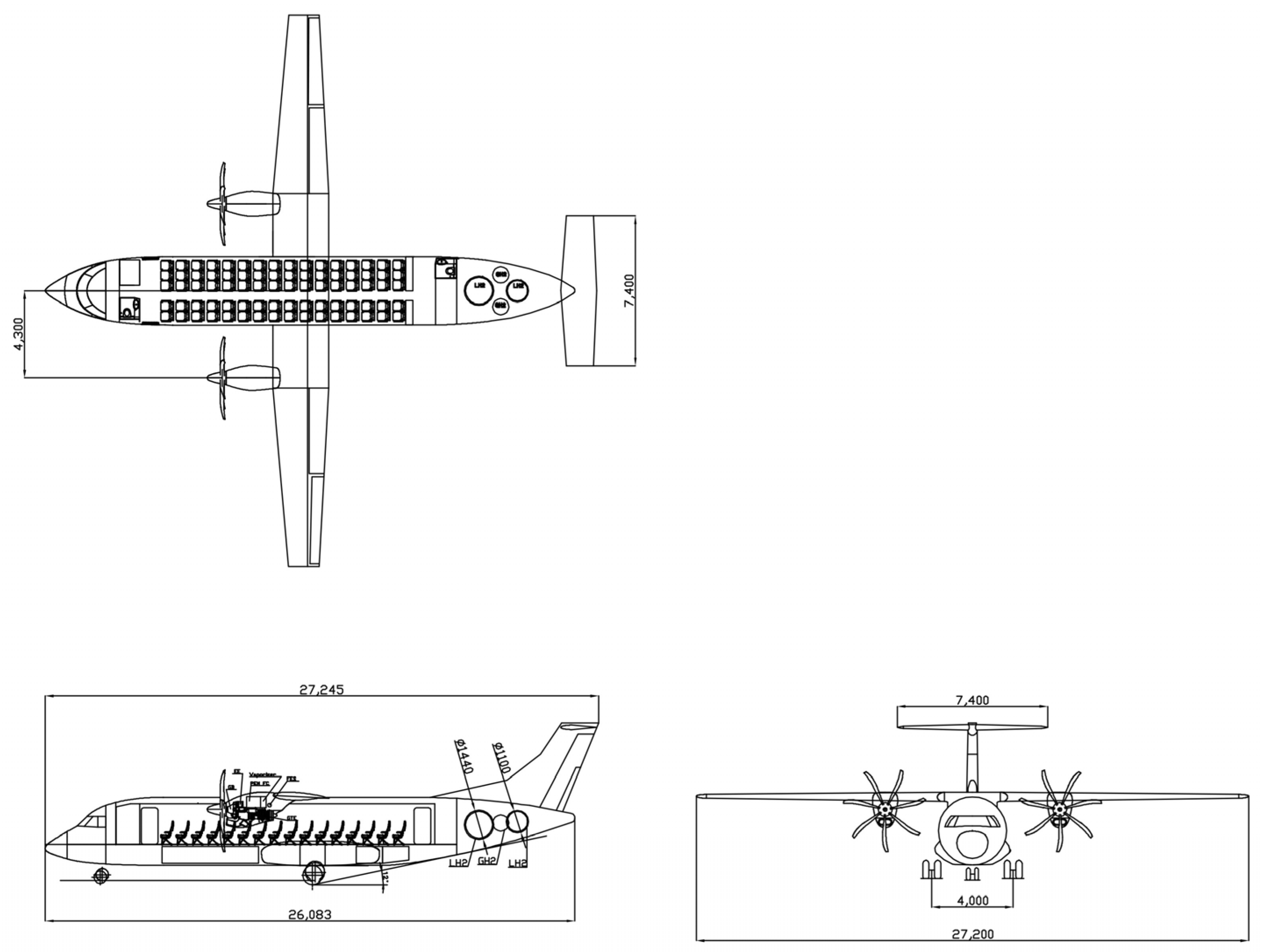
Figure 2 presents the lift-to-drag ratio as a function of drag coefficient for the cruise condition (M = 0.46), Figure 3 shows the general arrangement of aircraft.
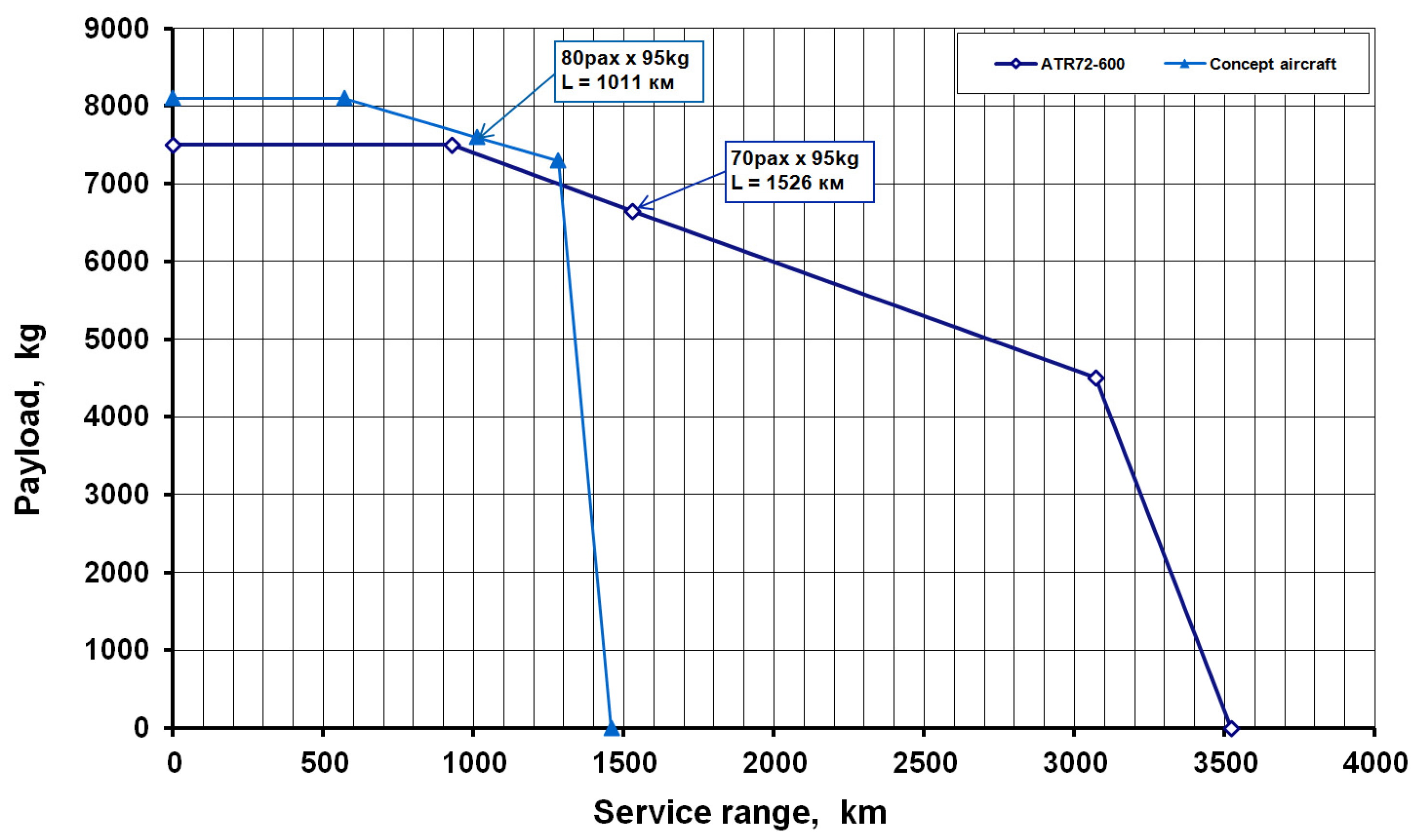
The main flight performance of the aircraft is determined and then compared with the reference ATR 72-600 aircraft, as shown in Table 5 and payload range diagram is shown in Figure 4.

5. Conclusions

Within the framework of the presented research, requirements were defined for an 80-seat regional passenger aircraft with a 1000 km range and hybrid propulsion.The work was carried out to determine both the aerodynamic and structural configuration of the concept aircraft and to assess its feasibility relative to the modern regional turboprop benchmarks.
The results show that if the forecast for specific mass and dimensional characteristics of equipment can be achieved, and if new-generation GTE, structural materials, and advanced manufacturing technologies are applied, the OEW of the 80-seat, 1000 km range regional aircraft will be approximately 14 810 kg. This corresponds to 185 kg per passenger, which is considered fully acceptable for this class of aircraft. For comparison, the OEW per passenger of the ATR 72-600 is 193 kg/pass.
Furthermore, the specific fuel consumption of the concept aircraft is 16% lower than that of the ATR 72-600, amounting to 20.5 g/pass-km.

Author Contributions

Conceptualization, D.B. and O.U., methodology, O.B.; formal analysis, O.B.; D.B.; investigation, O.B.; data curation, S.F.; writing—original draft preparation, O.U. and D.B.; writing—review and editing, O.U., D.B. and S.F., visualization, D.B., O.U. and A.K., supervision, A.K.; project administration, S.F. All authors have read and agreed to the published version of the manuscript.

Funding

This research was funded by the European Climate, Infrastructure and Environmental Executive Agency (CINEA), grant number 101056866.

Institutional Review Board Statement

Not applicable.

Informed Consent Statement

Not applicable.

Data Availability Statement

The data presented in this study are available on request from the corresponding author. The data are not publicity available due to institutional and confidentiality restrictions.

Conflicts of Interest

The authors are employed by the ANTONOV Company. All authors declare that the research was conducted in the absence of any commercial or financial relationships that could be construed as a potential conflict of interest.

Abbreviations

The following abbreviations are used in this manuscript:
HTEPHybrid Turbo-Electrical Propulsion
GTEGas Turbine Engine
EEElectric Engine
FCFuel Cell
MTOWMaximum Take-off Weight
OEWOperating Empty Weight
MPLMaximum Payload
LHLiquid Hydrogen

References

  1. Torenbeek, E. Advanced Aircraft Design; Wiley: Hoboken, NJ, USA, 2013. [Google Scholar]
  2. Roskam, J. Airplane Design: Part I, Preliminary Sizing of Airplanes; Roskam Aviation and Engineering Corporation: Toronto, ON, Canada, 1985. [Google Scholar]
  3. Silberhorn, D.; Atanasov, G.; Walther, J.-N.; Zill, T. Assessment of Hydrogen Fuel Tank Integration at Aircraft Level; University of California: Los Angeles, CA, USA, 2016. [Google Scholar]
  4. Bell, J. Design and Control of a Hydrogen Fuel Cell Vehicle; Institute of System Architectures in Aeronautics: Hamburg, Germany, 2018. [Google Scholar]
  5. Monkam, L.K.; von Schweinitz, A.G.; Friedrichs, J.; Gao, X. Feasibility Analysis of a New Thermal Insulation Concept of Cryogenic Fuel Tanks for Hydrogen Fuel Cell Powered Commercial Aircraft. Int. J. Hydrogen Energy 2022, 47, 31395–31408. [Google Scholar] [CrossRef]
  6. ATR. ATR 72-600, ATR DC/E Marketing; ATR: Toulouse, France, 2014. [Google Scholar]
  7. Tiwari, S.; Pekris, M.J.; Doherty, J.J. A review of liquid hydrogen aircraft and propulsion technologies. Int. J. Hydrog. Energy 2024, 57, 1174–1196. [Google Scholar] [CrossRef]
  8. Dietl, T.; Karger, J.; Kaupe, K.; Pfemeter, A.; Weber, P.; Zakrzewski, A.; Strohmayer, A. Polaris—Design of a Liquid Hydrogen Turbo-Electric Transport Aircraft; Institute of Aircraft Design: Stuttgart, Germany, 2018. [Google Scholar]
Figure 1. Flight profile of concept aircraft.
Engproc 133 00066 g001
Figure 2. Lift-to-drag ratio.
Engproc 133 00066 g002
Figure 3. General arrangement.
Engproc 133 00066 g003
Figure 4. Payload range diagram.
Engproc 133 00066 g004
Table 1. Requirements for aircraft.
Number of passengers80
Design Range (max payload)1000 km
Cruise speed≥500 km/h
Max flight altitude7620 m
Maximum payload8100 kg
Propulsion architectureHybrid (GTE and EE, common propeller)
Reference aircraftATR72-600
Table 2. Aircraft OEW in the first approximation.
ComponentsWeight, kg
Wing2600
Fuselage3900
Stabilizers450
Landing Gear750
Hybrid propulsion (HTEP)2600
Systems3500
Equipment800
OEW14,600
Table 3. Aircraft MTOW in the first approximation.
Weight, kg
Operating empty weight, first approximation14,600
Payload with max. number of passengers7600
Fuel required for a range of 1000 km with 80 passengers1900
MTOW24,100
Table 4. Clarified aircraft OEW.
ComponentsWeight, kg
Wing2600
Fuselage3900
Stabilizers450
Landing gear750
Hybrid propulsion2507
Including (for two hybrid power plants):
GTE with systems840
Electric engine with control system200
Combining gearbox300
Propeller with control system components390
GTE inlet40
Starter-generator with control system56
LT-PEMFC stack296
LT-PEMFC air supply system20
Water preparation system40
Vaporizer and heat exchanger for LT-PEMFC stack112
PMAD74
Fire extinguishing system components72
LH2 fuel tanks67
Systems3803
Equipment800
OEW14,810
Table 5. Flight performance.
Concept AircraftATR-72-600
Wing area, sq m 63.861
Fuselage cross section, m Ø 3.352.865 × 2.7
Fuselage length, m 26.08327.17
NFTLH2 2
LH2 fuel tanks dimensions, m Ø 1.44 + Ø 1.1
Placement of FC Wing section
LH2 fuel tanks capacity, m31.56 + 0.68
Placement of hydrogen tanksTail section
Cl/Cd (Cy = 0.5) 12.912.80
MTOW, kg24,61023,000
OEW, kg14,81013,500
Max payload, kg81007990
Payload max pax, kg7600 (80 pax)6650 (70 pax)
Maximum Fuel Weight, kg2200 (2100 kg—kerosene, 100 kg—hydrogen)5000
Flight time, min132135
Max cruise speed, km/h520500
TOFL (MTOW–ISA–SL), m 1325 1315
LFL (MLW–ISA–SL), m 1270915
Range with max pax, km 10001526
Fuel consumption (standard route 1000 km), g/pax-km17.3 *20.5 **
Fuel
efficiency
LH2 + A1 g/pax-km17.320.5
LH2 + A1, MJ/pax-km0.80.88
A1, g/pax-km16.520.5
*—H = 7000 m, V = 510 km/h, fuel reserve for 1.1 h; ** H = 6100 m, V = 500 km/h, fuel reserve for 1.1 h.
Disclaimer/Publisher’s Note: The statements, opinions and data contained in all publications are solely those of the individual author(s) and contributor(s) and not of MDPI and/or the editor(s). MDPI and/or the editor(s) disclaim responsibility for any injury to people or property resulting from any ideas, methods, instructions or products referred to in the content.