1. Introduction
Immersed boundary methods (IBM) based on volume penalization have emerged as a promising technique to address the difficulty of generating body fitted meshes for complex geometries. Immersed boundary refers to the representation of complex structures, such as solid objects as part of the fluid computational domain, without the need for a grid that conforms to their intricate shapes. This not only enhances the capability to model real-world industrial scenarios, but also significantly improves the computational efficiency (while reducing human intervention) of the simulation workflow because the time-consuming body-fitted mesh generation is avoided [
1,
2,
3].
The immersed boundary method holds considerable promise for optimizing the high-lift configurations for aircraft designs. In our proposed approach, body-fitted grids are employed for the primary aerodynamic components, such as the aircraft wing, while IBM is employed to model high-lift devices like flaps and slats. This approach offers a meshing advantage, enabling the optimizer to move and reposition the high-lift devices easily, without distorting the mesh or requiring remeshing for each new position or shape. Consequently, IBM serves as an efficient computational tool for rapid prototyping and optimization within CODA. Furthermore, we note that our implementation of the IBM is compatible with finite-volume methods and high-order discontinuous Galerkin methods and hence can benefit from the high accuracy provided by high-order simulations.
In this work we propose a new strategy for the optimization of the flap position of a high-lift configuration in the framework of a hybrid electric regional aircraft. The approach is based on the multidisciplinary design optimization software GEMSEO and the high-performance CFD solver CODA with the immersed boundary method.
2. Methodology
We have developed an optimization methodology using the open-source optimization suite GEMSEO [
4] and CODA [
5,
6,
7]. GEMSEO stands for Generic Engine for Multidisciplinary Scenarios, Exploration and Optimization. GEMSEO is an open-source Python software designed to automate multidisciplinary processes, starting with multidisciplinary design optimization (MDO) ones, and offering a catalogue of MDO formulations to make this automation possible. In this work we have used GEMSEO version 6.2.0 based on Python version 3.11.
The optimization can use body-fitted meshes (with remeshing at each optimization function evaluation) or immersed boundaries (IBVP). The latter can use remeshing via the octree mesh generator developed in-house to adjust the mesh to the IBVP (CAD in STL format) geometry or it can use a background mesh refined near the IBVP region avoiding the need for remeshing at each function evaluation.
Here, we show the results of the optimization’s first phase performed with CODA+IBVP and GEMSEO regarding the flap position while the wing and flap geometries are kept fixed. The goal in this optimization procedure is to maximize the lift coefficient under a given high-lift flight condition.
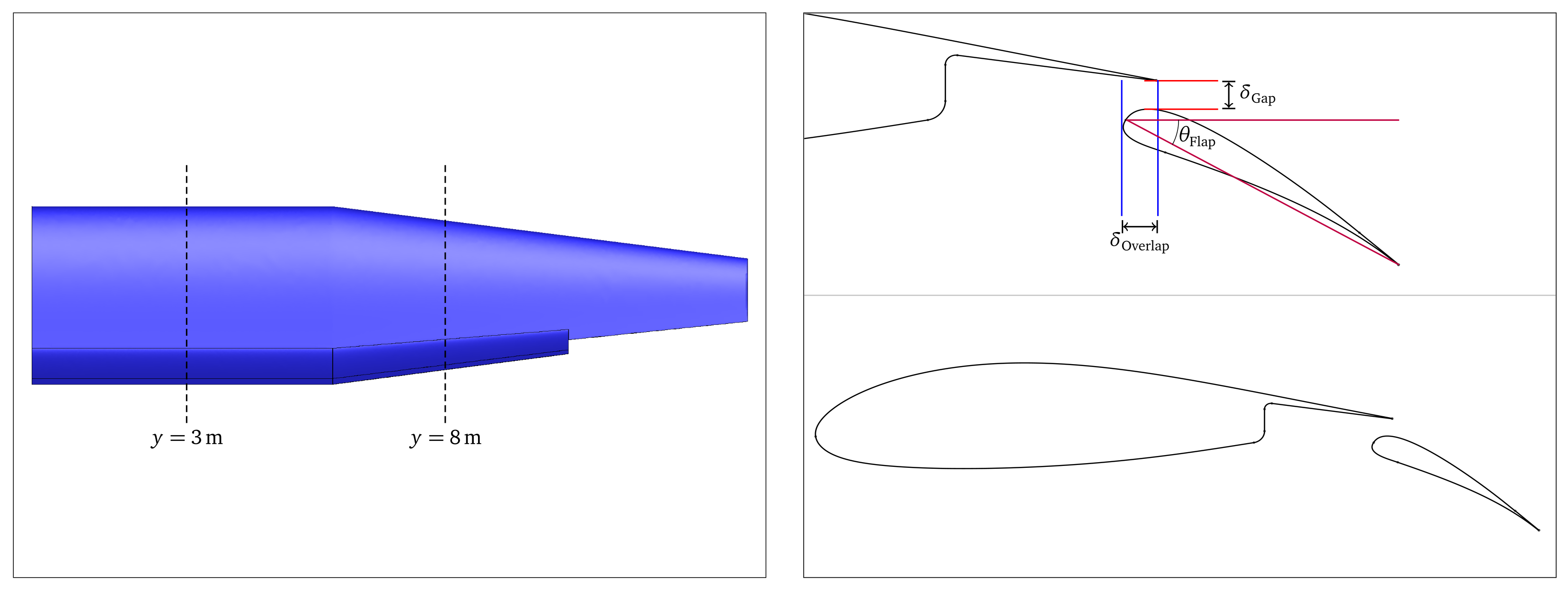
To shorten computational times, we decided to perform the analysis considering a 2D profile of the wing/flap system. We have selected the profile corresponding to the HERA cross-section of the wing/flap at
y = 3 m from the original 3D setup, as seen in
Figure 1 (left). The position of the flap with respect to the wing is characterized by the variables: gap, overlap, and deflection angle. The gap and overlap variables are measured with respect to the trailing edge coordinates of the wing and the leading edge of the flap. The deflection angle is the angle between the chord of the wing and the chord of the flap, as seen in
Figure 1 (right).
3. Results and Discussion
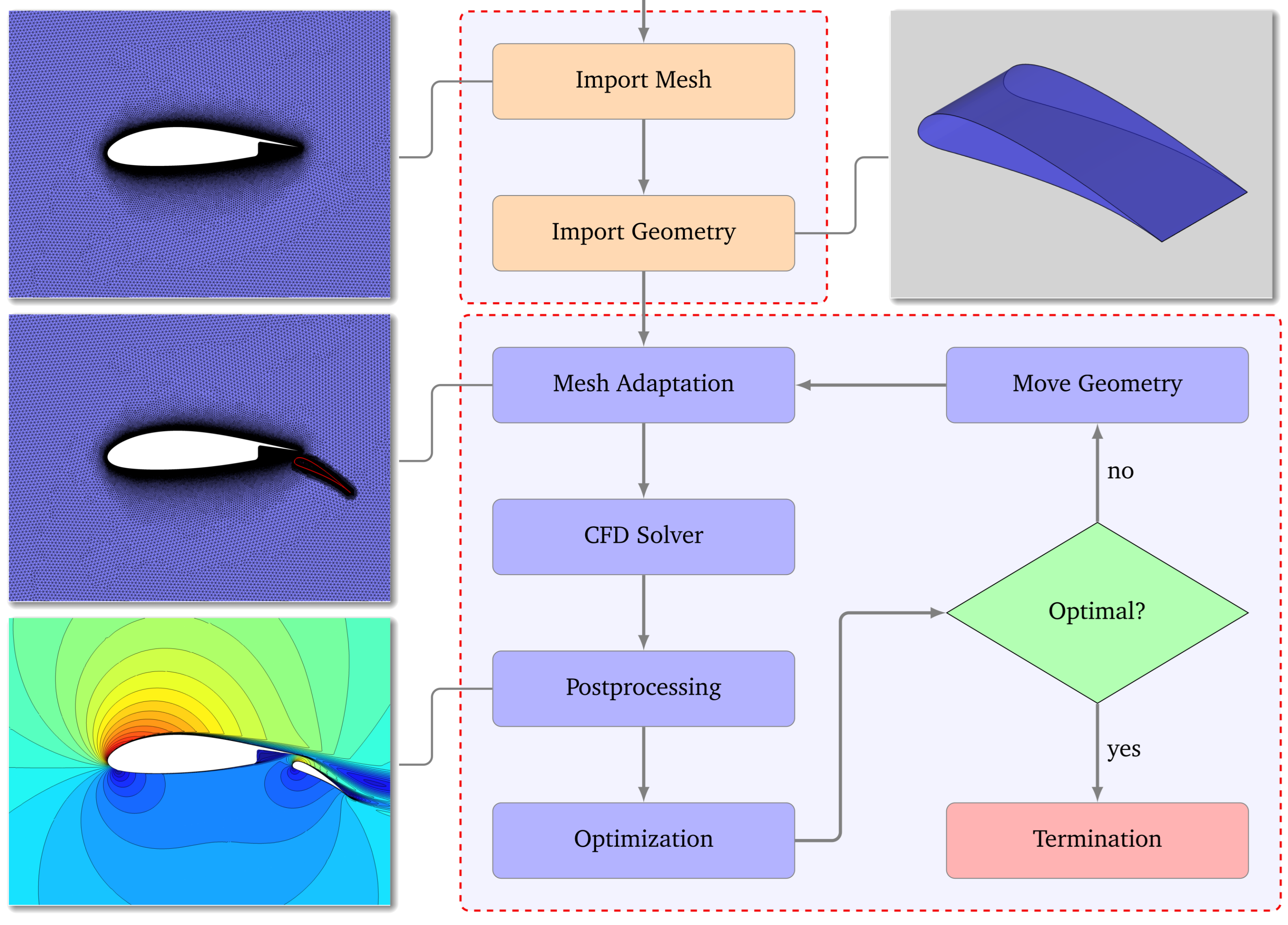
The optimization is carried out by using the following design variables: angle of attack, gap, overlap, and deflection angle of the flap with respect to the wing. The general workflow is sketched in
Figure 2. GEMSEO requires a set of design variables and an objective function to perform the optimization. The design variables have been already defined. The objective function (max lift or
) requires the CFD computation of the flow past the wing/flap system with the design variables as input variables, and a mesh file created for each configuration of the airfoil. An initial unstructured mesh of the domain containing the wing is created, and further refinement is done in the region where the flap is located according to the position given by the optimizer. CODA then simulates the turbulent (RANS) flow past the system wing/flap for the current position of the flap, with appropriate initial and boundary conditions according to the high-lift flight conditions. In the first step of the optimization, the objective function output is the maximization of the lift coefficient. GEMSEO will call this objective function as many times as the optimization algorithm needs. In this study we have selected the COBYQA algorithm because of its excellent convergence properties and because it does not require the computation of the adjoint as this is still not available for the IBVP method in CODA. COBYQA stands for Constrained Optimization BY Quadratic Approximations, and it is designed to supersede COBYLA as a general derivative-free optimization solver. It can handle unconstrained, bound-constrained, linearly constrained, and nonlinearly constrained problems. It uses only function values of the objective and constraint functions, if any. No derivative information is needed. Note that other optimization algorithms are available in GEMSEO and can be adapted to the provided framework with minimum effort.
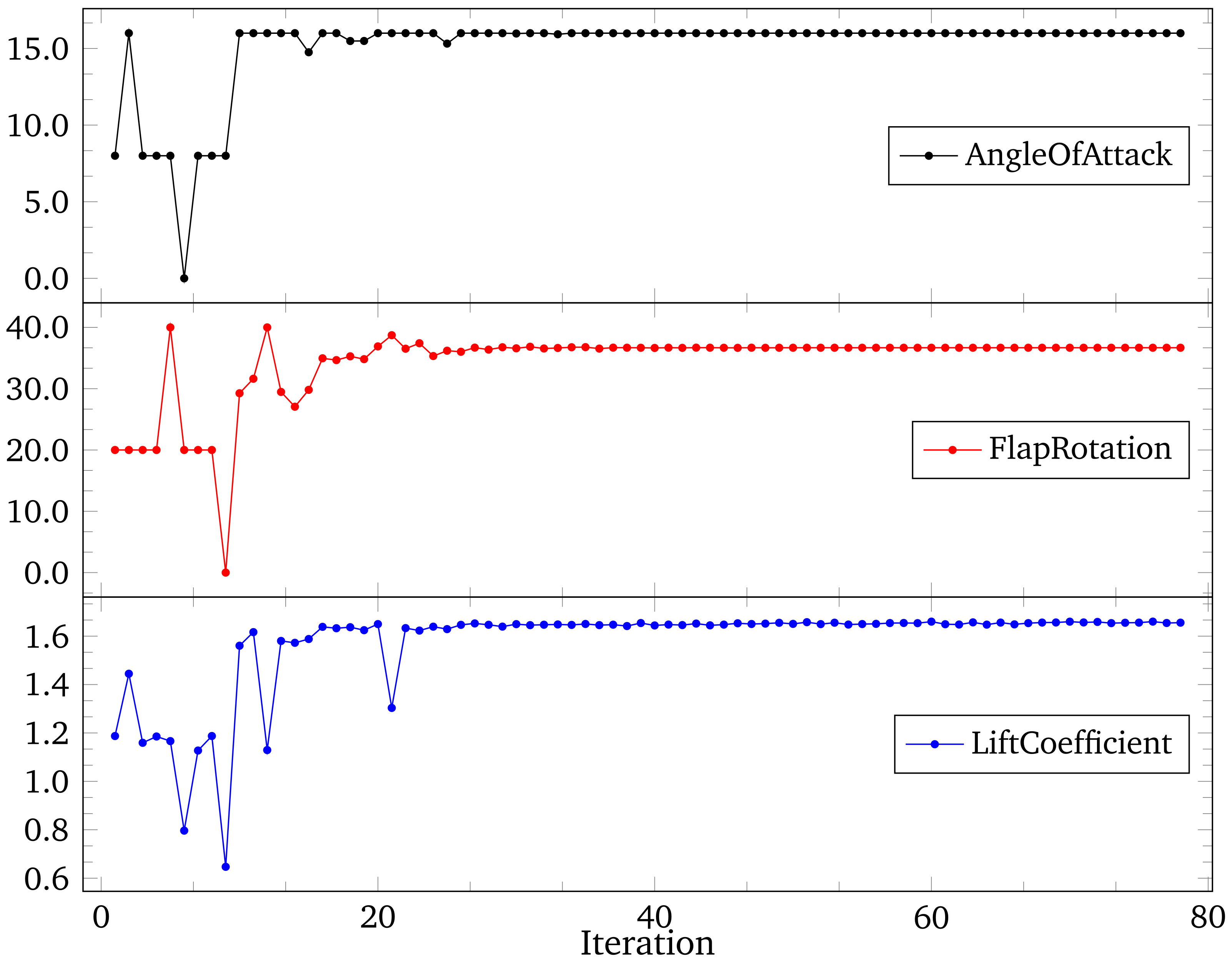
The convergence history of the optimization process is presented in
Figure 3. We point out that GEMSEO along with the COBYQA algorithm was able to converge in around 35 iterations, also in 35 CODA evaluations. In the figure, the evolution of the lift coefficient for different wing/flap configurations is shown. The values of the design variables for the optimal flap position, at which the lift coefficient is maximum, are summarized in
Table 1.
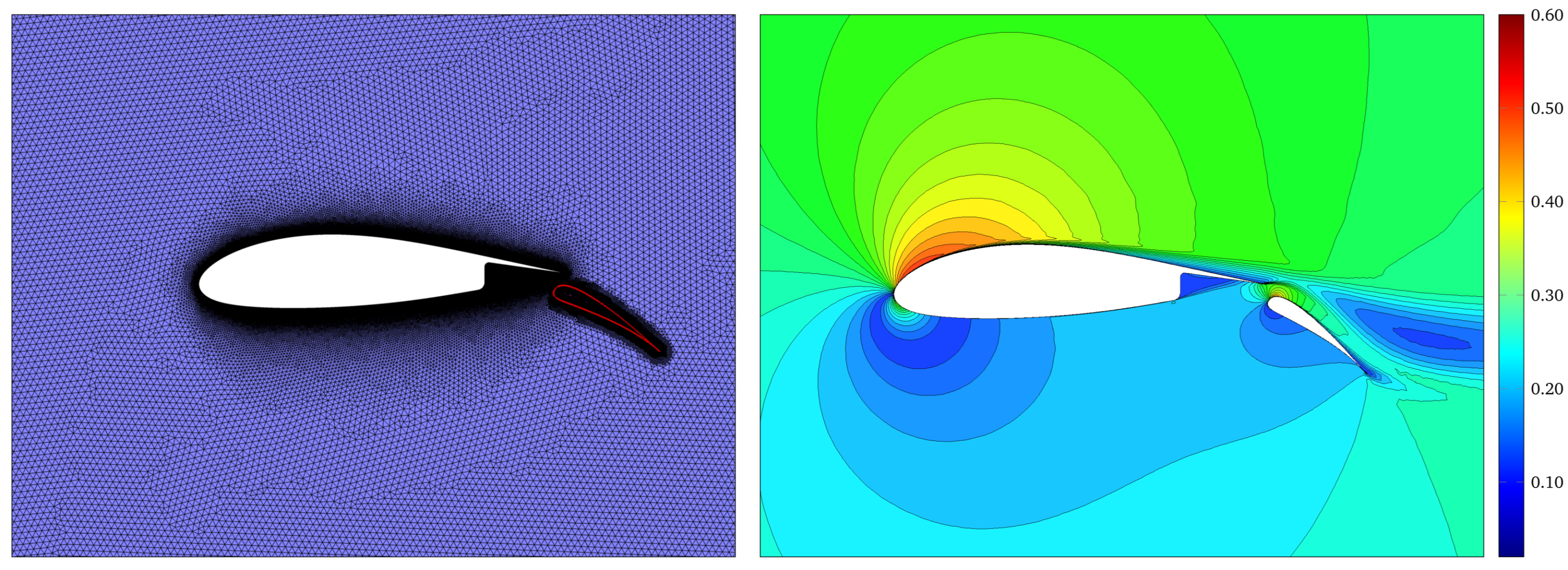
Additionally, we show the contour plots of the velocity magnitude for the baseline configuration (
Figure 4, left), and the optimal configuration, (
Figure 4, right).
4. Conclusions
In this work we have discussed a new strategy for the optimization of the flap position of a high-lift configuration in the framework of a hybrid electric regional aircraft. Our methodology is based on the multidisciplinary design optimization software GEMSEO and the CFD solver CODA with the immersed boundary methods. Our approach allows us to perform CFD simulations with the body-fitted mesh of the main airfoil and positioning the flap as an immersed boundary. The main advantage of this framework is to avoid the remeshing of the flap each time it changes its position with respect to the airfoil. This advantage can be reflected in the computational efficiency as no mesh generation is needed. Our results for the computation of the optimal configuration of the flap during takeoff and landing phases show the effectiveness of the methodology.
Author Contributions
Conceptualization, J.N.-d.l.R., A.M., E.F. and E.V.; methodology, J.N.-d.l.R. and A.M.; software, J.N.-d.l.R. and A.M.; validation, J.N.-d.l.R. and A.M.; formal analysis, J.N.-d.l.R.; investigation, J.N.-d.l.R. and A.M.; resources, E.F. and E.V.; data curation, J.N.-d.l.R.; writing—original draft preparation, J.N.-d.l.R.; writing—review and editing, J.N.-d.l.R., E.F. and E.V.; visualization, J.N.-d.l.R.; supervision, E.F. and E.V.; project administration, E.F. and E.V.; funding acquisition, E.F. and E.V. All authors have read and agreed to the published version of the manuscript.
Funding
This research was funded by the Clean Aviation Joint Undertaking under the European Union’s Horizon Europe Research and Innovation Programme under Grant Agreement HERA (Hybrid-Electric Regional Architecture) No. 101102007. All authors gratefully acknowledge Universidad Politécnica de Madrid for providing computing resources on Magerit Supercomputer.
Institutional Review Board Statement
Not applicable.
Informed Consent Statement
Not applicable.
Data Availability Statement
The data presented in this study are available on request from the corresponding author.
Acknowledgments
The authors gratefully acknowledge Universidad Politécnica de Madrid (
www.upm.es) for providing computing resources on Magerit Supercomputer. The authors also thankfully acknowledge the computer resources at MareNostrum and the technical support provided by Barcelona Supercomputing Center (RES-IM-2022-3-0023).
Conflicts of Interest
Andrés Mateo was employed by the Airbus Defence and Space S.A.U–Flight. The remaining authors declare that the research was conducted in the absence of any commercial or financial relationships that could be construed as a potential conflict of interest.
References
- Núñez, J.; Huergo, D.; Lodares, D.; Shrestha, S.; Guerra, J.; Florenciano, J.; Ferrer, E.; Valero, E. Implementation of immersed boundaries via volume penalization in the industrial aeronautical computational fluid dynamics solver CODA. Eng. Comput. 2025, 41, 2571–2592. [Google Scholar] [CrossRef] [Scilit]
- Colombo, S.; Rubio, G.; Kou, J.; Valero, E.; Codina, R.; Ferrer, E. A high-order immersed boundary method to approximate flow problems in domains with curved boundaries. J. Comput. Phys. 2025, 528, 113807. [Google Scholar] [CrossRef] [Scilit]
- Kou, J.; Joshi, S.; Hurtado-de Mendoza, A.; Puri, K.; Hirsch, C.; Ferrer, E. Immersed boundary method for high-order flux reconstruction based on volume penalization. J. Comput. Phys. 2022, 448, 110721. [Google Scholar] [CrossRef] [Scilit]
- Gallard, F.; Vanaret, C.; Guénot, D.; Gachelin, V.; Lafage, R.; Pauwels, B.; Barjhoux, P.J.; Gazaix, A. GEMS: A Python Library for Automation of Multidisciplinary Design Optimization Process Generation. In Proceedings of the 2018 AIAA/ASCE/AHS/ASC Structures, Structural Dynamics, and Materials Conference, Kissimmee, FL, USA, 8–12 January 2018. [Google Scholar]
- Kroll, N.; Abu-Zurayk, M.; Dimitrov, D.; Franz, T.; Führer, T.; Gerhold, T.; Görtz, S.; Heinrich, R.; Ilic, C.; Jepsen, J.; et al. DLR project Digital-X: Towards virtual aircraft design and flight testing based on high-fidelity methods. CEAS Aeronaut. J. 2016, 7, 3–27. [Google Scholar] [CrossRef] [Scilit]
- Jägersküpper, J.; Vollmer, D. On highly scalable 2-level-parallel unstructured CFD. In Proceedings of the 8th European Congress on Computational Methods in Applied Sciences and Engineering, Oslo, Norway, 5–9 June 2022. [Google Scholar] [CrossRef] [Scilit]
- Volpiani, P.; Chapelier, J.B.; Schwöppe, A.; Jägersküpper, J.; Champagneux, S. Aircraft simulations using the new CFD software from ONERA, DLR, and Airbus. J. Aircr. 2024, 61, 857–869. [Google Scholar] [CrossRef] [Scilit]
| Disclaimer/Publisher’s Note: The statements, opinions and data contained in all publications are solely those of the individual author(s) and contributor(s) and not of MDPI and/or the editor(s). MDPI and/or the editor(s) disclaim responsibility for any injury to people or property resulting from any ideas, methods, instructions or products referred to in the content. |