1. Introduction: IFAV Concept
Currently, the regulatory framework, including the EU Commission Regulation 2015/340 [
1], defines currency requirements that ensure ATCOs regularly practice to maintain their operational skills. These conditions require controllers to exercise their privileges within certain time intervals to remain qualified for active duty, although the specific requirements vary by State. ATCOs are typically certified for a limited number of sectors, and maintaining this certification requires extensive refresher training. This situation poses challenges for Air Navigation Service Providers (hereinafter ANSPs), particularly as operational demand increases and the need for controllers with multi-sector competencies grows. The lengthy training and the currency requirements, such as the need to have been on duty in a sector for a certain amount of time within a given period (e.g., every 45 days in Spain), limit the number of sectors in which ATCOs can be endorsed. It is also important to highlight that ATCO rostering remains critical for maintaining capacity and operational efficiency. European studies have linked inefficient rostering to over 60% of Air Traffic Flow Management (hereinafter ATFM) delays in 2019 and have high-lighted opportunities for optimization through workforce planning, mental workload management, and automation [
2,
3].
The IFAV3 solution aims to mitigate these obstacles. It is developed under the SESAR program, building on prior research from PJ.10-06 NGCV, PJ.10-W2-73 IFAV, and PJ.33-W3-01a FALCO [
4], which addressed challenges in flexible ATCO rostering and sector endorsements.
In 2018, under Solution PJ.10-06, a joint exercise involving NATS, Skyguide, and LFV highlighted that controllers working in unfamiliar sectors faced difficulties due to procedural, coordination, and geographical differences, which affected situational awareness and workload.
Building on this research, PJ.10-W2-73 and PJ.33-W3-01a explored standardized procedures, dedicated supporting tools, and adapted training to reduce reliance on detailed memorized sector knowledge. Validations showed positive effects on safety, workload, situational awareness, and efficiency, suggesting potential reductions in training time and endorsement maintenance while improving network-level cost efficiency.
The IFAV3 concept aims to build on previous research by addressing these challenges through enhanced flexibility in ATCO rostering, while mitigating the previously identified limitations. In this context, four strategies have been developed to reduce ATCOs’ mental effort, optimize resource allocation, optimize airspace organization, and standardize practices across units:
IFAV Tool Support—Involves the use of dedicated tools by ATCOs operating in sectors where they are fully competent, as determined by the measures established under the IFAV framework.
Smart Controller Experience Assessment and Required Competency Estimation—Defines several core competency categories and a methodology to assess them for each ATCO, based on their training and operational experience.
Smart Sector Groupings—Focuses on deploying optimal sector groupings that enable an Air Traffic Services Unit (hereinafter ATSU) to efficiently manage annual traffic demand (i.e., matching capacity to demand) while improving cost efficiency.
Common Unit Competence Scheme Framework—Proposes a harmonized methodological framework across Europe to align current and future currency requirements accepted by ANSPs and National Competent Authorities.
2. Strategy 3: Smart Sector Grouping (Solution 1c)
Currently, in the strategic phase, the Airspace Manager (hereinafter ASM) defines the sector groups within an ATSU for the different rating endorsement licenses based on their experience and the operational needs of the unit. This process is influenced by several factors such as historical traffic patterns, human factors considerations, and the need to maintain an efficient sector configuration. In this regard, the general principles for sector design and sectorization follow the guidelines established in the European Route Network Improvement Plan Part 1 for airspace design methodology [
5]. The manager determines the set of sector groups that will be formalized as unit endorsement licenses. Other factors must also be considered in this decision-making process, such as maintaining a balance in the number of sectors within each unit, minimizing training costs, and meeting operational efficiency requirements. Moreover, the ASM must ensure that enough ATCOs are on duty to consistently meet traffic demand in the coming years. Therefore, the definition of sectors within each sector grouping, and consequently within each unit endorsement license, is a key factor. A suboptimal selection of sector groups can reduce ATSU capacity, as it may require opening more sectors than necessary to handle the same traffic demand. This, in turn, increases the number of ATCOs needed per shift and can ultimately expose a shortage of endorsed ATCOs to cover peak hours.
The current method presents several limitations, the most significant being the inherent difficulty for the ASM to fully consider the vast range of possible operational scenarios. In practice, this would require calculating every hourly traffic load for each day of the year, across all possible combinations of elementary and collapsed sectors, and comparing them with the declared capacities of each configuration. Such an exhaustive analysis is not feasible from a cognitive standpoint, as the number of potential permutations grows exponentially with the number of elementary and collapsed sectors. Even with significant computational support, the amount of data to be processed and interpreted would be overwhelming, making it impossible to identify the optimal sector grouping manually.
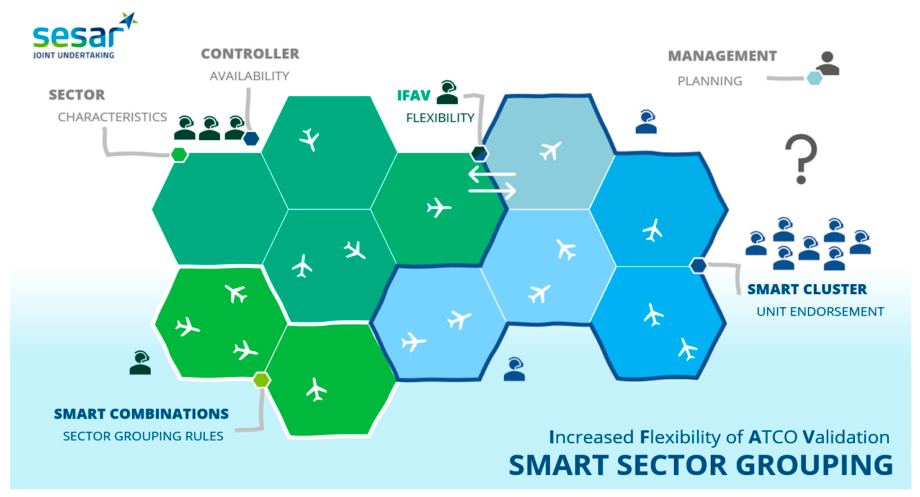
Furthermore, adding the IFAV3 ATCO flexibility concept to the current situation makes the design of sector groupings an even more complex task. To improve this methodology and mitigate the issues, the Smart Sector Grouping Strategy (
Figure 1), has been developed, with two main objectives:
To incorporate the IFAV Concept to design ATCO rostering.
To design, years in advance, the optimal sector grouping structure for endorsement purposes, leveraging IFAV flexibility opportunities.
3. Smart Sector Grouping Tool (GRU)
The development of the Smart Sector Grouping (hereinafter GRU) tool is proposed to optimize the sector grouping process and support the ASM in strategic decision-making. The tool will generate all feasible sector grouping solutions within the ATSU’s area of responsibility and will evaluate them using performance indicators to determine the configuration that best meets traffic demand under operational and staffing constraints.
First, the ASM must decide on the number of sector groups and the design of each group (i.e., the list of elementary sectors). Once both decisions are made, they constrain subsequent processes, such as feasible collapsed sectors and sector configurations. In other words, it will generally no longer be possible to use a collapsed sector that combines sectors from different sector groups, even if the traffic load suggests it would be more efficient, because such a collapsed sector would not be supported by the list of sectors within the Unit Endorsement. Consequently, the ATCO would not be able to manage those potentially collapsed sector groups.
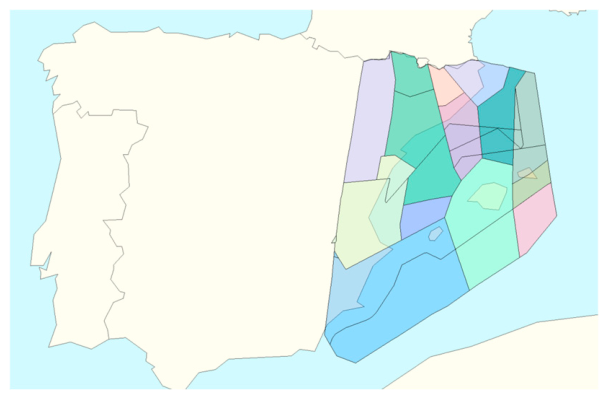
For example, in an ATSU containing 17 elementary sectors, as shown in
Figure 2, if it is necessary to design two sector groups to later define the two corresponding Unit Endorsements, there would exist thousands of possible alternatives. Each of these alternatives must be evaluated carefully to assess their respective advantages and disadvantages, not only for a shift in a specific sector group but for all the shifts throughout a year for the entire ATSU.
The GRU tool is designed to overcome human limitations by providing ASM with comprehensive, data-driven insights that would otherwise be difficult to obtain or consider precisely. This automation not only reduces ASM’s workload but also enhances the quality and breadth of information available for decision-making.
To calculate all possible sector groupings, the tool receives as input historical or forecast traffic data, the list of sectors comprising the ATSU, sector capacities, and a file listing sector neighborhoods to ensure sectors are adjacent. The user can define a set of constraints based on the ATSU’s operational requirements, including:
Desired number of sector groups in each sector grouping,
ATCO shift schedules and rest requirements (%),
The IFAV threshold (%), which refers to the maximum percentage of capacity at which a sector under demand can be controlled by an IFAV-qualified ATCO.
Once the constraints are defined, the GRU tool computes all data and creates all valid sector combinations under the given inputs and calculates a set of quantitative indicators for the ASM to evaluate each alternative. Some of these indicators are described as follows:
Estimated Workforce (in ATSU and per group): An estimate of the number of ATCOs needed to meet the demand during the assessed period.
ATCOs (in ATSU and per group): This metric indicates the total number of ATCOs needed, aggregated across all shifts over the assessed period (in this case, one year).
Sectors (in ATSU and per group): This reflects the total number of sector-hours across the year.
Points (in ATSU and per group): This indicator estimates how overloaded a combination is.
IFAV Sectors (in ATSU and per group): Total number of sector-hours in which the demand is lower than 70% of sector capacity (IFAV limit).
IFAV chances (in ATSU and by group): The number of shifts throughout the year in which one sector group has IFAV sector hours (demand lower than 70% of sector capacity) while, at the same time, the other sector group is not applying maximum sectorization. As a result, there are ATCOs available.
Non-coincident peak (in ATSU and per group): This indicator refers to the number of shifts in which the hourly peaks of different groups do not occur simultaneously, making it possible, by using the IFAV concept, to use controllers from one group to cover the peak of another.
Daily variation indicator (in ATSU and per group): This indicator shows how variable the number of sectors to be opened is during daytime shifts. The higher the value, the more uniform the demand is across shifts. It would be 1 if all shifts were completely uniform. It is calculated as:
Seasonal indicator (in ATSU and per group): This indicator gives an idea of how the number of ATCOs varies throughout the year compared to the peak period. It is the percentage difference between the number of ATCOs needed during the peak cycle and the average over the whole period.
‘=max’: This cell indicates, if checked, that the groups share the same cycle as the peak maximum. If unchecked, the peaks do not coincide.
CEF4 (in ATSU and per group): Measures workforce utilization throughout the year (which is based on the peak cycle). It is calculated as:
It would be 100 if the number of ATCOs in the peak cycle were repeated throughout the entire study period. The higher the value, the better the workforce utilization.
CEF2: Measures workforce productivity. It is calculated as the number of aircraft in the ATSU divided by the number of ATCO hours. The higher the value, the greater the controller efficiency.
Elasticity (in ATSU and per group): The difference between the maximum and minimum number of sectors opened during the study period.
No. ATCOs 1 unit endorsement: Minimum number of ATCOs required if the IFAV concept could be used to increase flexibility.
Workforce 1 unit endorsement: Minimum number of ATCOs needed to cover the entire period’s demand, assuming the IFAV concept could be used to increase flexibility.
Shifts improved with 1 unit endorsement: Maximum percentage of shifts that would improve if the IFAV concept could be used to increase flexibility.
IFAV shifts (%): This represents the percentage of shifts that include at least one hour assigned to an IFAV sector. A result is provided for each shift and sector group.
Peak cycle per group: Identifies the peak traffic cycle for each sector group.
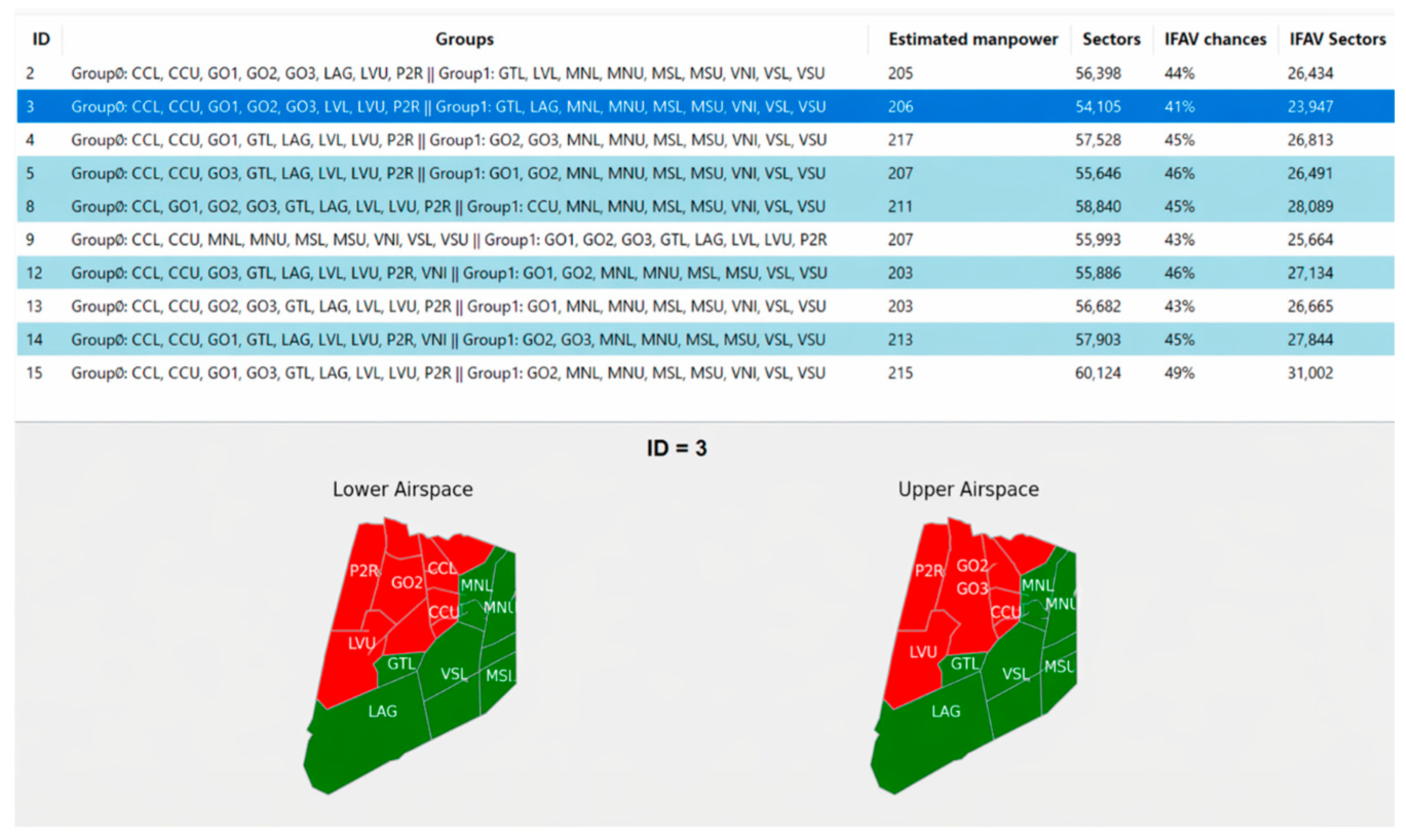
The user can order the sector group alternatives according to their interest indicator and compare them as shown in
Figure 3. With these indicators, the ASM can evaluate trade-offs of the given alternatives and select the sector grouping configuration that best aligns with the operational objectives and staffing efficiency of the ATSU. The chosen distribution must ensure compliance with regulatory constraints and allow for optimized staffing and operational flexibility. Depending on the situation, the ASM may be interested in optimizing the annual staffing plan even if it results in some imbalance between sector groups. In other contexts, however, the ASM might prefer a more balanced distribution among sector groups, even if this requires additional resources in the overall ATSU staffing.
4. Validation Exercise
4.1. Validation Scenario
The validation exercise was conducted in Spanish airspace. In Spain, airspace control is primarily managed through five ATSUs, located in Madrid, Barcelona, Seville, Palma de Mallorca, and the Canary Islands. Some ATSUs have more than one sector group, each associated with a unit endorsement. According to current national regulations, the maximum number of sectors allowed per unit endorsement is 10, which consequently limits the size of a sector group. If the number of sectors in an ATSU were to exceed this limit, the ATSU would require a redefinition of its sector groups. For the validation exercise, the chosen scenario was Barcelona En-Route ACC, which contains 17 elementary sectors and is currently divided into West and East Sector Groups. This distribution ensures compliance with current European and national regulations.
4.2. Exercise Description
The validation exercise of the GRU tool was conducted in May 2025 at the INECO facilities in Madrid. The purpose of the exercise was to ensure that the decision-making process for determining the best sector groupings for a future ATSU becomes more exhaustive and straightforward using the newly developed strategy tool.
The validation focused exclusively on the Barcelona En-Route ACC scenario and was conducted in two runs, each comprising a reference scenario and a solution scenario:
Run 1: The scenario was the Barcelona En-Route ACC sectors, which had to be divided into two sector groups. Additionally, experts were asked to consider the potential implementation of the IFAV concept. In the reference scenario, experts performed the task based solely on their expertise and supported by historical traffic data. In the solution scenario, experts performed the task using the GRU supporting tool.
Run 2: The scenario was again the Barcelona En-Route ACC sectors but divided into three groups. In the reference scenario, the task was performed based solely on expert knowledge and supported by historical traffic data. In the solution scenario, the task was performed using the GRU supporting tool.
The main validation technique applied in the exercise was Human-in-the-Loop. In this approach, experts interacted directly with the GRU tool: after selecting the input data and configuring the parameters, the system generated a series of indicators for the different sector group combinations. Using this information, they were able to identify the most suitable configuration based on the priorities defined for the ATSU.
The validation process consisted of a set of questionnaires and debriefings, which were evaluated to assess different aspects of GRU, including the relevance of the indicators, ease of use, and the extent to which it improved the overall experience compared with the traditional method.
5. Results and Discussion
The questionnaires completed during the validation runs were analyzed and compared between the reference and solution scenarios, and across both runs. Furthermore, the validation debriefing produced highly promising results, particularly regarding process optimization and reduced ASM workload. Additionally, for the different sector group alternatives selected with GRU support, the benefits in terms of cost efficiency associated with each option were analyzed. All the results presented below are based on expert opinion, quantitative assessment of key indicators, and analysis of the questionnaires.
5.1. GRU Tool Performance
Validation’s results demonstrate that GRU is an effective tool for identifying and evaluating optimal sector group alternatives within an ATSU, as evidenced by the case studies conducted at Barcelona. It has been demonstrated that the tool not only facilitates the definition of sector group structure with a more efficient estimated workforce but also provides a comprehensive set of operational indicators (including sector overload, IFAV distribution, and resource flexibility) that support informed decision-making. Compared to traditional expert-based methods, GRU explores a wider range of alternatives, helping ASMs to discard those less efficient configurations and uncover solutions that would normally be overlooked—some of which offer potential operational benefits. These outcomes confirm that GRU adds significant value to sector group design, enhancing automation of the design process, operational efficiency, and flexibility.
5.2. Cost-Efficiency
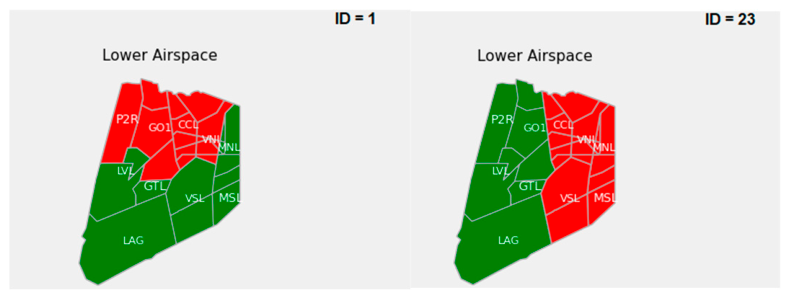
Moreover, the validation results confirm that the GRU tool effectively supports the selection of an optimal sector group structure according to indicators calculated by the tool, comparing different options such as the two shown in
Table 1 and
Figure 4, in terms of both workforce utilization and ATCO productivity. This was evaluated by comparing expert-selected reference scenarios with GRU-generated solutions over a one-year period. It was concluded that the tool consistently identified combinations that improved the annual utilization of the available controllers by up to 7% compared to the best reference configurations and by up to 13% compared to the worst. Similarly, for controller productivity, measured as the number of aircraft handled per controller hour, GRU-enabled selections increased controller efficiency by up to 6% relative to the current setup, and by approximately 3% compared conservatively to the best expert-selected configurations. These results demonstrate that GRU not only facilitates the identification of optimal sector groupings but also provides clear, quantitative support for operational decision-making, outperforming traditional expert-based approaches in both workforce utilization and productivity metrics.
5.3. Workload and Human Performance
Although sector grouping is a strategic task planned years in advance and is not time-critical, GRU demonstrated efficiency improvements, completing the process in a timelier manner—approximately 7% improvement. More importantly, GRU reduced the ASM workload by approximately 40%, as the current approach is highly dependent on expert judgment and manual calculations. In contrast, the tool enables systematic consideration of multiple indicators while reducing manual effort and preserving human authority in decision-making. End-user trust in the tool was assessed to be acceptable, and situational awareness remained within acceptable limits, slightly higher than with the current approach. Consequently, job satisfaction is expected to increase by approximately 30%, based on validation results.
5.4. Competence Requirements
The validation confirmed that the introduction of GRU will not significantly change competence requirements for ASMs. The decision-making responsibility remains unchanged from the current approach; GRU simply acts as a supporting tool by providing indicators more efficiently and accessibly. Validation participants confirmed this during the debriefing, emphasizing that the final decision remains up to the ASM.
Author Contributions
Conceptualization, T.A., J.M.R., M.R.D. and D.R.-M.; methodology and software, M.R.D.; validation, formal analysis, and investigation, T.A., J.M.R., M.R.D. and D.R.-M.; data curation, M.R.D.; writing—original draft preparation, T.A.; writing—review and editing, T.A., J.M.R. and D.R.-M.; visualization, T.A.; supervision and project administration, and funding acquisition, J.M.R. All authors have read and agreed to the published version of the manuscript.
Funding
This research was funded by SESAR Joint Undertaking, grant number 101114683, under HORIZON-JU-RIA—HORIZON JU Research and Innovation Actions.
Institutional Review Board Statement
Not applicable.
Informed Consent Statement
Not applicable.
Data Availability Statement
The data presented in this study are available on request from the corresponding author.
Conflicts of Interest
Authors Teresa Arangüete, José Manuel Rísquez, Mariano Rubio Diaz and David Rodríguez-Madridejos were employed by the company Ingeniería y Economía del Transporte (INECO). The remaining authors declare that the research was conducted in the absence of any commercial or financial relationships that could be construed as a potential conflict of interest.
References
- EASA Commission Regulation (EU) 2015/340. 20 February 2015. Available online: https://www.easa.europa.eu/en/document-library/regulations/commission-regulation-eu-2015340 (accessed on 8 September 2025).
- EUROCONTROL. Proposal for the Future Architecture of European Airspace; EUROCONTROL: Brussels, Belgium, 2015. [Google Scholar]
- EUROCONTROL. Air Traffic Flow Management Delays in Europe; EUROCONTROL: Brussels, Belgium, 2019. [Google Scholar]
- Finke, M.; Hunger, R.; Tyburzy, L.; Meier, J.; Jameel, M. Using Tool Support to Enable a More Flexible Deployment of Air Traffic Controllers to Sectors; Deutsche Gesellschaft für Luft- und Raumfahrt-Lilienthal-Oberth: Bonn, Germany, 2024. [Google Scholar]
- EUROCONTROL. ERNIP Part 1 European Airspace Design Methodology Guidelines. 2025. Available online: https://www.eurocontrol.int/publication/european-route-network-improvement-plan-ernip-part-1 (accessed on 3 September 2025).
| Disclaimer/Publisher’s Note: The statements, opinions and data contained in all publications are solely those of the individual author(s) and contributor(s) and not of MDPI and/or the editor(s). MDPI and/or the editor(s) disclaim responsibility for any injury to people or property resulting from any ideas, methods, instructions or products referred to in the content. |