1. Introduction
Aviation is one of the hardest sectors to decarbonize. Although responsible for about 2.5% of global CO
2 emissions, its total climate impact increases to 3.5–5% of global radiative forcing when non-CO
2 effects such as contrails, NOₓ, and water vapor are included [
1,
2]. These indirect effects are comparable to direct CO
2 emissions and highlight the need for a full well-to-wake perspective. With air traffic expected to double by mid-century, deep cuts require propulsion concepts beyond incremental efficiency gains.
Decarbonization pathways include bio-fuels, e-fuels, electric propulsion, and hydrogen-based systems [
2]. Bio-fuels recycle biogenic carbon, while e-fuels synthesized from green hydrogen and captured CO
2 offer drop-in compatibility with reduced life-cycle emissions when powered by renewables. Hydrogen combustion eliminates in-flight CO
2 but emits NOₓ and water vapor, whereas hydrogen fuel cell propulsion converts hydrogen electrochemically with no in-flight CO
2 and minimal NOₓ. These options differ widely in maturity, infrastructure needs, and environmental performance.
The exFAN project develops a next-generation hydrogen fuel cell aircraft integrating heat recuperation to recover waste thermal energy and reuse it for reactant preheating or thrust assistance, improving propulsive efficiency and reducing hydrogen demand. Recent work by Gerl et al. [
3] similarly emphasizes the benefits of advanced heat exchange integration in hydrogen–electric propulsion.
The current literature remains fragmented [
4,
5,
6,
7], often isolating fuel production (WTT), operational (TTW) impacts or non-CO
2 effects. Comparative studies of hydrogen combustion and fuel cell aircraft are limited, and few examine prospective 2050 scenarios. This work provides an integrated well-to-wake comparison of six propulsion systems—kerosene, bio-fuel, e-fuel, hydrogen combustion, hydrogen fuel cell, and exFAN—under a harmonized framework that consistently includes WTT, TTW, and non-CO
2 emissions. It introduces the exFAN configuration as an efficiency-enhanced hydrogen fuel cell concept, outlining the lower-bound climate footprint achievable through advanced hydrogen aviation technologies.
2. Methodology
2.1. System Boundaries and Functional Unit
The goal and scope of this study are to focus on fuel production and use-phase emissions, corresponding to the well-to-tank (WTT) and tank-to-wake (TTW) stages, which together represent the full well-to-wake (WTW) emissions for each propulsion system. Upstream processes include fuel extraction, production, and distribution, while downstream stages capture in-flight operational emissions. Moreover, dedicated studies on A320-class aircraft indicate that aircraft manufacturing and airport infrastructure are not dominant contributors to climate impacts, with operational emissions representing the main source of CO
2 in cradle-to-gate assessments [
8,
9]. Non-CO
2 climate effects—NOₓ, contrails, and water vapor—are also included and expressed as CO
2-equivalent emissions using published radiative forcing multipliers. The functional unit is one passenger-kilometer (PKM) for a medium-haul A320neo-type aircraft carrying 160 passengers, enabling the consistent comparison of propulsion systems on an equal transport service basis.
2.2. Scenario Design and Harmonized Assumptions
A harmonized modeling framework was applied across all propulsion options, assuming an A320-equivalent aircraft with identical payload, passenger capacity, and mission profile. Two time horizons were defined to reflect present and future energy system conditions (
Table 1). The 2025 baseline represents current industrial practice, with hydrogen supplied via Steam Methane Reforming (SMR) and electricity from the German grid mix. The 2050 scenario assumes a fully decarbonized system powered by 100% wind electricity and hydrogen produced via Proton Exchange Membrane Water Electrolysis (PEMWE). For bio-fuels and e-fuels, a 100% drop-in blending ratio was applied to ensure comparability. Mission parameters were kept constant across cases, isolating the effect of fuel and propulsion technology on total emissions.
Table 1 summarizes all scenario assumptions.
2.3. Fuel Consumption Estimation
Baseline fuel consumption for the kerosene-powered A320neo was taken from literature and industry data, adopting 0.025 kg fuel per passenger-km in line with HAW Hamburg values [
10]. Fuel demand for each alternative was then adjusted for:
Differences in the lower heating value (LHV) between fuels, which affect the amount of energy released per kilogram of fuel.
Engine and propulsive efficiency ratios, reflecting how effectively each propulsion system converts fuel energy into thrust.
Aircraft weight changes resulting from fuel storage requirements or system modifications, which influence overall fuel consumption.
Fuel demand for each alternative technology was computed using the following relation:
This relation links the fuel demand of each alternative not only to the fuel’s lower heating value but also to the corresponding engine efficiency and the resulting aircraft weight changes.
2.4. Life-Cycle Inventory (LCI) and Data Sources
Background data for all fuel production pathways were sourced from Ecoinvent v3.10, with electricity mixes adapted to the 2025 and 2050 scenarios described in
Table 1. Modeling and calculations were performed in SimaPro v9.6.0, which supports process-based LCA modeling, impact assessment, and scenario analysis. Non-CO
2 emission factors and their conversion to CO
2-equivalents followed Lee et al. [
5], while GWP
100 values were taken from IPCC AR6 (2021) [
11].
Upstream (well-to-tank, WTT) emissions were quantified using CO
2 intensities per kilogram of fuel (kg CO
2/kg fuel), covering extraction, conversion, and distribution. For each propulsion pathway, these values were obtained from Ecoinvent v3.10 or the recent literature. The resulting upstream CO
2 intensities for all fuels and scenarios are summarized in
Table 2. The 2025 cases reflect current production technologies and electricity mixes, while the 2050 cases represent renewable-based systems and decarbonized energy supply, consistent with the scenario assumptions in
Section 2.3.
To ensure consistency, emissions were either taken directly from the literature or recalculated using the published inventories with updated background data (Ecoinvent v3.10) and the scenario-specific electricity mixes defined in
Section 2.3. For bio-fuels, the average value of HEFA-based pathways from Prussi et al. [
6] was adopted, as these represent the most mature and widely deployed bio-fuel route. For 2050 scenarios, hydrogen-related processes were updated by substituting the 2025 SMR supply with PEMWE-based hydrogen powered by 100% wind electricity, maintaining harmonized system boundaries across all pathways.
2.5. Climate Change Impact
Climate impacts were quantified using the GWP100 indicator, expressed as grams of CO2-equivalent per passenger-kilometer (g CO2-eq/PKM).
A consolidated calculation links fuel use, emission factors, and radiative forcing multipliers to determine the final g CO2-eq/PKM value.
2.6. exFAN Fuel Consumption Estimation
For the exFAN configuration, the energy demand of a reference hydrogen fuel cell aircraft was adjusted to reflect the expected efficiency gain from the integrated heat recuperation system. Based on project design targets and ongoing internal simulations, a conservative upper-bound assumption of a 10% increase in propulsive efficiency was adopted, corresponding to an approximately 10% reduction in hydrogen consumption under identical flight conditions. This reduction was applied before calculating well-to-wake emissions, while all other parameters like hydrogen source, electricity mix, system boundaries, and non-CO2 treatment remained identical to the reference fuel cell case. This value represents a scenario assumption coming from consultation with project consortium experts rather than a validated performance result and is used to explore the potential sustainability implications of heat recuperation.
3. Results
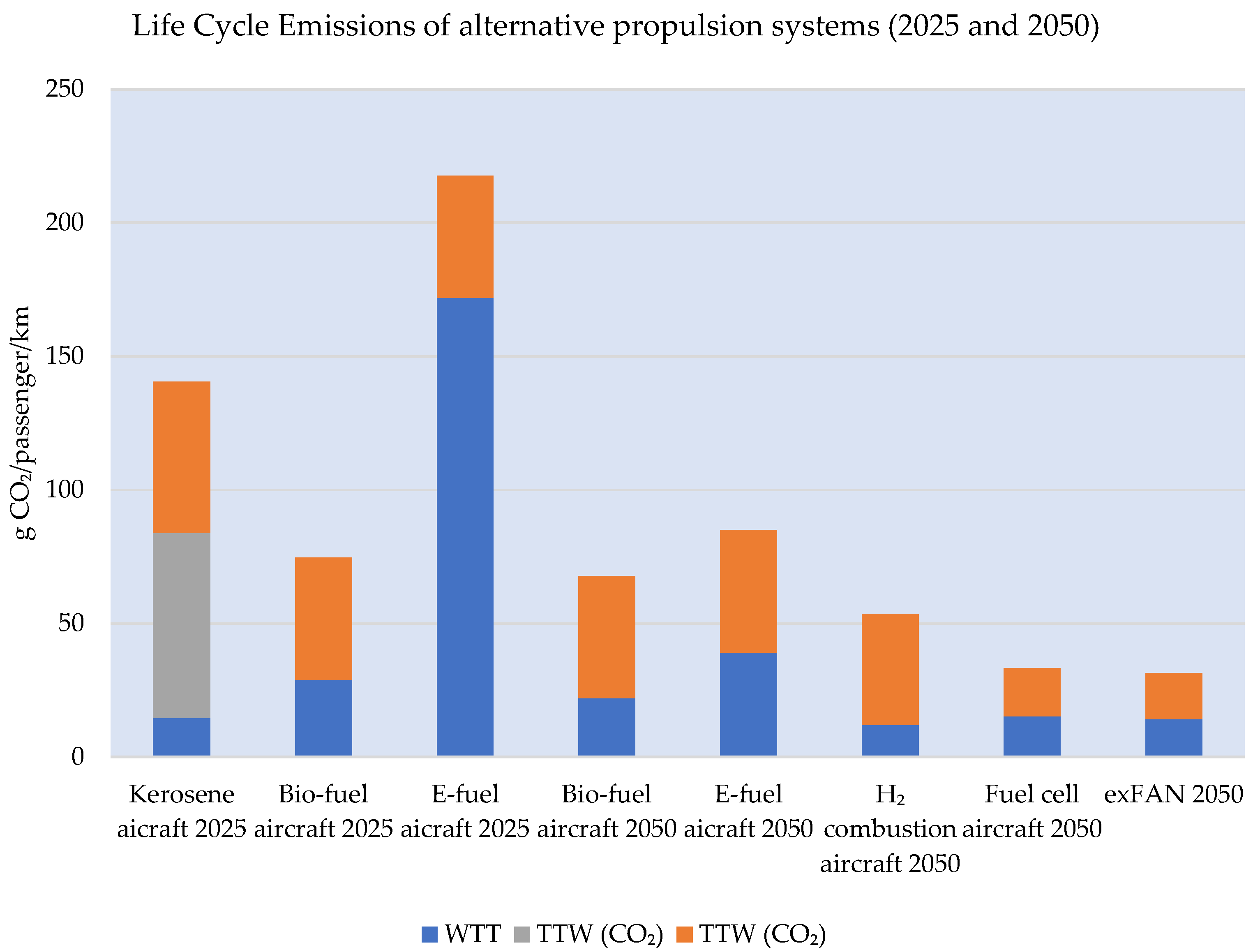
Figure 1 presents the combined well-to-wake (WTW) emissions of the assessed propulsion systems for 2025 and 2050, decomposed into well-to-tank (WTT), tank-to-wake CO
2, and tank-to-wake non-CO
2 contributions. The corresponding relative changes in each category compared with the 2025 kerosene baseline are summarized in
Table 3.
Kerosene shows the lowest upstream (WTT) contribution due to its mature, efficient production chain. Although its total climate impact is high, its supply chain emissions are relatively small compared with bio-fuels, e-fuels, and hydrogen fuel production routes. For e-fuels and hydrogen propulsion, hydrogen production dominates WTT emissions because H2 is required either as a synthesis intermediate or as the final fuel. In 2025, when hydrogen is mainly produced via SMR, e-fuels exhibit the highest upstream footprint due to the combined demands of hydrogen generation and CO2 conversion. By 2050, the assumed shift to renewable electrolysis (PEMWE) could reduce upstream emissions by more than 70% for all hydrogen-based pathways, underscoring their strong dependence on electricity’s carbon intensity.
Among the assessed propulsion systems, only kerosene combustion releases fossil CO
2 during flight. For bio-fuels, biogenic CO
2 emissions emitted from fuel combustion are assumed to be offset by the biomass carbon uptake that happened during feedstock growth and cultivation. E-fuels emit CO
2 captured during synthesis, yielding a near-net-zero balance between production and use. Hydrogen combustion and fuel cell systems emit no in-flight CO
2, as hydrogen oxidation produces only water vapor. This explains the disappearance of TTW CO
2 bars for all 2050 hydrogen-based configurations in
Figure 1.
Non-CO2 effects remain significant and vary across pathways:
NOₓ: Formed only in high-temperature combustion; kerosene, bio-fuels, e-fuels, and hydrogen combustion exhibit similar levels, while fuel cell systems eliminate NOₓ due to low-temperature operation.
Water vapor: Comparable for hydrocarbon fuels; hydrogen combustion and fuel cells emit approximately 2.5× more due to stoichiometric water formation.
Contrails: Synthetic hydrocarbons produce slightly less persistent contrails (lower soot), hydrogen combustion forms larger but more transparent contrails, and fuel cell exhaust is the least favorable for contrail formation [
13].
Overall, bio-fuels and e-fuels reduce non-CO2 impacts by ~19% and hydrogen combustion by ~27%, while fuel cell and exFAN configurations achieve the largest reductions due to the absence of NOₓ and minimal contrail-forming exhaust.
By 2050, under the assumption of carbon-free hydrogen during the use phase, hydrogen combustion and fuel cell systems eliminate direct CO2 emissions and yield the lowest non-CO2 effects, with fuel cells showing the smallest total WTW footprint. The exFAN configuration improves further on the fuel cell baseline through heat recuperation, providing ~10% higher propulsive efficiency and reduced hydrogen demand. Overall, exFAN achieves ~80% lower CO2-equivalent emissions than kerosene and ~11% lower than those of a conventional fuel cell aircraft.
4. Discussion and Conclusions
Hydrogen propulsion offers substantial decarbonization potential; however, its net benefit depends on low-carbon fuel supply chains, efficiency-enhancing system integration such as exFAN, and the effective mitigation of non-CO2 effects. Among the assessed concepts, exFAN shows the lowest well-to-wake (WTW) impact due to its heat recuperation system, which is assumed to enhance propulsive efficiency by reducing hydrogen demand relative to a conventional fuel cell configuration, thereby directly lowering upstream emissions that dominate the WTW footprint of hydrogen-based aviation systems. This highlights the importance of system-level efficiency improvements in addition to fuel substitution when evaluating future hydrogen aircraft concepts.
As operational emissions decline across advanced propulsion concepts, aviation climate performance becomes increasingly driven by upstream hydrogen and electricity production pathways, underscoring the critical role of fully decarbonized energy systems in realizing the climate benefits of hydrogen aviation. Differences between propulsion concepts therefore become increasingly sensitive to assumptions regarding electricity mix, hydrogen production technology, and overall energy system maturity.
Non-CO2 effects remain critical contributors to aviation climate impact and require targeted mitigation through operational measures (e.g., routing and altitude optimization), improved exhaust temperature control, or emerging catalytic solutions. Compared with combustion-based concepts, exFAN benefits from low-temperature operation, eliminating NOₓ formation and potentially reducing water vapor-induced and contrail-related climate effects.
5. Limitations and Future Work
This study uses simplified prospective scenarios rather than a full prospective life-cycle assessment and therefore does not capture dynamic supply chain evolution or future background system changes. Future work will extend the framework to a full prospective LCA integrating evolving energy mixes and system-level performance metrics.
A second limitation is the high uncertainty in aviation non-CO
2 climate effects, as reported by Lee et al. [
5]. The CO
2-equivalent factors used here inherit the wide confidence intervals reported by Lee et al. [
5], limiting the precision of the estimates. Future work should incorporate updated radiative forcing data, uncertainty ranges, and assessments of mitigation strategies such as contrail avoidance and high-temperature optimization.
Author Contributions
Conceptualization, A.P.; methodology, A.P. and A.G.; validation, A.P. and A.G.; formal analysis, A.P.; investigation, A.P. and A.G.; data curation, A.P. and A.G.; writing—original draft preparation, A.P. and A.G.; writing—review and editing, E.K.; visualization, A.P.; supervision, E.K.; project administration, E.K.; funding acquisition, E.K. All authors have read and agreed to the published version of the manuscript.
Funding
The activities presented in this paper were carried out as part of the European Union’s Horizon 2020 research and innovation programme exFAΝ: “exFAΝ—Novel recuperation system to maximize exergy from anergy for fuel cell powered geared electric aircraft propulsion system.” (Grant Agreement no. Project 101138184).
Data Availability Statement
The data presented in this study are available on request from the corresponding author. Restrictions apply to the availability of background LCI data derived from licensed databases (e.g., ecoinvent). Additional data were obtained from scientific literature and project-generated inputs.
Conflicts of Interest
The authors declare no conflict of interest.
References
- International Air Transport Association (IATA). Non-CO2 Climate Effects: Contrails. Available online: https://www.iata.org/en/programs/sustainability/non-co2-emissions-contrails/ (accessed on 5 November 2025).
- Su-Ungkavatin, P.; Tiruta-Barna, L.; Hamelin, L. Biofuels, electrofuels, electric or hydrogen: A review of current and emerging sustainable aviation systems. Prog. Energy Combust. Sci. 2023, 96, 101073. [Google Scholar] [CrossRef]
- Gerl, B.; Ronovsky-Bodisch, M.; Ferrari, N.; Berens, M. Fundamentals of Innovative Aircraft Heat Exchanger Integration for Hydrogen–Electric Propulsion. Aerospace 2025, 12, 320. [Google Scholar] [CrossRef]
- CE Delft. Potential for Reducing Aviation Non-CO2 Emissions through Cleaner Jet Fuel; CE Delft: Delft, The Netherlands, 2022; Available online: https://cedelft.eu/publications/potential-for-reducing-aviation-non-co2-emissions-through-cleaner-jet-fuel/ (accessed on 2 November 2025).
- Lee, D.S.; Fahey, D.W.; Skowron, A.; Allen, M.R.; Burkhardt, U.; Chen, Q.; Doherty, S.J.; Freeman, S.; Forster, P.M.; Fuglestvedt, J.; et al. The contribution of global aviation to anthropogenic climate forcing for 2000 to 2018. Atmos. Environ. 2021, 244, 117834. [Google Scholar] [CrossRef] [PubMed]
- Prussi, M.; Lee, U.; Wang, M.; Malina, R.; Valin, H.; Taheripour, F.; Velarde, C.; Staples, M.D.; Lonza, L.; Hileman, J.I. CORSIA: The first internationally adopted approach to calculate life-cycle GHG emissions for aviation fuels. Renew. Sustain. Energy Rev. 2021, 150, 111398. [Google Scholar] [CrossRef]
- Cho, H.H.; Strezov, V.; Evans, T.J. Environmental impact assessment of hydrogen production via steam methane reforming based on emissions data. Energy Rep. 2022, 8, 13585–13595. [Google Scholar] [CrossRef]
- Roosien, R.J.; Lim, M.N.A.; Petermeijer, S.M.; Lammen, W.F. Multi-Modal Life Cycle Assessment of Journeys by Aircraft, Train or Passenger Car. Aerospace 2024, 11, 98. [Google Scholar] [CrossRef]
- Lewis, T. A Life Cycle Assessment of the Passenger Air Transport System Using Three Flight Scenarios. Master’s Thesis, Norwegian University of Science and Technology (NTNU), Trondheim, Norway, 2013. [Google Scholar]
- Kühn, M. Fuel Consumption of the 50 Most Used Passenger Aircraft; Project Report; Hamburg University of Applied Sciences: Hamburg, Germany, 2023. [Google Scholar]
- Intergovernmental Panel on Climate Change (IPCC). Climate Change 2021: The Physical Science Basis; Cambridge University Press: Cambridge, UK, 2021. [Google Scholar]
- Bareiß, K.; de la Rua, C.; Möckl, M.; Hamacher, T. Life cycle assessment of hydrogen from proton exchange membrane water electrolysis in future energy systems. Appl. Energy 2019, 237, 862–872. [Google Scholar] [CrossRef]
- Clean Sky 2 Joint Undertaking; Fuel Cells and Hydrogen 2 Joint Undertaking. Hydrogen-Powered Aviation: A Fact-Based Study of Hydrogen Technology, Economics, and Climate Impact by 2050; Publications Office of the European Union: Luxembourg, 2020.
| Disclaimer/Publisher’s Note: The statements, opinions and data contained in all publications are solely those of the individual author(s) and contributor(s) and not of MDPI and/or the editor(s). MDPI and/or the editor(s) disclaim responsibility for any injury to people or property resulting from any ideas, methods, instructions or products referred to in the content. |