1. Introduction
Student teams play a pivotal role in fostering technical innovation [
1], teamwork [
2], and leadership [
3], providing hands-on experience that equips and prepares students for their first roles in the industry. These teams, driven by voluntary participation and constrained by limited resources, face unique challenges in maintaining organizational sustainability, competitive success and operational longevity. Finding balance in a voluntary environment that aspires to emulate a professional one is particularly challenging [
4,
5]. Globally, project management methodologies have been widely adopted across industries to enhance efficiency, minimize risks, and ensure successful execution of projects. Two major international organizations especially set the standards for project management practices: the Project Management Institute (PMI) in the United States and the International Project Management Association (IPMA) in Europe [
6]. These frameworks serve as foundational references for understanding and applying project management principles in diverse settings.
Project management approaches are typically categorized into two primary methodologies: Agile & Waterfall [
7]. The latter methodology follows a linear and sequential approach, where project phases are completed one after another. It is best suited for projects with well-defined requirements and minimal anticipated changes. In contrast, Agile project management is an iterative, flexible approach that allows for continuous improvement and adaptation throughout the project lifecycle. Agile is particularly advantageous in dynamic environments where requirements evolve rapidly.
The role of the project manager is central to coordinating and guiding various aspects of the project [
8]. A project manager oversees planning, execution, risk management, and resource allocation, ensuring alignment with project goals and team objectives. In larger organizations, a Project Management Office (PMO) provides centralized governance, standardizing processes, improving decision-making, and fostering a results-oriented culture. Such structures help create dynamic and competitive organizations that thrive in complex and evolving environments. In student teams, adopting elements of a PMO framework can significantly enhance efficiency, ensuring structured workflows, clear communication, and accountability among team members.
These practices can help alleviate some of the most common problems, including:
Member turnover: difficulty to maintain the number of active team members as the years pass by (triggered primarily by student graduation).
Time constraints: members can’t devote much time due to other priorities (i.e., exams).
Voluntary nature: higher difficulty to apply processes or maintain chain of command.
Limited resources: materials, working space, tools, budget resources are scarce.
To explore how student-led technical teams can effectively apply project management principles to address these challenges, we shall examine the use case of Beyond Robotics, to demonstrate real-world implementation of project management in a non-professional, voluntary environment. Beyond Robotics is a student team from Greece, specializing in the development of autonomous robotic systems (rovers) for the European Rover Challenge [
9].
This paper outlines strategies for team formation, recruitment, skill development, knowledge transfer, and long-term sustainability. It highlights the critical role of flexibility in meeting situational demands and how altering processes can lead to successful outcomes. It explores strategies contributing to a framework that helps student teams enhance resilience, optimize performance, and sustain long-term success. The aim of this paper is to act as a guideline for other student teams, gathering insights and best practices to improve resilience, operational efficiency, and performance. Finally, it examines how traditional industry project management processes can be adapted to the unique needs of technical teams in educational, often voluntary, environments.
2. Building a Team
Vision & Goals: From the start, a strong vision was set aiming to inspire and motivate people to action—as well as boost recruitment efforts. That vision was to develop a rover from scratch—particularly the 1st rover in Greece to participate in the European Rover Challenge. The first milestone concerned the successful design of the system that leads to qualification in the finals. Subsequently, the team should develop and build it in order to compete in a space simulant mission claiming the best possible position in the world ranking. Since no Greek team had ever accomplished, nor tried to build a rover at a student level, this goal inspired many students and young professionals to join the team.
Legal Entity: For the team to receive funds legally and also operate autonomously without external influence, it was decided by the founders to establish a legal entity in the form of civil non-profit partnership. This would ensure that our team can raise funds to build the rover, maintain a voluntary and non-profit nature.
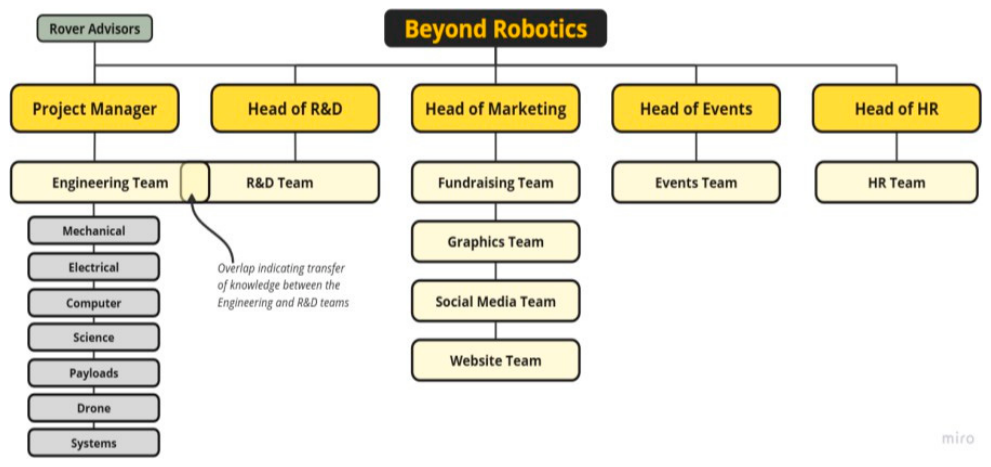
Organizing Structure: the structure focuses on dividing the team into smaller subteams which would correspond to the subsystems of the rover. These sub-teams would be responsible for all the design and development required to deliver the rover subsystems. The proposed subsystems were:
Mobility: wheels, suspension, motors and differential bar.
Structure: rover’s frame and supports.
Power: energy storage and power distribution systems.
Computer: control & navigation systems, user interface, and ground command center.
Telecom: telemetry, wireless communication and rover link.
Science: soil, environmental and geological analysis to meet scientific hypotheses.
Mechanisms: robotic arm, carousel sampling, end-effectors and other mechanisms.
Parallel, supporting to the engineering, other sub-teams include: Marketing, Events, Human Resources and R&D. The full team structure is presented in
Figure 1.
Leadership: For each subsystem, a leader is assigned (or 2 in some cases), responsible for the overall technical development of the subsystem as well as the management of the subsystem members. Supervising roles were the Project Manager and System Engineer.
The leader’s key duties include:
Managing sub-system members, assign and monitor tasks (define WBS and work).
Participating in recruiting efforts for new members (e.g., interviews).
Communicating with other subsystems for integration and co-dependencies.
Producing technical reports, coordinating meetings and sub-system communications.
Leading & organizing development efforts, according to timeline/budget constraints.
Recruiting: Based on subsystems needs, recruiting was executed with the aim of finding people most suitable for the open positions. Focus was on quality rather than quantity. Attracting and selecting the right talent was crucial for project success, as the unknowns, challenges and risks the team faced were enormous at the start of the project. The process starts by the subsystem leaders, who declare their needs and describe the positions in detail (responsibilities, required skills, time dedication etc.). Selecting the right candidate is summarized through the following recruitment process:
Open positions are promoted online, in social media and through word of mouth.
Leaders review applications & select promising applicants for the interview stage.
Interviews are arranged by the HR team, finding suitable date, time for all parties.
Online interviews are carried out to validate and extend information about the candidate and to provide valuable insight into their motivation and soft skills.
The leader and Head of HR decide the most suitable person for each position.
For the final selection, some of the criteria set include: motivation (passion for the team’s vision), time availability, and experience (technical ability to conduct their role).
3. Project Management Methodologies
Agile and Lean Integration: Beyond Robotics adopted a hybrid Agile-Lean framework, organizing rover development into iterative sprints using Jira for backlog management and visualization. Daily subsystem stand-ups and weekly planning ensured alignment, while Lean principles guided process refinement. As Agile methods improve success rates [
10] and Lean principles reduce inefficiency [
11], this combination enabled the team to adapt quickly and prioritize high-value tasks.
Customized Kanban: A digital Kanban board was tailored to the educational workflow, with stages reflecting learning objectives and development phases. Key milestones (e.g., design freeze, integration tests) were visually highlighted to signal deadlines. The board provided clear visibility of individual progress and overall workload, while workin-progress limits prevented overcommitment. This approach aligned with Lean-Agile practices, promoting milestone tracking, transparency, and student accountability [
11].
Skill Development through Management: Skills development was formalized through structured mentorship and team activities, where leaders guide members in:
Technical Skills: Senior members conducted workshops on CAD, embedded systems, and electronics integration. Additionally, pair programming and design reviews facilitated knowledge transfer from experienced peers to novices.
Soft Skills: Leaders fostered communication and leadership by requiring members to present progress during reviews. Regular peer feedback and retrospectives further encouraged open dialogue, initiative, and personal growth.
This approach ensured that individual members developed both technical capabilities and soft skills needed for projects [
12].
Systems Engineering and Requirements Management: The project adopted a systems-engineering approach based on NASA system engineering principles [
13] to align all subsystems with overall objectives. A requirements management tool (Valispace v2.2) was used to document specifications. Requirement verification methods were assigned to help later define the testing campaigns. The full requirement management process is showcased in
Figure 2. Beyond requirements, the systems team managed risk mitigation, integration (interfaces and assembly), testing, and comprehensive documentation.
Timeline Optimization with Dual-Layer Planning: Project scheduling employed a dual-layer strategy. A macro-schedule defined major milestones, while micro-schedules decomposed work into sprints and weekly tasks. Timeboxing was applied to prevent scope creeping. Post-sprint retrospectives fostered an iterative cycle of planning, execution, and review, ensuring schedule adherence and continuous learning consistent with Agile practices [
10,
12].
Financial Planning and Funding Strategies: Financial management was embedded in initial project planning via a detailed Bill of Materials (BOM) that guided budgeting and procurement scheduling. The team solicited multiple quotes and synchronized purchases with funding availability from university grants, sponsorships, and crowdfunding. Regular financial reviews allowed scope adjustments, ensuring resource constraints did not hinder technical progress [
12].
Communication Infrastructure and Coordination: A robust infrastructure was established to ensure effective coordination. Google Drive served as the central repository for documentation and version control, while a dedicated Discord server facilitated real-time communication through subsystem-specific channels. This setup supported a culture of transparency and continuous communication via two primary modes:
Synchronous Coordination: Weekly or bi-weekly subsystem meetings to discuss progress and issues, and a full-team meeting monthly to align on overall strategy.
Asynchronous Coordination: Team members posted updates and questions in chat channels, allowing others to respond to their schedule and ensure visibility for all. Subsystem leaders also maintained brief progress reports and checklists.
This ensured efficient information flow and project-wide awareness [
12].
4. Knowledge Transfer and Continuity Planning
Mentorship & Knowledge transfer: are vital to ensure project continuity. Mentoring can shape newcomers into future leaders, by slowly helping them to step into leadership roles. The team targets to pass on expertise and disseminate knowledge from senior members to the entire team, especially younger members. Knowledge sharing occurs in several ways. One method is for seniors to assign hands-on tasks to new members, and proceed to review, leave feedback or demonstrate solutions. These collaborative working sessions create engaging learning environments, turning senior members into mentors, ensuring knowledge retention through direct collaboration and narrowing the expertise gap.
Advisors: typically, a field expert such as a professor or industry professional, who offers guidance when needed. Their involvement is occasional, usually limited to attending meetings or reviewing reports. Although they are not part of daily activities, advisors provide valuable support by addressing complex technical issues or project dead-ends, acting more as strategic consultants than active team members.
Record Keeping: To ensure continuity for current and future members, the team systematically recorded and versioned code, designs, tests, milestones, and other documentation. This tracking is critical both for competition reporting and for quickly onboarding new members. Microsoft 365 tools were primarily used for technical reports and engineering documentation. JIRA supported project management, task allocation, and time tracking, while Discord facilitated meetings, discussions, knowledge sharing. Combined, these tools enable efficient task execution and knowledge transfer, with Word/PDF summaries playing a key role in the handover process by providing well-structured documentation.
Managing Team Turnover: In volunteer-based or project-driven teams, member turnover can disrupt continuity, leading to extra time and resources to onboard, train, and integrate new members. This is one of the greatest challenges student teams face, as severe turnover can threaten the team’s survival. A few actions are taken to mitigate this issue:
Vision and Objectives: a strong vision that inspires and attracts people
Knowledge Transfer: handover sessions to ensure smooth transition of responsibility Succession planning: leaders are responsible for recognizing, developing and selecting talents to ensure no gap forms into future leadership roles.
Mentorship: experienced members actively share their knowledge within the team. Values: create an environment of transparency, cooperation and accountability, while ensuring team members are treated with respect, inclusion, and recognition.
Motivation and Engagement: Member motivation is a key driver for performance in volunteer teams. Engagement is enhanced by allowing freedom to pursue research and learning opportunities, adapting schedules to accommodate personal commitments such as exams, and encouraging hands-on learning through practical contributions. Constructive feedback, clear goal-setting, and recognition of individual achievements foster responsibility and commitment. Social gatherings and informal team-building activities strengthen teamwork, build friendships, and reward contributions through shared enjoyment. Ensuring that members feel valued and involved in decision-making further improves retention and overall satisfaction.
5. From Theory to Practice
Over its 36 months of operation, Beyond Robotics transitioned from theory-based project management to real-world application, successfully taking part in two consecutive European Rover Challenges (ERC 2023 & 2024). This shift revealed the complexity of managing a large, multidisciplinary team under high pressure and tight deadlines. While initial project management frameworks provided useful direction, real-world constraints often required deviations. These were largely driven by four key factors: individual member dynamics, available resources, competition requirements, and managerial decisions. The severity of challenges couldn’t be assessed in advance without insights gained through real operational experience. Success relied less on fixed models and more on the team’s ability to stay flexible, responsive, and collaborative as conditions evolved. In
Table 1, the main problems are presented together with solutions followed.
6. Analysis of Results and Lessons Learned
Beyond Robotics began as a small group of students united by a passion for space robotics and has since evolved into a well-structured organization of nearly 100 members. The team’s growth was steady: starting with ~10 members in its founding (2021), expanding to ~40 after its first major recruitment (2022), which staffed the core subsystems. A second recruitment wave (2023) boosted the team to ~80 members, enabling a peak in activity that culminated in a major milestone, participating and thriving in ERC 2023.
This success attracted more students and young professionals, leading to a third major recruitment in 2024 that brought the team to around 100 members. In 2024, Beyond Robotics once again ranked among the top ten teams at the ERC World Finals in Poland, solidifying its presence in the competition. The results of the team have been documented in papers that have been presented in the 75th International Astronautical Congress (IAC) 2024 in Milan [
9] and the Space Resources Week 2025 in Luxembourg [
14].
The team’s evolution showcases the importance of resilience, adaptability, and strategic planning. Analyzing successes, setbacks and refining the team’s managerial approach are essential to ensure sustained growth and long-term competitiveness. As a result, it’s important to reflect on both the successes & shortcomings, presented in
Table 2.
7. Conclusions
This paper has shown how adapted project management methodologies can enhance the performance and sustainability of student-led technical teams. Through the case of Beyond Robotics, we demonstrated that incorporating flexible yet structured practices can address challenges such as turnover, limited resources, and organizational continuity. The integration of agile-lean practices, tailored Kanban visualization, systematic engineering processes, and structured communication improved transparency, accountability, and team learning, enabling the group to meet complex technical milestones on tight timelines. The experience also highlighted that clear, consistent communication is foundational to any management framework, as many operational issues stem from miscommunication or limited information exchange. By fostering open dialogue, engaging meetings, and shared understanding, teams can strengthen coordination and long-term resilience. Consequently, this work offers a replicable model for other student-led technical teams managing complexity and accelerating learning.
Author Contributions
Introduction, E.R., A.T., E.C.T. and C.B.; Building a Team, E.R., T.K., K.G. and A.S.; Project Management Methodologies, C.B., T.D., A.S., E.R. and M.D.; Knowledge Transfer and Continuity Planning, E.C.T., A.T., E.R., P.K. and T.K.; From Theory to Practice, T.K., C.B., E.C.T. and K.G.; Analysis of Results and Lessons Learned, A.T., E.R., T.K., K.G. and E.C.T.; Conclusions, E.R. All authors have read and agreed to the published version of the manuscript.
Funding
This research received no external funding.
Institutional Review Board Statement
Not applicable.
Informed Consent Statement
Not applicable.
Data Availability Statement
The original contributions presented in this study are included in the article. Further inquiries can be directed to the corresponding author.
Acknowledgments
This paper wishes to acknowledge all members of Beyond Robotics for their efforts over the past 3 years. Their collective contributions in engineering, leadership, and project coordination have been fundamental to the team’s development and success. We also thank the mentors and advisors whose guidance supported the team’s continuous growth. This work reflects the cumulative effort of everyone involved.
Conflicts of Interest
Beyond Orbit has no commercial conflict of interest with this work.
References
- Dungs, C.C.; Sheppard, S.; Chen, H.L. Extracurricular college activities fostering students’ innovation self-efficacy. In Proceedings of the 2017 ASEE Annual Conference & Exposition, Columbus, Ohio, USA, 24–28 June 2017. [Google Scholar]
- Holen, A.; Sortland, B. The Teamwork Indicator—A feedback inventory for students in active group learning or team projects. Eur. J. Eng. Educ. 2021, 47, 230–244. [Google Scholar] [CrossRef]
- Almazovaite, M.; Cohn, E.P.; Kumar, S. Group projects as spaces for leadership development in the liberal arts classroom: A case of American undergraduate students. Front. Educ. 2024, 9, 1480929. [Google Scholar] [CrossRef]
- Alegbeleye, I.D.; Friedel, C.R. Building effective student project teams: What has problem-solving styles got to do with it? J. Leadersh. Educ. 2025, 24, 290–304. [Google Scholar] [CrossRef]
- Ainsworth, J. Student-Led Project Teams: Significance of Regulation Strategies in High- and Low-Performing Teams. J. Manag. Educ. 2016, 40, 453–477. [Google Scholar] [CrossRef]
- Project Management Institute. A guide to the Project Management Body of Knowledge, 7th ed.; Project Management Institute: Newtown Square, PA, USA, 2017. [Google Scholar]
- Ghena, M.F.; Ghiculescu, L.D. Applicability of Waterfall and Agile Methodologies. FAIMA Bus. Manag. J. 2023, 11, 55–65. [Google Scholar]
- Munns, A.; Bjeirmi, B. The role of project management in achieving project success. Int. J. Proj. Manag. 1996, 14, 81–87. [Google Scholar] [CrossRef]
- Chachamis, E.; Karamani, S.; Tasoulis-Nonikas, A.; Makri, N.; Belogiannis, C.; Rigas, E.; Spanos, A.; Kalampoukas, T.; Maroulis, E.; Kardaras, P.; et al. Talos: Developing the First Greek Rover for the European Rover Challenge—Design, Implementation, and Lessons Learned from a Mars Simulant Mission. In Proceedings of the 52nd IAF Student Conference, Milan, Italy, 14–18 October 2024. [Google Scholar]
- Serrador, P.; Pinto, J.K. Does Agile work?—A quantitative analysis of agile project success. Int. J. Proj. Manag. 2015, 33, 1040–1051. [Google Scholar] [CrossRef]
- Larman, C.; Vodde, B. Practices for Scaling Lean and Agile Development: Large, Multisite, and Offshore Product Development with Large-Scale Scrum; Addison-Wesley: Boston, MA, USA, 2010. [Google Scholar]
- Kerzner, H. Project Management: A Systems Approach to Planning, Scheduling, and Controlling, 12th ed.; Wiley: Hoboken, NJ, USA, 2017. [Google Scholar]
- NASA Systems Engineering Handbook. Available online: https://www.nasa.gov/wp-content/uploads/2018/09/nasa_systems_engineering_handbook_0.pdf (accessed on 9 April 2026).
- Theochari, A.; Kalampoukas, T.; Moumouris, T.; Giotis, K.; Spanos, A.; Tasoulis, N.A.; Chachamis, E.; Tsigalidas, D.; Kardaras, P.; Rigas, E. Autonomous Micro-Rovers for In-situ Resource Scouting: Design Trade-Offs and Navigation Strategies. In Proceedings of the Space Resources Week 2025, Luxembourg, 19–21 May 2025. [Google Scholar]
| Disclaimer/Publisher’s Note: The statements, opinions and data contained in all publications are solely those of the individual author(s) and contributor(s) and not of MDPI and/or the editor(s). MDPI and/or the editor(s) disclaim responsibility for any injury to people or property resulting from any ideas, methods, instructions or products referred to in the content. |





 ,
,