Abstract
The increasing demand for electric, direct-drive propulsion systems with high torque density and high efficiency is driving the development of novel topologies in aviation. Conventional surface-mounted permanent magnet machines offer high efficiency with medium gravimetric shear force density. Flux-switching machines have a significantly higher specific force density and offer attractive advantages such as structural robustness, favorable permanent magnet utilization and simplified cooling options. In this work, two FSM variants and an SPM benchmark are investigated. A metamodel-based optimization framework is employed to efficiently explore a parameterized design space, allowing the identification of pareto-optimal solutions. Selected designs are analyzed in detail and compared with each other. The results show that high-pole FSM configurations are particularly suitable for torque-dense electric machines in aviation due to their high shear force density and scalability.
1. Introductions
The growing aviation industry contributes significantly to the global climate change [1]. To limit its impact, the reduction of CO2 emissions through innovative powertrain concepts has been identified as a solution [2]. Here, electrification, with its potential for improving drive train efficiency, comes into play. High-pole, large-diameter electric machines are being investigated as high-torque direct-drives for aircraft and ship propulsion, as well as in-wheel traction applications [3,4,5]. Numerous studies deal with the evaluation of the choice of electric machine topology for aviation [1,6]. Earlier work emphasizes the importance of reliability and safety in addition to the performance and mass of electric machines [7]. Initial design suggestions are derived from identified main failure modes to achieve these criteria [8]. The choice of the machine topology can reduce or avoid function-related, reliability-critical issues. Therefore, as suggested by Sanabria von Walter [8], the flux-switching machine (FSM) topology is analyzed in this study with regard to efficiency and gravimetric shear force density (GSFD) and compared with the common surface-mounted permanent magnet machine (SPM) topology.
According to Boldea and Nasar [9], the base structure of a ring-shaped electric machine topology may be simplified to a linear machine, which is finally analyzed as a 2D system. The abstraction of the 3D rotational machine to a 2D linear base machine, according to Figure 1, enables radius- and total pole number-independent machine analysis and therefore differs from general application-specific machine design optimizations directly relating to circular base structures [5,10,11]. Together with the fundamental knowledge of linear machines, as summarized by Ullah and Khan [12], the findings from application-specific optimizations in the linear case can be used for pre-sizing of high-pole, large-diameter rotational electric machines in terms of multiplication.
Figure 1.
Simplification of 3D rotational flux-switching machine design to 2D linear machine.
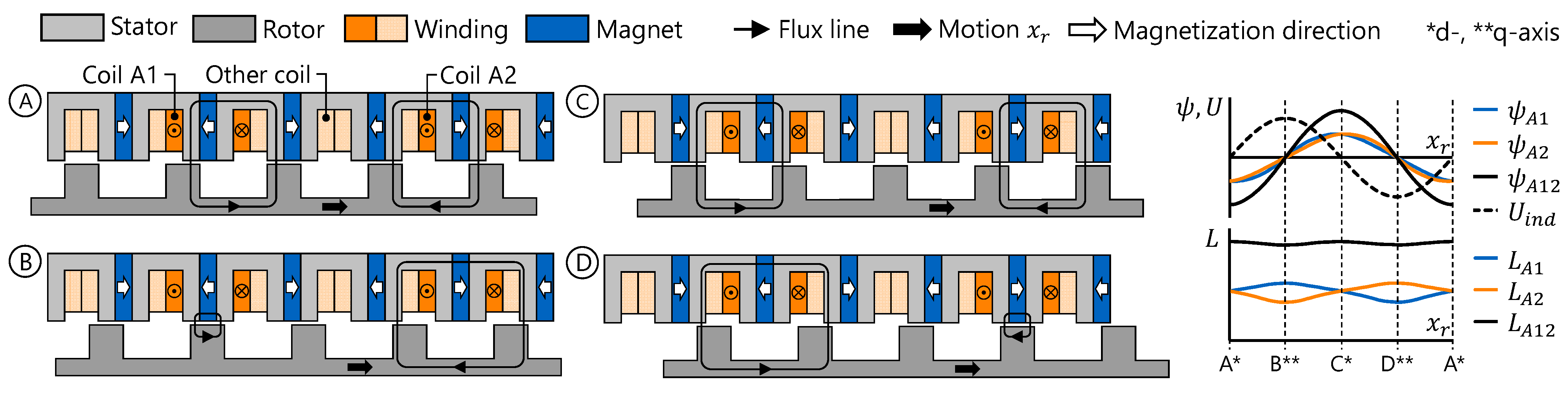
The permanently excited FSM investigated in this study is characterized by its robust rotor and its stator dual excitation by windings and permanent magnets (PMs). Due to their tangential magnetization direction in the stator tooth, the PMs in the FSM design lead to an almost sinusoidal flux linkage in the phases [13], as shown schematically in Figure 2. The series connection of the phase coils, shifted by 180 electrical degrees, reduces the total harmonic distortion in the phases, which enables operation with conventional converters [8], and results in an almost constant inductance [14]. This negligible reluctance component leads, analogous to an SPM, to a pure q-axis current for maximum shear force [14], which is used for the optimization strategy of this work. For the design investigations, metamodeling is used to reduce the calculation effort. This technique is gaining increasing influence in the field of multi-criteria sizing [15].
Figure 2.
Principle of flux linkage mechanism and profiles of induced voltage and inductances in flux-switching permanent magnet machines in no-load operation.
2. Methodology
2.1. Simulation Workflow
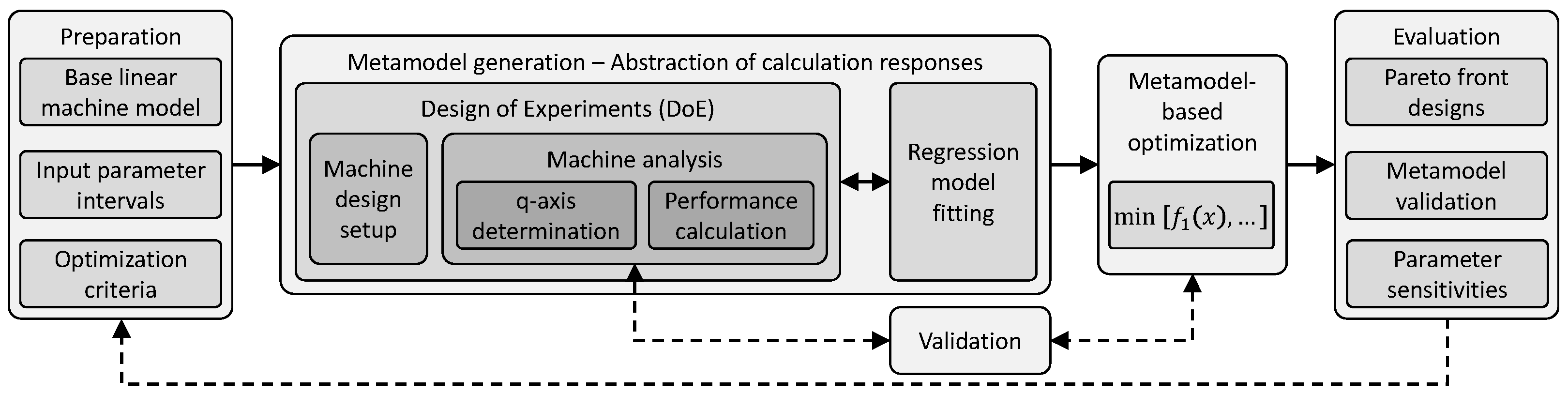
Figure 3 illustrates the design optimization procedure followed in this paper, which is divided into the following sections: preparation, metamodel generation, optimization, validation and evaluation. It is highlighted here that the metamodeling technique using support point-based regression models is applied to minimize the effort involved in design optimization by abstracting complex relationships. For the investigation of the FSM and its comparison to the SPM, the base 6/5 slot/pole configuration frequently used in the aviation context is considered [16]. Additionally, the high-torque C-core FSM in a 6/13 configuration, as suggested by Sanabria von Walter [8], is included in the comparison. For all three 2D linear machine variants, an optimized base structure in terms of efficiency and GSFD for tangential rotor speed of , slot fill factor of , current density of and machine depth of is to be found (the parameters are chosen according to [8]).
Figure 3.
Methodology of the metamodel-based optimization strategy.
2.2. Machine Topologies and Boundary Conditions
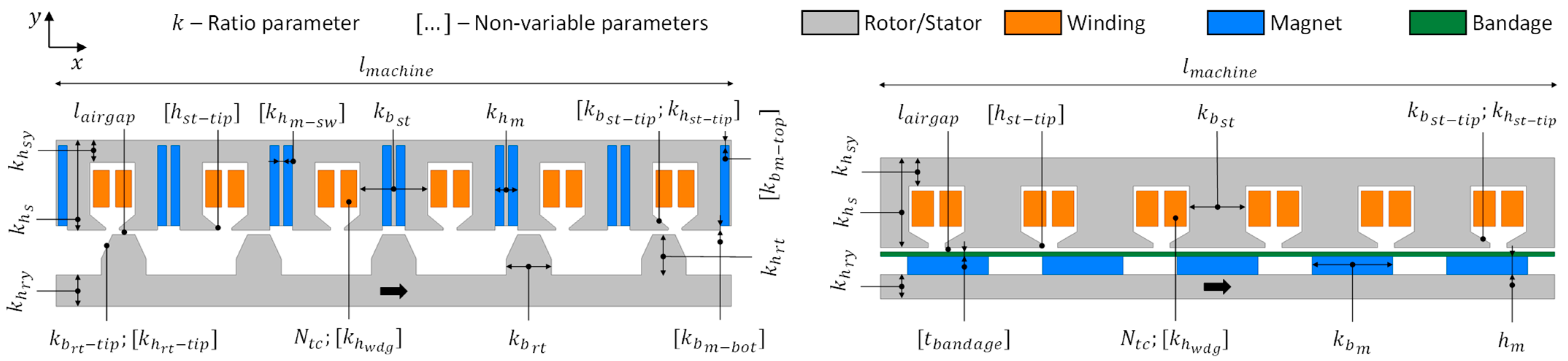
The basis for the design optimization is the respective parameterized machine FEM model, as shown in Figure 4. Here, the FSM and SPM approximations with their variable and non-variable parameters are highlighted. Most parameters are formulated in the form of ratio values in order to enable scaling effects, to exclude faulty geometries and to guarantee continuous response surfaces in metamodeling. In addition to the base machine definition, the following high-performance materials are used according to [6]: rotor and stator core—Vacoflux 48, PM—N48SH, and winding—copper (pure).
Figure 4.
Parameterized linear machine structure of the 6/5-FSM (left) and 6/5-SPM (right).
For the FSM and SPM investigations, 11 parameters are used. The non-variable parameters of the FSM design are selected analogously to the design according to Figure 1 in order to first consider the geometry of a conventional FSM. Figure 4 shows the dimensions of the non-variable SPM parameters, where the bandage thickness is set to . The machines, according to Figure 4, are used as the respective starting geometries for design optimization. In the first metamodel-optimization iteration, the ratio parameters are varied by ± 30% values based on the initial geometry, the number of windings , the airgap , the PM height and the machine length , according to [8]. This design space is iteratively adapted in each metamodel-optimization iteration on the basis of the previous optimization results until the objectives converge.
2.3. Metamodel Development
The metamodel is generated in two stages in an iterative process between design space sampling using the Design of Experiments (DoEs) method and the generation of the adaptive metamodel. Various approaches to DoEs and metamodel generation are described in the literature [17,18]. In this study the Advanced Latin Hypercube Sampling DoEs approach and a combination of polynomial, kriging and moving least squares approaches are used for the regression models. For a sample-specific calculation response, the machine design is first created. Under the assumption of ideal q-axis current for maximum shear force, the q-axis of the model is determined by a no-load simulation and subsequently the machine characteristics at pure q-axis loading are analyzed. The latter result is used as a support point for the regression models. The calculation responses include forces, losses, masses and inductances, as well as the induced voltage, the phase current, the flux linkage and the electric frequency. The rotor and stator core, PM and direct current winding losses are considered. The influence of alternating current losses is evaluated via the current-carrying conductor cross-section, caused by the skin effect, according to Wu et al. [19], using the skin effect threshold frequency . Depending on the functionality, different electrical frequencies occur in the topologies. For the same machine length , the electric frequencies must be classified according to Equation (1). These differences are directly reflected in alternating current losses and thus in efficiency .
A total of 500 samples is used for the metamodel generations. The time required for each calculation on a 24-core/32-processor computer is ~ 4 min. The prediction quality of the output parameters is described using the difference between the sample-based and metamodel-based values in the form of the Coefficient of Optimal Prognosis, [20]. This evaluation metric reaches high values with across all outputs and iterations for all calculation responses except for the force ripples ().
2.4. Design Optimization
The generated metamodel is further used for design optimization. Due to the multi-criteria optimization and the computational response complexity, the Evolutionary Algorithm approach is applied. Further possible strategies are described in the literature [17,21,22,23].
In this study, the initial geometries are optimized according to Equation (2). The input parameters (Figure 4) are varied in the design space between the lower and upper interval limit . In ~ 5 min, 5000 design points are calculated for optimization. The drastic reduction in calculation time highlights the potential of metamodeling integration in the machine sizing process [15]. Selected design points of the metamodel-based pareto front are recalculated later on using the FEM as ground truth to evaluate the prediction quality of the metamodel.
3. Results and Discussion
3.1. Pareto Front Analysis
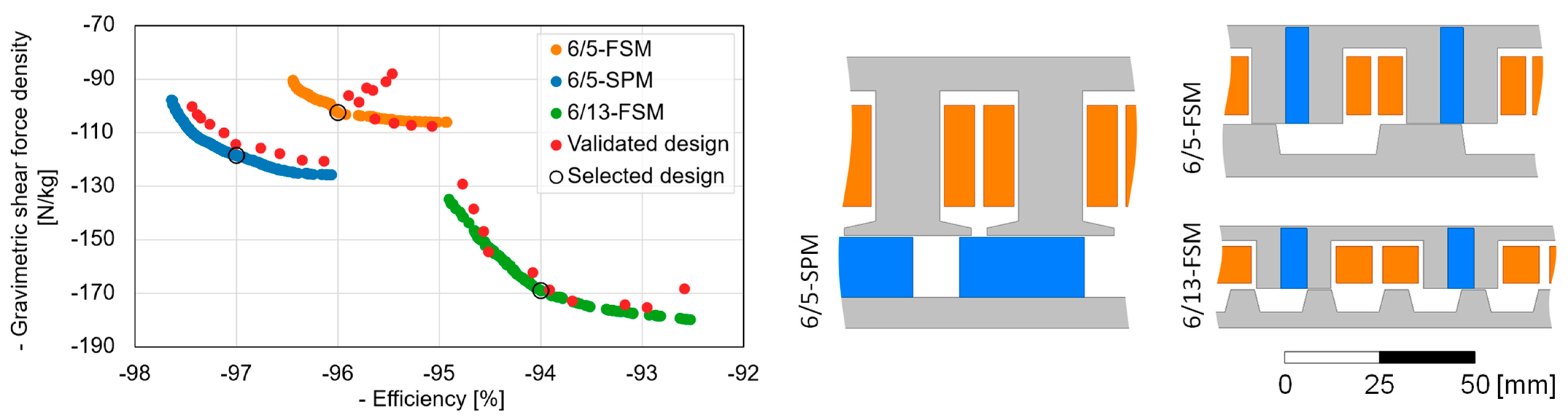
Figure 5 (left) shows the combined plot of the predicted pareto fronts with respect to the main objectives. After the third iteration of metamodel generation and optimization, a convergence is observed. In addition, the validated designs are displayed and show a moderate to good prediction quality. The study reveals a comparatively average GSFD with high efficiency for the 6/5-SPM (Figure 5, left—blue dots). The pareto front of the 6/13-FSM (Figure 5, left—green dots) has a reduced overall efficiency, but at significantly higher GSFDs. The 6/5-FSM pareto front (Figure 5, left—orange dots) is characterized by medium efficiency with a low GSFD.
Figure 5.
Pareto fronts of validated and selected designs (left) and excerpts of the selected pareto front designs of the machine topologies (right).
3.2. Detailed Comparison of Selected Optimal Designs
For the direct comparison of the optimized machines, one design per topology is selected and is examined in detail with regard to characteristics, loss distribution and parameter sensitivities. Figure 5 (right) illustrates excerpts of the selected designs on the same geometric scale and Table 1 summarizes their specifications.
Table 1.
Characteristics of the selected pareto front designs.
- Geometry
The 6/5-SPM tends towards a comparatively short (), high base structure for the objectives under consideration. The 6/13-FSM takes on an elongated, flat contour. The geometry of the 6/5-FSM is arranged in between. In all cases, the initial value for the machine length is reduced after optimization. The topologies tending towards a small airgap length achieve high GSFDs, whereby different airgap limitations are considered. The SPM airgap length is limited to due to higher assembly tolerances in the surface PM mounting and the FSM topologies to . Furthermore, the PM height of the 6/5-SPM strives for large values for an overall high GSFD, which results in reduced PM utilization.
- Performance
The 6/13-FSM shows its potential with regard to its high GSFD , low shear force ripple and comparatively low normal force and ripple compared to the 6/5-SPM. The 6/5-FSM shows the worst values. Also, by varying the previously non-variable parameters (Figure 4), no improved design of the 6/13-FSM can be identified in a metamodel-based optimization. Observing the design evolution, the stator teeth still tend to have rectangular contours for improved flux-switching behavior. The 6/13-FSM design presented by Sanabria von Walter [8] with a stator-side Halbach array PM arrangement, PM segmentation and minimal airgap length , as well as adapted rotor contours, shows the potential of the FSM through further design adaptions. and are achieved [8].
- Electrical and electromagnetic properties
Detailed analyses of the selected optimized designs for the FSM and SPM confirm the initial assumption of the low reluctance component . Furthermore, it becomes clear that despite the high flux linkage of the 6/5-SPM, only a moderate induced voltage results due to the low electric frequency . Although the 6/13-FSM has a medium flux linkage, the high electric frequency causes a strong increase in the induced voltage. The current and voltage-normalized shear forces indicate a high but short constant torque plateau in the equivalent map of a rotating machine design in the 6/13-base configuration. A medium-high, long plateau is expected for the 6/5-SPM variant.
- Losses
The results in Table 1 show that the influence of the alternating current winding losses due to the skin effect can be neglected across all topologies. The function-based higher electric frequencies of the FSM designs lead to dominant core losses, as illustrated in Figure 6 (left). A stator-outside Halbach array PM arrangement, introduced by Sanabria von Walter [8], is able to reduce the stator magnetic leakage flux and increase the force-generating flux. The highest losses of the 6/5-SPM occur in the PM due to its increasing height, whereby a reduction leads to a reduced gravimetric force density.
Figure 6.
Share of losses of all topologies (left), airgap length sensitivity of all topologies (middle) and PM height sensitivity of SPM (right) of the selected pareto front designs.
3.3. Sensitivity Studies
As a further investigation, the sensitivity of the airgap length , important for defining the manufacturing tolerances and minimizing function-critical reduction during operation, and the PM height of the 6/5-SPM due to the reduced PM utilization are considered. The opposing curves of the GSFD per total and per PM mass in Figure 6 (right) show why large PM heights result in this investigation. The airgap sensitivity analysis in the investigated range, displayed in Figure 6 (middle), reveals a linear decrease in GSFD for the 6/5-SPM and a quadratic correlation for the FSMs. The course of the GSFD over the airgap length of the 6/5-FSM shows a significantly lower decrease compared to that of the 6/13-FSM, but at a much lower GSFD level. Therefore, a thin rotor bandage for mitigating high radial tension stresses on the rotor is electromagnetically less critical in SPM designs. Moreover, an active airgap length adjustment for FSMs should be considered to permanently maintain a minimum airgap length [8].
4. Conclusions
In this study, design optimizations of 6/5-FSM, 6/5-SPM and 6/13-FSM base structures are performed with respect to efficiency and GSFD using the metamodeling technique of the respective linear setup. The optimization results highlight a superior GSFD for the 6/13-FSM but at the cost of slightly reduced efficiency. From the algorithm, the highest efficiency machine is the 6/5-SPM. In terms of GSFD, the 6/13-FSM design is superior but a small airgap length is to be ensured. When comparing the resulting designs, it is noticeable that the linear 6/5-SPM with high absolute shear forces is relatively short. For a ring-shaped rotational machine with specific torque and diameter requirements, a comparatively axially short SPM design with more 6/5-base structural elements offers superior efficiency, whereas an axially longer FSM design with fewer 6/13-base structures has a higher GSFD. From the analysis a strong influence of the airgap length on the performance of FSM topologies is concluded, whereas the SPM shows a comparably robust behavior. The 6/13-FSM topology shows advantages compared to the 6/5-FSM in GSFD but at an increased airgap length sensitivity. Further research with regard to loss reduction and reliable airgap length minimization could help to expand the potential of the FSM as a promising engine topology for a safer, more climate-friendly and more sustainable aviation in the future.
Author Contributions
Author E.T. developed the conceptualization of the project and elaborated and implemented the methodology of the metamodel-based design optimization process. He also conducted the investigation and formal analysis, prepared the data and wrote the original draft. Author M.L. supported the validation and contributed significantly to the evaluation and classification of the results. Authors I.K. and S.K. supervised the writing—review and editing of the manuscript and provided valuable support in its preparation. All authors have read and agreed to the published version of the manuscript.
Funding
This research received no external funding.
Institutional Review Board Statement
Not applicable.
Informed Consent Statement
Not applicable.
Data Availability Statement
Data are contained within the article.
Conflicts of Interest
The authors declare no conflicts of interest.
Abbreviations
The following abbreviations are used in this manuscript:
| DoE | Design of Experiment |
| FEM | Finite Element Method |
| FSM | Flux-Switching Machine |
| GSFD | Gravimetric Shear Force Density |
| PM | Permanent Magnet |
| SPM | Surface Permanent Magnet Machine |
References
- Benzaquen, J.; He, J.; Mirafzal, B. Toward more electric powertrains in aircraft: Technical challenges and advancements. CES Trans. Electr. Mach. Syst. 2021, 5, 177–193. [Google Scholar] [CrossRef] [Scilit]
- ATAG. Waypoint 2050. 2021. Available online: https://aviationbenefits.org/media/167417/w2050_v2021_27sept_full.pdf (accessed on 3 March 2024).
- Li, C.; Cui, H.; Bu, F.; Liu, J. Multi Objective Optimization Design of Permanent Magnet Ring Torque Motor Based on Response Surface Method. In Proceedings of the 2021 24th International Conference on Electrical Machines and Systems (ICEMS), Gyeongju, Republic of Korea, 31 October–3 November 2021. [Google Scholar] [CrossRef] [Scilit]
- Pan, G.; Cheng, B.; Zhang, P.; Cao, Y. Coupling design and performance analysis of rim-driven integrated motor propulsor. In Proceedings of the OCEANS 2016—Shanghai, Shanghai, China, 10–13 April 2016. [Google Scholar] [CrossRef] [Scilit]
- Ifedi, C.J.; Mecrow, B.C.; Widmer, J.D.; Atkinson, G.J.; Brockway, S.; Kostic-Perovic, D. A high torque density, direct drive in-wheel motor for electric vehicles. In Proceedings of the 6th IET International Conference on Power Electronics, Machines and Drives (PEMD 2012), Bristol, 27–29 March 2012. [Google Scholar] [CrossRef] [Scilit]
- Henke, M.; Narjes, G.; Hoffmann, J.; Wohlers, C.; Urbanek, S.; Heister, C.; Steinbrink, J.; Canders, W.-R.; Ponick, B. Challenges and Opportunities of Very Light High-Performance Electric Drives for Aviation. Energies 2018, 11, 344. [Google Scholar] [CrossRef] [Scilit]
- Teichert, E.; Kazula, S. Overview and Evaluation of Electric Machines for Electric Regional Aircraft Propulsion Systems. In Proceedings of the Deutscher Luft- und Raumfahrtkongress 2024, Hamburg, Germany, 30 September–2 October 2024. [Google Scholar] [CrossRef]
- Sanabria von Walter, C.D. Design of High-Torque-Density Synchronous Drives for Propulsion of Rotary-Wing Aircraft. Ph.D. Thesis, TU Delft, Delft, The Netherlands, 2016. [Google Scholar]
- Boldea, I.; Nasar, S.A. Linear electric actuators and generators. IEEE Trans. Energy Convers. 1999, 14, 712–717. [Google Scholar] [CrossRef] [Scilit]
- He, Q.; Wang, H.; Li, Q. Design Optimization and Performance Analysis of High Torque Density and Efficiency Motors for eVTOL Applications. IEEE Access 2025, 13, 78403–78415. [Google Scholar] [CrossRef] [Scilit]
- Liang, J.; Zhang, X.; Qiao, M.; Zhu, P.; Cai, W.; Xia, Y.; Li, G. Optimal design and multifield coupling analysis of propelling motor used in a novel integrated motor propeller. IEEE Trans. Magn. 2013, 49, 5742–5748. [Google Scholar] [CrossRef] [Scilit]
- Ullah, B.; Khan, F. Review of linear flux-switching machines for variable speed applications. World J. Eng. 2024, 22, 952–967. [Google Scholar] [CrossRef] [Scilit]
- Abunike, C.E.; Okoro, O.I.; Far, A.J.; Aphale, S.S. Advancements in Flux Switching Machine Optimization: Applications and Future Prospects. IEEE Access 2023, 11, 110910–110942. [Google Scholar] [CrossRef] [Scilit]
- Chen, H.; EL-Refaie, A.M.; Demerdash, N.A.O. Flux-Switching Permanent Magnet Machines: A Review of Opportunities and Challenges-Part II: Design Aspects, Control, and Emerging Trends. IEEE Trans. Energy Convers. 2019, 35, 699–713. [Google Scholar] [CrossRef] [Scilit]
- Riviere, N.; Stokmaier, M.; Goss, J. An Innovative Multi-Objective Optimization Approach for the Multiphysics Design of Electrical Machines. In Proceedings of the 2020 IEEE Transportation Electrification Conference & Expo (ITEC), Chicago, IL, USA, 23–26 June 2020. [Google Scholar] [CrossRef] [Scilit]
- Fang, S.; Wang, Y.; Liu, H. Design study of an aerospace motor for more electric aircraft. IET Electr. Power Appl. 2020, 14, 2881–2890. [Google Scholar] [CrossRef] [Scilit]
- Wang, G.G.; Shan, S. Review of Metamodeling Techniques in Support of Engineering Design Optimization. J. Mech. Des. 2006, 129, 370–380. [Google Scholar] [CrossRef] [Scilit]
- Jin, R.; Chen, W.; Simpson, T. Comparative studies of metamodeling techniques under multiple modeling criteria. In Proceedings of the 8th Symposium on Multidisciplinary Analysis and Optimization, Long Beach, CA, USA, 6–8 September 2000. [Google Scholar] [CrossRef] [Scilit]
- Wu, Y.; Gao, J.; Zhang, W.; Huang, S.; Hu, C.; Li, J. Analytic Model of Copper AC Loss of Permanent Magnet Synchronous Motor with Considering Conductor Gap. In Proceedings of the 2022 5th International Conference on Power and Energy Applications (ICPEA), Guangzhou, China, 18–20 November 2022. [Google Scholar] [CrossRef] [Scilit]
- Most, T.; Will, J. Sensitivity analysis using the Metamodel of Optimal Prognosis. arXiv 2011, arXiv:2408.03590. [Google Scholar] [CrossRef] [Scilit]
- Daoud, M.S.; Shehab, M.; Al-Mimi, H.M.; Abualigah, L.; Zitar, R.A.; Shambour, M.K.Y. Gradient-Based Optimizer (GBO): A Review, Theory, Variants, and Applications. Arch. Comput. Methods Eng. 2022, 30, 2431–2449. [Google Scholar] [CrossRef] [Scilit] [PubMed]
- Rakshit, P.; Konar, A.; Das, S. Noisy evolutionary optimization algorithms–A comprehensive survey. Swarm Evol. Comput. 2017, 33, 18–45. [Google Scholar] [CrossRef] [Scilit]
- Wu, Y.; Quan, S.J. A review of surrogate-assisted design optimization for improving urban wind environment. Build. Environ. 2024, 253, 111157. [Google Scholar] [CrossRef] [Scilit]
Disclaimer/Publisher’s Note: The statements, opinions and data contained in all publications are solely those of the individual author(s) and contributor(s) and not of MDPI and/or the editor(s). MDPI and/or the editor(s) disclaim responsibility for any injury to people or property resulting from any ideas, methods, instructions or products referred to in the content. |
© 2026 by the authors. Licensee MDPI, Basel, Switzerland. This article is an open access article distributed under the terms and conditions of the Creative Commons Attribution (CC BY) license.