1. Introduction
Multi-robot systems (MRSs) exhibit several properties that make them particularly suitable for planetary exploration missions. Their flexibility allows a wide variety of tasks to be accomplished by distributing different capabilities among individual robots. This distribution simplifies the design of each unit, which can positively affect development costs and overall system robustness. Moreover, MRSs can be designed in a scalable fashion, enabling adjustments to the number of deployed robots or the size of the operational area according to mission requirements. Redundancy among robots further increases fault tolerance—an essential feature in space missions, where maintenance or replacement is not feasible.
This paper investigates the fundamental criteria that distinguish different multi-robot system (MRS) applications, analyzes current trends, and identifies research gaps in European space-related MRS research. To this end, we conducted a literature review and classified existing studies based on criteria that describe the structural, functional, and interactive aspects of MRSs.
2. Categorization of Multi-Robot Systems
For the classification of MRS characteristics, we adopt a formalism inspired by the taxonomies proposed by Dudek and Jenkin [
1] and Leitner [
2]. These authors define a set of categories, each representing a conceptual dimension of an MRS, such as communication, reconfigurability, composition, and interaction type. The complete list of categories and their corresponding classes used in our study is provided in
Table 1.
The size in
Table 1 categorizes how many systems are working together within the multi-robot team. It can range from ONE or TWO systems to SOME, which means less than 10 systems, and MANY, which means unlimited systems. With the communication range and topology, two aspects of communication between agents are considered. For the communication range, at one extreme, systems may operate entirely without direct communication (NONE), relying instead on environmental cues to exchange information. At the other end, agents can be fully connected through broadband infrastructure that provides continuous and global communication links (INF). Between these two cases lies the class of ad hoc, proximity-based communication, where agents establish temporary links when they come into contact or detect one another (NEAR).
The communication topologies considered range from fully addressed systems to highly dynamic ad hoc networks. In the ADDR topology, each robot can communicate with specific peers whose names or addresses are known in advance. BROAD denotes systems in which every robot can reach all others directly, enabling fully global communication. In contrast, TREE topologies impose a hierarchical structure in which information flows through one or more central entities. GRAPH describes a more general structure where robots are connected through bilateral links forming an arbitrary communication graph. Finally, in AD-HOC communication, robots contact one another spontaneously as needed, which requires mechanisms for detecting nearby robots and establishing temporary communication channels.
Reconfigurability characterizes how the composition of a robot team changes over time. A coordinated system follows a predefined orchestration defined by a central authority, whereas a dynamically reconfigurable system allows a central planner to adapt team structures and roles at runtime. In contrast, spontaneous reconfiguration occurs when robots autonomously negotiate their roles and form teams without centralized control. In order to distinguish between the various reconfigurabilities, a distinction was made between STATIC, static arrangement of roles; COORDINATED, all rearrangements are dictated by the scenario logic; DYNAMIC, collective with dynamic size and role assignment; and SPONTANEOUS, the roles in spontaneous interactions are negotiated independently between robots.
The composition category distinguishes several levels of heterogeneity within robot collectives. IDENT systems are fully homogeneous, with identical robots in both form and function. HOMOGENEOUS systems remain uniform in morphology and implementation but assign different roles or functions to otherwise identical robots. HET-UNIFORM collectives exhibit heterogeneity in form and function while still relying on a uniform implementation, typically provided by a single vendor. Finally, HETEROGENEOUS systems incorporate diversity across shape, roles, and implementation, often involving robots from multiple vendors. In the later case, the systems must first establish interoperability, for instance by selecting a compatible communication protocol or negotiating complementary functions.
Control in an MRS can be divided into CENTRALIZED, DECENTRALIZED and HYBRID, which can contain centralized and decentralized elements.
In addition to these technical dimensions, we introduce an interaction category inspired by terminology from biology. This dimension summarized in
Table 2 describes how systems influence one another when operating in the same environment. Commensalism describes situations in which one robot benefits from another system without the latter being explicitly aware of the interaction, such as hitchhiking for transport or using an independent system for loading. In Mutualism, both systems pursue a common goal such that both benefit from the interaction, as seen in cooperative goods transfer or collaborative mapping tasks. Competition arises when individual objectives conflict, forcing both parties to take costly measures. This arises when independently operating robots must share limited resources or space, as in the case of congestion in a confined corridor, for example, resolving traffic jams in narrow corridors or negotiating access to shared resources. Neutralism refers to systems that act independently but might still take each other into account but with no significant impact on each other, such as when robots consider the planned routes of others during their own motion planning. Parasitism captures interactions in which one system benefits at the expense of the other, resembling destructive or exploitative behavior, while Amensalism denotes cases where one system is unintentionally harmed by another’s presence.
A web form was created to collect data. The categories were explained in the form, so people who were not familiar with the categorization system were introduced to it. We invited potential authors from the European space community to submit their papers and added papers that we found ourselves. Alongside this information, we collected additional data to classify the type of contribution. The focus of the research area was categorized, whether the contribution was about developing new theoretical concepts or experimental validation. For this study, we only considered scientific publications related to space robotics research in the field of multi-robot systems that were published within the last 10 years.
To illustrate how these categories can be applied, we refer to two experiments conducted during a field campaign on Lanzarote [
3]. In the first experiment, called MP-1 in the paper, two robots explored separate areas and subsequently merged their partial maps into a coherent global representation. This scenario assumes unlimited communication bandwidth and statically assigned roles, and the robots jointly pursue the mutual goal of expanding environmental knowledge. In the second experiment (MP-3), two robots physically connected via a large adapter to rappel down the skylight of a cave. Communication was established ad hoc once the connection was formed, and the robots executed a predefined coordination script that switched from docking to rappelling behavior. These two examples highlight how different MRS configurations can occupy distinct regions of the classification space summarized in
Table 2.
3. Results
In total, 11 contributions were received. Of those, two were rejected in the final evaluation for not being from European research or not matching the topic.
Table 3 summarizes the results.
Most systems rely on INF-range communication, indicating strong dependence on long-distance links (e.g., radio). Only one paper uses NEAR communication, which is established by physically attaching the two involved robot systems. Other proximity-based communication concepts were not considered so far in the included work.
Communication topologies are dominated by GRAPH and TREE structures, showing a preference for structured but flexible network connectivity. AD-HOC topologies are rare, appearing only once, suggesting that spontaneous, self-organizing communication is not yet widely adopted. This suggests a focus on closed-world scenarios, where all participating agents and environmental elements are known in advance. This is supported by the complete lack of competitive interaction. For the interaction types, Mutualism dominates, showing that most systems collaborate toward shared goals (e.g., joint transport, cooperative exploration). Neutral interactions without direct cooperation or conflict appear occasionally and Commensalism appears infrequently, indicating that asymmetric but non-harmful interactions are less explored.
Regarding the composition of MRS, HET-UNIFORM appears in the majority of papers, implying strong heterogeneity in roles and form, but uniformity at the implementation level (single-vendor or unified architecture). Fully heterogeneous systems (HETEROGENEOUS) appear only twice, suggesting that multi-vendor or multi-platform collectives are still uncommon. Finally, hybrid control (H) is widely used, meaning many systems combine centralized and decentralized elements and fully decentralized control (D) appears only once. This suggests that the level of granularity of this category is insufficient to capture meaningful distinctions between different coordination and control concepts.
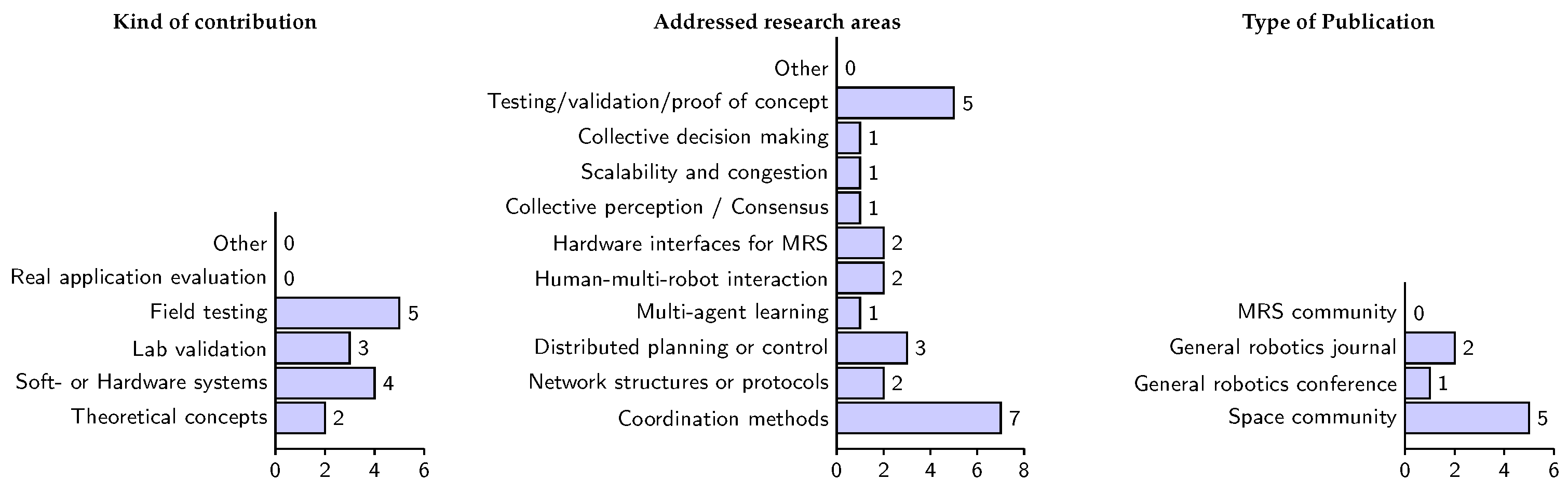
Figure 1 summarizes the results of the classification of publication and contribution types. The left plot shows publications focusing on technological developments, especially their evaluation in field tests. The works primarily focus on the coordination methods of MRS and mutualistic systems. Other relevant aspects, such as collective decision making and scalability considerations, are rarely addressed. Looking at the publication types on the right, we see that most research outputs appear within the space robotics community itself, with limited exchange with general robotics venues.
4. Conclusions
The focus is on coordinated teams operating within a closed environment. Unforeseen encounters between agents with different intentions are rarely addressed. Communication aspects are often inadequately addressed. Most studies assume the existence of a permanent, high-bandwidth communication infrastructure. However, this assumption does not apply to space environments, where autonomy is required precisely because communication is intermittent and delayed.
Overall, the results suggest a clear trend toward experimental validation in the field of space MRS research. This aligns with [
11] suggesting that conducting field tests in uncontrolled environments similar to the intended mission area—known as analog missions—is crucial, as systems and software often behave differently or reveal missing functions in these environments. However, the scope and diversity of contributions in the European space MRS literature remain limited. Fundamental questions such as how to reach a consensus under communication constraints, how to scale cooperative behaviors, and how to manage unplanned encounters between heterogeneous agents remain largely unexplored. This indicates that the experimental field validation did not yet capture the full complexity of real, productive MRS applications.
Therefore, we recommend strengthening research efforts that explicitly address MRS-specific challenges and promoting collaboration between the space robotics and general robotics communities. Publications should aim to disseminate their findings beyond the space domain to foster interdisciplinary exchange and stimulate progress on fundamental questions of autonomy, interaction, and scalability in multi-robot systems.
Author Contributions
Conceptualization, W.B. and M.W.; methodology, M.W.; investigation, M.W., W.B. and C.J.P.d.P.M.; resources, M.W., W.B. and C.J.P.d.P.M.; writing—original draft preparation, M.W. and W.B.; writing—review and editing, M.W., W.B. and C.J.P.d.P.M.; visualization, M.W. and W.B. All authors have read and agreed to the published version of the manuscript.
Funding
This work is part of the project FieldCoBots with support from the Federal Ministry of Research, Technology and Space, grant number 02K24K032. This work has been partially supported by the German Federal Ministry of Research, Technology and Space (BMFTR) under the Robotics Institute Germany (RIG).
Institutional Review Board Statement
Not applicable.
Informed Consent Statement
Not applicable.
Data Availability Statement
The raw data supporting the conclusions of this article will be made available by the authors on request.
Conflicts of Interest
The authors declare no conflicts of interest.
References
- Dudek, G.; Jenkin, M.; Milios, E.; Wilkes, D. A taxonomy for multi-agent robotics. Auton. Robot. 1996, 3. [Google Scholar] [CrossRef]
- Leitner, J. Multi-robot Cooperation in Space: A Survey. In Proceedings of the 2009 Advanced Technologies for Enhanced Quality of Life, Iasi, Romania, 22–26 July 2009; pp. 144–151. [Google Scholar] [CrossRef]
- Domínguez, R.; Pérez-del Pulgar, C.; Paz-Delgado, G.J.; Polisano, F.; Babel, J.; Germa, T.; Dragomir, I.; Ciarletti, V.; Berthet, A.C.; Danter, L.C.; et al. Cooperative robotic exploration of a planetary skylight surface and lava cave. Sci. Robot. 2025, 10, eadj9699. [Google Scholar] [CrossRef] [PubMed]
- Suresh, A.; Laux, M.; Brinkmann, W.; Danter, L.C.; Kirchner, F. Enhancing Heterogeneous Multi-Robot Teaming for Planetary Exploration. Eng. Proc. 2025, 90, 112. [Google Scholar] [CrossRef]
- Sonsalla, R.U.; Cordes, F.; Christensen, L.; Roehr, T.M.; Stark, T.; Planthaber, S.; Maurus, M.; Mallwitz, M.; Kirchner, E.A. Field Testing of a Cooperative Multi-Robot Sample Return Mission in Mars Analogue Environment. In Proceedings of the 14th Symposium on Advanced Space Technologies in Robotics and Automation (ASTRA 20017), Leiden, The Netherlands, 20–22 June 2017; p. 8. [Google Scholar]
- Brinkmann, W.; Schilling, M.; Chowdhury, P.; Eisenmenger, J.; Benz, J.; Langosz, M.; Li, J.; Michelson, E.; Yüksel, M.; Kirchner, F. Toward Sustainable Space Exploration: Designing an AI-Powered Modular Toolbox for Future Planetary Exploration. Eng. Proc. 2025, 90, 26. [Google Scholar] [CrossRef]
- Burkhard, L.; Sakagami, R.; Lakatos, K.; Gmeiner, H.; Lehner, P.; Reill, J.; Müller, M.G.; Durner, M.; Wedler, A. Collaborative Multi-Rover Crater Exploration: Concept and Results from the ARCHES Analog Mission. In Proceedings of the 2024 IEEE Aerospace Conference, Big Sky, MT, USA, 2–9 March 2024; pp. 1–14. [Google Scholar] [CrossRef]
- Arm, P.; Waibel, G.; Preisig, J.; Tuna, T.; Zhou, R.; Bickel, V.; Ligeza, G.; Miki, T.; Kehl, F.; Kolvenbach, H.; et al. Scientific Exploration of Challenging Planetary Analog Environments with a Team of Legged Robots. Sci. Robot. 2023, 8, eade9548. [Google Scholar] [CrossRef] [PubMed]
- Sakagami, R.; Brunner, S.G.; Dömel, A.; Wedler, A.; Stulp, F. ROSMC: A High-Level Mission Operation Framework for Heterogeneous Robotic Teams. In Proceedings of the 2023 IEEE International Conference on Robotics and Automation (ICRA), London, UK, 29 May–June 2023; pp. 5473–5479. [Google Scholar] [CrossRef]
- Govindaraj, S.; Brinkmann, W.; Colmenero, F.J.; Nieto, I.S.; But, A.; De Benedetti, M.; Danter, L.C.; Alonso, M.; Heredia, E.; Lacroix, S.; et al. Building a Lunar Infrastructure with the Help of a Heterogeneous (Semi)Autonomous Multi-robot-Team. In Space Robotics; Yan, X.T., Visentin, G., Eds.; Springer Nature: Cham, Switzerland, 2024; pp. 395–431. [Google Scholar] [CrossRef]
- Planthaber, S.; Frese, U.; Brinkmann, W.; Domínguez, R.; Laux, M.; Yüksel, M.; Bresser, A.; Kirchner, F. Artificial Intelligence for planetary exploration—Lessons learned from a decade of analog field tests. In Proceedings of the 15th EASN International Conference on Innovation in Aviation & Space Towards Sustainability Today and Tomorrow, Madrid, Spain, 14–17 October 2025. [Google Scholar]
| Disclaimer/Publisher’s Note: The statements, opinions and data contained in all publications are solely those of the individual author(s) and contributor(s) and not of MDPI and/or the editor(s). MDPI and/or the editor(s) disclaim responsibility for any injury to people or property resulting from any ideas, methods, instructions or products referred to in the content. |