1. Introduction
Robotic systems have proven to be an effective solution for exploring planets and moons in the solar system on site [
1,
2]. The German Research Center for Artificial Intelligence (DFKI) conducts research and development across a broad spectrum of space robotics. Special emphasis is placed on locomotion, Simultaneous Localization and Mapping (SLAM), multi-robot cooperation, and the development of artificial intelligence (AI) for planetary applications. Robotic systems with AI need to be tested in real environments. However, testing on another celestial body is so complex that it becomes the actual mission, rather than a test. An alternative is terrestrial analog sites (also called “space analogs”). These are places on Earth with geological, environmental, or biological conditions assumed to resemble those of a celestial body such as the Moon or Mars. Analog sites are used in the context of space exploration to study geological or biological processes observed on other planets, or to prepare astronauts for surface extra-vehicular activity. For the same reason, DFKI conducts space-related field testing of robots at analog sites. Field tests, in general, are important for evaluating the behavior of robotic systems and AI under real, uncontrolled conditions. Analog sites allow the challenges of the target environment to be matched. For robotics focusing on locomotion, navigation, and mapping, the geometrical, mechanical, and optical characteristics of the environment must align. In addition, planetary science is interested in specific sites because they offer potential scientific insights. For Mars-like environments, the desert in Utah and parts of the Moroccan desert have proven to be well suited as test analogs. For Moon-like environments, areas on Lanzarote, Fuerteventura, Vulcano (Italy), and Tenerife are well suited.
It is also important to plan and prepare all aspects of the tests. Equipment needs to be transported. Robots, equipment, and personnel must be able to work and live on site to perform the experiments. In addition, infrastructure is required, such as electricity, internet, food, and repair tools.
This paper describes the preparation and implementation of field tests, as well as the lessons learned. The systems tested are robots operated using a stack of primarily classical artificial intelligence. In the respective publications [
3,
4,
5,
6], the detailed experiments and specific algorithmic insights are discussed. Here, we focus on the overarching lessons learned and the practical effort involved in conducting the field tests.
2. Experiments and Locations
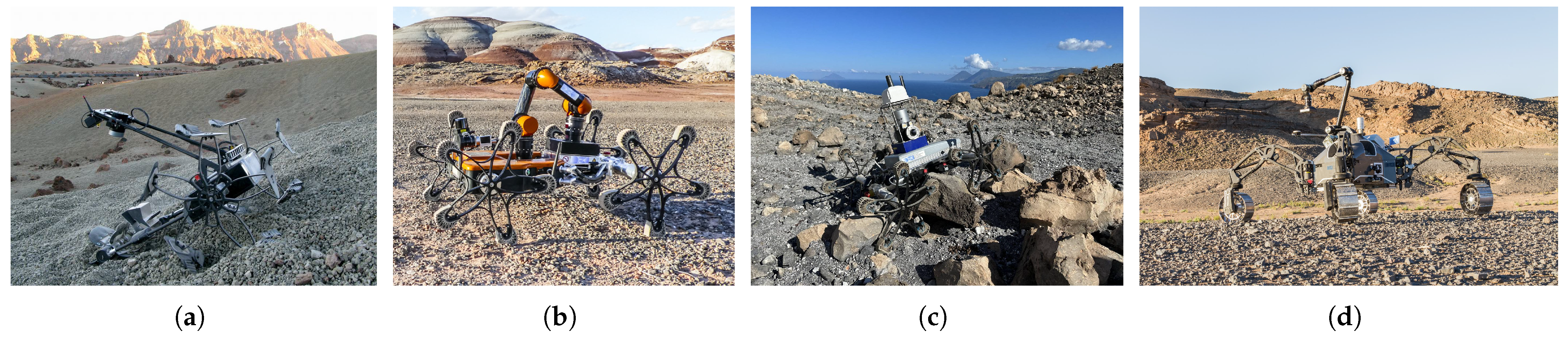
During the field tests, several robots with different locomotion capabilities and weights were used (for a brief overview, see
Figure 1). All robots have a wheel–leg combination to maximize locomotion capabilities in exploration scenarios. While SherpaTT [
7] has legs with wheels attached, the smaller rovers have star-shaped wheels to achieve legged advantages in a wheeled system. Coyote III [
8] and SherpaTT also have manipulator arms for handling payloads.
The selection of environments for space-related analogs depends on the focus of the experiment (
Table 1). A general distinction is between surface and underground environments. On Earth, large open environments without vegetation, similar to the surfaces of Mars and the Moon, can be found in deserts and on volcanic mountains. Underground environments have varying mechanisms of geophysical formation that affect their geometry and surface mechanics. On Earth, water-based erosion dominates. Lava tubes are known on Earth and the Moon, are suspected on Mars, and are of particular scientific interest, making them attractive analog sites. In addition, specific ground features, such as duricrust, inverted riverbeds, light loose rocks, and spatter, are relevant in the choice of an analog site.
We now discuss the analog environments in which we conducted field tests, along with the features they offer and the phenomena encountered.
Deserts: In deserts, the experiments focused on locomotion and long-range open-terrain exploration. This part of the mission often takes a long time and would benefit from semi-autonomous execution. In addition, the different components of the navigation software, from feature detection to mapping and path planning, have long been research topics in robotics and AI. Both factors suggest evaluating their performance in an environment that is as realistic as possible.
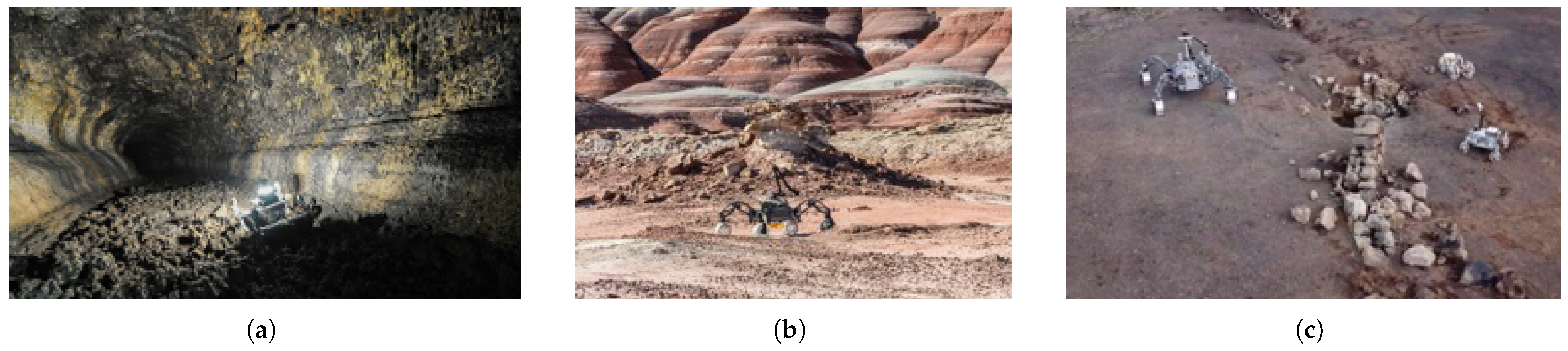
Besides the locomotion capabilities and dust resistance of the robots, the focus here was on long-term exploration, in which hardware and software were tested. In Utah (
Figure 2b), a robot team was deployed, in which the smaller robot Coyote III (
Figure 1b) provided logistical support for the larger exploration rover SherpaTT (
Figure 1d), supplying it with fresh batteries and returning samples to the landing module, so that the larger rover did not have to spend time returning to the lander.
The Utah desert features duricrust, a hard surface layer over softer material that is also found on Mars. It provides a specific challenge for locomotion because the robot can break through the hard layer into the soft subsurface and have difficulty exiting these depressions.
The Utah desert also features a so-called inverted riverbed, which is probably also present on Mars. This geological feature develops because when a river dries out, the entire terrain erodes away, but the dried riverbed does not because it is harder. On the sides of this inverted riverbed, material buried beneath the riverbed becomes accessible without excavation. This makes inverted riverbeds scientifically interesting.
In Morocco, the focus was on software behavior during long-term missions (3 km range) and on the evaluation of a framework of data fusion techniques for localization and mapping, among other applications [
9]. Both deserts have an open, hilly but not mountainous terrain and a color similar to that of Mars. This makes the analog well suited for navigation experiments using computer vision and optical sensors, i.e., LiDAR.
Volcanic: The Minas de San José area within Tenerife’s Teide National Park in Spain has been selected as an analog site for lunar polar craters for ESA’s Lunar Robotics Challenge 2008 and for the final tests of the project PerSim due to its volcanic structure, topographic complexity, and ground dynamics. The volcanic basaltic terrain offers mechanical properties similar to lunar regolith due to its abrasive, granular, and loose structure [
10]. The test site’s 15 m deep crater structure, gradients reaching 40°, and rock obstacles of varying sizes realistically reflect the fundamental robotic challenges of lunar missions in terms of mobility, navigation, robot control, and stability. Tests conducted in this area with CESAR (
Figure 1a) [
11] have enabled the validation of critical subsystems, such as ground interaction with the locomotion system, sample collection mechanisms, navigation, and crater-interior remote operations under real dark conditions at night, as well as the evaluation of the entire mission.
Lava Tubes: In space exploration, especially on the Moon, accessing lava tubes is of considerable interest. They can provide natural shelter and may contain bacteria that could not survive surface conditions. These tubes have a very characteristic geometry, different from that of voids created by other geological mechanisms, e.g., erosion. Some also contain spatter, i.e., drops of lava that fell from the ceiling and solidified on the ground. At first sight, they look like gravel, but they cannot be pushed away because they are connected to the ground. This creates the risk that the robot’s wheels or legs become entangled, hindering rotation in place by skid steering. These challenges motivate conducting tests in lava tubes on Earth as an analog environment.
During the Entern field trip to Tenerife (
Figure 2a), the goal was to create a map of a lava tube semi-autonomously. The challenge was handling loss of communication during exploration because as soon as the line of sight from the entry point was lost, there was too much rock between the sender and receiver. The approach was to set an exploration goal for the robot, which it executed autonomously, and after the goal was achieved, or no further exploration was possible, the robot would return to the entrance, deliver the data, and a new exploration target, deeper in the tube, could be selected.
Some lava tubes on the Moon have skylights, i.e., vertical holes that provide access to the otherwise horizontal tube. Often, the skylight is the only feature visible from above. This makes it difficult for a robot to enter a lava tube. Any technique addressing this challenge should be tested on an analog environment featuring a lava tube with a skylight. The CoRob-X field trip on Lanzarote (
Figure 2c) evaluated such an autonomous technique for entering a lava tube via a skylight. A larger rover rappelled a small scout rover down the skylight into the tube, after which the scout rover explored the tube itself. During this exploration, the attachment point of the rappel acted as a base station, providing energy and communication to the scout rover.
3. Practical Issues for Experiments in the Field
The choice of materials needed strongly depends on the location and duration of the field test, but even for one-day tests, there may be infrastructure required such as electricity, internet access, tools, and spare parts. Here, we discuss field trials that last multiple weeks. For one-day tests, some of the following steps may be irrelevant.
Site Scouting and Permits: First, a suitable analog site has to be identified. Initial candidates are often already known to space agencies, but they can also be found via the internet or through local experts. Site scouting without the robots should be conducted first to choose among the candidates and to ensure that the locations are feasible for the experiments and equipment required (space for tents, equipment, etc.). Often, sites are located in national parks, requiring additional administrative work to obtain permits. Due to preservation rules, some locations are inaccessible for such experiments. Also, location scouts from the film industry can help identify suitable sites and assist with obtaining the required permits.
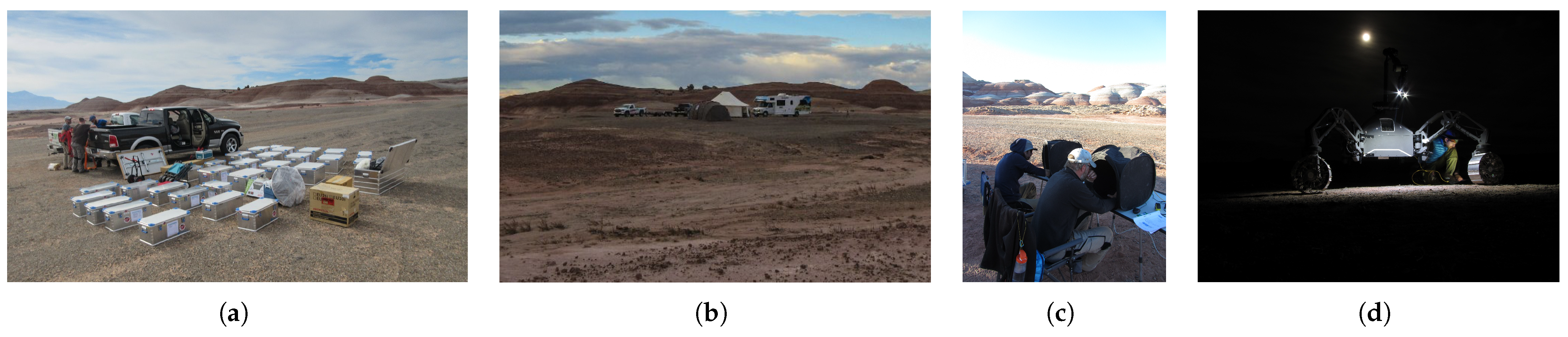
Accommodation: Once the site has been selected, suitable accommodation must be found that is not too far away from the actual test site. Even if some personnel stay on site in a tent or camper van to guard the equipment (
Figure 3b), it is advantageous to have access to showers and a reliable internet connection available (which may not be available at the testing site).
Transport: Apart from site selection, transport for the equipment and robots to the testing site must be arranged. How this is achieved depends in the robot size and location and ranges from a short drive to container shipping. Some testing sites are remote, so direct container delivery to the site may not be possible. Equipment in boxes can easily be transported using other vehicles (like pick-up trucks; see
Figure 3a). For international travel, strict planning is required, including customs documentation (Carnet ATA). The Carnet is a list of all goods (and their value) taken (equipment, robots, etc.), which is needed to avoid tariffs on entering each country.
Site Preparation: The experimental site may require preparation if it is to be used as an analog environment (e.g., removing vegetation). Also, infrastructure may need to be established on site, such as a power supply, tents or camper vans for shelter and work, toilets, and internet access (including the administration of a local network). Additionally, the ability to take ground-truth measurements and to use a common local coordinate system is beneficial for the later evaluation of the experiments. Food and drinking water must also be organized.
Nature: During a field test, personnel are exposed to nature in several forms. This means that personal protective equipment is needed (e.g., appropriate footwear, helmets, torches), as well as shelter in case of adverse weather (rain, heat, cold). Potentially dangerous animals may also live in the area. Daylight constrains planning: after sunset, environmental conditions change, and experiments may be difficult to perform. Falling behind schedule may require setting up the same experimental configuration again the next morning. Also, reading laptop screens in direct sunlight may be difficult (
Figure 3c,d).
Equipment: In summary, the following equipment is necessary: shelter for personnel and equipment, seating, tables, power equipment (generator, batteries, solar panels, or long cables to the nearest outlet), toilets within a reasonable distance, tools for repairs (robots and equipment), networking infrastructure, and an internet router.
4. Lessons Learned for Space Robotics
The detailed results of the experiments themselves are discussed in the respective papers [
3,
4,
5,
6]. Here, we discuss the results obtained from conducting experiments in the field rather than in a laboratory.
Ground and Surface: Overall, locomotion in the terrain considered here remains a challenge. There is a significant difference between experiments conducted in laboratories (including test facilities) and those conducted in analog environments in the field.
In lava tubes, the ground is rough, and legged, wheeled, or hybrid legged–wheel robots can become stuck. Even worse, a controller operating while a wheel or leg is stuck can easily topple the robot and end the mission. This is a real risk and must be mitigated, e.g., by limiting motor torque or stopping when the robot’s attitude changes unexpectedly.
Loose rocks are also difficult to distinguish from solid ones until they are stepped on, making it difficult to prevent the robot from becoming stuck based on visual or LiDAR data. This also applies to duricrust surfaces, where a solid layer a few centimeters thick covers dry sand. In certain circumstances, the robot can break through the surface, possibly with only a single wheel, and must adapt its locomotion to handle the situation.
Also, as the ground is not flat, robot arms must compensate for object orientation when grasping objects from the ground or another robot. We anticipated this and designed the robot arm with 5 DOF, which, when combined with the robot’s 3 DOF, is more than sufficient. However, the robot could move only 1 DOF differentially, and maneuvering introduced additional errors. The typical grasping configuration had 2 joints rotating in yaw and 3 in pitch. So, the robot arm could not compensate for tilt errors. In hindsight, this is obvious, but it was not recognized until the analog tests.
Communications: At the time of the Utah field trip, Starlink was not yet available, and INMARSAT was used for remote control from Bremen; however, it had ping times of up to 20 s, whereas the Moon has only 2 s with a direct connection. Latencies this high can render TCP/IP communication ineffective because the protocol assumes that packages are lost before acknowledgements are received. If such latencies must be handled, UDP or UDT (
https://udt.sourceforge.io, access: 10 May 2026) protocols perform better. Direct teleoperation is impossible, or at least ergonomically impractical, and potentially dangerous for the robot. This necessitates shared autonomy, in which the robot performs autonomous actions commanded from the control center. This is the standard approach for planetary missions, but it was notable that the same requirement arises on Earth.
Parameters in Algorithms: Robotics algorithms often contain many tunable parameters, in both perception and control components. We found that most of these parameters needed to be retuned in the new environment for the algorithms to function properly. We expect this to occur in real missions as well, despite prior analog testing. For a real mission, such a tuning phase would need to be included in the mission plan, consuming time and energy and potentially introducing risk. An alternative would be to develop algorithms that require fewer parameters or support auto-tuning. However, this is challenging and requires further research. We expect this issue to become even more significant with machine learning due to the need to collect data for retraining within standard workflows.
Planning in the field: An important preparatory step for field tests is to conduct comprehensive technical testing of all integrated hardware components in advance. If possible, such integrated testing should take place in an environment that closely resembles the target setting. This is particularly important when multiple partners are involved. While some unforeseen software issues can be addressed during the field test, discovering a hardware deficiency (e.g., insufficiently precise IMU measurements) for the first time at the analog site is likely to be critical for the tests that rely on it. However, debugging software integration problems on site is inconvenient and wastes both financial resources and field time. This can be avoided through thorough pre-deployment integration testing, including contingency time in the schedule.
Dynamic environments require complex and reliable decision-making. It is impossible to create algorithms for every possible scenario in advance. While algorithms for detecting anomalies or unintended behavior, such as those based on predictive maintenance, can be very helpful, they require extensive testing with real hardware, hardware-in-the-loop setups, and various types of simulation before field deployment to generate sufficient data. Especially under constraints of limited time and budget, a human operator capable of making complex decisions remains essential for executing a robotic mission; simple automation can reduce stress on the human operator, lower error rates, and free up time for other tasks.
Logging: Recording log data can be valuable for future research and debugging. Ensure that log files are replayable. Plan ahead what to log and how much storage is required (camera images and LiDAR can be large). Document what has been logged so that others can locate and use the log files. These files constitute valuable data for future software development, AI training, and testing, and should be preserved after each experiment and protected against loss (e.g., due to lost luggage or failed drives).
5. Improvements of Robot Behavior in Unknown Environments Using AI
Prediction-based Failure Prevention: This method is based on two different approaches that have been tested in field tests. The first approach consists of generating 3D physics simulations on board the rover to prevent potential harm in the absence of a path validation capability at the ground control center [
12]. The second approach, based on machine learning, uses trained models to generate predictions of current IMU measurements and compare them with subsequent sensor readings. When the error between the predictions and the actual sensor readings exceeds a threshold, a warning flag is raised, and action can be taken to prevent damage [
13]. This technique has proven valuable in field tests and real missions, as incorrect actions are often more harmful than inaction. Hence, generating predictions and comparing them with observations is a powerful way to detect unexpected events and intervene.
Reinforcement Learning for robust behaviors in varying environments: As discussed, many learning-based control algorithms require tedious manual tuning of hyperparameters to achieve acceptable real-world performances due to overfitting and a large sim-to-real gap. A promising approach in reinforcement learning (RL) is to address this challenge by utilizing additional information through learning context-dependent policies conditioned on varying environment parameters, e.g., weight or friction. These environment variations can be formalized as context vectors that are mapped to concrete environment parameters [
14]. The context vector may be provided (e.g., during training in simulation) or estimated from past experience. By training on more than a single context, the resulting policies are more likely to perform reasonably well in different but similar scenarios [
15,
16]. The exact extent of the resulting robustness and generality remains to be confirmed empirically on real systems. We consider this a promising direction for future work because the formalism is able to capture not only low-level environment variations but also high-level variations, such as varying robot team configurations for multi-robot planetary exploration [
17].
6. Conclusions and Outlook
Analog field tests are essential for testing hardware and software developed for planetary applications outside a controlled laboratory environment. Before such systems can be used on the Moon, Mars, or other extraterrestrial environments, they must be tested in accessible yet realistic environments. Field tests in Utah, Tenerife, Lanzarote, etc., have shown that both the hardware and software must function equally reliably. Many issues encountered are primarily practical and system-level rather than related to core scientific questions. Also, the environment is often unpredictable, and many algorithmic parameters had to be adjusted.