OSIRIS—Generation of System-Specific Failure Cases Using Artificial Intelligence Based on Information from Abstract System Models †

Abstract
1. Introduction
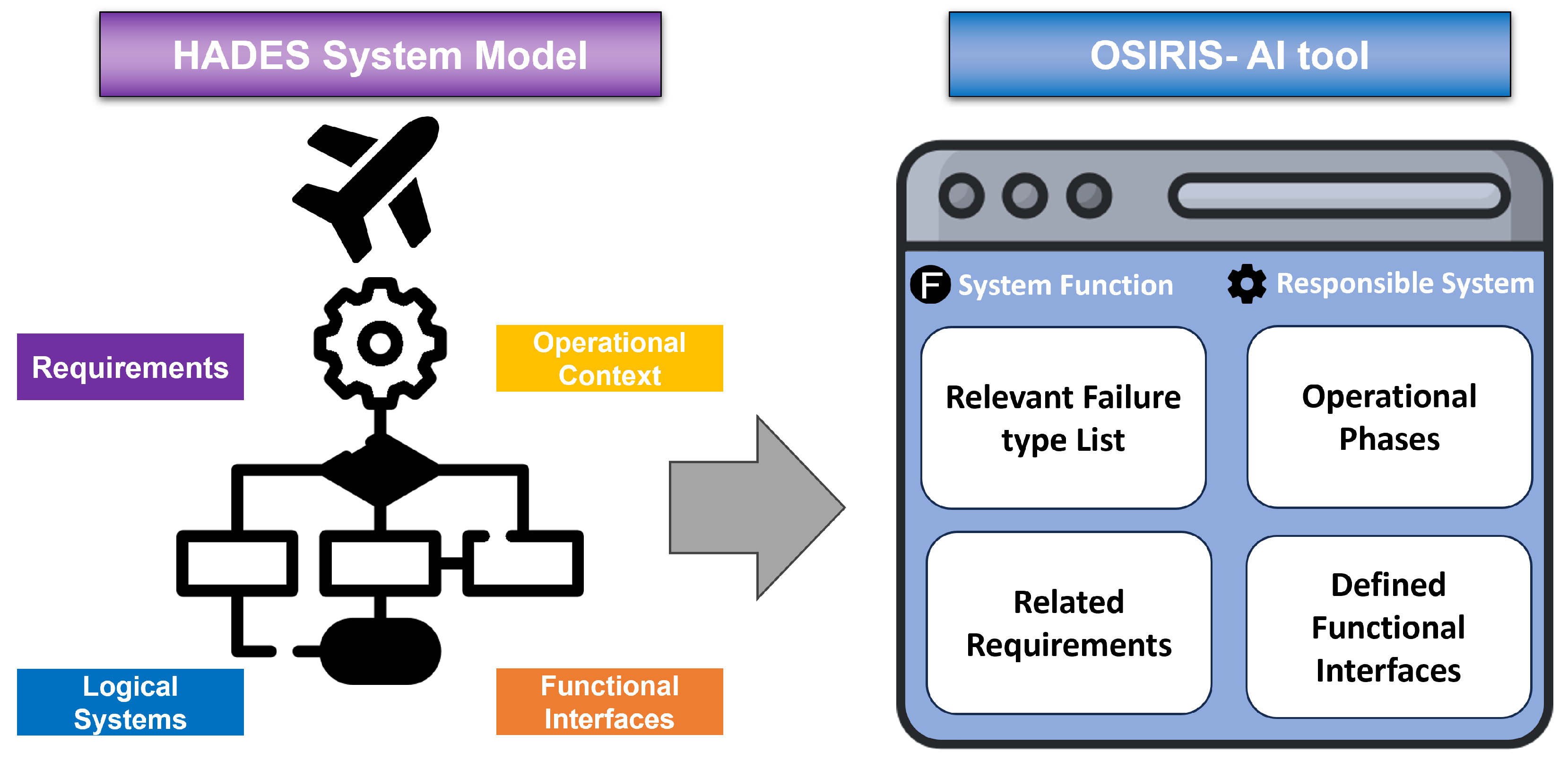
2. Methodology Behind OSIRIS
2.1. Abstract System Data Retrieval and Request Formulation
- Variable context: Utilization of a customized data retrieval strategy to extract a limited amount of relevant information as additional context for the LLM.
- Fixed context: Inclusion of all the considered regulatory data was added as context for text generation in the form of structured instructions in a tuned manner.
2.2. Structuring a Failure Case in Context of FHA
3. Results
3.1. Evaluation of Failure Conditions
- Failure condition statement;
- Effect analysis;
- Hazard classification (based on effects).
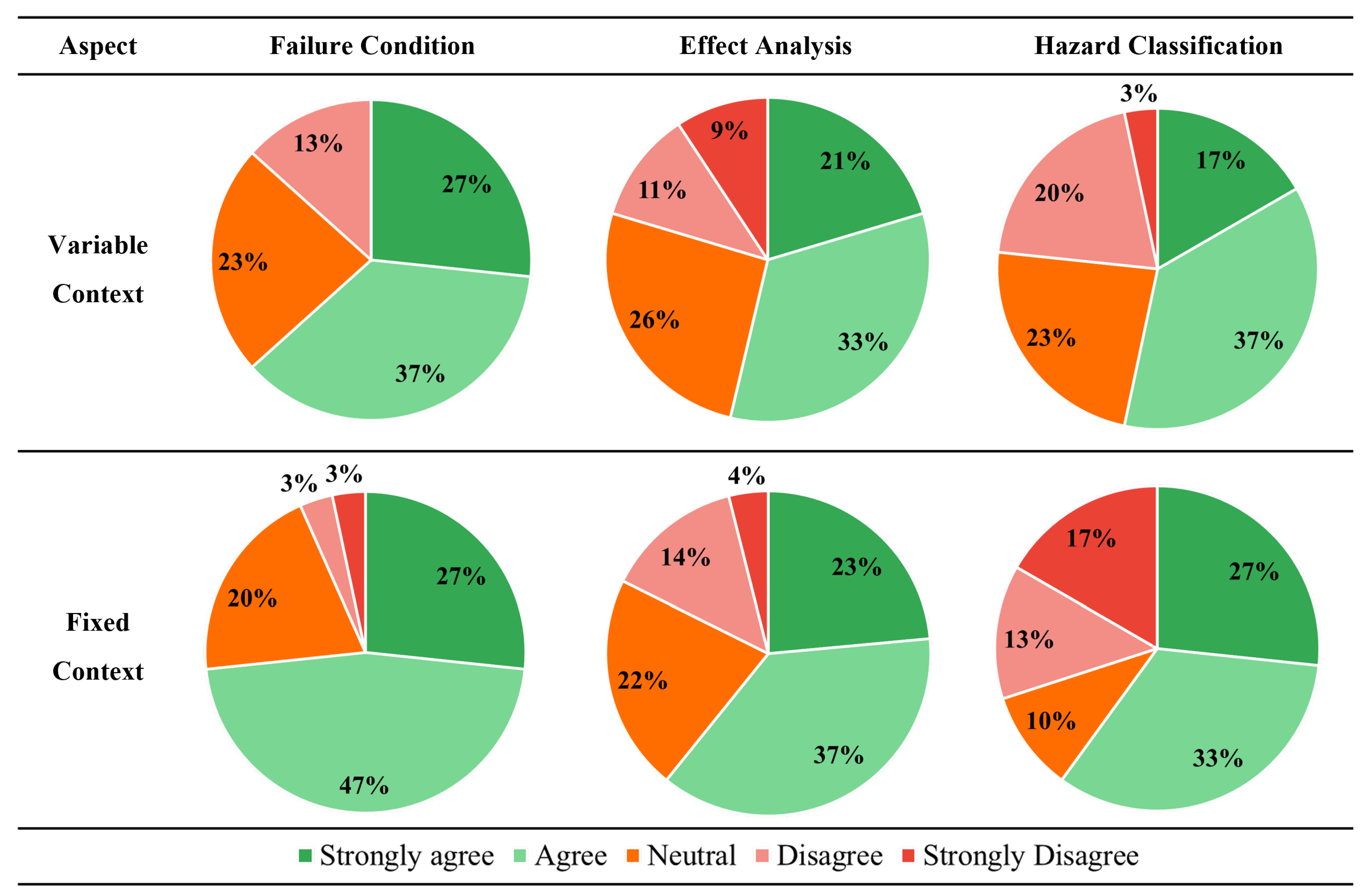
- More than 50% of the information generated by the LLM was suitable for consideration in a failure condition.
- The fixed-context variant failure conditions have been identified with more valid failure condition statements than the variable-context.
- In the case of effect analysis, both versions provided similar kinds of results, whereas the fixed context had showcased a slightly better outcome.
- The hazard classification aspect has the highest disagreement percentages in both cases, with variable context implicating slightly less disagreement than the other.
3.2. Observations on OSIRIS Functionality
- The variable context addition, considering a customized data retrieval, has provided flexibility to include relevant key data, which is not a possibility in the fixed context addition option.
- The increase in size of contextual data has a negligible difference in the time required to generate failure conditions.
- With the increase in the number of failure conditions, the time taken by the model with limited computing power has increased proportionally.
4. Future Work
5. Conclusions
Author Contributions
Funding
Institutional Review Board Statement
Informed Consent Statement
Data Availability Statement
Conflicts of Interest
References
- Soleymani, M.; Mostafavi, V.; Hebert, M.; Kelouwani, S.; Boulon, L. Hydrogen propulsion systems for aircraft, a review on recent advances and ongoing challenges. Int. J. Hydrogen Energy 2024, 91, 137–171. [Google Scholar] [CrossRef] [Scilit]
- European Union Aviation Safety Agency. Proposed CM Ref. CM-21. A-004 Issue 01 on “Acceptable Approaches for the Certification of Electric/Hybrid Propulsion Systems”; EASA: Cologne, Germany, 2024. [Google Scholar]
- DeSalvo, P.; Fogarty, D. Safety Issues and Shortcomings With Requirements Definition, Validation, and Verification Processes Final Report; (DOT/FAA/TC-16/39); Federal Aviation Administration: Washington, DC, USA, 2016.
- Perera, O.; Noteboom, C. Data integration with diverse data: Aerospace industry insights from a systematic literature review. Issues Inf. Syst. 2023, 24, 132–143. [Google Scholar]
- Kritzinger, D. Aircraft System Safety: Assessments for Initial Airworthiness Certification; Woodhead Publishing: Cambridge, UK, 2016. [Google Scholar]
- SAE International. Guidelines for Development of Civil Aircraft and Systems; (ARP4754, Rev.B); SAE International: Warrendale, PA, USA, 2023. [Google Scholar]
- SAE International. Guidelines and Methods for Conducting the Safety Assessment Process on Civil Aircraft, Systems and Equipment; (ARP4761, Rev.A); SAE International: Warrendale, PA, USA, 2023. [Google Scholar]
- Yang, M.; Wu, S.; Li, J.; Luo, C.; Hu, J. Research on an Integrated Modeling and Simulation Method for Small Satellite System. In Proceedings of the 2020 32nd Chinese Control and Decision Conference (CCDC), Hefei, China, 22–24 May 2020; pp. 5885–5890. [Google Scholar]
- Sun, M.; Gautam, S.; Elks, C.; Fleming, C. Characterizing the Identity of Model-based Safety Assessment: A Systematic Analysis. arXiv 2022, arXiv:2212.05401. [Google Scholar] [CrossRef] [Scilit]
- Kuelper, N.; Jeyaraj, A.K.; Liscouët-Hanke, S.; Thielecke, F. Integration of a model-based systems engineering framework with safety assessment for early design phases: A case study for hydrogen-based aircraft fuel system architecting. Results Eng. 2025, 25, 104249. [Google Scholar] [CrossRef] [Scilit]
- Lawless, W.F.; Mittu, R.; Sofge, D.A.; Shortell, T.; McDermott, T.A. Introduction to “Systems Engineering and Artificial Intelligence” and the Chapters. In Systems Engineering and Artificial Intelligence; Lawless, W.F., Mittu, R., Sofge, D.A., Shortell, T., McDermott, T.A., Eds.; Springer: Cham, Switzerland, 2021; pp. 1–22. [Google Scholar]
- Chami, M.; Abdoun, N.; Bruel, J.-M. Artificial Intelligence Capabilities for Effective Model-Based Systems Engineering: A Vision Paper. Incose Int. Symp. 2022, 32, 1160–1174. [Google Scholar] [CrossRef] [Scilit]
- Diemert, S.; Weber, J.H. Can Large Language Models assist in Hazard Analysis? arXiv 2023, arXiv:2303.15473. [Google Scholar] [CrossRef] [Scilit]
- Qi, Y.; Zhao, X.; Khastgir, S.; Huang, X. Safety Analysis in the Era of Large Language Models: A Case Study of STPA using ChatGPT. Mach. Learn. Appl. 2025, 25, 100622. [Google Scholar] [CrossRef] [Scilit]
- Mischke, M.; Katabathula, D.S.S.; Melico, L.F.; Berres, A. HADES—A Framework for Hierarchical Architecture Design for Engineering Systems. In Proceedings of the 15th EASN International Conference on “Innovation in Aviation & Space Towards Sustainability Today & Tomorrow”, Madrid, Spain, 14–17 October 2025. [Google Scholar]
- Federal Aviation Administration. System Safety Analysis and Assessment for Part 23 Airplanes; (AC23.1309-1E, 2011-11); Federal Aviation Administration: Washington, DC, USA, 2011.
- European Aviation Safety Agency. Certification Specifications for Large Aeroplanes; (CS-25.1309, 2023-01); European Union Aviation Safety Agency: Cologne, Germany, 2023. [Google Scholar]



| Attribute | Significance |
|---|---|
| Function | Function on which the failure condition is derived |
| System | Logical system that is considered from an abstract system model |
| Failure type | Failure modes considered for derivation as per AC23.1309-1E [16] |
| Phase | Operational phase or flight phase considered |
| Description | Elaborated description of the failure condition |
| Effect on aircraft | Failure effect of the FC on an aircraft system |
| Effect on crew | Effect of the FC on crew considering the operational phase |
| Effect on occupants | Effect of the FC on occupants considering the operational phase |
| Effect on a higher level | Failure effect of the FC on a higher level system |
| Hazard classification | Classification of the FC based on EASA CS25.1309 [17] |
| Pros | Cons |
|---|---|
|
|
Disclaimer/Publisher’s Note: The statements, opinions and data contained in all publications are solely those of the individual author(s) and contributor(s) and not of MDPI and/or the editor(s). MDPI and/or the editor(s) disclaim responsibility for any injury to people or property resulting from any ideas, methods, instructions or products referred to in the content. |
© 2026 by the authors. Licensee MDPI, Basel, Switzerland. This article is an open access article distributed under the terms and conditions of the Creative Commons Attribution (CC BY) license.
Share and Cite
Katabathula, D.S.S.; Mischke, M.; Stoppa, S.; Frank, R. OSIRIS—Generation of System-Specific Failure Cases Using Artificial Intelligence Based on Information from Abstract System Models. Eng. Proc. 2026, 133, 134. https://doi.org/10.3390/engproc2026133134
Katabathula DSS, Mischke M, Stoppa S, Frank R. OSIRIS—Generation of System-Specific Failure Cases Using Artificial Intelligence Based on Information from Abstract System Models. Engineering Proceedings. 2026; 133(1):134. https://doi.org/10.3390/engproc2026133134
Chicago/Turabian StyleKatabathula, Durga Sri Sharan, Marcel Mischke, Sebastian Stoppa, and Robin Frank. 2026. "OSIRIS—Generation of System-Specific Failure Cases Using Artificial Intelligence Based on Information from Abstract System Models" Engineering Proceedings 133, no. 1: 134. https://doi.org/10.3390/engproc2026133134
APA StyleKatabathula, D. S. S., Mischke, M., Stoppa, S., & Frank, R. (2026). OSIRIS—Generation of System-Specific Failure Cases Using Artificial Intelligence Based on Information from Abstract System Models. Engineering Proceedings, 133(1), 134. https://doi.org/10.3390/engproc2026133134