Proceeding Paper

Advancing Aerial Firefighting with Extended Operational Design Using Novel Strategies and Aircraft Concepts †
by
Shraddha Meda Sheshadri
1,*,‡,
Alex Mercier
1,‡,
Sarah Treece
1,‡,
Cristian Puebla Menne
1,‡,
Burak Bagdatli
1,
Dimitri Mavris
1,
Nikolaos Kalliatakis
2,
Nabih Naeem
2 and
Prajwal Shiva Prakasha
2
1
Aerospace Systems Design Laboratory, Georgia Institute of Technology, Atlanta, GA 30332, USA
2
Institute of System Architectures in Aeronautics, German Aerospace Center (DLR), 21129 Hamburg, Germany
*
Author to whom correspondence should be addressed.
Presented at the 15th EASN International Conference, Madrid, Spain, 14–17 October 2025.
These authors contributed equally to this work.
Eng. Proc. 2026, 133(1), 133; https://doi.org/10.3390/engproc2026133133 (registering DOI)
Published: 14 May 2026

Abstract

Wildfire severity and frequency continue to increase worldwide, making effective aerial wildfire suppression a critical component of wildfire response. The COLOSSUS (Collaborative SoS) X-Challenge project established a system-of-systems (SoS) framework to design and evaluate next-generation firefighting capabilities and operational concepts. Building on this framework, this paper presents a simulation environment that jointly evaluates conventional fixed-wing and electric vertical takeoff and landing (eVTOL) firefighting aircraft concepts by integrating aircraft design, fleet-level coordination, and mission-level tactics into the unified SoS assessment, enabling performance-driven design exploration. The framework was expanded with new tactics, including a ridge-based drop method, and a flanking selection algorithm that leverages road networks to establish anchor points and construct fire lines. Simulations across three representative wildfire locations (Salamis, Pyrenees, and Palisades) demonstrate that combining purpose-built aircraft with adaptive tactics can significantly improve mission effectiveness.

1. Introduction

Wildfires present an increasingly dangerous threat to life, infrastructure, and the environment. Over the last two decades, wildfire events have become more frequent, more intense, and significantly larger [1], making effective suppression strategies more critical than ever. Wildfire fighting is inherently difficult due to dynamic fire behavior and unpredictable factors such as incident terrain, wind, and humidity. Aerial assets play a central role in modern wildfire response by delivering rapid, targeted suppression across large and dynamic fire fronts. However, most platforms currently used in aerial firefighting were originally designed for unrelated missions and later adapted for suppression operations. The misalignment between design intent and operational need creates a significant opportunity: the development of purpose-built aircraft specifically for wildfire response, provided such designs remain cost-effective within operational constraints.
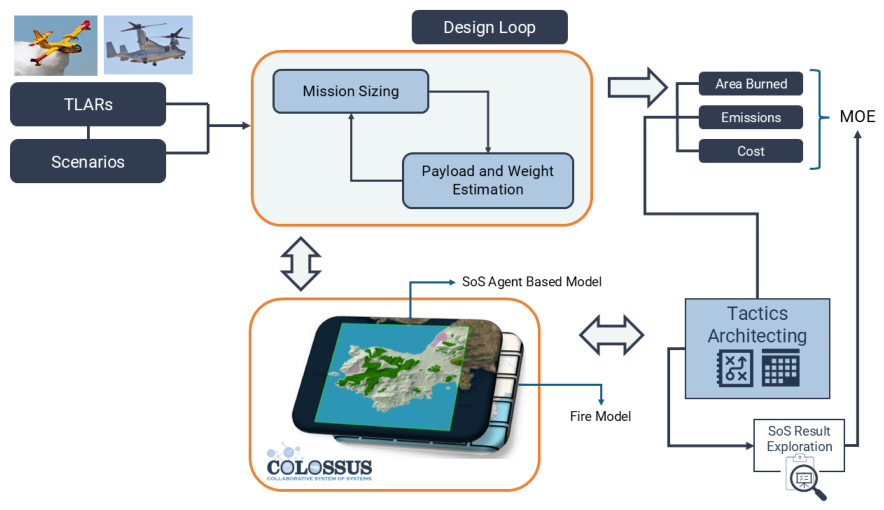
This work was carried out as part of a six-month international student competition, with teams being tasked with developing innovative aircraft designs and expanding the COLOSSUS SoS framework with new insights, models, and operational features. Details on three scenarios referred to in this analysis (Salamis in Greece, the Pyrenees in France, and Pacific Palisades in the United States), each of which poses unique challenges in terms of elevation, topography, and proximity to water sources, along with further information on the challenge, can be found on the challenge website [2]. Two primary aircraft types were investigated: a modernized conventional fixed-wing scooper and an eVTOL concept. Each platform offers distinct opportunities for performance and operational enhancement. The existing COLOSSUS firefighting environment was also extended with new SoS-level tactics and decision-making logic, enabling a richer exploration of how aircraft design, mission strategy, and environmental context interact. These additions support the identification of the most effective combinations of aircraft configuration and wildfire-suppression tactics. Figure 1 illustrates the overall system-of-systems framework adopted in this study, where the orange-highlighted boxes represent the methodological tools used in the analysis.

2. Aircraft Design Methodology

The aircraft design process was specialized for wildfire suppression missions by simulating aircraft under the X-Challenge constraints [2]: Maximum Take Off Mass ( M 0 )—25 t ; Payload—10 t ; and Entry Into Service—2035. Trade studies and parameter sweeps using 400-case designs of experiments (DoE) were used to balance performance, payload, endurance, and operational flexibility [3] within the project’s €100M total fleet cost cap. The sections that follow detail the design rationale, geometry definition, and mission performance estimates for both the conventional and electric configurations. Each design concept was assessed for feasibility and operational effectiveness in wildfire environments. using the expression provided by the COLOSSUS X-Challenge [2]. The average of the normalized parameter values corresponding to each one of the three scenarios was used as the operational effectiveness score for each design case run through the simulation.

2.1. Conventional Aircraft Design

The conventional configuration’s design focused on simplicity, cost-effectiveness, and compatibility with existing infrastructure; optimized for scooping and drop efficiency over large fires. It draws inspiration from legacy firefighting aircraft such as the CL-415 [4] and the upcoming DHC-515 [5], both renowned for their water scooping capability, short takeoff performance, and robust operations in rugged wildfire environments. A modernized fixed-wing concept was developed that retains scooping capability while incorporating composite airframe construction, enhanced aerodynamic efficiency, and advanced propulsion technologies. The design is conceived explicitly within an SoS framework, ensuring that aircraft performance, turnaround time, and mission flexibility are optimized not only individually but in coordination with the broader firefighting fleet.
To explore the design space and perform trade-offs, the variables and ranges for the DoE were selected based on mission requirements, historical data, and top level aircraft requirements (TLARs) by making forward-looking assumptions about technology readiness by 2035. Empty Mass ( M empty ) was estimated using an empirical formula for twin turboprop aircraft [6] given in Equation (1) with a composite adjustment factor of 0.9 to reflect 2035-era composite material and structure efficiency. Aircraft range and lift-to-drag ratio were not defined in the DoE; therefore, the propellant mass ( M fuel ) was derived as the residual from M 0 after accounting for payload and M empty (Equation (2) per Raymer [6]), with 1% margin for crew. For each case, the reserve fuel mass was computed as a fraction of total fuel. Other mission segment fuel consumptions (taxi, climb, cruise, descent, and loiter) were parametrically tied to the DoE variables for consistency across the missions.
M empty / M 0 = 0.90 · 1.51 · M 0 0.10
M fuel = 0.99 · M 0 M empty M payload

2.2. eVTOL Design

The all-electric eVTOL aircraft concept was designed for precision wildfire response in rugged or urban-constrained environments, where conventional scooper aircraft have operational limitations. It draws inspiration from military tiltrotor platforms such as the V-22 Osprey [7]. The design prioritizes vertical take-off and landing capability, enabling access to remote bases and steep terrain without the need for traditional runways. Its compact tilt-wing configuration supports rapid deployment and extraction in time-critical fire suppression missions. The eVTOL concept could use distributed electric propulsion and swappable and fast-charging batter batteries to enable high sortie rates.
For the eVTOL configuration, battery weight and capacity was calculated during mission analysis and sizing. An optimistic M empty fraction of 45% of the M 0 was assumed (Equation (3)) to reflect expected 2035 advancements in lightweight structures and integrated battery packaging. Battery mass was calculated based on the mission energy demand and added to the structural M empty (Equation (3)), with an estimated energy density of ρ battery = 1 1800 k g / k J , corresponding to an energy density of approximately 500 W h / k g battery pack (2035 estimate). For mission phase durations, the time spent in each flight segment was estimated using kinematic relations. A fixed cruise segment distance of d cruise = 30,000 m was assumed, representing short-haul firefighting operations. The total mission energy demand was computed as the sum of energy consumed in each phase (Equation (3)), where P i is the power demand in the ith mission phase (taxi, take-off, transition, cruise climb, cruise, descent, re-transition, landing, and loiter) and t i is the corresponding duration.
M empty = 0.45 · M 0 + M battery = 0.45 · M 0 + E mission ρ battery = 0.45 · M 0 + i P i · t i ρ battery
Available payload was derived from the M 0 after subtracting M empty and M battery . Battery capacity was estimated to accommodate battery inefficiencies and energy margin. A 20% efficiency margin and 5% reserve buffer were added to determine required energy capacity and battery sizing. The formulation ensures consistency across mission phases while capturing the full energy profile needed to size the eVTOL.

2.3. Aircraft Cost Modeling

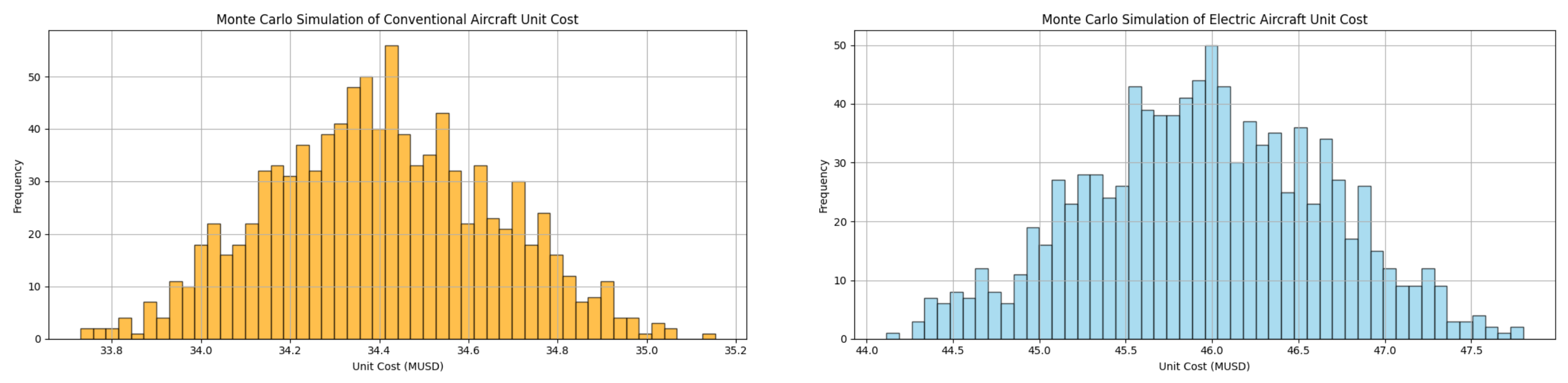
A unified cost model was developed to estimate development and operational costs for both conventional and electric aircraft under technological uncertainty. Three cost estimation approaches were sequentially examined: (i) multi-variable regression-based models developed by the research team, (ii) the “Development and Production Costs for Aircraft (DAPCA) IV” cost model [8], and (iii) a custom, code-based cost model. Given the limited historical data on the electric aircraft configuration, the custom model was selected for both aircraft types to preserve homogeneity. Both aircraft types were decomposed into major subsystems (airframe, propulsion, avionics, integration, etc.), with the electric variant reflecting added propulsion, thermal management, and certification complexity. Uncertainty was captured through Monte Carlo simulations using triangular distributions, with Technology Readiness Level (TRL) and Integration Complexity defining development risk. Manufacturing costs incorporated a five-year ramp-up, a learning curve, inflation, and profit margins. Operational costs included crew expenses as well as fuel and electrical energy consumption. Simulations were implemented in Python (version 3.11, Python Software Foundation, Beaverton, OR, USA) [9]. The resulting unit costs were $34.4M for the conventional and $45.95M for the eVTOL aircraft, aligning with the X-Challenge’s expectations (Figure 2).

3. System of Systems Expansion

Uncontrollable variables such as wind velocity and proximity to built-up areas affect the rate, direction, and criticality of fire growth. To react to potential fire spread scenarios, pilots need several tactics to most effectively fight the current fire. The (System of Systems Inverse Design) SoSID toolkit from the COLOSSUS project [3] provides many tactics for selecting different locations to drop, called selected points of interest (POIs), as well as ways to switch the selection tactic based on influencing environmental factors, called change tactics. Further additions were made to the list of available tactics by this effort to provide new capabilities for the toolkit. Different added tactics and methods were effective in different scenarios (see Section 4).
Four initial tactics were created and implemented into the toolkit to gain a robust understanding of the capabilities, and implementation of the current capabilities: a temperature tactic change, loiter time suppression, elevation POI selection, and a coordinated attack POI selection. Each of these additions were suggested by the COLOSSUS team and implemented to demonstrate full understanding of the toolkit. Stochasticity was added to the simulation by including water drop success factors. This is a method that may be expanded upon in the future for increased realism to the simulation. Two major new tactics were added to the toolkit to be able to further improve suppression strategies: a ridge-based POI selection and a flanking suppression method. All tactics were implemented in Python (version 3.11, Python Software Foundation, Beaverton, OR, USA) [9].

3.1. Ridge POI Selection

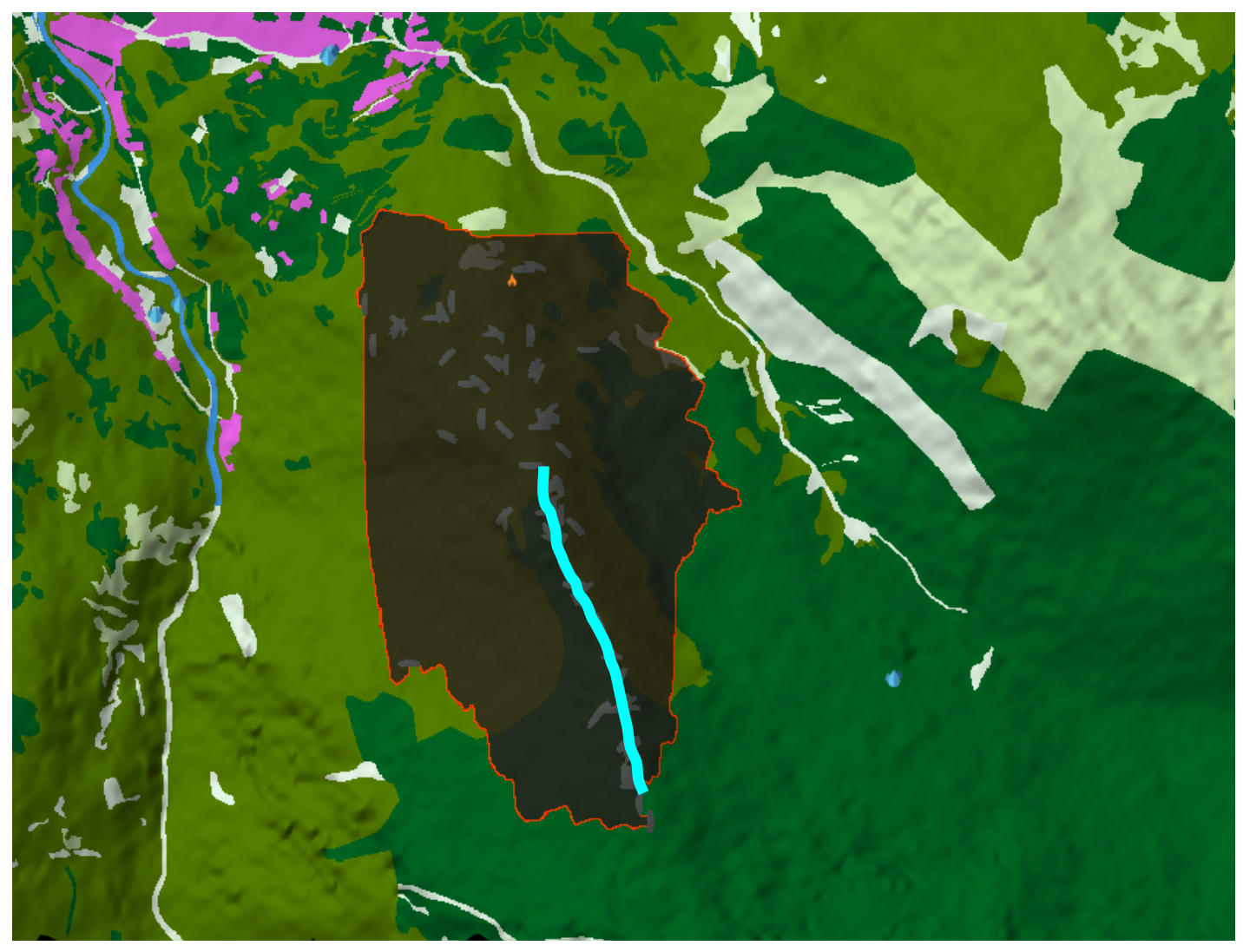
Steep slopes in the direction of fire spread lead to an increased burn rate uphill [10]. Thus, water drops dropped along an uphill slope are not as effective as dropping along a ridge at the end of an uphill slope. A ridge tactic was added as a direct attack in the Select_POI class. When selecting a location for a drop, this tactic evaluates the elevation of neighboring cells for each grid cell and assigns a ridge prominence value, i.e., the likelihood of the burning cell being a ridge. The class guides aircraft to drop along ridge lines as shown in Figure 3, with blue lines tracing out the prominent ridge in the area of fire spread.

3.2. Flanking

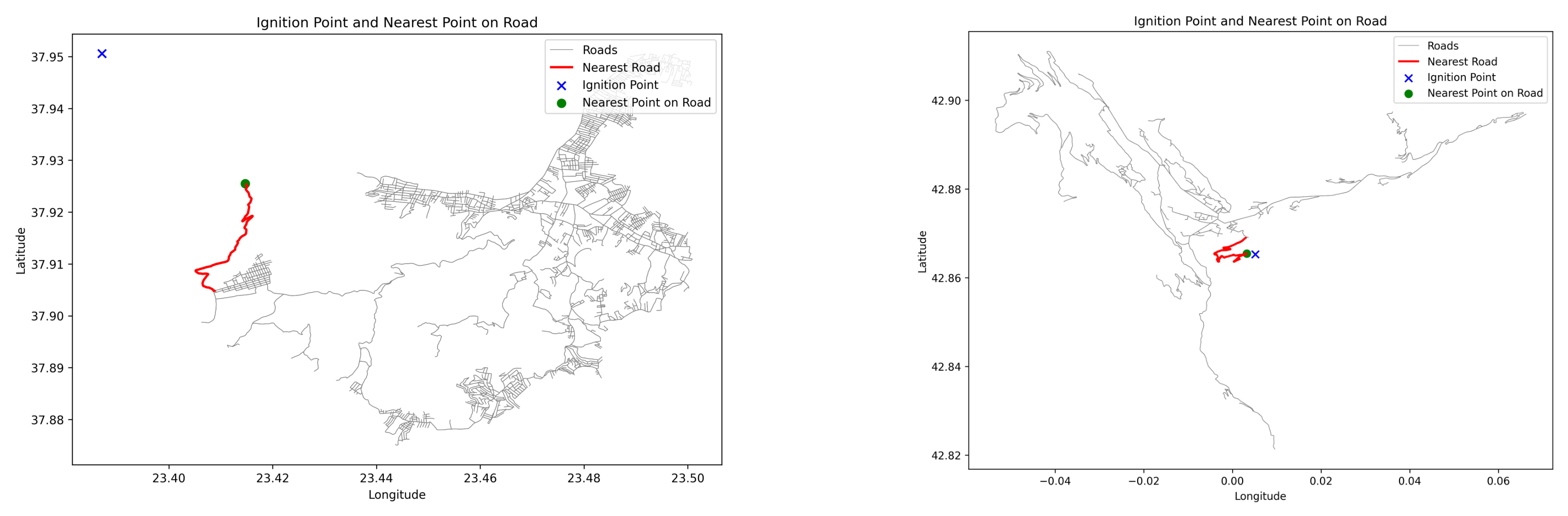
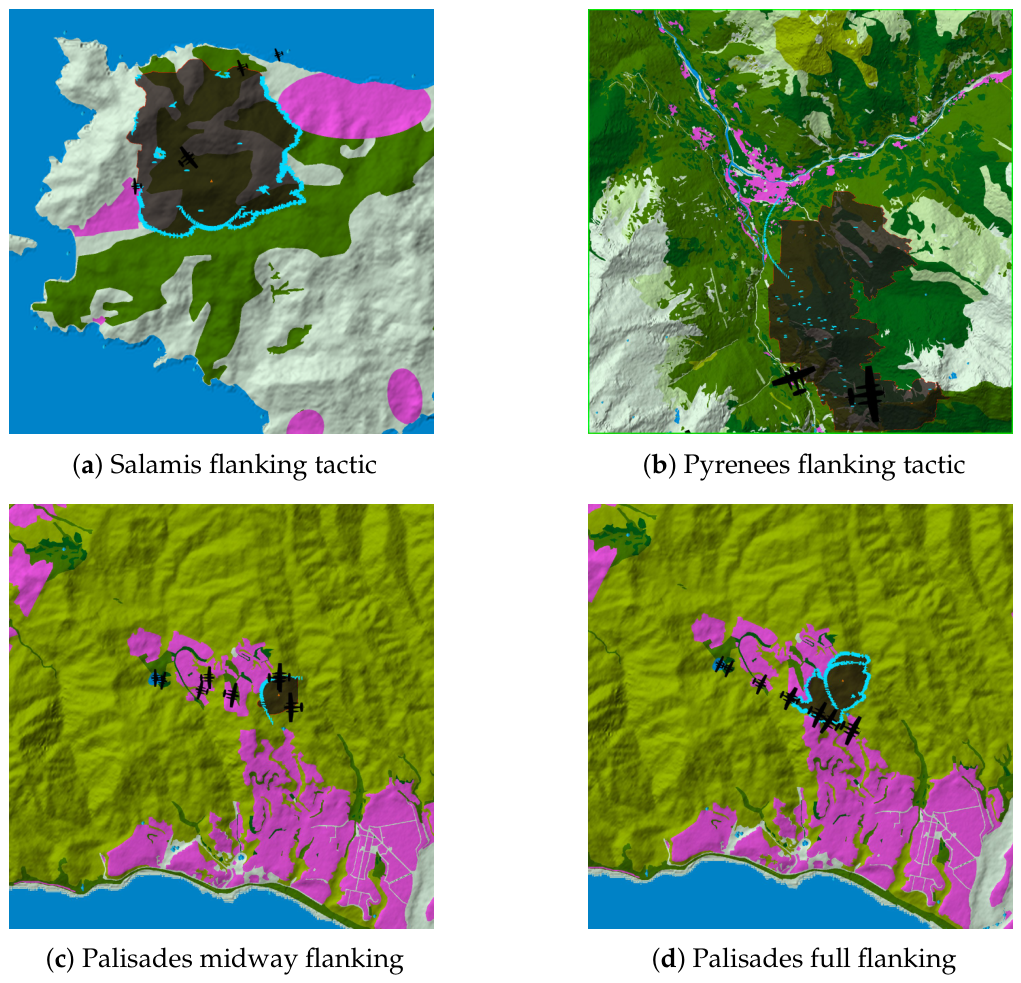
The most significant addition to the framework is the flanking fire Select_POI method. It selects an anchor point, usually a road or similar artificial barrier opposite the fire spread direction, and builds fire lines outwards.The lines can be a combination of retardant and water drops as well as controlled burns to stop fire spread back through the controlled area [11]. An OpenStreetMap [12] query overlays the road network, shown in red in Figure 4, to determine the closest point on a road to the ignition point, to be used as the anchor point. The flanking method builds a suppression line outward from the anchor point in both directions (Figure 5a). The suppression line starts with the curved parabola on the South side of the fire before changing tactics for the rest of the fire.

3.3. Scenario Flanking Tactics

For the Salamis scenario, the new flanking method was utilized for one run and a purely indirect method was used for another. The indirect method involves surrounding the fire with a fireline over time. Flanking built an initial fire line to the south of the ignition point, as shown in blue in Figure 5a. The flanking method resulted in a total burned area of approximately 500 Ha in comparison to approximately 818 Ha for the indirect method.
For the Pyrenees scenario, the flanking tactic was not as useful in terms of reducing burned area. A fire line is built to prevent the fire from expanding rapidly into residential areas, as seen in Figure 5b. The fire naturally grows away from this area, rendering the tactic unused. In this scenario, due to the direction of growth of the fire, the tactic was not needed. If the fire were to change direction and head back towards residential areas to the north west of the ignition point, the pre-existing fire line developed by the flanking tactic would be beneficial in containing the fire and preventing further growth.
The flanking method along with the selection method that prioritizes important locations being protected (VIP) was used in the Palisades scenario. The number of aircraft was raised from four to eight to see better results in both the flanking and indirect tactic simulations. Figure 5c shows the initial fire line is built to the north west of the ignition point, preventing spread into the residential area. As the fire continues to spread, the planes switch to a VIP method of attack and contain any spotting that occurs, as seen in Figure 5d. As a result, the flanking method yielded just 83 Ha of burned area in comparison to 3644 Ha of burned area while using the indirect method.

4. Results: Selected Configuration

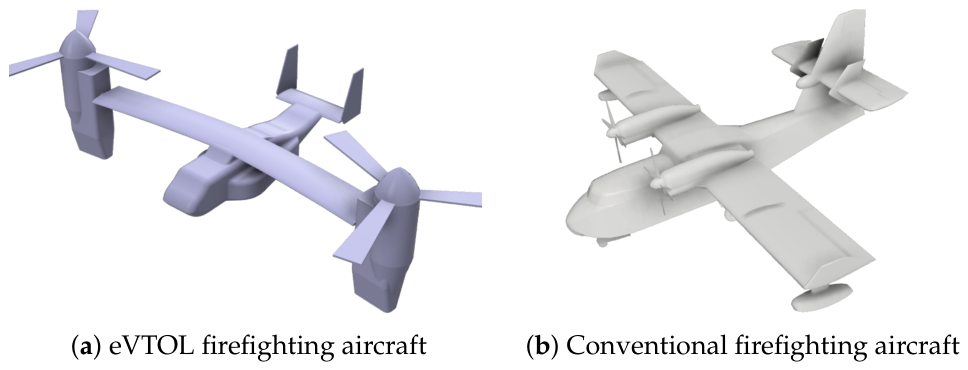
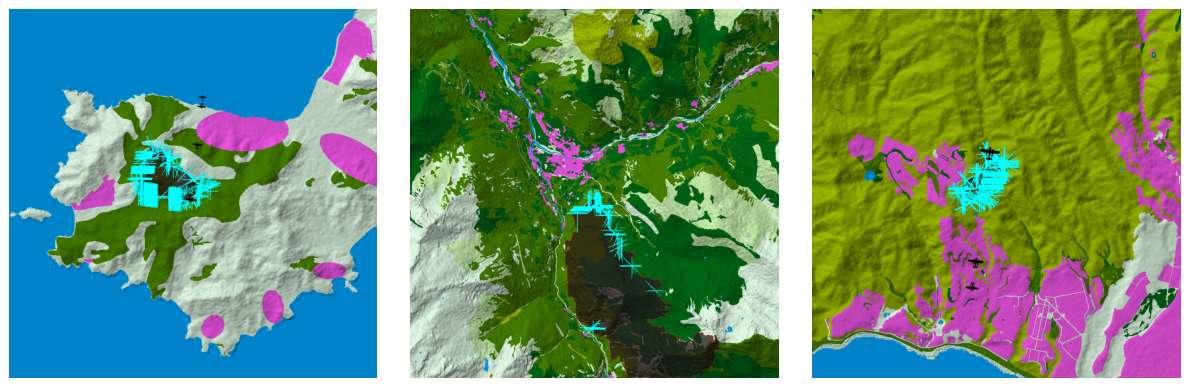
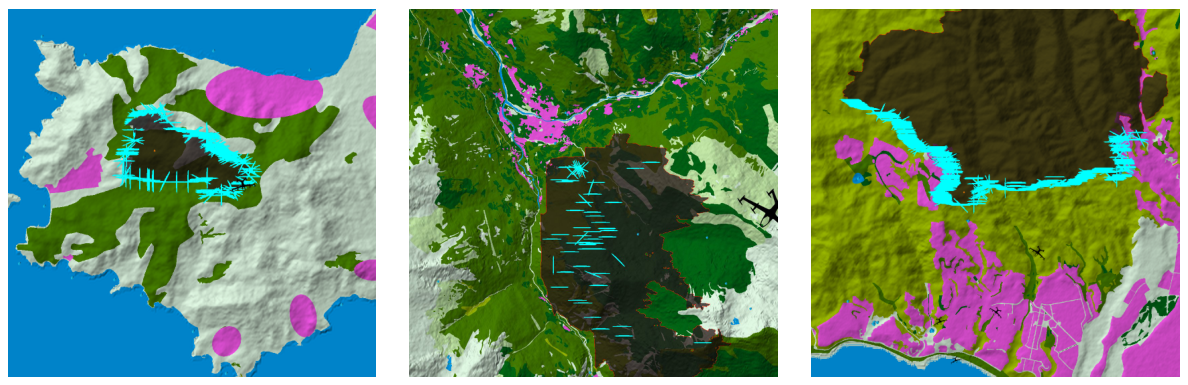
To determine the final combination of tactics and aircraft design, respective Measures of Effectiveness (MoE) were calculated for each DoE case. The aircraft in Figure 6 have the highest MoE. Based on reducing burned area, overall cost, and emissions, specific tactics were used with the designs in all three locations. The final results are illustrated in Figure 7 and Figure 8, where the scenarios with the highest MoE show a significant reduction in burned area (dark gray region) compared to lower-performing tactic–design combinations. Overall, the direct water tactic generally outperformed the indirect tactic; however, in the Pyrenees scenario the two perform similarly, with a marginal advantage for the indirect approach. In contrast, the Palisades and Salamis scenarios favor the indirect tactic, with a particularly strong advantage observed in the Palisades case.
It should be noted that, in the analysis of both designs across the various scenarios, the Palisades and Salamis cases were assessed using a fleet of four aircraft. This configuration allowed for the placement of one aircraft at each available base. Although this exceeded the allotted budget, it was deemed necessary to assess these fleet compositions to provide a more representative overall solution for these scenarios. There are further opportunities to optimize and investigate designs and tactics by using computational methods such as surrogate models, Bayesian optimization, and uncertainty modeling; however, the developed tactics were sufficient in determining the final MoE-optimized aircraft designs.
The selected aircraft configurations were visualized as preliminary CAD models to show key configuration features, assess integration of firefighting systems, and ensure feasibility within mission and SoS constraints. Figure 6b shows the external layout, derived from the CL-415 and DHC-515 lineage and modernized for 2035 operations. Some key features include a high-wing layout, twin turboprops, wingtip pods, high-mounted horizontal stabilizer, dorsal fin, and a composite structure. Figure 6a shows the eVTOL concept with the tilt-wing VTOL mechanism, high-wing design, twin-boom empennage, battery bays, a modular payload bay, and a composite airframe.

5. Discussion: Limitations and Future Refinements

For future work, more rigorous structural and aerodynamics analysis should be conducted to validate these design concepts. This will ensure that the designs meet all necessary performance and safety standards, and provide a more realistic assessment of their behavior under actual operational conditions. Additionally, further optimizations should consider manufacturing constraints, material properties, and real-world operational data, as they could affect the overall performance and feasibility of the aircraft designs.
The addition of the ridge, flanking, and stochasticity are the most significant improvements to the code base. For the ridge tactic, it is important to test this in numerous scenarios where this may be applicable. For the flanking, it has been proven to be successful and useful, but where and when is still up for debate. Further optimizations for each scenario could be conducted to determine where the best use of this tactic is. There is an infinite number of trajectories for the firefighting mission to play out based on the stochastic nature of the problem. However, it is necessary to keep developing this capability if robust simulation outputs are needed to make investment decisions. The reported stochastic capabilities can be developed to further improve and represent the real-life logistics of conducted drops for planes to suppress wildfires throughout the globe.

6. Conclusions

This work demonstrates that specific tactics such as the newly introduced flanking method may be useful in specific scenarios. However, to know exactly when specific tactics are most useful, a full optimization case study determining which tactics and for which scenarios must be conducted. To do this, future work may include a full factorial DoE to run all tactic combinations for each of the three scenarios and compare MoEs to determine the best outcome. Additionally, further expansion in the SoS environment to include more stochasticity and realistic aspects in the environment will further demonstrate the benefits of this project. In its current state, this work shows it is beneficial to the system of systems and wildfire communities to evaluate how firefighting tactics may work alongside novel aircraft to successfully suppress wildfires in a simulation environment. This work may be utilized to analyze predicted fire growth and determine the best ways in which to stop fires quickly to reduce acres burned, loss of life, property, and emissions.

Author Contributions

Conceptualization, methodology, validation, formal analysis, investigation, data curation, and visualization, S.M.S., A.M., S.T. and C.P.M.; writing, review and editing, B.B., S.M.S., A.M., S.T. and C.P.M.; supervision, B.B. and D.M.; project administration, N.K., N.N. and P.S.P.; funding acquisition, P.S.P. All authors have read and agreed to the published version of the manuscript.

Funding

This research was conducted in the framework of the COLOSSUS project (Collaborative System of Systems Exploration of Aviation Products, Services, and Business Models) and has received funding from the European Union Horizon Europe Program under grant agreement No. 101097120.

Institutional Review Board Statement

Not applicable.

Informed Consent Statement

Not applicable.

Data Availability Statement

The data presented in this study are available on request from the corresponding author. The data are not publicly available due to restrictions associated with in-house developed tools and project-specific data.

Conflicts of Interest

The authors declare no conflicts of interest.

References

  1. Wildfires and Climate Change. NASA. 2025. Available online: https://science.nasa.gov/earth/explore/wildfires-and-climate-change (accessed on 15 May 2025).
  2. Kalliatakis, N.; Naeem, N.; Prakasha, P.S. COLOSSUS X-Challenge Student Competition—Exploring Solutions to Wildfire Fighting Using Systems-of-Systems Analysis. In Proceedings of the 15th EASN Conference, Madrid, Spain, 14–17 October 2025. [Google Scholar]
  3. Prakasha, P.S.; Naeem, N.; Amadori, K.; Donelli, G.; Akbari, J.; Nicolosi, F.; Franzén, L.K.; Ruocco, M.; Lefebvre, T.; Nagel, B. COLOSSUS EU Project—Collaborative SoS Exploration of Aviation Products, Services and Business Models: Overview and Approach. In Proceedings of the ICAS 2024, Florence, Italy, 9–13 September 2024. [Google Scholar]
  4. Canadair CL-415 Aerial Firefighting Aircraft. Available online: https://dehavilland.com/cl-415-2 (accessed on 10 May 2025).
  5. DHC-515 Firefighter Program Launched. Available online: https://dehavilland.com/de-havilland-canadair-515 (accessed on 10 May 2026).
  6. Raymer, D. Aircraft Design: A Conceptual Approach; American Institute of Aeronautics and Astronautics, Inc.: Reston, VA, USA, 2012. [Google Scholar]
  7. V-22 Osprey: Unlike Any Aircraft in the World. Available online: https://www.boeing.com/defense/v-22-osprey (accessed on 15 June 2025).
  8. Hess, R.; Romanoff, H.P. Aircraft Airframe Cost Estimating Relationships: Study Approach and Conclusions; RAND Corporation: Santa Monica, CA, USA, 1987; Available online: https://www.rand.org/pubs/reports/R3255.html (accessed on 10 July 2025).
  9. Van Rossum, G.; Drake, F.L. Python 3 Reference Manual; Python Software Foundation: Beaverton, OR, USA, 2009; Available online: https://www.python.org (accessed on 30 April 2025).
  10. Northwest Fire Science Consortium. What Is? Topography. Fire Facts Series. Available online: https://www.nwfirescience.org/our-products/nwfsc-fire-facts-what-topography (accessed on 2 July 2025).
  11. Colorado Firecamp. Suppression Tactics Guide. Available online: https://www.coloradofirecamp.com/suppression-tactics/suppression-tactics-guide.pdf (accessed on 2 July 2025).
  12. OpenStreetMap Contributors. OpenStreetMap. Available online: https://www.openstreetmap.org (accessed on 15 June 2025).
Figure 1. System-of-systems architecture integrated with the COLOSSUS toolkit.
Engproc 133 00133 g001
Figure 2. Monte Carlo unit cost distributions: conventional aircraft (left); electric aircraft (right).
Engproc 133 00133 g002
Figure 3. Pyrenees ridge drop with the blue line indicating the ridge location.
Engproc 133 00133 g003
Figure 4. Road structures for Salamis (left), Pyrenees (right).
Engproc 133 00133 g004
Figure 5. Different flanking tactics for different locations (water drops are shown in blue).
Engproc 133 00133 g005
Figure 6. Conceptual CAD models of the two aircraft concepts.
Engproc 133 00133 g006
Figure 7. Final conventional aircraft tactics for Salamis (left), Pyrenees (middle), and Palisades (right).
Engproc 133 00133 g007
Figure 8. Final eVTOL tactics for Salamis (left), Pyrenees (middle), and Palisades (right).
Engproc 133 00133 g008
Disclaimer/Publisher’s Note: The statements, opinions and data contained in all publications are solely those of the individual author(s) and contributor(s) and not of MDPI and/or the editor(s). MDPI and/or the editor(s) disclaim responsibility for any injury to people or property resulting from any ideas, methods, instructions or products referred to in the content.