Design of a Twin-Disc Rig for the Investigation of the Thermo-Mechanical Behaviour of Wheels, Rails and Brake Shoes of Railway Freight Waggons †



Abstract
1. Introduction
2. Design of the Scaled Twin-Disc Bench
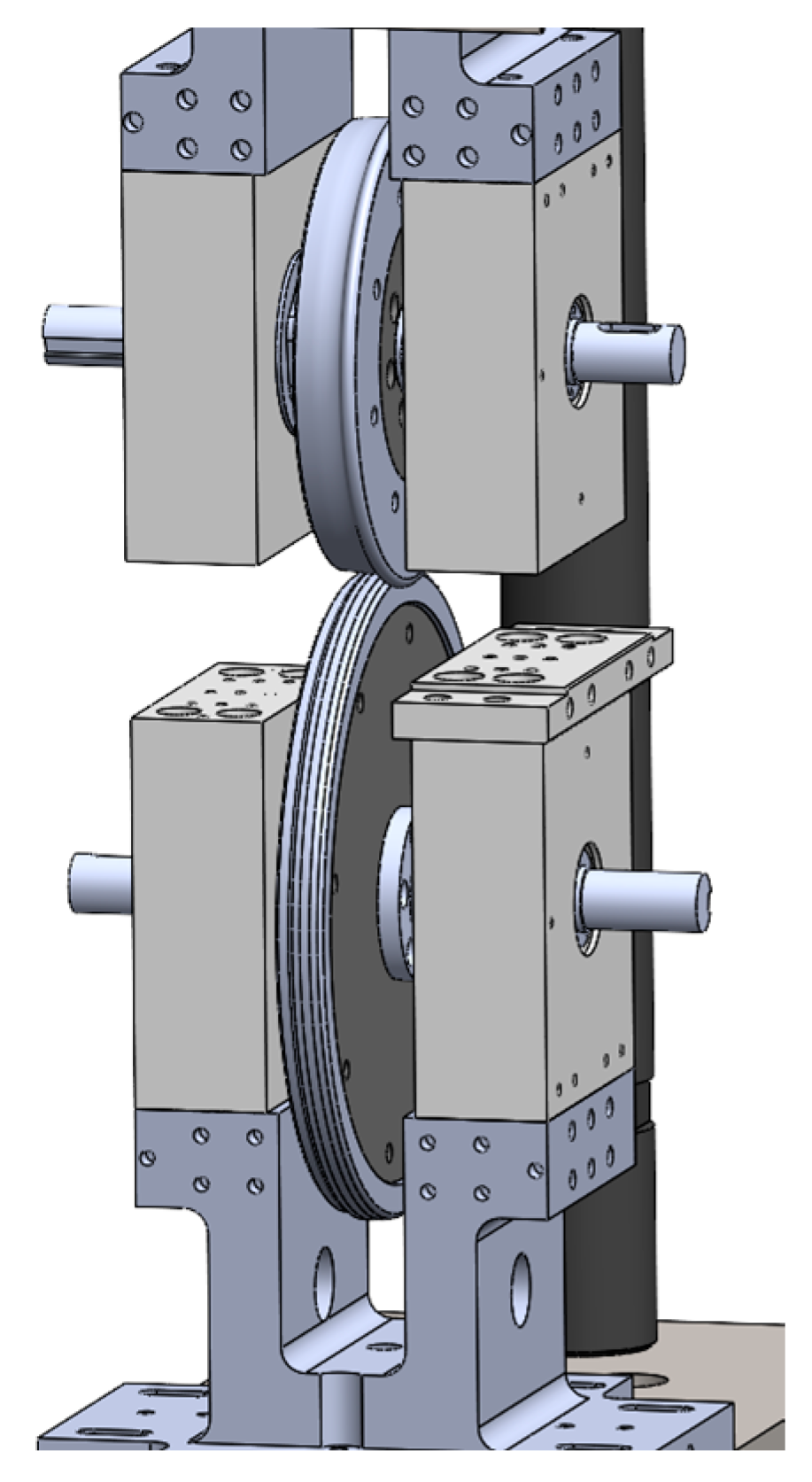
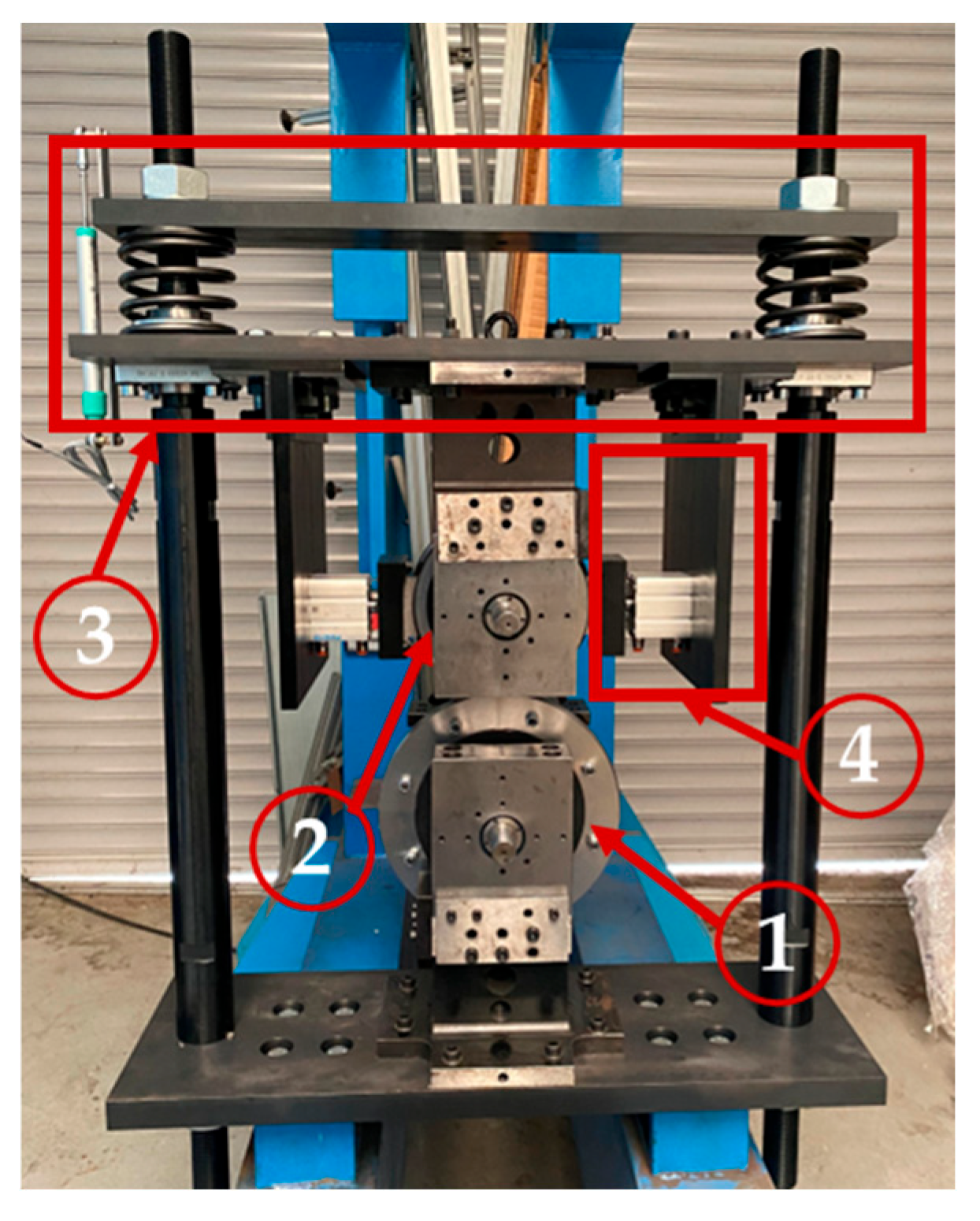
- Rail disc.
- Wheel disc.
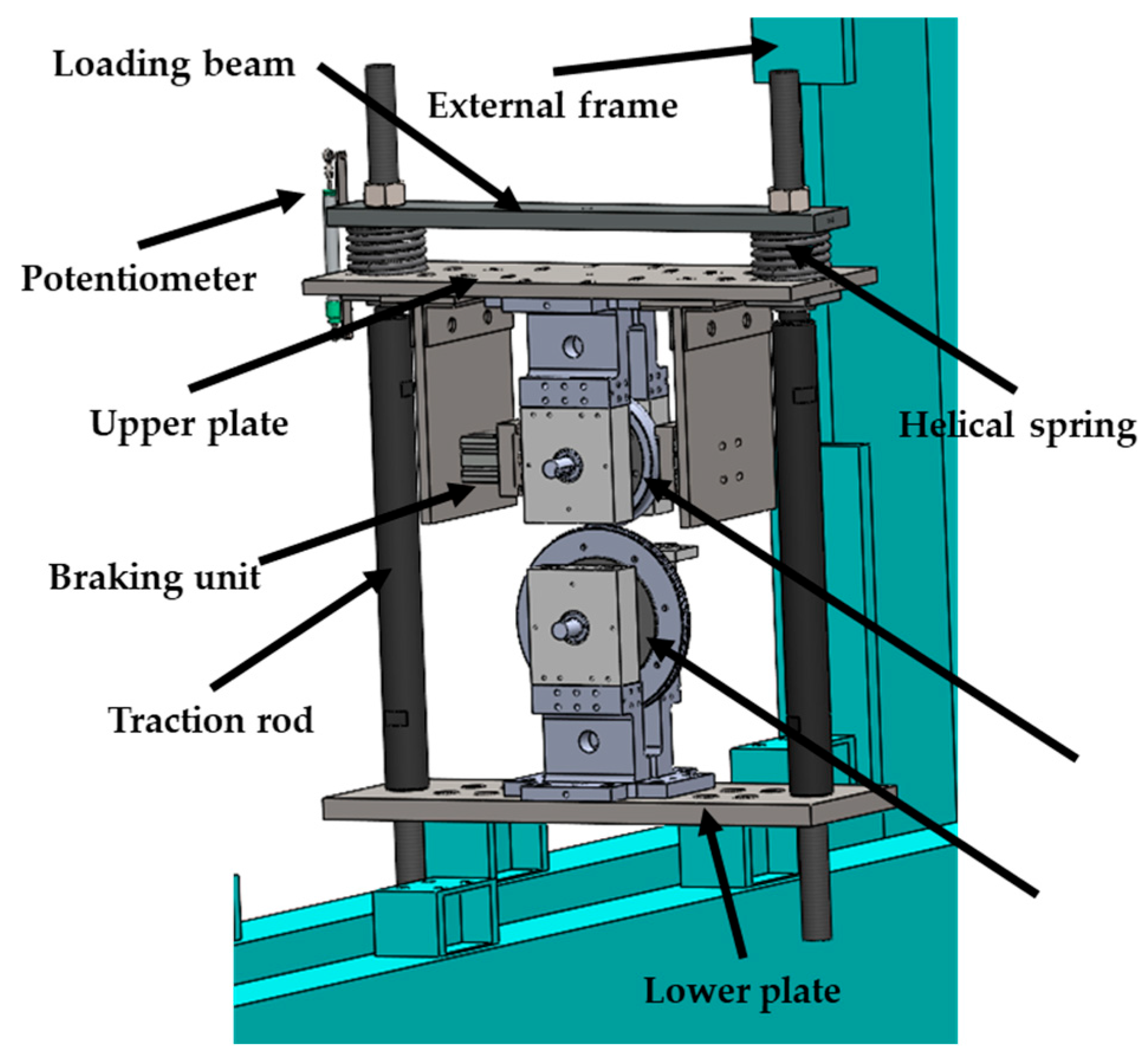
- Load the application system.
- Mechanical power supply system.
3. Bench Configuration and Calibration
- Tribological tests at the wheel–rail interface. This is the typical test performed on common twin-discs to obtain the values of wear and/or adhesion coefficients at the contact interface between the two discs. For this type of test, both discs are connected to independent brushless motors that control the speed in order to generate slip at the contact interface. This type of test is run in adherence with Pascal’s similitude rule, which ensures a unitary scaling of the contact pressure. This is achieved by properly setting the normal load through the load application system. When running tribological tests at the wheel–rail interface, no braking effort is applied with the scaled tread braking system.
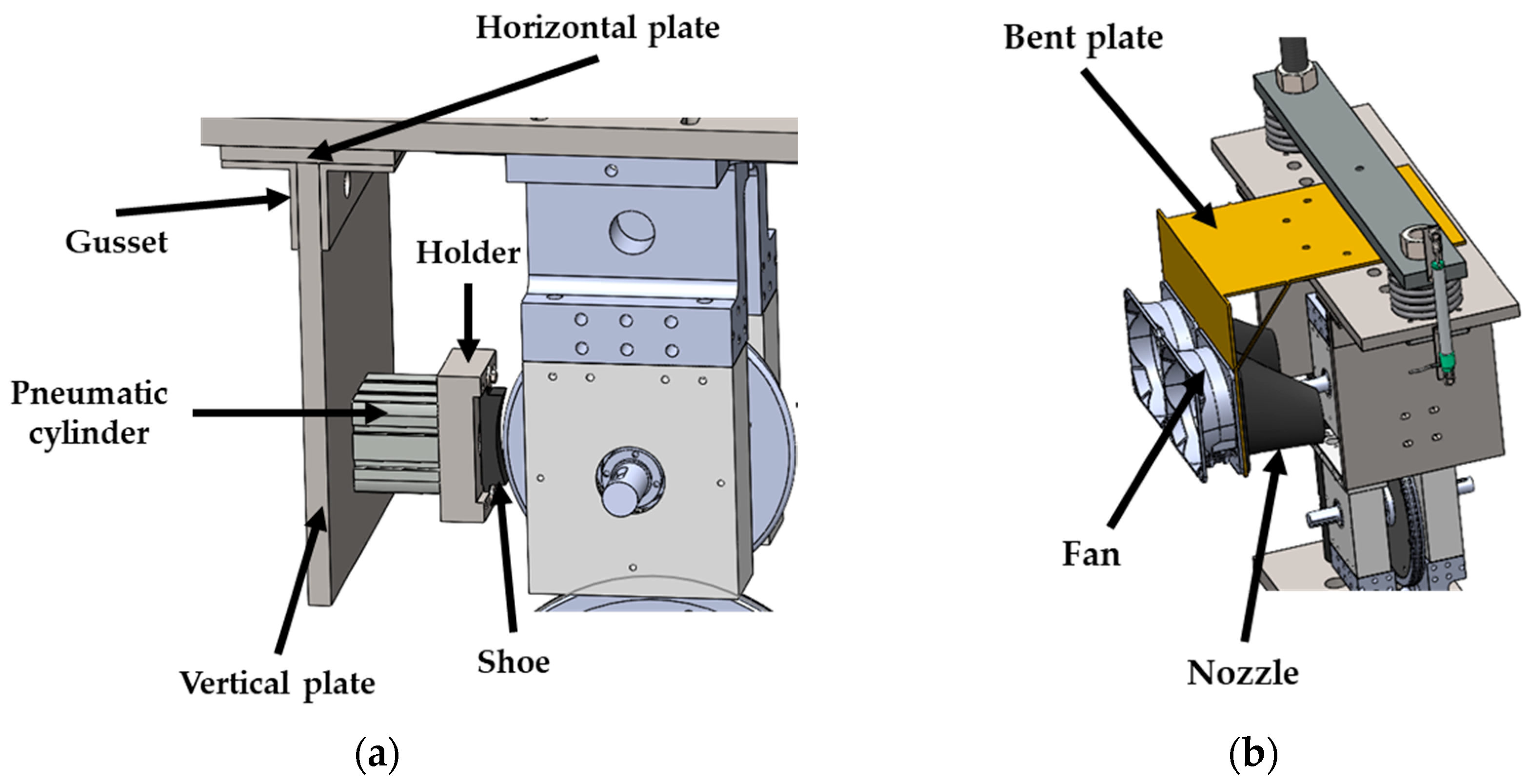
- Tribological tests at the wheel–shoe interface. This type of test intends to assess the wear and frictional behaviour of the wheel–shoe contact. This has great relevance nowadays, as traditional cast iron shoes are being replaced with composite materials that have different frictional behaviours. These tests are run according to Pascal’s rule and hence control the proportional valve to obtain the same contact pressure at the wheel–shoe interface for the full-scale system. These tests are run with only one brushless motor, mounted on the rail disc shaft. The normal load at the wheel–rail disc contact interface is adjusted to ensure high adhesion levels between the two discs and avoid slip so that power supplied by the brushless motor on the rail disc shaft only balances the resistant torque given by the braking effort applied on the wheel disc shaft.
- Tread braking thermal tests. This kind of test aims at investigating the thermal field produced inside the wheel and brake shoes during tread braking, and measured data is used not only to compare different shoe materials but also to validate numerical models for the temperature field prediction inside wheels [38] and shoes [39,40]. These tests are again run with one motor only, connected to the rail disc shaft, whilst applying large values of normal load at the wheel–rail disc contact interface to minimise slip. The pneumatic cylinder pressure, rail roller speed and test time are adjusted to obtain heat flux and dissipated thermal energy values that comply with the specifically conceived thermal scaling rule [31], which differs from Pascal’s. Currently, preliminary thermal tests are being run that measure the thermal field with a thermal image camera, but work to install pyrometers on the bench is ongoing.
4. Conclusions
- As an upgrade to typical benches, the novel scaled twin-disc rig can be equipped with scaled modular tread braking units, thus improving and extending its testing capabilities.
- The helical springs of the load application system are selected to ensure limited loss of normal contact even after the profiles are significantly worn out, hence contributing to the repeatability and robustness of the bench. The load application system is designed to comply with Pascal’s similitude rule, allowing to simulate axle-load values up to the limit values for European vehicles.
- The selection of the pneumatic cylinder and the design of the fan–nozzle system used in the tread braking system are made to comply with a novel thermal scaling rule. This ensures that the thermal field in the scaled wheel and shoes corresponds to the thermal field on the full-scale system. The selected pneumatic cylinder allows reproducing common drag braking operations on the scaled test rig.
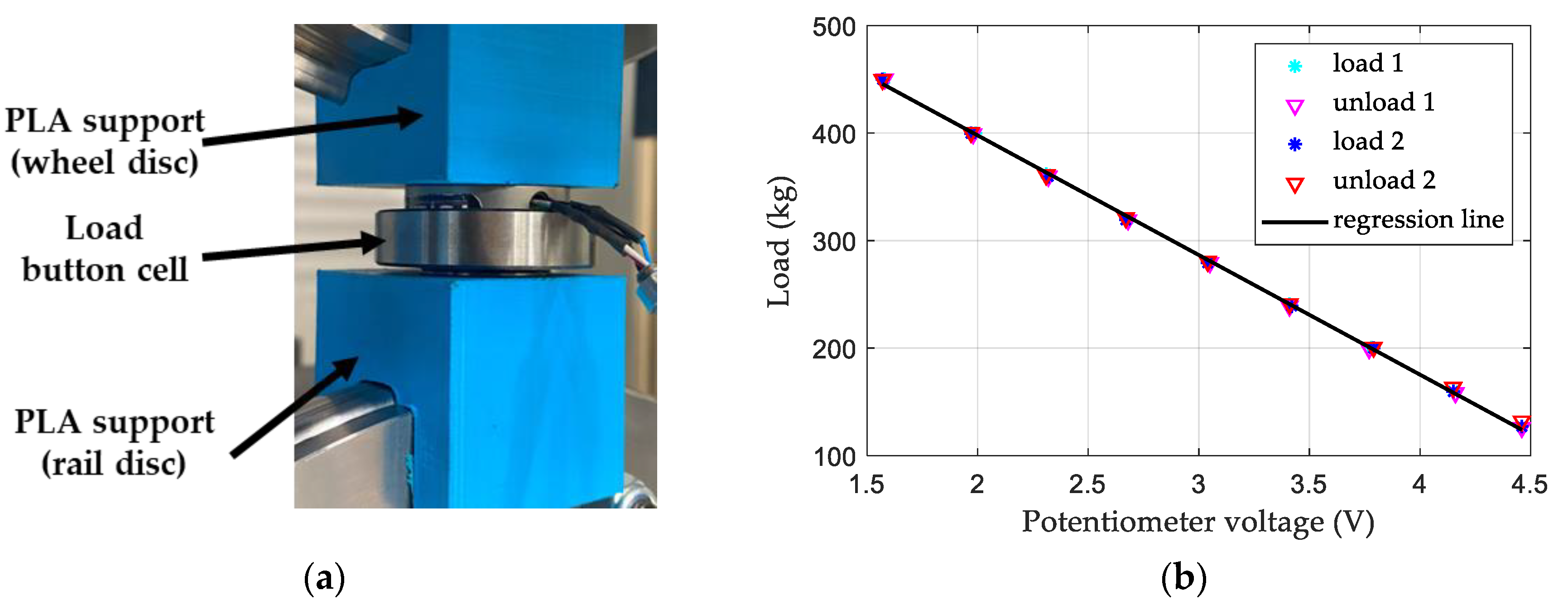
- The calibration of the load application system proves that good linearity exists between the potentiometer voltage output and the normal load, making it possible to estimate the applied normal load with high reliability in the planned future stages of experimental campaigns.
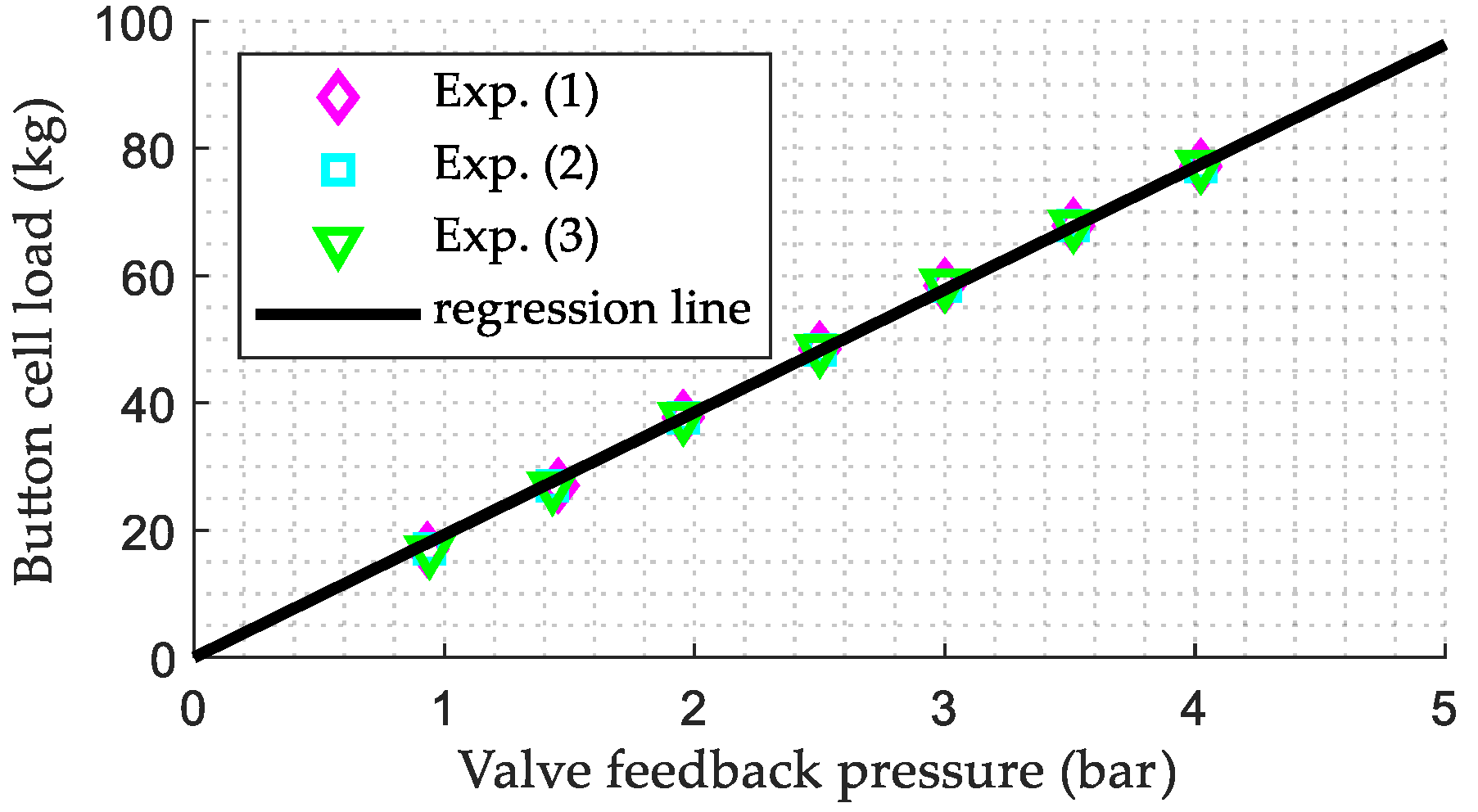
- The calibration law obtained for the tread braking unit allows estimation of the applied normal force from the proportional valve feedback pressure with high linearity.
Author Contributions
Funding
Institutional Review Board Statement
Informed Consent Statement
Data Availability Statement
Conflicts of Interest
References
- Polach, O. Creep forces in simulations of traction vehicles running on adhesion limit. Wear 2005, 258, 992–1000. [Google Scholar] [CrossRef] [Scilit]
- Olofsson, U.; Lewis, R.; Harmon, M. Tribology of the Wheel-Rail Contact. In Handbook of Railway Vehicle Dynamics, 2nd ed.; Iwnicki, S., Spiryagin, M., Cole, C., McSweeney, T., Eds.; CRC Press: Boca Raton, FL, USA, 2019; pp. 281–305. [Google Scholar]
- Zhai, W. Vehicle–Track Coupled Dynamics—Theory and Applications; Springer: Singapore, 2020. [Google Scholar]
- Lewis, R.; Olofsson, U. Basic tribology of the wheel-rail contact. In Wheel–Rail Interface Handbook; Lewis, R., Olofsson, U., Eds.; Woodhead Publishing: Cambridge, UK, 2009; pp. 34–57. [Google Scholar]
- Lewis, S.R.; Dwyer-Joyce, R.S. 14—Effect of contaminants on wear, fatigue and traction. In Wheel–Rail Interface Handbook; Lewis, R., Olofsson, U., Eds.; Woodhead Publishing: Cambridge, UK, 2009; pp. 437–455. [Google Scholar]
- Günay, M.; Korkmaz, M.E.; Özmen, R. An investigation on braking systems used in railway vehicles. Eng. Sci. Technol. Int. J. 2020, 23, 421–431. [Google Scholar] [CrossRef] [Scilit]
- Tunna, J.; Sinclair, J.; Perez, J. A Review of wheel wear and rolling contact fatigue. Proc. Inst. Mech. Eng. Part F J. Rail Rapid Transit 2007, 221, 271–289. [Google Scholar] [CrossRef] [Scilit]
- Polach, O.; Nicklisch, D. Wheel/rail contact geometry parameters in regard to vehicle behaviour and their alteration with wear. Wear 2016, 366–367, 200–208. [Google Scholar] [CrossRef] [Scilit]
- Ekberg, A.; Kabo, E. Fatigue of railway wheels and rails under rolling contact and thermal loading—An overview. Wear 2005, 258, 1288–1300. [Google Scholar] [CrossRef] [Scilit]
- Braghin, F.; Bruni, S.; Lewis, R. Railway wheel wear. In Wheel–Rail Interface Handbook; Lewis, R., Olofsson, U., Eds.; Woodhead Publishing: Cambridge, UK, 2009; pp. 172–210. [Google Scholar]
- Akama, M. Rolling Contact Fatigue and Wear of Rails and Wheels: A Comprehensive Review. Machines 2025, 13, 970. [Google Scholar] [CrossRef] [Scilit]
- Megna, G.; Bracciali, A. Tread-Braked Wheels: Review and Recent Findings. Machines 2025, 13, 579. [Google Scholar] [CrossRef] [Scilit]
- Wasilewski, P. Frictional Heating in Railway Brakes: A Review of Numerical Models. Arch. Comput. Methods Eng. 2020, 27, 45–58. [Google Scholar] [CrossRef] [Scilit]
- Teimourimanesh, S.; Vernersson, T.; Lundén, R. Modelling of temperatures during railway tread braking: Influence of contact conditions and rail cooling effect. Proc. Inst. Mech. Eng. Part F J. Rail Rapid Transit 2014, 228, 93–109. [Google Scholar] [CrossRef] [Scilit]
- Jendel, T.; Berg, M. Prediction of Wheel Wear for Rail Vehicles—Methodology and Verification. In Proceedings of the 3rd Contact Mechanics International Symposium, Peniche, Portugal, 17–21 June 2001; pp. 229–236. [Google Scholar]
- Vernersson, T. Temperatures at railway tread braking. Part 1: Modelling. Proc. Inst. Mech. Eng. Part F J. Rail Rapid Transit 2007, 221, 167–182. [Google Scholar] [CrossRef] [Scilit]
- Vernersson, T. Temperatures at railway tread braking. Part 2: Calibration and numerical examples. Proc. Inst. Mech. Eng. Part F J. Rail Rapid Transit 2007, 221, 429–441. [Google Scholar] [CrossRef] [Scilit]
- Pradhan, S.; Samantaray, A.K. A Recursive Wheel Wear and Vehicle Dynamic Performance Evolution Computational Model for Rail Vehicles with Tread Brakes. Vehicles 2019, 1, 88–115. [Google Scholar] [CrossRef] [Scilit]
- Bosso, N.; Gugliotta, A.; Magelli, M.; Zampieri, N. Monitoring of railway freight vehicles using onboard systems. Procedia Struct. Integr. 2019, 24, 692–705. [Google Scholar] [CrossRef] [Scilit]
- Fletcher, D.I.; Beynon, J.H. Development of a Machine for Closely Controlled Rolling Contact Fatigue and Wear Testing. J. Test. Eval. 2000, 28, 267–275. [Google Scholar] [CrossRef] [Scilit]
- Lewis, R.; Dwyer-Joyce, R.S. Wear mechanisms and transitions in railway wheel steels. Proc. Inst. Mech. Eng. Part J J. Eng. Tribol. 2004, 218, 467–478. [Google Scholar] [CrossRef] [Scilit]
- Gallardo-Hernandez, E.A.; Lewis, R. Twin disc assessment of wheel/rail adhesion. Wear 2008, 265, 1309–1316. [Google Scholar] [CrossRef] [Scilit]
- Chen, H.; Ban, T.; Ishida, M.; Nakahara, T. Experimental investigation of influential factors on adhesion between wheel and rail under wet conditions. Wear 2008, 265, 1504–1511. [Google Scholar] [CrossRef] [Scilit]
- Omasta, M.; Machatka, M.; Smejkal, D.; Hartl, M.; Křupka, I. Influence of sanding parameters on adhesion recovery in contaminated wheel–rail contact. Wear 2015, 322–323, 218–225. [Google Scholar] [CrossRef] [Scilit]
- Zani, N.; Petrogalli, C.; Battini, D. Optimizing Railway Tribology: A Systematic Review and Predictive Modeling of Twin-Disc Testing Parameters. Lubricants 2024, 12, 382. [Google Scholar] [CrossRef] [Scilit]
- Vakkalagadda, M.R.K.; Srivastava, D.K.; Mishra, A.; Racherla, V. Performance analyses of brake blocks used by Indian Railways. Wear 2015, 328–329, 64–76. [Google Scholar] [CrossRef] [Scilit]
- Monreal-Perez, P.; Elduque, D.; López, D.; Sola, I.; Yaben, J.; Clavería, I. Full-scale dynamometer tests of composite railway brake shoes including latxa sheep wool fibers. J. Clean. Prod. 2022, 379, 134533. [Google Scholar] [CrossRef] [Scilit]
- Landström, E.V.; Vernersson, T.; Lundén, R. Analysis and testing of tread braked railway wheel—Effects of hot spots on wheel performance. Int. J. Fatigue 2024, 180, 108116. [Google Scholar] [CrossRef] [Scilit]
- UIC. Brakes—Requirements of Friction Test Benches for the International Certification of Brake Pads and Brake Blocks; UIC: Paris, France, 2015; Volume 548. [Google Scholar]
- Magelli, M.; Pagano, R.; Zampieri, N. Design of an Innovative Twin-Disc Device for the Evaluation of Wheel and Rail Profile Wear. Designs 2024, 8, 73. [Google Scholar] [CrossRef] [Scilit]
- Magelli, M.; Pagano, R.; Zampieri, N. Adapting a scaled twin-disc device for tread braking investigations based on an ad-hoc thermal similitude model. Wear 2025, 574–575, 206105. [CrossRef] [Scilit]
- Jaschinski, A.; Chollet, H.; Iwnicki, S.; Wickens, A.; Würzen, J. The Application of Roller Rigs to Railway Vehicle Dynamics. Veh. Syst. Dyn. 1999, 31, 345–392. [Google Scholar] [CrossRef] [Scilit]
- Heliot, C. Small-scale test method for railway dynamics. Veh. Syst. Dyn. 1986, 15, 197–207. [Google Scholar] [CrossRef] [Scilit]
- Bosso, N.; Gugliotta, A.; Zampieri, N. RTCONTACT: An Efficient Wheel-Rail Contact Algorithm for Real-Time Dynamic Simulations. In Proceedings of the 2012 Joint Rail Conference, Philadelphia, PA, USA, 17–19 April 2012; pp. 195–204. [Google Scholar]
- Bosso, N.; Gugliotta, A.; Magelli, M.; Zampieri, N. Experimental Setup of an Innovative Multi-Axle Roller Rig for the Investigation of the Adhesion Recovery Phenomenon. Exp. Tech. 2019, 43, 695–706. [Google Scholar] [CrossRef] [Scilit]
- European Commission. Commission Regulation (EU) No 321/2013 of 13 March 2013 Concerning the Technical Specification for Interoperability Relating to the Subsystem ‘Rolling Stock—Freight Wagons’ of the Rail System in the European Union and Repealing Decision 2006/861/EC; European Commission: Brussels, Belgium, 2013. [Google Scholar]
- Milošević, M.S.; Stamenković, D.S.; Milojević, A.P.; Tomić, M.M. Modeling thermal effects in braking systems of railway vehicles. Therm. Sci. 2012, 16, 515–526. [Google Scholar] [CrossRef] [Scilit]
- Magelli, M.; Zampieri, N. A new finite element axisymmetric model with non-axisymmetric thermal loads for thermal analyses of tread braked wheels. Tribol. Int. 2025, 209, 110675. [Google Scholar] [CrossRef] [Scilit]
- Wu, Q.; Magelli, M.; Zampieri, N.; Bernal, E. Adding a brake shoe temperature model into freight train longitudinal braking dynamics simulations. Proc. Inst. Mech. Eng. Part F J. Rail Rapid Transit 2022, 237, 631–641. [Google Scholar] [CrossRef] [Scilit]
- Magelli, M.; Zampieri, N.; Wu, Q. Integration of brake block thermal equations within a railway vehicle multibody model: A multiphysics approach. Int. J. Rail Transp. 2025, 13, 69–84. [Google Scholar] [CrossRef] [Scilit]



Disclaimer/Publisher’s Note: The statements, opinions and data contained in all publications are solely those of the individual author(s) and contributor(s) and not of MDPI and/or the editor(s). MDPI and/or the editor(s) disclaim responsibility for any injury to people or property resulting from any ideas, methods, instructions or products referred to in the content. |
© 2026 by the authors. Licensee MDPI, Basel, Switzerland. This article is an open access article distributed under the terms and conditions of the Creative Commons Attribution (CC BY) license.
Share and Cite
Bosso, N.; Gugliotta, A.; Magelli, M.; Pagano, R.; Zampieri, N. Design of a Twin-Disc Rig for the Investigation of the Thermo-Mechanical Behaviour of Wheels, Rails and Brake Shoes of Railway Freight Waggons. Eng. Proc. 2026, 131, 42. https://doi.org/10.3390/engproc2026131042
Bosso N, Gugliotta A, Magelli M, Pagano R, Zampieri N. Design of a Twin-Disc Rig for the Investigation of the Thermo-Mechanical Behaviour of Wheels, Rails and Brake Shoes of Railway Freight Waggons. Engineering Proceedings. 2026; 131(1):42. https://doi.org/10.3390/engproc2026131042
Chicago/Turabian StyleBosso, Nicola, Antonio Gugliotta, Matteo Magelli, Rosario Pagano, and Nicolò Zampieri. 2026. "Design of a Twin-Disc Rig for the Investigation of the Thermo-Mechanical Behaviour of Wheels, Rails and Brake Shoes of Railway Freight Waggons" Engineering Proceedings 131, no. 1: 42. https://doi.org/10.3390/engproc2026131042
APA StyleBosso, N., Gugliotta, A., Magelli, M., Pagano, R., & Zampieri, N. (2026). Design of a Twin-Disc Rig for the Investigation of the Thermo-Mechanical Behaviour of Wheels, Rails and Brake Shoes of Railway Freight Waggons. Engineering Proceedings, 131(1), 42. https://doi.org/10.3390/engproc2026131042