1. Introduction
In naval and offshore engineering, accurately predicting the dynamic response of submerged structures subjected to extreme pressure loads is essential for ensuring both safety and operational reliability. Among these loads, underwater explosions (UNDEX) represent a critical threat due to their ability to induce severe structural vibrations and compromise onboard systems.
UNDEX events are generally classified as contact or non-contact, depending on the distance between the detonation and the structure [
1,
2,
3]. While contact explosions typically produce localized damage such as ruptures, non-contact events generate intense shock waves and oscillating gas bubbles, which may lead to significant global structural responses. Even in the absence of immediate hull failure, these phenomena can induce large vibrations and permanent deformations, thereby affecting equipment functionality and reducing operational capability [
2,
4].
In non-contact scenarios, the structural response is primarily governed by two loading mechanisms: the high-frequency shock wave and the subsequent low-frequency pulsations of the gas bubble [
2,
4]. The shock wave excites a broad spectrum of structural modes, transmitting vibrations throughout the hull, while bubble oscillations may induce large-scale global responses such as whipping [
5,
6].
Within this framework, the role of the water–seabed interface has historically received limited attention. However, early studies, such as those by Cole [
1], already suggested that the seabed can behave as a reflective boundary, giving rise to secondary pressure waves that interact with the primary loading field. These reflected waves may alter both the magnitude and temporal evolution of the pressure history experienced by submerged structures, thereby influencing their dynamic response.
More recent investigations have progressively emphasized the relevance of seabed effects, particularly in shallow-water environments. Numerical studies have shown that explicitly including the seabed in the modelling domain leads to significant modifications in shock wave propagation and bubble dynamics. In this regard, Walters et al. [
7] demonstrated that the presence of the ocean floor can substantially change both reflection patterns and bubble behaviour, while Xu et al. [
8] highlighted the strong dependence of these phenomena on the mechanical properties of the seabed, such as its rigidity or deformability. Additional research has further clarified that seabed-induced reflections not only affect the primary shock wave but also influence the evolution of gas bubble pulsations, introducing complex interactions between different loading components. These effects are particularly pronounced in shallow-water conditions, where multiple wave reflections may occur [
9,
10]. Experimental investigations, including centrifuge modelling, have corroborated these findings, showing that the soil–water interface plays a crucial role in modifying both wave propagation and bubble oscillation characteristics [
11].
Quantitative analyses have also reported non-negligible reflection coefficients associated with the seabed, confirming its capability to intensify the local pressure field [
12]. More recently, Bardiani et al. [
13] provided further evidence that such reflected waves can impact not only local responses but also the global dynamic behaviour of simplified cylindrical underwater structures.
Together, these studies confirm that the seabed should be regarded as an active participant in the UNDEX loading process, capable of substantially altering the vibrational environment experienced by naval equipment [
14].
This study builds upon and extends previous investigations on vibration mitigation of naval equipment under non-contact UNDEX events. It originates from the numerical assessment of traditional resilient mounting systems presented in Bardiani et al. [
15], where the effectiveness of conventional solutions was evaluated without accounting for environmental effects such as seabed reflections. It also relates to the more recent developments proposed in Bardiani et al. [
16], in which advanced metamaterial-based concepts were explored as alternative vibration mitigation strategies. The present work advances these contributions by explicitly incorporating the influence of the water–seabed interface, thus moving toward more realistic and operationally relevant scenarios. Different seabed conditions, characterized by distinct reflection properties, are systematically introduced to evaluate how reflected shock waves modify the loading environment and the acceleration transmitted to onboard equipment. To this end, a high-fidelity coupled acoustic–structural model (CASA) implemented in ABAQUS CAE is adopted, enabling the simultaneous representation of direct and reflected wave propagation. This extended framework allows for a more comprehensive assessment of vibration transmission mechanisms in naval structures, providing new insights into the role of seabed-induced effects and their implications for the design and optimization of both traditional and advanced resilient mounting solutions.
The paper is organized as follows.
Section 2 details the numerical modelling framework, describing the case study vessel, the onboard equipment considered, and the implementation of seabed reflections.
Section 3 introduces the traditional resilient mounting system adopted as a reference solution for vibration control.
Section 4 presents the numerical results, highlighting the influence of different seabed reflection coefficients on the equipment response. Finally,
Section 5 discusses the main findings and their implications for vibration mitigation strategies and concludes by outlining directions for future research.
2. Numerical Modelling Set-Up
This section recalls the computational framework and the vessel geometry adopted in the present study to investigate the structural response of a patrol vessel subjected to far-field underwater explosions with seabed reflection. The modelling approach and the case study configuration are consistent with those previously introduced in Bardiani et al. [
15,
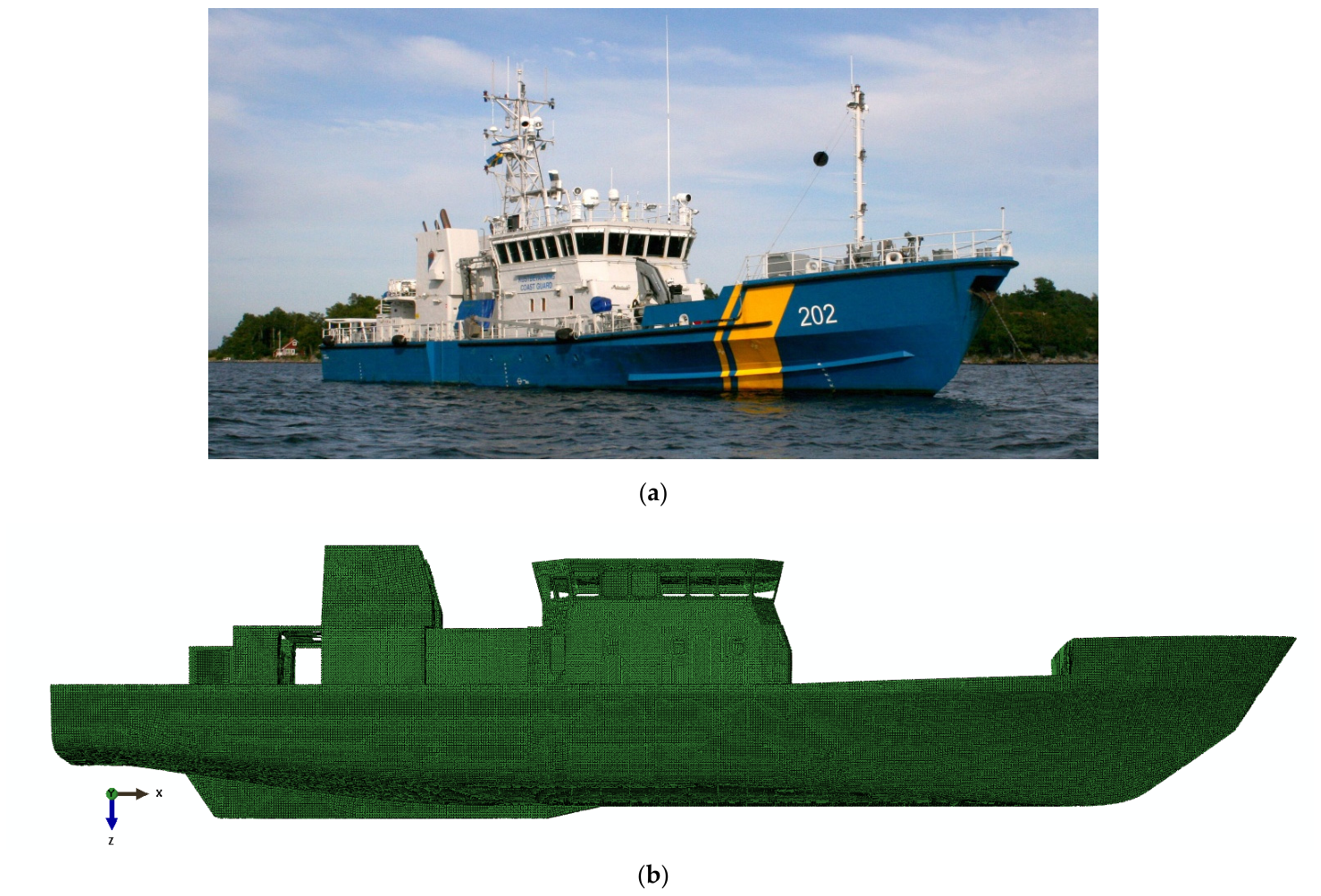
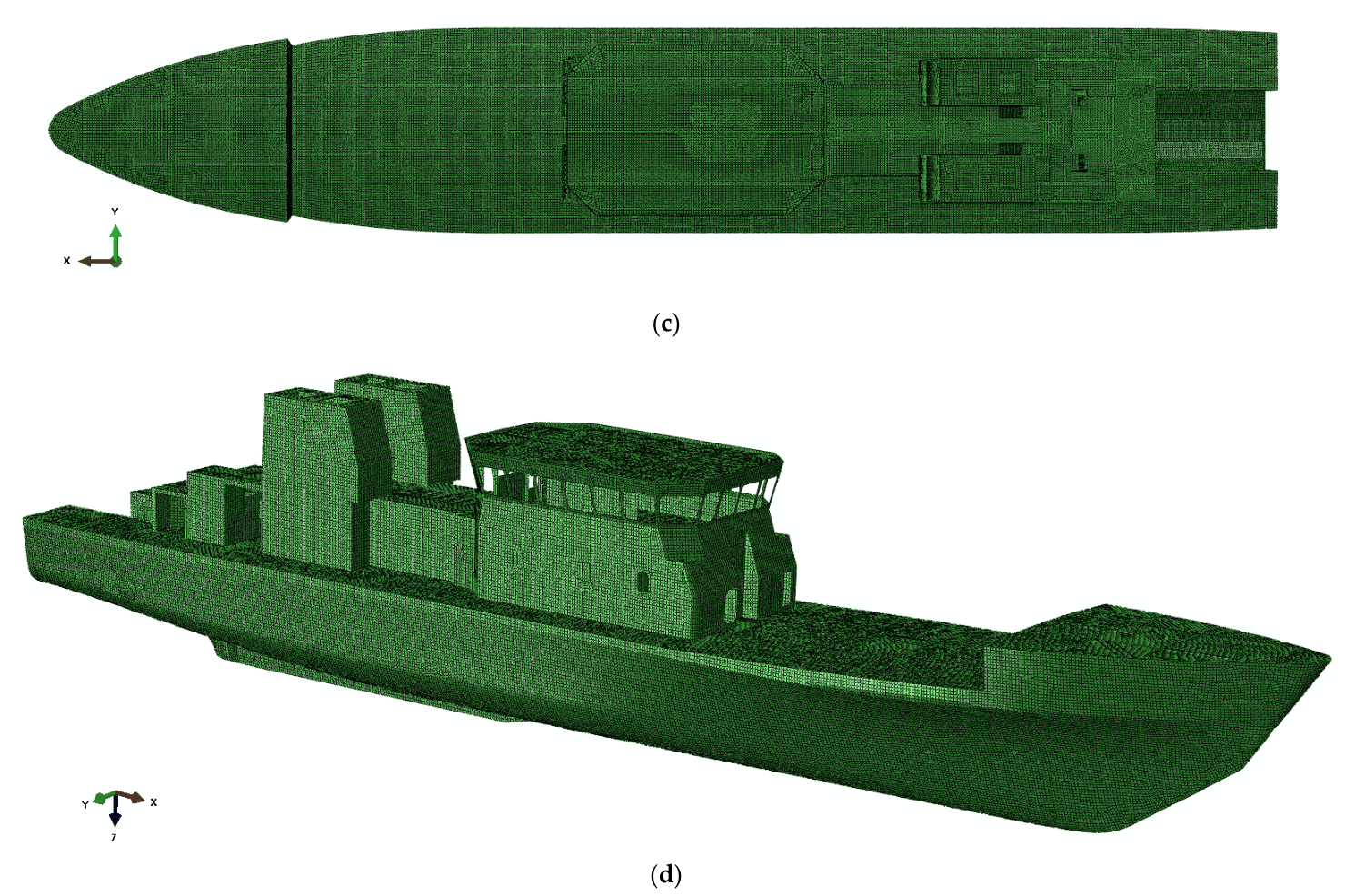
16], to which the reader is referred for further details. As a representative case study, the Swedish patrol vessel KBV 202, belonging to the KBV 201 class, is considered for the validation of the proposed methodology (
Figure 1a–d). The vessel has a displacement of 476 tons, a length of 52 m, a breadth of 8.6 m, and a design draught of about 3.2 m. Its structural layout follows a conventional mixed arrangement, combining both longitudinal and transverse reinforcements, as commonly adopted in patrol vessel design.
The numerical model adopted for the UNDEX simulations builds upon the computational framework previously developed in Bardiani et al. [
15,
16], here extended to include seabed reflection effects. The modelling strategy is designed to ensure an appropriate balance between accuracy and computational efficiency, while preserving the capability to capture the key physical phenomena governing fluid–structure interaction under explosive loading.
The simulations are performed in ABAQUS/CAE (ver. 6.24) using a coupled acoustic–structural approach (CASA), which enables a consistent representation of the interaction between the fluid domain and the deformable structure. A simplified structural representation is employed due to the limited availability of detailed information on internal arrangements and secondary stiffeners. The hull model is derived using Smith’s method and the MAESTRO [
17], assuming a uniform plating thickness of 0.04 m, which provides a suitable compromise between modelling fidelity and computational cost.
The structural domain is discretized using S4 shell elements with a mesh resolution selected to accurately capture the relevant structural modes, while the surrounding fluid is modelled through acoustic brick elements, with mesh characteristics defined according to standard criteria for wave propagation problems. In particular, the discretization is chosen to ensure an adequate representation of both high-frequency shock wave propagation and lower-frequency bubble-induced dynamics. Material properties, boundary conditions, and fluid–structure coupling are consistently defined following Refs. [
15,
16,
18], ensuring continuity with the previously validated modelling approach.
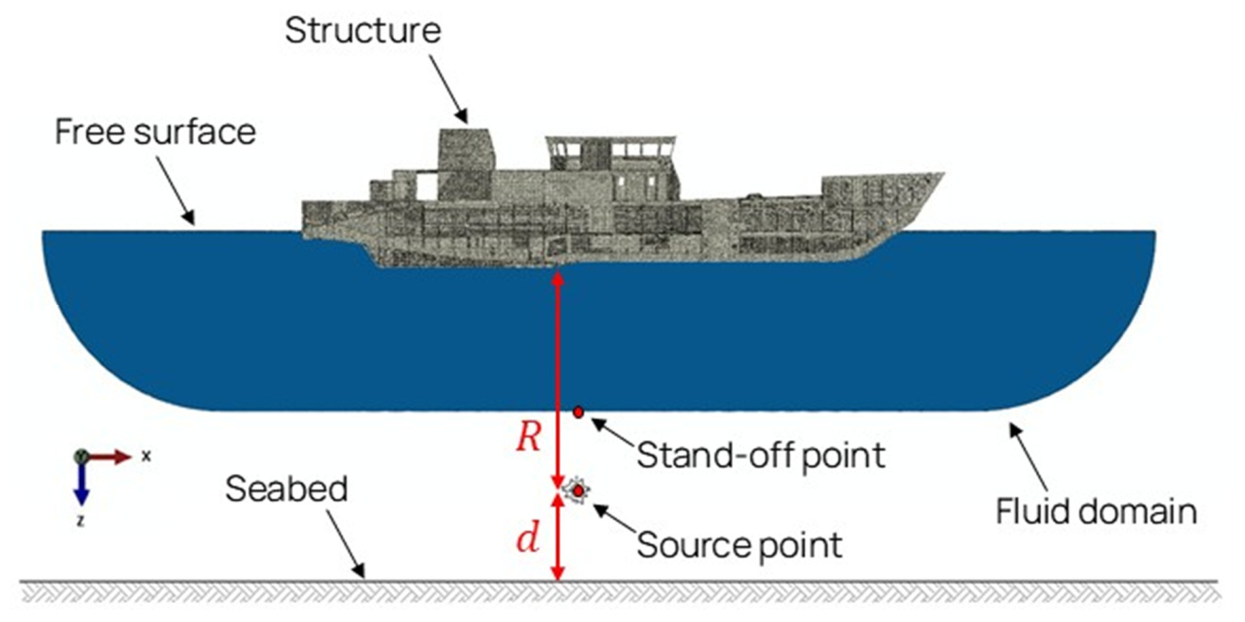
The main novelty introduced in the present study lies in the explicit modelling of the seabed, which enables the simulation of reflected shock waves and allows for a systematic assessment of their influence on the dynamic response of the structure and the vibration levels transmitted to onboard equipment. This extension provides a more realistic representation of operational scenarios, particularly in shallow-water conditions, where seabed-induced reflections may significantly alter the loading environment experienced by naval systems. The scenario considered is shown schematically in
Figure 2.
It considers the detonation of a 516 kg (
) TNT charge placed at a depth of 31.6 m (source point) and at a stand-off distance
of 28.4 m from the vessel’s hull. The seabed is located at a distance
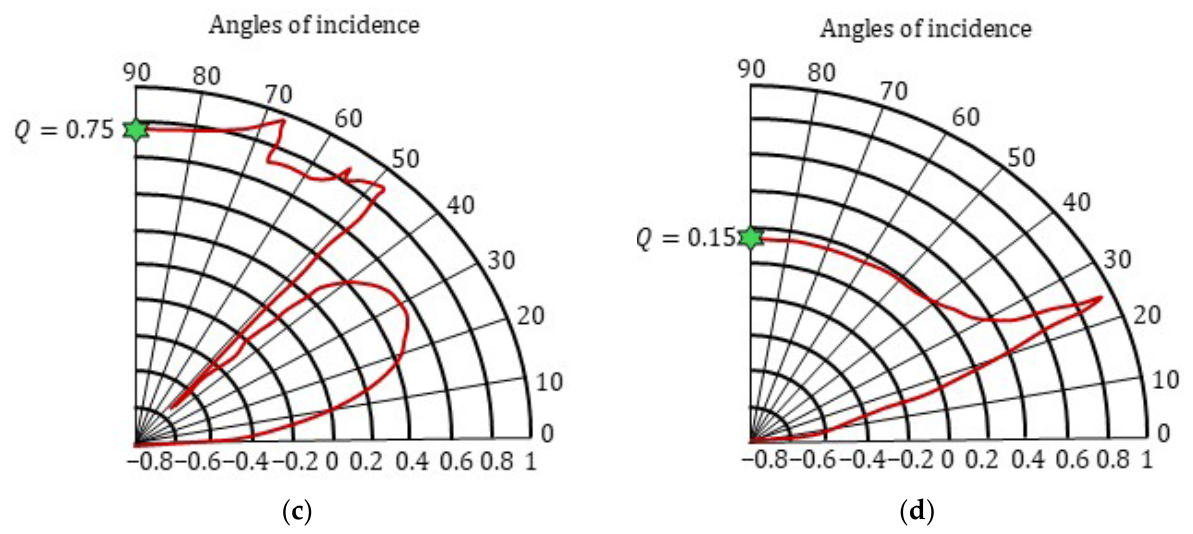
equal to 4 m below the source point. Different seabed material types were considered, namely rigid (representing the most severe condition), muddy, sand, rock, and a layered muddy-over-sand case. These materials are characterized by specific reflection coefficients
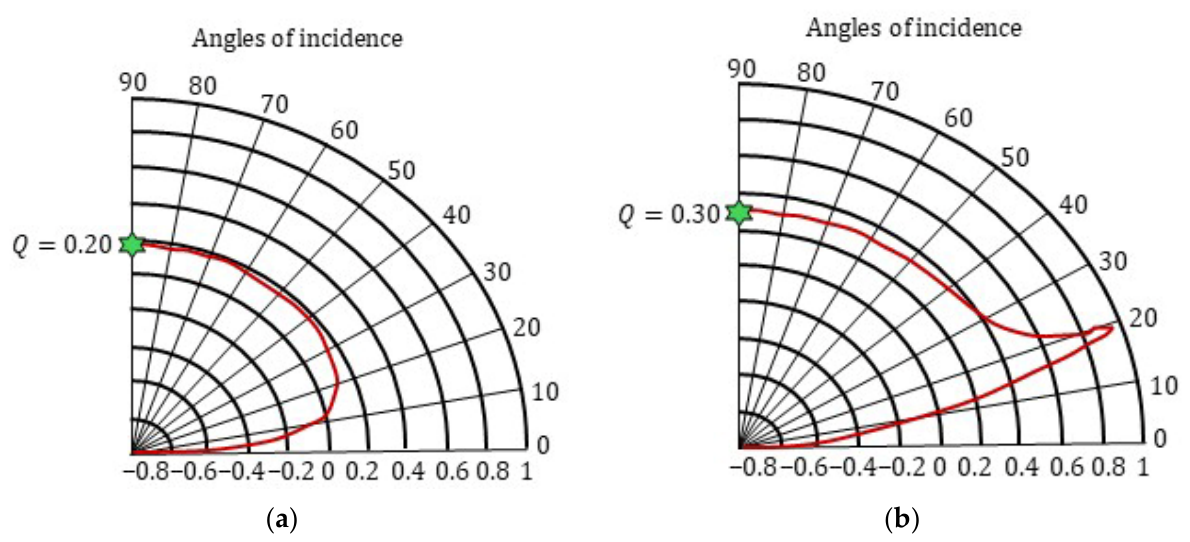
, respectively equal to 1.00, 0.20, 0.30, 0.75, and 0.15. The adopted values are extracted from the polar diagrams shown in
Figure 3, which are derived from Ref. [
19] through experimental investigations, where the angle of incidence is always 90° due to the considered under-keel explosion scenario.
This parameter
is required by the solver to model the interaction between the incident wave and the seabed boundary. In practice, the reflection coefficient directly scales the amplitude of the reflected pressure wave with respect to the incident one, according to the relation:
where
is the amplitude of the incoming pressure wave and
the amplitude of the corresponding reflected wave. Only real values of
are admissible within the ABAQUS formulation. It should be noted that this modelling approach does not account for the interaction between the gas bubble and the reflected wave propagating back towards the structure. Therefore, although it provides useful insights into the influence of seabed conditions on the global response, the framework must be regarded as a simplified representation of the actual physical phenomenon.
The simulation is performed over a total duration of 1 s to capture the evolution of the shock wave and subsequent gas bubble pulsations, which are described in ABAQUS using the Geers and Hunter formulation. According to Cole’s empirical formulas [
1], the arrival time of the bubble’s secondary shock wave is estimated at 0.771 s, a value that is consistent with the numerical predictions and further validates the adopted setup.
In the following section, attention is shifted to the modelling of the foundation–resilient–equipment subsystem, which represents the focus of the present study. This subsystem plays a key role in the dynamic response of the vessel, as it directly governs the transmission of vibrational loads from the hull to the onboard equipment.
3. Traditional Resilient Mounting System as Solution to Vibration Control
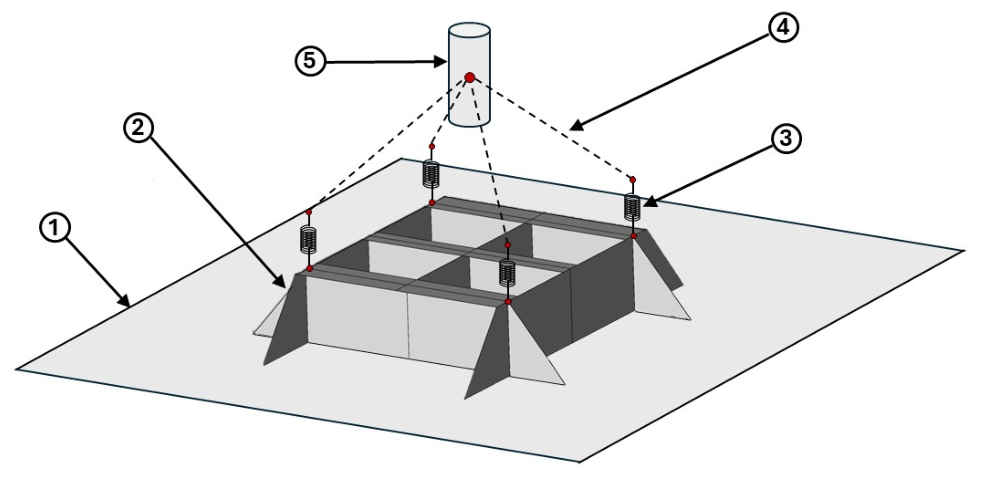
To evaluate the vibrational effects transmitted to onboard equipment in the presence of seabed reflection, a representative subsystem was incorporated into the numerical model. A schematic overview of this configuration is provided in
Figure 4. The subsystem consists of three main components: a foundation (explicitly modelled), resilient elements represented by spring-type connectors, and a cylindrical mass acting as a simplified model of generic equipment requiring protection. The resilient supports, chosen from the Vulkan MG series [
20], are characterized by a stiffness of 1.5 × 10
5 N/m, which is representative of typical marine-grade isolation devices. The cylindrical mass is assumed to be made of steel (density 7850 kg/m
3) and has an equivalent weight of approximately 270 kg. Its height is constrained by the available space within the compartment, reflecting realistic installation limitations for shipboard systems.
As done in Refs. [
15,
16], the subsystem was analyzed in three different locations within the vessel: at the aft section, amidships, and at the forward section, to capture possible variations in the vibratory response due to the relative position with respect to the shock source. In each case, the foundation was discretized using shell elements and rigidly attached to the deck through surface-based tie constraints, ensuring an accurate representation of the load transfer path. The spring connectors were kinematically coupled with the cylindrical mass, allowing the resilient elements to act as the primary isolation mechanism. Since ABAQUS/Explicit does not permit spring elements to function in a single direction, additional kinematic constraints were introduced to suppress undesired in-plane motions, thereby ensuring that the springs operated only along the intended load-bearing axis.
4. Results and Discussion
This section presents the response of the foundation–resilient–equipment subsystem when subjected to the UNDEX scenario described in the previous sections, in the presence of seabed reflection.
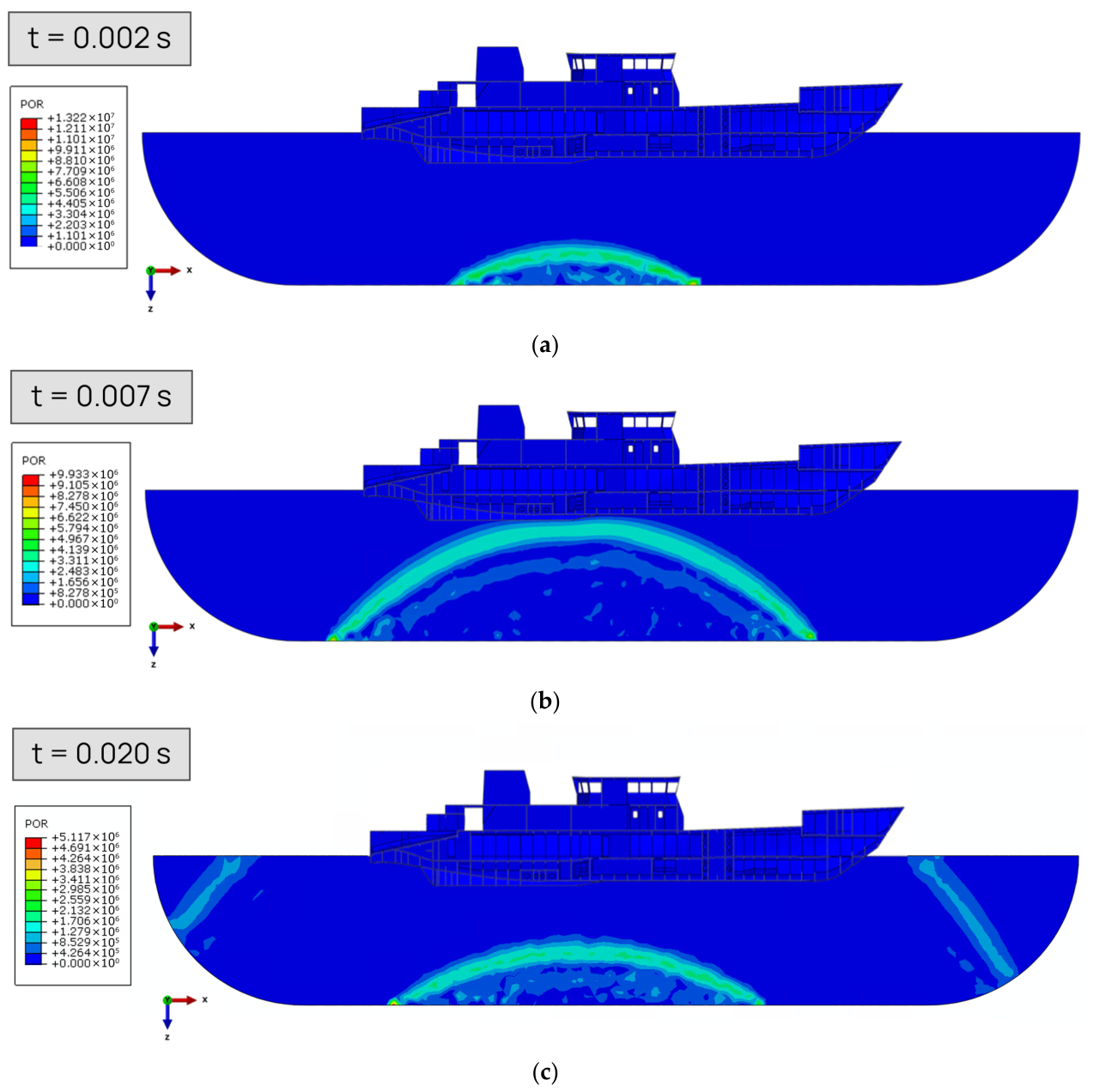
Figure 5 illustrates the distribution of the dynamic acoustic pressure (POR) on a longitudinal section of the full CASA model at different time instants for the rigid seabed case, clearly showing the reflected shock wave generated at the seabed and its imminent interaction with the structure. The recorded POR values are in good agreement with analytical formulations available in the literature, thereby confirming the reliability and accuracy of the numerical predictions.
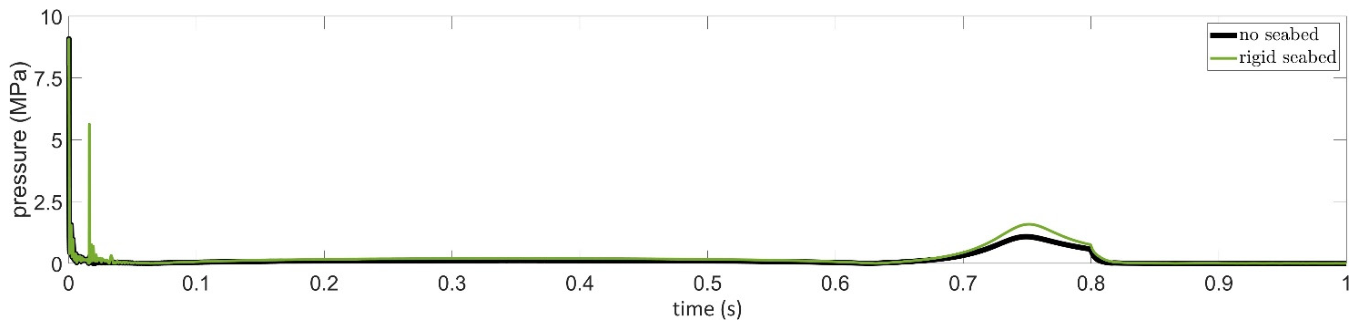
The POR time history extracted at the stand-off point is shown in
Figure 6. The signal is characterized by an initial pressure peak of 9.4 MPa associated with the primary shock, followed by an exponential decay. In addition, a second peak is observed at approximately 0.022 s, corresponding to the arrival of the seabed-reflected wave. Finally, a third peak occurs at approximately 0.75 s, corresponding to the first gas bubble pulsation. This secondary pressure pulse has a lower magnitude but a longer duration. It is important to note that the response shown in
Figure 6 during the time window corresponding to the first gas bubble pulsation cannot be regarded as fully accurate. This limitation arises because the ABAQUS CAE approach for modelling seabed reflections does not account for the direct interaction between the gas bubble dynamics and the reflected waves generated at the seabed.
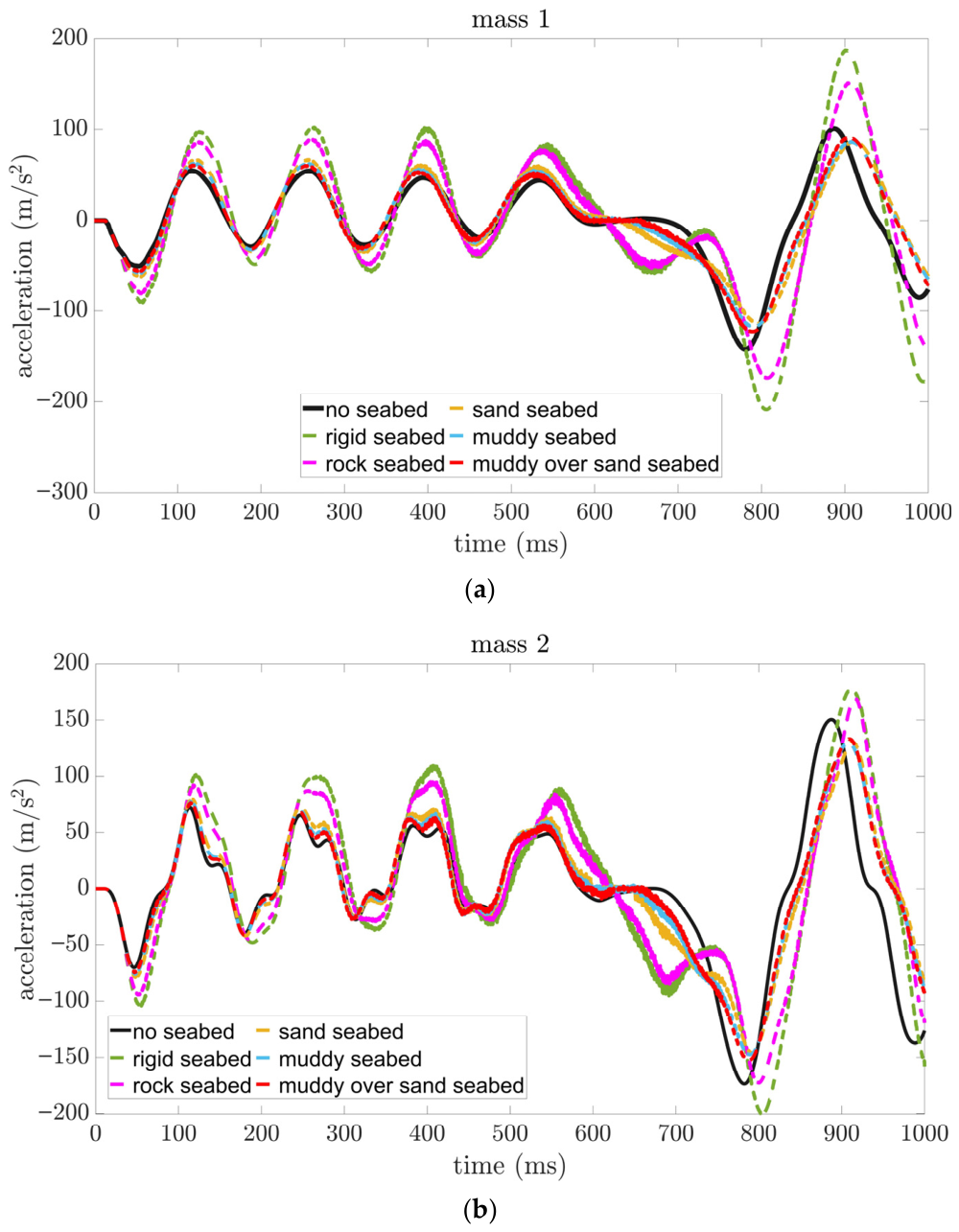
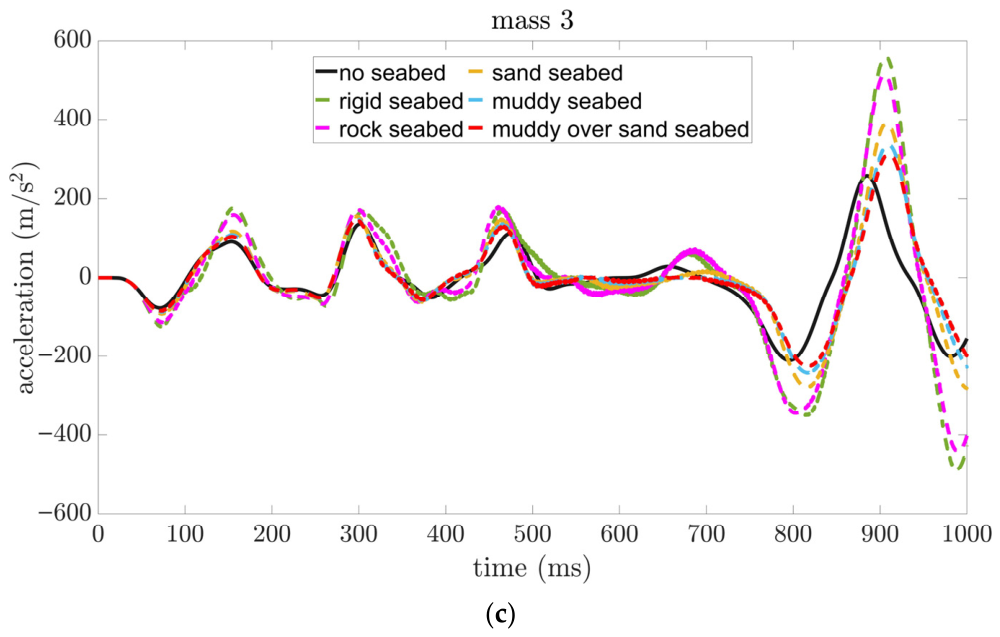
Figure 7 reports the acceleration results for the three foundation–resilient–mass subsystems over a time window of 1 s. The plots show the vertical accelerations recorded on the three equipment masses (mass 1—aft section, mass 2—amidships and mass 3—forward section), comparing the responses obtained for different seabed conditions—including rigid (the most severe case), muddy, sand, rock, and muddy-over-sand—with the reference case of no seabed.
For simplicity, the following discussion refers to the response of mass 1, which is representative of the overall behavior of the three masses. The dynamic response exhibits three typical phases: an initial sharp peak caused by the primary and seabed-reflected shock waves, a subsequent stage dominated by oscillatory vibrations, and a final peak associated with the first gas bubble pulsation.
In the first phase, the no-seabed configuration records a positive peak acceleration of about 50 m/s2, while the rigid seabed condition almost doubles this value, reaching approximately 100 m/s2, i.e., an increase of 100%. In the subsequent oscillatory phase and during the gas bubble pulsation, the rigid seabed continues to produce quantitatively similar amplifications, with acceleration levels remaining roughly twice those observed in the no-seabed case. The rock seabed case exhibits response curves that closely follow those of the rigid seabed configuration, as expected, although with a clearly lower level of amplification.
Consistently with the reflection coefficient , the muddy, sand, and muddy-over-sand seabeds display smaller amplification effects compared to the rock case, with overall acceleration levels closer to those of the no-seabed reference.
These findings clearly demonstrate that seabed characteristics, and particularly the rigid seabed case, have a decisive influence on the vibration levels transmitted to resiliently mounted equipment.
5. Conclusions
In this study, a coupled acoustic–structural numerical framework was developed to investigate the impact of seabed reflections on the vibrational response of naval equipment subjected to far-field underwater explosions. The analysis focused on a foundation–resilient–mass subsystem mounted on a patrol vessel, with the objective of assessing how different seabed conditions modify the acceleration levels transmitted to onboard equipment.
A set of representative seabed types was considered, namely rigid, rock, sand, muddy, and muddy-over-sand, each characterized by distinct reflection coefficients derived from experimental polar diagrams available in the literature. Although no additional experimental validation was performed within the present work, the adopted coefficients are based on consolidated experimental evidence. Moreover, the parametric nature of the study—spanning a wide range of reflection coefficients from highly reflective to strongly absorptive seabed—can be regarded as an implicit sensitivity analysis, allowing the robustness of the observed trends to be assessed and highlighting the relative influence of seabed properties on the system response.
The results clearly demonstrate that seabed characteristics play a decisive role in shaping the vibration environment of resiliently mounted equipment. Compared to the free-field configuration, rigid seabed conditions lead to a marked amplification of the response, with the initial acceleration peak almost doubling. Rock seabeds exhibit a similar trend, although with lower amplification levels. During both the subsequent oscillatory phase and the first gas bubble pulsation, these two seabed types continue to produce higher acceleration levels. Conversely, sandy, muddy, and muddy-over-sand seabeds show significantly reduced amplification effects, with responses much closer to the no-seabed case, consistently with their lower reflection coefficients. The location of the subsystem within the vessel was also found to have a secondary but non-negligible influence on the response.
It should be noted that the proposed modelling framework adopts a simplified treatment of seabed reflections and does not account for the direct interaction between gas bubble dynamics and the reflected pressure waves. Consequently, the response predicted during the bubble pulsation phase should be interpreted with caution, particularly in terms of absolute amplitude. Nevertheless, the primary aim of the present study is the comparative assessment of seabed-induced effects on the vibration levels transmitted to onboard equipment. From this perspective, the model is considered adequate to capture the dominant mechanisms governing the relative amplification or mitigation trends associated with different seabed types.
Overall, the proposed numerical approach provides valuable engineering insights into how seabed reflections alter the dynamic loading environment experienced by naval equipment. The findings highlight the importance of accounting for seabed properties when evaluating shock and vibration scenarios and may support the design and optimization of resilient mounting systems. Future work will aim to extend the present framework by incorporating more advanced treatments of bubble–seabed interactions and by performing dedicated experimental validations to further corroborate the numerical predictions and polar diagrams.
Author Contributions
Conceptualization, J.B., G.M.; methodology, J.B., G.M., C.S., A.M.; software, J.B., G.M.; validation, J.B.; formal analysis, J.B., G.M.; investigation, J.B., G.M., C.S., A.M.; resources, J.B., G.M., C.S., A.M.; data curation, J.B.; writing—original draft preparation, J.B., G.M., C.S., A.M.; writing—review and editing, J.B., G.M., C.S., A.M.; visualization, J.B.; supervision, C.S., A.M. All authors have read and agreed to the published version of the manuscript.
Funding
This work is part of the dTHOR project, which has received funding from the European Defence Fund (EDF) under Grant agreement 101103257–dTHOR–EDF-2021-NAVAL-R-2.
Institutional Review Board Statement
Not applicable.
Informed Consent Statement
Not applicable.
Data Availability Statement
The data presented in this study are available upon request from the corresponding author.
Conflicts of Interest
The authors declare no conflict of interest.
References
- Cole, R.H.; Weller, R. Underwater Explosions. Phys. Today 1948, 1, 35. [Google Scholar] [CrossRef] [Scilit]
- de Camargo, F.V. Survey on experimental and numerical approaches to model underwater explosions. J. Mar. Sci. Eng. 2019, 7, 15. [Google Scholar] [CrossRef] [Scilit]
- Bardiani, J.; Sbarufatti, C.; Manes, A. Transfer Learning with Deep Neural Network Toward the Prediction of the Mass of the Charge in Underwater Explosion Events. J. Mar. Sci. Eng. 2025, 13, 190. [Google Scholar] [CrossRef] [Scilit]
- Tran, P.; Wu, C.; Saleh, M.; Neto, L.B.; Nguyen-Xuan, H.; Ferreira, A.J.M. Composite structures subjected to underwater explosive loadings: A comprehensive review. Compos. Struct. 2021, 263, 113684. [Google Scholar] [CrossRef] [Scilit]
- Ming, F.R.; Zhang, A.M.; Xue, Y.Z.; Wang, S.P. Damage Characteristics of Ship Structures Subjected to Shockwaves of Underwater Contact Explosions. Ocean Eng. 2016, 117, 359–382. [Google Scholar] [CrossRef] [Scilit]
- Didoszak, J.M.; Kwon, Y.W. Failure assessment of shipboard equipment subjected to underwater explosions. Multiscale Multidiscip. Model. Exp. Des. 2025, 8, 17. [Google Scholar] [CrossRef] [Scilit]
- Walters, A.P.; Didoszak, J.M.; Kwon, Y.W. Explicit modeling of solid ocean floor in shallow underwater explosions. Shock. Vib. 2013, 20, 901042. [Google Scholar] [CrossRef]
- Xu, L.Y.; Wang, S.P.; Liu, Y.L.; Zhang, A.M. Numerical simulation on the whole process of an underwater explosion between a deformable seabed and a free surface. Ocean. Eng. 2021, 219, 108311. [Google Scholar] [CrossRef] [Scilit]
- Shahid, U.; Munir, M.R.; Shah, S.J.; Shahdin, A.; Iqbal, M.Z. Numerical investigation of pulsating bubble dynamics in shallow and deep-sea underwater explosions. J. Ocean. Eng. Mar. Energy 2024, 11, 307–326. [Google Scholar] [CrossRef] [Scilit]
- Liu, L.; Wang, J.; Zhang, Y.; Tang, K.; Ma, T. Coupling characteristics between bubble and free surface in a shallow water environment. Ocean. Eng. 2021, 237, 109577. [Google Scholar] [CrossRef] [Scilit]
- Zhang, J.; Guan, L.H.; Li, W.J.; Li, J.C.; Wang, Y.B. Centrifuge modeling of underwater explosion near the water–soil interface. Phys. Fluids 2025, 37, 047124. [Google Scholar] [CrossRef] [Scilit]
- Yan, F.H.; Qiu, Y.Y.; Yue, S.L.; Liu, L.; Wang, J.P.; Gao, X.K. Interaction between underwater explosion bubbles and soil–water interface: A numerical and experimental study. Phys. Fluids 2024, 36, 103334. [Google Scholar] [CrossRef] [Scilit]
- Bardiani, J.; Giglio, M.; Sbarufatti, C.; Manes, A. On the Exploration of the Influence of Seabed Reflected Waves on Naval Structures. Eng. Proc. 2025, 85, 7. [Google Scholar] [CrossRef] [Scilit]
- Du, J.-Y.; Du, Z.-P.; Li, Y.; Shao, K. The progress of naval ship explosion protection technology. Acta Armamentarii 2015, 36, 391–400. (In Chinese) [Google Scholar]
- Bardiani, J.; Sbarufatti, C.; Manes, A. Numerical assessment of the effectiveness of traditional resilient mounting systems in mitigating vibrations of naval equipment subjected to underwater explosions. WIT Trans. Built Environ. 2025, 215, 75–83. [Google Scholar] [CrossRef] [Scilit]
- Bardiani, J.; D’Amore, G.K.O.; Marchesi, G.; Biot, M.; Sbarufatti, C.; Manes, A. On the effectiveness of abh-based metamaterials in vibration control of naval equipment subjected to underwater explosion loads. Results Eng. 2025, 27, 106117. [Google Scholar] [CrossRef] [Scilit]
- Smith, C.S. Influence of local compressive failure on ultimate longitudinal strength of a ship’s hull. In Proceedings of the International Symposium on Practical Design in Shipbuilding (PRADS), Tokyo, Japan, 17–21 October 1977; pp. 73–79. [Google Scholar]
- Lin, L.; Zhi, X.-D.; Fan, F.; Meng, S.-J.; Su, J.-J. Determination of parameters of Johnson-Cook models of Q235B steel. J. Vib. Shock. 2014, 33, 153–158+172. (In Chinese) [Google Scholar] [CrossRef]
- Mannacio, F. The Effect of Underwater Explosion on a Mine Countermeasures Vessel: Structural Response and Material Design. Doctoral Thesis, University of Genoa, Genoa, Italy, 2023. [Google Scholar]
- VULKAN Group. MG Series Resilient Mounts Catalogue. Available online: https://www.vulkan.com/ (accessed on 28 January 2025).
| Disclaimer/Publisher’s Note: The statements, opinions and data contained in all publications are solely those of the individual author(s) and contributor(s) and not of MDPI and/or the editor(s). MDPI and/or the editor(s) disclaim responsibility for any injury to people or property resulting from any ideas, methods, instructions or products referred to in the content. |