

Proceeding Paper

Environmental Impact and Recycling Routes of Rare Earth Elements in Permanent Magnets of Electric Machines for Industrial and Automotive Applications: A Systematic Review †

Department of Industrial Engineering, University of Florence, Via di Santa Marta 3, 50139 Firenze, FI, Italy
*
Author to whom correspondence should be addressed.
Presented at the 54th Conference of the Italian Scientific Society of Mechanical Engineering Design (AIAS 2025), Florence, Italy, 3–6 September 2025.
Eng. Proc. 2026, 131(1), 11; https://doi.org/10.3390/engproc2026131011

Published: 27 March 2026

Abstract

This study presents a systematic literature review on the environmental impact of industrial applications of Rare Earth Elements (REEs), particularly those classified as Critical Raw Materials (CRMs), such as Neodymium alloys. These materials are key components of permanent magnets (PMs) used in electrical machines, including automotive applications, wind turbine generators, and various consumer electronics. A structured methodology began with a comprehensive search across multiple scientific databases utilizing primary and secondary keywords. Studies were selected through a multi-step process, including screening by title, abstract, and full-text review, ensuring the inclusion of relevant and high-quality research. This approach allowed for a rigorous and reproducible assessment of the literature. The review was conducted to address two central issues: the main environmental impacts of using rare earths in permanent magnets for electric motors, and the role of recycling and reuse strategies in reducing them. The review summarizes current knowledge on the life cycle environmental impacts of REEs, from extraction to end-of-life management, highlighting opportunities and challenges in recycling and reuse. While recycling can partially reduce environmental impact, significant gaps remain in efficiency and large-scale feasibility. The literature also emphasizes the substantial impacts of REEs in permanent magnets, including resource depletion, energy use, and emissions. Overall, the study highlights the need to integrate environmental considerations into the design and management of REE-containing systems and identifies research gaps to support more sustainable and efficient materials management.

1. Introduction

The transition towards a low-carbon economy is no longer a future objective but an urgent necessity to curb climate change and ensure sustainable development. Reducing dependence on fossil fuels and focusing on the extensive use of renewable energy, energy efficiency, and electrification of consumption is crucial to achieving these goals. In this context, the 2015 Paris Agreement and the European Green Deal set ambitious targets: to reduce greenhouse gas emissions by at least 55% by 2030 and to achieve climate neutrality by 2050 [1]. The transition entails a profound economic model transformation, moving from a fossil fuel-based economy to a climate-neutral one. However, developing low-emission technologies requires a significant increase in the demand for Critical Raw Materials (CRMs). Among these, Rare Earth Elements (REEs) play a strategic role. REEs comprise a group of 17 metallic elements, including the 15 lanthanides, scandium, and yttrium, which are classified as Light Rare Earth Elements (LREEs) or Heavy Rare Earth Elements (HREEs) depending on atomic weight and natural abundance. REEs are essential across strategic sectors, from consumer electronics to defense, and in the energy transition, including electric vehicles (EVs), wind turbines, and storage systems. In particular, praseodymium (Pr), neodymium (Nd), samarium (Sm), terbium (Tb), and dysprosium (Dy) are indispensable for high-performance permanent magnets (PMs), used in electric motors and wind generators due to their high energy density, lightness, and resistance to demagnetization. Neodymium magnets (NdFeB) provide the best performance. They are the most widely used in the automotive industry, containing small amounts of Dy and/or Pr alongside Nd and Fe to enhance their properties [2].
The growing adoption of green technologies is therefore driving the demand for REEs. According to the European Raw Materials Alliance (ERMA), the European EV market is expected to grow from 1.4 million units sold in 2019 to approximately 7.3 million in 2030, while annual new wind capacity will increase from 17 GW in 2019 to 47 GW in 2030. This will lead to an unprecedented rise in demand for PMs and, consequently, the rare earths required for their production [3].
The global REE supply, however, is geographically concentrated. China controls 100% of the HREE market and 85% of the LREE market, and a significant portion of the value chain [4]. The country accounts for 60–70% of global extraction, 90% of refining, and 85–90% of NdFeB magnet production, exporting approximately 16,000 tons annually to the EU, covering 98% of total European demand [2]. In addition to this, on 4 April 2025, China implemented new restrictions on the export of specific REEs and PMs, introducing an export licensing regime for seven LREEs and HREEs. This fact underscores the geopolitical vulnerabilities of national economies. CRMs may serve as instruments of geopolitical leverage, with direct and immediate implications for global supply chains and market prices [5]. This situation prompts the EU and other governments to diversify supply sources and strengthen supply chains. Among the adopted measures, the Critical Raw Materials Act (CRMA, 2023) sets clear targets for 2030: at least 10% of annual consumption shall come from domestic extraction, 40% from domestic processing capacity, and 25% from recycling, with a maximum of 65% of the demand supplied by a single third country. These measures aim to ensure European strategic autonomy and supply chain resilience [6].
Recycling and circularity of REEs play a crucial role in this context. Recovery from electronic waste, batteries, and decommissioned motors can reduce pressure on primary extraction, ensure a more secure supply, and decrease the environmental impacts associated with mining activities. Recycling also allows for correcting imbalances between less critical elements (La, Ce) and strategic elements (Nd, Dy), diversifying supply sources, and reducing geopolitical risks.
To assess the true sustainability of these strategies, it is essential to apply the Life Cycle Assessment (LCA) methodology in accordance with ISO 14040 and 14044 standards [7,8]. LCA analysis enables the quantification of environmental impacts throughout the entire life cycle of recovered magnets and REEs, from recycling to reuse, supporting the selection of more efficient and low-impact processes, and integrating environmental considerations into circular supply chain planning. From an economic and sustainability perspective, recycling aligns with the principles of the circular economy; however, significant challenges remain: the complex composition of magnetic waste, technological limitations in separation processes, and overall economic feasibility have hindered the creation of a complete supply chain within the EU [9]. European research is developing innovative processes, ranging from hydrometallurgical techniques to selective separation and direct magnet recycling.
This systematic review aims to provide an overview of current strategies for recycling REEs from waste, focusing on PMs used in electric motors for industrial and automotive applications, and to evaluate the main environmental impacts associated with treatment processes through LCA.

2. Materials and Methods

The present study is based on a systematic literature review to analyze the environmental impact of REEs employed in PMs, primarily used in industrial and automotive electric motors. This methodology, inspired by international standards for systematic reviews, ensures transparency and replicability of the process, collecting and objectively analyzing all available scientific evidence on a given topic, thereby allowing the identification of well-established findings and underexplored areas [10,11].
The research was conducted through a structured strategy involving consultation of several international scientific databases (Scopus, IEEE Xplore, Web of Science, and Springer) to gather the largest number of relevant contributions possible. Following an initial phase, keywords (Table S1 of Supplementary Materials) were identified to ensure comprehensive coverage of the available literature. Subsequently, several research queries were employed to identify all studies containing at least one primary and one secondary keyword in the title, repeating the procedure for each primary keyword. The scripts used are provided in Table S2 of the Supplementary Materials. After the initial collection phase, duplicate documents were removed, and the remaining studies underwent a three-step selection process: title screening, abstract screening, and full-text evaluation. Two research questions guided this selection:
  • Q1: What are the main environmental impacts of using REEs in PMs for electric motors for industrial and automotive applications?
  • Q2: What are the main recycling and reuse routes for REEs, and how do they contribute to reducing overall environmental impacts?
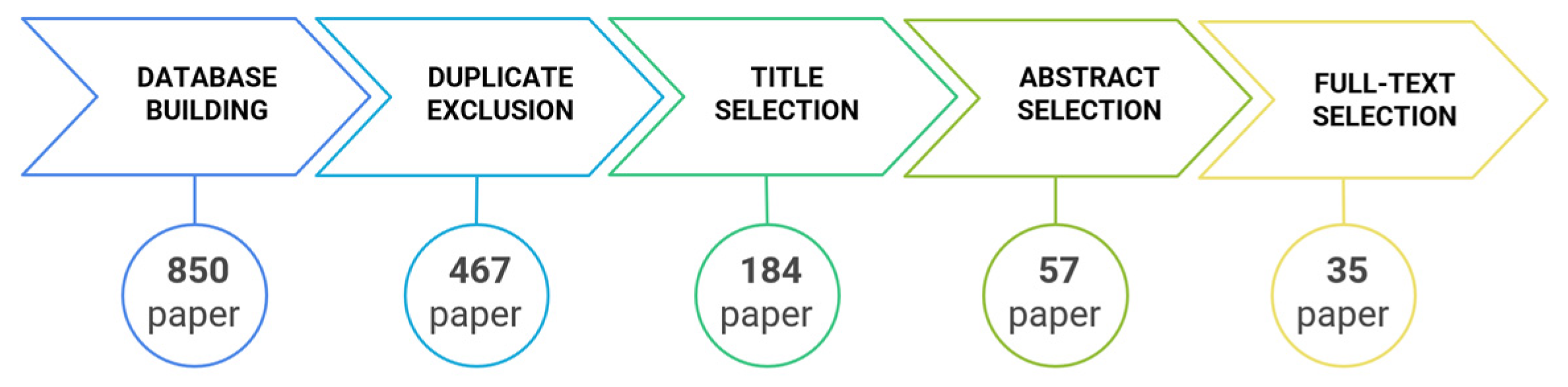
Out of the 850 articles initially identified (Table S3 of Supplementary Materials), duplicate removal reduced the number to 467. Title screening excluded clearly irrelevant documents, resulting in 184 articles selected for abstract evaluation. Subsequently, abstract screening identified 57 articles for full-text analysis. This phase involved an in-depth reading of the texts and allowed for further exclusions, ultimately selecting 35 studies for detailed analysis. The selection of articles for full-text review was guided by their relevance to the two formulated research questions. Contributions not corresponding to scientific publications and/or conference proceedings, as well as all works published before 2015, were excluded. Figure 1 summarizes the selection process. The analysis not only highlighted the primary established scientific evidence but also identified areas of research that remain relatively unexplored.

3. Results

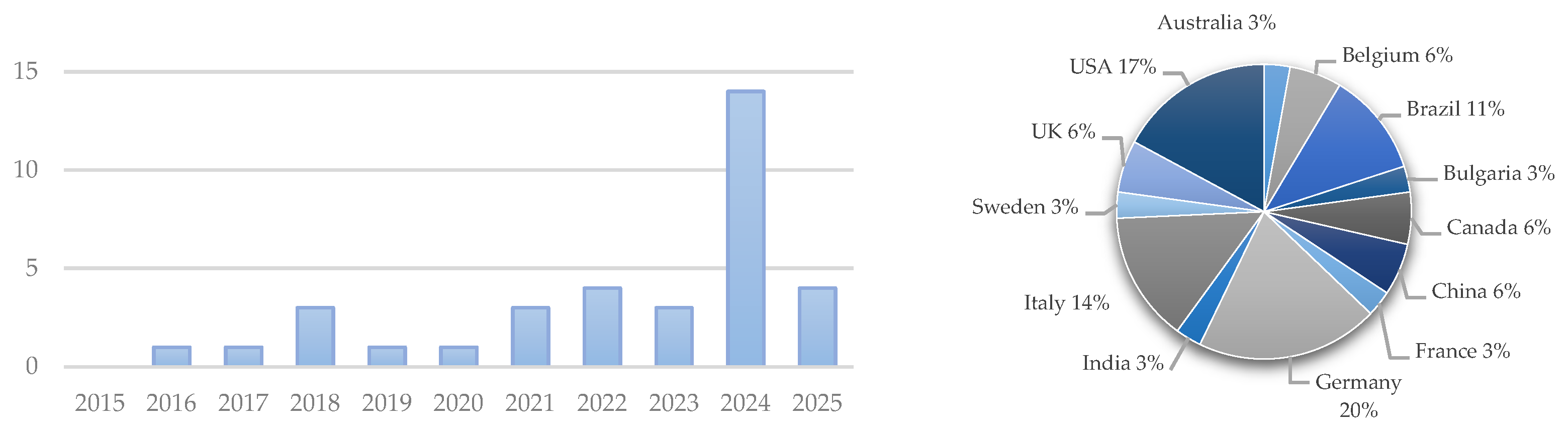
Among the 35 articles selected, the majority were published in recent years, with a particularly significant peak in 2024, reflecting the growing academic interest in this field of research. About geographical distribution, most contributions originate from countries such as Germany, the United States, and Italy, followed by other European and non-European nations (Figure 2).
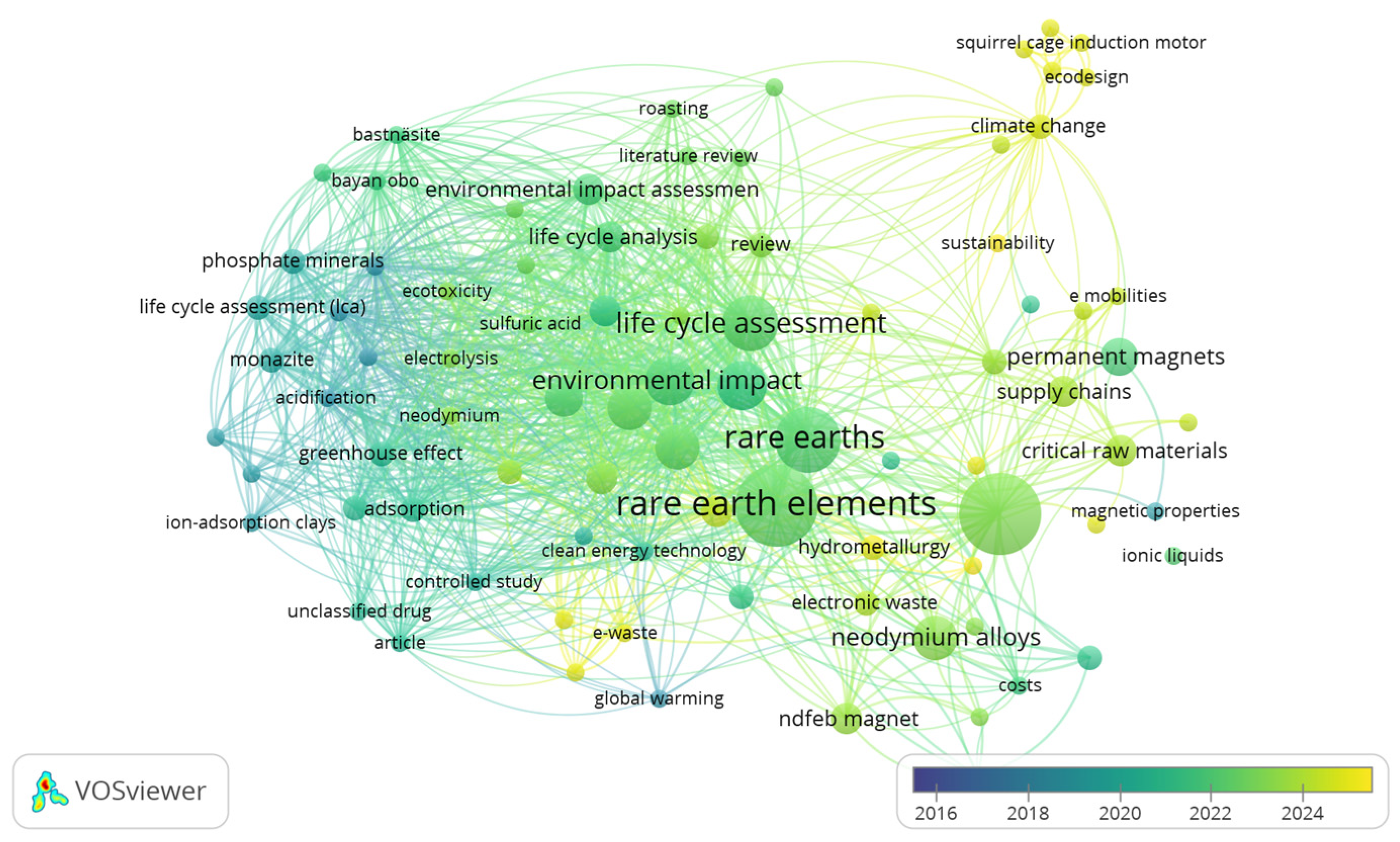
Regarding document type, only four studies correspond to conference proceedings, three to book chapters, while the remainder consists of articles published in scientific journals. The bibliometric analysis carried out using the open-source tool VOSviewer v1.6.20 [12], enabled the construction of a keyword co-occurrence map organized by year of publication. The graphical representation of these connections is provided in Figure 3.
Compared to a few years ago, when keywords such as “life cycle assessment”, “rare earth elements”, “greenhouse effect”, and “environmental impact” were predominant, recent attention has shifted towards the recycling of rare earths from e-waste and from permanent magnets, as highlighted by the keywords shown in light green/yellow in Figure 3. Based on this keyword analysis, the entire bibliographic corpus was divided into two main thematic areas: on the one hand, 18 articles focus on currently available recycling techniques; on the other hand, 17 contributions examine the associated environmental impacts, primarily through LCA studies. These two perspectives are discussed in greater detail in the following sections.

3.1. State of the Art: REE Recycling Techniques

REEs are essential for numerous modern technologies, yet their recycling rate remains surprisingly low, around 1%. This is due to several factors: low concentrations in products, ranging from milligrams to a few kilograms; the complexity of chemical separation, owing to the similarity of REEs and the strong binding structures of sintered magnets; the long lifespan of products, which can reach up to 30 years for NdFeB magnets; economic factors; and the lack of infrastructure, making collection and end-of-life treatment difficult and costly [9,13,14]. Currently, materials in electronic waste and electric motor treatment processes are generally shredded, and separation technologies allow the isolation of copper, aluminum, iron, and plastics. Magnetic materials, however, tend to adhere to the ferrous stream and end up in slag, making the recovery of NdFeB magnets inefficient. For this reason, commercial recycling remains limited, although several companies are developing new technologies at various stages of implementation [15]. Global electronic waste generation is steadily increasing. From 2014 to 2020, it rose from 44.4 to 55.5 Mt, projected to reach around 75 Mt by 2030 [16]. A significant portion of this increase will come from the automotive sector, as an increasing number of EVs will reach the end of their life cycle. Considering an average lifespan of 8–12 years or 150,000 km, many models introduced in Europe since 2013 are now entering the recycling stream. This rapid expansion requires a corresponding increase in recycling capacity and the scalability of dedicated technologies [17].
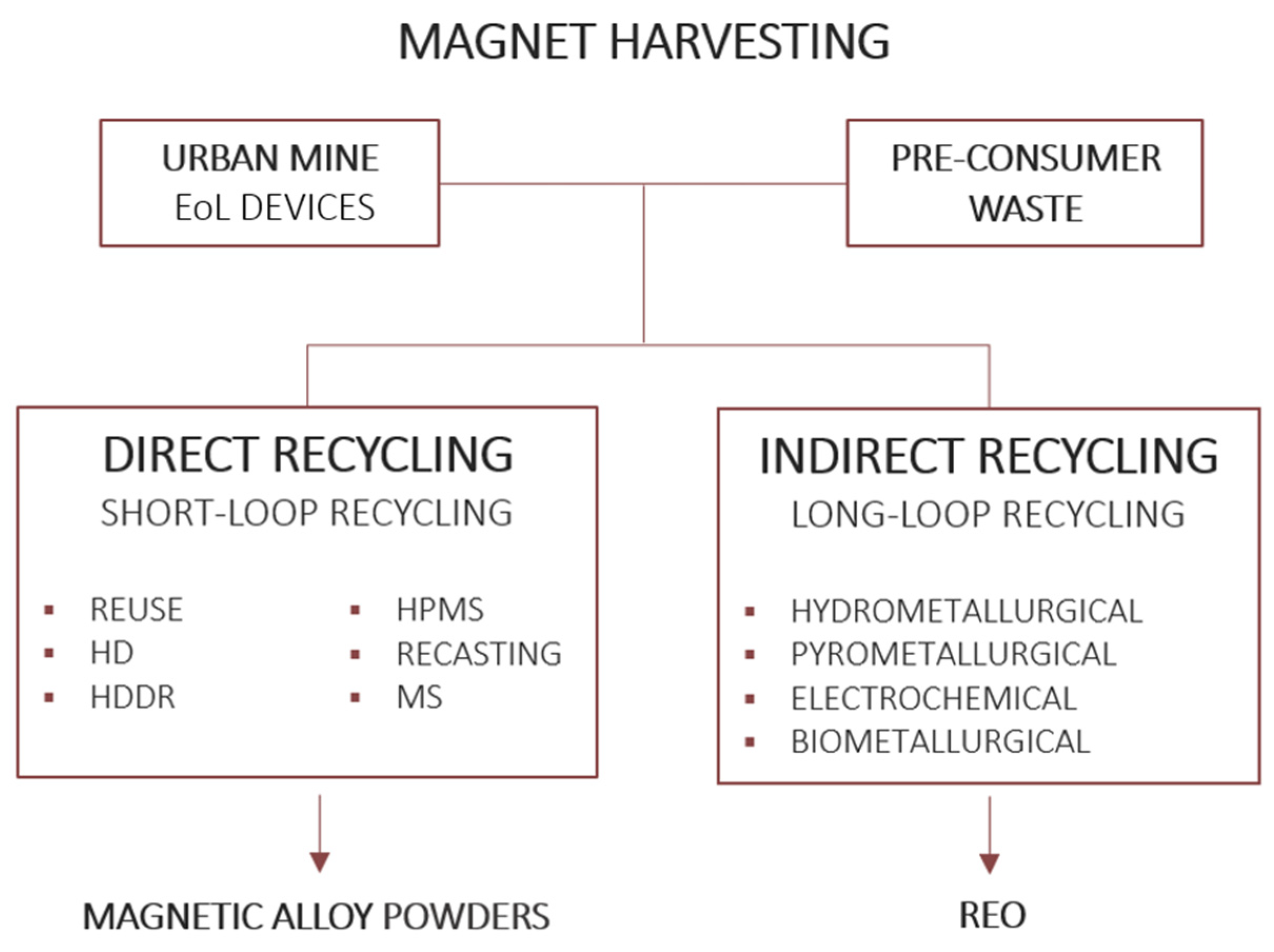
Recycling REEs contained in PMs can follow two main streams: so-called urban mines, i.e., end-of-life products, and pre-consumer waste, i.e., scrap generated during primary extraction and production stages. The main recycling pathways are direct and indirect recycling. Indirect recycling offers a high degree of flexibility, as it allows recovery of individual rare earths in the form of oxides (REOs), which can then be used for a broader range of applications beyond permanent magnets. On the other hand, direct recycling (also known as “magnet-to-magnet”) produces a powder subsequently used to manufacture new magnets. Both pathways require an initial disassembly phase, often a critical step due to limited mechanization and the difficulty in identifying permanent magnet motors. This stage is also an active area of research. A simplified schematic of major recycling and recovery routes is shown in Figure 4.
For instance, Baghel et al. [18] proposed an innovative method to select electric motors containing rare earths without disassembly, reducing costs and improving recycling efficiency. The process combines permanent magnet motor identification via cogging detection and differentiation between REE-based and ferrite magnets using power density (PD), achieving 100% accuracy in the first phase and 78% in the second. While results are promising, the authors highlight the need to refine PD thresholds for different applications and suggest machine learning algorithms to reduce uncertainty. The approach is compatible with automation, making it promising for future industrial scale-up of Rare-Earth Permanent Magnet (REPM) motor recycling.

3.1.1. Indirect Methods

Indirect techniques include pyrometallurgical, hydrometallurgical, electrochemical, and biometallurgical approaches, each with distinct advantages and limitations. Pyrometallurgy, well-established and widely used, relies on high-temperature thermal processes (600–1000 °C) to transform materials, with or without further refining steps. It is effective for high-concentration materials but involves high energy consumption and the release of harmful gases, including CO2, making it less suitable for low-concentration waste streams. Hydrometallurgical processes are more sustainable, operate at low temperatures, and enable the separation of rare earths from base metals. In typical pathways, magnets are pretreated (demagnetization and crushing), followed by leaching in acidic solution and purification via solvent extraction. These methods allow for nearly 100% recovery and reduce pollutant emissions but require wastewater and toxic reagents management. Electrochemical processes offer high conductivity, chemical stability, and fast reaction rates, but are energy-intensive and rarely used alone. Biometallurgical approaches, based on microorganisms, provide a low environmental impact alternative. However, they are limited by the difficulty of controlling operational conditions such as pH and temperature, which are essential for microbial efficiency [19,20]. Despite being relatively mature, these methods continue to be studied and refined.
For example, Opoku et al. [21] systematically investigated the leaching of rare earths from NdFeB magnets using molten magnesium, demonstrating that longer processing times and constant agitation increase recovery up to 80%. At the same time, preliminary demagnetization improves selectivity, reducing the extraction of undesired metals such as nickel and copper. In a subsequent study [22], the same authors further refined the method, showing that agitation during leaching and filtration using zirconia ceramic foam enables high Nd yields and substantial reduction of iron impurities. They also introduced Mg separation from Nd via G-METS-assisted distillation, reducing energy consumption by up to 67% and costs by 35–40% compared to conventional techniques. This advancement strengthens the process’s potential as a basis for a sustainable rare earth magnet recycling supply chain. Kaya et al. [23] proposed a new process for recovering rare earths from NdFeB magnets based on acid baking, iron removal via hydrolysis, and oxide production through ultrasonic spray pyrolysis. The authors then proposed a further four-step process: acid baking, ultrasound-assisted water leaching, rare earth oxide production via solution combustion, and final calcination. Compared to conventional precipitation-based methods, these approaches offer significant advantages: they eliminate the need for large quantities of precipitating agents, reduce metal loss, and prevent the introduction of unwanted impurities [24]. Cherkezova-Zheleva et al. [25] explored two emerging recycling methods for NdFeB magnets: microwave treatment, which removes polymer coatings and recovers Nd even from oxidized magnets, and mechanochemistry, which improves yield and selectivity while reducing chemical consumption and emissions. The authors also emphasize the potential of combining these methods to produce NdFeB powders suitable for additive manufacturing of new magnets.

3.1.2. Direct Methods

Direct methods include Hydrogen Processing of Magnet Scrap (HPMS), which uses hydrogen at room temperature to fracture NdFeB magnets into fine powder, easily separable from other materials and suitable for new alloys or magnets. Hydrogenation Disproportionation Desorption Recombination (HDDR) employs high-temperature hydrogen to decompose and recombine magnet structures, producing a much finer powder suitable for bonded magnets in complex shapes, though with slightly lower performance than the original sintered magnets. Based on this, Kimiabeigi et al. [26] studied the first use of HPMS recycled magnets in a permanent magnet traction motor. Through multiphysics simulations and prototype testing, the study demonstrated that these magnets not only meet application requirements but can provide higher torque density and efficiency, with demagnetization performance comparable to ferrite magnets. Furthermore, HPMS-recycled magnets could be more cost-effective at large-scale production than conventional NdFeB and even competitive with low-cost ferrite magnets. Upadhayay et al. [27] developed a methodology and analytical tool for applying direct reuse in electric mobility. They analyzed the use of recycled magnets produced via hydrogen decrepitation in a claw-pole machine, comparing it with a machine using virgin magnets. Energy consumption was evaluated over two driving cycles, showing nearly identical consumption for both magnet types.
The techniques explored so far are suitable for sintered magnets, while bonded PMs have received very little attention for recycling. This can be explained by the lower rare earth content in bonded magnets and the presence of polymer or resin binders, which complicate direct recycling pathways (e.g., hydrogen decrepitation). Önal et al. [28] demonstrated that end-of-life bonded NdFeB magnets can be recycled using ionic liquids to separate magnetic powder from polymer without losing their properties. In 25 magnets analyzed, the powder retained over 90% of its original performance. This material produced new compression-bonded magnets, showing characteristics comparable to commercial products. The method proved environmentally friendly, versatile, and promising for producing recycled magnets with new designs and materials; however, a potential limitation of chemical processing is the need to tune the process to the polymer used for bonding.

3.2. State of the Art: REE Life Cycle Assessment

This systematic review aims not only to analyze currently available techniques for recycling REEs contained in PMs but also to evaluate the environmental impacts associated with their recovery. To correctly interpret these results, it is essential to consider the effects arising from the primary extraction of these elements, which serve as a reference point for quantifying the environmental benefits of recycling.
In recent years, several reviews have been published on this topic; among them, the work by Schreiber et al. [29] is particularly noteworthy. The authors, analyzing numerous studies on the production of rare earth oxides (REOs) at Bayan Obo and on ion-adsorption clays (IACs) in China, highlight that although these studies provide a good understanding of the processes, many present incomplete, inconsistent, or non-transparent inventories. This generates high uncertainty in estimating environmental impacts, particularly regarding radioactivity, wastewater, and sludge. Results are highly heterogeneous, often due to missing data, hypothetical scenarios, or analogous processes, and the authors emphasize that errors or undeclared assumptions can significantly alter assessments. According to Schreiber et al., a conclusive estimate of the environmental impact of REO production in China is not yet possible because illegal mining activities are rarely considered. Zapp et al. [30] similarly highlight that the LCA studies reviewed in their work predominantly rely on regulatory limits or estimated data, without direct measurements at plants, and often overlook emissions from wastewater, exhaust gases, and natural radioactivity (232Th and 238U). Environmental impacts of REE production vary depending on the mineral and deposit, with chemical reagents being the dominant factor in many impact categories. Processing operations have a greater effect on categories such as climate change, acidification, and toxicity, while electricity consumption significantly affects Global Warming Potential (GWP). LCA indicates opportunities for improvement through reagent recycling, exhaust gas treatment, process optimization, and closure of illegal mines [31]. As previously mentioned, the primary REEs extraction occurs in China, but other mining sites exist worldwide. Marx et al. [32] compare the three significant rare earth deposits, Bayan Obo (China), Mount Weld (Australia), and Mountain Pass (USA), applying uniform methodological conditions and assumptions, thus providing a more coherent overview of the environmental impacts of the NdFeB magnet supply chain. The analysis of producing 1 kg of NdFeB magnet shows that the rare earth component production phase dominates the overall impact (50–99.9%). The US mine demonstrates the best environmental performance due to more careful chemical management, whereas the Chinese pathway is the most impactful. The most significant differences are observed for ecotoxicity, acidification, eutrophication, and particulate matter, while variations are smaller for climate change and resource depletion. HREEs are extracted in China mainly through open-pit mining of bastnaesite/monazite or in situ leaching of ion-adsorption clays. The latter technique requires minerals with lower REE content but avoids physical and chemical enrichment, as the REEs remain in cationic form. Vahidi et al. [33] present the first LCA on in situ leaching of REEs from ion-adsorption clays in southern China, defining 1 kg of mixed rare earth oxides (REO) at 92% as the functional unit. Results show that while impact categories such as global warming and cumulative energy demand are similar to traditional methods, eutrophication and acidification differ significantly. Applying value-based allocation, REOs derived from clays show lower environmental impacts. Since this accounts for approximately 35% of Chinese production, the study contributes to a more comprehensive understanding of the impacts of HREE technologies. Wan et al. [34] also assessed the impact of producing REO from ion-adsorption RE resources, analyzing the sources and factors influencing the carbon footprint. Their results indicate that the carbon footprint of producing 1 kg of mixed REO using ion-adsorption rare earth is subject to a 15.54% uncertainty, impacts have decreased since 2018, and illegal mining activities are quite significant. Amato et al. [35] highlight that replacing rare-earth-rich permanent magnets (NdFeB) with REE-free magnets (sintered ferrite or MnAlC prototypes) can provide substantial environmental and social benefits. LCA analysis shows that producing 1 kg of REE-free magnets generates much lower CO2 emissions compared to NdFeB magnets (e.g., 5–10 kg CO2 eq versus 69 kg CO2 eq), with possible reductions in worker health and safety risks by 3–12 times. However, for a realistic sustainability assessment, the full life cycle of the devices in which the magnets are used must be considered, as larger sizes or additional materials can modify the overall impact. Table 1 provides a schematic overview of the climate change impacts reported in each of the articles relating to primary REE production.
LCA studies on rare earth recycling often do not provide complete or easily comparable assessments, making it challenging to compare environmental impacts across different technologies or scenarios. Among the studies examined, only Wang et al. [36] evaluated and compared five standard processes: magnet-to-magnet, complete leaching, selective leaching, double salt precipitation, and molten salt electrolysis. Results show significant differences among processes: direct magnet-to-magnet recycling is the most effective in reducing greenhouse gas emissions, followed by molten salt electrolysis, whereas double salt precipitation may generate higher emissions than primary production. The main impacts stem from REO production and the pretreatment phase, which account for a significant share of overall emissions. The study also highlights that increasing the proportion of recycled magnets does not guarantee a linear reduction in emissions. There is a threshold beyond which benefits diminish due to the energy and chemicals required for collection and pretreatment. Complete and selective leaching processes show intermediate impacts, with emissions slightly lower than primary production but influenced by pretreatment intensity. Accardo et al. [37] assessed the environmental impact of recycled (NdDy)FeB permanent magnets using an innovative hydrogen decrepitation process, comparing them with virgin magnets. Three functional units were considered: magnet mass, magnetization coercivity, and maximum energy product. Results indicate that recycled magnets reduce climate impact by 18–33%, with the highest reductions (26–33%) when considering coercivity and energy product. The authors note that the recycling process is still at laboratory scale and can be optimized, suggesting further reductions in environmental impacts. Jin et al. [38] evaluated the environmental impact of magnet-to-magnet recycling, comparing results with production from virgin materials. Magnet-to-magnet recycling reduced environmental impact by 64–96%, depending on the specific impact categories considered. Magrini et al. [39] assessed the environmental and economic feasibility of bioleaching Nd, Dy, and Pr from waste NdFeB magnets, an emerging process previously used mainly for other metals. Using LCA and MFCA (Material Flow Cost Accounting), the process was analyzed in six main stages: demagnetization, crushing, bacterial cultivation, bioleaching, rare earth extraction, and oxidation. Key critical points identified include electricity consumption, oxalic acid use, and bioreactor costs, suggesting optimization strategies such as oxalic acid recycling or scale-up of bioreactors. The study highlights that the technology is highly promising but requires further pilot-scale research. Chowdhury et al. [40] present an innovative technology using copper nitrate to dissolve rare earths in chips and re-cover them as high-purity oxides. Environmental assessment shows a significant reduction in impacts, particularly on climate change, making the process a promising solution for sustainable REE recycling. Copper nitrate is identified as the main critical point, but its recycling or replacement with other copper salts can improve performance.
Regarding the environmental impact of REEs use in electric motors, De Souza et al. [41], through a literature review, highlight that the usage phase represents the most significant contribution. At the same time, production and disposal become relevant only for high-efficiency motors or those with shorter operating times. Further analyses by the same authors [42] show that synchronous reluctance motors (SynRM) and permanent magnet synchronous motors (PMSM) offer high efficiency and energy savings. Still, with higher production impacts, SynRMs require more electrical steel, while PMSMs use rare earths, with implications for the environment and recycling. Nevertheless, IE5 motors are more sustainable overall than Squirrel Cage Induction Motors (SCIM) due to the high recyclability of components. Giolito et al. [43] explore the role of critical materials, showing that targeted interventions on copper and permanent magnets yield significant reductions in environmental impact, whereas less critical modifications, such as aluminum light-weighting, have negligible effects. Mafrici et al. [44] confirm that the usage phase dominates impacts but underline that geographic context and motor application can modify its weight: in countries with renewable energy mixes, such as Sweden, production becomes more significant, whereas larger or heavier vehicles, such as SUVs, result in higher impacts in both production and usage. Nordelöf et al. [45] provide further design insights, showing that SynRM-PM motors with strontium ferrite magnets achieve high efficiency and reduced CO2 emissions. At the same time, copper production remains critical for toxicity and human health.
All studies highlight the importance of design strategies, such as thin housings, compact windings, segmented laminations, and ease of disassembly, which maximize operational efficiency and reduce overall environmental impact. Table 2 provides a schematic overview of the climate change impacts reported in each of the articles considered, relating to the type of recycling.

4. Discussion and Conclusions

The energy and digital transition increasingly highlight the strategic importance of critical raw materials, which simultaneously represent a valuable resource and a source of vulnerability for economies. Rare Earth Elements (REEs) used in permanent magnets are essential for key technologies, such as electric vehicles, wind turbines, and electronic devices; however, their extraction and processing are heavily concentrated in China. This dependence exposes Europe and other countries to geopolitical, economic, and environmental risks, making it urgent to diversify supply sources and develop resilient and sustainable value chains.
The work described here focuses on a literature analysis of the topic of REE PM. The first phase of the activity defined an analysis method based on a systematic review; the elements arising highlight that there has been a strong presence of the topic in the literature, highlighting the research interest in the topic according to the research methodology here defined. However, despite such relevance for the last decade, our method suggested considering a limited number of them, which are mainly focused on it; starting from 850 articles related to PM, a subset of 35 documents has been selected for their significance and originality on the topic of circular economy and impact assessment.
Looking at the second phase of the activity, that is, the exploitation of the subset of references, an overview of the results is provided. Recycling magnets containing REEs emerges as a particularly promising option. Recovering these materials from end-of-life devices can reduce dependence on primary extraction, decrease environmental impacts, and align with the objectives of the European Green Deal. The techniques currently available, both direct and indirect, are evolving rapidly; despite technological and economic complexities, recent progress demonstrates that recycled materials can achieve performance comparable to, and in some cases even superior to, that of virgin materials.
LCA confirms that the environmental benefits of recycling depend on several factors: the processes employed, the energy mix of the production context, and, in the case of electric motors, product design strategies. Nevertheless, the evidence consistently shows that recovering rare earths can significantly reduce emissions and environmental impacts, primarily because it eliminates the most critical and polluting phase: mining. It is important, however, to acknowledge the limitations of the available literature: data are often incomplete, based on a limited number of sources, they cover only specific recycling stages rather than the entire value chain, and are difficult to compare due to methodological heterogeneity.
It is therefore evident from the results reported that technological progress alone is insufficient to make recycling truly effective and competitive; a coordinated effort from research, industry, and policy is required. More efficient separation and treatment techniques need to be developed, dedicated collection infrastructure and specialized value chains must be established, and economic incentives and regulatory tools should be implemented to make rare-earth recovery a sustainable and economically viable alternative to primary extraction. Only through such measures can magnetic waste be transformed into a strategic resource, strengthening supply security and accelerating the transition toward a more resilient and sustainable economy. This work has primarily focused on the environmental aspects of recycling; however, for a more comprehensive assessment, future research should also extend the analysis to economic and social dimensions.

Supplementary Materials

The following supporting information can be downloaded at https://www.mdpi.com/article/10.3390/engproc2026131011/s1.

Author Contributions

Conceptualization, G.C., M.G. and L.B.; methodology, G.C. and M.G.; software, G.C.; validation, G.C., M.G. and L.B.; formal analysis, G.C.; investigation, G.C.; resources, G.C.; data curation, G.C.; writing—original draft preparation, G.C.; writing—review and editing, G.C., M.G., L.B. and M.D.; visualization, G.C.; supervision, L.B. and M.D.; project administration, L.B. and M.D.; funding acquisition, M.D. All authors have read and agreed to the published version of the manuscript.

Funding

Funded by the European Union under the HARMONY project (Grant agreement ID: 101138767, https://www.harmonyproject.eu/). However, views and opinions expressed are those of the authors only and do not necessarily reflect those of the European Union or HADEA. Neither the European Union nor the granting authority can be held responsible for them. This work includes data obtained and processed as part of the “RAMITERA” project (Riciclare Motori Contenenti Terre Rare), funded by the Italian MASE–Ministry of the Environment and the Energy Security, under the 2021 Call for WEEE, Decree EC-DEC-85 of 07.09.23 (Bando RAEE Edizione 2021).

Institutional Review Board Statement

Not applicable.

Informed Consent Statement

Not applicable.

Data Availability Statement

The original contributions presented in this study are included in the article/Supplementary Material.

Conflicts of Interest

The authors declare no conflict of interest. The funders had no role in the design of the study; in the collection, analyses, or interpretation of data; in the writing of the manuscript; or in the decision to publish the results.

References

  1. European Commission. The European Green Deal. COM(2019) 640 Final. Brussels: European Commission. 2019. Available online: https://eur-lex.europa.eu/legal-content/EN/TXT/?uri=CELEX%3A52019DC0640 (accessed on 4 September 2025).
  2. Rizos, V.; Righetti, E.; Kassab, A. Understanding the Barriers to Recycling Critical Raw Materials for the Energy Transition: The Case of Rare Earth Permanent Magnets. Energy Rep. 2024, 12, 1673–1682. [Google Scholar] [CrossRef]
  3. Gauß, R.; Burkhardt, C.; Carencotte, F.; Gasparon, M.; Gutfleisch, O.; Higgins, I.; Karajić, M.; Klossek, A.; Mäkinen, M.; Schäfer, B.; et al. Rare Earth Magnets and Motors: A European Call for Action; European Raw Materials Alliance: Brussels, Belgium, 2021; Available online: https://eitrawmaterials.eu/sites/default/files/2024-11/2021_07-13_REE%20Cluster%20Report.pdf (accessed on 4 September 2025).
  4. European Commission: Directorate-General for Internal Market, Industry, Entrepreneurship and SMEs; Grohol, M.; Veeh, C. Study on the Critical Raw Materials for the EU 2023—Final Report, Publications Office of the European Union. 2023. Available online: https://data.europa.eu/doi/10.2873/725585 (accessed on 4 September 2025).
  5. European Parliament. Resolution of 10 July 2025 on Tackling China’s Critical raw Materials Export Restrictions (2025/2800(RSP), P10_TA(2025)0166). Official Journal of the European Union. 2025. Available online: https://www.europarl.europa.eu/doceo/document/TA-10-2025-0166_EN.pdf (accessed on 4 September 2025).
  6. European Parliament and Council. Regulation (EU) 2024/1252 of 11 April 2024 on a Framework for Ensuring a Secure and Sustainable Supply of Critical Raw Materials. Official Journal of the European Union, L 1252. 3 May 2024. Available online: https://eur-lex.europa.eu/legal-content/EN/TXT/?uri=CELEX%3A32024R1252 (accessed on 4 September 2025).
  7. ISO 14040:2006; Environmental Management—Life Cycle Assessment—Principles and Framework. ISO: Geneva, Switzerland, 2006; pp. 1–28.
  8. ISO 14044:2006; Environmental Management—Life Cycle Assessment—Requirements and Guidelines. ISO: Geneva, Switzerland, 2006; pp. 1–46.
  9. Zakeri, A.; Tafaghodi, L. A Review of the Current Progress in High-Temperature Recycling Strategies for Recovery of Rare-Earth Elements from Magnet Waste. J. Sustain. Metall. 2025, 11, 88–113. [Google Scholar] [CrossRef]
  10. Sala, V.; Moja, L.; Moschetti, I.; Bidoli, S.; Pistotti, V.; Liberati, A. Revisioni Sistematiche—Breve Guida All’uso; Centro Cochrane Italiano: Milano, Italy, 2006; Available online: https://www.cochrane.it/sites/cochrane.it/files/uploads/guidausorevisioni.pdf (accessed on 4 September 2025).
  11. Higgins, J.P.T.; Green, S. Cochrane Handbook for Systematic Reviews of Interventions; Wiley-Blackwell: Chichester, UK, 2008. [Google Scholar] [CrossRef]
  12. VOSviewer—Visualizing Scientific Landscapes. Available online: https://www.vosviewer.com (accessed on 4 September 2025).
  13. Ihne, T.; Hahn, R.; Wieprecht, N.; Franke, J.; Kühl, A. Recycling Concept for Electric Vehicle Drives in the Context of Rare Earth Recovery. In International Conference on Production Technologies and Systems for E-Mobility (EPTS); Springer: Bamberg, Germany, 2024; pp. 1–9. [Google Scholar] [CrossRef]
  14. Li, Z.; Hamidi, A.S.; Yan, Z.; Sattar, A.; Hazra, S.; Soulard, J.; Guest, C.; Ahmed, S.H.; Tailor, F. A Circular Economy Approach for Recycling Electric Motors in the End-of-Life Vehicles: A Literature Review. Resour. Conserv. Recycl. 2024, 205, 107582. [Google Scholar] [CrossRef]
  15. Forstner, A.; Ghahreman, A.; Mahandra, H.; Hepburn, M.; Griffith, M. A Critical Review and Future Perspectives of Rare Earth Magnet Recycling Technologies. In 63rd Conference of Metallurgists, COM 2024; Metallurgy and Materials Society of CIM: Westmount, QC, Canada, 2024; pp. 1487–1497. [Google Scholar] [CrossRef]
  16. Vuppaladadiyam, S.S.V.; Thomas, B.S.; Kundu, C.; Vuppaladadiyam, A.K.; Duan, H.; Bhattacharya, S. Can E-Waste Recycling Provide a Solution to the Scarcity of Rare Earth Metals? An Overview of e-Waste Recycling Methods. Sci. Total Environ. 2024, 924, 171453. [Google Scholar] [CrossRef]
  17. Ihne, T.; Hahn, R.; Wieprecht, N.; Franke, J.; Kühl, A. Approach for Advanced Mechanical Recycling Strategies of Rare Earth Magnets Applied in Traction Drives. In Production at the Leading Edge of Technology; Bauernhansl, T., Verl, A., Liewald, M., Möhring, H.-C., Eds.; Springer: Cham, Switzerland, 2024; pp. 458–468. [Google Scholar] [CrossRef]
  18. Baghel, A.; Karati, A.; Prodius, D.; Nlebedim, I. Sorting Rare Earth Magnets Motors for Recycling without Opening the Motors. Sci. Rep. 2025, 15, 12260. [Google Scholar] [CrossRef] [PubMed]
  19. Nacif Petraglia, F.F.; Vinhal, J.T.; Junior, A.B.B.; Espinosa, D.C.R. Recycling of Permanent Magnets: A Perspective for Application of Organic Acids and Ionic Liquids towards Eco-Friendly Process. J. Environ. Chem. Eng. 2024, 12, 114389. [Google Scholar] [CrossRef]
  20. Godbole, P.; Deshpande, K.; Jawadand, S.; Dora, M.L.; Selokar, A.; Daware, G.; Sahu, M.; Nandi, A.K.; Randive, K. Innovative Technologies for Recycling and Extraction of Rare Earth Elements. In Current Trends in Mineral-Based Products and Utilization of Wastes: Recent Studies in India; Springer: Cham, Switzerland, 2024; pp. 1–25. [Google Scholar] [CrossRef]
  21. Opoku, E.; Chinwego, C.; Powell, A.; Mishra, B. Liquid Metal Leaching for Rare Earth Magnet Recycling. Metals 2024, 14, 1299. [Google Scholar] [CrossRef]
  22. Opoku, E.; Chinwego, C.; Powell, A.C.; Mishra, B. Recycling Rare Earth Permanent Magnets via Liquid Magnesium Leaching and Distillation. In Rare Metal Technology 2025. TMS 2025; Forsberg, K., Karamalidis, A., Ouchi, T., Azimi, G., Alam, S., Neelameggham, N.R., Baba, A.A., Peng, H., Kim, H., Eds.; Springer: Cham, Switzerland, 2025; pp. 39–47. [Google Scholar] [CrossRef]
  23. Kaya, E.E.; Kaya, O.; Stopic, S.; Gürmen, S.; Friedrich, B. Ndfeb Magnets Recycling Process: An Alternative Method to Produce Mixed Rare Earth Oxide from Scrap Ndfeb Magnets. Metals 2021, 11, 716. [Google Scholar] [CrossRef]
  24. Emil-Kaya, E.; Stopic, S.; Gürmen, S.; Friedrich, B. Production of Rare Earth Element Oxide Powders by Solution Combustion: A New Approach for Recycling of NdFeB Magnets. RSC Adv. 2022, 12, 31478–31488. [Google Scholar] [CrossRef] [PubMed]
  25. Cherkezova-Zheleva, Z.; Burada, M.; Sobetkii, A.E.; Paneva, D.; Fironda, S.A.; Piticescu, R.-R. Green and Sustainable Rare Earth Element Recycling and Reuse from End-of-Life Permanent Magnets. Metals 2024, 14, 658. [Google Scholar] [CrossRef]
  26. Kimiabeigi, M.; Sheridan, R.S.; Widmer, J.D.; Walton, A.; Farr, M.; Scholes, B.; Harris, I.R. Production and Application of HPMS Recycled Bonded Permanent Magnets for a Traction Motor Application. IEEE Trans. Ind. Electron. 2018, 65, 3795–3804. [Google Scholar] [CrossRef]
  27. Upadhayay, P.; Awais, M.; Lebouc, A.-K.; Garbuio, L.; Degri, M.; Walton, A.; Mipo, J.-C.; Dubus, J.-M. Applicability of Direct Reuse and Recycled Rare Earth Magnets in Electro-mobility. In Proceedings of the 7th International Conference on Renewable Energy Research and Applications (ICRERA); IEEE: Paris, France, 2018; pp. 846–852. [Google Scholar] [CrossRef]
  28. Önal, M.A.R.; Dewilde, S.; Degri, M.; Pickering, L.; Saje, B.; Riaño, S.; Walton, A.; Binnemans, K. Recycling of Bonded NdFeB Permanent Magnets Using Ionic Liquids. Green Chem. 2020, 22, 2821–2830. [Google Scholar] [CrossRef]
  29. Schreiber, A.; Marx, J.; Zapp, P. Life Cycle Assessment Studies of Rare Earths Production—Findings from a Systematic Review. Sci. Total Environ. 2021, 791, 148257. [Google Scholar] [CrossRef]
  30. Zapp, P.; Schreiber, A.; Marx, J.; Kuckshinrichs, W. Environmental Impacts of Rare Earth Production. MRS Bull. 2022, 47, 267–275. [Google Scholar] [CrossRef]
  31. Prados, T.; Barroso, T.; Forster-Carneiro, T.; Lovón-Canchumani, G.; Colpini, L. Life Cycle Assessment and Circular Economy in the Production of Rare Earth Magnets: An Updated and Comprehensive Review. Clean Technol. Environ. Policy 2025, 27, 471–494. [Google Scholar] [CrossRef]
  32. Marx, J.; Schreiber, A.; Zapp, P.; Walachowicz, F. Comparative Life Cycle Assessment of NdFeB Permanent Magnet Production from Different Rare Earth Deposits. ACS Sustain. Chem. Eng. 2018, 6, 5858–5867. [Google Scholar] [CrossRef]
  33. Vahidi, E.; Navarro, J.; Zhao, F. An Initial Life Cycle Assessment of Rare Earth Oxides Production from Ion-Adsorption Clays. Resour. Conserv. Recycl. 2016, 113, 1–11. [Google Scholar] [CrossRef]
  34. Wan, C.; Zhou, D.; Xue, B. LCA-Based Carbon Footprint Accounting of Mixed Rare Earth Oxides Production from Ionic Rare Earths. Processes 2022, 10, 1354. [Google Scholar] [CrossRef]
  35. Amato, A.; Becci, A.; Bollero, A.; Cerrillo-Gonzalez, M.; Cuesta-Lopez, S.; Ener, S.; Dirba, I.; Gutfleisch, O.; Innocenzi, V.; Montes, M.; et al. Life Cycle Assessment of Rare Earth Elements-Free Permanent Magnet Alternatives: Sintered Ferrite and Mn-Al-C. ACS Sustain. Chem. Eng. 2023, 11, 13374–13386. [Google Scholar] [CrossRef] [PubMed]
  36. Wang, Q.-Q.; Wang, L.; Zhao, S.; Li, F.-P.; Chen, W.-Q.; Wang, P. A Critical Life Cycle Assessment of Present and Potential Rare Earth Circularity Routes from Permanent Magnets. Resour. Conserv. Recycl. 2025, 215, 108106. [Google Scholar] [CrossRef]
  37. Accardo, A.; Costantino, T.; Spessa, E. LCA of Recycled (NdDy)FeB Permanent Magnets through Hydrogen Decrepitation. Energies 2024, 17, 908. [Google Scholar] [CrossRef]
  38. Jin, H.; Afiuny, P.; Dove, S.; Furlan, G.; Zakotnik, M.; Yih, Y.; Sutherland, J. Life Cycle Assessment of Neodymium-Iron-Boron Magnet-to-Magnet Recycling for Electric Vehicle Motors. Environ. Sci. Technol. 2018, 52, 3796–3802. [Google Scholar] [CrossRef] [PubMed]
  39. Magrini, C.; Jagodzińska, K. Can Bioleaching of NIB Magnets Be an Answer to the Criticality of Rare Earths? An Ex-Ante Life Cycle Assessment and Material Flow Cost Accounting. J. Clean. Prod. 2022, 365, 132672. [Google Scholar] [CrossRef]
  40. Chowdhury, N.A.; Deng, S.; Jin, H.; Prodius, D.; Sutherland, J.W.; Nlebedim, I.C. Sustainable Recycling of Rare-Earth Elements from NdFeB Magnet Swarf: Techno-Economic and Environmental Perspectives. ACS Sustain. Chem. Eng. 2021, 9, 15915–15924. [Google Scholar] [CrossRef]
  41. de Souza, D.F.; da Silva, P.P.F.; Sauer, I.L.; de Almeida, A.T.; Tatizawa, H. Life Cycle Assessment of Electric Motors—A Systematic Literature Review. J. Clean. Prod. 2024, 456, 142366. [Google Scholar] [CrossRef]
  42. de Souza, D.F.; Fong, J.; Hernandez, C.; do Carmo, C.E.M.; Lourenço, J.L.; Sauer, I.L.; Tatizawa, H.; de Almeida, A.T. Environmental Impacts of Electric Motor Technologies: Life Cycle Approach Based on EuP Eco-Report. Environ. Impact Assess. Rev. 2025, 111, 107741. [Google Scholar] [CrossRef]
  43. Giolito, F.; Accardo, A.; Spessa, E. Evaluation of the Environmental Benefit of an Eco-design Strategy on the Life Cycle Assessment of a Permanent Magnet Synchronous High-speed Electric Motor. Transp. Res. Procedia 2023, 70, 241–248. [Google Scholar] [CrossRef]
  44. Mafrici, S.; Accardo, A.; Spessa, E.; Tenconi, A. A Novel Scenario Analysis Framework for the Life Cycle Assessment of Permanent Magnet Synchronous Motors for Electric Vehicles. IEEE Access 2024, 12, 156837–156848. [Google Scholar] [CrossRef]
  45. Nordelöf, A.; Grunditz, E.; Lundmark, S.; Tillman, A.; Alatalo, M.; Thiringer, T. Life Cycle Assessment of Permanent Magnet Electric Traction Motors. Transp. Res. D Transp. Environ. 2019, 67, 263–274. [Google Scholar] [CrossRef]
Figure 1. Article selection process for systematic review.
Engproc 131 00011 g001
Figure 2. Research publication trend by year and by country.
Engproc 131 00011 g002
Figure 3. A bibliometric map that illustrates the interconnections between various keywords. The map’s color gradient from blue to green to yellow indicates the publication timeline from 2016 to 2025, demonstrating the evolution of research interests over time. The minimum number of occurrences of a keyword was set to 2, with 86 keywords meeting the threshold.
Engproc 131 00011 g003
Figure 4. Simplified schematic of major recycling and recovery routes.
Engproc 131 00011 g004
Table 1. Overview of climate change impacts reported in studies on primary REE production.
SourceFunctional UnitLCIA
Methodology
Climate Change
[kg CO2 eq]
Marx et al. [32]1 kg NdFeBReCiPe40–80
Vahidi et al. [33]1 kg REOTRACI20.9–35.5
Wan et al. [34]1 kg REOCF 117.8–24.3
Amato et al. [35]1 kg magnet RE-freeEF 15–10
1 CF = Carbon Footprint; EF = Environmental Footprint.
Table 2. Overview of climate change impacts reported in studies on the recycling processes.
SourceType of RecyclingFunctional Unit
and
LCIA Methodology
Climate Change
[kg CO2 eq]
VirginRecycled
Wang et al. [36]Magnet-to-Magnet
Complete leaching
Selective leaching
Double salt precipitation
Molten salt electrolysis
1 kg REE from EoL NdFeB–TRACI8.40 × 1012.65 × 101
5.63 × 101
5.49 × 101
8.97 × 101
4.83 × 101
Accardo et al. [37]Hydrogen
Decrepitation
1 kg mass–EF4.66 × 1013.82 × 101
Jin et al. [38]Magnet-to-Magnet1 kg of NdFeB–TRACI1.3 × 1022.5 × 101
Magrini et al. [39]Bioleaching7.9–29.4 kg/month
of REO–CML
-1.58 × 101
Chowdhury et al. [40]Acid-free dissolution1 kg of Nd2O3–TRACI
Copper Nitrate–TRACI
1.1 × 10²
-
5.5 × 10
3.6 × 100
Disclaimer/Publisher’s Note: The statements, opinions and data contained in all publications are solely those of the individual author(s) and contributor(s) and not of MDPI and/or the editor(s). MDPI and/or the editor(s) disclaim responsibility for any injury to people or property resulting from any ideas, methods, instructions or products referred to in the content.