Proceeding Paper

Development of an Android-Based Mobile Application for Menstrual Health and Sports Performance Tracking in Female Athletes †
by
Lee Fan Tan
1,2,*,
Xuan Ning Chai
1,
Choon Hian Goh
1,2,
Kamala Krishnan
3 and
Muhammad Noh Zulfikri Mohd Jamali
3
1
Lee Kong Chian Faculty of Engineering and Science, Universiti Tunku Abdul Rahman, Kajang 43000, Selangor, Malaysia
2
Centre for Healthcare Science and Technology, Universiti Tunku Abdul Rahman, Kajang 43000, Selangor, Malaysia
3
M. Kandiah Faculty of Medicine and Health Sciences, Universiti Tunku Abdul Rahman, Kajang 43000, Selangor, Malaysia
*
Author to whom correspondence should be addressed.
Presented at the 7th Eurasia Conference on Biomedical Engineering, Healthcare and Sustainability 2025 (ECBIOS 2025), Kaohsiung, Taiwan, 23–25 October 2025.
Eng. Proc. 2026, 129(1), 4; https://doi.org/10.3390/engproc2026129004
Published: 25 February 2026

Abstract

Female sports science has historically relied on evidence derived largely from male cohorts, despite known menstrual-cycle-related hormonal effects on thermoregulation, metabolism, and performance in women. We developed an Android application to support female athletes in documenting menstrual health alongside self-rated sports performance, addressing an underexplored area in current mobile health tools. The app was built in the Massachusetts Institute of Technology’s App Inventor following a rapid application development process (requirements determination, user design, construction, and implementation). Implemented features include period-date recording and prediction, health and performance logging, record review, basic personalization, and phase-specific, non-personalized training and nutrition tips. Unit test results verified core functions, including date recording, period prediction, navigation, and record retrieval, and a small-sample usability assessment (n = 5) using the system usability scale indicated above-average usability. In conclusion, the application offers a practical tool for period-date and symptom tracking with integrated performance self-logging.

1. Introduction

Women’s participation in sport has increased markedly, yet foundational knowledge and applied practices remain shaped by research on male cohorts. Female athletes experience menstrual-cycle-related hormonal fluctuations that affect thermoregulation and metabolism [1], which also influence perceived performance [2]. Related clinical observations have been reported [3]. Meanwhile, mobile health tools are widely used but vary in scope and quality, leaving a gap for athlete-centered, context-specific tracking [4]. Recent reviews also highlight the methodological diversity of mHealth usability work [5]. We developed an Android-based application that integrates menstrual cycle recording with self-reported sports performance, emphasizing feasibility and usability rather than physiological efficacy.

2. Materials and Methods

2.1. Methodology

The mobile application was built in the Massachusetts Institute of Technology’s App Inventor, which was selected for its accessibility for rapid prototyping. The interface was designed to enable quick, low-effort tracking through structured inputs (stars/checkboxes), sensible defaults, and on-device persistence.

2.1.1. Requirements Determination

Information gathering and requirements identification were conducted through a literature review to understand the subject matter, particularly the menstrual cycle. This phase informed the project direction and produced functional and non-functional requirements that guided subsequent design and implementation, as outlined below.
  • Functional requirements
    • Calendar tracking: The application displays a comprehensive calendar view, selects specific days, months, and years, uses color-coding for weekends, days within the current month, days outside the month, and recorded menstrual dates, edits cycle length and period length, records menstrual period dates, predicts the next menstrual period date, records menstrual health information, tracks sports performance, and marks race dates on the calendar.
    • Reminders/information: The application provides users with information about hormonal fluctuations, the effects of the menstrual cycle on athletic performance, and recommendations for training and proper nutrition during different menstrual phases.
  • Non-functional requirements
    • The mobile application is exclusively accessible to Android users. It supports persistent on-device storage without internet and is accessible at all times. The application prioritizes an intuitive user interface (discernible buttons, comprehensible icons, clear headings, and informative messages), preserves user data after reinstallation, and offers interface color theme customization.

2.1.2. User Design (Use-Case Model)

A use-case diagram depicts how users interact with the application and the functionalities offered (Figure 1). Use-case descriptions provided the narrative steps for core scenarios (calendar view, record menstrual date, record menstrual health, record sports performance, check records, and read tips) and informed the screen flows in the prototype.

2.1.3. Construction and Implementation

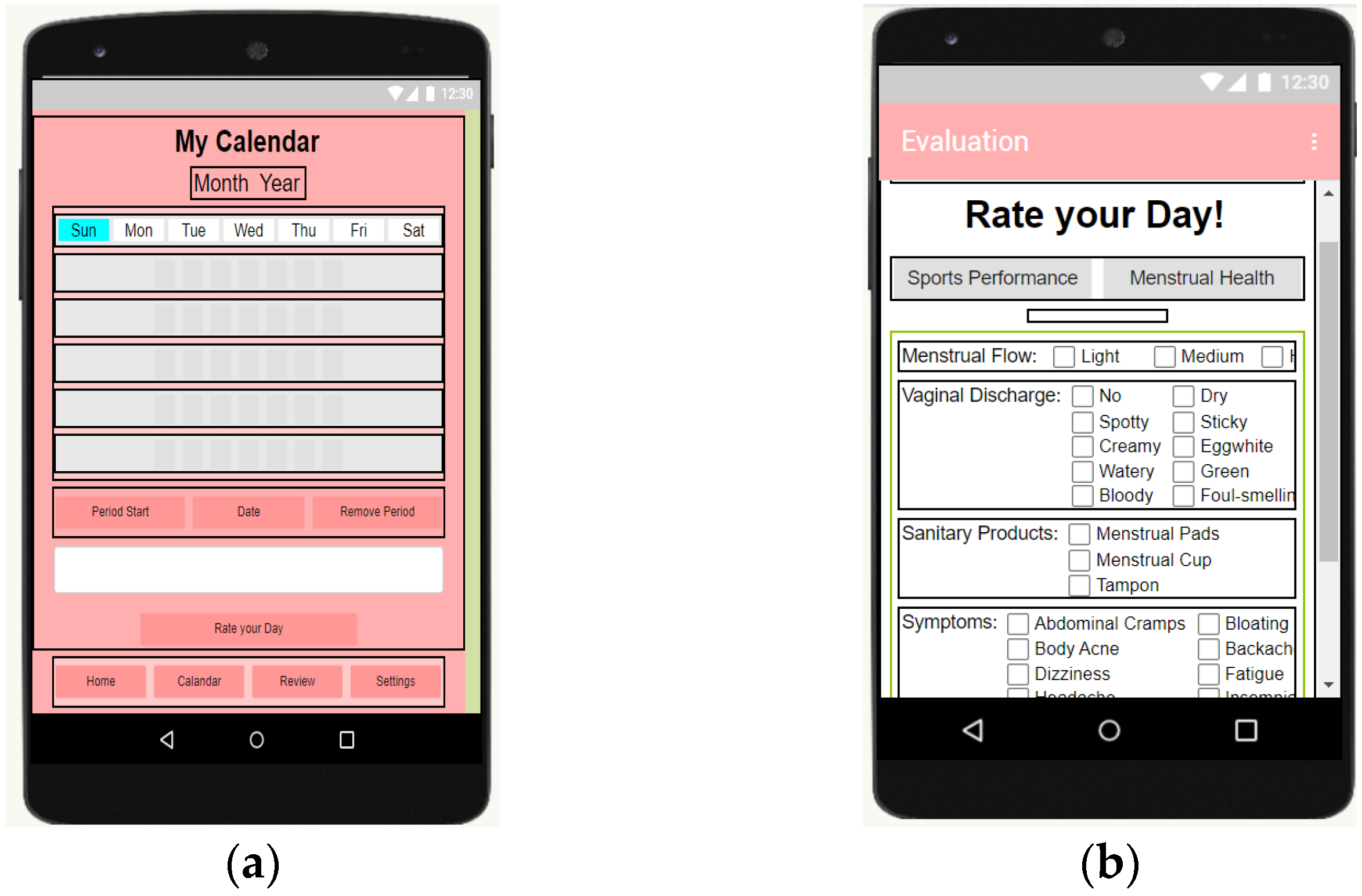
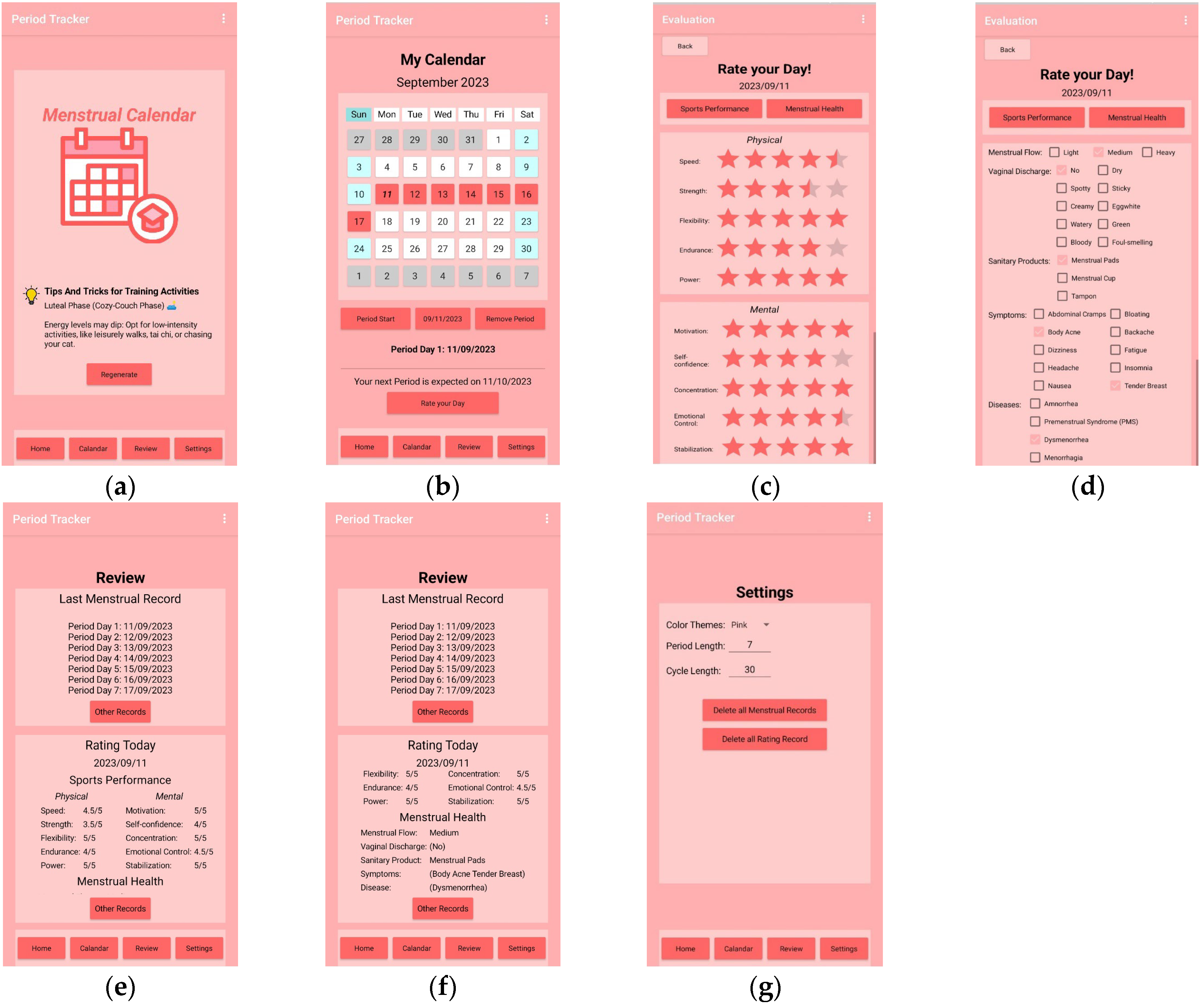
Upon launching the application, users are directed to the Home screen. Beneath the application logo, a Tips and Tricks panel provides users with non-personalized, phase-specific training and nutrition tips. It refreshes automatically every 30 s and includes a “Regenerate” button for on-demand updates. The Calendar presents a monthly grid (6 × 7) with color-coded days. Users tap “Period Start” to record period days and “Remove Period” to clear; the next predicted period date is displayed. A date picker lets users select a day, month, and year; the selected day is highlighted in bold. The “Rate your Day!” button links to the Evaluation screen. The evaluation screen provides menstrual health criteria (e.g., menstrual flow, vaginal discharge, sanitary products, symptoms, and diseases) and sports performance criteria (physical: speed, strength, flexibility, endurance, and power; mental: motivation, self-confidence, concentration, emotional control, and stabilization) for same-day logging. Figure 2 shows the Calendar and Evaluation sections in the MIT App Inventor Designer and Blocks editors. The Review screen displays the most recent menstrual and evaluation records and provides date lists to retrieve stored entries. Settings include theme color selection, editing of period and cycle length, and delete controls for menstrual or rating records. By default, period length is 7 days and cycle length is 30 days.

2.1.4. Functional Verification and Usability Evaluation

Unit tests verified the saving, editing, and deleting of records; the correct display of the next predicted period date; and navigation between screens. Usability testing was performed with five participants using the system usability scale (SUS) (10 items, 5-point) [6].

3. Results

The prototype successfully implemented the planned features, with key features including menstrual cycle tracking and prediction; symptom and performance logging; records and history review; and a Tips and Tricks panel with non-personalized, phase-specific training and nutrition tips. The main interfaces are shown in Figure 3.
All pre-specified unit tests passed, confirming expected behavior. The usability evaluation yielded an average SUS score of 78.5 (n = 5, Table 1). Participant comments and feedback highlighted the intuitive design and practicality for female athletes; however, areas for improvement include more accurate cycle prediction and expanded health and performance content.

4. Discussion

Relative to prior app reviews, many women’s health applications vary in scope and quality, leaving an athlete-centered, context-specific tracking gap [4]. Recent usability work also highlights methodological diversity in mHealth assessment [5]. This prototype addresses that gap by combining period/date prediction with structured performance self-logging and record review within a single tool.
The application demonstrates the feasibility of integrating menstrual health tracking with sports-performance logging in one platform. This approach aligns with ongoing calls to incorporate sex-specific considerations in sports science and athlete monitoring. While pilot testing indicated promising usability, further refinement is needed to enhance predictive accuracy and ensure robust data privacy. Future work may also explore incorporating larger datasets, wearable integration, and more personalized recommendations.
The findings of this study align with reports that athletes’ experiences and performance effects across the menstrual cycle are highly individualized, with notable symptom variability and inconsistent objective performance shifts. Recent reviews and team-sport syntheses emphasize methodological heterogeneity and the need for individualized approaches rather than phase-based prescriptions [7]. Longitudinal evidence from elite track-and-field athletes similarly documents perceived effects and cycle irregularities while underscoring between-athlete differences [8]. In applied team settings, structured symptom logging is feasible and informative for staff–athlete communication [9].
Concept mapping identifies priority domains for implementing menstrual cycle tracking in performance environments—ethics, tools and methods, performance and health, education, interpretation and framing, and communication [10]. Consistent with those recommendations, the present prototype was designed with simple daily logging, optional granularity, and privacy-aware data handling to minimize burden while preserving usefulness for self-awareness and workflow integration.
Evaluations of women’s health apps note higher quality when symptom logging is paired with actionable notifications and clear feedback loops [4]. Umbrella reviews of mHealth usability methods recommend multimethod assessment and explicit links to recognized frameworks to support validity and comparability [5]. The average SUS rating (78.5) is above the commonly cited digital-health benchmark (mean ≈ 68), which remains suitable for interpreting usability in app prototypes [11].
Given the mixed evidence on performance changes across menstrual cycle phases [7], findings from elite track-and-field athletes highlight the value of individualized approaches [8], while applied team settings similarly emphasize the importance of practical monitoring and clear communication [9]. In summary, the prototype operationalizes an individualized stance by emphasizing quick, low-effort tracking, symptom-trend visualization, and privacy safeguards suitable for educational and team contexts.

5. Conclusions

We developed an Android-based application tailored to female athletes that combines menstrual cycle tracking with performance self-logging. Unit testing confirmed core functionality, and usability testing suggested above-average usability. The application emphasizes prototype development and functional/usability evaluation rather than physiological validation, offering a practical basis for athlete-centered monitoring in educational or team contexts.

Author Contributions

Conceptualization, K.K. and M.N.Z.M.J.; methodology, execution, investigation, and writing—original draft preparation, X.N.C.; supervision, project administration, writing—review and editing, L.F.T.; supervision, C.H.G. All authors have read and agreed to the published version of the manuscript.

Funding

This research received no external funding.

Institutional Review Board Statement

The study was conducted in accordance with the Declaration of Helsinki. It involved minimal-risk usability testing of a prototype mobile application using an anonymous questionnaire with voluntary adult participants. No identifiable personal or medical data were collected.

Informed Consent Statement

Informed consent was obtained from all subjects involved in the study.

Data Availability Statement

Anonymized usability (SUS) scores are available from the corresponding author upon reasonable request.

Conflicts of Interest

The authors declare no conflicts of interest.

Abbreviations

The following abbreviations are used in this manuscript:
RADRapid application development
SUSSystem usability scale

References

  1. Elliott-Sale, J.L.; Minahan, K.A.; de Jonge, N.; Ackerman, L.; Sipilä, S.; Hackney, A.L. Methodological considerations for studies in sport and exercise science with women as participants: A working guide for standards of practice for research on women. Sports Med. 2021, 51, 843–861. [Google Scholar] [CrossRef] [PubMed]
  2. De Souza, C.L. Menstrual disturbances in athletes: A focus on luteal phase defects. Med. Sci. Sports Exerc. 2003, 35, 1553–1563. [Google Scholar] [CrossRef] [PubMed]
  3. Gimunová, M.; Paulínyová, A.; Bernaciková, M.; Paludo, A.C. The prevalence of menstrual cycle disorders in female athletes from different sports disciplines: A rapid review. Int. J. Environ. Res. Public Health 2022, 19, 14243. [Google Scholar] [CrossRef] [PubMed]
  4. Ko, S.; Lee, J.; An, D.; Woo, H. Menstrual tracking mobile app review by consumers and health care providers: Quality evaluations study. JMIR mHealth uHealth 2023, 11, e40921. [Google Scholar] [CrossRef] [PubMed]
  5. Hach, S.; Alder, G.; Stavric, V.; Taylor, D.; Signal, N. Usability assessment methods for mobile apps for physical rehabilitation: Umbrella review. JMIR mHealth uHealth 2024, 12, e49449. [Google Scholar] [CrossRef] [PubMed]
  6. Brooke, J. SUS: A quick and dirty usability scale. In Usability Evaluation in Industry; Jordan, P.W., Thomas, B., McClelland, I.L., Weerdmeester, B., Eds.; Taylor & Francis: London, UK, 1996; pp. 189–194. [Google Scholar]
  7. Vogel, K.; Larsen, B.; McLellan, C.; Bird, S.P. Female athletes and the menstrual cycle in team sports: Current state of play and considerations for future research. Sports 2023, 12, 4. [Google Scholar] [CrossRef] [PubMed]
  8. Jones, B.P.; L’Heveder, A.; Bishop, C.; Kasaven, L.; Saso, S.; Davies, S.; Chakraverty, R.; Brown, J.; Pollock, N. Menstrual cycles and the impact upon performance in elite British track and field athletes: A longitudinal study. Front. Sports Act. Living 2024, 6, 1296189. [Google Scholar] [CrossRef] [PubMed]
  9. Roffler, A.; Fleddermann, M.-T.; de Haan, H.; Krüger, K.; Zentgraf, K. Menstrual cycle tracking in professional volleyball athletes. Front. Sports Act. Living 2024, 6, 1408711. [Google Scholar] [CrossRef] [PubMed]
  10. Carmichael, M.A.; Roberts, A.H.; Donaldson, A.; Clarke, A.C. Implementing menstrual cycle tracking: A pilot concept mapping study investigating considerations of coaches, support staff, and female athletes. J. Sci. Med. Sport 2024, 27, 557–564. [Google Scholar] [CrossRef] [PubMed]
  11. Hyzy, M.; Bond, R.; Mulvenna, C.F.; Mulvenna, A.; Martin, D. System usability scale benchmarking for digital health apps. JMIR mHealth uHealth 2022, 10, e37290. [Google Scholar] [CrossRef] [PubMed]
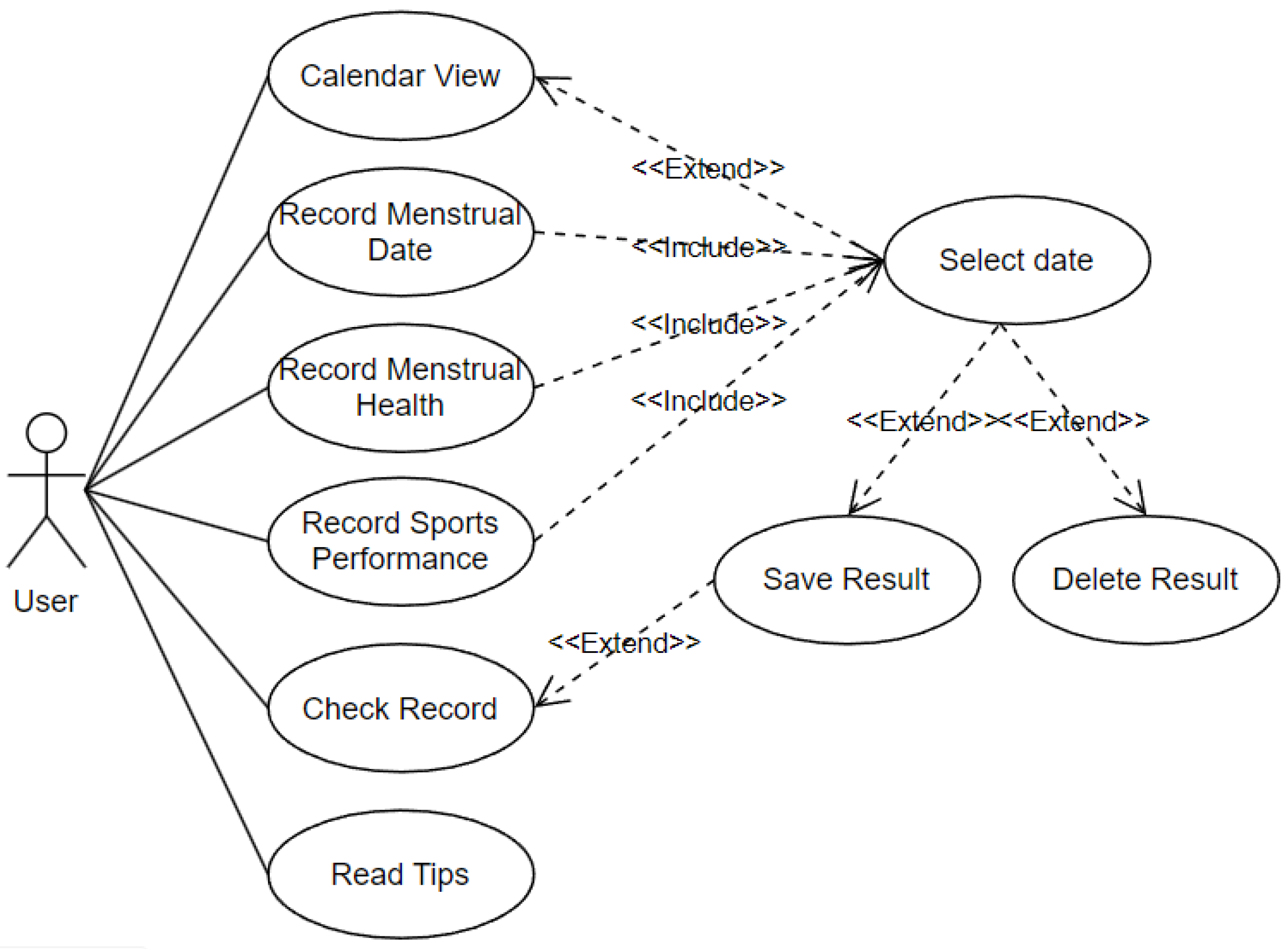
Figure 1. Use case diagram.
Engproc 129 00004 g001
Figure 2. (a) The Calendar view and (b) the Evaluation section in the MIT App Inventor development environment.
Engproc 129 00004 g002
Figure 3. Main interfaces of the menstrual-cycle tracking application: (a) Home; (b) Calendar; (c) Evaluation—sports performance logging; (d) Evaluation—menstrual health logging; (e) Review—sports performance records; (f) Review—menstrual health records; (g) Settings.
Engproc 129 00004 g003
Table 1. Usability testing results (SUS scores).
ParticipantSUS Score
185
272.5
377.5
480
577.5
Average78.5
Disclaimer/Publisher’s Note: The statements, opinions and data contained in all publications are solely those of the individual author(s) and contributor(s) and not of MDPI and/or the editor(s). MDPI and/or the editor(s) disclaim responsibility for any injury to people or property resulting from any ideas, methods, instructions or products referred to in the content.