Intelligent Analysis and Prediction of Building Energy Consumption in Cloud Computing †
Abstract
1. Introduction
2. Data Analysis Model Based on Data Mining
2.1. Outlier Analysis
- The power consumption equipment of the monitored building fails, and the energy consumption value obtained is too large or too small.
- The operating state of the monitored building is different from usual, and the energy consumption value obtained is too large or too small.
- The energy consumption monitoring system’s collection and measurement equipment is abnormal or the network is faulty, and the energy consumption data is lost or the value is too small.
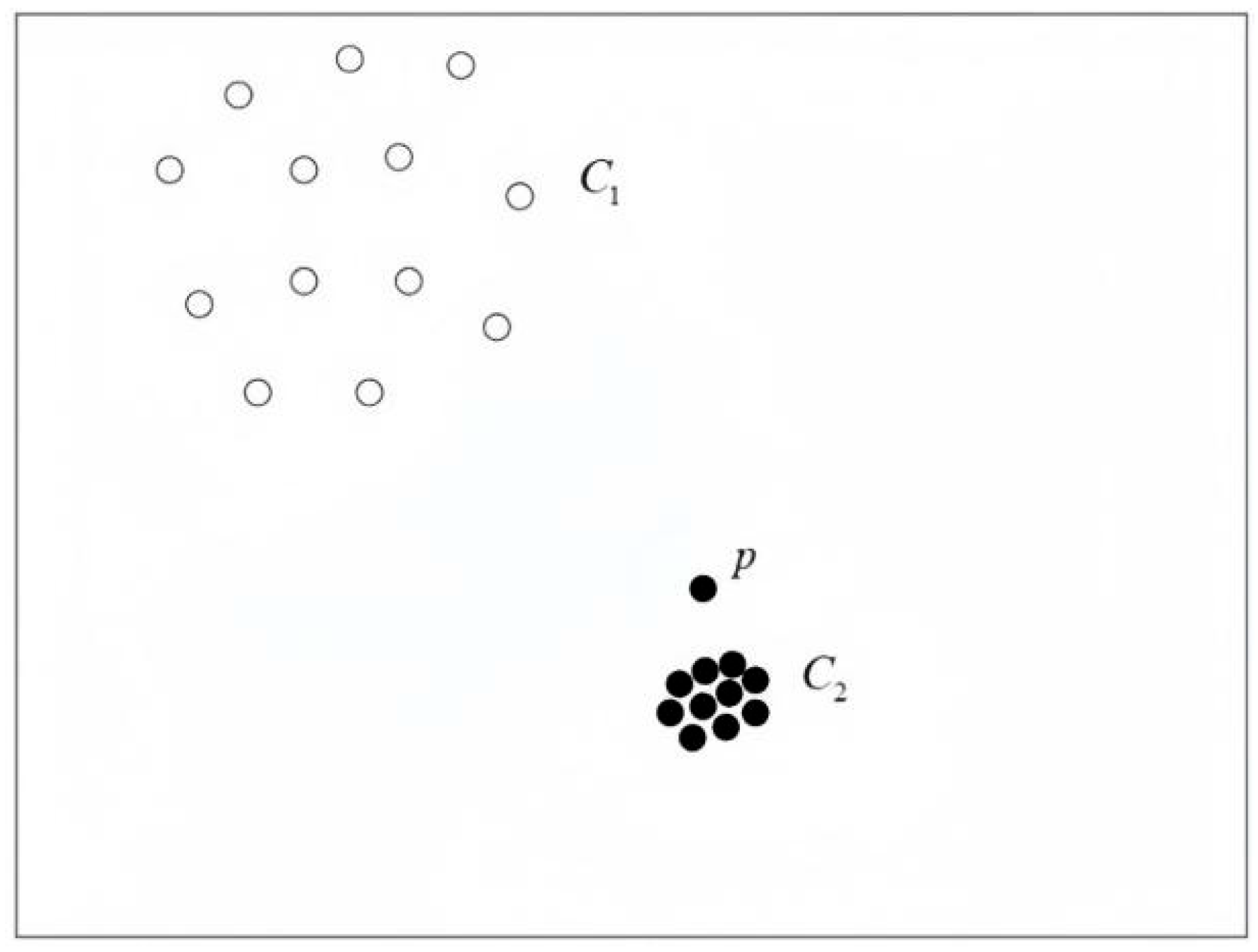
2.2. Local Outlier Factor (LOF) Algorithm
2.3. Energy Consumption Prediction Algorithm
- Set the training set with n samples, and repeatedly sample these samples as a new dataset when building each tree.
- Select m (m < n) features from the original feature set as the new feature set.
- Construct a decision tree based on the new training set and feature set without pruning.
- Predict new test samples by combining the results of all decision trees.
3. Results and Discussion
3.1. Dataset
3.2. Data Preprocessing
- The average annual electricity consumption and average annual natural gas energy consumption are unified as heat units.
- The annual average energy consumption of the final target variable is calculated.
- Each attribute variable with too high a missing rate is removed to calculate the missj rate of each attribute variable. If missj > 0.1, the attribute variable is removed.
- Each sample with too high a missing rate is removed. If the value of the sample on a certain attribute is null, then the sample is removed [14].
3.3. Evaluation Indicators
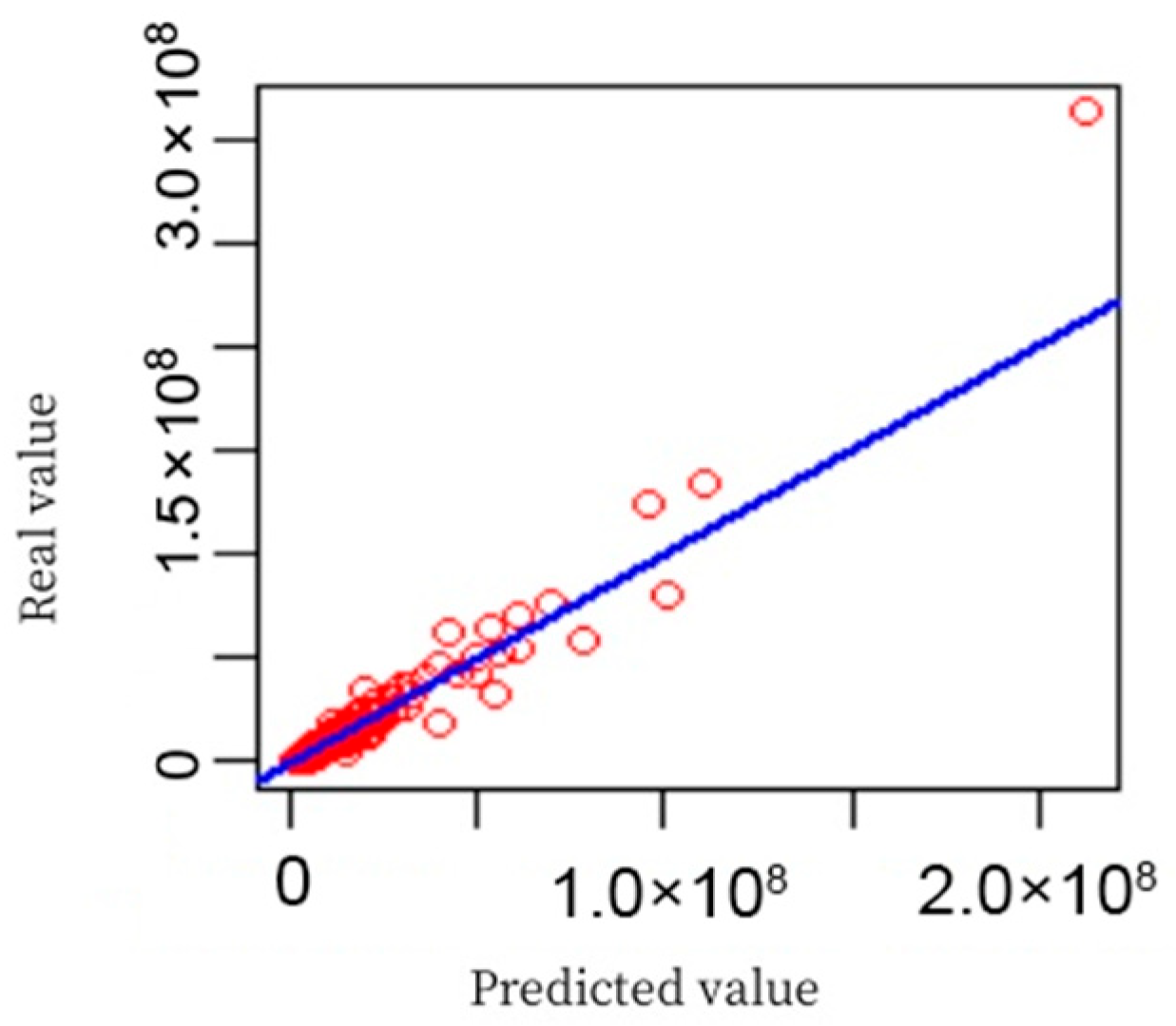
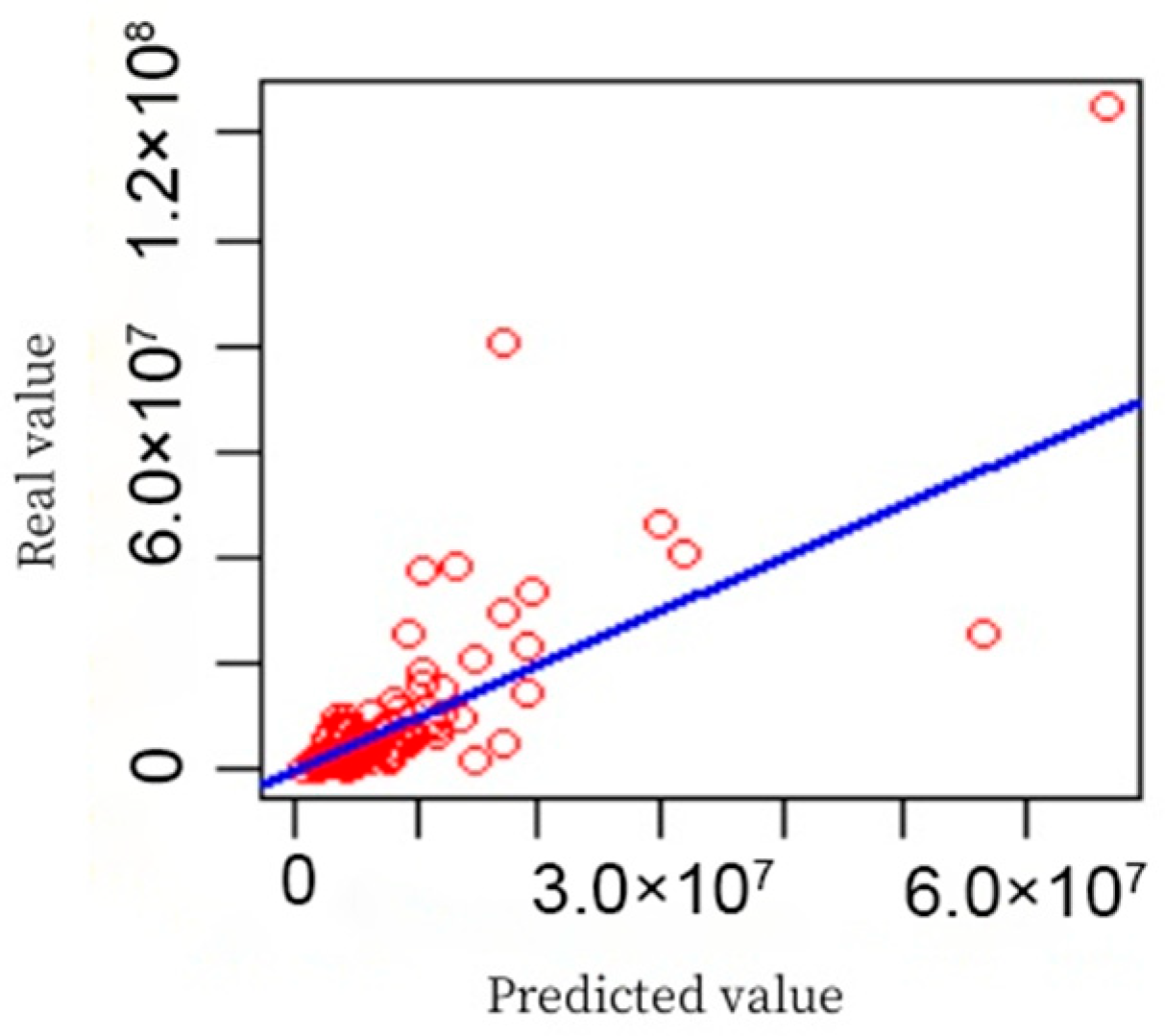
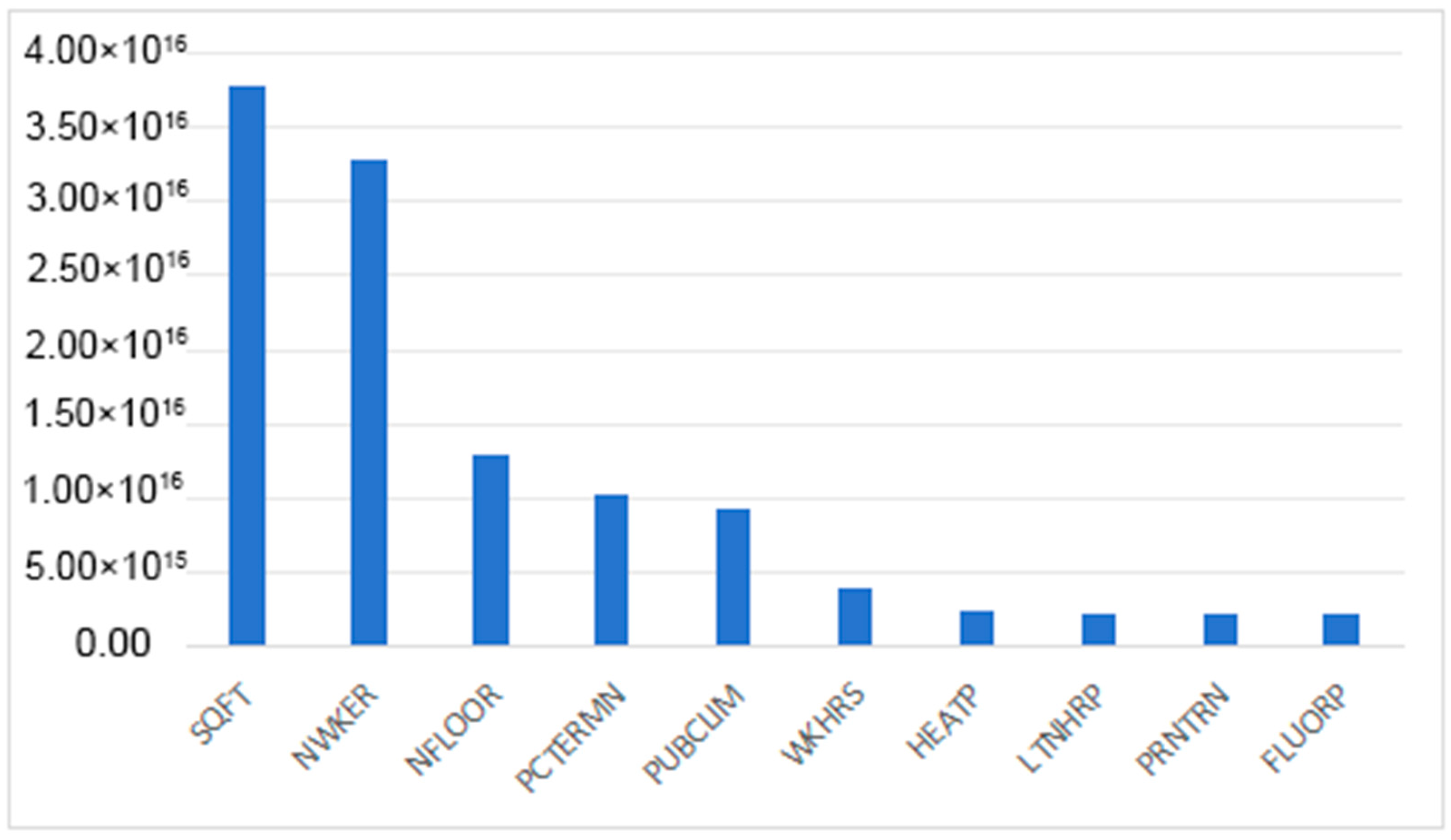
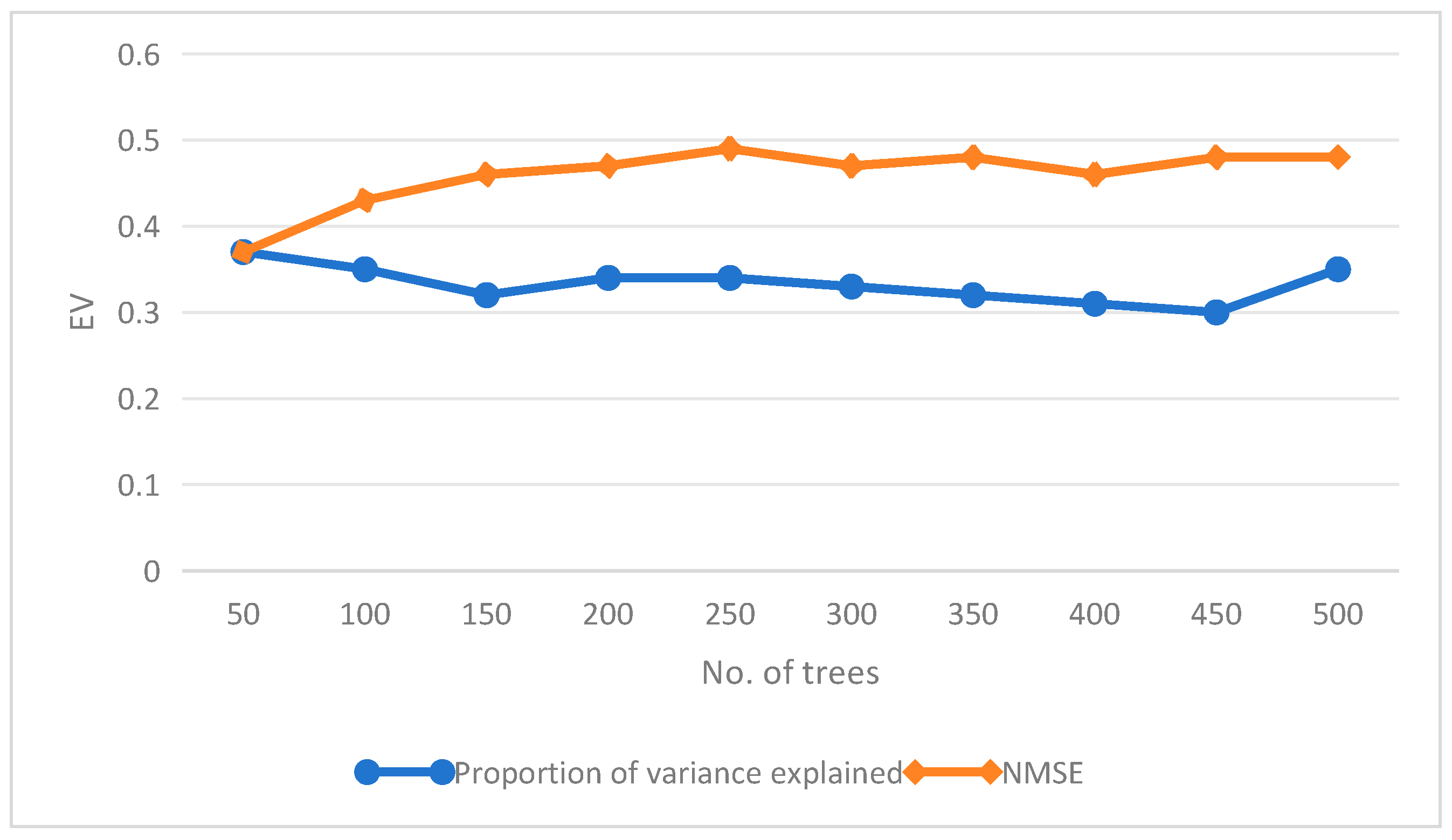
3.4. Analysis of Results
4. Conclusions
Author Contributions
Funding
Institutional Review Board Statement
Informed Consent Statement
Data Availability Statement
Conflicts of Interest
References
- Amasyali, K.; El-Gohary, N.M. A review of data-driven building energy consumption prediction studies. Renew. Sustain. Energy Rev. 2018, 81, 1192–1205. [Google Scholar] [CrossRef]
- Somu, N.; Raman M R, G.; Ramamritham, K. A deep learning framework for building energy consumption forecast. Renew. Sustain. Energy Rev. 2021, 137, 110591. [Google Scholar] [CrossRef]
- Bourdeau, M.; Zhai, X.Q.; Nefzaoui, E.; Guo, X.; Chatellier, P. Modeling and forecasting building energy consumption: A review of data-driven techniques. Sustain. Cities Soc. 2019, 48, 101533. [Google Scholar] [CrossRef]
- Khalil, M.; McGough, A.S.; Pourmirza, Z.; Pazhoohesh, M.; Walker, S. Machine Learning, Deep Learning and Statistical Analysis for forecasting building energy consumption—A systematic review. Eng. Appl. Artif. Intell. 2022, 115, 105287. [Google Scholar] [CrossRef]
- Somu, N.; Raman M R, G.; Ramamritham, K. A hybrid model for building energy consumption forecasting using long short term memory networks. Appl. Energy 2020, 261, 114131. [Google Scholar] [CrossRef]
- Chen, Y.; Guo, M.; Chen, Z.; Chen, Z.; Ji, Y. Physical energy and data-driven models in building energy prediction: A review. Energy Rep. 2022, 8, 2656–2671. [Google Scholar] [CrossRef]
- Divina, F.; Torres, M.G.; Vela, F.A.G.; Noguera, J.L.V. A comparative study of time series forecasting methods for short term electric energy consumption prediction in smart buildings. Energies 2019, 12, 1934. [Google Scholar] [CrossRef]
- Seyedzadeh, S.; Pour Rahimian, F.; Glesk, I.; Roper, M. Machine learning for estimation of building energy consumption and performance: A review. Vis. Eng. 2018, 6, 1–20. [Google Scholar] [CrossRef]
- Olu-Ajayi, R.; Alaka, H.; Sulaimon, I.; Sunmola, F.; Ajayi, S. Building energy consumption prediction for residential buildings using deep learning and other machine learning techniques. J. Build. Eng. 2022, 45, 103406. [Google Scholar] [CrossRef]
- Gao, Y.; Ruan, Y.; Fang, C.; Yin, S. Deep learning and transfer learning models of energy consumption forecasting for a building with poor information data. Energy Build. 2020, 223, 110156. [Google Scholar] [CrossRef]
- González-Torres, M.; Pérez-Lombard, L.; Coronel, J.F.; Maestre, I.R.; Yan, D. A review on buildings energy information: Trends, end-uses, fuels and drivers. Energy Rep. 2022, 8, 626–637. [Google Scholar] [CrossRef]
- Parekh, R. Comparison Analysis of Construction Costs according to LEED and non-LEED Certified Educational Buildings. SSRN 2024, 4924703. [Google Scholar] [CrossRef]
- Alzoubi, A. Machine learning for intelligent energy consumption in smart homes. Int. J. Comput. Inf. Manuf. (IJCIM) 2022, 2, 62–75. [Google Scholar] [CrossRef]
- Khan, I.; Zakari, A.; Ahmad, M.; Irfan, M.; Hou, F. Linking energy transitions, energy consumption, and environmental sustainability in OECD countries. Gondwana Res. 2022, 103, 445–457. [Google Scholar] [CrossRef]
- Himeur, Y.; Elnour, M.; Fadli, F.; Meskin, N.; Petri, I.; Rezgui, Y.; Bensaali, F.; Amira, A. AI-big data analytics for building automation and management systems: A survey, actual challenges and future perspectives. Artif. Intell. Rev. 2023, 56, 4929–5021. [Google Scholar] [CrossRef] [PubMed]
- Wilberforce, T.; Olabi, A.; Sayed, E.T.; Elsaid, K.; Maghrabie, H.M.; Abdelkareem, M.A. A review on zero energy buildings–Pros and cons. Energy Built Environ. 2023, 4, 25–38. [Google Scholar] [CrossRef]
- D’Agostino, D.; Parker, D.; Epifani, I.; Crawley, D.; Lawrie, L. How will future climate impact the design and performance of nearly zero energy buildings (NZEBs)? Energy 2022, 240, 122479. [Google Scholar] [CrossRef]
- Degen, F.; Schütte, M. Life cycle assessment of the energy consumption and GHG emissions of state-of-the-art automotive battery cell production. J. Clean. Prod. 2022, 330, 129798. [Google Scholar] [CrossRef]
- Strielkowski, W.; Vlasov, A.; Selivanov, K.; Muraviev, K.; Shakhnov, V. Prospects and challenges of the machine learning and data-driven methods for the predictive analysis of power systems: A review. Energies 2023, 16, 4025. [Google Scholar] [CrossRef]



| Variables | CBECS Number | Variables | CBECS Number | Variables | CBECS Number |
|---|---|---|---|---|---|
| PUBCLIM | 1119 | HFLOOR | 18 | PRNTRN | 381 |
| SQFT | 6 | No. of elevators | 21 | EMS | 340 |
| FM | 8 | e.g., of building | 25 | HEATP | 136 |
| RM | 9 | WKHRS | 91 | PRRERN | 208 |
| DORI | 11 | NWKER | 93 | ENSME | 265 |
| FBuild | 12 | Daylighting | 441 | LTNHRP | 410 |
| Window-wall ratio | 13 | PCTERMN | 386 | - | - |
| NFLOOR | 16 | FLUORP | 429 | - | - |
| Number of Trees | Residual Squared Mean (×1014) | EV (%) | MAE | NMSE |
|---|---|---|---|---|
| 50 | 3.35 | 38.52 | 3,796,844 | 0.371947 |
| 100 | 2.93 | 43.11 | 3,507,899 | 0.360031 |
| 150 | 3.00 | 45.02 | 3,592,455 | 0.325356 |
| 200 | 2.96 | 45.66 | 3,571,541 | 0.341542 |
| 250 | 2.77 | 49.09 | 3,607,535 | 0.342511 |
| 300 | 2.87 | 47.51 | 3,542,081 | 0.331310 |
| 350 | 2.84 | 47.91 | 3,732,900 | 0.329176 |
| 400 | 2.89 | 46.90 | 3,456,172 | 0.309835 |
| 450 | 2.84 | 47.88 | 3,482,833 | 0.306016 |
| 500 | 2.84 | 47.93 | 3,500,214 | 0.347529 |
Disclaimer/Publisher’s Note: The statements, opinions and data contained in all publications are solely those of the individual author(s) and contributor(s) and not of MDPI and/or the editor(s). MDPI and/or the editor(s) disclaim responsibility for any injury to people or property resulting from any ideas, methods, instructions or products referred to in the content. |
© 2026 by the authors. Licensee MDPI, Basel, Switzerland. This article is an open access article distributed under the terms and conditions of the Creative Commons Attribution (CC BY) license.
Share and Cite
Huang, L.; Zhu, X.; Ren, X. Intelligent Analysis and Prediction of Building Energy Consumption in Cloud Computing. Eng. Proc. 2026, 128, 8. https://doi.org/10.3390/engproc2026128008
Huang L, Zhu X, Ren X. Intelligent Analysis and Prediction of Building Energy Consumption in Cloud Computing. Engineering Proceedings. 2026; 128(1):8. https://doi.org/10.3390/engproc2026128008
Chicago/Turabian StyleHuang, Lan, Xiaoli Zhu, and Xiangfeng Ren. 2026. "Intelligent Analysis and Prediction of Building Energy Consumption in Cloud Computing" Engineering Proceedings 128, no. 1: 8. https://doi.org/10.3390/engproc2026128008
APA StyleHuang, L., Zhu, X., & Ren, X. (2026). Intelligent Analysis and Prediction of Building Energy Consumption in Cloud Computing. Engineering Proceedings, 128(1), 8. https://doi.org/10.3390/engproc2026128008