Proceeding Paper

AI-Driven Predictive Analytics for Kapok Supply Chain Governance †
by
Nila Firdausi Nuzula
* and
Sopyan
Department of Business Administration, Universitas Brawijaya, Malang 65145, Indonesia
*
Author to whom correspondence should be addressed.
Presented at 2025 IEEE International Conference on Computation, Big-Data and Engineering (ICCBE), Penang, Malaysia, 27–29 June 2025.
Eng. Proc. 2026, 128(1), 24; https://doi.org/10.3390/engproc2026128024
Published: 12 March 2026

Abstract

The kapok (Ceiba pentandra) fiber industry plays a vital role in Indonesia’s rural bioeconomy, particularly in regions with high production intensity such as Pasuruan Regency. Despite its economic potential and alignment with the green economy agenda, the industry faces increasing volatility due to seasonal harvest cycles, climate-induced disruptions, global demand fluctuations, and exchange rate instability. These conditions necessitate an adaptive and predictive approach to supply chain risk governance. We evaluated the performances of predictive analytics models, including linear regression, random forest, gradient boosting, XGBoost 3.2.0 libraries, K-nearest neighbors, and stacking regressor. Using multi-year monthly data on production volume, residual stock, and exchange rates, the stacking regressor was the most accurate model, achieving the lowest root mean square error and highest R2 values. The results bridge the gap by applying predictive analytics to a resource-based, seasonal small industry sector. Practically, the results also enable leveraging AI in strengthening the long-term sustainability of agribusiness supply chains.

1. Introduction

The kapok fiber industry constitutes a pivotal component of Indonesia’s rural bioeconomy, particularly in key production zones such as Pasuruan Regency, which alone contributes 30% of East Java’s kapok yield (7560 tons annually). Beyond its direct economic contributions to local livelihoods and household industries, the kapok industry aligns with national goals for sustainable resource utilization and circular bioeconomy. Kapok exhibits high buoyancy and thermal insulation, making it valuable for life-saving equipment, green construction materials, and eco-friendly textiles.
Despite its socio-economic significance, the kapok supply chain remains vulnerable to volatile global demand, exchange rate fluctuations, extreme weather events, seasonal production cycles, and substitutions by synthetic fiber alternatives such as polyester. They bring significant threats to both supply continuity and market competitiveness. If the industry lacks a robust risk mitigation strategy and adaptive supply chain governance, such disruptions may lead to raw material shortages, excessive inventory holding, and financial losses at all stakeholders’ levels.
We incorporated predictive analytics into the supply chain governance mechanism for risk management, ranging from a reactive to a proactive paradigm. Although previous studies have examined predictive models in the context of large-scale logistics and manufacturing [1,2], there has been limited focus on the integration of predictive decision support systems in mid-sized, resource-dependent industries such as kapok fiber processing. We developed an ensemble-based model using a stacking regressor, significantly outperforming other algorithms, showing superior accuracy, lower prediction errors, and robustness in handling non-linear relationships and temporal fluctuations.

2. Literature Review

Supply chain management (SCM) encompasses the coordination of production, storage, distribution, and information management among participating organizations so that the company can fulfil customer requirements optimally [3]. Meanwhile, supply chain governance (SCG) refers to the mechanisms that regulate inter-organizational relationships within a supply network so that the leaders may manage risks and improve collective performance.
Recent advances in information technologies, such as big data analytics, the internet of things, and AI, have begun to revolutionize SCM by enabling faster and more accurate data-driven decision-making to improve supply-chain transparency, responsiveness, and resilience, and create new value [3,4]. Nonetheless, technology acceptance is still concentrated in large, high-tech firms, while resources-based and highly seasonal industries remain under-digitized and continue to deal with volatile demand, fragmented actors, and limited analytics capabilities [5].
Applying predictive analytics for a seasonal industry such as kapok fiber, where raw material scarcity and demand uncertainty are prevalent, becomes a form of adaptive sound governance [6]. Predictive analytics refers to data-driven technologies employing methodologies such as big data, machine learning (ML), and AI to forecast future occurrences based on historical data. It enhances an organization’s ability to manage uncertainty by offering precise forecasts related to market demand, environmental business shifts, and supply chain risks [2,3,7].

3. Research Method

The collected data in this study include export sales, production, remaining production, and exchange rate during 2020–2024. Sales were the monthly quantity of processed kapok fiber exported via the Tanjung Perak Port (in kg). Data for kapok fiber exports were sourced from Indonesia’s official export statistics provided by the Indonesian Central Bureau of Statistics (bps.go.id). Production was the total monthly quantity of processed kapok fiber produced by fiber processing plants (in kg). Remaining stock production referred to the quantity of kapok fiber material (in kg) that fails to meet export quality standards, thus not exported by the plants. The average monthly exchange rate represented the purchasing power of the Indonesian Rupiah (IDR) against the United States Dollar (USD). Data were gathered from the official portal of the Indonesian Ministry of Trade for the periods 2020–2024 [8].
The data analysis technique was employed to develop a prediction model based on machine learning algorithms. The analytical process includes systematic steps, beginning with data preparation, separation of independent and dependent variables, splitting data into training and testing sets, model building, and evaluation [9].

4. Results and Discussion

4.1. Descriptive Analysis

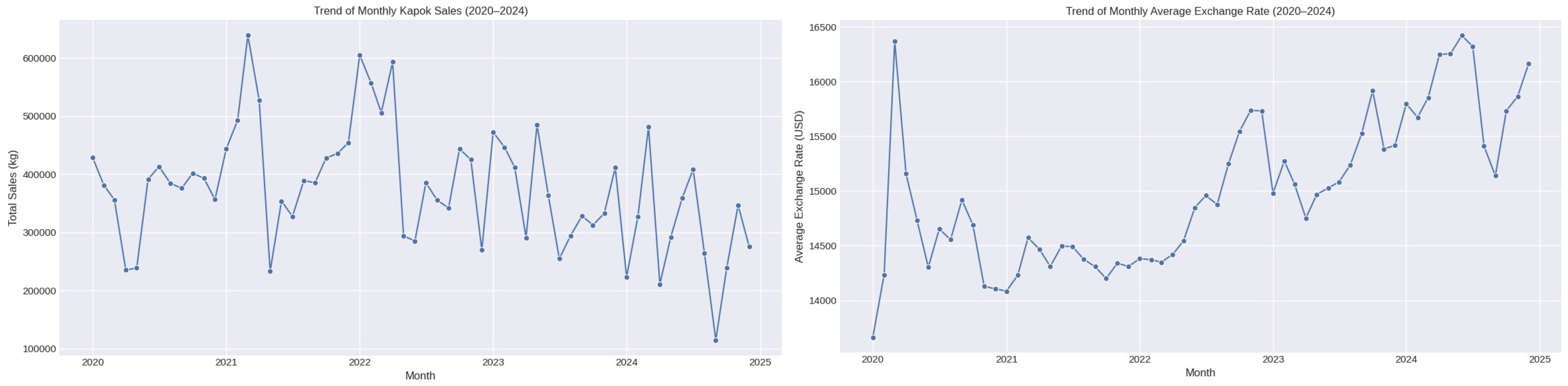
The monthly export sales of the kapok fiber from 2020 to 2024 demonstrate significant fluctuations. Initially, a sharp decline was observed in the third quarter of 2020, due to initial pandemic-related disruptions or limited stocks from delayed harvests. However, the sales peaked sharply at 630,000 kgs in early 2021, followed by a drop to around 230,000 kgs. The noticeable volatility shows the industry’s dependence on harvest seasons and spot market orders throughout 2020–2024 (Figure 1). Descriptive analyses of monthly kapok fiber production and remaining stocks show the two trends aligning closely with sales volumes. A decline in production during 2020 resulted from early pandemic disruptions such as labor shortages and harvest distribution issues, while volatilities due to seasonal harvest and international demands occurred up to 2024. Figure 1 also shows the monthly changes in the average exchange rate.

4.2. Predictive Analytics

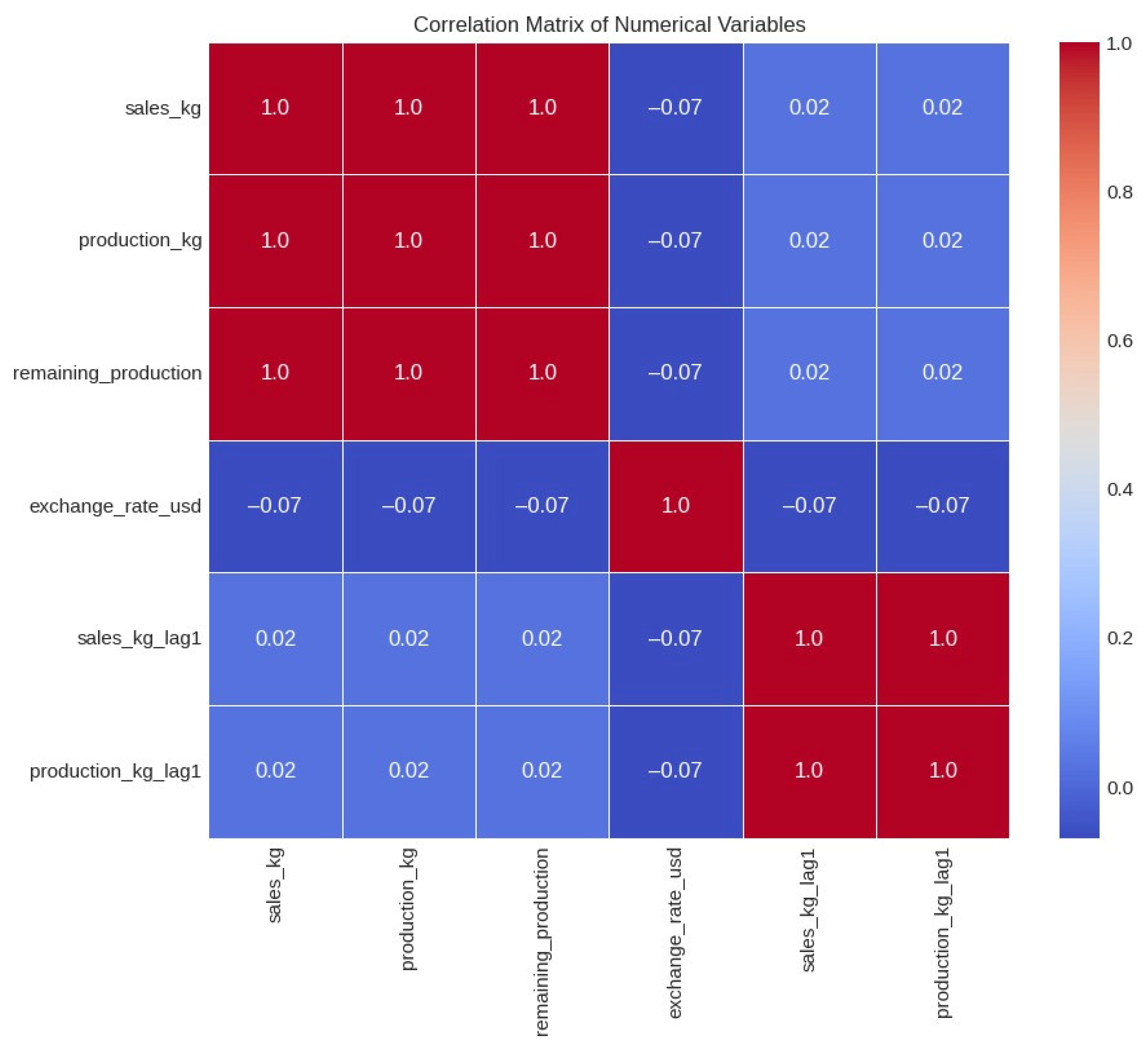
Before conducting predictive analysis, this study utilized Python 3.12.12 programming to perform a heat map Matrix Diagonal-symmetry Quantitative-Multi-Dimensional (MDQMD) (Figure 2). Sales_kg, production_kg, and remaining_production exhibit remarkably high correlations with each other (coefficients close to 1.00), highlighting a strong interdependence among the variables (red cells). Variables display low and negative correlations (blue cells). For instance, the exchange_rate_usd negatively correlates weakly with export sales and production.
We compared the performance of six regression algorithms in forecasting sales_kg. The main goal is to identify the best-performing model through quantitative evaluation on three indicators: root mean squared error (RMSE), mean absolute error (MAE), and R-squared (R2). Table 1 here demonstrates the results of the evaluation.
The evaluation results indicate that five out of six models demonstrate the capacity to produce remarkably high prediction performance, with R2 scores exceeding 0.99, except for KNN. The stacking regressor demonstrated the highest overall performance, as indicated by a combination of R2, RMSE, and MAE. In contrast, the K-Nearest Neighbor model exhibited the poorest performance, with an MAE of 6.350 and an R2 of 0.951.
We compare the normalized RMSE (NRMSE) to ascertain the extent to which the RMSE of the Stacking Regressor model is diminished. The following is the NRMSE measurement equation.
N R M S E = R M S E m e a n ( y )
Given an RMSE of 255.63 and a monthly sales volume ranging from 100,000 to 650,000 kgs, the NRMSE calculation in this study is as follows:
N R M S E = 255.63 ( 650.000 100.000 ) = 0.46 %
NRMSE is less than 10%, suggesting that stacking regressor model exhibits a high degree of accuracy, demonstrating its capacity to capture nearly all variations in sales data with a minimal error rate. Next, for quantitative evaluation, the following presents the prediction results from six models using the testing data: stacking, gradient boosting, random forest, linear regression, XGBoost, and K-nearest neighbors. Table 2 shows that stacking regressor and gradient boosting methods consistently yield prediction values that are near the true values (y_(true)), even when dealing with outlying values. For example, in the third observation with an actual value of 195,232.00, the prediction from the stacking regressor method is 195,425.2, which shows an approximate discrepancy of 0.1%. In contrast, the K-nearest neighbor model exhibited a substantial discrepancy, as evidenced by an observation with a predicted value of 162,930.1, significantly below the actual value.
A quantitative evaluation and direct observation of the predicted values revealed that the stacking regressor model is the most effective predictive model for this study. This model yielded the highest R2 score and the lowest prediction error, and it demonstrated prediction stability across a range of target values. The findings suggest the stacking regressor as the best predictive analytics model to project sales_kg values.
y = a + 0.638   x 1 + 0.363   x 2 0.001 x 3
(y = export sales (kgs)
x1 = production (kgs)
x2 = remaining production stock (kgs)
x3 = exchange rate (USD))

5. Conclusions

The stacking regressor model exhibits superior accuracy and reduced prediction error in comparison to other machine learning approaches, such as random forest and XGBoost. This finding substantiates the efficacy of the developed method in predicting sales volume within a supply chain, contingent upon production volume data, the exchange rate of the Indonesian Rupiah against the US Dollar, and residual production inventory. This model can be used as a primary option for implementing strategic sales predictions in the kapok fiber industry, particularly in the context of supply and sales risk governance.

Author Contributions

Conceptualization, N.F.N. and S.; methodology, N.F.N. and S.; software, S.; validation, N.F.N. and S.; formal analysis, S.; investigation, N.F.N.; resources, S.; data curation, S.; writing—original draft preparation, N.F.N.; writing—review and editing, N.F.N.; visualization, S.; supervision, N.F.N.; project administration, S.; funding acquisition, N.F.N. All authors have read and agreed to the published version of the manuscript.

Funding

This research received no external funding.

Institutional Review Board Statement

Not applicable.

Informed Consent Statement

Not applicable.

Data Availability Statement

The data sets presented in this article are not readily available because it contains the firm’s internal data regulations. Requests to access the datasets should be directed to the corresponding author.

Acknowledgments

We extend our sincere gratitude to Universitas Brawijaya for providing an invaluable opportunity to conduct this research. Their support has been instrumental in the successful completion of this study.

Conflicts of Interest

The authors declare no conflicts of interest.

Abbreviations

The following abbreviations are used in this manuscript:
AIArtificial Intelligence
BDABig Data Analytics
MLMachine Learning
IoTInternet of Things
kgskilograms
SCMSupply Chain Management
SCGSupply Chain Governance

References

  1. Hazen, B.T.; Boone, C.A.; Ezell, J.D.; Jones-Farmer, A.L. Data quality for data science, predictive analytics, and big data in supply chain management: An introduction to the problem and suggestions for research and applications. Int. J. Prod. Econ. 2014, 154, 72–80. [Google Scholar] [CrossRef]
  2. Gunasekaran, A.; Papadopoulos, T.; Dubey, R.; Wamba, S.F.; Childe, S.J.; Hazen, B.; Akter, S. Big data and predictive analytics for supply chain and organizational performance. J. Bus. Res. 2017, 70, 308–317. [Google Scholar] [CrossRef]
  3. Lee, I.; Mangalaraj, G. Big data analytics in supply chain management: A systematic literature review and research directions. Big Data Cogn. Comput. 2022, 6, 17. [Google Scholar] [CrossRef]
  4. Jabbar, A.; Akhtar, P.; Ali, S.I. The interplay between blockchain and big data analytics for enhancing supply chain value creation in micro, small, and medium enterprises. Ann. Oper. Res. 2025, 350, 649–671. [Google Scholar] [CrossRef]
  5. Rodrigues, A.P.; Fernandes, R.; Vijaya, P.; Al Washahi, M.; Shaker, H. Predictive analytics techniques in the agricultural industry: A case study. In Proceedings of the 2024 11th International Conference on Reliability, Infocom Technologies and Optimization (Trends and Future Directions) (ICRITO), Noida, India, 14–15 March 2024; pp. 1–6. [Google Scholar]
  6. Srinivasan, R.; Swink, M. An investigation of visibility and flexibility as complements to supply chain analytics: An organizational information processing theory perspective. Prod. Oper. Manag. 2018, 27, 1849–1867. [Google Scholar] [CrossRef]
  7. Benzidia, S.; Makaoui, N.; Bentahar, O. The impact of big data analytics and artificial intelligence on green supply chain process integration and hospital environmental performance. Technol. Forecast. Soc. Change 2021, 165, 120557. [Google Scholar] [CrossRef]
  8. Ministry of Trade of the Republic of Indonesia. Foreign Exchange Rates. Available online: https://www.bi.go.id/en/statistik/informasi-kurs/transaksi-bi/default.aspx (accessed on 10 December 2025).
  9. Kapoor, S.; Narayanan, A. Leakage and the reproducibility crisis in ML-based science. Patterns 2023, 4, 100804. [Google Scholar] [CrossRef] [PubMed]
Figure 1. Monthly export sales volume of Kapok Fiber and exchange rate during 2020–2024.
Engproc 128 00024 g001
Figure 2. Correlation matrix of numerical variables.
Engproc 128 00024 g002
Table 1. Evaluation results of predictive models.
ModelRMSEMAER2
Linear regression--1.000000
Stacking regressor255.630198.1340.999962
Gradient boosting350.521263.8650.999929
Random forest395.643276.9320.999910
XGBoost596.347404.9180.999795
K-nearest neighbors9184.0836350.3330.951375
Table 2. Accuracy of predictive models.
DataPredictive Model
y_(True)StackingGradient BoostingRandom ForestLinear RegressionXGBoostK-Nearest Neighbors
60,427.9 60,256.8 60,047.0 60,155.2 60,427.9 59,790.3 63,766.6
86,705.4 86,552.0 86,167.5 86,054.9 86,705.4 86,748.1 72,981.1
104,860.0 105,070.7 104,501.7 104,438.7 104,860.0 104,964.3 102,949.6
195,232.0 195,425.2 195,158.7 194,097.2 195,232.0 194,314.9 162,930.1
24,779.6 24,808.1 24,947.5 24,673.8 24,779.6 23,922.6 35,441.4
Disclaimer/Publisher’s Note: The statements, opinions and data contained in all publications are solely those of the individual author(s) and contributor(s) and not of MDPI and/or the editor(s). MDPI and/or the editor(s) disclaim responsibility for any injury to people or property resulting from any ideas, methods, instructions or products referred to in the content.