Proceeding Paper

Modelling Helmet Manufacturing System Using Discrete Event Simulation †
1
Faculty of Accountancy, Finance and Business (FAFB), Tunku Abdul Rahman University of Management and Technology (TAR UMT), Setapak, Kuala Lumpur 53300, Malaysia
2
School of Quantitative Sciences, Universiti Utara Malaysia (UUM), Sintok 06010, Malaysia
3
Faculty of Engineering and Technology (FOET), Tunku Abdul Rahman University of Management and Technology (TAR UMT), Setapak, Kuala Lumpur 53300, Malaysia
4
University Secretariat, Universitas Muhammadiyah Sidoarjo, Sidoarjo 61215, Indonesia
*
Author to whom correspondence should be addressed.
Presented at 2025 IEEE International Conference on Computation, Big-Data and Engineering (ICCBE), Penang, Malaysia, 27–29 June 2025.
Eng. Proc. 2026, 128(1), 10; https://doi.org/10.3390/engproc2026128010
Published: 9 March 2026

Abstract

We simulated the manufacturing production line in a micro, small, and medium enterprise (MSME) to assess the efficiency of a helmet product organization, using ARENA simulation modelling software version 15.10.00000. The process and standard time for each process in the production line were estimated from data provided by the enterprise’s management and direct observation. The enterprise line was engaged in six different processes to manufacture a singular product type. ARENA was used to analyse data. The simulation results showed an increase in workers’ utilization and reduced production duration for restructuring worker allocations, while maintaining a constant throughput rate.

1. Introduction

In 2021, micro, small, and medium enterprises (MSMEs) in Malaysia constituted the backbone of the national economy, accounting for 97.4% of all business establishments and contributing 38.4% to the country’s gross domestic product (GDP). In the same year, the MSME manufacturing industry experienced notable growth, reaching 8.5%, a significant rebound from its decline in 2020. These figures underscore the pivotal role of MSMEs in driving economic development, fostering innovation, and generating employment opportunities [1,2].
Despite their importance, Malaysian MSMEs face challenges in the competitive global market, including limited financing, inadequate technological capabilities, and evolving consumer demands, all of which hinder improving operational efficiency and competitiveness [1,2,3]. Among these challenges, optimizing production processes has emerged as a critical concern. Therefore, MSMEs must streamline operations, reduce costs, and adhere to stringent quality standards to maintain sustainability in the marketplace [2,3].
Understanding the manufacturing landscape is essential when examining MSME operations. The sector involving MSMEs is categorized into light, medium, and heavy industries, providing a framework for analyzing diverse production activities. Light industries produce consumer goods and are often associated with efficiency and sustainability. Medium industries serve as a transitional segment, encompassing a broad array of production processes. Heavy industries, by contrast, involve large-scale operations and the production of complex machinery and materials. This classification enables an understanding of MSME contributions to Malaysia’s industrial and economic development.
To address existing challenges of MSMEs, policymakers have advocated for the adoption of digital technologies and advanced methodologies to enhance MSMEs production capabilities [1,2]. Among these, simulation has proven to be a valuable tool for modeling, analyzing, and optimizing complex manufacturing systems. It enables MSMEs to evaluate various operational scenarios, identify inefficiencies, and refine production processes in a virtual environment before implementation, thereby mitigating risks and improving performance [2,4].
However, the adoption of simulation technologies by MSMEs remains difficult due to limited awareness, insufficient technical expertise, and resource constraints. These barriers impede widespread utilization and successful integration of simulation tools within MSME manufacturing settings [2,5,6]. Moreover, there has not been extensive research on the application of simulation in MSMEs, particularly in the context of optimizing manufacturing lines.
Considering the substantial economic significance of MSMEs in Malaysia and the transformative potential of simulation technologies, it is required to address this research gap. Therefore, we conducted a case study and simulations of a Malaysian MSME manufacturing enterprise to enhance production line efficiency. The results provide a basis and strategic recommendations for the broader adoption and effective implementation of simulation technologies for the MSMEs in Malaysia.

2. Literature Review

2.1. Industry Revolution 4.0

Industry Revolution 4.0 (IR4.0) signifies a major change in the global manufacturing sector, driven by the merging of digital technology, data analytics, and automation. This paradigm change offers potential and difficult issues for MSMEs, as they are crucial to the nation’s economy. This is because MSMEs considerably contribute to economic growth, job creation, and innovation in a country’s industrial environment [1,2,3,6].
IR4.0 is driven by cutting-edge technologies, including Internet of Things (IoT), artificial intelligence (AI), robotics, and big data analytics, whereby these technologies have transformed manufacturing production lines and enhanced productivity and efficiency levels [1,2]. However, successful incorporation of IR4.0 technologies into MSME operations requires overcoming challenges. MSMEs are obstructed in adopting and benefiting from technological improvements because of the constraints in resources, technological skills, and organizational readiness [1,2,6].
To address these obstacles, MSMEs require strategic planning, capacity building, and collaboration with stakeholders across the public and private sectors [2]. Strategic planning involves evaluating the organization’s existing competencies, identifying matters that need enhancement, and creating a plan for digital transformation. In addition, capacity building actions, involving training programs and information sharing platforms, are crucial for providing MSMEs with the necessary skills and experience to effectively utilize IR4.0 technology [1,2,7]. Finally, engaging with stakeholders, including government agencies, industry groups, and technology providers, is essential to establishing a supportive setting that promotes innovation and enables the implementation of IR4.0. Government agencies must offer incentives, regulatory assistance, and financial possibilities to encourage MSMEs to invest in digital technology [8]. Meanwhile, industry associations can act as hubs of information, enabling networking opportunities and sharing best practices among MSME organizations, and offer customized solutions to MSMEs to assist them in overcoming implementation challenges and maximizing the benefits of IR4.0 [1,2].
Driven by digital technology’s convergence, the IR4.0 demonstrates a paradigm shift in manufacturing and business operations. The nine core technological domains that underpin this transformation, spanning applications from large-scale industries to smart agriculture [9]. The domains highlight the transformative potential of IR4.0 across diverse sectors. These foundational pillars and their applications are explored, with an emphasis on their implications and challenges for MSMEs. The nine key pillars driving IR4.0 include autonomous robots, simulation, system integration, IoT, cybersecurity, cloud computing, additive manufacturing, big data, and analytics [10].
Autonomous robots enhance operational efficiency and precision in production processes [10]. Simulation facilitates virtual prototyping and process optimization, thereby reducing development costs and accelerating time to market [11,12]. System integration enables seamless data exchange and communication across departments and platforms. IoT connects machines and devices, generating vast volumes of data for real-time monitoring and control [13]. Cybersecurity plays a critical role in safeguarding sensitive data and protecting infrastructure from cyber threats [14]. Cloud platforms offer scalable and cost-effective computing resources for data storage and processing. Additive manufacturing, such as three-dimensional (3D) printing, supports rapid prototyping and customized production [15]. Finally, big data and analytics empower organizations with actionable insights for informed decision-making and process optimization [16].
For MSMEs, IR4.0 technologies present opportunities and challenges. MSMEs harness digital innovations to improve productivity, enhance product quality, reduce operational costs, and strengthen their competitive positioning. For example, IoT-enabled sensors enable equipment performance monitoring and predictive maintenance, minimizing downtime. Cloud-based solutions grant access to advanced software and computing capabilities without substantial upfront investment. Additive manufacturing allows MSMEs to rapidly customize products in response to shifting market demands, while big data analytics provide insights into consumer preferences and support targeted marketing strategies.
Among the IR4.0 pillars, simulation technology is particularly beneficial for MSMEs, especially in terms of cost efficiency [17]. By leveraging digital twins, MSMEs can create virtual representations of processes, products, or systems, enabling them to test and refine designs and operations prior to implementation [18]. In simulation, technologies, including artificial intelligence (AI), system integration, and data analytics, are integrated [19]. Such an integration enables a risk-free environment for MSMEs to explore various strategies and optimize their return on investment when adopting IR4.0 technologies.

2.2. MSME and Simulation Technology

MSMEs in the manufacturing industry are under pressure to enhance their production processes to stay competitive and adapt to changing market needs. Simulation technology adoption is a critical approach for MSMEs to improve production line efficiency and attain sustainable growth [1,2]. Simulation technology enables MSMEs to create virtual models that imitate real-world manufacturing processes with remarkable precision [20]. MSMEs can analyze various production situations to obtain insights into their operations, identify inefficiencies, and discover optimization opportunities. In addition, they can use data-driven analysis to make well-informed choices rather than depending just on intuition or trial-and-error methods [21].
Simulation technology is advantageous since it allows risk-free experimentation. Hence, MSMEs need to adopt simulations to evaluate different scenarios for feasibility and potential impact, rather than making changes directly on the production line, which interrupts operations and results in expenses [20,22,23]. This allows MSMEs to experiment with various strategies, assess their efficiency, and identify the most effective solutions prior to actual implementation. As a result, simulation technology enables MSMEs to make informed decisions, reduce risks, and prevent expensive errors [1,24]. Furthermore, simulation technology facilitates improvement efforts. Production processes are dynamic and are impacted by various factors, including market demand, technical improvements, and resource availability [6]. Simulation technology offers a platform to track production performance, analyze patterns, and discover areas for enhancement over time. This allows MSMEs to enhance operational efficiency by using simulation in their continuous improvement initiatives to uncover new possibilities and optimize operations consistently [5,24].

3. Materials and Methods

In this study, we conducted a case study to examine a manufacturing system within a specific manufacturing facility and understand its operations in a particular environment. Bell and colleagues [25] define a case study as an in-depth and thorough examination of one case. We adopted the discrete event simulation (DES) to obtain better results. Shannon [26] suggested 12 stages to conduct simulation, beginning with problem definition, project planning, system definition, conceptual model formulation, preliminary experimental design, input data preparation, model translation, verification and validation, final experimental design, experimentation, analysis and interpretation, and implementation and documentation. On another hand, Maria [27] proposed 11 steps in developing an experiment simulation modelling, which involve the following: identify the problem, formulate the problem, collect and process real system data, formulate and develop a model, validate the model, document model for future use, select appropriate experimental design, establish experimental conditions for runs, perform simulation runs, interpret and present results, and recommend further course of action.
We considered the stages in previous studies to establish a simulation model in the following eight stages.
  • Problem identification: A clear set of objectives and rationale was established to guide the investigation of the selected subject. The researchers evaluated the utilization of the assembly production line, focusing on components such as protective padding, retention systems, accessories, packaging, and quality inspection points.
  • System definition: To construct and assess the functionality of the system and its processes, key parameters and constraints were defined, including logical subsystems, entities, resources, and the fundamental flow patterns of entities throughout the system.
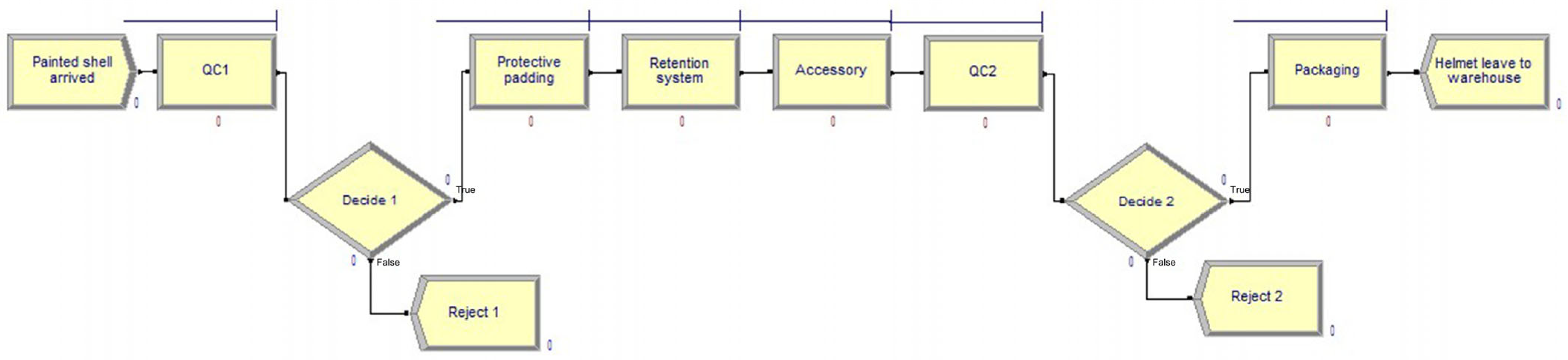
  • Conceptual model formulation: An initial model was developed, and a process flowchart was drawn. The model described system elements, descriptive variables, and logical interactions that define the system’s behavior.
  • Data collection and processing: Real-time data were collected from the point of part arrival through to the final assembly stage. A dataset comprising 1500 observations was obtained from the assembly production line for analysis.
  • Model formulation and development: The ARENA simulation software was employed to construct and modify the system model. A trace analysis was conducted to ensure that parts progressed through the production line as expected. The model was refined using cycle time data and additional parameters derived from interviews, including error rates, rework durations, and product order sequences. The finalized simulation model was compared with the assembly process map to verify behavioral consistency. Operators reviewed the model to validate its representativeness. Upon validation, the model was loaded with a continuous sequence of product orders, which was also applied in the enhanced simulation mode to facilitate fair comparison.
  • Model verification and validation: It was confirmed that the simulation program operated according to its intended design and expected behavior. This process included rigorous testing to demonstrate the independent and integrated functioning of model components using appropriate data inputs. The model was presented to workers and the business owner for feedback, which informed subsequent modifications (Figure 1). Workers assessed the model’s performance through test runs. Validation focused on determining the extent to which the model accurately replicated the behavior of the actual system, and the model’s systematic procedure for establishing confidence in the model’s accuracy and relevance. A deviation of less than 10% between the model output and real-world data was considered acceptable for validation.
  • Experiment design and execution: A structured experimental method was developed to generate the required data. This included outlining specific procedures for each test run. Simulations were then conducted to produce the necessary data, followed by sensitivity analyses to evaluate the impact of varying parameters.
  • Analysis and interpretation: The final stage involved interpreting the data generated from the simulation experiments to draw meaningful conclusions and insights regarding system performance and optimization potential.
The assembly of a helmet is critical to minimize rider head injuries. It involves multidimensional processes, including design, material processing, component integration, and rigid quality assurance [28]. All the simulation data were analyzed by using the Arena Input Analyzer. All the inter-arrival times were analyzed to determine the mathematical statistics with the best-fit distribution for each data set (Table 1).

4. Results and Discussion

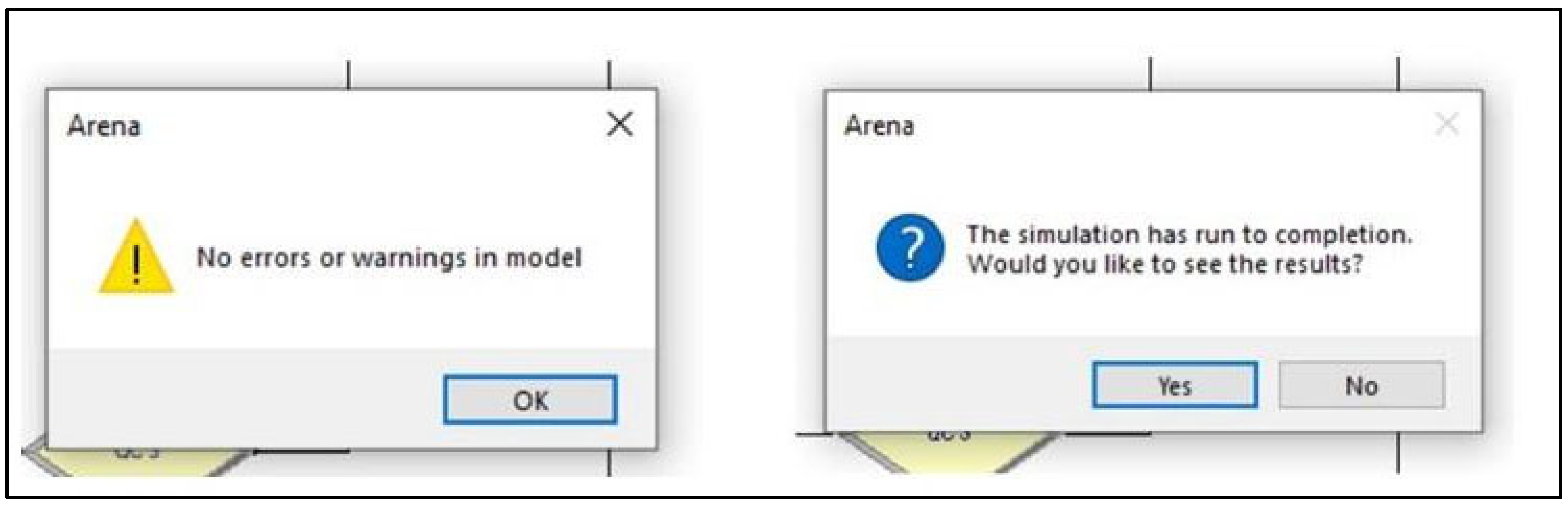
The current simulation operation model was evaluated to identify its absence of logical errors (Figure 2). To validate the data set, actual data and simulation results were compared. The model performed well when the different outcomes were below 10%. Hence, the model was used for further analysis.
The current simulation model revealed an average worker utilization rate of 61.95% across all processes, with individual rates ranging from 47.49 to 99.75%. The retention system exhibited exceptionally high utilization, indicating a potential bottleneck. Most processes demonstrated suboptimal utilization, with rates below 70%, suggesting inefficiencies within the assembly production line. The retention system was identified as the primary bottleneck, characterized by prolonged waiting times. Entities experienced an average delay exceeding seven hours, with a maximum waiting time of 738.86 min, despite the allocation of four workers to this process.
In response to these results, the simulation model was modified to enhance resource utilization through worker reallocation. The modification involved merging the accessory and quality check point 2 processes, enabling shared resource allocation. This adjustment was modeled using a Poisson distribution with a parameter value of POIS(10), aimed at reducing process duration.
The original and modified models were compared to evaluate process efficiency following the integration of the accessory and quality check functions, now operated by two workers. The modified model increased worker utilization rates, with all processes exceeding 50% (Table 2). The most significant improvement was observed in the accessory process, where utilization rose from 41.13% to 93.16%, indicating a more effective deployment of labor. However, this increase prolonged the average waiting time per entity, which escalated from a negligible 0.00134 to 8.5702 min. This suggests that while the combined process improved labor efficiency, it introduced a new bottleneck. Additionally, the average value-added time per entity in the accessory process doubled from 4.4739 to 10.021 min, potentially contributing to the observed delay.
Other processes, such as the retention system, showed a slight reduction in waiting time, representing a positive outcome. Data for quality check point 2 were unavailable in the improved model due to its integration with the accessory process. Small increases in waiting times for quality check point 1 and packaging were attributable to shifts in workload distribution from preceding processes.
A trade-off between enhanced worker utilization and increased entity waiting time in the improved model was observed. Under the termination condition of Packaging.NumberOut = 1502, the original model concluded at 16,868.218 min. In contrast, the improved model reduced the total simulation time by 167.789 min, ending at 16,700.429 min. Furthermore, the number of entities processed increased from 1669 to 1673, indicating a modest improvement in throughput.

5. Conclusions

We simulated the assembly production line of a helmet manufacturing operation in MSMEs to evaluate its effectiveness. ARENA simulation software was employed to model the existing system and propose improvements through a comparative analysis. The modified model showed a notable increase in worker utilization rates, exceeding 50%, alongside a significant reduction in average waiting time per entity.
The simulation model developed enabled the enterprise to understand its current assembly line operations. The model assessed potential enhancements to be implemented using existing resource capacities. Further investigation is recommended to identify the underlying causes of bottlenecks and to explore strategies for minimizing waiting times without compromising worker utilization.
The development of virtual simulation models fosters connectivity between cyber-physical systems within MSME environments. Practically, simulation models contribute to the optimization of material flow, production scheduling, and resource allocation, thereby improving operational efficiency and effectiveness. From a policy standpoint, the findings underscore the importance of government initiatives that promote simulation capabilities through targeted funding programs for MSMEs.
The enterprise in the case study enhanced production line utilization, which aligns with a goal of the green economy. However, the scope of the research is limited to the assembly line in single-product manufacturing. Further research is required to incorporate additional systems to enable a deeper understanding of overall operations. Expanding data collection in the process flow is also recommended to strengthen the robustness of subsequent analyses.

Author Contributions

Conceptualization, K.T.W. and W.L.H.M.D.; methodology, K.T.W. and W.L.H.M.D.; software, K.T.W. and W.L.H.M.D.; validation, K.T.W. and L.L.L.; formal analysis, K.T.W., W.L.H.M.D. and K.A.K.; investigation, K.T.W., L.L.L. and K.A.K.; resources, H.C.T. and C.L.M.; data curation, K.T.W., L.L.L., H.C.T. and C.L.M.; writing—original draft preparation, K.T.W. and L.L.L.; writing—review and editing, W.L.H.M.D., K.A.K., H.C.T. and C.L.M.; visualization, H.C.T. and C.L.M.; supervision, K.T.W. and W.L.H.M.D.; project administration, K.T.W. and W.L.H.M.D. All authors have read and agreed to the published version of the manuscript.

Funding

This research received no external funding.

Institutional Review Board Statement

Not applicable.

Informed Consent Statement

Informed consent was obtained from all subjects involved in the study.

Data Availability Statement

Due to the proprietary nature of the information and the terms of the Non-Disclosure Agreement (NDA) with the corporate partner, the raw data used in this case study cannot be shared. The findings presented in this article are derived from sanitized and aggregated data to protect the organization’s commercial interests.

Acknowledgments

During the preparation of this work the authors used AI tools to correct grammatical errors. After using these tools, the authors reviewed and edited the content and took full responsibility for the content of the publication.

Conflicts of Interest

The authors declare no conflict of interest.

References

  1. Malaysian Investment Development Authority (MIDA). Malaysia Investment Performance Report 2022: Sustainable Investment for Growth. Available online: https://www.mida.gov.my/wp-content/uploads/2023/03/MIPR-2022.pdf (accessed on 22 February 2025).
  2. Ministry of International Trade and Industry Malaysia (MITI). New Industrial Master Plan 2030. 2023. Available online: https://www.nimp2030.gov.my/ (accessed on 22 February 2026).
  3. Abdul, H.H.; Andalib, T.W.; Ahmad, N.H.; Ramayah, T. Effect of internal barriers on innovation performance in embryonic SMEs in Malaysia. Asian Acad. Manag. J. 2023, 28, 29–60. [Google Scholar] [CrossRef]
  4. Talib, N.A.C.; Abd Razak, N.; Mahmud, N. Enhancing small and medium enterprise performance through supply chain integration: A case study of Malaysia. Inf. Manag. Bus. Rev. 2023, 15, 405–417. [Google Scholar] [CrossRef] [PubMed]
  5. Deif, A.; Mohib, A. Temporary clusters: A new SME clustering management model. J. Model. Manag. 2020, 16, 486–505. [Google Scholar] [CrossRef]
  6. Ab Rani, N.Z.A.; Ismail, M.K.; Kumaran, V.V.; bin Muhamad, M.Z.; Ahmad Shaupi, N.S. Analysing the challenges in adopting digitalisation among SMEs: A case study in Malaysia. Res. Militaris 2022, 12, 499–509. [Google Scholar]
  7. Shahzad, A.; Zakaria, M.S.A.; Hussain, A.; Kotzab, H.; Majid, M.M.A.; Fischer, J. Adoption of Fourth Industrial Revolution 4.0 among Malaysian small and medium enterprises (SMEs). Humanit. Soc. Sci. Commun. 2023, 10, 693. [Google Scholar] [CrossRef]
  8. Abdul, R.A.A.; Chong, P.L.; Ong, T.S.; The, B.H.; Ong, T.C. Business network and balanced scorecard: An analysis of small and medium enterprises in Malaysia. Arab Gulf J. Sci. Res. 2024, 42, 621–635. [Google Scholar]
  9. Ministry of International Trade and Industry (MITI). Industry 4WRD: NATIONAL POLICY ON INDUSTRY 4.0. Available online: https://www.miti.gov.my/miti/resources/National%20Policy%20on%20Industry%204.0/Industry4WRD_Final.pdf (accessed on 22 February 2026).
  10. Hercik, R.; Byrtus, R.; Jaros, R.; Koziorek, J. Implementation of autonomous mobile robot in smartfactory. Appl. Sci. 2022, 12, 8912. [Google Scholar] [CrossRef]
  11. Gutmann, T.; Nyffenegger, F.; Pellegrini, M.; Cabrucci, A.; Guzzini, A. A digital twin-based approach for the optimization of floor-ball manufacturing. Electronics 2023, 12, 4979. [Google Scholar] [CrossRef]
  12. Kabir, M.R.; Ravi, B.B.Y.; Ray, S. A virtual prototyping platform for exploration of vehicular electronics. IEEE Internet Things J. 2023, 10, 16144–16155. [Google Scholar] [CrossRef]
  13. Islahudin, N.; Nugroho, D.S.; Arifin, Z.; Rahadian, H.; Suprijono, H. Real-time scheduling approach in internet of things-enabled production monitoring systems. Int. J. Ind. Eng. Prod. Res. 2024, 35, 12–28. [Google Scholar]
  14. Al-Janabi, S.; Jabbar, H.; Syms, F. Cybersecurity transformation: Cyber-resilient IT project management framework. Digital 2024, 4, 886–897. [Google Scholar] [CrossRef]
  15. Zhao, D.; Guo, W.; Han, Y. General Function sets theory-based type synthesis of the collaborative 3D printer for planar and non-planar printing. Proc. Inst. Mech. Eng. Part C J. Mech. Eng. Sci. 2022, 236, 8965–8979. [Google Scholar] [CrossRef]
  16. Ahmed, R.; Shaheen, S.; Philbin, S.P. The role of big data analytics and decision-making in achieving project success. J. Eng. Technol. Manag. 2022, 65, 101697. [Google Scholar] [CrossRef]
  17. Gobinath, P.; Crawford, R.H.; Traverso, M.; Rismanchi, B. Comparing the life cycle costs of a traditional and a smart HVAC control system for Australian office buildings. J. Build. Eng. 2024, 9, 109686. [Google Scholar] [CrossRef]
  18. Azizian, M.; Sepehri, M.M.; Mirzapour Al-e-Hashem, S.M.J. Simulation-based models of multi-tier financial supply chain management problem: Application in the pharmacy sector. Mathematics 2023, 11, 4188. [Google Scholar] [CrossRef]
  19. Zhang, S.; Fu, D.; Liang, W.; Zhang, Z.; Yu, B.; Cai, P.; Yao, B. TrafficGPT: Viewing, processing and interacting with traffic foundation models. Transp. Policy 2024, 50, 95–105. [Google Scholar] [CrossRef]
  20. Hawari, N.N.; Desa, W.L.H.M.; Nordin, N.; Zaki, N.H.M. Improving Customer Service at Gas Stations Using Discrete Event Simulation Approach. ASM Sci. J. 2025, 20, 1–11. [Google Scholar] [CrossRef]
  21. Li, C.; Chen, Y.; Shang, Y. A review of industrial big data for decision making in intelligent manufacturing. Eng. Sci. Technol. Int. J. 2022, 29, 101021. [Google Scholar] [CrossRef]
  22. Raja, V.; Nimbkar, S.; Moses, J.A.; Nair, S.V.R.; Anandharamakrishnan, C. Modeling and simulation of 3D food printing systems—Scope, advances, and challenges. Foods 2023, 12, 3412. [Google Scholar] [CrossRef]
  23. Desa, W.L.H.M.; Kamaruddin, S.; Nawawi, M.K.M.; Zulkepli, J. Evaluation on Absenteeism Effect in Production Line at Aircraft Composite Manufacturer. J. Teknol. (Sci. Eng.) 2015, 77, 63–67. [Google Scholar]
  24. Attaran, M.; Attaran, S.; Celik, B.G. The impact of digital twins on the evolution of intelligent manufacturing and Industry 4.0. Adv. Comput. Intell. 2023, 3, 11. [Google Scholar] [CrossRef]
  25. Bell, E.; Harley, B.; Bryman, A. Business Research Methods; Oxford University Press: Oxford, UK, 2022. [Google Scholar]
  26. Shannon, R.E. Introduction to the Art and Science of Simulation. In Proceedings of the 1998 Winter Simulation Conference, Washington, DC, USA, 13–16 December 1998; pp. 7–14. [Google Scholar]
  27. Maria, A. Introduction to Modeling and Simulation. In Proceedings of the 1997 Winter Simulation Conference, Atlanta, GA, USA, 7–10 December 1997; Andradóttir, S., Healy, K.J., Withers, D.H., Nelson, B.L., Eds.; IEEE Computer Society: Washington, DC, USA; pp. 7–13.
  28. Khoong, T.W.; Desa, W.L.H.M.; Leong, L.K.; Kusuma, K.A.; Ka-Shing, C. Application of Discrete Event Simulation in Modelling a SME Manufacturing System. Int. J. Bus. Technol. Manag. 2024, 6, 537–544. [Google Scholar]
Figure 1. Current simulation model of assembly process.
Engproc 128 00010 g001
Figure 2. Verification of model developed in this study using ARENA software.
Engproc 128 00010 g002
Table 1. Mathematical distribution of process time for various processes (actual model).
ProcessExpressionTotal Resource
Painted shell arrived time (minutes)EXPO(10)
Quality check 1 (minutes)—97% reject rate2 + LOGN(2.81, 1.34)1
Protective padding arrived (minutes)3 + ERLA(0.633, 6)1
Retention system arrived (minutes)4 + ERLA(0.961, 7)4
Accessory arrived (minutes)1 + 10 ∗ BETA(5.18, 9.53)1
Quality check 2 (minutes)—97% reject rate2 + 15 ∗ BETA(5.8, 10.1)2
Packaging (minutes)TRIA(2, 4.59, 9.88)1
Simulation setupPackaging.NumberOut == 1502
Table 2. Comparisons of original and modified models.
IdentifierProcessCurrent modelImprovement Model
Average worker utilization (%)Quality check 1 47.49%47.99%
Protective padding 65.43%66.15%
Retention system 99.75%99.27%
Accessory 41.13%93.16%
Quality check 2 68.79%-
Packaging49.12%50.06%
Average waiting time per entity (minutes)Quality check 1 2.27362.4042
Protective padding 4.87924.2339
Retention system 453.69387.90
Accessory 0.001348.5702
Quality check 2 0.30497-
Packaging0.090060.17082
Average value-added time per entity (minutes)Quality check 1 4.79994.7973
Protective padding 6.84416.7897
Retention system 10.79810.667
Accessory 4.473910.021
Quality check 2 7.4525-
Packaging5.51665.5657
Disclaimer/Publisher’s Note: The statements, opinions and data contained in all publications are solely those of the individual author(s) and contributor(s) and not of MDPI and/or the editor(s). MDPI and/or the editor(s) disclaim responsibility for any injury to people or property resulting from any ideas, methods, instructions or products referred to in the content.