1. Introduction
The increased pace of technology has led to significant growth in the Electronics and Electrical Equipment (EEE) industry, consequently transforming modern economies and lifestyles. This increased demand is associated with a heavy environmental impact. Currently, the world produces 62 billion kilograms of e-waste, and only 22.3% is formally recycled. This is estimated to be 13.8 billion kilograms. These statistics indicate that this number is likely to reach 82 billion kilograms by 2030, and this situation needs to be addressed by policies, legislation, and standards [
1].
The volume of electronic waste produced by Sri Lanka is estimated to be 175 million kilograms per year [
1]. Most of these products end up in landfills or are burned rather than going through proper waste management procedures [
2]. According to studies, the Asian region contributes more e-waste than other regions. Sri Lanka is in the top five countries in South Asia for e-waste generation [
3].
The EEE manufacturing value chain is a resource-intensive sector, and precious metals, including gold, platinum, palladium, and rare earth elements, are heavily relied upon [
4]. Companies are interested in circular supply chain designs to ensure economic sustainability, reduce the environmental footprint, and minimize the carbon footprint, as the supply of these valuable resources is declining and the extraction processes are unsustainable [
5]. This has resulted in e-waste management, which is a two-fold necessity. It not only solves the problem of harmful emissions from conventional waste processing and helps to protect human health, but it also helps to protect the limited resources [
6]. Although new technologies have been developed for recycling and end-of-life treatment, most e-waste is burned or sent to landfills, with negative impacts on the ecosystem and communities [
7].
Due to the hazards of the improper disposal of e-waste, all countries have been forced to develop better e-waste management systems that comply with regulations [
8]. These systems provide several interdependent economic, environmental, and social benefits that cannot be neglected in the process of sustainable development. Furthermore, formal e-waste management creates significant value through material recovery from a financial perspective: it can enable material recycling because electronic products include valuable metals and rare earth elements that can be recovered and reused in the supply chain [
9].
Regulatory authorities play a key role in the development of sound waste management systems, as they implement the legal frameworks that control this industry [
10]. However, many countries rely heavily on informal waste collection systems, and the number of e-waste collectors licensed in countries like Sri Lanka is minimal [
11]. That is why the proportion of unrecorded e-waste is high in every country. In Sri Lanka, regulatory authorities do not have a detailed database of e-waste, yet they have not implemented any monitoring mechanisms to measure the amount of e-waste generated [
12]. In the absence of up-to-date information about the amount of generated e-waste and its disposal, it will be extremely hard to develop and adopt proper management policies. In addition, there is also a lack of adequate regulatory frameworks that enable the regulation of stakeholders in the e-waste management process. With that, this study analyzes e-waste supply chains and the position of regulatory authorities in such systems. Further, it depicts how circularity takes place in e-waste management systems, and which options are available to authorities to intervene in the system.
2. Search Strategy
A systematic search strategy was used to locate and access literature on e-waste management globally as well as in the Sri Lankan context. The keyword search field in Scopus was set as title–abstract–keywords. The search command was restricted to choosing articles, reviews, conference papers, and book chapters written in English. Additionally, governmental reports from the Central Environmental Authority (CEA) and other organizational documents were reviewed to provide insights into policy frameworks and local practices. The search was conducted using targeted keywords, including “e-waste,” “electronic waste,” “circularity,” “supply chain,” “reverse logistics,” “policy frameworks,” and “regulatory bodies”.
3. Selection Criteria
Studies were identified and selected and then underwent a systematic screening process to ensure that high-quality, relevant literature was included in this review.
Studies addressing e-waste management systems and policy frameworks throughout the life cycle of products were selected.
The focus was on studies that apply to Sri Lanka, and global studies were included if they provided comparative insights or best practices applicable to the Sri Lankan context.
Only studies offering quantitative or qualitative data on management systems, circularity, supply chain dynamics, stakeholder roles, or policy frameworks were considered.
4. Results
4.1. Comparative Analysis of E-Waste Management Systems
Among the 10 South Asian countries, Sri Lanka ranks 5th in e-waste generation (in total), producing 175 million kg annually. With a population of 22 million, the per capita e-waste generation stands at 8.0 kg, which is slightly higher than the global average of 7.8 kg per capita. The most significant concern for Sri Lanka is the absence of comprehensive data on formally collected and recycled e-waste. This lack of documentation represents a critical gap in the e-waste management system. Multiple research studies have identified this as a fundamental barrier to effective waste management [
4,
12]. Without proper tracking mechanisms, it becomes impossible to assess the true scope of the problem or measure progress towards sustainable solutions.
In 2023, Sri Lanka had 12 licensed e-waste collectors [
11], which increased to 16 in 2025 [
13]. However, most of these collectors operate with limited technology and infrastructure capabilities. Their operations primarily focus on collection and sorting, with basic dismantling processes before redirecting materials to other options. The value addition in Sri Lanka’s e-waste management system remains significantly lower compared to the best global practices. Within the South Asian region, only two countries have established proper e-waste legislation (India and Bangladesh). Globally, only 41% of countries have national policies on e-waste management [
1]. The CEA formulated the national policy on e-waste management in 2008. However, this policy has not been implemented to date, representing a significant failure in government intervention and policy execution. The inability to implement national policy constitutes a major challenge for establishing proper e-waste management systems in the country.
Table 1 illustrates Sri Lanka’s performance compared to developed countries across key performance indicators, highlighting significant gaps in formal collection systems, policy implementation, and regulatory frameworks.
4.2. Sri Lanka’s E-Waste Management System
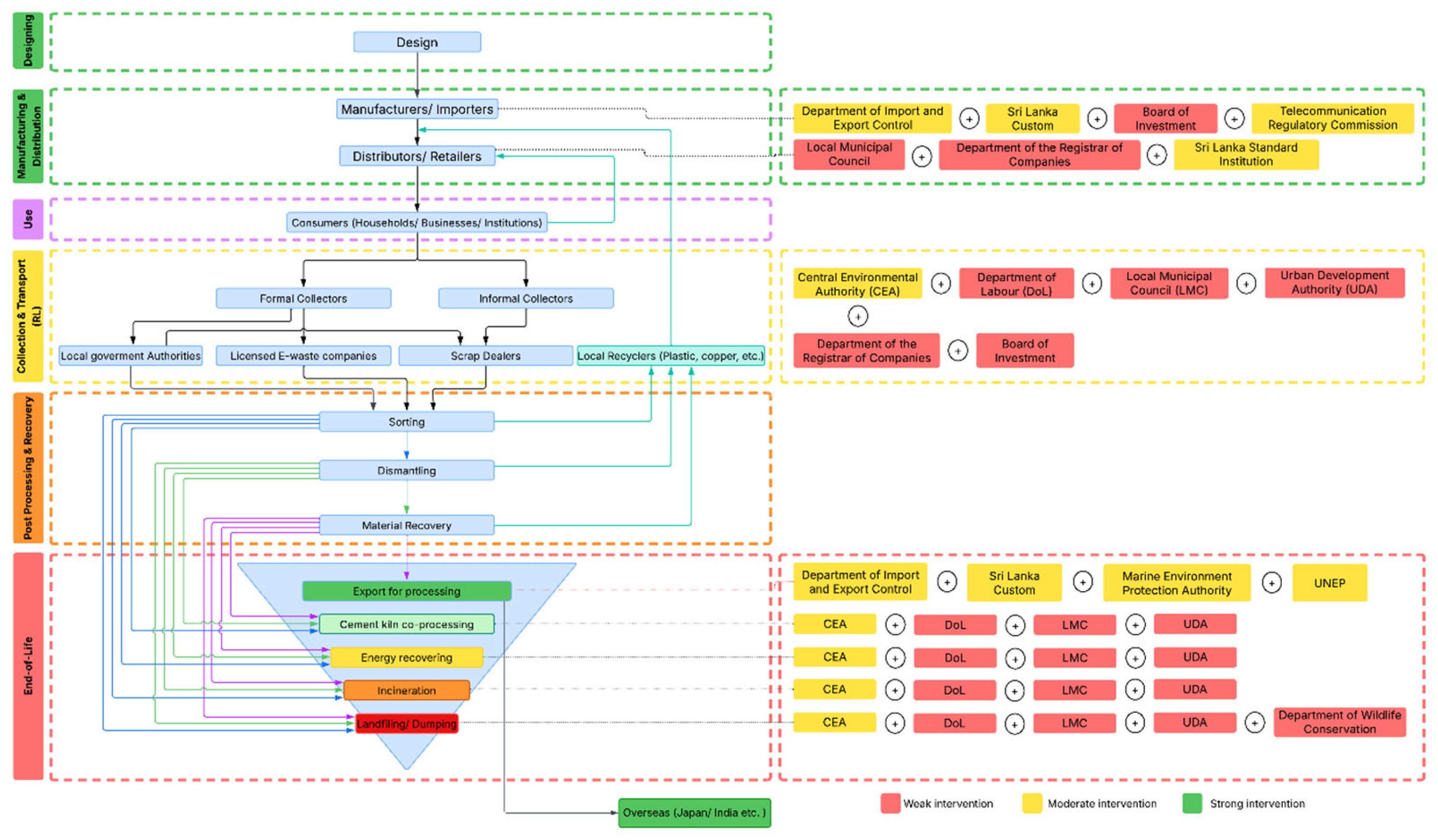
As part of this study, we examined how policies and regulations influence Sri Lanka’s e-waste management system across the entire product life cycle (
Figure 1). A key contribution of this research is the development of a conceptual framework that maps the interactions between regulatory bodies and stakeholders within the e-waste supply chain. This framework not only highlights the intended oversight but also identifies critical governance gaps. It illustrates how regulatory bodies create a multi-level governance system that can monitor compliance, environmental standards, and coordination mechanisms. However, there are significant regulatory oversight gaps at critical stages. During the collection and transport phase, the CEA serves as the primary regulatory body, but its capability appears insufficient to coordinate both formal and informal collection networks, which is the most critical gap that emerges. The existing literature further confirms that Sri Lanka lacks an integrated regulatory mechanism to ensure proper tracking and accountability throughout the reverse logistics chain [
11,
12]. This can be used as a valuable tool for identifying where the country lacks regulation and material flow, enabling targeted interventions. By addressing specific gaps in regulations, informal collection networks, and post-processing stages, policymakers can prioritize the implementation of tracking systems and material flow monitoring at those critical points.
5. Recommendations
Several recommendations emerge from the investigations carried out on Sri Lanka’s e-waste management system.
Implement digital reporting systems for all licensed collectors with monthly data submission requirements to address the unrecorded e-waste quantities.
Finalize the policy regarding e-waste management and empower the CEA as the primary coordinating body with expanded authority over both formal and informal sectors.
Certify and integrate repair technicians and refurbishment centers into the formal system, converting existing repair culture into a competitive advantage.
Empower informal collectors to carry out their roles in a more environmentally and socially responsible manner by discouraging harmful practices that release toxic heavy metals and pose serious health and safety risks to workers and nearby communities.
Establish an information management system for electronic products, using tools like Digital Product Passports to provide essential data on materials; hazardous components; and circularity options such as reuse, repair, and recycling.
6. Conclusions
The supply chain and regulatory framework revealed that different regulatory bodies oversee various aspects of e-waste management, and their coordination remains inadequate and ineffective. The informal sector (including repair and refurbishment networks) operates with minimal regulatory supervision, creating significant governance loopholes that threaten the system’s effectiveness. While developed countries invest heavily to recreate repair cultures, Sri Lanka’s existing ecosystem of skilled technicians, lower costs, and strong second-hand market acceptance provides a natural circular economy infrastructure. One of the key contributions of this study is the development of a conceptual framework that maps the interactions between regulatory bodies and stakeholders, identifying critical oversight gaps and opportunities for targeted intervention. To initiate a proper e-waste management system, Sri Lanka needs to prioritize the implementation of tracking systems at key points of the supply chain, especially in the collection and post-processing stages. The country requires a common regulatory framework that integrates formal and informal sectors, consolidates authority in middle-stage processes, and creates integrated coordination mechanisms between existing regulatory bodies.
Author Contributions
Conceptualization, K.K.A. and K.T.; methodology, K.T. and K.K.A.; writing—original draft preparation, K.T.; writing—review and editing, K.K.A. and L.M.; visualization, K.T.; supervision, K.K.A. and L.M. All authors have read and agreed to the published version of the manuscript.
Funding
This research received no external funding.
Institutional Review Board Statement
Not applicable.
Informed Consent Statement
Not applicable.
Data Availability Statement
No new data were created.
Conflicts of Interest
The authors declare no conflicts of interest.
References
- Forti, V.; Balde, C.P.; Kuehr, R.; Bel, G. The Global E-Waste Monitor 2024: Quantities, Flows and the Circular Economy Potential. 2024. Available online: https://www.itu.int/itu-d/sites/environment (accessed on 2 August 2025).
- Accounting and Financial Management Association, E-Waste Management in Sri Lanka. 2015. Available online: https://mgt.sjp.ac.lk/acc/e-waste-management-in-sri-lanka/ (accessed on 6 August 2025).
- Jayawardene, G.; Kariyapperuma, S. Unraveling Challenges in E-Waste Management: Insights from the Western Province of Sri Lanka. Int. J. Res. Innov. Soc. Sci. 2025, 9, 1486–1498. [Google Scholar] [CrossRef]
- Widanapathirana, S.; Perera, I.J.J.U.N.; Bellanthudawa, B.K.A. Electrical and Electronic Waste (E-Waste) Recycling and Management Strategies in South Asian Region: A Systematic Review from Sri Lankan Context; Springer: Berlin/Heidelberg, Germany, 2023. [Google Scholar] [CrossRef]
- Ali, S.; Shirazi, F. The Paradigm of Circular Economy and an Effective Electronic Waste Management. Sustainability 2023, 15, 3. [Google Scholar] [CrossRef]
- Chi, X.; Streicher-Porte, M.; Wang, M.Y.L.; Reuter, M.A. Informal electronic waste recycling: A sector review with special focus on China. Waste Manag. 2011, 31, 731–742. [Google Scholar] [CrossRef] [PubMed]
- Kang, H.Y.; Schoenung, J.M. Electronic waste recycling: A review of U.S. infrastructure and technology options. Resour. Conserv. Recycl. 2005, 45, 368–400. [Google Scholar] [CrossRef]
- Samarakoon, M. A Review of Electrical and Electronic Waste Management in Sri Lanka. In Proceedings of the International Conference on Chemical, Civil and Environmental Engineering (CCEE’2014), Singapore, 18–19 November 2014. [Google Scholar] [CrossRef]
- Kumar, A.; Holuszko, M.; Espinosa, D.C.R. E-Waste: An Overview on Generation, Collection, Legislation and Recycling Practices; Elsevier B.V.: Amsterdam, The Netherlands, 2017. [Google Scholar] [CrossRef]
- Widmer, R.; Oswald-Krapf, H.; Sinha-Khetriwal, D.; Schnellmann, M.; Böni, H. Global perspectives on e-waste. Environ. Impact Assess Rev. 2005, 25, 436–458. [Google Scholar] [CrossRef]
- Perera, C.; Perera, C.K. Integrating Materials Flows of Formal and Informal E-Waste Management Practices in Sri Lanka. 2023. Available online: https://www.researchgate.net/publication/371539007 (accessed on 11 October 2025).
- Ranasinghe, W.W.; Athapattu, B.C.L. Challenges in E-waste management in Sri Lanka. In Handbook of Electronic Waste Management: International Best Practices and Case Studies; Elsevier: Amsterdam, The Netherlands, 2019; pp. 283–322. [Google Scholar] [CrossRef]
- Licensed E-Waste Collectors in Sri Lanka. Available online: https://www.cea.lk/web/images/pdf/2022/HW/E-Waste_List_New.pdf (accessed on 11 September 2025).
| Disclaimer/Publisher’s Note: The statements, opinions and data contained in all publications are solely those of the individual author(s) and contributor(s) and not of MDPI and/or the editor(s). MDPI and/or the editor(s) disclaim responsibility for any injury to people or property resulting from any ideas, methods, instructions or products referred to in the content. |