Proceeding Paper

Energy Absorption Characteristics of Biodegradable and Recyclable Composite with Interlocking Periodic Honeycomb Sandwich Structure †

by
Quanjin Ma
1,2,3,4,*,
Mohd Ruzaimi Mat Rejab
1,*,
Nasrul Hadi
2,
Yiheng Song
5,
Sivasubramanian Palanisamy
6 and
Zahidah Ansari
1
1
Faculty of Mechanical & Automotive Engineering Technology, Universiti Malaysia Pahang Al-Sultan Abdullah, Pekan 26600, Pahang, Malaysia
2
Centre for Advanced Industrial Technology, Universiti Malaysia Pahang Al-Sultan Abdullah, Pekan 26600, Pahang, Malaysia
3
Centre for Advanced Composite Materials (CACM), Universiti Teknologi Malaysia (UTM), Skudai 81310, Johor, Malaysia
4
School of Automation and Intelligent Manufacturing, Southern University of Science and Technology, Shenzhen 518055, China
5
School of Civil Engineering, Southeast University, Nanjing 211189, China
6
Department of Mechanical Engineering, School of Engineering, Mohan Babu University, Tirupati 517102, Andhra Pradesh, India
*
Authors to whom correspondence should be addressed.
Presented at the 6th International Electronic Conference on Applied Sciences, 9–11 December 2025; Available online: https://sciforum.net/event/ASEC2025.
Eng. Proc. 2026, 124(1), 48; https://doi.org/10.3390/engproc2026124048
Published: 25 February 2026
(This article belongs to the Proceedings of The 6th International Electronic Conference on Applied Sciences)

Abstract

The demand for biodegradable, recyclable, natural composites with lightweight structures is driven by the fact that advanced structures can withstand quasi-static and dynamic loadings. This study examined the energy-absorbing characteristics of interlocking periodic honeycomb sandwich structures made from short sugar palm, kenaf, and pineapple leaf fibres (PALFs) reinforced with a polylactic acid (PLA) composite. The biodegradable sugar palm, kenaf, and PALF/PLA composite sheets were subjected to hot compression and cut into single- and double-slot square plates. The interlocking technique was used to assemble periodic two-dimensional square-honeycomb sandwich structures. Moreover, new and recyclable PLA-based composites with three fibres were tested for tensile properties. The biodegradable PLA-based composite honeycomb sandwich structure underwent a quasi-static compression test. Finite element modelling was used to simulate the load–displacement curve, energy-absorption characteristics, and failure behaviour, incorporating tensile properties and geometric imperfections. The results revealed that the double-slot design of the pineapple/PLA sandwich structure significantly increased by 1.33 times compared to the sugar palm/PLA sandwich structure. Notably, it reduced the compressive strength of recyclable pineapple/PLA (66.4%) and recyclable sugar palm/PLA (31.5%) composite sandwich structures compared to the new pineapple/sugar palm PLA-based composite. In addition, finite element analysis (FEA) showed reasonable agreement with experimental data, with a 7.11% error in energy absorption (EA). It was highlighted that biodegradable, recyclable, interlocking sandwich-structured composites have potential for advanced, sustainable energy-absorbing structures.

1. Introduction

The imperative to address the environmental liabilities of conventional non-degradable composite materials has elevated the pursuit of sustainable engineering materials to a core research priority [1]. Biodegradable polymer composites reinforced with various natural fibres represent a highly viable alternative in this landscape, as they reconcile adequate mechanical functionality with end-of-life ecological compatibility [2]. Polylactic acid (PLA), a biodegradable thermoplastic, has emerged as a flagship matrix material, yet its intrinsic limitations hinder broader engineering applications [3]. The incorporation of various natural fibres into PLA mitigates these deficiencies, enhancing toughness, stiffness, and damping performance while preserving the biodegradability of polymer composites [4]. Concurrently, the design of lightweight, high-performance structures for crashworthiness and impact protection (e.g., automotive interiors, packaging, and protective sport equipment) routinely leverages sandwich structures with various core designs [5]. For example, a honeycomb core is preeminent in two-dimensional core design, owing to its exceptional specific energy absorption (SEA), predictable deformation behaviour, and tuneable mechanical properties [6].
Various types of natural fibres have been investigated as a high-potential natural reinforcement phase, attributed to their favourable mechanical strength, durability, and matrix compatibility [7]. For example, Ravichandran, G. et al. [8] studied the effect of hybrid polyester composites reinforced with snake grass fibre, Sal wood, and Babool sawdust fillers. The tensile strength increased from 38 MPa to 56 MPa. Several studies have characterised the thermal and mechanical properties and validated their utility in composite systems. For instance, Bachtiar, D. et al. [9] examined the impact of alkaline treatment on the mechanical, thermal, and morphological properties of sugar palm fibre-reinforced thermoplastic polyurethane composites. Subsequent investigations of sugar palm/PLA biocomposites have achieved significant enhancements in tensile, flexural, and mechanical properties compared to neat PLA [10]. Further investigations of natural biocomposites under varied environmental conditions have confirmed their hygrothermal stability and biodegradation behaviour, validating their ecological credentials as sustainable materials.
The integration of natural fibre/PLA biodegradable biocomposites with sandwich structures constitutes a novel and strategically important research pathway for the development of sustainable energy-absorbing components [11,12]. The energy-absorption performance of hybrid structures is governed by the complex interplay between the biocomposite properties and novel core designs. For example, Jose, S. et al. [13] outlined a sandwich composite made of biodegradable coarse wool–PLA, which exhibited a high stiffness modulus of 964 MPa. Mahasuwanchai, N., et al. [14] focused on the mechanical properties of various cellular panels made of a wood fibre/PLA biocomposite, including bending properties, and on the state-of-the-art performance of cellular architectures fabricated via additive manufacturing. The translation of natural fibre biocomposites into engineered cellular structures is a rapidly expanding research frontier [15].
Some studies have investigated the energy-absorption performance of natural fibre composites with cellular structures, while sandwich panels with bio-based cores (e.g., foam and balsa) have yielded promising results for lightweight engineering applications [16]. Recent investigations into PLA-based honeycomb cores have included fabrication development and compressive response characterisation, with additive manufacturing-focused research on PLA honeycombs shedding light on manufacturing process–property relationships for biodegradable cellular structures [17]. Notably, a systematic investigation of biodegradable energy-absorbing structures and natural fibre/PLA biocomposites, which serve as the constitutive material for lightweight sandwich structures, remains a significant and unaddressed research gap for new and recycled fibre biocomposites designed with an interlocking technique.
This paper aims to address the energy-absorption performance of interlocking periodic honeycomb sandwich structures fabricated from biocomposites of kenaf, pineapple leaf, and sugar palm fibres. The effects of new and recycled fibre types, natural fibre types, and the number of slots is discussed under quasi-static loading. Finite element analysis results are validated by experimental results. Furthermore, the energy absorption characteristics and failure behaviour of biodegradable and recyclable composite honeycomb sandwich structures are determined.

2. Materials and Methods

2.1. Materials

Polylactic acid (PLA) of grade 3001TDS was supplied by NatureWorks LLC, Minnetonka, United States. The sugar palm fibres were obtained from Acheh, Indonesia, whereas the pineapple leaf fibres (PALFs) were obtained from Subang, West Java, Indonesia. The kenaf fibres were provided by the Institute of Tropical Forestry and Forest (INTROP), Universiti Putra Malaysia, Malaysia.

2.2. Specimen Preparation

The long fibres were processed into short fibres by passing through a crusher and an 850 µm sieve to obtain short fibres approximately 2 mm in length. Even though long fibres were known to possess better mechanical strength, since this experiment involved recycling the fibres, short fibres were more applicable to maintain consistency throughout the process. Each type of short fibre was then combined homogeneously with PLA in a batch mixer at 180 °C, using the respective ratio shown in Table 1.
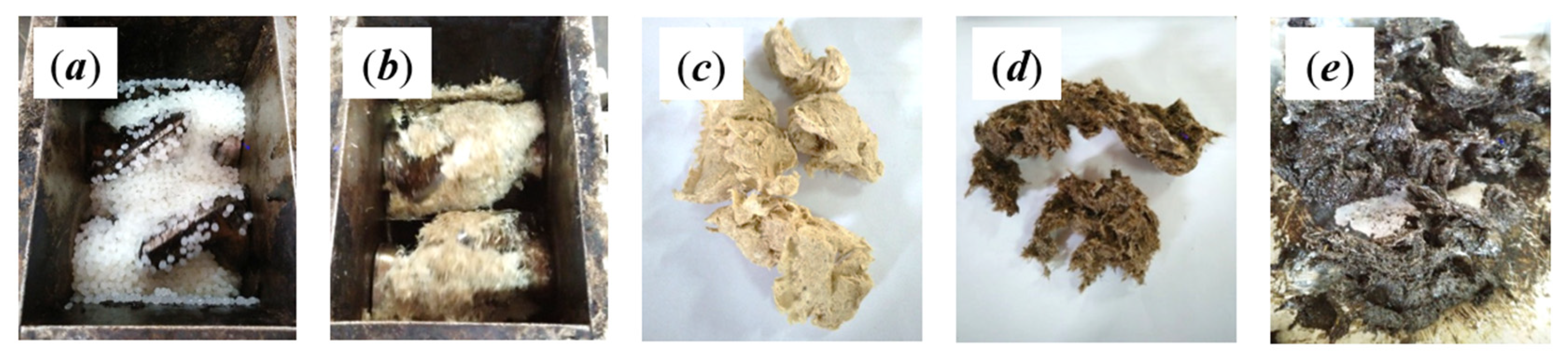
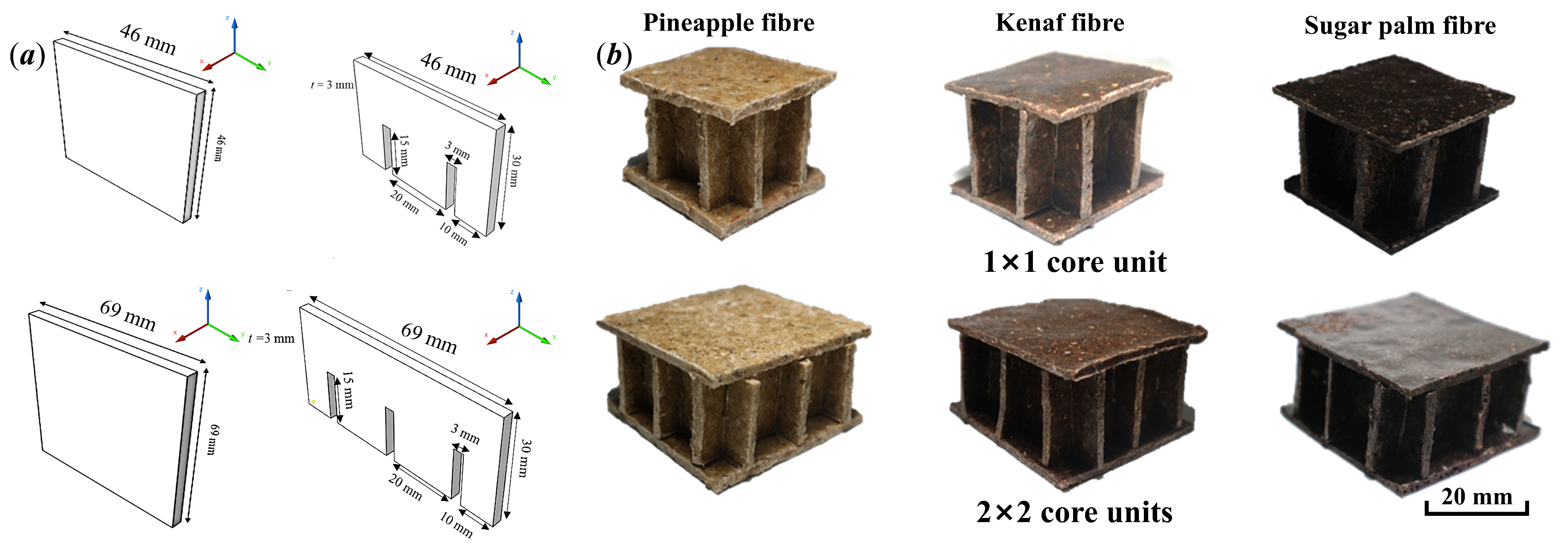
The PLA was pre-melted for 20 min before the fibres were slowly added to avoid overflow and to aid in obtaining a homogeneous mixture. The mixing continued for 20 more minutes; then, the mixture was removed, cooled to room temperature, and further crushed into small pellets using a crusher. These smaller pallets then underwent a hot-press process using a mould size of 150 mm × 150 mm with a thickness of 3 mm, and each press utilised 300 g of the pellets. Figure 1 presents the mixing condition of biodegradable and recyclable composite and PLA pellets. The powder mixture was pressed using a CARVER Monarch Hydraulic Hot Press, Carver, Inc., Indiana, United States, at 180 °C for 5 min under 60 tons of compression pressure. A thin projector transparency film was used to prevent the composite from sticking to the mould. The fibre/PLA plates were further cut to produce the targeted single and double slots, as shown in Figure 2a. Specimens of biodegradable and recyclable PLA-based composite honeycomb sandwich structures with different core units are shown in Figure 2b.

2.3. Experimental Test

Tensile properties of new and recyclable composites were determined by applying axial loading on both ends of the specimens until rupture. Loading was conducted using Type V dumbbell shapes following the ASTM 638 standard [12]. To obtain the Poisson ratio, type FLA-2-8 strain gauges with 120 Ω were attached to the side surface of each specimen at a loading rate of 2 mm/min using an INSTRON 3366 Universal Testing Machine, Illinois Tool Works Inc, Norwood, United States. Both single and double slots of the honeycomb sandwich structure underwent quasi-static compression loading using an INSTRON 3366 Universal Testing Machine according to the ASTM D1621 standard [18]. A load was applied steadily with a quasi-static loading rate of 2 mm/min. The maximum compressive load was divided by the cross-sectional area of two face-sheet plates with dimensions of 46 × 46 and 69 × 69 mm2. A minimum of three specimens were prepared for each new and recyclable composite with different natural fibres. Figure 2 illustrates the interlocking, periodic two-dimensional square honeycomb sandwich structure with geometric dimensions and manufactured specimens.

2.4. Finite Element Modelling

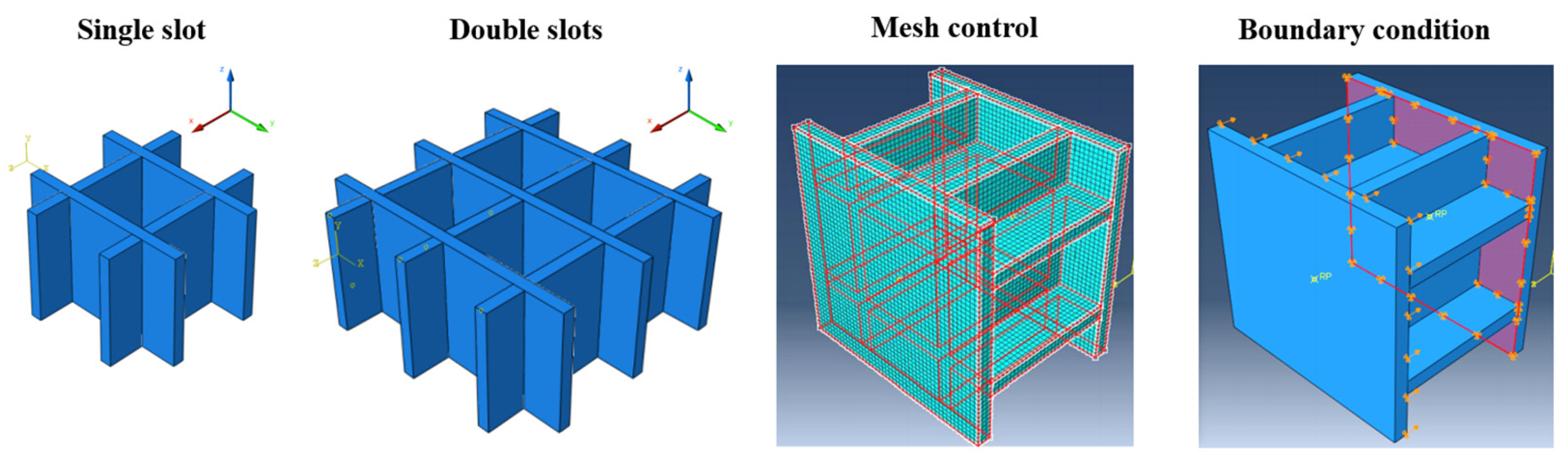
Abaqus/CAE 6.13 was used to simulate the compressive response of composite honeycomb sandwich structures under quasi-static compression loading. All the parts were created as 3D deformable parts, with extrusion as the base feature type. Both the elastic and plastic behaviours of the proposed composite materials were considered by inserting the Young’s modulus, Poisson ratio, and yield stress obtained from the experimental data [19]. Figure 3 presents the finite element modelling procedure, mesh control, and boundary conditions of composite honeycomb sandwich structures. Both the face-sheet plates and the core were fixed, with the top plate set for the downward displacement at its reference point. An 8-node linear brick, reduced-integration, hourglass control (C3D8R) with six degrees of freedom was used [20]. The values of the friction coefficient was set to 0.1. The imperfection sensitivity was determined over a range of 0 to 0.5 of the imperfection amplitudes.

3. Results and Discussion

3.1. Results of Tensile Load

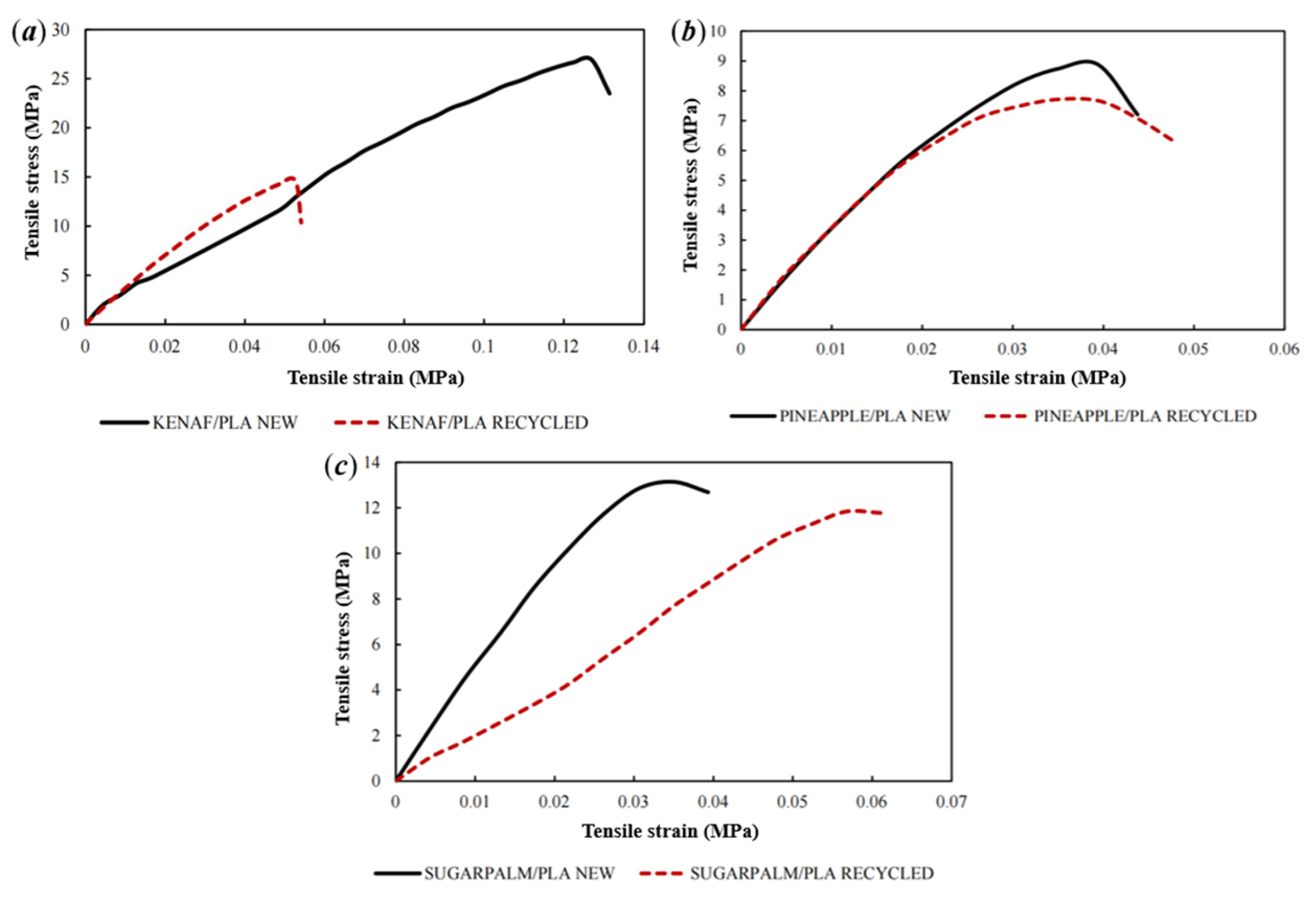
Figure 4 plots the tensile stress–strain curves of new and recyclable PLA-based composites. The kenaf/PLA composite showed a significant difference in tensile strength between the new and recyclable composites. The new composite recorded 36.28 MPa, whereas the recyclable composite recorded 19.72 MPa, corresponding to a 45.6% reduction in tensile strength. Besides that, pineapple/PLA showed only a small reduction in tensile strength during recycling. The new pineapple/PLA composite had 11.95 MPa, whereas the recyclable composite had a 13.1% decrease to 10.38 MPa. The mixture of pineapple/PLA composite did not provide a significant difference in terms of its tensile strain. It was similar to the sugar palm/PLA composite, and the reduction in tensile strength was minimal between the new and recyclable composites [21]. The new sugar palm/PLA composite recorded 17.70 MPa, compared with 15.49 MPa for the recyclable counterpart. Table 2 summarises the results of the tensile test with new and recyclable composites.

3.2. Results of Quasi-Static Compressive Load

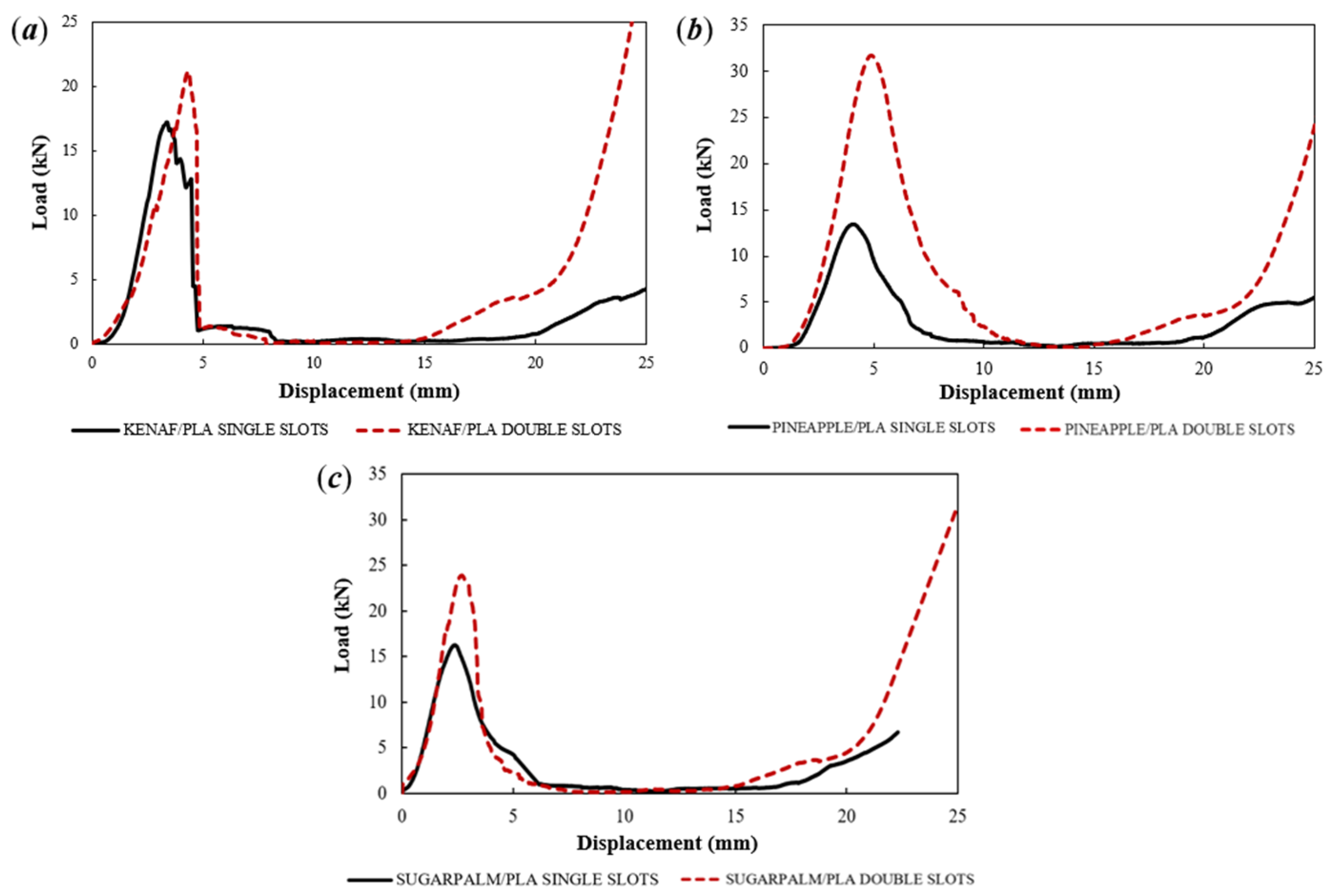
Single- and double-slot honeycomb sandwich structures underwent compression tests to investigate the effect of the scaling factor on the maximum compression stress and energy absorption. Figure 5 shows the load–displacement curves for both single and double slots of biodegradable and recyclable PLA-based composite honeycomb sandwich structures. At the beginning, all fibres displayed the same pattern of initial plastic behaviour, reaching the maximum load, then declining upon rupture [12]. Generally, all maximum compressive loads increased when the number was doubled, but the pineapple/PLA composite showed the largest increase, at 136.9%. The sugar palm/PLA composite achieved 44.6%, followed by the kenaf/PLA composite, at 22.6%.
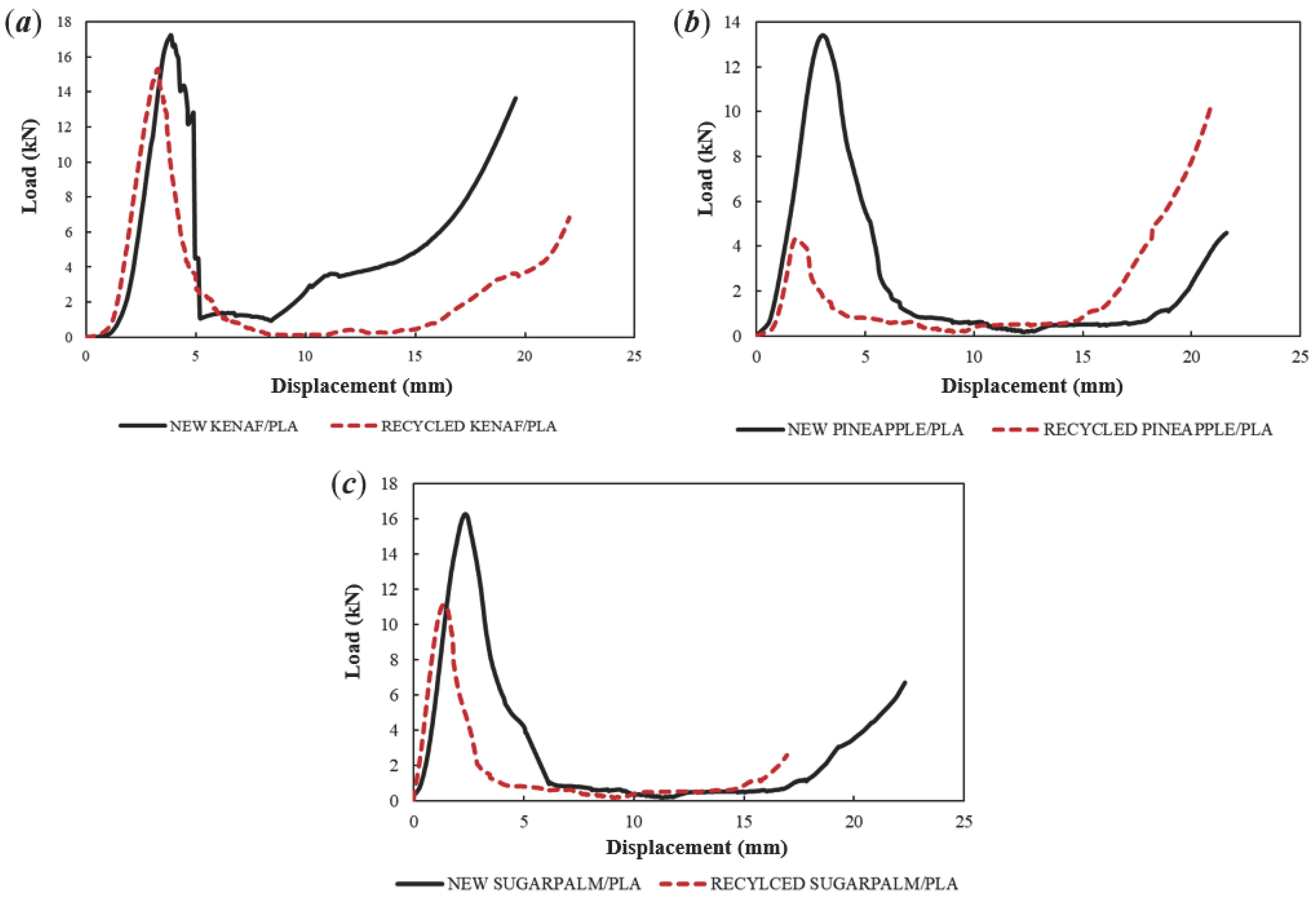
Figure 6 presents the load–displacement curves of new and recyclable composite honeycomb sandwich structures with three types of natural fibres. As shown in Figure 6, new and recyclable kenaf/PLA honeycomb sandwich structures displayed similar plastic behaviour before reaching the maximum load. The recyclable kenaf/PLA composite showed an 11.5% decrease in mechanical properties when the composite was recyclable. The maximum load decreased by 66.4% when the composite was recyclable. Hence, it reduced the energy absorption value by 23.6%. Apart from that, an illustrated 31.5% decrement in terms of maximum load between new and recyclable sugar palm/PLA composites was observed. A similar trend was observed for the energy absorption value, which decreased by 54.8%. Table 3 summarises the energy-absorption characteristics of biodegradable, recyclable PLA-based composite honeycomb sandwich structures.

3.3. Results of Experimental Test and Finite Element Modelling

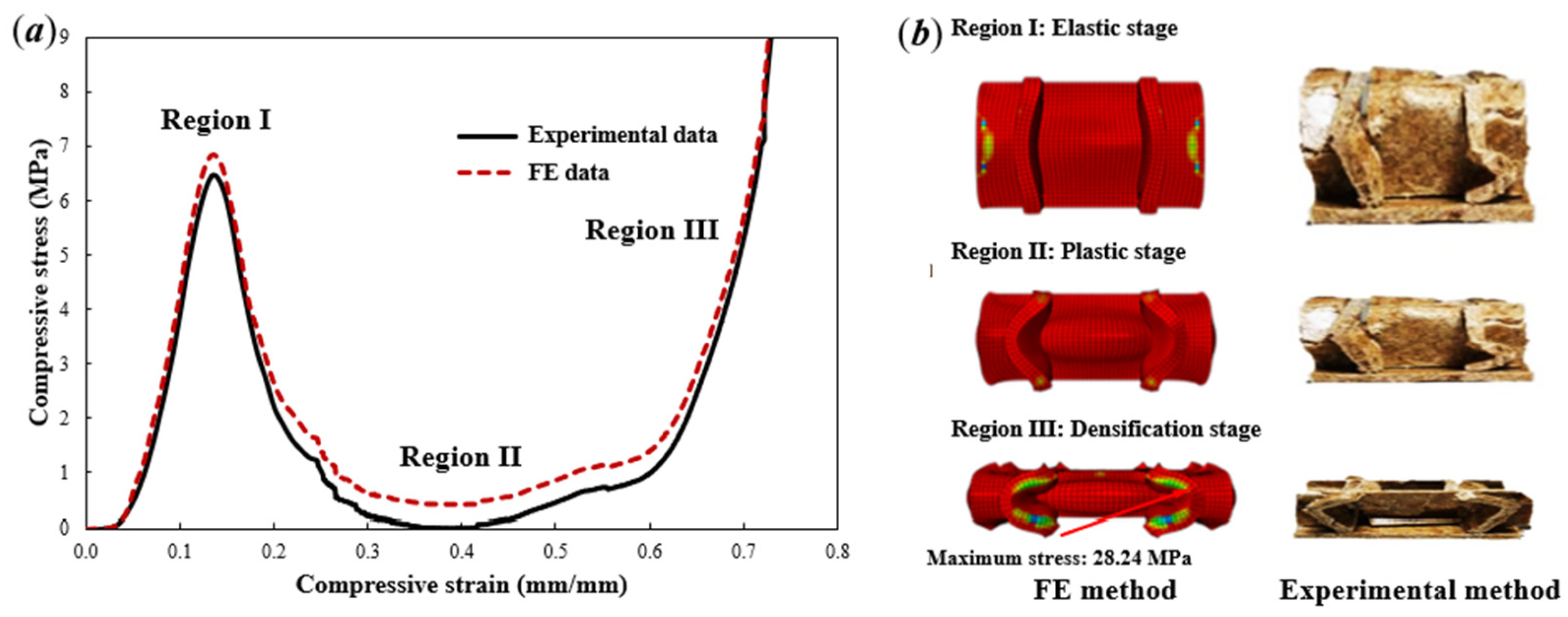
In the first step of finite element modelling, three buckling modes of eigenvalues were generated, which were 0.03619, 0.04173 and 0.04183. Mode 1 was chosen because it best matched the experimental behaviour, and the imperfection value was applied to the vertical cell members. A pineapple/PLA double-slot honeycomb sandwich structure was chosen as the case study for comparison between experimental and FEA results. Figure 7 presents the comparison of experimental and FE results of pineapple/PLA sandwich honeycomb structures. Figure 7a displays the compressive stress–strain curve between the experimental and FEA data, which divides into region I, II and III. During the elastic phase, the compressive stress increased to a peak of 6.48 MPa in the experimental data and 6.86 MPa in the FE data. Upon buckling, the curve began to drop rapidly; this region is commonly known as the plastic phase, as shown in Figure 7b. Observed failure behaviour of the specimens included buckling, shear deformation, debonding, and honeycomb core folds [6]. Moreover, the failure mechanisms were mainly attributed to buckling, shear deformation, folding, debonding, and cracking, in agreement with the relevant literature [18,22,23].

4. Conclusions

This study successfully developed biodegradable, recyclable square honeycomb sandwich structures from short sugar palm, kenaf, and pineapple leaf fibres (PALFs) reinforced with PLA using hot compression and an interlocking assembly method. It was revealed that the double-slot design of the pineapple/PLA sandwich structure achieved 1.33 times the performance of the sugar palm/PLA sandwich structure. However, this design also resulted in a substantial reduction in compressive strength, with pineapple/PLA decreasing by 66.4% and sugar palm/PLA decreasing by 31.5% compared with the new fibre-reinforced PLA-based composites. Finite element analysis demonstrated reasonable prediction capability, with only 7.11% error in energy absorption compared to experimental tests. These main findings confirm that interlocking natural fibre/PLA composite honeycomb structures offer tuneable, sustainable, and recyclable solutions for lightweight energy-absorbing applications.

Author Contributions

Conceptualisation, Q.M., M.R.M.R., N.H. and Z.A.; methodology, Q.M. and Z.A.; software, Z.A.; validation, Q.M., N.H., Y.S., S.P. and Z.A.; formal analysis, N.H. and Z.A.; investigation, Q.M. and Z.A.; resources, M.R.M.R.; data curation, N.H., Y.S., S.P. and Z.A.; writing—original draft preparation, Q.M. and Z.A.; writing—review and editing, Q.M., M.R.M.R., Y.S. and Z.A.; visualisation, Q.M., Y.S., S.P. and Z.A.; supervision, M.R.M.R. and N.H.; project administration, M.R.M.R.; funding acquisition, M.R.M.R. All authors have read and agreed to the published version of the manuscript.

Funding

This research was funded by the Ministry of Education of Malaysia (RDU190158, FRGS/1/2023/TK10/UMP/02/9) and Universiti Malaysia Pahang Al-Sultan Abdullah (PGRS180319).

Institutional Review Board Statement

Not applicable.

Informed Consent Statement

Not applicable.

Data Availability Statement

The data presented in this study are available on request from the corresponding author.

Acknowledgments

This research work is strongly supported by the Structural Performance Materials Engineering (SUPREME) Focus Group, Universiti Malaysia Pahang Al-Sultan Abdullah, Malaysia.

Conflicts of Interest

The authors declare no conflicts of interest.

Abbreviations

The following abbreviations are used in this manuscript:
ASTMAmerican Society for Testing and Materials
EAEnergy absorption
FEAFinite element analysis
PALFPineapple leaf fibre
PLAPolylactic acid
SEASpecific energy absorption

References

  1. Supian, A.B.M.; Asyraf, M.R.M.; Syamsir, A.; Ma, Q.; Hazrati, K.Z.; Azlin, M.N.M.; Mubarak Ali, M.; Ghani, A.; Hua, L.S.; SaifulAzry, S.; et al. Kenaf/glass fiber-reinforced polymer composites: Pioneering sustainable materials with enhanced mechanical and tribological properties. Polym. Compos. 2024, 45, 14421–14447. [Google Scholar] [CrossRef]
  2. Sanaka, R.; Sahu, S.K.; Sreekanth, P.R.; Senthilkumar, K.; Badgayan, N.D.; Siva, B.V.; Ma, Q. A review of the current state of research and future prospectives on stimulus-responsive shape memory polymer composite and its blends. J. Compos. Sci. 2024, 8, 324. [Google Scholar] [CrossRef]
  3. Taib, N.A.A.B.; Rahman, M.R.; Huda, D.; Kuok, K.K.; Hamdan, S.; Bakri, M.K.B.; Julaihi, M.R.M.B.; Khan, A. A review on poly lactic acid (PLA) as a biodegradable polymer. Polym. Bull. 2023, 80, 1179–1213. [Google Scholar] [CrossRef]
  4. Ng, L.F.; Rahman, M.Z.; Ma, Q.; Azad, H.M.; Yahya, M.Y.; Rejab, M.R.M. Characterisation of eco-friendly fibers and polymers for the sustainable environment. In Eco-Friendly Fiber Reinforced Polymer Composite Materials; Woodhead Publishing: Cambridge, UK, 2026; pp. 109–133. [Google Scholar]
  5. Ma, Q.; Rejab, M.R.M.; Siregar, J.P.; Guan, Z. A review of the recent trends on core structures and impact response of sandwich panels. J. Compos. Mater. 2021, 55, 2513–2555. [Google Scholar] [CrossRef]
  6. Ma, Q.; Kuai, T.; Rejab, M.R.M.; Kumar, N.M.; Idris, M.S.; Abdullah, M.H. Effect of boundary factor and material property on single square honeycomb sandwich panel subjected to quasi-static compression loading. J. Mech. Eng. Sci. 2020, 14, 7348–7360. [Google Scholar] [CrossRef]
  7. Ng, L.F.; Yahya, M.Y.; Muthukumar, C.; Parameswaranpillai, J.; Ma, Q.; Muhammad Asyraf, M.R.; Abdul Majid, R. Mechanical characterisation, water absorption, and thickness swelling of lightweight pineapple leaf/ramie fabric-reinforced polypropylene hybrid composites. Polymers 2024, 16, 1847. [Google Scholar] [CrossRef] [PubMed]
  8. Ravichandran, G.; Ramasamy, K.; Kalidas, S.; Jayamani, M.; Mausam, K.; Palanisamy, S.; Ma, Q.; Al-Farraj, S.A. Effect of Sal Wood and Babool Sawdust Fillers on the Mechanical Properties of Snake Grass Fiber-Reinforced Polyester Composites. BioResources 2025, 20, 8674–8694. [Google Scholar] [CrossRef]
  9. Bachtiar, D.; Mohammed, A.A.; Palanisamy, S.; Imran, A.I.; Siregar, J.P.; Rejab, M.R.b.M.; Syaubari, S.; Cionita, T.; Fitriyana, D.F.; Al-Farraj, S.A.; et al. Effect of alkaline treatment on the thermal and mechanical properties of sugar palm fibre reinforced thermoplastic polyurethane composites. Sci. Rep. 2025, 15, 14085. [Google Scholar] [CrossRef] [PubMed]
  10. Salah, H.B.H.; Trad, O.; Trad, A.; Louhichi, B. Mechanical and microstructural evaluation of Palm, Alfa, and Luffa fibers as sustainable reinforcements in Bio-Composites: A comparative study under uniform processing. Polym. Bull. 2026, 83, 118. [Google Scholar] [CrossRef]
  11. Ansari, Z.; Rejab, M.R.M.; Bachtiar, D.; Siregar, J.P. Crushing response of green square honeycomb structure from sugar palm & PLA. Mater. Sci. Forum 2017, 909, 122–126. [Google Scholar] [CrossRef]
  12. Ansari, Z.; Tan, C.W.; Rejab, M.R.M.; Bachtiar, D.; Siregar, J.; Zuhri, M.Y.M.; Marzuki, N.S.D.M. Crushing behaviour of composite square honeycomb structure: A finite element analysis. J. Mech. Eng. Sci. 2017, 11, 2637–2649. [Google Scholar] [CrossRef]
  13. Jose, S.; Shanumon, P.S.; Kadam, V.; Tom, M.; Thomas, S. Preparation, characterisation and application of biodegradable coarse wool-poly (lactic acid) sandwich composite. Polym. Bull. 2024, 81, 10293–10310. [Google Scholar] [CrossRef]
  14. Mahasuwanchai, N.; Udtaranakron, T.; Chanto, K.; Pulngern, T. Behavior of Sandwich Glued Laminated Bamboo Structures with a Core Formed by Bioplastic Fiber Using 3D Printing Technology. J. Renew. Mater. 2025, 13, 2453. [Google Scholar] [CrossRef]
  15. Ma, Q.; Rejab, M.R.M.; Kang, S.; Idris, M.S.; Zin, M.A.A.M. The energy-absorbing characteristics of single spherical-roof contoured-core (SRCC) cell with composite materials. Int. J. Automot. Mech. Eng. 2020, 17, 8265–8273. [Google Scholar] [CrossRef]
  16. Sapuan, S.M.; Mohammadsalih, Z.G.; Harussani, M.M.; Ibrahim, M.I.; Omar, A.A.; Fadill, N.F.M.; Shahrum, A.F.; Siddiqui, V.U. Review of biocomposite sandwich structures. In Biocomposites for Lightweight Sandwich Structures; CRC Press: Boca Raton, FL, USA, 2024; pp. 10–30. [Google Scholar]
  17. Ainin, F.N.; Azaman, M.D.; Abdul Majid, M.S.; Ridzuan, M.J.M. Mechanical behavior, energy absorption, and failure mechanism of 3D-printed hexagonal honeycomb core under dynamic and quasi-static loadings. Polym. Compos. 2025, 46, 6346–6359. [Google Scholar] [CrossRef]
  18. Idris, M.S.; Ma, Q.; Aziz, N.A.; Mohammed, A.A.; Zhang, B.; Rejab, M.R.M. 3D-printed honeycomb sandwich structures: Mechanical characterisation of biocomposite materials. In Biocomposites for Lightweight Sandwich Structures; CRC Press: Boca Raton, FL, USA, 2024; pp. 31–45. [Google Scholar]
  19. Rejab, M.R.M.; Cantwell, W.J. The mechanical behaviour of corrugated-core sandwich panels. Compos. Part B Eng. 2013, 47, 267–277. [Google Scholar] [CrossRef]
  20. Ma, Q.; Rejab, M.R.M.; Hassan, S.A.; Azeem, M.; Saffirna, M.S. Failure behavior analysis of the Spherical-Roof Contoured Core (SRCC) under quasi-static loading: A numerical study. J. Fail. Anal. Prev. 2023, 23, 511–519. [Google Scholar] [CrossRef]
  21. Ismail, M.; Rejab, M.R.M.; Siregar, J.P.; Mohamad, Z.; Quanjin, M.; Mohammed, A.A. Mechanical properties of hybrid glass fiber/rice husk reinforced polymer composite. Mater. Today Proc. 2020, 27, 1749–1755. [Google Scholar] [CrossRef]
  22. Ma, Q.; Rejab, M.R.M.; Alang, N.A.; Hanon, M.M.; Yang, B.; Hu, H.; Zhang, B. Crashworthiness performance of sandwich panel with self-reinforced polypropylene (SRPP) and carbon fiber-reinforced plastic (CFRP) spherical-roof contoured cores. In Thin-Walled Composite Protective Structures for Crashworthiness Applications: Recent Advances and Future Developments; Springer: Singapore, 2023; pp. 1–12. [Google Scholar]
  23. Huang, S.; Wen, K.; Liu, Y.; Wu, C.; Du, X.; Liang, C.; Ma, Q.; Liu, Y. Optimised design, fabrication, and enhanced performance of honeycomb sandwich structure for excellent impact resistance and broadband microwave absorption. J. Colloid Interface Sci. 2025, 681, 365–375. [Google Scholar] [CrossRef] [PubMed]
Figure 1. (a) PLA pellets before melting; (b) mixture of biodegradable and recyclable composite and PLA inside the pot of the bra-blender; (c) mixture of pineapple/PLA composite; (d) mixture of kenaf/PLA composite; (e) mixture of sugar palm/PLA composite.
Engproc 124 00048 g001
Figure 2. The interlocking, periodic two-dimensional square honeycomb sandwich structure: (a) geometric dimension of slot and face sheets; (b) specimens of biodegradable and recyclable PLA-based composite honeycomb sandwich structures with different core units.
Engproc 124 00048 g002
Figure 3. Finite element modelling procedure and boundary condition of composite honeycomb sandwich structure with single and double slots.
Engproc 124 00048 g003
Figure 4. Tensile stress–strain curves of new and recyclable PLA-based composites: (a) kenaf/PLA composite; (b) pineapple/PLA composite; (c) sugar palm/PLA composite.
Engproc 124 00048 g004
Figure 5. Load–displacement curves of biodegradable and recyclable PLA-based composite honeycomb sandwich structures with single and double slots: (a) kenaf/PLA composite; (b) pineapple/PLA composite; (c) sugar palm/PLA composite.
Engproc 124 00048 g005
Figure 6. Load–displacement curves of new and recyclable composite honeycomb sandwich structures: (a) kenaf/PLA composite; (b) pineapple/PLA composite; (c) sugar palm/PLA composite.
Engproc 124 00048 g006
Figure 7. Comparison of experimental and FE results of pineapple/PLA sandwich honeycomb structures: (a) compressive stress–strain curve of pineapple/PLA sandwich honeycomb structure with double slots’ design; (b) compressive behaviour with three regions.
Engproc 124 00048 g007
Table 1. The fibre-mixed mass ratio used for biodegradable and recyclable composites from literature references [11,12].
Type of FibreFibre Weight Ratio (wt%)PLA Weight Ratio (wt%)
Kenaf2080
Pineapple3070
Sugar palm3070
Table 2. Results of the tensile test with the new and recyclable composites.
Composite TypePoisson’s RatioTensile Strength (MPa)
NewRecyclableNewRecyclable
Kenaf/PLA0.37 ± 0.030.26 ± 0.0336.28 ± 3.0519.72 ± 1.85
Pineapple/PLA0.28 ± 0.020.27 ± 0.0211.95 ± 1.4410.38 ± 0.87
Sugar palm/PLA0.38 ± 0.040.32 ± 0.0317.70 ± 1.7215.94 ± 1.74
Table 3. Results of energy-absorption characteristics of biodegradable and recyclable PLA-based composite honeycomb sandwich structures.
Composite TypeMaximum Compression Load (kN)Maximum Stress
(MPa)
Energy Absorption (kJ)
Single
Slot
Double SlotsSingle
Slot
Double SlotsSingle
Slot
Double Slots
Kenaf/PLA17.23 ± 1.0221.12 ± 1.697.80 ± 0.524.31 ± 0.310.64 ± 0.060.38 ± 0.03
Pineapple/PLA13.40 ± 0.8131.75 ± 2.866.06 ± 0.556.48 ± 0.450.68 ± 0.060.81 ± 0.04
Sugar palm/PLA16.50 ± 1.4223.86 ± 2.157.35 ± 0.444.87 ± 0.380.83 ± 0.080.45 ± 0.07
Disclaimer/Publisher’s Note: The statements, opinions and data contained in all publications are solely those of the individual author(s) and contributor(s) and not of MDPI and/or the editor(s). MDPI and/or the editor(s) disclaim responsibility for any injury to people or property resulting from any ideas, methods, instructions or products referred to in the content.