Hydrogel-Based Conductive Inks for the Additive Printing of Biodegradable Radiofrequency Electronic Circuits †
 ,
,  ,
,  and
and
Abstract
1. Introduction
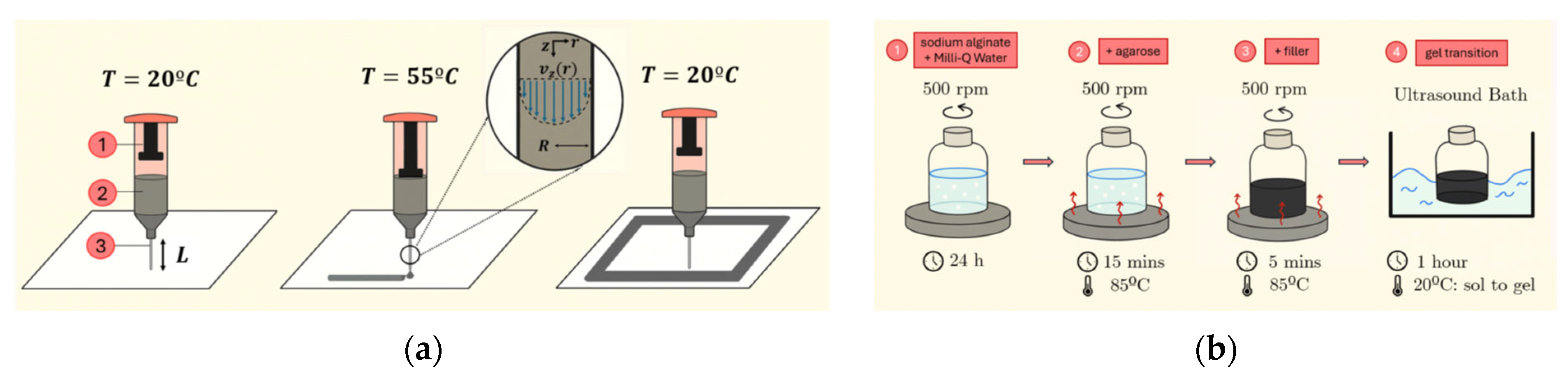
2. Hydrogel-Based Ink Preparation
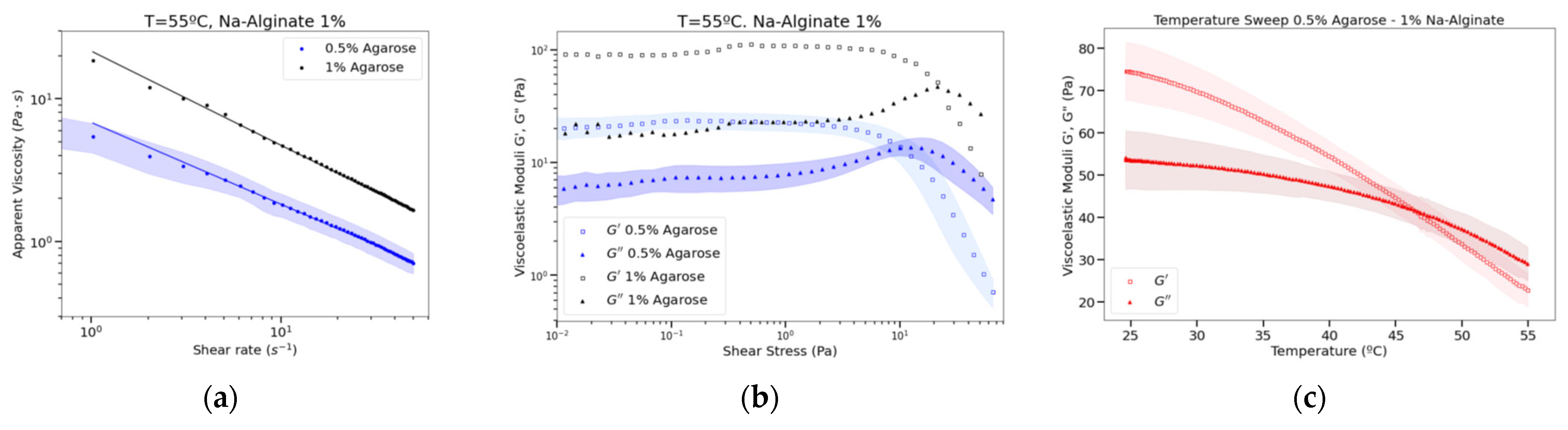
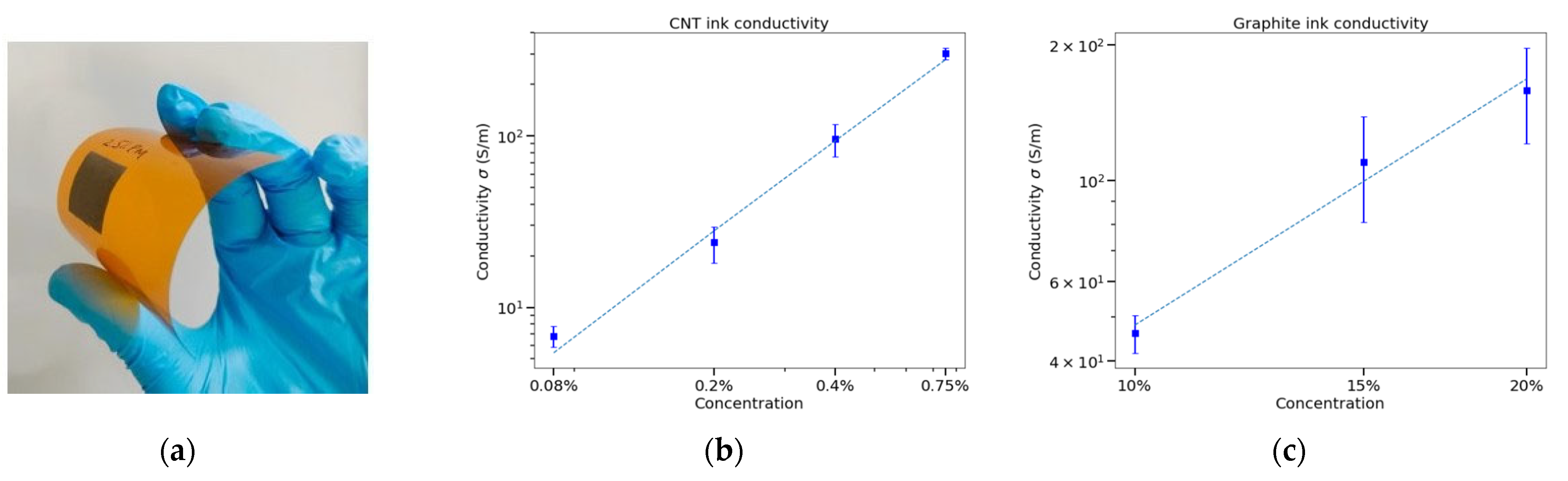
3. Results
4. Conclusions
Author Contributions
Funding
Institutional Review Board Statement
Informed Consent Statement
Data Availability Statement
Conflicts of Interest
References
- IoT Analytics. State of IoT—Summer Report 2024. Available online: https://iot-analytics.com/product/state-of-iot-summer-2024 (accessed on 29 June 2025).
- Tavares, J.; Loss, C.; Pinho, P.; Alves, H. Flexible Textile Antennas for 5G Using Eco-Friendly Water-Based Solution and Scalable Printing Processes. Adv. Mater. Technol. 2024, 9, 2301499. [Google Scholar] [CrossRef]
- International Telecommunication Union (ITU); United Nations Institute for Training and Research (UNITAR). The Global E-Waste Monitor 2024—Electronic Waste Rising Five Times Faster than Documented E-Waste Recycling; United Nations University (UNU): Shibuya, Japan; ITU: Geneva, Switzerland; UNITAR: Geneva, Switzerland; ISWA: Rotterdam, The Netherlands, 2024. [Google Scholar]
- Nocheseda, C.J.C.; Liza, F.P.; Collera, A.K.M.; Caldona, E.B.; Advincula, R.C. 3D Printing of Metals Using Biodegradable Cellulose Hydrogel Inks. Addit. Manuf. 2021, 48, 102380. [Google Scholar] [CrossRef]
- Casiraghi, C.; Jurchescu, O.D.; Magdassi, S.; Su, W. Introduction to Nanomaterials for Printed Electronics. Nanoscale 2023, 15, 10480–10483. [Google Scholar] [CrossRef] [PubMed]
- Galliani, M.; Ferrari, L.M.; Bouet, G.; Eglin, D.; Ismailova, E. Tailoring Inkjet-Printed PEDOT:PSS Composition toward Green, Wearable Device Fabrication. APL Bioeng. 2023, 7, 016101. [Google Scholar] [CrossRef] [PubMed]
- Orangi, J.; Hamade, F.; Davis, V.A.; Beidaghi, M. 3D Printing of Additive-Free 2D Ti3C2Tx (MXene) Ink for Fabrication of Micro-Supercapacitors with Ultra-High Energy Densities. ACS Nano 2020, 14, 640–650. [Google Scholar] [CrossRef]
- Ho, M.; Ramirez, A.B.; Akbarnia, N.; Croiset, E.; Prince, E.; Fuller, G.G.; Kamkar, M. Direct Ink Writing of Conductive Hydrogels. Adv. Funct. Mater. 2025, 35, 2415507. [Google Scholar] [CrossRef]
- Bergonzi, C.; Remaggi, G.; Graiff, C.; Bergamonti, L.; Potenza, M.; Ossiprandi, M.C.; Zanotti, I.; Bernini, F.; Bettini, R.; Elviri, L. Three-Dimensional (3D) Printed Silver Nanoparticles/Alginate/Nanocrystalline Cellulose Hydrogels: Study of the Antimicrobial and Cytotoxicity Efficacy. Nanomaterials 2020, 10, 844. [Google Scholar] [CrossRef] [PubMed]
- Zhang, C.; McKeon, L.; Kremer, M.P.; Park, S.-H.; Ronan, O.; Seral-Ascaso, A.; Barwich, S.; Coileáin, C.Ó.; McEvoy, N.; Nerl, H.C.; et al. Additive-Free MXene Inks and Direct Printing of Micro-Supercapacitors. Nat. Commun. 2019, 10, 1795. [Google Scholar] [CrossRef] [PubMed]
- Liu, J.; Garcia, J.; Leahy, L.M.; Song, R.; Mullarkey, D.; Fei, B.; Dervan, A.; Shvets, I.V.; Stamenov, P.; Wang, W.; et al. 3D Printing of Multifunctional Conductive Polymer Composite Hydrogels. Adv. Funct. Mater. 2023, 33, 2214196. [Google Scholar] [CrossRef]
- Darabi, M.A.; Khosrozadeh, A.; Mbeleck, R.; Liu, Y.; Chang, Q.; Jiang, J.; Cai, J.; Wang, Q.; Luo, G.; Xing, M. Skin-Inspired Multifunctional Autonomic-Intrinsic Conductive Self-Healing Hydrogels with Pressure Sensitivity, Stretchability, and 3D Printability. Adv. Mater. 2018, 30, 1705922. [Google Scholar] [CrossRef] [PubMed]
- Bao, P.; Lu, Y.; Tao, P.; Liu, B.; Li, J.; Cui, X. 3D Printing PEDOT-CMC-Based High Areal Capacity Electrodes for Li-Ion Batteries. Ionics 2021, 27, 2857–2865. [Google Scholar] [CrossRef]
- Liu, J.; Mckeon, L.; Garcia, J.; Pinilla, S.; Barwich, S.; Möbius, M.; Stamenov, P.; Coleman, J.N.; Nicolosi, V. Additive Manufacturing of Ti3C2-MXene-Functionalized Conductive Polymer Hydrogels for Electromagnetic-Interference Shielding. Adv. Mater. 2022, 34, 2106253. [Google Scholar] [CrossRef] [PubMed]
- Bird, R.B.; Armstrong, R.C.; Hassager, O. Dynamics of Polymeric Liquids. Vol. 1: Fluid Mechanics, 2nd ed.; John Wiley and Sons Inc.: New York, NY, USA, 1987. [Google Scholar]
- ASTM 1529; ASTM International Standard Test Method for Sheet Resistance Uniformity Evaluation by in-Line Four-Point Probe with the Dual-Configuration Procedure. ASTM: West Conshohocken, PA, USA, 1997.
- MG Chemicals. Technical Data Sheet: 838AR-P Carbon Conductive Pen. 2025. Available online: https://mgchemicals.com/downloads/tds/tds-838ar-p.pdf (accessed on 13 February 2026).
- Sahimi, M. Applications of Percolation Theory, 1st ed.; CRC Press: Boca Raton, FL, USA, 1994. [Google Scholar]
- Franco, M.; Alves, R.; Perinka, N.; Tubio, C.R.; Costa, P.; Lanceros-Mendéz, S. Water-Based Graphene Inks for All-Printed Temperature and Deformation Sensors. ACS Appl. Electron. Mater. 2020, 2, 2857–2867. [Google Scholar] [CrossRef]


Disclaimer/Publisher’s Note: The statements, opinions and data contained in all publications are solely those of the individual author(s) and contributor(s) and not of MDPI and/or the editor(s). MDPI and/or the editor(s) disclaim responsibility for any injury to people or property resulting from any ideas, methods, instructions or products referred to in the content. |
© 2026 by the authors. Licensee MDPI, Basel, Switzerland. This article is an open access article distributed under the terms and conditions of the Creative Commons Attribution (CC BY) license.
Share and Cite
Méndez-Espinosa, Á.; Ortiz-Ruiz, S.; Palomo, M.G.; Pasadas, F.; Rodríguez-Arco, L.; López-López, M.T.; Ruiz, F.G. Hydrogel-Based Conductive Inks for the Additive Printing of Biodegradable Radiofrequency Electronic Circuits. Eng. Proc. 2026, 127, 3. https://doi.org/10.3390/engproc2026127003
Méndez-Espinosa Á, Ortiz-Ruiz S, Palomo MG, Pasadas F, Rodríguez-Arco L, López-López MT, Ruiz FG. Hydrogel-Based Conductive Inks for the Additive Printing of Biodegradable Radiofrequency Electronic Circuits. Engineering Proceedings. 2026; 127(1):3. https://doi.org/10.3390/engproc2026127003
Chicago/Turabian StyleMéndez-Espinosa, Álvaro, Sergio Ortiz-Ruiz, Mikel G. Palomo, Francisco Pasadas, Laura Rodríguez-Arco, Modesto T. López-López, and Francisco G. Ruiz. 2026. "Hydrogel-Based Conductive Inks for the Additive Printing of Biodegradable Radiofrequency Electronic Circuits" Engineering Proceedings 127, no. 1: 3. https://doi.org/10.3390/engproc2026127003
APA StyleMéndez-Espinosa, Á., Ortiz-Ruiz, S., Palomo, M. G., Pasadas, F., Rodríguez-Arco, L., López-López, M. T., & Ruiz, F. G. (2026). Hydrogel-Based Conductive Inks for the Additive Printing of Biodegradable Radiofrequency Electronic Circuits. Engineering Proceedings, 127(1), 3. https://doi.org/10.3390/engproc2026127003