Proceeding Paper

Modeling Framework for Solid-Phase Peptide Synthesis on SiO2  †
1
DeepNano Research Group, University of Glasgow, Glasgow G12 8QQ, UK
2
Materials and Condensed Matter Physics (MCMP), School of Physics and Astronomy, University of Glasgow, Glasgow G12 8QQ, UK
3
School of Computing Science, University of Glasgow, Glasgow G12 8QQ, UK
*
Authors to whom correspondence should be addressed.
Presented at the International Conference on Responsible Electronics and Circular Technologies (REACT 2025), Glasgow, UK, 11–12 November 2025.
Eng. Proc. 2026, 127(1), 14; https://doi.org/10.3390/engproc2026127014
Published: 16 March 2026

Abstract

Solid-phase peptide synthesis (SPPS) allows for the sequential assembly of diverse peptide sequences. Alongside its scalability and capacity for automation, this makes it the method of choice for the synthesis of peptide-based pharmaceuticals. SPPS reaction pathways, however, suffer from a negative environmental footprint due to the super-stoichiometric quantities of reagents and high solvent use required to ensure reaction completion. In this paper, we propose the use of charge-based measurements as a complement to optical methods for measuring reaction completion. We extend the capabilities of our hybrid modeling framework to a representative four-step SPPS pathway on SiO2, showing each reaction intermediate, its molecular encoding, and the resulting modeled surface potential ( ψ 0 ). We show that the simulated ψ 0 ( pH ) plots are separable for three of the four key reaction steps in the representative pathway, indicating that charge-based measurements may help verify protection/deprotection steps.

1. Introduction

Solid-phase peptide synthesis (SPPS), introduced by Merrifield, may be used to assemble diverse peptide sequences [1]. Along with its scalability and capacity for automation, this is a promising method to complement the development of peptide-based pharmaceuticals [2]. SPPS routes typically require super-stoichiometric reagents and large volumes of solvent, many of which are classed as environmentally problematic. This motivates monitoring the completion of reaction steps to curtail reagent and solvent use [2]. To model these steps, we first encode each covalently immobilized reaction intermediate on SiO2 as a simplified molecular input line entry system (SMILES) object. This encoding prepares the immobilization–peptide system for downstream modeling tasks. In this study, we use it to apply our hybrid framework to compute and plot the surface potential, ψ 0 ( pH ) , and to assess the use of charge-based field-effect transistor (FET) readouts to complement surface plasmon resonance (SPR) for verifying the completion of reaction steps in our representative SPPS pathway [3,4,5,6].

2. Methodology

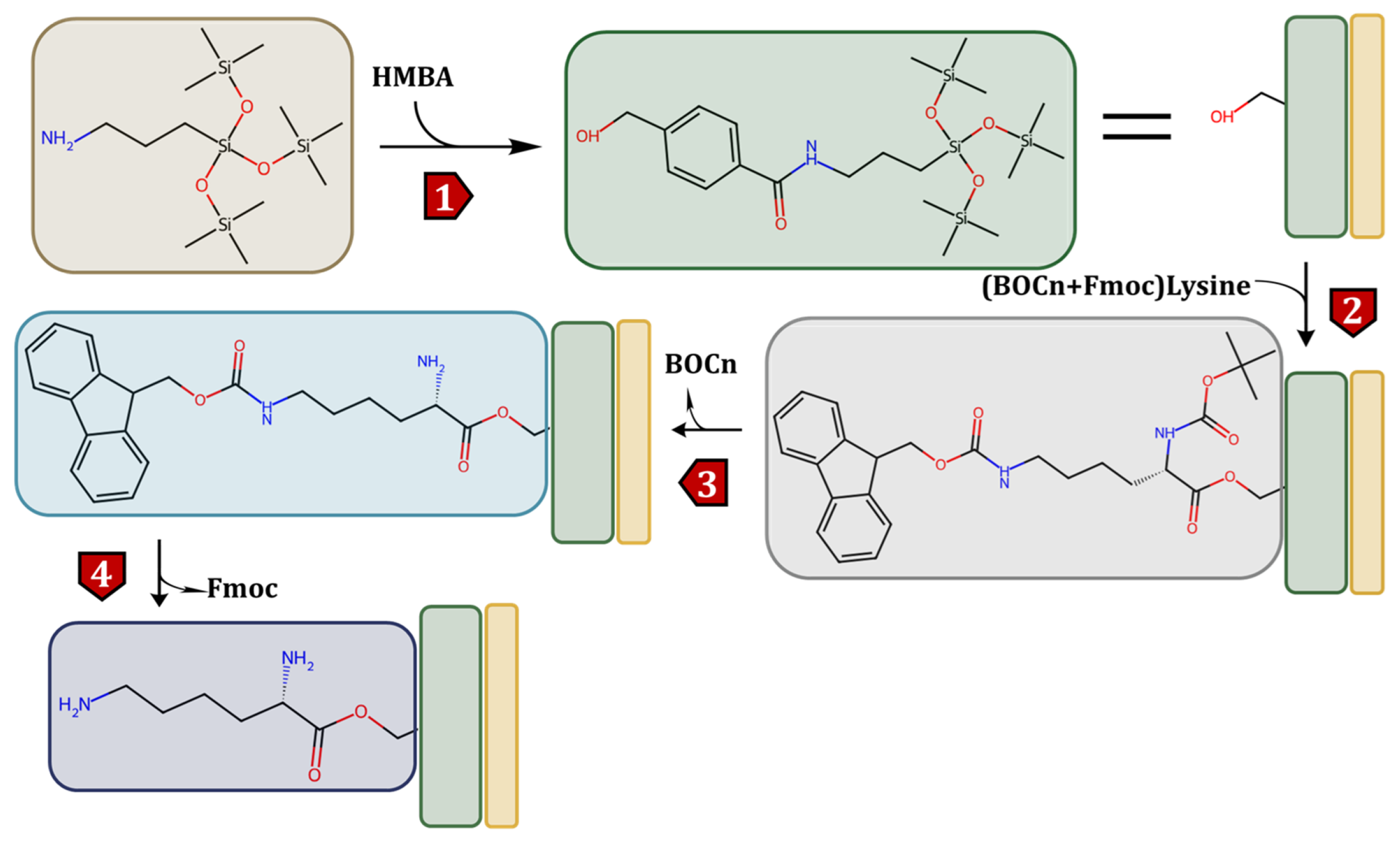
Figure 1 shows a representative four-step route using (3-aminopropyl)triethoxysilane (APTES) grafted on SiO2 with standard tert-butoxycarbonyl (BOCn) and 9-fluorenyl-methoxycarbonyl (Fmoc) for the protection/deprotection of amino acids [5]. The steps in the figure are (1) 4-hydroxymethylbenzoic acid (HMBA) attachment—which allows for peptide immobilization by the C-terminus; (2) anchoring of dually protected lysine (Fmoc on the N-terminus; BOCn on the side-chain amine); (3) BOCn deprotection; and (4) Fmoc deprotection [5]. These steps broadly fall into reagent coupling, deprotection and washing cycles, with the washing cycles often including numerous solvents added in succession [5].
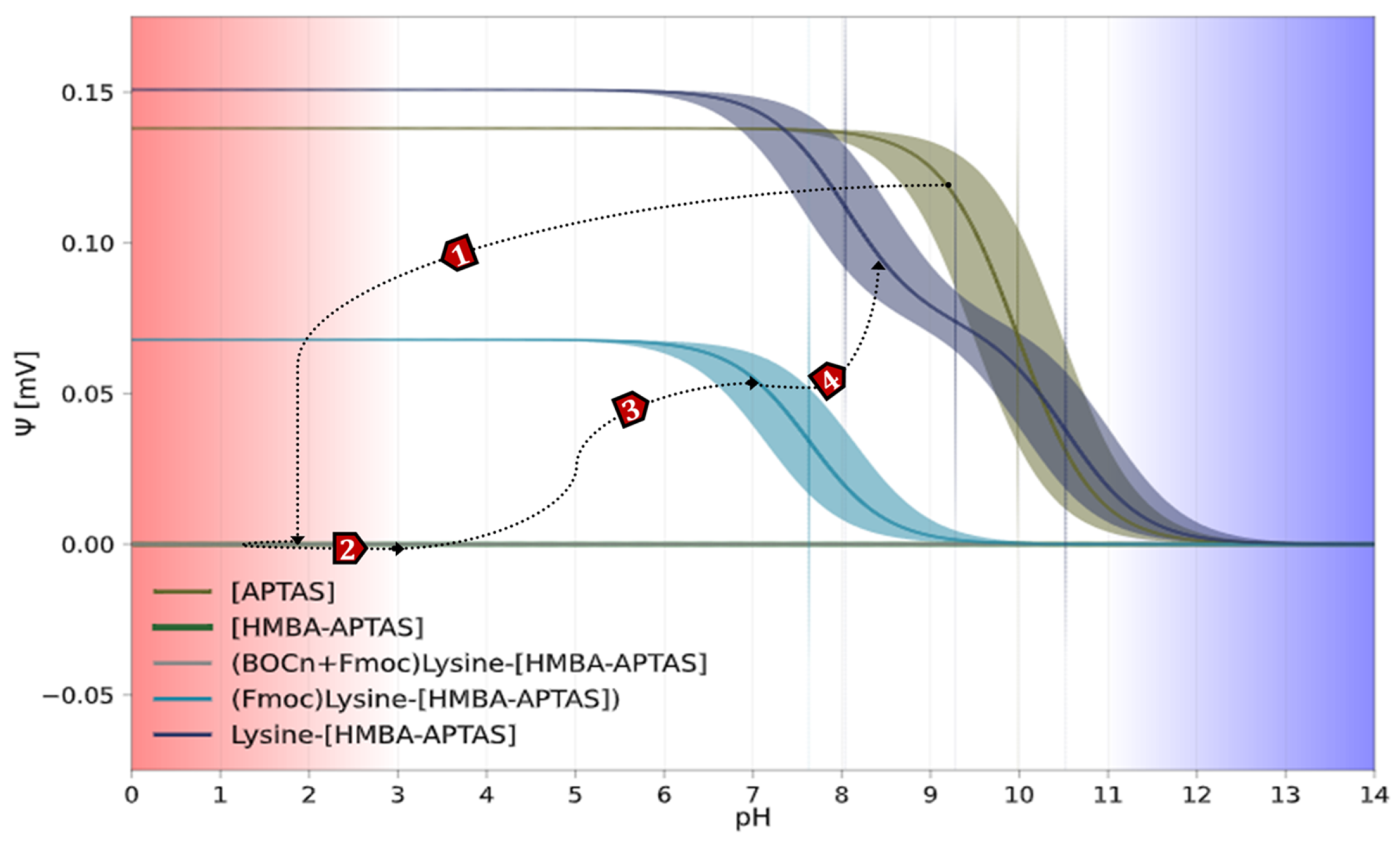
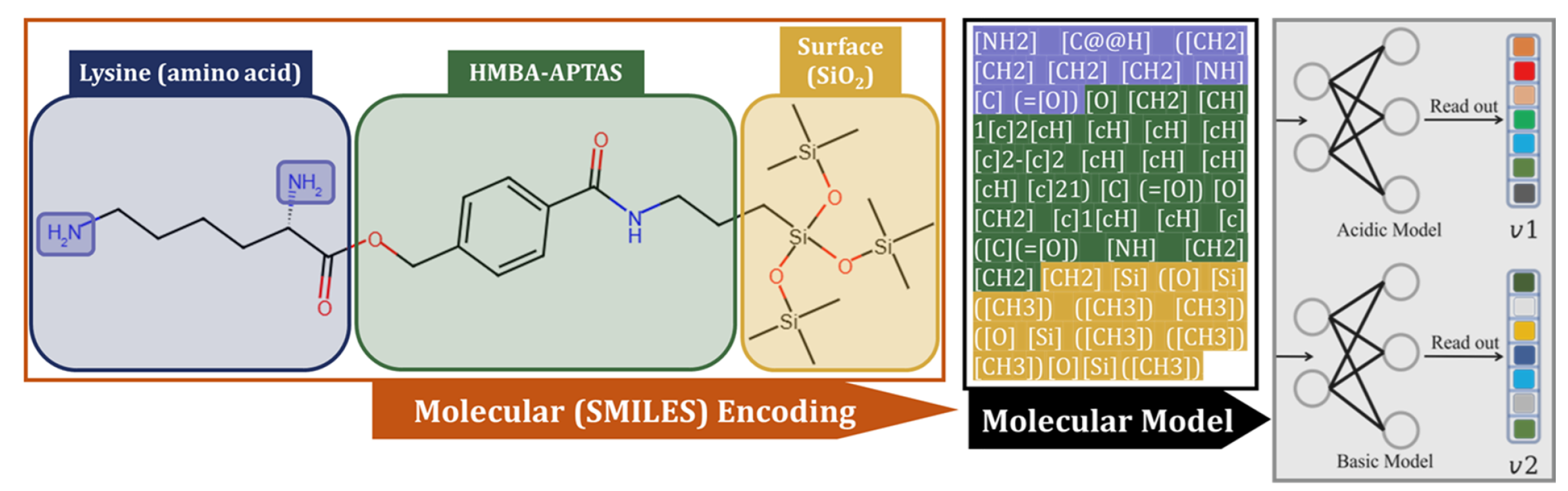
Each reaction intermediate in Figure 1 is encoded following the methodology in Figure 2, with a representative SiO2 surrogate shown in yellow. This treatment of the surface captures immobilization and bonding chemistry without explicitly modeling the extended surface and all atoms, making the problem computationally tractable for large peptide libraries. We first encode the combined peptide–immobilization–surface as SMILES, which converts the covalent bonding of the molecular system into a one-dimensional machine-interpretable object. We then pass the SMILES object to the molecular modeling steps, which here includes MolGpKa’s graph-convolutional model to predict site-specific pK values alongside the topological polar surface area (TPSA)—which are key molecular parameters in producing the ψ 0 ( pH ) plots [3,7]. For every titratable group in each intermediate molecule, we propagate an illustrative per-site ±0.5 pK confidence interval envelope to the parameters as a representative order-of-magnitude uncertainty inspired by benchmarks [8,9]. As in our prior framework, the site-binding model maps protonation to surface charge, and a coupled Gouy–Chapman–Stern solve yields the ψ 0 ( pH ) , as shown in Figure 3, noting that we report ψ 0 as the FET-relevant surface input and do not fit a specific device transfer curve [3,7].
Figure 2. SMILES-based encoding used for downstream modeling. Here, MolGpKa [8] supplies pK and TPSA descriptors; however, other tasks may include conformational sampling, as shown in Figure 4. Colors: blue-deprotected amino acid with titratable amines; green-HMBA; yellow-SiO2 surrogate. Fragment highlights (middle pane) correspond to substructures (left pane).
Engproc 127 00014 g002
Figure 3. Simulated ψ 0 ( pH ) titrations for steps 1–4 with per-site ±0.5 pK confidence envelopes. Arrows indicate reaction progression only and the start/end positions are not relevant. The colour of each plot matches the colour of the inserts in Figure 1.
Engproc 127 00014 g003
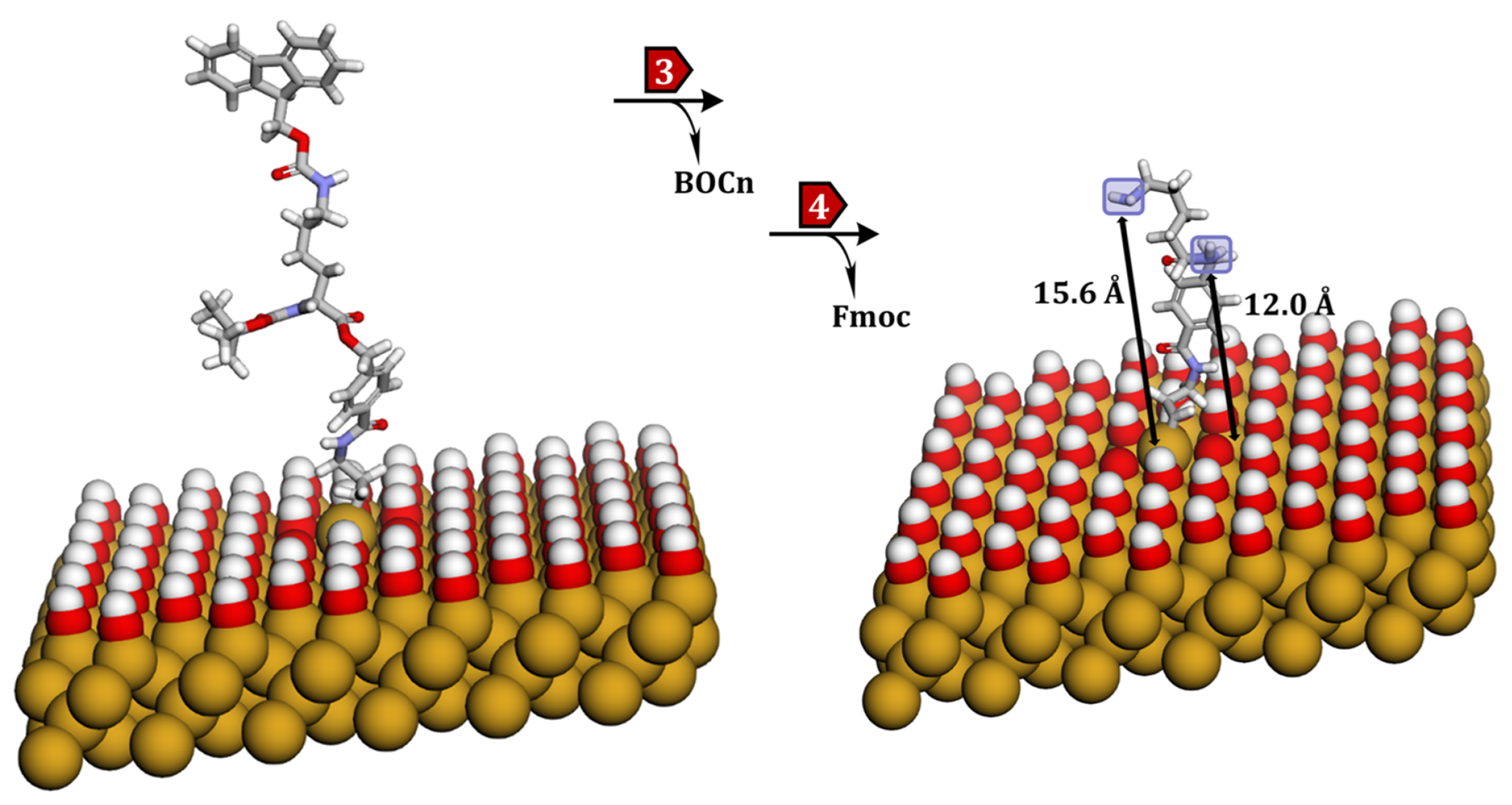
Figure 4. Example energy-minimized conformation of (left) (BOCn+Fmoc)Lysine-[HMBA-APTES] and (right) Lysine-[HMBA-APTES] with tridentate APTES linkage on SiO2, generated using the UFF [10]. Height labels denote charge-centre (titratable group) distances from the oxide surface, which we define as the central point of the surface oxygen atom. Energy minimization was performed by freezing the surface molecules, and an initial section of the [HMBA-APTES] section was placed in an extended conformation to ensure that the initial pose had no atom collisions. Note: We present a mixed visualization, representing the surface as van der Waals spheres, and the peptide-immobilization system as ‘sticks’.
Engproc 127 00014 g004

3. Results

We test whether modeled ψ 0 ( pH ) plots may be used to signal reaction completion for key steps in our representative SPPS pathway. Figure 3 plot ψ 0 ( pH ) titrations are shown for each reaction intermediate in Figure 1, with each reaction step (1–4) shown in red arrows. The addition of HMBA (step 1) removes the basic amine from the initial APTES immobilization and renders a neutral molecule over the pH domain—reflected in a flat titration profile with zero ψ 0 at all pH values. The addition of BOCn and Fmoc protected lysine (step 2) shows no charge contrast in Figure 3 (reflected in overlapping, flat plots); however, given that the added residue increases layer mass and molar refractivity, we expect this step to be the most robustly discernible through SPR measurements alone [4,5]. The removal of BOCn (step 3) exposes the side-chain amine, providing a basic site that yields a separable ψ 0 ( pH ) plot, exposing the N-terminus (step 4) through a subsequent deprotection, providing an additional inflection point and further shifting the resulting ψ 0 (pH) envelope such that it remains separated from step 3. Here, we deem steps distinguishable when their confidence bands exhibit any non-overlapping interval.

4. Future Work

Our SMILES-based encoding methodology is task-agnostic, driving the prediction of molecular parameters pK and TPSA, and as illustrated here, conformational sampling and further modeling work. Figure 4 shows the conformations of fully protected (left), and deprotected (right) lysine–immobilization–surface systems in the absence of solvent generated using the universal force field (UFF) [10]. By considering the spatial extent of the peptide, we can address assumptions in our analytical model related to the treatment of the electrolyte, such as screening and ion crowding [11]. We highlight this initial treatment by labeling with height labels, which could be used in the consideration of ion screening and more granular modeling of the electrolyte and explicit modeling of molar refractivity for SPR responses.

5. Conclusions

In this paper, we show that simulated ψ 0 ( pH ) titrations may be used to distinguish the HMBA addition along with BOCn and Fmoc deprotection steps in an illustrative SiO2 SPPS sequence, indicating a complementary role for optical monitoring alongside our proposed FET-based verification of reaction completion [5,6]. We model covalent attachment using an idealised tridentate APTES tether, extending our previous implementation to SiO2 [3]. Encoding each immobilized intermediate as a SMILES object readies the system for downstream tasks, including conformational–electrolyte analyses and prospective SPR-response studies as next steps.

Author Contributions

Conceptualization, methodology, and writing—N.S.; supervision, V.G.; co-supervision, P.P. and C.M.; writing—review and editing, all authors. All authors have read and agreed to the published version of the manuscript.

Funding

Supported by the Engineering and Physical Sciences Research Council (EPSRC) through the University of Glasgow DTP (EP/W524359/1).

Institutional Review Board Statement

Not applicable.

Informed Consent Statement

Not applicable.

Data Availability Statement

Data are available upon request from the corresponding authors.

Conflicts of Interest

The authors declare no conflicts of interest.

References

  1. Merrifield, R.B. Solid Phase Peptide Synthesis. I. The Synthesis of a Tetrapeptide. J. Am. Chem. Soc. 1963, 85, 2149–2154. [Google Scholar] [CrossRef]
  2. Martin, V.; Egelund, P.H.G.; Johansson, H.; Quement, S.T.L.; Wojcik, F.; Pedersen, D.S. Greening the Synthesis of Peptide Therapeutics: An Industrial Perspective. RSC Adv. 2020, 10, 42457–42492. [Google Scholar] [CrossRef] [PubMed]
  3. Smoliak, N.; Kumar, N.; Parreira, P.M.; Macdonald, C.; Georgiev, V. A Hybrid Analytical and Machine Learning Model of BioFETs for the Detection of Peptides. IEEE Sens. Lett. 2025, 9, 4502604. [Google Scholar] [CrossRef]
  4. Nguyen, H.H.; Park, J.; Kang, S.; Kim, M. Surface Plasmon Resonance: A Versatile Technique for Biosensor Applications. Sensors 2015, 15, 10481–10510. [Google Scholar] [CrossRef] [PubMed]
  5. Cristóbal-Lecina, E.; El-Maiss, J.; Figueras, E.; Singh, A.C.; Krishnamoorthy, S.; Østerbye, T.; Pascual García, C.; Andreu, D. Acid-Modulated Peptide Synthesis for Application on Oxide Biosensor Interfaces. Nanomaterials 2023, 13, 3092. [Google Scholar] [CrossRef] [PubMed]
  6. Shukla, R.P.; Bomer, J.G.; Wijnperle, D.; Kumar, N.; Georgiev, V.P.; Singh, A.C.; Krishnamoorthy, S.; García, C.P.; Pud, S.; Olthuis, W. Planar Junctionless Field-Effect Transistor for Detecting Biomolecular Interactions. Sensors 2022, 22, 5783. [Google Scholar] [CrossRef] [PubMed]
  7. Kumar, N.; Pritam Singh Dhar, R.; El Maiss, J.; Georgiev, V.; García, C.P. Discovery of Amphoteric Fingerprints of Amino Acids With Field-Effect Transistors. IEEE Access 2024, 12, 134085–134090. [Google Scholar] [CrossRef]
  8. Pan, X.; Wang, H.; Li, C.; Zhang, J.Z.H.; Ji, C. MolGpka: A Web Server for Small Molecule pKa Prediction Using a Graph-Convolutional Neural Network. J. Chem. Inf. Model. 2021, 61, 3159–3165. [Google Scholar] [CrossRef] [PubMed]
  9. Işık, M.; Rustenburg, A.S.; Rizzi, A.; Gunner, M.R.; Mobley, D.L.; Chodera, J.D. Overview of the SAMPL6 pKa Challenge: Evaluating Small Molecule Microscopic and Macroscopic pKa Predictions. J. Comput.-Aided Mol. Des. 2021, 35, 131–166. [Google Scholar] [CrossRef] [PubMed]
  10. Landrum, G.; Tosco, P.; Kelley, B.; Rodriguez, R.; Cosgrove, D.; Vianello, R.; sriniker; Gedeck, P.; Jones, G.; Kawashima, E.; et al. Rdkit/Rdkit: 2025_03_6 (Q1 2025) Release. Zenodo. 2025. Available online: https://zenodo.org/records/16996017 (accessed on 10 October 2025).
  11. Israelachvili, J.N. Chapter 14—Electrostatic Forces between Surfaces in Liquids. In Intermolecular and Surface Forces, 3rd ed.; Israelachvili, J.N., Ed.; Academic Press: San Diego, CA, USA, 2011; pp. 291–340. [Google Scholar] [CrossRef]
Figure 1. Representative SPPS reaction pathway (solvents excluded) on SiO2. Step labels match text references and those in Figures through this work.
Engproc 127 00014 g001
Disclaimer/Publisher’s Note: The statements, opinions and data contained in all publications are solely those of the individual author(s) and contributor(s) and not of MDPI and/or the editor(s). MDPI and/or the editor(s) disclaim responsibility for any injury to people or property resulting from any ideas, methods, instructions or products referred to in the content.