Proceeding Paper

Alternative Navigation Approaches for Railways: Overcoming GNSS Limitations †

by
Jakub Steiner
1,2,*,
Timo Pech
3,
Tomáš Duša
1,
Klaus Mößner
3 and
Mária Kmošková
4
1
GNSS Centre of Excellence, 14200 Prague, Czech Republic
2
Department of Air Transport, Faculty of Transportation Sciences, Czech Technical University in Prague, 12800 Prague, Czech Republic
3
Faculty of Electrical Engineering and Information Technology, Chemnitz University of Technology, 09126 Chemnitz, Germany
4
CEDA Maps, 14000 Prague, Czech Republic
*
Author to whom correspondence should be addressed.
Presented at the European Navigation Conference 2025 (ENC 2025), Wrocław, Poland, 21–23 May 2025.
Eng. Proc. 2026, 126(1), 23; https://doi.org/10.3390/engproc2026126023
Published: 25 February 2026
(This article belongs to the Proceedings of European Navigation Conference 2025)

Abstract

Accurate and reliable train localization is critical for rail safety, particularly on regional and rural lines where traditional track-based infrastructure (e.g., balises, track circuits) is often too costly. Global Navigation Satellite Systems (GNSSs) offer a potential solution, but their performance degrades significantly in obstructed environments such as tunnels, forested areas, and deep cuttings commonly present on rail. This study presents a real-world case study of a GNSS-only navigation performance measurement on a regional railway track. Using a mass-market GNSS receiver and a high-precision reference system, the study analyses the position accuracy. Results highlight the limitations of GNSS-only navigation, particularly in meeting accuracy requirements for critical applications such as track distinction. To address these challenges, the study presents a comparative review of Alternative Positioning, Navigation, and Timing (A-PNT) methods. The technology level points to a multi-sensor fusion approach to ensure resilient, cost-effective rail localization for future intelligent and autonomous rail systems.

1. Introduction

Traditional railway positioning systems predominantly relied on track-based infrastructure to determine train location. The European Train Control System (ETCS) employs Eurobalises, which are RFID-based passive transponders installed at regular intervals along railway tracks. As trains pass over these balises, onboard equipment detects their unique identifiers, enabling position updates based on the balise block defined by the distance between balises. This technology is particularly significant in ETCS implementations at levels two and three, where it works in conjunction with odometry systems to maintain continuous position awareness between balise detections [1].
Track circuits and axle counters represent another fundamental track-based positioning component. Track circuits function by detecting the presence of train wheelsets that complete an electrical circuit between the rails [2]. While these systems effectively determine occupancy on specific track segments, they provide limited resolution for precise localization. Similarly, axle counters operate by registering the passage of train axles at fixed points, enabling the system to confirm train movement between designated locations and train physical integrity. However, like track circuits, axle counters primarily serve detection rather than continuous positioning functions.
Recent technological advances have facilitated a shift towards sophisticated onboard sensor systems that enhance or, in some applications, replace traditional track-based positioning methods [3,4]. Global Navigation Satellite Systems (GNSSs), including GPS and Galileo constellations, for example, provide absolute continuous positioning capabilities with great accuracy.
Exploring and testing innovative localization methods and their integration into established railway systems is not a new endeavor. Already in the early 2000s, projects were conducted to investigate and integrate GNSSs, for example, with GADEROS (2000–2004) [5] or LOCOPROL (2001–2004) [6], which examined the integration of GNSSs into European railway operations. Additional GNSS-based projects followed, such as GaLoROI (2012–2014) [7,8,9]. The project shows that combined inputs from Galileo, eddy current sensors, and detailed track maps can enhance the accuracy of train positioning. However, GNSS reliability diminishes in challenging environments such as tunnels, dense urban areas, and deep cuttings where signal obstruction occurs, necessitating complementary technologies.
Odometers and wheel sensors calculate the distance traveled by measuring wheel rotations. While fundamental to train positioning, these systems face inherent limitations due to wheel slip and skid phenomena, particularly during acceleration, braking, or adverse weather conditions. Consequently, modern implementations typically integrate odometry with other positioning technologies to mitigate these effects. The CLUG [10] and CLUG 2 [11] projects aim to develop a reliable train positioning system that functions accurately in rail environments by fusing GNSSs with eddy current sensors, IMUs, digital maps, and odometry for safety-critical applications, while addressing railway-specific requirements, regulatory compliance, and standardization.
Inertial Navigation Systems (INSs) employ accelerometers and gyroscopes to track train movement and orientation by measuring acceleration forces and rotational changes. These systems prove invaluable when GNSS signals are unavailable, though they suffer from cumulative drift errors over extended operation periods, requiring periodic recalibration against absolute position references [12]. Also, a multi-sensory approach for localization was investigated in the Sensors4Rail [13] project. Localization of the train was measured by a combination of different systems, including GNSSs in combination with a vehicle odometer and onboard sensor-based detection of landmarks in combination with 3D maps.
The use case of regional European rail tracks is, in the majority of cases, not profitable enough for expensive traditional track-based infrastructure deployment. The GRAIL project estimates the price for a new kilometer of traditional track-based rail infrastructure to be around 115 million USD [14]. This creates a use case for Alternative Positioning, Navigation, and Timing (A-PNT) systems to the traditional track-based infrastructure. GNSSs can seem like a cost-effective and scalable navigation/localization solution for rail. However, a GNSS has its limitations, especially on regional tracks in more rural areas. To better illustrate and quantify these GNSS limitations on a regional rail track, a GNSS navigation performance case study was performed, and results are presented in Section 3. Subsequently, an overview of A-PNT solutions and approaches is given in Section 4 as a roadmap for future development, which will aid in overcoming GNSS limitations. Within the presented paper, the term A-PNT should be understood as a technology providing position, velocity, and time (PVT) independently from GNSSs.

2. Materials and Methods

The GNSS navigation performance case study was performed on a test track in the Czech Republic using a mass-market receiver as the device under test and a geodesy-grade multi-PNT source system for reference. This section introduces the measurement methods and materials used in detail.

2.1. Track Description

The Chomutov–Vejprty is a single-track railway line, non-electrified, situated in the Czech Republic. The track spans a diverse landscape that includes densely forested areas, urban environments, and open-sky areas. The track goes through multiple underpasses that introduce substantial GNSS signal obstruction, making it a challenging environment for GNSS-based navigation. This section of the railway presents suitable regional rail case study conditions for GNSS and A-PNT solutions testing due to its geographical complexity and intermittent GNSS signal availability. Additionally, in 2023, this track was re-classified as a test track, making measurement organization much easier and faster. The surrounding terrain contributes to multipath errors, where GNSS signals reflect off nearby surfaces, affecting positional accuracy. These factors make the Chomutov–Vejprty route a valuable testing ground for assessing the limitations of standalone GNSS-based navigation and the feasibility of A-PNT localization techniques.

2.2. Measurement Setup and Used Hardware

For the GNSS navigation measurement run, a mass-market receiver and a reference receiver were deployed on a measurement platform. The platform was mounted on a flat wagon with careful consideration given to vibration damping and structural integrity to minimize disturbances in recorded data. The measurement campaign consisted of two runs, the first from Chomutov to Vejprty and the second the other way around.
The reference receiver was a POS LV 610 model produced by the company Trimble Applanix [15] a mobile mapping and positioning company. It combines a multi-frequency multi-constellation high-precision GNSS receiver with a high-grade Inertial Measurement Unit (IMU) and odometer to provide precise positioning data even during GNSS signal outages. The reference receiver also supports Real-Time Kinematic (RTK) corrections, further improving accuracy. The RTK corrections were sourced from a Czech national provider, CZEPOS. The system has two Trimble GNSS antennas with enhanced multipath mitigation features, ensuring optimal signal reception even in challenging environments. The receiver was connected to a data logging system capable of capturing PVT information at 10 Hz. The system also logged raw GNSS observables, allowing for post-processing and detailed performance evaluation. Using the Applanix POSPac v9.4 and RiProcess v1.9.4 (RIEGL) software tools, the RTK corrections were applied, and the final position accuracy was estimated by the post-processing RIEGL tools to be in the range of 0.037 to 0.072 m.
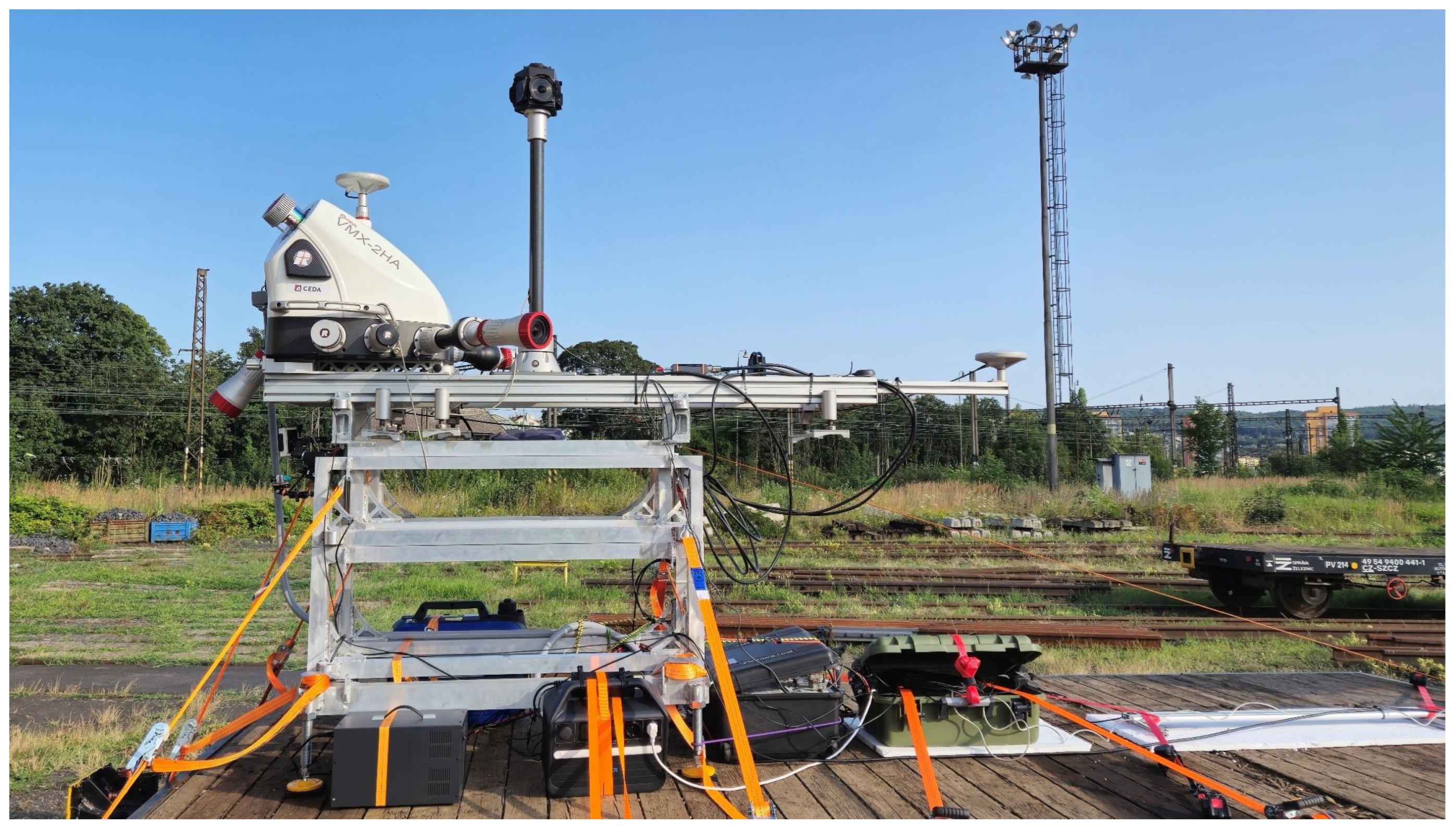
The mass-market receiver is a multi-frequency multi-constellation receiver without IMU coupling. It supports the L1, L2, and L5 GNSS frequency bands and GPS, GLONASS, Galileo, and BeiDou constellations. The mass-market receiver is equipped with an IMU. However, the use of IMU was disabled for the run. The receiver also receives and processes EGNOS. Two types of datasets were derived from the mass-market receiver. The first is the raw GNSS PVT receiver output, and the second is PVT information after the RTK correction application. Figure 1 displays the entire measurement apparatus consisting of both the reference receiver and the mass-market receiver deployed on the flat wagon.

2.3. Navigation Performance Evaluation Methodology

The ground truth PVT data derived from the reference receiver was compared with the mass-market receiver PVT data (both raw and after RTK) to evaluate the navigation performance. The evaluation included the computation of the Horizontal Position Error (HPE) and availability metrics. HPE is computed as the coordinate difference between the two receivers in the international terrestrial reference frame. No track data was used in the HPE calculation. HPE is described via the Cumulative Distribution Function (CDF) and statistical metrics of Max, Min, Mean, Median, and Standard Deviation (std). The availability in percentage is determined as a relation between all epochs with a valid time stamp and the count of all tested epochs.

3. Results

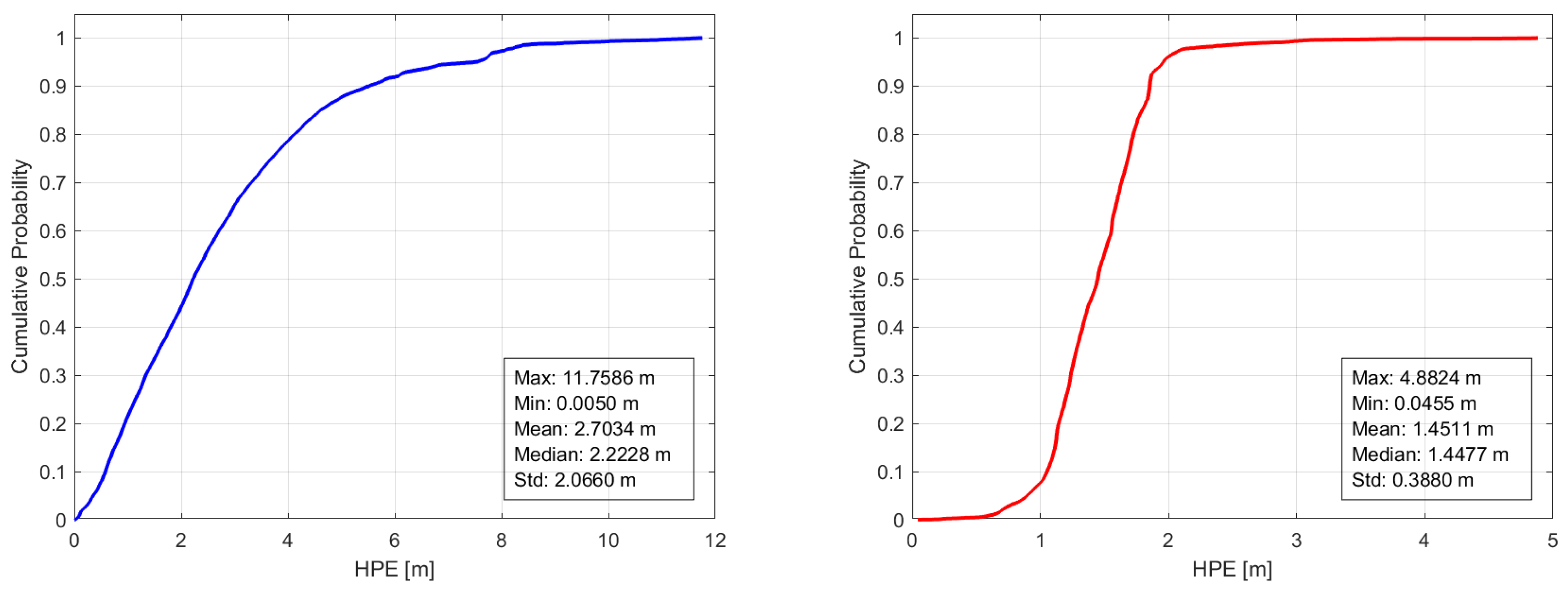
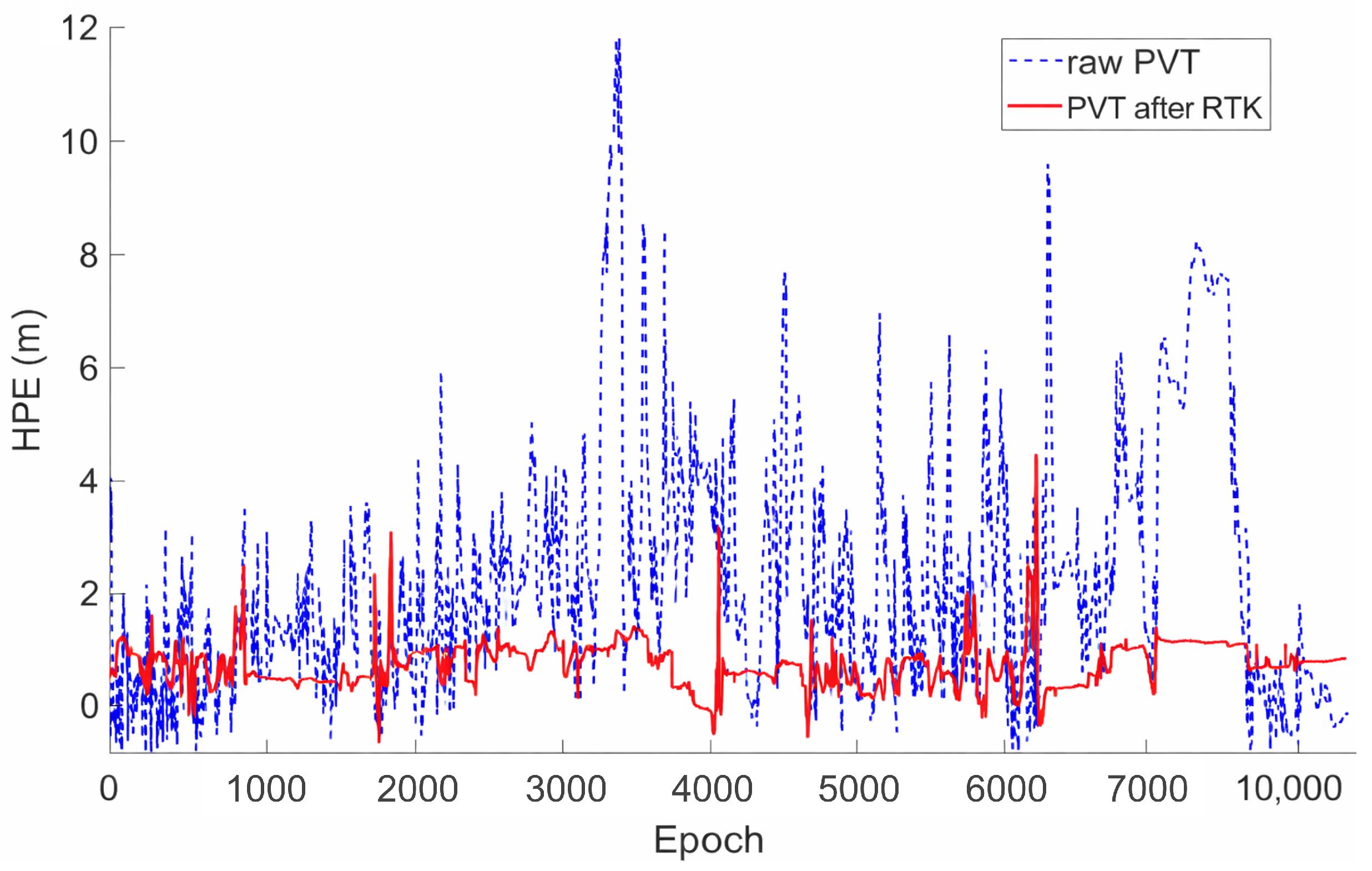
Figure 2 depicts the HPE CDF for both datasets. The raw PVT dataset directly from the mass-market receiver, without any corrections applied, is visualized in blue. The PVT dataset after RTK application is displayed in red. Additionally, Figure 3 provides the HPE evolution over the course of the measurement run from Chomutov to Vejprty for both datasets. The mass-market receiver achieved 100% availability during the test run.

4. A-PNT Solutions and Approaches

Alternative railway localization systems have varying degrees of accuracy, deployment feasibility, scalability, and reliability. The following analysis compares PNT technologies based on current state-of-the-art technology for railway applications; see Table 1.
The classification of high (H), medium (M), low (L) or unknown (–) in Table 1, means, for example, with high feasibility, the corresponding system is realistically implementable cost-efficiently with relatively less effort. A low scalability, for example, means that the solution is difficult, costly, or impractical to deploy widely. Reliability is low if it is limited, for example, due to stability or environmental influences. In some cases, precise data on the technologies within the application domain is unavailable and was instead inferred from the findings and conclusions presented in the cited literature.
GNSSs and INSs are established PNT systems. In the railway sector, these technologies are rather new in regard to safety-critical applications and are currently used for information or onboard applications. However, some countries already provide RTK-network solutions for train positioning. For comparison with other technologies, GNSSs and INSs are also mentioned in Table 1, which provides an A-PNT technology overview and comparison.
GNSS and INS implementation feasibility is high with affordable receivers already integrated into many rail systems. INSs are used mainly to support GNSSs in GNSS-denied environments. A paper by Zhou [16] describes a methodology in which location-dependent track irregularities are mapped and used only for localization with INSs. However, the general operational reliability of GNSSs and INSs is medium. GNSSs diminish significantly in tunnels and urban canyons. INS drift characteristics require periodic corrections.
Fiber Optic Sensing (FOS) as an A-PNT utilizes existing fiber cables for meter-level train detection accuracy. Implementation feasibility is medium to high when repurposing existing fiber cables. Scalability is excellent with single interrogators monitoring dozens of track kilometers. Operational reliability is high, unaffected by weather or electromagnetic interference [17,18].
Ultra-Wideband (UWB) technology achieves impressive centimeter-level accuracy, making it valuable for applications where precision is essential [19,20]. Implementation feasibility is low to medium due to the required dedicated infrastructure and a rather limited area of use. This requires a high UWB anchor density. Scalability is estimated as medium because of the necessary equipment of the tracks. Currently, UWB is used mainly indoors, that is, in train stations, underpasses, or tunnels [21].
Emerging Integrated Sensing and Communication (ISAC) methodologies based on 5G networks offer theoretical accuracy at the meter- to decimeter-level with dense antenna deployment. Implementation feasibility is a theoretical medium, constrained by infrastructure requirements along rail corridors. However, the technology is in an early research stage. Scalability advantages are significant with network-based positioning, depending on whether FRMCSs (Future Railway Mobile Communication Systems) or public infrastructure can be used. Operational reliability is still being evaluated as the technology is still under development [22,23,24].
Camera and LiDAR sensors have gained prominence in advanced train applications, providing not only speed measurement capabilities but also environmental perception for obstacle detection, e.g., [7,25]. These technologies increasingly support vision-based positioning approaches through track marker recognition, feature-based localization of landmarks, and Simultaneous Localization and Mapping (SLAM) [26] techniques that dynamically build environmental models while determining the position within them [27,28]. In the Sensors4Rail project, optical sensor-based localization techniques were explored to improve positioning in GNSS-challenged environments [13]. Implementation feasibility is medium to high due to integration costs and environmental sensitivity. The relative advantage regarding costs and effort here is that the sensors are integrated into the train and the infrastructure does not need to be changed. Scalability is challenging, requiring detailed mapping for each route. Operational reliability is medium, with performance degradation in adverse conditions if no countermeasures are taken. The technology is still under development for operational use.
The Magnetic Pattern Matching approach leverages magnetic field variations for meter positioning accuracy. Implementation feasibility is medium, requiring high-resolution magnetic maps. Scalability considerations mirror other map-based approaches, needing updates when track environments change. Reliability ranges from medium to high, with immunity to GNSS denial but sensitivity to ferrous disruptions [29,30].
Each PNT technology exhibits complementary strengths and limitations. While a GNSS offers excellent coverage and scalability, its performance degrades in obstructed environments. UWB delivers good accuracy and infrastructure requirements but is mainly used indoors. Methodologies leveraging 5G technologies show potential as an A-PNT solution, though they are in the research phase. Optimal railway positioning will likely emerge from multi-sensor fusion approaches, leveraging complementary characteristics for continuous, accurate positioning across diverse operational environments.
Table 1. Comparative analysis of PNT technologies for train localization; classification: high (H), medium (M), low (L), and unknown (–).
TechnologyMeasured ValuesAccuracyFeasibilityScalabilityReliabilityRail Applications
GNSSabsolute position, velocitymeter-level to centimeter-level with RTKHHMused in different applications and projects [6,9,31,32]
INSvelocity, acceleration, headingdrift accumulates over timeHMMGNSS backup, esp. in tunnels  [16,33]
FOSposition through vibrationmeter-levelM—HHHtrain tracking, asset monitoring  [17,18]
UWBposition, velocitydecimeter to centimeter-levelL—MMHpossible use: subways, dense infrastructure [19,20,21]
5G positioningpositionmeter- to decimeter-level in theoryMHearly research stage [23,24]
LIDAR3D structure, relative motioncentimeter- to decimeter-levelM—HMMresearch stage; mostly for mapping/inspection  [27,28,34]
Cameravisual odometry, markersmeter- to centimeter-levelM—HMMused in pilot projects and perception stacks  [35,36]
Magnetic field sensorposition, velocitymeter- to centimeter-levelMMM—Hresearch stage; usage in tunnels [29,30]

5. Discussion

The results in Section 3 demonstrate the GNSS navigation limitations on regional rail tracks. With no corrections applied, the mass-market receiver achieved an HPE of 7.46 m at the 95th percentile. Naturally, after applying the RTK correction, the HPE 95th percentile decreased to 1.96 m. Although this navigation performance might seem sufficient for some rail operations, in the case of a double-track railway, the requirement for track distinction is 1.5 m HPE or lower. Additionally, the RTK correction availability might be limited on regional railway tracks due to incomplete internet coverage.
These navigation performance results underline the need for a second source of PNT besides GNSSs for reliable and safe rail operations. A second independent source of PNT is also a key requirement for autonomous train driving systems. The presented navigation accuracy results complement the previously published study on GNSS integrity in railways [37]. Other important requirements for the implementation of A-PNT systems in the railway sector are cost-effectiveness and integrability. One such project aiming for rail implementation is the ALTRAINAV project [38], which develops an A-PNT system based on visual sensors enabled by highly accurate mapping point cloud references.
Regarding the A-PNT usage, a multi-sensor onboard localization system could be particularly useful on low-density, operational grounds and regional lines. A-PNT can also be used alongside ETCS. A-PNT can augment ETCS by providing positioning continuity between balises, see, e.g., ERTMS Hybrid Level 3 [39].

6. Conclusions

This study demonstrates the operational limitations of GNSS-only localization for regional railways, particularly in complex environments with frequent signal obstructions. Through empirical data gathered on the Chomutov–Vejprty track, we show that a mass-market GNSS receiver (even with RTK) might struggle to meet the more demanding horizontal accuracy requirements for applications such as track distinction. These findings reaffirm the necessity for robust and redundant localization systems in rail.
To address this gap, we present a simplified evaluation of multiple A-PNT technologies suitable for rail, considering accuracy, scalability, and implementation feasibility. While no single technology stands out as the clear solution, many show promise when integrated into multi-sensor solutions. The presented analysis underscores the importance of combining complementary systems such as GNSS, inertial sensors, optical sensors, and infrastructure-agnostic methods to provide reliable positioning across varying operational contexts.
Future work can focus on the technology development and its suitability for rail applications. There are many projects developing A-PNT for rail solutions aiming to become driver advisory systems. Continued interdisciplinary collaboration will be essential to move from concepts and advisory systems to certified systems that can support also the safety-critical demands of autonomous rail operations, for example.

Author Contributions

Conceptualization, T.D. and T.P.; methodology, J.S., T.P. and K.M.; software, J.S. and K.M.; formal analysis, T.P. and J.S.; investigation, J.S., T.P., T.D. and K.M.; resources, T.P. and M.K.; data curation, J.S.; writing—original draft preparation, J.S. and T.P.; writing—review and editing, T.D., K.M. and M.K.; visualization, J.S. and M.K.; supervision, T.D. and K.M.; project administration, T.D.; funding acquisition, T.D. and T.P. All authors have read and agreed to the published version of the manuscript.

Funding

This research was executed in the ALTRAINAV project, which is a Czech–German cross–border project co-founded by the European Union (EFRE) through the Technology Agency of the Czech Republic (TACR), as well as co-founded by the European Union (EFRE) and co-financed from tax revenues on the basis of the budget adopted by the Saxon State Parliament.

Institutional Review Board Statement

Not applicable.

Informed Consent Statement

Not applicable.

Data Availability Statement

The data presented in this study are available on request from the corresponding author.

Acknowledgments

The flat wagon and the motor universal vehicle wagon were provided to the research team by Správa železnic, which is the owner and provider of the Czech national and regional railway infrastructure owned by the Czech Republic.

Conflicts of Interest

Author Mária Kmošková was employed by the company CEDA Maps. The remaining authors declare that the research was conducted in the absence of any commercial or financial relationships that could be construed as a potential conflict of interest.

Abbreviations

The following abbreviations are used in this manuscript:
A-PNTAlternative Positioning, Navigation, and Timing
CDFCumulative Distribution Function
ETCSEuropean Train Control System
FOSFiber Optic Sensing
FRMCSFuture Railway Mobile Communication System
GNSSGlobal Navigation Satellite System
HPEHorizontal Position Error
IMUInertial Measurement Unit
INSInertial Navigation System
ISACIntegrated Sensing and Communication
LiDARLight Detection and Ranging
PNTPositioning, Navigation, and Timing
PVTPosition, Velocity, and Timing
RTKReal-Time Kinematic
SLAMSimultaneous Localization and Mapping
UWBUltra-Wideband

References

  1. EEIG ERTMS Users Group. ETCS: System Requirements Specification, Subset-026-4—Chapter 3 Principles. Version 4.0.0. 2023. Available online: https://www.era.europa.eu (accessed on 11 January 2025).
  2. Pachl, J. Railway Signalling Principles: Edition 2.0; Universitätsbibliothek Braunschweig: Braunschweig, Germany, 2021. [Google Scholar] [CrossRef]
  3. Albrecht, T.; Luddecke, K.; Zimmermann, J. A precise and reliable train positioning system and its use for automation of train operation. In Proceedings of the 2013 IEEE International Conference on Intelligent Rail Transportation (ICIRT), Beijing, China, 30 August–1 September 2013; pp. 134–139. [Google Scholar] [CrossRef]
  4. Löffler, W.; Bengtsson, M. Train Localization During GNSS Outages: A Minimalist Approach Using Track Geometry And IMU Sensor Data. In Proceedings of the 2024 27th International Conference on Information Fusion (FUSION), Venice, Italy, 8–11 July 2024. [Google Scholar]
  5. Urech, A.; Pérez Diestro, J.; González, O. GADEROS, a GAlileo Demonstrator for Railway Operation System. In Proceedings of the Data Systems in Aerospace, Dublin, Ireland, 13–16 May 2002; Harris, R.A., Ed.; ESA Special Publication: Noordwijk, The Netherlands, 2002; Volume 509, p. 46.1. [Google Scholar]
  6. ALSTOM. LOCOPROL-Low Cost Satellite Based Train Location System for Signalling and Train Protection for Low Density Railway Lines. European Commission, Transport Research and Innovation Monitoring and Information System (TRIMIS). 2004. Available online: https://trimis.ec.europa.eu/project/low-cost-satellite-based-train-location-system-signalling-and-train-protection-low-density (accessed on 11 January 2025).
  7. Stein, D. An analysis of different sensors for turnout detection for train-borne localization systems. In Proceedings of the Computers in Railways XIV, Online, 21–23 October 2025; Lauer, M., Spindler, M., Eds.; WIT Press: Billerica, MA, USA, 2014; Volume 1, pp. 827–838. [Google Scholar] [CrossRef]
  8. Nguyen, K.; Beugin, J.; Marais, J. RAMS analysis of GNSS based localisation system for the train control application. In Proceedings of the 2014 International Conference on Computing, Management and Telecommunications (ComManTel), Da Nang, Vietnam, 27–29 April 2014; pp. 101–106. [Google Scholar] [CrossRef]
  9. Nguyen, T.; Beugin, J.; Marais, J. Dependability evaluation of a GNSS and ECS based localisation unit for railway vehicles. In Proceedings of the 2013 13th International Conference on ITS Telecommunications (ITST), Tampere, Finland, 5–7 November 2013; IEEE: New York, NY, USA, 2013; pp. 474–479. [Google Scholar] [CrossRef]
  10. CLUG Project Consortium. CLUG Project: Certifiable Localisation Unit with GNSS in the Railway Environment. 2025. Available online: https://clugproject.eu/en (accessed on 14 April 2025).
  11. CLUG 2.0 Project Consortium. CLUG 2.0: Certifiable Localisation Unit with GNSS in the Railway Environment. 2025. Available online: https://www.clug2.eu/ (accessed on 14 May 2025).
  12. Allotta, B.; D’Adamio, P.; Malvezzi, M.; Pugi, L.; Ridolfi, A.; Vettori, G. A localization algorithm for railway vehicles. In Proceedings of the 2015 IEEE International Instrumentation and Measurement Technology Conference (I2MTC) Proceedings, Pisa, Italy, 11–14 May 2015; pp. 681–686. [Google Scholar] [CrossRef]
  13. Digitale Schiene Deutschland. Sensors4Rail Project Overview. 2025. Available online: https://digitale-schiene-deutschland.de/Sensors4Rail (accessed on 13 April 2025).
  14. Jenkins, B.; Urech, A.; Jose, M.; Prieto, G. GNSS Introduction in the RAIL sector. In Proceedings of the 2007 IET Seminar on Global Navigation Satellite Systems, Portsmouth, UK, 29 March 2007; pp. 143–155. Available online: https://ieeexplore.ieee.org/document/4160196 (accessed on 13 April 2025).
  15. Trimble Inc. (Applanix). Applanix POS LV: Designed for Integration, Built for Performance. Datasheet. Part Number (PN): 022520-034C (05/25). 2025. Available online: https://assets.ctfassets.net/9k5dj5b59lqq/1Rk6xUsM94XQFXfjtdHrGE/ae8163104c040819678bbb1f63ed7be3/022520-034C-PO_LV_USL_0525_LR_1.pdf (accessed on 3 February 2025).
  16. Zhou, Y.; Chen, Q.; Wang, R.; Jia, G.; Niu, X. Onboard Train Localization Based on Railway Track Irregularity Matching. IEEE Trans. Instrum. Meas. 2022, 71, 9501013. [Google Scholar] [CrossRef]
  17. Beirao, G.; Harper, W.; Coronel, C.; Austin, E. Combination of Fibre Optic Acoustic Sensing, IoT & Smart CCTV Data And Its Uses For The Rail Industry. Transp. Res. Procedia 2023, 72, 2668–2675. [Google Scholar] [CrossRef]
  18. Du, C.; Dutta, S.; Kurup, P.; Yu, T.; Wang, X. A review of railway infrastructure monitoring using fiber optic sensors. Sens. Actuators A Phys. 2020, 303, 111728. [Google Scholar] [CrossRef]
  19. Lin, H.; Ye, L.; Wang, Y. UWB, Multi-sensors and Wifi-Mesh based precision positioning for urban rail traffic. In Proceedings of the 2010 Ubiquitous Positioning Indoor Navigation and Location Based Service, Kirkkonummi, Finland, 14–15 October 2010; pp. 1–8. [Google Scholar] [CrossRef]
  20. Wang, R.; Jiang, H.; Zhang, Q.; Liu, G.; Yu, F.R. Real-Time UWB and IMU Fusion Positioning System for Urban Rail Transit with High Mobility. In Proceedings of the 2024 IEEE 99th Vehicular Technology Conference (VTC2024-Spring), Singapore, 24–27 June 2024; pp. 1–7. [Google Scholar] [CrossRef]
  21. Fall, B.; Elbahhar, F.; Heddebaut, M.; Rivenq, A. Time-Reversal UWB positioning beacon for railway application. In Proceedings of the International Conference on Indoor Positioning and Indoor Navigation (IPIN), Sydney, NSW, Australia, 13–15 November 2012; Rizos, C., Ed.; IEEE: Piscataway, NJ, USA, 2012; pp. 1–8. [Google Scholar] [CrossRef]
  22. Lu, F.; Huang, Z.; Li, Y.; Song, X.; Shi, X.; Wang, Y. Intergrated Sensing and Communications (ISAC) in 5G-Advanced for High-Precison Localization and Tracking of Vessels at Sea. In Proceedings of the 2024 10th International Conference on Computer and Communications (ICCC), Chengdu, China, 13–16 December 2024; pp. 1288–1292. [Google Scholar] [CrossRef]
  23. Talvitie, J.; Levanen, T.; Koivisto, M.; Pajukoski, K.; Renfors, M.; Valkama, M. Positioning of high-speed trains using 5G new radio synchronization signals. In Proceedings of the 2018 IEEE Wireless Communications and Networking Conference (WCNC), Barcelona, Spain, 15–18 April 2018; pp. 1–6. [Google Scholar] [CrossRef]
  24. Trivedi, M.A.; van Wyk, J.H. Localization and Tracking of High-speed Trains Using Compressed Sensing Based 5G Localization Algorithms. In Proceedings of the 2021 IEEE 24th International Conference on Information Fusion (FUSION), Sun City, South Africa, 1–4 November 2021; pp. 1–8. [Google Scholar] [CrossRef]
  25. Ziegler, M.; Mhasawade, V.; Köppel, M.; Neumaier, P.; Eiselein, V. A Comprehensive Framework for Evaluating Vision-Based on-Board Rail Track Detection. In Proceedings of the IEEE IV 2023, Anchorage, AK, USA, 4–7 June 2023; pp. 1–8. [Google Scholar] [CrossRef]
  26. Heirich, O.; Robertson, P.; Strang, T. RailSLAM—Localization of rail vehicles and mapping of geometric railway tracks. In Proceedings of the 2013 IEEE International Conference on Robotics and Automation, Karlsruhe, Germany, 6–10 May 2013; pp. 5212–5219. [Google Scholar] [CrossRef]
  27. Wang, Y.; Song, W.; Lou, Y.; Zhang, Y.; Huang, F.; Tu, Z.; Liang, Q. Rail Vehicle Localization and Mapping with LiDAR-Vision-Inertial-GNSS Fusion. IEEE Robot. Autom. Lett. 2022, 7, 9818–98250. [Google Scholar] [CrossRef]
  28. Wang, Y.; Lou, Y.; Song, W.; Tu, Z.; Wang, Y.; Zhang, S. Simultaneous Localization of Rail Vehicles and Mapping of Surroundings With LiDAR-Inertial-GNSS Integration. IEEE Sens. J. 2022, 22, 14501–14512. [Google Scholar] [CrossRef]
  29. Siebler, B.; Heirich, O.; Sand, S.; Hanebeck, U.D. Joint Train Localization and Track Identification based on Earth Magnetic Field Distortions. In Proceedings of the 2020 IEEE/ION Position, Location and Navigation Symposium (PLANS), Portland, OR, USA, 20–23 April 2020; pp. 941–948. [Google Scholar] [CrossRef]
  30. Strang, T.; Lehner, A.; Heirich, O.; Siebler, B.; Sand, S. Train-Localization in Tunnels using Magnetic Signatures. In Proceedings of the 2024 IEEE International Conference on Pervasive Computing and Communications Workshops and Other Affiliated Events (PerCom Workshops), Biarritz, France, 11–15 March 2024; pp. 702–707. [Google Scholar] [CrossRef]
  31. Exail. LOC4RAIL Project Overview. 2023. Available online: https://www.exail.com/resources/customer-stories/engineering-the-future-of-train-localization-within-the-loc4rail-project (accessed on 11 January 2025).
  32. Winter, H.; Willert, V.; Adamy, J. Train-borne Localization Exploiting Track-Geometry Constraints—A Practical Evaluation. arXiv 2019, arXiv:1906.07569. [Google Scholar] [CrossRef]
  33. Cunha, M.; Fund, F.; Meyer, S.; Legros, R.; Laurichesse, D.; Karouche, N.; Barré, A. A New GNSS-PPP/INS Data Fusion for Global Infrastructure-less Safe Train Positioning. In Proceedings of the 32nd International Technical Meeting of the Satellite Division of The Institute of Navigation (ION GNSS+ 2019), Miami, FL, USA, 16–20 September 2019; pp. 1265–1271. [Google Scholar] [CrossRef]
  34. Rahmig, C.; Johannes, L.; Lüddecke, K. Detecting Track Events with a Laser Scanner for using within a Modified Multi-Hypothesis Based Map-Matching Algorithm for Train Positioning. In Proceedings of the ENC 2013 Proceedings. European Navigation Conference (ENC 2013), Wien, Austria, 23–25 April 2013. [Google Scholar]
  35. Tschopp, F.; Schneider, T.; Palmer, A.W.; Nourani-Vatani, N.; Cadena, C.; Siegwart, R.; Nieto, J. Experimental Comparison of Visual-Aided Odometry Methods for Rail Vehicles. IEEE Robot. Autom. Lett. 2019, 4, 1815–1822. [Google Scholar] [CrossRef]
  36. Burschka, D.; Robl, C.; Ohrendorf-Weiss, S. Optical Navigation in Unstructured Dynamic Railroad Environments. arXiv 2020, arXiv:2007.03409. [Google Scholar] [CrossRef]
  37. Jonáš, M. GNSS Integrity for Railway Transportation. Trans. Transp. Sci. 2011, 4, 183–192. [Google Scholar] [CrossRef]
  38. Alternative Train Navigation (TM05000027). Project Supported by the Technology Agency of the Czech Republic Under Public Tender STA02024TM050. 2024. Available online: https://starfos.tacr.cz/en/projekty/TM05000027 (accessed on 11 January 2025).
  39. EEIG ERTMS Users Group. Hybrid ERTMS/ETCS Level 3: Principles; Technical Report Ref. 16E042 Version 1A; EEIG ERTMS Users Group: Brussels, Belgium, 2017. [Google Scholar]
Figure 1. The measurement apparatus combining the tested mass-market and reference receivers with all the other necessary components like data logging and power supply on a flat wagon.
Engproc 126 00023 g001
Figure 2. CDFs for HPE derived from mass-market receiver. The CDF on the left (in blue) was computed from the raw PVT dataset, whereas the CDF on the right (in red) was computed from the PVT dataset after the RTK application. Both plots also include HPE statistics in the bottom right corner for their respective datasets.
Engproc 126 00023 g002
Figure 3. HPE over the course of the measurement run for raw PVT output in blue and for PVT after RTK applied in red.
Engproc 126 00023 g003
Disclaimer/Publisher’s Note: The statements, opinions and data contained in all publications are solely those of the individual author(s) and contributor(s) and not of MDPI and/or the editor(s). MDPI and/or the editor(s) disclaim responsibility for any injury to people or property resulting from any ideas, methods, instructions or products referred to in the content.