1. Introduction
Global Navigation Satellite Systems (GNSSs) are widely used for positioning, navigation, and timing (PNT), but they face well-known limitations in signal-degraded environments such as urban canyons, indoors, or in the presence of jamming and spoofing. These challenges stem from the weak signal power and medium Earth orbit (MEO) geometry of GNSS satellites.
Low Earth Orbit (LEO) constellations offer several inherent advantages for PNT: significantly stronger received signal power due to closer proximity, improved geometry and visibility due to higher satellite density, and rapid orbital motion resulting in large Doppler dynamics. These features make LEO satellites especially attractive for Doppler-based navigation and resilient PNT applications.
Recent work in navigation using Signals of Opportunity (SoP) has shown that existing LEO constellations—originally designed for communications—can be opportunistically leveraged for positioning. Doppler-based positioning using Orbcomm and Iridium signals has been demonstrated for aiding inertial navigation or enabling standalone PNT in GNSS-denied environments [
1,
2]. Starlink signals have also been used to track pilot tones and carrier phases with high precision [
3,
4,
5]. Multi-constellation fusion approaches have improved robustness and accuracy, although integration is limited by varying signal characteristics and orbital behaviors [
6,
7,
8].
Despite these advances, many existing testbeds focus on single-constellation experiments or lack synchronization between receivers. Indoor applicability—critical for emerging LEO-based positioning use cases—remains largely unexplored. A notable exception is [
9], which used COTS SDRs for multi-constellation acquisition but without receiver synchronization and it was limited to outdoor tests.
To address these gaps, this work introduces a portable, SDR-based testbed for synchronized multi-constellation LEO signal acquisition and analysis using COTS components. Its performance is validated through outdoor and indoor campaigns, confirming its viability for real-world opportunistic navigation.
2. Multi-Constellation LEO Testbed Design
This section presents the multi-constellation LEO testbed, detailing its system architecture, signal acquisition, and software processing pipeline. First, the hardware components and synchronization mechanisms of the system are introduced. Then, the signal acquisition process is described, including the relevant parameters for each constellation and the challenges associated with simultaneous multi-band reception. Finally, the digital signal processing techniques employed to extract positioning observables are discussed.
2.1. System Architecture
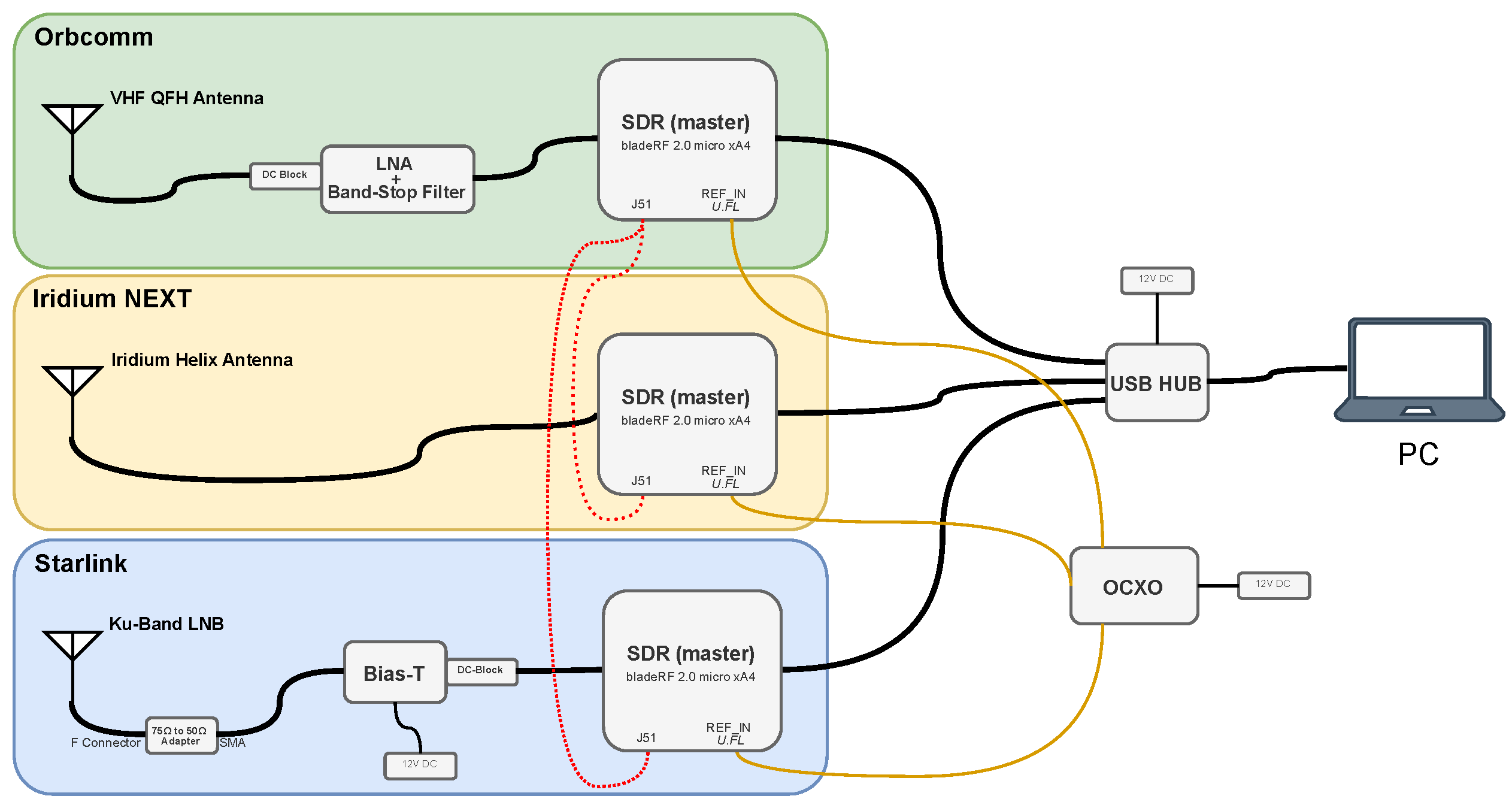
The proposed testbed facilitates synchronous reception and analysis of signals from multiple LEO constellations—Orbcomm, Iridium, and Starlink—using a modular hardware design. A high-level block diagram of the system is shown in
Figure 1. Each constellation employs a dedicated receiving chain optimized for its specific signal parameters (e.g., frequency bands, modulation schemes). All chains are synchronized via a common clock and controlled through a centralized software framework to ensure temporal alignment and coherent data fusion.
2.1.1. Constellation Specific Reception Chains
Each constellation is received using a dedicated chain tailored to its frequency and polarization characteristics, while all signals are digitized using bladeRF 2.0 micro xA4 SDRs (Nuand, San Francisco, CA, USA).
For Orbcomm (137–138 MHz), a quadrifilar helix antenna (UC-1374-531R; Antennas.us, Margate, FL, USA [
10]) matched to RHCP is used in combination with a Nooelec SAWbird+ NOAA LNA (Nooelec, Wheatfield, NY, USA [
11]), which includes a SAW filter to suppress FM broadcast interference. In budget-constrained setups, a dipole antenna arranged in a V-configuration also provides sufficient reception due to Orbcomm’s strong signal power.
Iridium NEXT signals (1620–1626.5 MHz) are captured using a compact RHCP helical antenna (M1621HCT-EXT; Maxtena, Rockville, MD, USA [
12]), offering a balance between gain (1 dBic) and portability for field deployment. The polarization match ensures reliable reception of Iridium’s short-burst transmissions.
For Starlink, Ku-band downlink beacons are downconverted to L-band using a high-gain MegaSat 0400072 LNB (Megasat Werke GmbH, Niederlauer, Germany [
13]), powered by a 12 V bias-tee. A 75
to 50
adapter is used to interface with the SDR. Though originally intended for TV applications, this LNB provides sufficient bandwidth and gain (70 dB) for capturing Starlink pilot tones for Doppler tracking.
2.1.2. System Synchronization Mechanism
All bladeRF 2.0 micro xA4 SDRs share a 10 MHz oven-controlled crystal oscillator (OCXO) reference via U.FL connector. To ensure tight clock synchronization between the SDRs, inter-device coordination is established through J51 test point connections [
14], enabling low-level communication. The Orbcomm SDR acts as the master, with the others configured as slaves to ensure coherent acquisition.
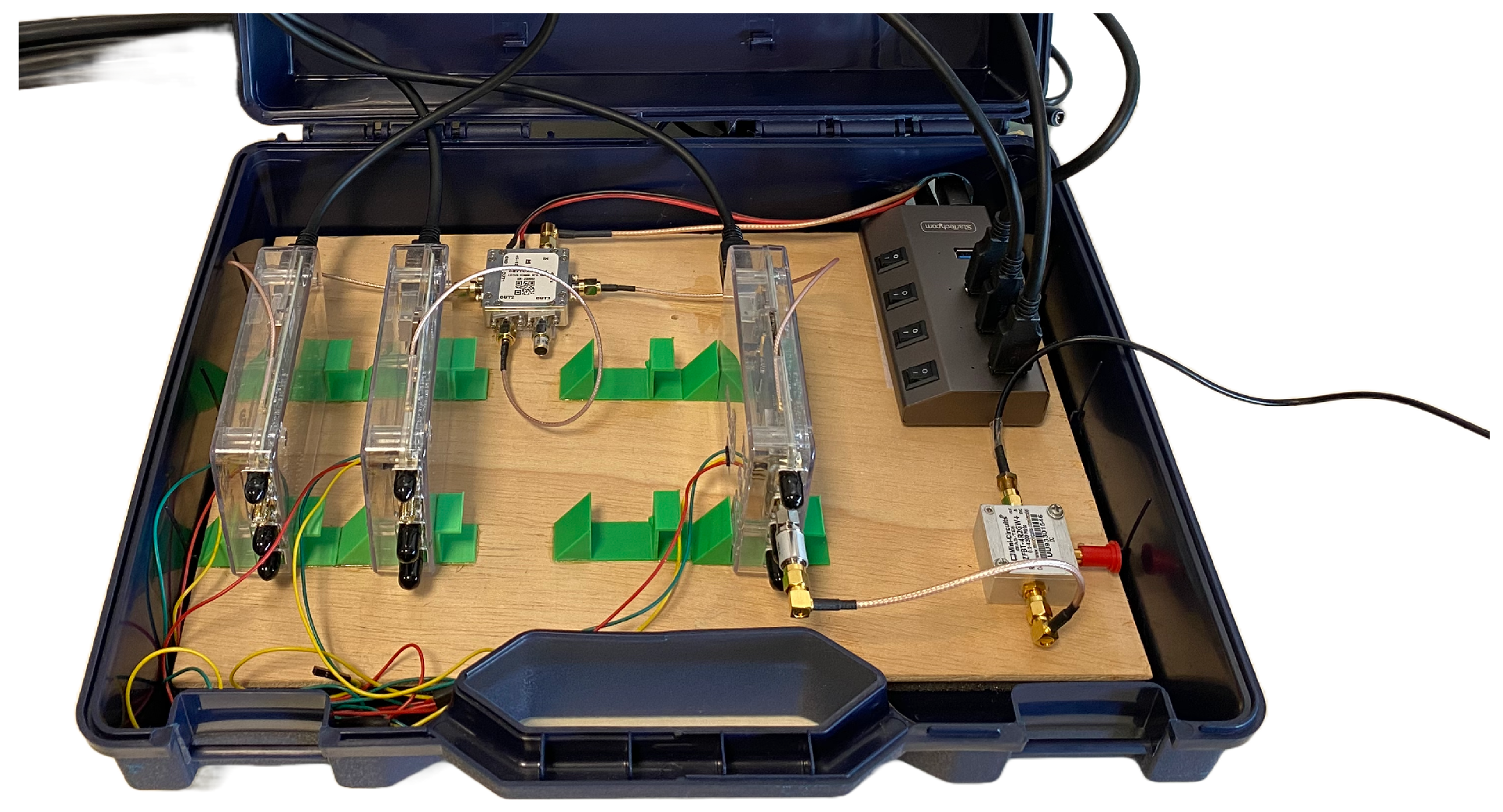
A prototype implementation of the synchronized multi-SDR platform is shown in
Figure 2.
2.2. Signal Acquisition
The signal acquisition strategy must consider the unique characteristics and challenges of each LEO constellation—Orbcomm, Iridium, and Starlink—including variations in signal strength, bandwidth, transmission periodicity, and susceptibility to attenuation. These differences directly impact the design and coordination of a multi-constellation SDR-based testbed.
2.2.1. Orbcomm Signal Characteristics and Challenges
Orbcomm is a global provider of industrial IoT and M2M services, primarily supporting low-data-rate applications across the logistics, maritime, and energy sector. A summary of relevant signal characteristics is provided in
Table 1.
Despite a larger number of satellites in orbit, only a subset (approximately 10) is consistently observed transmitting. This reduces the density of usable downlink signals at any given time. Passes occur approximately every 15 min, introducing temporal sparsity into acquisition windows.
Another critical challenge is interference from nearby FM broadcast signals (88–108 MHz), which can leak into the Orbcomm band. In urban environments or near powerful radio towers, this interference can significantly degrade signal quality. To mitigate this, an LNA with integrated filtering was selected to suppress out-of-band interference. Alternatively, an external FM notch filter is recommended when using COTS SDRs with limited front-end selectivity.
2.2.2. Iridium Signal Characteristics and Challenges
The Iridium constellation provides global voice, data, and messaging services using L-band frequencies. It operates in two bands: the duplex band (1616–1626 MHz) for uplink and downlink, and the simplex band (1626–1626.5 MHz) for downlink-only communication. This work focuses on signals in the simplex band.
Table 2 summarizes the key parameters relevant to acquisition.
Iridium bursts consist of three segments: an unmodulated tone, a BPSK-modulated unique word, and QPSK-modulated data. While the received signal strength is generally high—making acquisition easier—these bursts occur sporadically and are not transmitted continuously throughout a satellite pass. This non-continuous nature makes Iridium less predictable for short observation periods, and calls for timing-aware acquisition strategies to capture these intermittent bursts.
2.2.3. Starlink Signal Characteristics and Challenges
Starlink, developed by SpaceX, delivers high-speed broadband via a large LEO constellation. Downlink signals (10.7–12.7 GHz) are organized into eight 240 MHz wide channels spaced 250 MHz apart. Each channel uses OFDM. Within each OFDM frame a subset of subcarriers is dedicated to transmitting data-less pilot signals, also known as leakage tones in [
15].
In this work, the term beacons will refer specifically to these data-less pilot tones, to avoid confusion with the broader OFDM frame structure described also as beacons in [
5]. These pilot beacons are typically located at the center of each user downlink channel and within the guard bands separating adjacent channels.
Table 3 provides an overview of relevant parameters for acquisition.
Starlink beacons exhibit distinct characteristics: intra-channel tones are strong/isolated, while inter-channel tones form persistent clusters. All tones remain sporadic and OFDM-synchronized, with transmission activity governed by dynamic traffic patterns and beam steering variability across satellites, locations, and time [
16]. The proprietary waveform’s ongoing evolution—including 2023 power modifications—directly impacts detectability [
5]. These factors, coupled with transient signal availability, create substantial acquisition and tracking challenges.
2.3. Software Processing
The software-defined receiver extracts three key observables critical for LEO-based positioning:
Carrier Phase and Doppler Frequency, which enable relative velocity estimation and are fundamental for Doppler-based navigation.
Symbol-Level Time Delay, required for synchronization and reliable demodulation.
Signal-to-Noise Ratio (SNR), which provides a measure of signal quality and reliability for the above estimations.
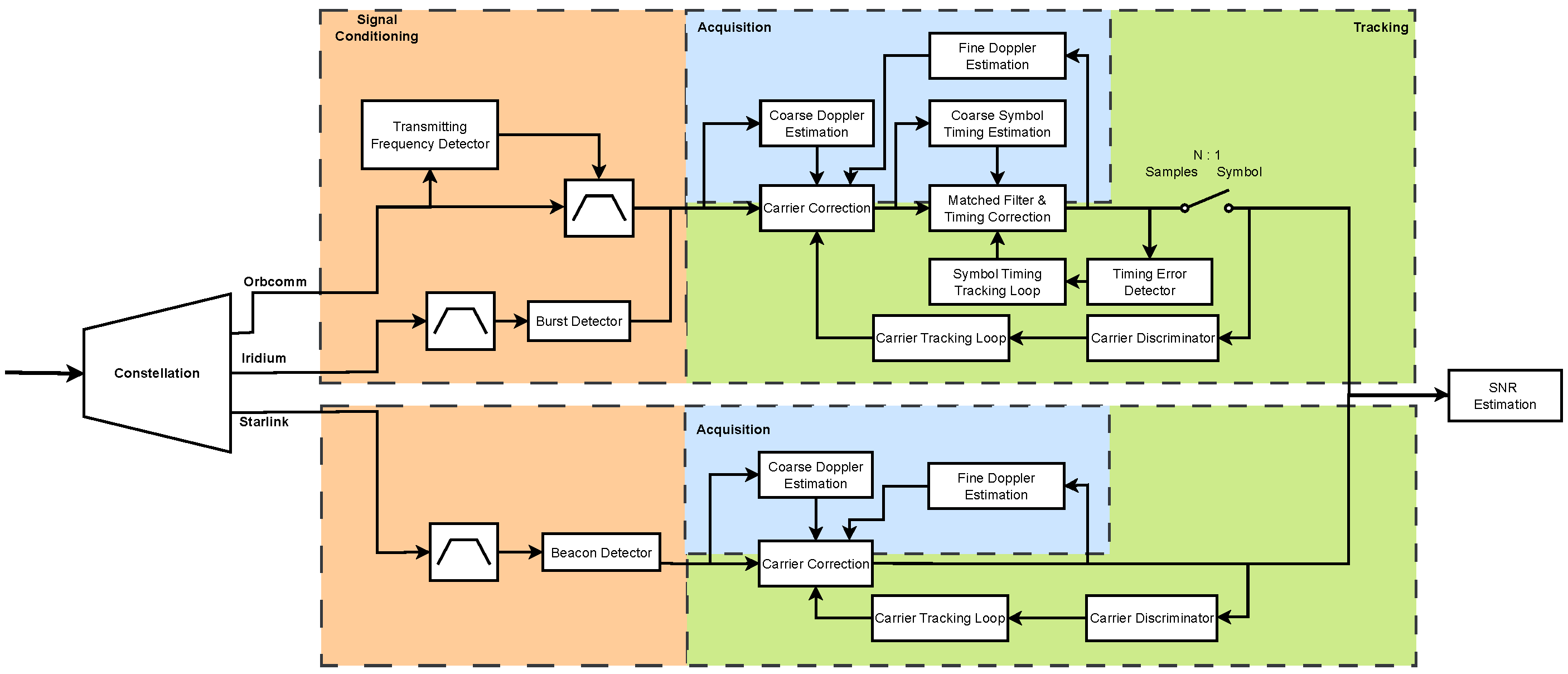
The receiver architecture, shown in
Figure 3, is adapted to each constellation’s signal characteristics and consists of three main processing stages:
Signal Conditioning performs baseband preprocessing, including constellation-specific tasks such as burst detection for Iridium and beacon detection for Starlink.
Acquisition carries out coarse Doppler estimation and carrier correction for all constellations, along with initial symbol timing estimation for Orbcomm and Iridium.
Tracking refines Doppler and phase estimates using a PLL. For Orbcomm and Iridium, a symbol-level loop (SLL) further improves timing synchronization—particularly under low SNR conditions.
3. Measurement Campaign
To validate the complete multi-constellation receiver, a measurement campaign was conducted to extract key observables from live satellite signals in both outdoor and indoor environments.
3.1. Experimental Setup
The campaign was conducted at two locations: a semi-urban outdoor site with open-sky visibility, and an indoor site with partial visibility through a large window. Conditions were mild and consistent. Each session lasted 5 min. Satellites tracked include Orbcomm FM118, Iridium 166, and Starlink-32431 (outdoor); and Orbcomm FM112 and Iridium 129 (indoor). No Starlink signals were detected indoors due to higher Ku-band attenuation.
3.2. Data Collection
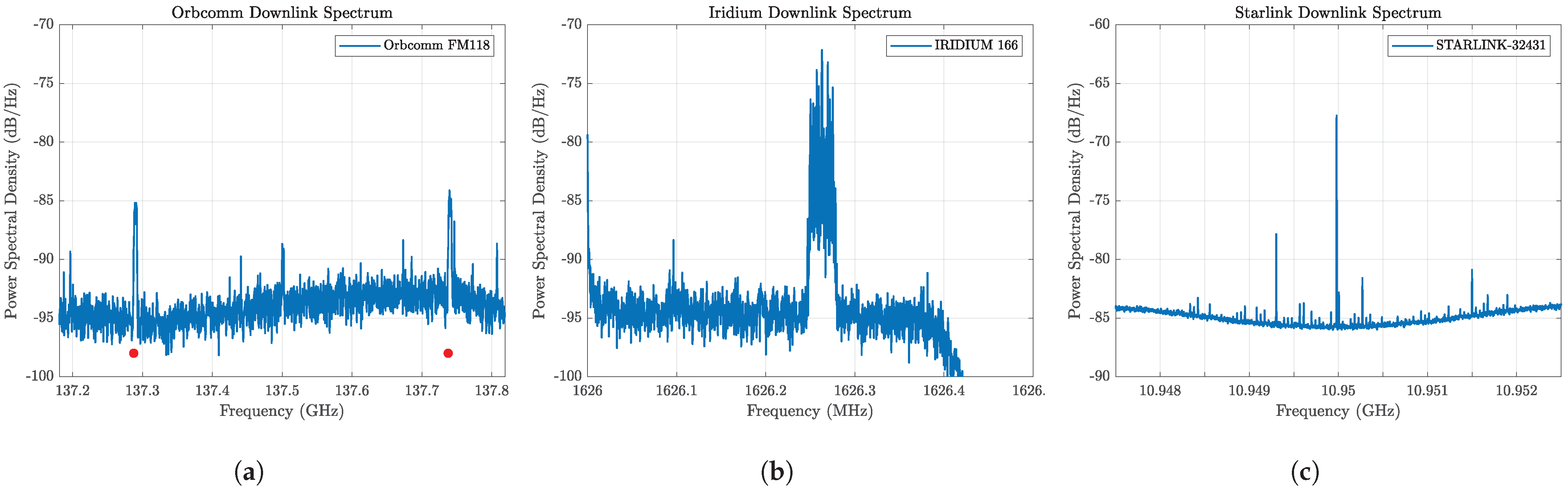
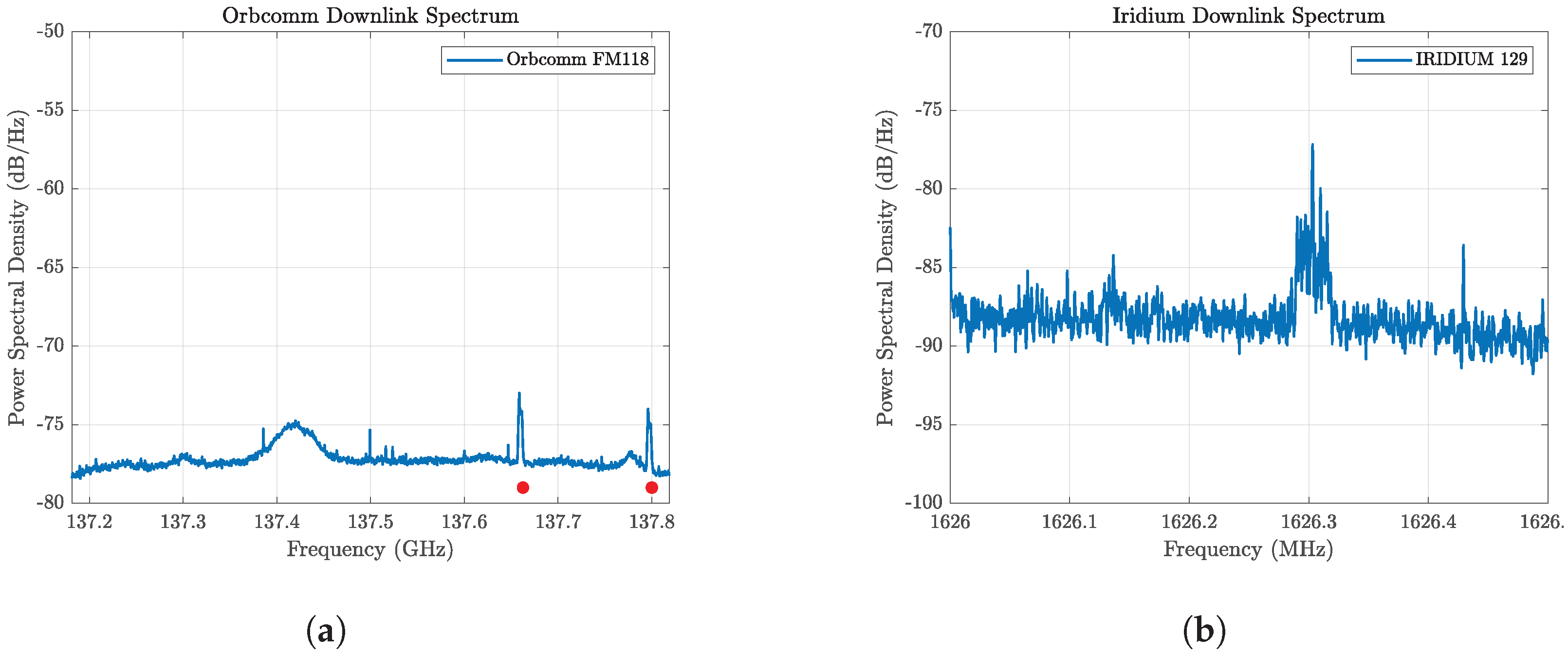
Figure 4 and
Figure 5 show the recorded spectra in outdoor and indoor scenarios respectively. Outdoors, Orbcomm signals were 10–20 dB above the noise floor, while Iridium reached 20 dB. Indoors, signal levels dropped significantly, with Orbcomm near 5 dB above noise and Iridium at 10 dB. Starlink beacons, when detectable, barely exceeded 5 dB above noise, highlighting their vulnerability to propagation losses and limited transmission power.
3.3. Results and Analysis
To assess the accuracy of the derived observables, the extracted parameters were compared against predictions obtained from Two-Line Element (TLE) ephemerids.
3.3.1. Outdoor Performance
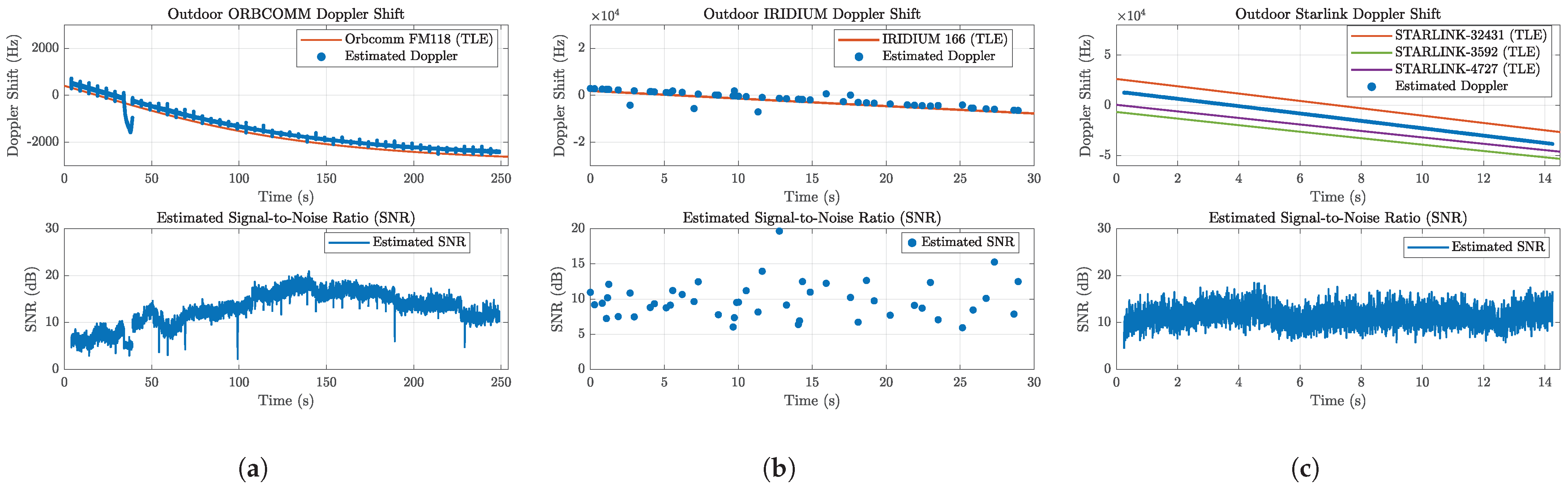
Figure 6 presents the Doppler shift estimates obtained from live signal tracking of Orbcomm, Iridium, and Starlink satellites during the outdoor measurement campaign, alongside theoretical Doppler curves derived from TLE-based orbital predictions.
For Orbcomm, the estimated Doppler closely follows the theoretical curve, with a brief deviation between 30 to 50 s attributed to SNR drops below 5 dB—likely causing a temporary loss of phase lock. A small frequency offset is also observed, likely due to reference clock inaccuracies in the SDR.
For Iridium, the Doppler trace is discontinuous due to its TDMA burst transmission. Despite this, the estimates align well with expected trends. A similar frequency offset is observed, and Doppler tracking degrades noticeably when SNR falls below 7 dB.
For Starlink, Doppler tracking was successful for satellite STARLINK-32431, identified via the Doppler slope. A frequency offset is present due to the unknown center frequency of the pilot beacons. SNR values appear artificially elevated due to narrowband filtering during processing, which introduces sample correlation and biases the estimation. As a result, SNR peaks should be interpreted qualitatively.
3.3.2. Indoor Performance
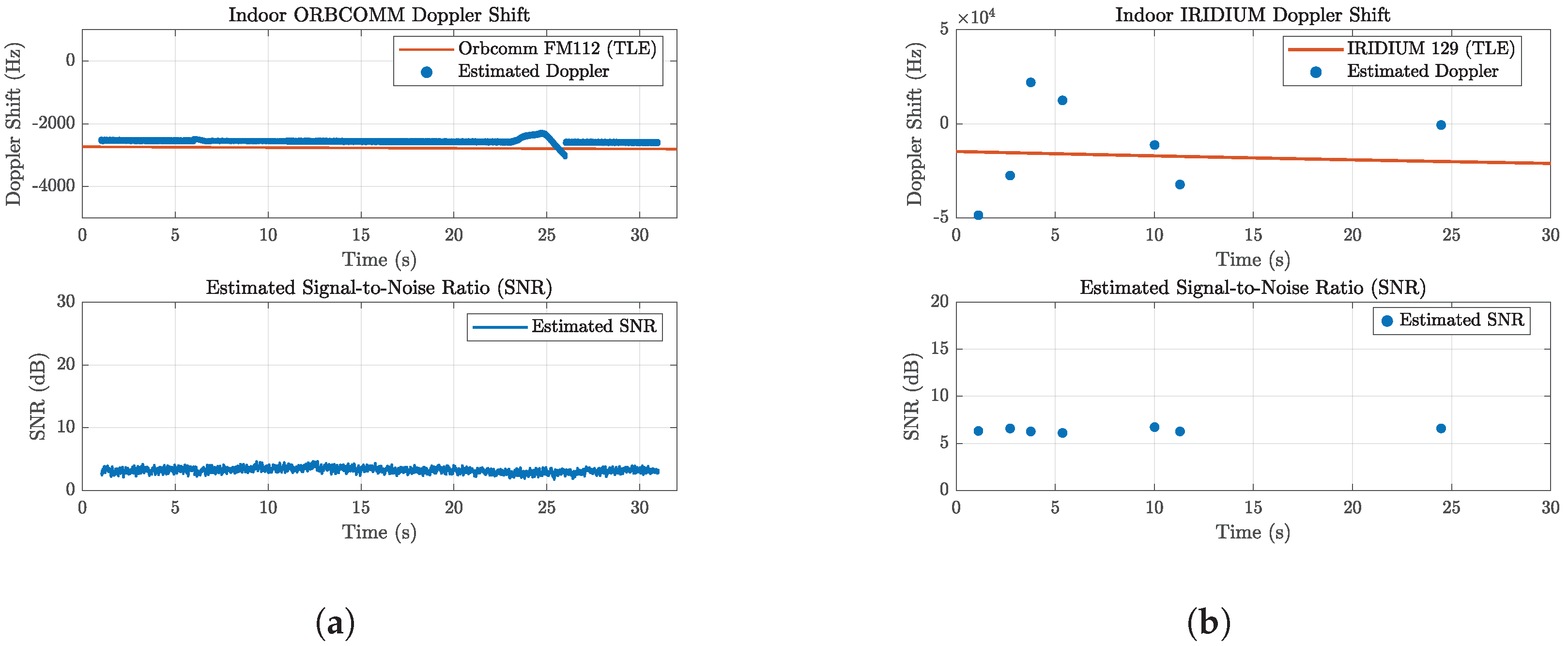
Figure 7 shows the Doppler shift estimates for Orbcomm and Iridium under indoor conditions, compared to theoretical predictions. Due to their lower operating frequencies—VHF for Orbcomm and L-band for Iridium—both constellations demonstrate better signal penetration, enabling indoor tracking.
For Orbcomm, a brief deviation from the Doppler curve is observed, likely caused by attenuation from building materials, although the SNR remains stable since the disturbance only affects the carrier tracking loop and not the overall signal-to-noise ratio. The receiver quickly regains lock and maintains overall tracking.
Iridium performance degrades more noticeably. Fewer bursts are detected, and Doppler errors increase due to reduced SNR, which hampers burst detection and tracking stability indoors.
4. Conclusions
This work presented a portable, SDR-based testbed for synchronized acquisition and analysis of LEO satellite signals from Orbcomm, Iridium, and Starlink, using only commercial off-the-shelf components. Spanning over 10 GHz of the spectrum, the system supports multi-constellation reception with strong resilience to interference and jamming.
Validated through indoor and outdoor measurements, the testbed demonstrated reliable extraction of Doppler, delay, and SNR observables, with Doppler estimates closely matching theoretical predictions. It maintained tracking even under low SNR conditions, confirming its robustness—particularly for Orbcomm and Iridium, whose signals were trackable indoors. Starlink signals, while usable outdoors, remain limited indoors due to low beacon power and high-frequency attenuation.
Future work includes extending support to additional constellations, integrating adaptive tracking algorithms, and exploring real-time Doppler-based positioning. Overall, the proposed testbed provides a scalable platform for advancing resilient, opportunistic LEO-based navigation research.
Author Contributions
Testbed design, hardware validation and investigation, M.F.-T.; software, validation, analysis, A.R.-B. and J.A.L.-S.; writing—original draft preparation, M.F.-T.; writing—review and editing, M.F.-T., A.R.-B. and J.A.L.-S.; supervision, G.S.-G. and J.A.L.-S. All authors have read and agreed to the published version of the manuscript.
Funding
This work has received funding from the Government of Catalonia within the framework of the New Space Strategy of Catalonia.
Institutional Review Board Statement
Not applicable.
Informed Consent Statement
Not applicable.
Data Availability Statement
The data presented in this study are available on request from the corresponding author.
Conflicts of Interest
The authors declare no conflict of interest.
References
- Morales, J.J.; Khalife, J.; Abdallah, A.A.; Ardito, C.T.; Kassas, Z.M. Inertial navigation system aiding with Orbcomm LEO satellite Doppler measurements. In Proceedings of the 31st International Technical Meeting of the Satellite Division of The Institute of Navigation (ION GNSS+ 2018), Miami, FL, USA, 24–28 September 2018; pp. 2718–2725. [Google Scholar]
- Tan, Z.; Qin, H.; Cong, L.; Zhao, C. New Method for Positioning Using IRIDIUM Satellite Signals of Opportunity. IEEE Access 2019, 7, 83412–83423. [Google Scholar] [CrossRef]
- Khalife, J.; Neinavaie, M.; Kassas, Z.M. The first carrier phase tracking and positioning results with Starlink LEO satellite signals. IEEE Trans. Aerosp. Electron. Syst. 2021, 58, 1487–1491. [Google Scholar] [CrossRef]
- Jardak, N.; Adam, R. Practical use of Starlink downlink tones for positioning. Sensors 2023, 23, 3234. [Google Scholar] [CrossRef]
- Kozhaya, S.; Saroufim, J.; Kassas, Z.Z.M. Unveiling Starlink for PNT. Navig. J. Inst. Navig. 2025, 72. [Google Scholar] [CrossRef]
- Orabi, M.; Khalife, J.; Kassas, Z.M. Opportunistic Navigation with Doppler Measurements from Iridium Next and Orbcomm LEO Satellites. In Proceedings of the 2021 IEEE Aerospace Conference (50100), Big Sky, MT, USA, 6–13 March 2021; pp. 1–9. [Google Scholar] [CrossRef]
- Zhao, C.; Qin, H.; Li, Z. Doppler measurements from multiconstellations in opportunistic navigation. IEEE Trans. Instrum. Meas. 2022, 71, 8500709. [Google Scholar] [CrossRef]
- Jardak, N.; Adam, R.; Jault, Q. Leveraging Multi-LEO Satellite Signals for Opportunistic Positioning. IEEE Access 2024, 12, 127100–127114. [Google Scholar] [CrossRef]
- Farhangian, F.; Landry, R., Jr. Multi-constellation software-defined receiver for Doppler positioning with LEO satellites. Sensors 2020, 20, 5866. [Google Scholar]
- UC-1374-531R, +4 dBic Orbcomm Antenna. Available online: https://www.antennas.us/uc-1374-531-4dBic-Orbcomm-Antenna.html (accessed on 14 April 2025).
- Nooelec. SAWbird+. Available online: https://www.nooelec.com/store/sdr/sdr-addons/sawbird/sawbird-plus-noaa-308.html (accessed on 16 March 2025).
- Iridium. Maxtena-M1621HCT-EXT Antenna. Available online: https://www.iridium.com/products/maxtena-m1621hct-ext/ (accessed on 14 April 2025).
- Megasat. High Gain Single LNB. Available online: https://www.megasat.tv/en/produkt/high-gain-single-lnb/ (accessed on 14 April 2025).
- Terris-Gallego, R.; Fernandez-Hernandez, I.; López-Salcedo, J.A.; Seco-Granados, G. E1-E6 SDR Platform Based on BladeRF for Testing Galileo-Assisted Commercial Authentication Service. Eng. Proc. 2023, 54, 29. [Google Scholar]
- Humphreys, T.E.; Iannucci, P.A.; Komodromos, Z.M.; Graff, A.M. Signal structure of the Starlink Ku-band downlink. IEEE Trans. Aerosp. Electron. Syst. 2023, 59, 6016–6030. [Google Scholar]
- Blázquez-García, R.; Cristallini, D.; Seidel, V.; Heckenbach, J.; Slavov, A.; O’Hagan, D. Experimental acquisition of Starlink satellite transmissions for passive radar applications. In Proceedings of the IET Conference Proceedings CP804, Edinburgh, UK, 24–27 October 2022; IET: Stevenage, UK, 2022; Volume 2022, pp. 130–135. [Google Scholar]
| Disclaimer/Publisher’s Note: The statements, opinions and data contained in all publications are solely those of the individual author(s) and contributor(s) and not of MDPI and/or the editor(s). MDPI and/or the editor(s) disclaim responsibility for any injury to people or property resulting from any ideas, methods, instructions or products referred to in the content. |



 ,
,