


Abstract
Artificial intelligence is increasingly being applied not only in the economy but also across various social sectors. As a result, research into maintenance activities is justified, particularly in the context of complex corporate systems. These systems often involve significant investments in fixed assets and advanced technologies, which implies high maintenance costs. Therefore, maintenance should be considered both in the formulation and implementation of business strategies. The research hypothesis proposes that the application of artificial intelligence can enhance business and production processes, particularly by optimizing maintenance and reducing costs. Accordingly, maintenance should be integrated into the broader business strategy as a key implementation process. To ensure effective application, all available AI capabilities should be thoroughly explored. Through analysis and discussion, the advantages of using artificial intelligence in maintenance are to be identified, ultimately leading to the validation of the hypothesis. Given the rapid development of information technology especially, this topic offers significant potential for further research.
1. Introduction
In this study, maintenance is examined within corporations characterized by a high level of technological development. One of the key reasons for this focus is the inherent complexity of such systems, often defined as “a system consisting of several interconnected and interdependent components that work together to achieve a specific goal or function. These systems typically include technological, organizational, and human elements, and are characterized by complex interrelationships, nonlinear behavior, and a high level of uncertainty” [1].
From this definition, it is evident that complex systems integrate advanced technologies, human resources, and material components into a single process, often supported by an information system. The complexity increases when such systems exist within corporate structures composed of multiple interconnected units. According to another definition, corporations, as an advanced form of enterprise, are designed to minimize risks and overcome organizational weaknesses [2].
In complex technical corporate systems, fixed assets—especially machinery and equipment—represent the core value. Their acquisition and installation require significant investments, which makes maintenance a key aspect of strategic management. Therefore, maintenance must be considered in both the development and implementation of business strategies.
This research focuses on the evolution of maintenance practices, in particular the transition towards digitalization and the growing role of artificial intelligence (AI). The integration of AI into maintenance activities offers potential benefits, such as increased efficiency, cost reduction, and improved overall system performance. Consequently, AI should be considered as a strategic tool in both business planning and maintenance management.
The central hypothesis of the research is that the application of AI in maintenance increases efficiency and reduces operational costs, thereby significantly contributing to the success of the business strategy. By defining a model for the implementation of AI in maintenance, this study aims to identify specific benefits that support improved system performance and to validate the hypothesis.
2. Core Characteristics of Artificial Intelligence
The rapid development of information and communication technologies has opened up numerous opportunities for applications in economic and social areas—especially in the field of artificial intelligence (AI). According to the Croatian Encyclopedia, AI is a branch of computer science focused on enabling computers perform tasks that require intelligence or simulate intelligent behavior in non-living systems [3]. The key question in AI is the following: how can a small, slow biological or electronic brain perceive, understand, and manipulate a world far more complex than itself? [4].
AI has been recognized as one of the seven key technologies of the Fourth Industrial Revolution, along with robotics, nanotechnology, the Internet of Things (IoT), autonomous vehicles, quantum computing, and 3D printing [5]. ML enables systems to learn from data with minimal human input, while DL uses multilayer neural networks inspired by the human brain [6].
There are four main types of machine learning:
- Supervised learning—the model learns from labeled input–output data [7];
- Semi-supervised learning—combines a small amount of labeled data with a large amount of unlabeled data [8];
- Unsupervised learning—identifies patterns in unlabeled data [9];
- Reinforcement learning—an agent learns by interacting with an environment and receiving rewards or penalties [10].
Deep learning involves complex architectures such as:
- Convolutional Neural Networks (CNNs)—used for image and video recognition; notable models include LeNet-5 and AlexNet [11];
- Recurrent Neural Networks (RNNs)—suited for sequential data like time series or natural language, with advanced variants such as LSTM to handle long-term dependencies [12];
- Generative Adversarial Networks (GANs)—consist of a generator and a discriminator that improve through competition, widely used in image synthesis and data augmentation [13].
3. Traditional Approach to Maintenance and Maintenance Costs
Management and maintenance in corporations is complex due to their technical nature. Consequently, special attention must be paid to an integrated maintenance strategy. The following are approaches established for maintaining highly complex technical systems. According to research sources, the following are the main types of maintenance:
- Reactive maintenance—this approach involves addressing equipment failures after they occur. It often leads to unplanned downtime and increased production costs. According to recent studies, approximately 45.7% of machine maintenance is reactive. Facilities in the top 25% of reactive maintenance usage experienced 3.3 times more downtime compared to those in the bottom 25%. Moreover, these organizations reported 16 times more defects, 2.8 times more lost sales due to maintenance-related defects, 2.4 times more lost sales due to maintenance delays, and 4.9 times higher inventory levels caused by maintenance inefficiencies [14].
- Planned (Preventive) maintenance—this strategy involves scheduling regular inspections and repairs based on predefined intervals, either time-based or usage-based. The objective is to extend asset lifespan and prevent failures before they happen. However, without proper monitoring, this approach may result in redundant tasks, inefficient use of resources, and even post-maintenance failures due to over-maintenance [15].
- Predictive maintenance—this strategy uses real-time monitoring technologies, sensors, and data analytics to detect early signs of equipment failure. The aim is to perform maintenance only when it is needed, optimizing costs and minimizing downtime [16].
When developing a business strategy for highly complex technical corporations, it is important to consider not only the high capital expenditures related to equipment, but also the substantial costs associated with maintenance. The following research explores how maintenance costs compare to overall operating costs in high-tech systems as follows: steel industry 10.4%, paper industry 6.7%, oil industry 5.4%, construction industry 4.3%, chemical industry 5.5%, textile industry 4.4%, rubber industry 2.7%, and automotive industry 4.4% [17]. In this sense, the implementation of information technologies, especially artificial intelligence, can be beneficial from the perspective of reducing maintenance costs.
4. Strategic Maintenance Supported by Artificial Intelligence
4.1. Corporate Business Strategy
In a complex corporate system, it is not easy to set a business strategy and ensure its successful implementation. The business strategy of a business entity itself has several definitions in theory, one of which is that it is the way in which companies achieve their goals and that it is a kind of navigation map intended for the period in which the goals will be achieved by certain methods and resources [18]. Related to this is the concept of strategic management, which dates back to the 1950s and became very popular, and even necessary in theoretical and practical application, during the 1960s and 1970s.
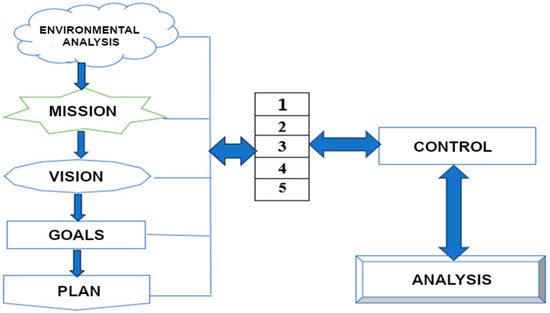
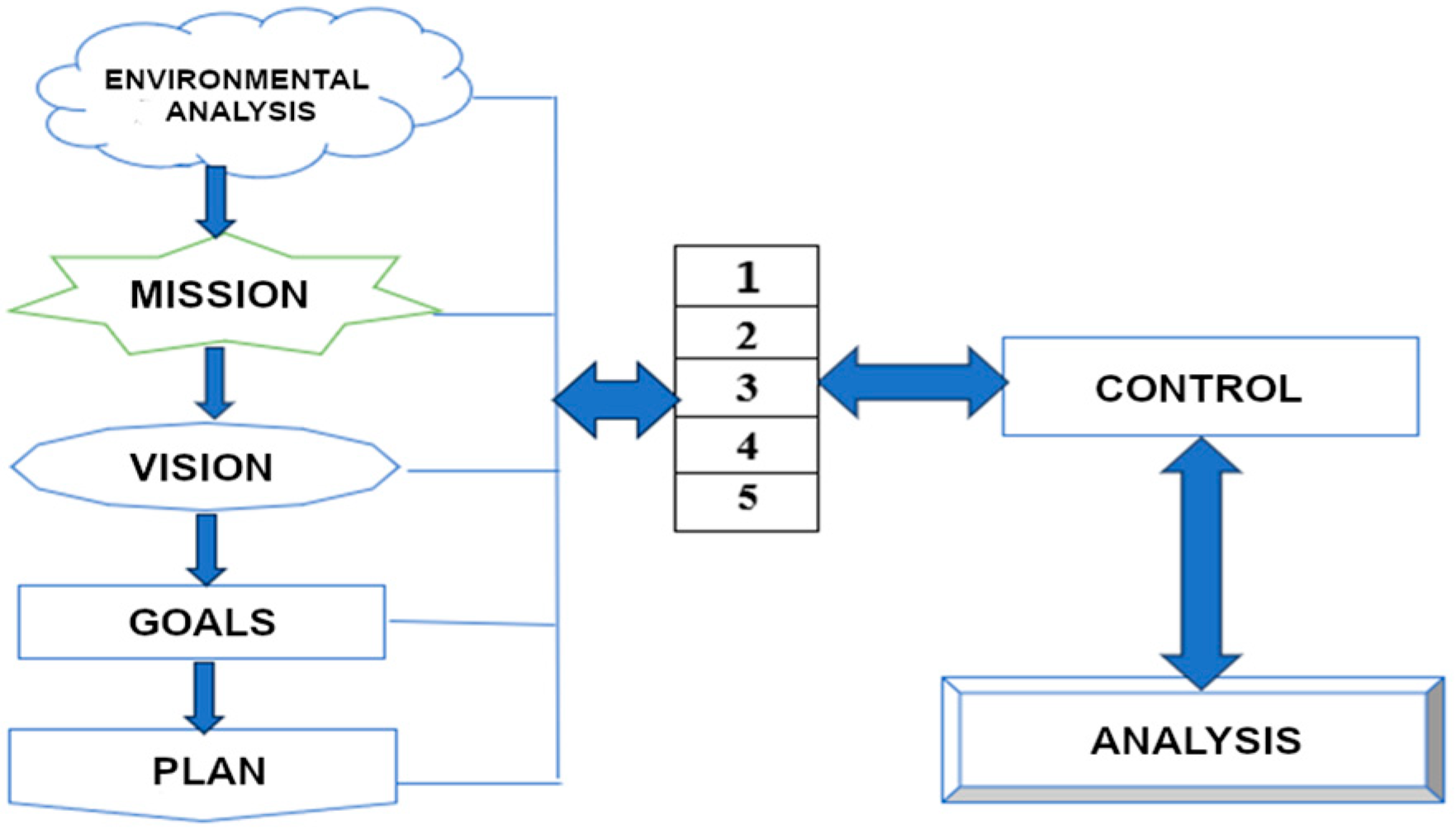
Figure 1 illustrates how strategic management integrates environmental analysis, vision, mission, and planning with maintenance as a strategic component that supports competitiveness. Unlike business strategy, which is a defined roadmap for the future of each company, strategic management is a multi-stage process. Figure 1 assumes that a complex technical corporation consists of five business units that can complement each other or can be expanded with dislocated capacities. Defining a business strategy and its implementation consists of several steps. According to Figure 1, the process begins with defining the strategic components, which are environmental analysis, vision, mission, and plan [19]. A strategic plan is a document that defines all the company’s resources in quantitative value and time form. Defining the plan actually determines the business strategy of the corporation. This is followed by the process of management with implementation or strategic management. The management, coordination, and control of the implementation of the strategy are the responsibility of managers according to their level of management. At the end of the process, an analysis is desirable to determine the success of the business strategy, but also as a basis for future strategy.
Figure 1.
Strategic corporate governance process.
4.2. The Role of Artificial Intelligence in Strategic Maintenance
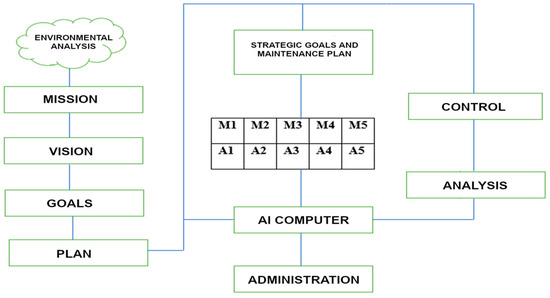
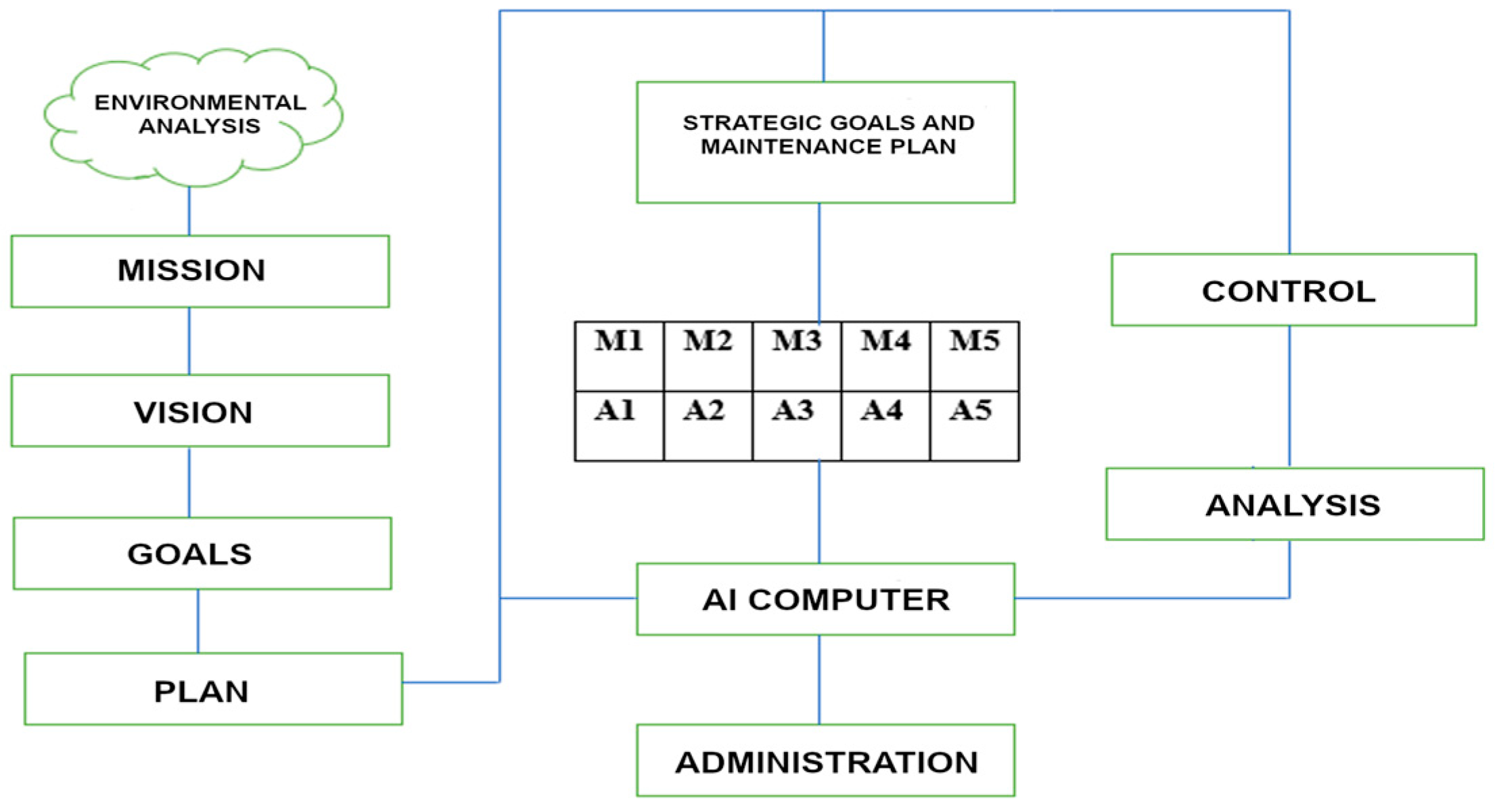
In accordance with the definition and implementation of the corporation’s business strategy, one of its segments can be linked to the maintenance strategy. The reason for this is primarily the technical and technological complexity of the system. In modern business conditions, special attention should be paid to the role of artificial intelligence in maintenance. According to Figure 2, after the strategic plan has been set, the maintenance strategy can be defined and its implementation as a long-term process can be started. Figure 2 shows how AI tools (A1–A5) interact with maintenance units (M1–M5) through predictive models to improve reliability and adaptability. The first phase is to determine strategic maintenance goals for all corporate business units. Goals can contain different data according to the type and technical level of individual business units. Given that the role of artificial intelligence in the maintenance process should also be taken into account, possible corporate strategic maintenance goals are as follows:
Figure 2.
Defining a maintenance strategy and its implementation.
- Identify maintenance problem points for all business units of the corporation and specifically for each unit.
- Review current maintenance practices in all units and their impact on production efficiency.
- Pay special attention to types of downtime according to the intensity of impact on the production system.
- Precisely determine costs by units and time periods.
- Identify essential factors in order to set a maintenance strategy based on the application of artificial intelligence in combination.
Based on the set strategic goals, a detailed maintenance plan can be defined.
According to Figure 2, each corporate business unit can have a special type of production and thus a maintenance technology adapted to it, which is shown in the figure with the marks M1 to M5. In this sense, the tools shown in Figure 2 will be defined with labels A1 to A5. The artificial intelligence application phase is carried out under the guidance of corporate management with time control for each business unit. At the end of the strategic period, a performance analysis can be carried out, which can also be used to define the future maintenance strategy. Below is Table 1 with typical effects and risks of different maintenance approaches.
Table 1.
Typical effects and risks of different maintenance approaches.
4.3. Artificial Intelligence Tools in Implementing a Maintenance Strategy
As previously mentioned, artificial intelligence, when applied as maintenance-oriented software, can significantly improve efficiency through the use of specialized applications commonly referred to as tools. Available research identifies several such tools specifically tailored for maintenance management, as listed below [20]:
- IoT Sensors—sensors provide real-time data, including vibration, sound, and thermal readings. These data are essential for predictive maintenance applications.
- Metilja (with Fluke infrared thermometers)—enables manufacturers to obtain temperature readings from a safe distance, helping to prevent unexpected failures or accidents.
- Teledyne FLIR—offers thermal sensors designed for enhancing safety and maintenance in electrical substations.
- C3 AI—utilizes generative AI and natural language processing (NLP) to detect equipment risks. It provides summary insights to help reduce maintenance costs, downtime, and improve operational productivity and asset uptime.
- Ferro Labs—offers contextual machine learning services aimed at optimizing industrial processes by reducing energy usage, costs, waste, and raw material consumption.
- MachineMetrics—allows users to develop, monitor, and manage custom algorithms for predictive analytics. It also integrates with CMMSs (Computerized Maintenance Management Systems) to provide critical machine performance data.
- Hitachi Lumada—a collaborative platform that supports optimization of production and maintenance planning across organizational teams.
- Aurora by Stottler Henke—identifies key scheduling decision points and performs sensitivity analyses to determine the optimal timing and allocation of resources. It helps maintain a stable schedule while incorporating new data inputs.
5. Discussion
Based on the initial hypothesis and the identified opportunities enabled by artificial intelligence (AI), both a business strategy and an accompanying maintenance strategy have been defined for a complex technical corporate system. The analysis of available AI tools and applications shows that AI can significantly contribute to improvements in maintenance, especially in terms of cost reduction, operational efficiency, and system reliability. In addition to reducing costs, AI-based maintenance directly enhances corporate competitiveness. It increases equipment reliability, optimizes resource allocation, and enables faster, data-driven decision-making. These advantages lead to higher production flexibility and product quality, improving the company’s market position. Therefore, AI maintenance should be recognized as a strategic driver of competitiveness, not only as a tool for operational efficiency.
As illustrated in Figure 1, the maintenance strategy plays a key role within the broader business strategy of such systems. For this reason, it is essential to incorporate recent advancements in information technology—particularly those related to AI—into maintenance planning and execution.
Recent research confirms that the integration of AI into maintenance yields measurable benefits, including:
- Increased equipment uptime, improved operational efficiency, and better asset utilization;
- Enhanced worker safety through reduced risk of failures and unexpected breakdowns;
- Flexibility of AI models to adapt to various equipment types, enabling tailored maintenance solutions;
- Improved decision-making through human–AI collaboration, where AI provides data-driven insights to support human expertise;
- Integration with advanced robotics and autonomous systems, which further boosts maintenance automation;
- Effective processing and analysis of large industrial data sets, leading to more accurate failure predictions and actionable insights.
The application of AI—especially when combined with predictive maintenance and supported by appropriate software tools—produces substantial improvements in the maintenance and operation of complex corporate systems. Research shows that AI-based predictive maintenance can reduce maintenance costs by up to 60% [22], while preventive maintenance enhanced by AI can lead to a 25–35% reduction in maintenance costs and a 70–75% drop in failure rates [23]. Furthermore, downtime can be reduced by 25–35% [24].
These results confirm that applying AI in maintenance not only reduces direct maintenance expenses but also contributes to lowering total operational costs. In addition, AI-driven approaches bring broader improvements across safety, efficiency, and production quality, further reinforcing their strategic value.
6. Conclusions
Several key conclusions can be drawn from this research. Most importantly, the efficiency of maintenance has a direct and measurable impact on the overall performance of complex corporate systems. As such, maintenance must be considered a strategic component of corporate planning and not merely an operational task.
This study demonstrated that artificial intelligence (AI) offers valuable support across various types of maintenance, particularly through predictive and preventive strategies. To verify the hypothesis, a comprehensive maintenance strategy was defined, along with the identification of AI tools capable of improving maintenance outcomes.
The findings indicate that AI contributes to more efficient maintenance processes and, consequently, to improvements in the broader technological and business operations of the corporation. Notably, the application of AI leads to a reduction in maintenance costs and an increase in overall business efficiency.
Given the rapid advancement of technology—especially in the field of information systems—new research opportunities continue to emerge. Future efforts should focus not only on the modernization of maintenance systems but also on the integration of AI into all levels of production and management. It is likely that AI-based approaches will become the standard in complex technical systems in the near future.
Author Contributions
Conceptualization, Z.L. and K.S.; methodology, Z.L.; validation, K.D., Z.L. and K.S.; formal analysis, K.S.; resources, Z.L.; writing—original draft preparation, Z.L.; writing—review and editing, K.S.; visualization, K.D.; supervision, Z.L. All authors have read and agreed to the published version of the manuscript.
Funding
This research received no external funding.
Institutional Review Board Statement
Not applicable.
Informed Consent Statement
Not applicable.
Data Availability Statement
Data are available in this manuscript.
Conflicts of Interest
The authors declare no conflict of interest.
Abbreviations
The following abbreviations are used in this manuscript:
| AI | Multidisciplinary Digital Publishing Institute |
| IR | Infrared |
| GAN | Generative Adversarial Networks |
| RNN | Recurrent Neural Network |
| CNN | Convolutional Neural Networks |
| IoT | Internet of Things |
| CMMS | Computerized Maintenance Management System |
References
- Weck, O.L.; Roos, D.; Magee, C.L. Engineering Systems: Meeting Human Needs in a Complex Technological World. Available online: https://ieeexplore.ieee.org/book/6267533 (accessed on 11 November 2024).
- Tomić, Z. Teorija i Praksa Odnosa s Javnošću; Synopsis: Zagreb, Croatia, 2016; p. 329. [Google Scholar]
- Leksikografski Zavod Miroslav Krleža, Zagreb. Available online: https://www.enciklopedija.hr/clanak/umjetna-inteligencija (accessed on 11 October 2024).
- Russell, S.T.; Norvig, P. Artificial Intelligence: A Modern Approach, 3rd ed.; AIMA; Pearson: London, UK, 2009. [Google Scholar]
- Prister, V. Umjetna inteligencija. Medija Cult. Public Relat. 2019, 10, 67–72. [Google Scholar]
- GeeksForGreeks. Difference Between Machine Learning and Deep Learning. Available online: https://www.geeksforgeeks.org/artificial-intelligence/difference-between-machine-learning-and-deep-learning/ (accessed on 13 October 2024).
- Haykin, S. Neural Networks: A Comprehensive Foundation, 2nd ed.; Prentice Hall PTR: Hoboken, NJ, USA, 1998. [Google Scholar]
- SAS. Machine learning: What It Is Why It Matters. Available online: https://www.sas.com/en_us/insights/analytics/machine-learning.html (accessed on 17 October 2024).
- Bantan, R.A.; Ali, A.; Naeem, S.; Jamal, F.; Elgarhy, M.; Chesneau, C. Discrimination of sunflower seeds using multispectral and texture dataset in combination with region selection and supervised classification methods. Chaos: Interdiscip. J. Nonlinear Sci. 2020, 30, 113142. [Google Scholar] [CrossRef] [Scilit] [PubMed]
- Sutton, R.S.; Barto, A.G. Reinforcement Learning: An Introduction, 2nd ed.; MIT Press: Cambridge, MA, USA, 2019. [Google Scholar]
- Sultana, F.; Sufian, A.; Dutta, P. Advancements in image classification using convolutional neural network. In Proceedings of the 2018 Fourth International Conference on Research in Computational Intelligence and Communication Networks (ICRCICN), Kolkata, India, 22–23 November 2018. [Google Scholar]
- Hochreiter, S.; Bengio, Y.; Frasconi, P.; Schmidhuber, J.; Elvezia, C. Gradient flow in recurrent nets: The difficulty of learning long-term dependencies. In A Field Guide to Dynamical Recurrent Neural Networks; Kolen, J.F., Kremer, S.C., Eds.; IEEE Press: Piscataway, NJ, USA, 2001. [Google Scholar]
- Jordan, M.I. On Discriminative vs. Generative Classifiers: A Comparison of Logistic Regression and Naïve Bayes; NIPS MIT Press: Cambridge, MA, USA, 2002. [Google Scholar]
- Rodrigues, T. Planned, Reactive, Predictive: What’s the Right Maintenance Mix? 2023. Available online: https://www.industryweek.com/operations/maintenance/article/21271953/planned-reactive-predictive-whats-the-right-maintenance-mix (accessed on 22 November 2024).
- Goncavles, T. Available online: https://fiixsoftware.com/blog/evaluating-maintenance-strategies-select-model-asset-management/ (accessed on 15 December 2024).
- ISO 13374-4:2010; Praćenje Stanja i Dijagnostika Strojnih Sustava Obrada Podataka, Komunikacija i Prezentacija. ISO: Geneva, Switzerland, 2010. Available online: https://repozitorij.hzn.hr/norm/HRN+ISO+13374-1%3A2010 (accessed on 15 December 2024).
- Adamović, Ž.; Manojlović, N.; Marinković, S. Ciljevi, struktura i troškovi funkcije održavanja strojeva u industriji Srbije i u svijetu. In Proceedings of the 38 Međunarodna Konferencija Održavatelja Srbije i 1 Konferencija Napredne Tehnologije u Funkciji Razvoja Privrede, Vrnjačka Banja, Srbija, 1–3 June 2022. [Google Scholar]
- Poslovna Strategija—Što je To, Definicija i Koncept. Available online: https://hr.economy-pedia.com/11039450-business-strategy (accessed on 21 November 2024).
- Misija i Vizija Poduzeća—Zašto su Važne i Primjer iz Prakse. Available online: https://mentorica.biz/aktualno/vizija-i-misija-64/ (accessed on 28 November 2024).
- Ali, A.; Abdelhadi, A. Condition-Based Monitoring and Maintenance: State of the Art and Applications. Appl. Sci. 2022, 12, 688. [Google Scholar] [CrossRef] [Scilit]
- Ucar, A.; Karakose, M.; Kırımça, N. Artificial Intelligence for Predictive Maintenance Applications. Appl. Sci. 2024, 14, 898. [Google Scholar] [CrossRef] [Scilit]
- Aziro Marketing. Available online: https://www.aziro.com/blog/top-predictive-analytics-tools-in-2024/ (accessed on 29 November 2024).
- 23. AI for Predictive Maintenance in Industrial Systems. Available online: https://www.researchgate.net/publication/375722960_AI_for_Predictive_Maintenance_in_Industrial_Systems (accessed on 2 December 2024).
- Serradilla, O.; Zugasti, E.; Ramirez de Okariz, J.; Rodriguez, J.; Zurutuza, U. Methodology for data-driven predictive maintenance models design, development and implementation on manufacturing guided by domain knowledge. Int. J. Comput. Integr. Manuf. 2022, 35, 1310–1334. [Google Scholar] [CrossRef] [Scilit]

Disclaimer/Publisher’s Note: The statements, opinions and data contained in all publications are solely those of the individual author(s) and contributor(s) and not of MDPI and/or the editor(s). MDPI and/or the editor(s) disclaim responsibility for any injury to people or property resulting from any ideas, methods, instructions or products referred to in the content. |
© 2026 by the authors. Licensee MDPI, Basel, Switzerland. This article is an open access article distributed under the terms and conditions of the Creative Commons Attribution (CC BY) license.