Proceeding Paper

Purification of Waste Cooking Oil Using Coconut Shell Derived Activated Carbon: Reduction in Free Fatty Acids and Quality Enhancement †

by
Lasitha Madhusanka
1,
Lakshan Priyankara
1,
Isuranga Abejeewa
1,
Rumesha Thathsarani
2,
Helitha Nilmalgoda
1,2,
Ashan Induranga
1,3,
Chanaka Galpaya
1,4 and
Kaveenga Koswattage
1,3,*
1
Center for Nanodevice Fabrication and Characterization, Faculty of Technology, Sabaragamuwa University of Sri Lanka, Belihuloya 70140, Sri Lanka
2
Department of Biosystems Technology, Faculty of Technology, Sabaragamuwa University of Sri Lanka, Belihuloya 70140, Sri Lanka
3
Department of Engineering Technology, Faculty of Technology, Sabaragamuwa University of Sri Lanka, Belihuloya 70140, Sri Lanka
4
Faculty of Graduate Studies, University of Sri Jayewardenepura, Nugegoda 10100, Sri Lanka
*
Author to whom correspondence should be addressed.
Presented at the 6th International Electronic Conference on Applied Sciences, 9–11 December 2025; Available online: https://sciforum.net/event/ASEC2025.
Eng. Proc. 2026, 124(1), 58; https://doi.org/10.3390/engproc2026124058
Published: 4 March 2026
(This article belongs to the Proceedings of The 6th International Electronic Conference on Applied Sciences)

Abstract

Waste cooking oil (WCO) from households and the food industry causes environmental pollution when improperly disposed of. Repeated oil use leads to oxidation, hydrolysis, and polymerization, increasing free fatty acids (FFAs) and degrading quality. This study evaluated coconut shell-derived activated carbon for WCO purification. Activated carbon was produced by carbonization at 450 °C for 3 h and KOH activation. Adsorption experiments used 2.5% (w/w) adsorbent in 450 mL WCO for 30–90 min. FFAs decreased from 0.286% to 0.049% (82.9%), pH increased from 4.62 to 5.91, and calorific value rose from 8981 to 9019 Cal/g, demonstrating suitability for biodiesel and circular economy applications.

1. Introduction

Waste cooking oil (WCO) is a commonly generated by-product from households, restaurants, and the food processing industry. Improper disposal of WCO, such as discharging it into sewage systems or the environment, causes serious environmental problems, including water pollution, soil contamination, and increased wastewater treatment costs [1]. With the rapid growth of urbanization and the food service sector, the quantity of WCO generated worldwide continues to increase, making its sustainable management an important environmental challenge [2]. Repeated heating and prolonged use of cooking oil lead to chemical degradation through oxidation, hydrolysis, and polymerization reactions. These processes result in the formation of free fatty acids (FFAs), peroxides, and other polar degradation compounds, causing darkening of oil color, unpleasant odors, increased acidity, and reduced calorific value [3]. Elevated FFA content not only poses potential health risks but also limits the direct utilization of WCO for biodiesel production due to soap formation and reduced conversion efficiency. Despite its degraded quality, WCO remains a valuable resource due to its high energy content and availability. When properly treated, WCO can be converted into biodiesel and other non-food industrial products, contributing to waste minimization and circular economy implementation. Therefore, effective and low-cost purification methods are required to improve WCO quality and expand its industrial usability [4].
Several studies have investigated coconut shell-derived activated carbon for purification of WCO [1,2]. These investigations have consistently demonstrated the ability of coconut-based adsorbents to reduce free fatty acid content and improve oil quality under various operating conditions. In some cases, purification efficiency was enhanced through the use of composite materials or higher adsorbent loadings, while other studies examined the effects of contact time and dosage optimization on adsorption performance [5,6]. Additionally, coconut-derived materials have been evaluated for upgrading waste oil to a biodiesel feedstock. Despite these contributions, the majority of previous work has primarily emphasized free fatty acid reduction, with comparatively limited attention given to a comprehensive assessment of other fuel-relevant physicochemical properties [7,8,9].
Adsorption using biomass-derived activated carbon remains an attractive purification method due to its simplicity, cost-effectiveness, and ability to remove acidic and polar degradation compounds [10]. Biomass-derived activated carbons are particularly attractive because they utilize renewable, low-cost waste materials while offering high surface area and adsorption capacity [11]. Coconut shells, which are abundantly available in tropical regions, possess high carbon content and excellent mechanical properties, making them an ideal precursor for activated carbon production [12]. This study aims to investigate the effectiveness of coconut shell-derived activated carbon in purifying waste cooking oil. The influence of adsorption contact time on reductions in FFA and improvement of key oil quality parameters, including pH, calorific value, viscosity, and density, was evaluated. The results provide insight into a sustainable and cost-effective approach to upgrading WCO into a value-added feedstock suitable for biodiesel production and other non-food industrial applications.

2. Materials and Method

2.1. Materials

Waste cooking oil (WCO) was collected from local food preparation outlets. Coconut shells were obtained from household waste sources. Potassium hydroxide (KOH, analytical grade) and all other chemicals used for analysis were of analytical grade. Whatman No. 1 filter paper (110 mm diameter) was used for oil filtration.

2.2. Method

2.2.1. Preparation of Coconut Shell-Derived Activated Carbon

Cleaned coconut shells were sun-dried and carbonized at 450 °C for 3 h under limited oxygen conditions using a laboratory-scale pyrolysis reactor. After carbonization, these samples were mixed with water and KOH in a beaker with a weight ratio of KOH/sample equal to 2:1. At this ratio, chemical activation results from carbonized charcoal being soaked in an activating solution before being heated. In the chemical activation process, charcoal soaked in the solution for 24 h was then drained and heated at 800 °C for up to 2 h. The products were cooled to room temperature and washed with HCl and deionized water until the pH of the washing solution reached 7, then oven-dried at 105 °C for moisture removal [13,14]. The activated carbon was ground to a fine powder and sieved to obtain particle sizes ≤250 μm for adsorption experiments.

2.2.2. Adsorption Experiments

Adsorption studies were conducted by adding 2.5% (w/w) activated carbon to 450 mL of WCO in a batch system. The mixture was stirred at 600 rpm to ensure uniform contact between the oil and adsorbent. Contact times of 30, 60, and 90 min were investigated to evaluate the effect of adsorption duration on FFA concentration during oil purification. After treatment, the oil was filtered using Whatman No. 1 filter paper to remove the spent activated carbon.

2.2.3. Wase Cooking Oil Quality Analysis

Untreated and treated WCO samples were analyzed to determine FFA content, pH, calorific value, viscosity, and density using standard analytical methods. FFA content was determined by acid–base titration, while calorific value was measured using a bomb calorimeter (Model 5E-C5508). Viscosity and density were measured using the Anton Paar SVM 3001 Viscometer from a temperature of 30 °C to 60 °C.

3. Results and Discussion

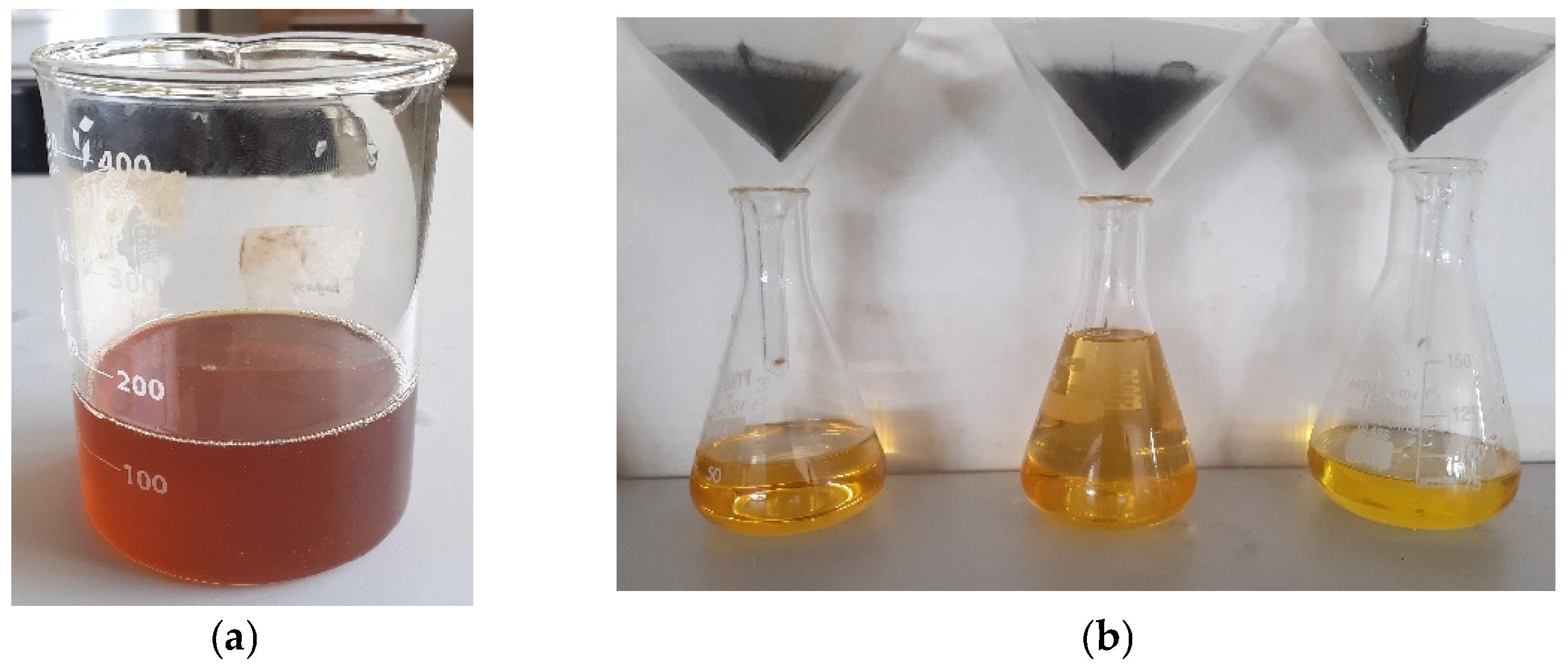
As shown in Figure 1, the untreated waste cooking oil exhibited a darker color and visible turbidity, indicating the presence of degradation products and suspended impurities formed during repeated frying. After adsorption treatment with coconut shell-derived activated carbon, the oil samples appeared noticeably clearer and lighter in color, with progressive improvement observed at longer contact times (30, 60, and 90 min). This visual enhancement supports the analytical results, suggesting effective removal of polar degradation compounds and impurities through adsorption. The Table 1 shows the free fatty acid concentration of cooking oil measured in various contact times.
The initial FFA concentration of the untreated oil was recorded at 0.286%, indicating the moderate degradation typically seen in used oils. As contact time increased, a significant decline in FFA content was observed, demonstrating the adsorptive efficiency of activated carbon. After 30 min of treatment, the FFA content reduced to 0.135%, marking a 52.7% decrease from the initial value. Further reductions were noted at 60 min, with FFA reaching 0.081%, and finally 0.049% at 90 min, achieving an overall 82.9% reduction in free fatty acid levels. This progressive decrease correlates directly with contact time, highlighting the importance of sufficient interaction between the adsorbent surface and the oil matrix for optimal removal of polar degradation compounds. The proposed mechanism includes physical adsorption through pore filling, van der Waals interactions, and the interaction between oxygen-containing functional groups on the activated carbon surface and acidic components in the oil.
The achieved FFA reduction (82.9%) using 2.5% (w/w) activated carbon is comparable to or higher than several previously reported values, where higher adsorbent loading was used. This indicates that KOH chemical activation and optimized contact time improve adsorption efficiency. Compared to previous studies that primarily evaluated FFA reduction, the present work provides a broader assessment of fuel-relevant properties, thereby strengthening its applicability for biodiesel feedstock upgrading.
Table 2 shows the variation in pH of WCO during treatment with 2.5% (w/w) activated carbon, over different contact times. The initial pH of the untreated oil was measured at 4.62, indicating a slightly acidic nature typical of thermally degraded oils, mainly due to the accumulation of FFAs and oxidation by-products. Upon adsorption treatment, a progressive increase in pH was observed, rising to 5.21 after 30 min and 5.54 at 60 min, reaching 5.91 after 90 min of contact time. This trend reflects the effective adsorption of acidic compounds by activated carbon.
Table 3 represents the calorific values at different contact times of used cooking oil sample. The untreated oil exhibited an initial calorific value of 8981 Cal/g, which slightly increased to 9008 Cal/g after 30 min of treatment. A comparable value of 9007 Cal/g was observed at 60 min, followed by a further rise to 9019 Cal/g at 90 min. This gradual enhancement can be attributed to the removal of oxidized and polar compounds, particularly FFAs and degradation by-products, which typically lower the energy density of oils. The minor but consistent increase in calorific value indicates a qualitative improvement in the fuel properties of the oil.
The viscosity and density data in Table 4 shown that increasing the temperature from 30 °C to 60 °C consistently reduces both kinematic and dynamic viscosity of the used cooking oil, regardless of contact time with the 2.5% (w/w) adsorbent. At 30 °C, kinematic viscosity values ranged around 41–42 mm2/s, dropping to approximately 14.9–15.0 mm2/s at 60 °C. Correspondingly, density decreased slightly with temperature, from about 0.916 g/cm3 at 30 °C to around 0.895 g/cm3 at 60 °C. Contact time variations (0, 30, 60, and 90 min) showed minimal influence on viscosity and density values, suggesting that temperature has a more dominant effect than adsorption duration under these conditions.

4. Conclusions

The findings of this study clearly establish that activated carbon produced from coconut shells can serve as a highly efficient and sustainable adsorbent for the purification of WCO. Treatment with 2.5% (w/w) coconut shell activated carbon achieved a substantial reduction in FFA content from 0.286% to 0.049%, representing an overall removal efficiency of 82.9%. This reduction was accompanied by a gradual increase in pH from 4.62 to 5.91, reflecting the effective adsorption of acidic degradation by-products. The calorific value of the oil improved marginally from 8981 Cal/g to 9019 Cal/g, indicating the removal of oxidized and polar compounds that typically diminish energy content. Viscosity and density measurements confirmed that thermal effects play a dominant role in altering rheological properties, while contact time had minimal influence within the tested range, suggesting that adsorption primarily targeted chemical rather than physical properties. Collectively, these improvements demonstrate that the treated oil possesses enhanced quality parameters, making it a suitable candidate for value-added applications such as biodiesel production, soap manufacturing, or other non-food industrial uses. By utilizing coconut shell waste, a widely available and renewable agricultural by-product, this approach not only addresses the environmental challenges associated with WCO disposal but also supports resource valorization and circular economy strategies. The method provides a low-cost, scalable, and eco-friendly alternative to conventional purification techniques, with significant potential for adoption in both household and industrial waste oil management systems.

Author Contributions

Conceptualization, L.M., L.P., I.A., R.T., H.N., A.I., C.G. and K.K.; methodology, L.M., L.P., I.A., R.T., H.N., A.I., C.G. and K.K.; formal analysis, L.M. and H.N.; investigation, L.M., L.P. and I.A.; writing—original draft preparation, L.M.; writing—review and editing, L.M., H.N., C.G. and K.K.; supervision, H.N., A.I., C.G. and K.K.; funding acquisition, K.K. All authors have read and agreed to the published version of the manuscript.

Funding

This research was supported by the Science and Technology Human Resource Development Project, Ministry of Education, Sri Lanka, funded by the Asian Development Bank (Grant No CRG-R2-SB-1).

Data Availability Statement

The data presented in this study are available on request from the corresponding author.

Acknowledgments

The authors are thankful for the support of the Science and Technology Human Resource Development Project, Ministry of Education, Sri Lanka, funded by the Asian Development Bank (Grant No CRG-R2-SB-1).

Conflicts of Interest

The authors declare no conflicts of interest.

Abbreviations

The following abbreviations are used in this manuscript:
WCOWaste Cooking Oil
FFAFree Fatty Acids
KOHPotassium Hydroxide

References

  1. Jumiati, E. Refinement of Cooking Oil Using Activated Carbon from Coconut Shell and Zeolite. J. Teknosains 2024, 13, 152–161. [Google Scholar] [CrossRef]
  2. Khuzaimah, S.; Eralita, N. Utilization of Adsorbent Carbon Coconut Shell for Purification of Used Cooking Oil. Indones. J. Chem. Anal. (IJCA) 2020, 3, 88–95. [Google Scholar] [CrossRef]
  3. Miskah, S.; Aprianti, T.; Agustien, M.; Utama, Y.; Said, M. Purification of Used Cooking Oil Using Activated Carbon Adsorbent from Durian Peel. IOP Conf. Ser. Earth Environ. Sci. 2019, 396, 012003. [Google Scholar] [CrossRef]
  4. Monika; Banga, S.; Pathak, V.V. Biodiesel Production from Waste Cooking Oil: A Comprehensive Review on the Application of Heterogenous Catalysts. Energy Nexus 2023, 10, 100209. [Google Scholar] [CrossRef]
  5. Fajriati, I.; Aji, T.; Dhemi, P.; Kumalawati, D.; Puspitaningrum, R.C. Purification of Used Cooking Oil of Shredded Chicken Using Activated Carbon from Coconut Shell. In AIP Conference Proceedings; AIP Publishing LLC: Melville, NY, USA, 2023; Volume 2540. [Google Scholar]
  6. Oktavian, R.; Poerwadi, B.; Pahleva, M.; Muharyanto, M.; Super, S.D. Synthesis and Performance Assessment of Coconut Fiber Solid Adsorbent for Waste Cooking Oil Purification as Biodiesel Feedstock. Malays. J. Fundam. Appl. Sci. 2020, 16, 374–377. [Google Scholar] [CrossRef]
  7. Rachmawati, D.; Suswandi, I. Physical Parameters of Used Cooking Oil Clearance Quality Based on Active Charcoal Temperature. In Proceedings of the 4th International Conference on Innovative Research Across Disciplines (ICIRAD 2021); Atlantis Press: Dordrecht, The Netherlands, 2022. [Google Scholar]
  8. Susilowati, E.; Hasan, A.; Syarif, A. Free Fatty Acid Reduction in a Waste Cooking Oil as a Raw Material for Biodiesel with Activated Coal Ash Adsorbent. J. Phys. Conf. Ser. 2019, 1167, 012035. [Google Scholar] [CrossRef]
  9. Ferrusca, M.C.; Romero, R.; Martínez, S.L.; Ramírez-Serrano, A.; Natividad, R. Biodiesel Production from Waste Cooking Oil: A Perspective on Catalytic Processes. Processes 2023, 11, 1952. [Google Scholar] [CrossRef]
  10. David, E. Production of Activated Biochar Derived from Residual Biomass for Adsorption of Volatile Organic Compounds. Materials 2022, 16, 389. [Google Scholar] [CrossRef] [PubMed]
  11. Chaemsanit, S.; Matan, N.; Matan, N. Activated Carbon for Food Packaging Application: Review. Walailak J. Sci. Technol. (WJST) 2017, 15, 255–271. [Google Scholar] [CrossRef]
  12. Madhusanka, L.; Nilmalgoda, H.; Wijethunga, I.; Ampitiyawatta, A.; Koswattage, K. Agri-Eco Energy: Evaluating Non-Edible Binders in Coconut Shell Biochar and Cinnamon Sawdust Briquettes for Sustainable Fuel Production. AgriEngineering 2025, 7, 132. [Google Scholar] [CrossRef]
  13. Saputro, E.; Wulan, V.; Winata, B.; Yogaswara, R.; Erliyanti, N. Process of Activated Carbon Form Coconut Shells Through Chemical Activation. Nat. Sci. J. Sci. Technol. 2020, 9, 23–28. [Google Scholar] [CrossRef]
  14. Song, C.; Wu, S.; Cheng, M.; Tao, P.; Shao, M.; Gao, G. Adsorption Studies of Coconut Shell Carbons Prepared by KOH Activation for Removal of Lead(II) From Aqueous Solutions. Sustainability 2013, 6, 86–98. [Google Scholar] [CrossRef]
Figure 1. (a) Untreated waste cooking oil, (b) purified waste cooking oil after adsorption treatment at different contact times (30, 60, and 90 min).
Engproc 124 00058 g001
Table 1. Free fatty acids at various contact times.
Used Cooking Oil Sample (mL)Adsorbent Weight % (w/w)Contact Time
(min)
Free Fatty Acids
(%)
0 0.286
300.135
4502.5% (w/w)600.081
900.049
Table 2. pH at various contact times.
Used Cooking Oil Sample (mL)Adsorbent Weight % (w/w)Contact Time
(min)
pH
04.62
305.21
4502.5% (w/w)605.54
905.91
Table 3. Calorific value at various contact times.
Used Cooking Oil Sample (mL)Adsorbent Weight % (w/w)Contact Time
(min)
Calorific Value (Cal/g)
08981
309008
4502.5% (w/w)609007
909019
Table 4. Viscosity and density measurements at various contact times.
Used Cooking Oil Sample (mL)Adsorbent Weight % (w/w)Contact Time
(min)
Temperature Steps (°C)Kinematic Viscosity (mm2/s)Dynamic Viscosity
(mPa·s)
Density (g/cm3)
3042.02338.5170.9165
4028.55725.9700.9094
4502.5% (w/w)05020.27218.2920.9023
6014.98513.4140.8951
3041.21637.7160.9150
4028.09625.5120.9080
4502.5% (w/w)305020.00518.0280.9011
6014.82913.2620.8943
3041.47537.9890.9159
4028.33025.7420.9086
4502.5% (w/w)605020.15018.1680.9016
6014.93113.3560.8945
3041.54838.0560.9159
4028.33025.7810.9087
4502.5% (w/w)905020.15018.1840.9016
6014.93113.3520.8947
Disclaimer/Publisher’s Note: The statements, opinions and data contained in all publications are solely those of the individual author(s) and contributor(s) and not of MDPI and/or the editor(s). MDPI and/or the editor(s) disclaim responsibility for any injury to people or property resulting from any ideas, methods, instructions or products referred to in the content.