Proceeding Paper

A Comprehensive Review and Experimental Study on Biodiesel Upgrade Through Selective Partial Catalytic Hydrogenation †

by
Alexandros Psalidas
1,
Elissavet Emmanouilidou
1,2 and
Nikolaos C. Kokkinos
1,2,3,*
1
Department of Chemistry, School of Sciences, Democritus University of Thrace, Ag. Loukas, 654 04 Kavala, Greece
2
Petroleum Institute, Democritus University of Thrace, Ag. Loukas, 654 04 Kavala, Greece
3
Hephaestus Laboratory, School of Sciences, Democritus University of Thrace, Ag. Loukas, 654 04 Kavala, Greece
*
Author to whom correspondence should be addressed.
Presented at the 6th International Electronic Conference on Applied Sciences, 9–11 December 2025; Available online: https://sciforum.net/event/ASEC2025.
Eng. Proc. 2026, 124(1), 26; https://doi.org/10.3390/engproc2026124026
Published: 11 February 2026
(This article belongs to the Proceedings of The 6th International Electronic Conference on Applied Sciences)

Abstract

Biodiesel is a promising alternative to conventional diesel, but its widespread use is inhibited by oxidative stability issues. To address this problem, various strategies have been tested, and among them, the partial hydrogenation of biodiesel FAMEs has shown promising results. Within the framework of the present study, a comprehensive review and an experimental study on biodiesel upgrading through selective partial catalytic hydrogenation have been conducted. The literature indicates that biphasic aqueous/organic catalytic systems have great potential for biodiesel catalytic upgrade, offering high reaction rates, good selectivity and convenient catalyst separation. In this context, an aqueous/organic biphasic system with a Ru/TPPTS catalyst was tested for the partial hydrogenation of biodiesel derived from WCOs. The results were comparable to those reported in the literature, indicating the potential of this process and contributing to the scarce body of research on these systems.

1. Introduction

As energy demand, oil prices, population growth and greenhouse gases (GHG) emissions have shown a continuous increase over recent years, biofuels are considered as an alternative solution to meet the demand for fossil fuels and energy with respect to the environment and human health [1]. In this context, biodiesel has emerged as a promising renewable alternative to conventional diesel fuel. It is primarily composed of fatty acid methyl esters (FAMEs) and is produced through the transesterification process [2]. During transesterification, biomass feedstock of lipid nature (e.g., vegetable oils, animal fats, algal oils, waste cooking oils, etc.) reacts with methanol in the presence of a homogeneous alkali catalyst (usually NaOH or KOH) under mild reaction conditions (temperature ≈ 60 °C and atmospheric pressure) [3]. For the time being, the most common feedstock for commercial-scale biodiesel production is edible vegetable oils [4]. Yet, as the demand for edible oils continues to rise and concerns persist over diverting food resources for fuel, non-edible oils, like non-edible vegetable oils from energy crops, waste cooking oils (WCOs) and algal oils, are increasingly considered a more suitable and sustainable option for biodiesel production [5]. Specifically, WCOs are an interesting alternative feedstock, as their utilization for biodiesel production simultaneously offers an environmentally friendly solution for the management and disposal of these wastes, which aligns with the principles of the circular economy [6]. However, their widespread application is limited due to poor quality, as far as oxidative stability is concerned. Biodiesel produced from WCOs has a high content of poly-unsaturated FAMEs, which makes it much more prone to oxidation compared to what is required by the international biodiesel quality standards [2,5,7]. Poor oxidation stability refers to the chemical degradation of biodiesel after a short period, leading to multiple mechanical problems, such as solid deposition on engine components, filter blockages, and even early engine failures [8,9,10].
To address this issue, various strategies have been proposed, including blending, adding antioxidants, and partial hydrogenation. Among these, partial hydrogenation is particularly interesting because it targets the core of the problem, which is the chemical composition of biodiesel. Specifically, partial hydrogenation is a catalytic process that reduces the degree of unsaturation in biodiesel, resulting in a product with enhanced oxidative stability [8,11,12]. However, non-selective hydrogenation may degrade biodiesel’s cold flow properties due to the high saturated and trans-monounsaturated FAME content. According to the literature, cis-monounsaturated FAMEs offer the best compromise between acceptable oxidative stability and satisfying cold flow performance [8], and as a result, the research must focus on studying more selective catalytic systems. Conventional partial hydrogenation processes, even if they effectively increase oxidative stability, usually are not sufficiently selective to prevent the degradation of cold flow properties. As a result, there is an increased academic interest in the development of unconventional partial hydrogenation catalytic processes. Such processes include the catalytic transfer hydrogenation, the simultaneous transesterification and partial hydrogenation, and the partial hydrogenation via a biphasic catalytic system [13,14,15].
The present study has a twofold approach. First, a theoretical scale was developed, and a comprehensive literature review was conducted to investigate both conventional and emerging catalytic approaches for the selective partial hydrogenation of biodiesel FAMEs. Secondly, an experimental study on upgrading biodiesel derived from WCOs using a Ru-TPPTS biphasic catalytic system was conducted to contribute to the limited existing literature on applications of biphasic catalytic systems for biodiesel upgrading.

2. Materials and Methods

2.1. Literature Review

According to the recent literature data, upgrading biodiesel to optimize its properties has been proposed by selectively hydrogenating polyunsaturated FAMEs to cis-monounsaturated FAMEs [8,16,17]. In a recent literature review [8], it was found that conventional hydrogenation catalytic systems used for biodiesel upgrading, although they achieve their primary goal of improving oxidative stability, often fail to preserve the fuel’s cold flow properties due to their insufficient selectivity toward cis-monounsaturated FAMEs. As a result, the development of non-conventional hydrogenation methods is of utmost importance for identifying an effective catalytic system with high selectivity.
For this reason, over the last few years, research on testing new approaches has increased. There are many studies in which the researchers tried a new approach in terms of an unusual or modified catalyst support [18,19,20], contributing to the understanding of how the support can manipulate selectivity and reactivity. Another approach is the use of a bimetallic catalytic system [21,22,23,24]. In these systems, two metals commonly used as catalysts (such as Ni, Pd, Cu, etc.) are combined into one catalytic system [21,22,23,24], and by acting synergistically, they have the potential to be even more effective than conventional catalysts [21]. Additionally, there is a growing amount of research on the unconventional hydrogenation method called Catalytic Transfer Hydrogenation (CTH) [23,24,25], in which the necessary hydrogen is supplied via a compound that acts as a hydrogen donor, thereby avoiding the use of explosive and expensive H2 gas [14,24,25]. Moreover, there are studies on homogeneous catalysis for the partial hydrogenation of biodiesel [25,26], which was not favored in the past, because, even though they offer great selectivity and reactivity, the recovery of the catalyst cannot be facilitated easily [27]. Furthermore, of great interest are advanced catalytic systems such as solvent-stabilized colloid catalysts [28], which have the potential to increase both selectivity and reactivity like a homogeneous catalyst and can be recovered like a heterogeneous catalyst.
Finally, one of the least studied unconventional methods with high potential is the partial hydrogenation via an aqueous/organic biphasic catalytic system (PHBC). According to the scarce body of research on the PHBC [15,28,29,30], it combines the valorization of organometallic catalysts, achieving much higher reaction rates with high selectivity, and facilitates the convenient catalyst separation and reuse.
By employing a biphasic aqueous/organic system, exceptionally high reaction rates can be achieved, while efficient catalyst recovery and the environmentally friendly nature of such systems make them a highly attractive area of research [28,29,31,32].

2.2. Experimental Section

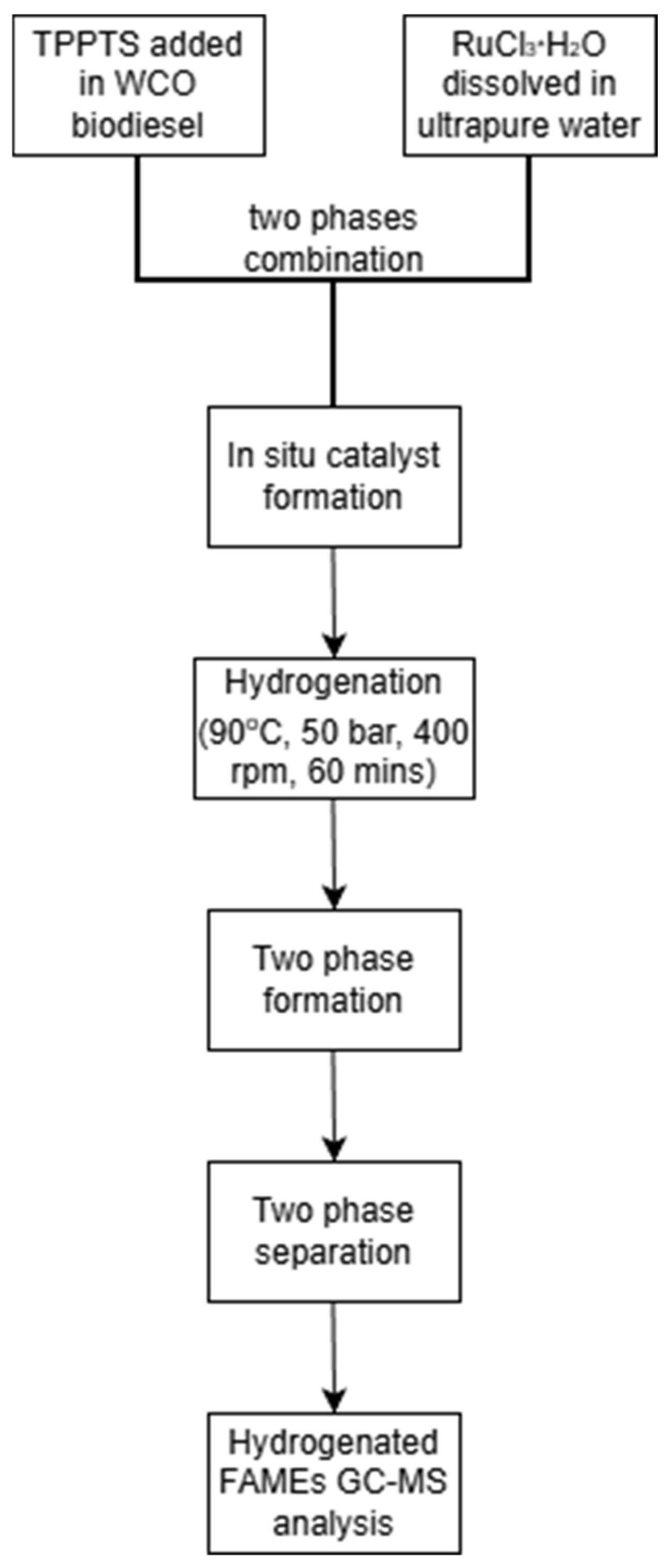
Consequently, in the experimental part of the present study, biodiesel upgrading was carried out using an aqueous/organic biphasic catalytic system. The aqueous phase of the studied biphasic catalytic system consisted of ultrapure water in which the Ru-TPPTS organometallic catalyst was contained, while the organic phase consisted solely of biodiesel derived from WCO. A flow diagram of the process steps is illustrated in Figure 1. The Ru-TPPTS catalyst was generated in situ by adding TPPTS (triphenylphosphine trisulfonate) to the organic biodiesel phase, while the RuCl3·xH2O (ruthenium(III) chloride hydrate) precursor was dissolved in deoxygenated water and subsequently combined with the biodiesel. The hydrogenation reaction was conducted in a 100 mL batch reactor (Autoclave Engineers, Erie, Pennsylvania, USA). Before pressurization and heating, the reactor was purged with hydrogen, and the reaction was carried out under the following conditions: 90 °C, 50 bar, 400 rpm, for 60 min.

3. Results and Discussion

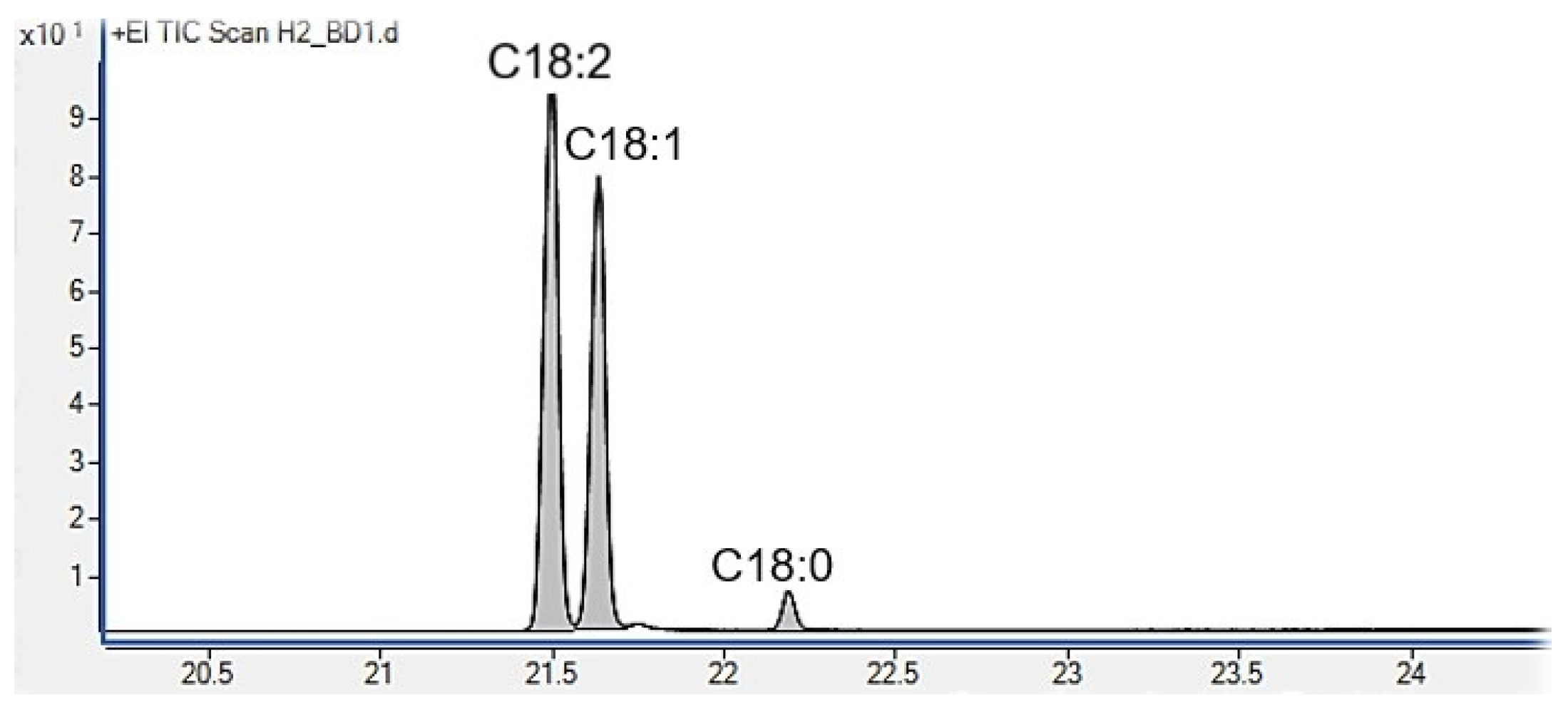
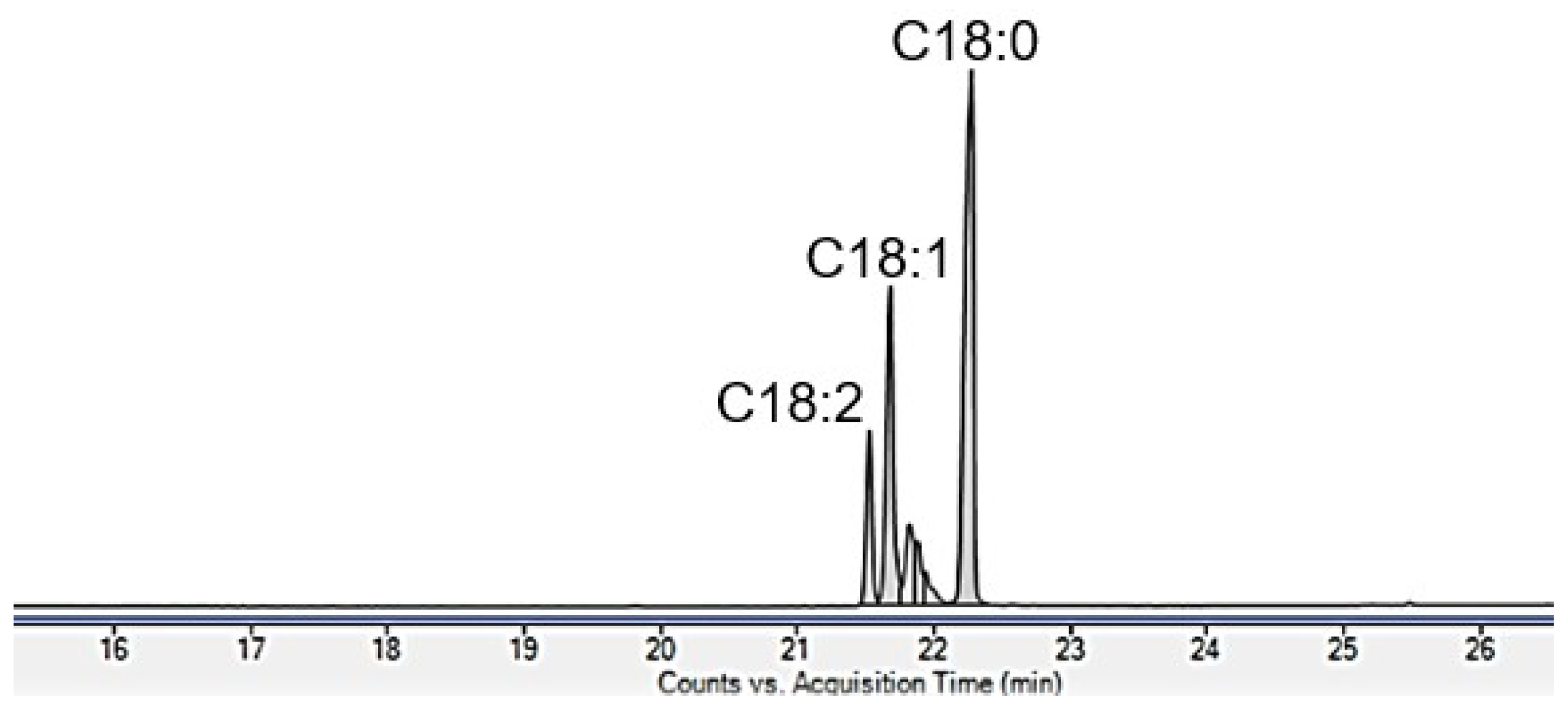
As illustrated in Figure 2 and Figure 3, the total ion chromatograms (TIC) of WCO biodiesel before and after biphasic catalytic hydrogenation exhibit notable alterations in the FAME profile. Specifically, the content of linoleic acid methyl ester (C18:2) before hydrogenation was 54.00%, while it decreased sharply to 12.67% at the end of the catalytic process, representing a 41.33% reduction. In contrast, the biodiesel’s composition in oleic acid methyl ester (C18:1) remained nearly the same, as it showed only a slight decrease, from 42.61% to 41.99%, indicating its partial conversion. Most notably, the greatest change was observed in the content of fully saturated stearic acid methyl ester (C18:0), which increased substantially from 3.39% to 45.34%.
As reported in the literature, these compositional alterations had a substantial effect on key properties, such as oxidative stability. The measured induction time (in hours) using the Rancimat method before hydrogenation was 0.4 h, while after the biphasic Ru-TPPTS-catalyzed hydrogenation, oxidative stability increased to 0.85 h. A summary of FAME composition and oxidative stability changes is presented in Table 1. Although oxidative stability remains below the EN 14112 [33] specified limit, there is significant potential for improving crucial properties of waste biomass-derived biofuels.
According to the literature, polyunsaturated FAMEs do not convert automatically to saturated FAMEs; they lose one double bond every time, and gradually they get less unsaturated, until they do not have any double bonds [34,35]. Additionally, it is known that the hydrogenation of C18:2 to C18:1 happens faster than that of C18:1 to C18:0 [36,37,38]. As a result, the nearly unchanged content of C18:1 FAMEs in the experiment’s hydrogenated biodiesel is not due to catalyst inefficiency, but because the hydrogenation reactions of C18:2 FAMEs and C18:1 FAMEs occurred simultaneously, leading to the production of additional C18:1 FAMEs that were subsequently hydrogenated to C18:0 FAMEs. In fact, the higher reaction rate of C18:2 FAME hydrogenation clearly indicates that there was a point when C18:1 FAMEs were the majority in the mixture, but due to continuous hydrogenation, they were converted into C18:0 FAMEs. Consequently, the catalytic system has the potential to produce biodiesel with the desired composition, if the reaction conditions are studied thoroughly in order to achieve higher selectivity towards C18:1 FAMEs. Furthermore, the catalytic system must be engineered in such a way as to promote the hydrogenation of C18:2 to C18:1 much faster than that of C18:1 to C18:0, and consequently lead to the desired composition.

4. Conclusions

Selective partial hydrogenation is a promising route for enhancing biodiesel quality, but for the time being, the conventional catalytic systems cannot ensure the selectivity needed to preserve biodiesel’s acceptable cold flow properties. In this context, unconventional catalytic processes for biodiesel upgrading have emerged and shown great potential. According to the literature, aqueous/organic biphasic catalytic processes are of interest because they combine the high reaction rates of homogeneous organometallic catalysts with the convenience and catalyst recovery of a heterogeneous catalytic system. For this reason, a biphasic aqueous/organic catalytic system was developed and tested in the framework of the present study. Using Ru/TPPTS as a catalyst and WCO biodiesel as feedstock, the experiment’s results show that the biphasic catalytic system was effective, as evidenced by the significant reduction in polyunsaturated FAMEs and the substantial formation of saturated FAMEs without solvent addition. Moreover, the hydrogenation outcomes for biodiesel are comparable to those reported in several studies. Biphasic catalytic systems could be a promising approach for the catalytic upgrading of biodiesel via hydrogenation. Nevertheless, further investigation is required to achieve the optimized FAME composition under mild hydrogenation conditions.

Author Contributions

Conceptualization, N.C.K., A.P. and E.E.; methodology, N.C.K., A.P. and E.E.; validation, N.C.K.; formal analysis, N.C.K., A.P. and E.E.; investigation, N.C.K., A.P. and E.E.; resources, N.C.K.; data curation, N.C.K., A.P. and E.E.; writing—original draft preparation, A.P. and E.E.; writing—review and editing, N.C.K.; visualization, N.C.K., A.P. and E.E.; supervision, N.C.K.; project administration, N.C.K.; funding acquisition, N.C.K. All authors have read and agreed to the published version of the manuscript.

Funding

“Industrial Catalysis and Sustainable Energy” in the framework of the subproject “Internationalization of the educational services of the Higher Education Institutions” of the project SUB2 “Universities of Excellence” with MIS code TA 5180665, funded by the Recovery and Resilience Fund “Greece 2.0” (Code: Action 16289).

Data Availability Statement

The data that support the findings of this study are available from the corresponding author upon reasonable request.

Acknowledgments

Special thanks are due to the Petroleum Institute at the Democritus University of Thrace, Greece, for their research support.

Conflicts of Interest

The authors declare no conflicts of interest. The funders had no role in the design of the study; in the collection, analyses, or interpretation of data; in the writing of the manuscript; or in the decision to publish the results.

Abbreviations

The following abbreviations are used in this manuscript:
CTHCatalytic Transfer Hydrogenation
FAMEsFatty Acid Methyl Esters
GHGGreenhouse Gasses
PRISMAPreferred Reporting Items for Systematic Reviews and Meta-Analyses
STPHSimultaneous Transesterification and Partial Hydrogenation
TICTotal Ion Chromatograph
TPPTSTriphenylphosphinetrisulfonic acid trisodium salt
WCOsWasting Cooking Oils

References

  1. Kokkinos, N.C.; Kikalishvili, T.; Emmanouilidou, E. Developing Biomass for Biofuel Production and Its Future Opportunities. In Emerging Materials for Biofuel Developments; CRC Press: Boca Raton, FL, USA, 2025. [Google Scholar]
  2. Emmanouilidou, E.; Lazaridou, A.; Mitkidou, S.; Kokkinos, N.C. Biodiesel Production from Edible and Non-Edible Biomasses and Its Characterization. E3S Web Conf. 2023, 436, 04003. [Google Scholar] [CrossRef]
  3. Pruszko, R. Biodiesel Production. In Bioenergy; Academic Press: Cambridge, MA, USA, 2015; pp. 339–359. [Google Scholar]
  4. Woiciechowski, A.; Medeiros, A.; Rodrigues, C.; Vandenberghe, L.; Tanobe, V.; Dall’Agnol, A.; Gazzoni, D.; Soccol, C. Feedstocks for Biofuels. In Green Fuels Technology; Springer: Cham, Switzerland, 2016; pp. 15–39. [Google Scholar]
  5. Emmanouilidou, E.; Lazaridou, A.; Mitkidou, S.; Kokkinos, N.C. A Comparative Study on Biodiesel Production from Edible and Non-Edible Biomasses. J. Mol. Struct. 2024, 1306, 137870. [Google Scholar] [CrossRef]
  6. Manikandan, G.; Kanna, P.R.; Taler, D.; Sobota, T.; Manikandan, G.; Kanna, P.R.; Taler, D.; Sobota, T. Review of Waste Cooking Oil (WCO) as a Feedstock for Biofuel—Indian Perspective. Energies 2023, 16, 1739. [Google Scholar] [CrossRef]
  7. Kokkinos, N.; Theochari, G.; Emmanouilidou, E.; Angelova, D.; Toteva, V.; Lazaridou, A.; Mitkidou, S. Biodiesel Production from High Free Fatty Acid Byproduct of Bioethanol Production Process. IOP Conf. Ser. Earth Environ. Sci. 2022, 1123, 012009. [Google Scholar] [CrossRef]
  8. Psalidas, A.; Emmanouilidou, E.; Kokkinos, N.C. Catalytic Upgrading of Biodiesel by Partial Hydrogenation of Its FAME Composition: A Systematic Review. Energies 2024, 17, 561. [Google Scholar] [CrossRef]
  9. Longanesi, L.; Pereira, A.P.; Johnston, N.; Chuck, C.J. Oxidative Stability of Biodiesel: Recent Insights. Biofuels Bioprod. Biorefin. 2022, 16, 265–289. [Google Scholar] [CrossRef]
  10. Kumar, N. Oxidative Stability of Biodiesel: Causes, Effects and Prevention. Fuel 2017, 190, 328–350. [Google Scholar] [CrossRef]
  11. Adu-Mensah, D.; Mei, D.; Zuo, L.; Zhang, Q.; Wang, J. A Review on Partial Hydrogenation of Biodiesel and Its Influence on Fuel Properties. Fuel 2019, 251, 660–668. [Google Scholar] [CrossRef]
  12. Adu-Mensah, D.; Mei, D.; Zuo, L.; Dai, S.; Gao, Y. Improving Biodiesel Made from Cottonseed and Soyabean Oil with Partial Hydrogenation. Proc. Inst. Civ. Eng. Energy 2021, 174, 131–136. [Google Scholar] [CrossRef]
  13. Lee, H.-S.; Lee, J.; Seo, H.; Kang, H.; Kim, D.H.; Lee, Y.-W. Evaluation of Pd/ZSM-5 Catalyst for Simultaneous Reaction of Transesterification and Partial Catalytic Transfer Hydrogenation of Soybean Oil under Supercritical Methanol. Fuel Process. Technol. 2021, 218, 106870. [Google Scholar] [CrossRef]
  14. Zhang, L.; Xin, Z.; Liu, Z.; Wei, G.; Li, Z.; Ou, Y. Mechanistic Study of the Catalytic Transfer Hydrogenation of Biodiesel Catalyzed by Raney-Ni under Microwave Heating. Renew. Energy 2020, 147, 695–704. [Google Scholar] [CrossRef]
  15. Bouriazos, A.; Mouratidis, K.; Psaroudakis, N.; Papadogianakis, G. Catalytic Conversions in Aqueous Media. Part 2. A Novel and Highly Efficient Biphasic Hydrogenation of Renewable Methyl Esters of Linseed and Sunflower Oils to High Quality Biodiesel Employing Rh/TPPTS Complexes. Catal. Lett. 2008, 121, 158–164. [Google Scholar] [CrossRef]
  16. Chen, S.-Y.; Attanatho, L.; Chang, A.; Laosombut, T.; Nishi, M.; Mochizuki, T.; Takagi, H.; Yang, C.-M.; Abe, Y.; Toba, M.; et al. Profiling and Catalytic Upgrading of Commercial Palm Oil-Derived Biodiesel Fuels for High-Blend Fuels. Catal. Today 2019, 332, 122–131. [Google Scholar] [CrossRef]
  17. Liu, W.; Lu, G. Partial Hydrogenation of Sunflower Oil-Derived Fames Catalyzed by the Efficient and Recyclable Palladium Nanoparticles in Polyethylene Glycol. J. Oleo Sci. 2017, 66, 1161–1168. [Google Scholar] [CrossRef] [PubMed]
  18. Fiore, A.M.; Romanazzi, G.; Leonelli, C.; Mastrorilli, P.; Dell’anna, M.M. Partial Hydrogenation of Soybean and Waste Cooking Oil Biodiesel over Recyclable-Polymer-Supported Pd and Ni Nanoparticles. Catalysts 2022, 12, 506. [Google Scholar] [CrossRef]
  19. Phumpradit, S.; Reubroycharoen, P.; Kuchonthara, P.; Ngamcharussrivichai, C.; Hinchiranan, N. Partial Hydrogenation of Palm Oil-Derived Biodiesel over Ni/Electrospun Silica Fiber Catalysts. Catalysts 2020, 10, 993. [Google Scholar] [CrossRef]
  20. Supabunnapong, T.; Rungsi, A.N.; Luengnaruemitchai, A.; Chen, S.-Y.; Mochizuki, T.; Numwong, N.; Chollacoop, N. Effects of Synthetic Conditions on the Pd Particle Sizes of Pd/SBA-15 Catalysts and Their Performance for the Partial Hydrogenation of Biodiesel Fuels. Biomass Convers. Biorefin. 2024, 14, 16005–16018. [Google Scholar] [CrossRef]
  21. Longprang, T.; Kaewtrakulchai, N.; Kiatkittipong, W.; Srifa, A.; Chollacoop, N.; Eiad-Ua, A.; Assabumrungrat, S. Bimetallic PdNi Catalyst on Cattail Leaves-Derived Nanoporous Carbon Support for Synthesis of Partially Hydrogenated Fatty Acid Methyl Ester (H-FAME). Arab. J. Chem. 2024, 17, 105800. [Google Scholar] [CrossRef]
  22. Jaruwat, D.; Kaewtrakulchai, N.; Siriorarnroj, S.; Srifa, A.; Kiatkittipong, W.; Charojrochkul, S.; Fuji, M.; Eiad-Ua, A.; Assabumrungrat, S. Nanoporous Carbon-Supported Bimetallic (Ni, Cu, and Fe)-Mo Catalysts for Partial Hydrogenation of Biodiesel. ACS Omega 2024, 9, 42329–42342. [Google Scholar] [CrossRef]
  23. Leone, M.S.; Mastrorilli, P.; Mesto, E.; Schingaro, E.; Comparelli, R.; Porfido, C.; Dell’Anna, M.M. Partial Hydrogenation of Waste Cooking Oil Biodiesel Catalyzed by Iron Oxide/Nickel Nanoparticles Supported on Steel Slags. ACS Omega 2025, 10, 54070–54085. [Google Scholar] [CrossRef] [PubMed]
  24. Lugito, G.; Pamungkas, A.Y.; Realdi, M.N.D.; Alam, A.K.; Egiyawati, C.; Pradana, Y.S.; Adhi, T.P.; Soerawidjaja, T.H.; Makertihartha, I.G.B.N.; Mohtar, W.H.M.W.; et al. Biodiesel Stability Enhancement Through Catalytic Transfer Hydrogenation Using Glycerol as Hydrogen Donor. Eng 2025, 6, 94. [Google Scholar] [CrossRef]
  25. Sejie, F.P.; Oyetunji, O.A.; Makhubela, B.C.E.; Darkwa, J.; Leeuw, N.H. de Evaluation of Cobalt, Nickel, and Palladium Complexes as Catalysts for the Hydrogenation and Improvement of Oxidative Stability of Biodiesel. Catalysts 2024, 14, 653. [Google Scholar] [CrossRef]
  26. Olaoye, O.E.; Oyetunji, O.; Makhubela, B.C.E.; Kumar, G.; Darkwa, J. Hydrogenation of Biodiesel Catalysed by Pyrazolyl Nickel(II) and Palladium(II) Complexes. RSC Sustain. 2023, 1, 1814–1825. [Google Scholar] [CrossRef]
  27. Gürsel, I.V.; Noël, T.; Wang, Q.; Hessel, V. Separation/Recycling Methods for Homogeneous Transition Metal Catalysts in Continuous Flow. Green Chem. 2015, 17, 2012–2026. [Google Scholar] [CrossRef]
  28. Roth, T.F.H.; Kühl, A.; Spiekermann, M.L.; Wegener, H.W.; Seidensticker, T. Biodiesel as a Sustainable Platform Chemical Enabled by Selective Partial Hydrogenation: Compounds Outplace Combustion?! ChemSusChem 2024, 17, e202400036. [Google Scholar] [CrossRef]
  29. Bouriazos, A.; Sotiriou, S.; Vangelis, C.; Papadogianakis, G. Catalytic Conversions in Green Aqueous Media: Part 4. Selective Hydrogenation of Polyunsaturated Methyl Esters of Vegetable Oils for Upgrading Biodiesel. J. Organomet. Chem. 2010, 695, 327–337. [Google Scholar] [CrossRef]
  30. Bouriazos, A.; Vasiliou, C.; Tsichla, A.; Papadogianakis, G. Catalytic Conversions in Green Aqueous Media. Part 8: Partial and Full Hydrogenation of Renewable Methyl Esters of Vegetable Oils. Catal. Today 2015, 247, 20–32. [Google Scholar] [CrossRef]
  31. Stathis, P.; Stavroulaki, D.; Kaika, N.; Krommyda, K.; Papadogianakis, G. Low Trans-Isomers Formation in the Aqueous-Phase Pt/TPPTS-Catalyzed Partial Hydrogenation of Methyl Esters of Linseed Oil. Appl. Catal. B Environ. 2017, 209, 579–590. [Google Scholar] [CrossRef]
  32. Kokkinos, N.C.; Nikolaou, N.; Psaroudakis, N.; Mertis, K.; Mitkidou, S.; Mitropoulos, A.C. Two-Step Conversion of LLCN Olefins to Strong Anti-Knocking Alcohol Mixtures Catalysed by Rh, Ru/TPPTS Complexes in Aqueous Media. Catal. Today 2015, 247, 132–138. [Google Scholar] [CrossRef]
  33. Wieselburg, B. Review on Bioidiesel Standardization World-Wide. 2004. Available online: https://task39.ieabioenergy.com/wp-content/uploads/sites/37/2013/05/Review-on-Biodiesel-Standardization.pdf (accessed on 5 March 2024).
  34. Kokkinos, N.C.; Lazaridou, A.; Nikolaou, N.; Papadogianakis, G.; Psaroudakis, N.; Chatzigakis, A.K.; Papadopoulos, C.E. Hydrogenation of a Hydroformylated Naphtha Model (Mixture of Specific Aldehydes) Catalysed by Ru/TPPTS Complex in Aqueous Media. Appl. Catal. A Gen. 2009, 363, 129–134. [Google Scholar] [CrossRef]
  35. Konkol, M.; Wróbel, W.; Bicki, R.; Gołębiowski, A.; Konkol, M.; Wróbel, W.; Bicki, R.; Gołębiowski, A. The Influence of the Hydrogen Pressure on Kinetics of the Canola Oil Hydrogenation on Industrial Nickel Catalyst. Catalysts 2016, 6, 55. [Google Scholar] [CrossRef]
  36. Quaranta, E.; Cornacchia, D. Partial Hydrogenation of a C18:3-Rich FAME Mixture over Pd/C. Renew. Energy 2020, 157, 33–42. [Google Scholar] [CrossRef]
  37. Spiekermann, M.L.; Seidensticker, T. Catalytic Processes for the Selective Hydrogenation of Fats and Oils: Reevaluating a Mature Technology for Feedstock Diversification. Catal. Sci. Technol. 2024, 14, 4390–4419. [Google Scholar] [CrossRef]
  38. Quaranta, E.; Dibenedetto, A.; Colucci, A.; Cornacchia, D. Partial Hydrogenation of FAMEs with High Content of C18:2 Dienes. Selective Hydrogenation of Tobacco Seed Oil-Derived Biodiesel. Fuel 2022, 326, 125030. [Google Scholar] [CrossRef]
Figure 1. Flow diagram of biphasic catalytic upgrading process steps.
Engproc 124 00026 g001
Figure 2. TIC of WCO biodiesel FAME composition before hydrogenation.
Engproc 124 00026 g002
Figure 3. TIC of WCO biodiesel FAME composition after hydrogenation.
Engproc 124 00026 g003
Table 1. Compositional and oxidative stability changes after hydrogenation.
BiodieselLinoleic Acid Methyl Ester (C18:2) (%)Oleic Acid Methyl Ester (C18:1) (%)Stearic Acid Methyl Ester (C18:0) (%)Oxidative Stability (Hours)
WCO biodiesel54.0042.613.390.40
Hydrogenated biodiesel 12.6741.9945.340.85
Disclaimer/Publisher’s Note: The statements, opinions and data contained in all publications are solely those of the individual author(s) and contributor(s) and not of MDPI and/or the editor(s). MDPI and/or the editor(s) disclaim responsibility for any injury to people or property resulting from any ideas, methods, instructions or products referred to in the content.