1. Introduction
Breast cancer (BC) is among the most common malignancies worldwide, with metastasis being the main cause of cancer-related death [
1]. Accurate prediction of metastatic risk at the time of diagnosis is crucial for improving patient outcomes through risk stratification and treatment optimization. Current prediction methods rely on conventional staging systems (TNM classification, tumor grade, and lymph node status) that assess anatomical and histopathological features. Commercial gene expression assays such as OncotypeDX [
2] (21-gene panel for HR+/HER2- breast cancer) and MammaPrint [
3] (70-gene panel) have improved prognostic stratification and treatment planning. These assays are primarily based on proliferation, hormone receptor signaling, and cell cycle-related pathways. However, their predictive performance varies across cancer types and subtypes, and these molecular tests are costly and often overlook dynamic cellular behaviors such as cytoskeletal remodeling and mechanotransduction that are critical for metastatic dissemination.
Migration, motility, and actin cytoskeleton remodeling are fundamental features of cells with high metastatic potential [
4,
5]. The acquisition of this phenotype is accompanied by changes in gene expression profiles. Based on our previous research [
4,
6], we selected a panel of actin cytoskeleton-related genes as potential biomarkers for metastasis prediction:
ACTN4,
ANXA2,
ANXA6,
CFL1,
ECM1,
EZR,
FSCN1,
GSN,
MYH9,
PFN1, and
TAGLN.
Machine learning approaches have shown promise in cancer outcome prediction [
7]. However, the predictive potential of focused mechanobiological gene panels using state-of-the-art ensemble algorithms has not been systematically evaluated in clinical patient cohorts.
In this study, we investigated whether expression levels of 11 mechanobiological genes in primary breast tumors can accurately predict distant metastasis. We applied supervised machine learning models to transcriptomic data from the TCGA Breast Invasive Carcinoma dataset and compared five algorithms, including linear methods (Logistic Regression), tree-based approaches (Decision Trees, Random Forest, and XGBoost), and instance-based methods (k-Nearest Neighbors), to identify both high-performing predictive models and the most informative genes contributing to metastatic risk.
2. Materials and Methods
2.1. Dataset
The Breast Invasive Carcinoma dataset (TCGA, Firehose Legacy) was obtained from the cBioPortal database [
8], containing genomic and clinical information from primary breast cancer tumors. Gene expression data for 11 previously identified genes [
6] (
ACTN4,
ANXA2,
ANXA6,
CFL1,
ECM1,
EZR,
FSCN1,
GSN,
MYH9,
TAGLN, and
PFN1) were analyzed. These genes encode proteins involved in cytoskeleton regulation, cell motility and extracellular matrix remodeling. The predictive target was distant metastasis status according to the American Joint Committee on Cancer (AJCC) staging [
9], where M0 indicates the absence of distant metastases and M1 indicates their presence.
2.2. Data Preprocessing
Expression data was normalized as log
2(TPM + 1), where TPM represents transcripts per million. Due to class imbalance (902 M0 vs. 22 M1 samples), Synthetic Minority Over-sampling Technique (SMOTE) [
10] was applied to the metastatic samples to prevent model bias toward the majority class. Following SMOTE application, the dataset contained 902 samples per class. The dataset was split into training (80%) and test (20%) sets. SMOTE was applied prior to the train–test split in order to increase the number of metastatic samples available for model training and evaluation. We acknowledge that oversampling the full dataset before splitting may lead to optimistic performance estimates due to information leakage; this limitation is explicitly addressed in the Discussion section. Per-gene z-score standardization was performed using scaling parameters (mean and standard deviation) derived from the training set, which were then applied to the test set to prevent information leakage.
2.3. Machine Learning Models
Five supervised machine learning algorithms were evaluated: k-Nearest Neighbors (kNN), Logistic Regression, Decision Trees, Random Forest, and XGBoost. Hyperparameters were optimized using Grid Search and Optuna with 10-fold cross-validation on the training set. Models were compared on the test set using accuracy, precision, sensitivity, specificity and F1-score. Following class balancing via SMOTE, accuracy was considered an appropriate primary metric due to the equal representation of both classes in the dataset. Additionally, F1-score was used to assess the balance between precision and sensitivity, which is particularly relevant in clinical settings where both false negatives and false positives carry significant consequences. Feature importance was assessed using model-specific methods to identify the most informative genes associated with metastasis. For Logistic Regression, feature importance was derived from the magnitude of model coefficients. For tree-based models feature importance was computed based on impurity reduction or gain, depending on the algorithm. Since feature importance metrics differ across model types, importance scores were normalized using min-max scaling to a 0–1 range within each model to facilitate qualitative comparison of feature rankings. Given the exploratory nature of this study and the extreme rarity of metastatic cases, model evaluation was primarily used to compare algorithms and identify informative features rather than to establish clinically deployable predictive performance.
2.4. Software
All analyses were performed in RStudio (2023 Posit Software, PBC, Boston, MA, USA) using R (v.4.3.3) and packages: smotefamily (v.1.4.0), caret (v.7.0-1), rpart (v.4.1.24), xgboost (v.1.7.11.1), reticulate (v.1.43.0), tidyr (v.1.3.1), and ranger (v.0.17.0).
3. Results
We analyzed expression data for 11 mechanobiological genes from 924 primary breast cancer tumors in the TCGA dataset (902 M0; 22 M1). To address class imbalance, SMOTE was applied, resulting in 902 samples for both M0 and M1 classes. We employed five supervised machine learning algorithms to evaluate the predictive potential of mechanobiological gene signatures: Logistic Regression, a linear model estimating the probability; Decision Trees, which recursively partition the feature space using threshold-based rules; Random Forest, an ensemble method aggregating multiple decision trees to improve predictive performance and reduce overfitting; XGBoost, a gradient boosting algorithm that builds additive decision trees; and k-Nearest Neighbors, an instance-based method classifying samples based on similarity to neighboring data points.
3.1. Model Performance
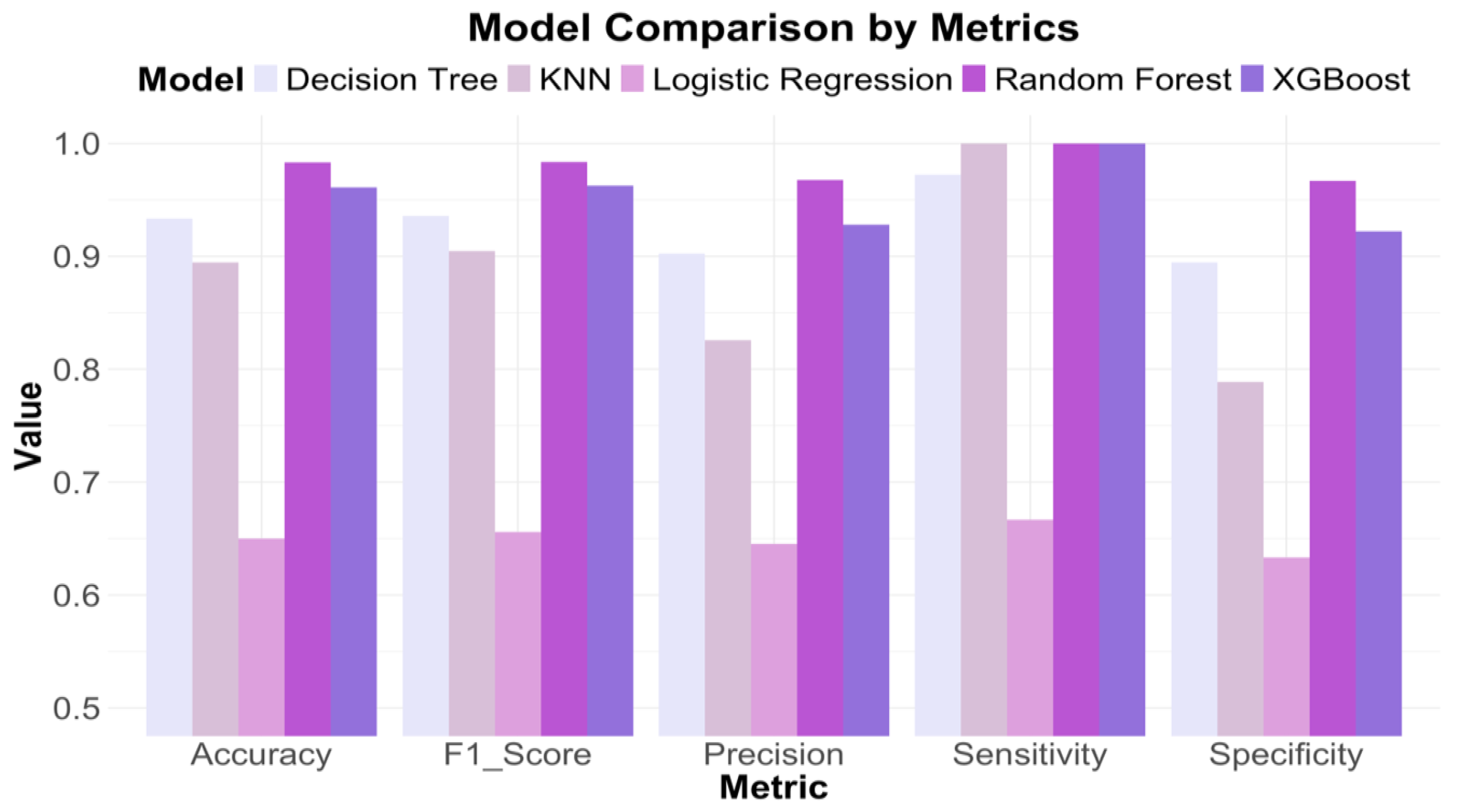
Model performance was evaluated by the following parameters: accuracy (overall classification correctness), precision (positive prediction reliability), sensitivity (true positive rate), specificity (true negative rate), and F1-score (balance between precision and sensitivity). Comprehensive performance metrics for all five machine learning models are presented in
Figure 1; higher score represents better performance.
The ensemble methods (Random Forest and XGBoost) substantially outperformed all other approaches across all evaluation metrics, with all scores exceeding 0.92. Random Forest emerged as the best-performing model, achieving near-perfect scores: accuracy = 0.98; sensitivity = 1.0; specificity = 0.97; precision = 0.97; F1-score = 0.98. Notably, Random Forest demonstrated the most balanced performance across sensitivity and specificity, which is clinically important for minimizing both false negatives (missed metastases) and false positives (unnecessary patient interventions). XGBoost ranked second with accuracy = 0.96; sensitivity = 1.0; specificity = 0.92; precision = 0.92; F1-score = 0.96. While slightly lower than Random Forest, XGBoost maintained excellent predictive performance across all metrics.
An interesting pattern emerged with k-Nearest Neighbors, which achieved high sensitivity (1.0) comparable to ensemble methods, but substantially lower specificity (0.79). This imbalance suggests that kNN tends to over-predict metastatic cases, potentially leading to false positives. Decision Trees showed moderate performance (accuracy = 0.93), demonstrating the substantial benefit of ensemble approaches over single decision trees.
Logistic Regression exhibited the poorest performance across all metrics (accuracy = 0.65; sensitivity = 0.67; specificity = 0.63), strongly suggesting that the relationship between mechanobiological gene expression and metastasis status is highly non-linear.
3.2. Gene Importance Analysis
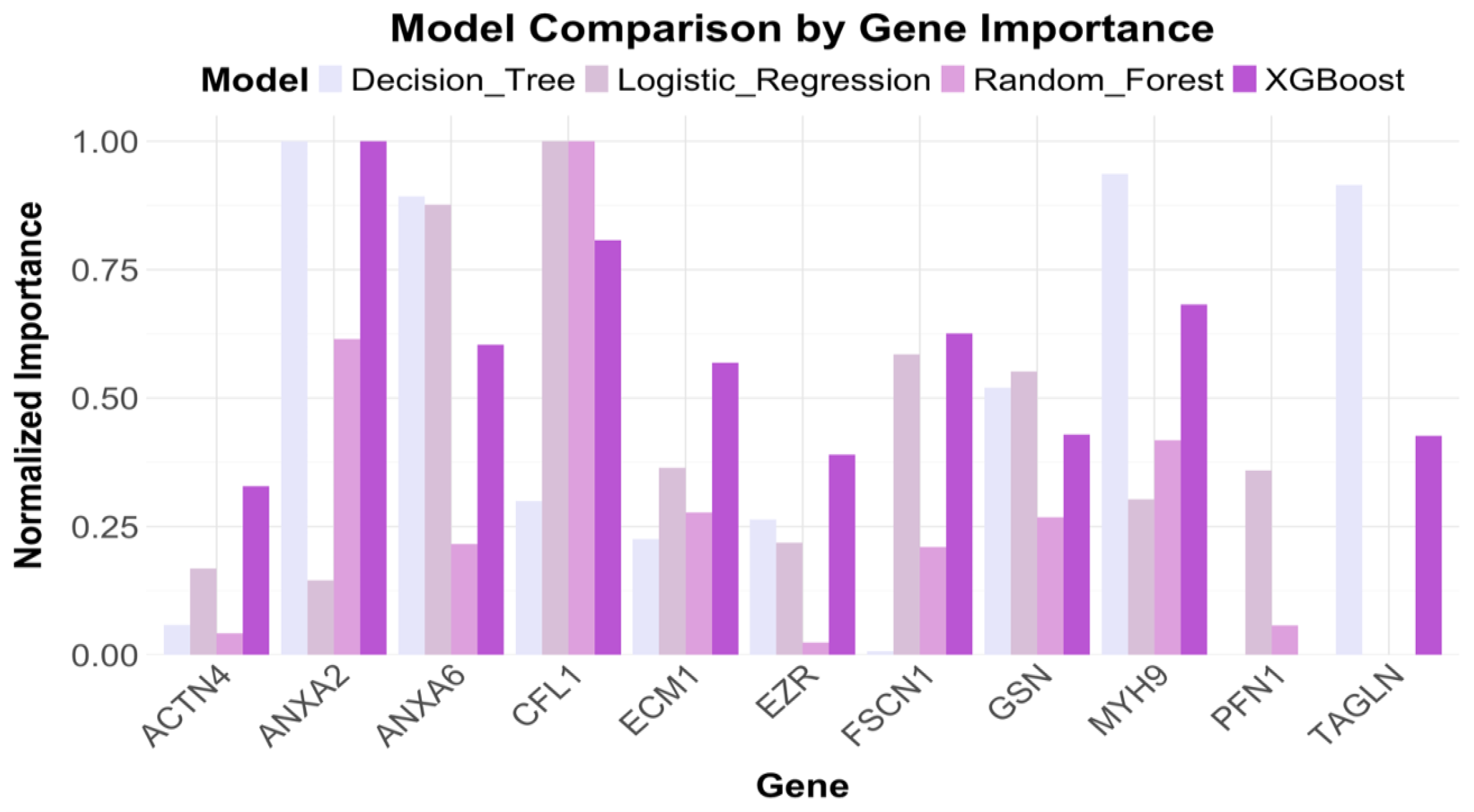
Given the strong predictive performance, we examined which genes contribute most significantly to metastasis to prioritize candidates for further validation and identify potential therapeutic targets. Normalized feature importance scores are presented in
Figure 2.
CFL1 emerged as the most influential predictor across all models, achieving near-maximal importance in Random Forest (1.0) and XGBoost (0.81).
ANXA2 and
MYH9 also demonstrated consistently high importance in top-performing models, suggesting their critical role in metastasis prediction and making them high-priority candidates for further investigation. Interestingly,
TAGLN,
FSCN1 and
ECM1 exhibited model-depended patterns, showing substantially higher importance in XGBoost compared to Random Forest (0.63 and 0.28 for
FSCN1; 0.57 and 0.28 for
ECM1). This finding is particularly noteworthy as these genes were previously identified in DepMap cell line analyses [
11] as having the highest prognostic value. Other genes showed consistently lower importance, suggesting their expression levels are less directly associated with distant metastasis development.
4. Discussion
This study demonstrates that machine learning models trained on mechanobiological gene expression can accurately predict distant breast cancer metastasis. Random Forest achieved the highest performance (accuracy = 0.98) with balanced sensitivity and specificity, while
CFL1,
ANXA2, and
MYH9 emerged as the most robust predictors. These results align with previous studies demonstrating the superior performance of Random Forest in cancer gene expression analysis. For example, Duan et al. reported that Random Forest outperformed other classifiers, achieving accuracy of 0.936 in predicting distant metastasis in breast cancer using a 21-gene expression panel [
12]. Similarly, Ayubi et al. found that Random Forest reached the highest accuracy (0.97) in predicting colorectal cancer metastasis [
13].
The ensemble methods achieved high accuracy (>0.96), comparing favorably with recent machine learning approaches while using a focused 11-gene panel rather than broader signatures [
14]. The superior performance of Random Forest over Logistic Regression confirms that gene–metastasis relationships are highly non-linear, consistent with the complex molecular mechanisms underlying metastatic progression [
15]. Class imbalance is a common challenge in biomedical datasets, and oversampling approaches such as SMOTE are widely used in biological and clinical research to improve classification performance on minority classes [
16,
17]. In this study, the balanced performance achieved through SMOTE and ensemble methods addresses a critical clinical requirement: minimizing both false negatives (missed metastases) and false positives (unnecessary interventions).
The consistent high importance of
CFL1,
ANXA2, and
MYH9 aligns with their established biological roles in metastases.
CFL1 (cofilin-1) regulates actin filament dynamics and is essential for cell migration and invasion [
18].
ANXA2 (annexin A2) facilitates membrane trafficking and has been implicated in promoting tumor cell invasion and angiogenesis [
19].
MYH9 (myosin-9) is a cytokine with an important role in the formation of cellular pseudopodia [
20]. The robustness of these genes across different model architectures strongly suggests they represent core mechanobiological processes required for metastatic dissemination, making them high-priority candidates for further investigation and potential therapeutic targeting.
Interestingly,
TAGLN,
FSCN1, and
ECM1 showed higher importance in XGBoost than Random Forest, despite both being ensemble methods. This pattern mirrors our previous cell line findings [
11], where these genes demonstrated the highest prognostic value and represented optimal therapeutic targets. The concordance between XGBoost feature importance and prior findings suggests that this model better captures the biological relevance of these biomarkers in patient samples, highlighting them as promising candidates for clinical validation. This pattern aligns with studies showing that XGBoost’s feature importance ranking effectively identifies biologically relevant biomarkers: Li et al. used XGBoost feature importance to discover a 6-gene signature for breast cancer metastasis, with subsequent in vitro validation confirming the biological roles of identified genes [
21], while Ghuriani et al. demonstrated that XGBoost-ranked features consistently revealed cancer-specific biomarkers across multiple cancer types, with pathway analysis validating their biological significance [
22].
These findings enable several clinical applications: a streamlined diagnostic panel for risk stratification, identification of therapeutic targets, and a balanced predictive tool suitable for clinical decision-making. However, several limitations of this study should be acknowledged. First, the number of patients with distant metastasis in the TCGA cohort is extremely small (22 cases), reflecting the rarity of metastatic disease at the time of primary tumor sampling. To mitigate this imbalance, SMOTE was applied prior to the train–test split, which allowed stable model training but may introduce information leakage and artificially optimistic performance estimates. When we tested a leakage-free alternative strategy, where the dataset was first split and SMOTE was applied only to the training set, the test set contained only 3–4 metastatic samples. Under this setting, model performance became highly unstable and substantially decreased, particularly for non-linear ensemble models, making reliable estimation of generalization performance infeasible. Therefore, the reported performance metrics should be interpreted as exploratory, upper-bound estimates. The primary aim of this study is biomarker identification and hypothesis generation, supported by the consistent ranking of informative genes across models, rather than the development of a clinically validated predictive classifier. For an accurate assessment and clinical generalizability, future studies should involve larger independent patient cohorts with enough metastatic cases.
In conclusion, mechanobiological gene signatures analyzed using ensemble machine learning show promise for identifying metastasis-associated expression patterns and prioritizing candidate biomarkers, warranting further validation in larger independent cohorts before clinical translation.