1. Introduction
The application of phosphate coatings is one of the simplest, most economical and reliable ways to protect parts, equipment and structures made of carbon and low-alloy steels and cast iron from corrosion. High-alloy steels, especially chromium–tungsten, chromium–vanadium and copper-alloyed steels, are poorly phosphated, and low-quality films are formed on their surface. On stainless steels, phosphate coatings are not deposited directly from the solution [
1,
2,
3].
A very important advantage of cold phosphating methods is the wide possibility of controlling the process and using them for processing large surfaces and bulky complex structures by solution pulverization.
The development of phosphating methods began with the use of phosphate films to protect metals from corrosion. Subsequently, antifriction, electrical insulation and other properties of phosphate coatings were identified and used.
Phosphate coatings protect the metal surface mechanically. They isolate the protected metal from the environment. At the same time, porosity reduces the protective properties of coatings, and it becomes necessary to develop new solutions for coatings with reduced porosity. The phosphate coating layer consists of many crystals of very different sizes, which have grown from the nucleation centers, joined and covered the surface. The structure of this type initially implies the presence of microcracks and pores extending to the metal surface in the intercrystalline zones. The porosity of phosphate coatings is usually quite low, about 0.5–1.5% of the area of the phosphated surface [
4]. It is generally believed that porosity decreases with increasing thickness of the phosphate coating.
Although the porosity of the coating has a negative impact on its anti-corrosion characteristics, it also provides some advantages. The pores in phosphate coatings act as large reservoirs into which organic materials can be collected [
5]. This property is used to improve the protective properties of phosphate coatings by impregnating the pores with oil. Thus, a homogeneous fine-crystalline phosphate coating can be recommended to increase the adhesion of the paint film, while the coarse-crystalline coating should be additionally protected with oils, varnishes, etc.
Since the corrosion resistance of the phosphate coating is increased tenfold by impregnation with lubricating oils or applying varnish [
6], it is a good primer for painting. Phosphate films significantly increase the adhesion of paint coatings [
7,
8].
The main valuable property of the phosphate film is its high corrosion resistance in all types of combustible, lubricating and organic oils, in benzene, toluene and in all gases except hydrogen sulfide [
2,
9,
10].
The presence of phosphate coatings on the surface facilitates the flow of metal, reducing the effort required for drawing pipes and wire drawing, and accordingly increases the service life of the tool (drawing boards) [
2]. After the phosphate films are impregnated with lubricants, the friction during cold drawing, rolling, and deep drawing of sheet steel is significantly reduced [
11]. The phosphate film holds the lubricant well and significantly facilitates the running-in of rubbing steel parts, preventing jamming, so phosphating is used to reduce the wear of machine parts working on friction, shaft pushers, gears, bearing liners, etc. [
2]. The presence of phosphate coatings on the steel surface facilitates stamping, while increasing the service life of the dies and reducing energy consumption [
12].
Fine-crystalline phosphate films, characterized by good anticorrosive properties, are obtained from solutions based on the Mazev Salt containing Mn(H
2PO
4)
2∙2H
2O (proportion of phosphoric acid, in terms of P
2O
5 46–52%; mass fraction of manganese not less than 14%) [
13,
14,
15]. In such solutions, good-quality coatings are deposited on products made of structural steel and cast iron. To speed up the deposition of coatings, additives of accelerators, such as zinc nitrate, are introduced into the phosphating solutions. The use of additives also makes it possible to phosphatize the metal surface at room temperature [
16,
17,
18]. During cold phosphating, coatings with hydrophilic properties are formed. This circumstance indicates that the temperature conditions of phosphating have a significant effect on the molecular surface properties of phosphate coatings.
Numerous studies are known in which the behavior of phosphate coatings under chemical and thermal effects is described in detail. Phosphate coatings undergo significant changes when the temperature changes. When they are heated above room temperature, a gradual weight loss occurs. This was due to non-structural weight loss. However, with a subsequent increase in the temperature, dehydration of the constituent phases of phosphate crystals occurs [
19]. Weight loss increases significantly between 250 and 600 °C. At temperatures above 600 °C, zinc and phosphorus sublimate, which leads to complete destruction of the coating. The change in the appearance, color and morphology of phosphate coatings remains virtually unchanged up to 200 °C. However, above this temperature, the gray color of the crystalline phosphate coating changes to silver–gray and appears dusty. At temperatures above 500 °C, the color changes to brown, and at temperatures above 600 °C, complete destruction of the phosphate coating occurs [
20].
Thus, in the processes of metal phosphating, the composition of the solution, the mode and method of phosphating determine not only the properties of phosphate coatings such as corrosion resistance, wear resistance, color, and the nature of the crystal structure, but also their molecular nature.
In recent years, the requirements for the quality of phosphate coatings and their application technologies, including economic and environmental aspects, have significantly increased. Priority areas for improving phosphating processes are improving the protective and other functional properties of coatings, reducing the concentration of solutions, temperature and processing time, simplifying adjustments, unifying phosphating compositions, and reducing the environmental hazard of processes.
The aim of the work was to study the characteristics of colored phosphate coatings in order to establish the directions of their application not only as protective and decorative, but also as special coatings.
2. Materials and Methods
Solutions of the following compositions have been developed [
21] for cold deposition of phosphate coatings [g/L]: Mazev Salt (containing Mn(H
2PO
4)
2∙2H
2O (proportion of phosphoric acid, in terms of P
2O
5 46–52%; mass fraction of manganese not less than 14%)) 35–45, Zn(NO
3)
2 50–65, NaNO
2 3–4, glycerin 1–2, trilon B 6–8, the preparation OS-20 5–10. In this work, colored phosphate films were obtained from a phosphating solution of the following composition [g/L]: Mazev Salt 40 (NPF Nevsky Khimik LLC, Saint Petersburg, Russia), Zn(NO
3)
2 60, NaNO
2 3, glycerin 2, trilon B 7, the preparation OS-20 7 (NPF Nevsky Khimik LLC, Saint Petersburg, Russia), by suspending in it the powders of procyon olive green (Jacquard Products, Healdsburg, CA, USA) and methylene blue (LenReactive JSC, Saint Petersburg, Russia) dyes in an amount of 8 g/L for the deposition of green and blue films, respectively. The solutions were prepared immediately before deposition of the coatings.
To form phosphate coatings without heating, the pH of the solution should be 2.6–3.2 [
22,
23]. The pH of phosphating solutions was monitored using a pH meter before and after deposition of films on steel samples (
Table 1).
Phosphate coatings were applied to the surface of the 100 × 50 × 3 mm and 50 × 50 × 3 mm samples made of hot-rolled St3 steel sheets (Ziskon, Ekaterinburg, Russia). The chemical composition of the steel is shown in
Table 2. The surface of the samples was pre-sanded with sanding paper (the surface roughness of the steel samples was 0.86–0.89), degreased in 5% Na
2CO
3 solution with the addition of solid soap (1%) at a temperature of 50–70 °C for 10 min, and then wiped with a swab soaked in pure ethanol for 10 s.
The coating was formed on the surface of a steel sample immersed in a phosphating solution for 15 min at a temperature of 20 °C without mixing. Each sample was placed in a separate container with a 300 cm3 phosphating solution. After extraction from the solution, the sample was washed with running water and dried in air.
To determine the application areas of colored phosphate coatings, a few of their physical and mechanical properties are investigated. For each type of test, a group of 5 samples of each color was produced. The results were averaged.
2.1. Method of Surface Investigation Using an Atomic Force Microscope
A scanning atomic force microscope SolverP47-PRO (NT-MDT, Moscow, Russia) was used to analyze the surface of the samples under study. To determine the average grain size of the deposited phosphate coatings, a grid was constructed on the intermediate divisions on the axes in the images. The grain diameter was measured at the intersections of the lines.
2.2. Determination of the Protective Ability of the Phosphate Film
The heat resistance of the phosphate films was tested at temperatures of 100, 200 and 300 °C by placing the samples in a muffle furnace for 2 min. After extraction of the samples and their cool down, the protective ability of phosphate coatings was tested by the drip method. A solution containing CuSO4·5H2O—80 g/L, NaCl—33 g/L, HCl (0.1 N)—13 mL/L was applied to the surface of the sample, and the time of change in the color of the surface from blue to red was monitored. If, at 15–20 °C on a steel sample with a phosphate film, the color change occurred earlier than 2 min, then the protective ability of the film was considered as low, at 2–5 min—medium, longer than 5 min—high. When tested under a drop of reagent, the release of the smallest particles of metallic copper was sometimes observed. This phenomenon, if it was not accompanied by a drop change, was not considered when evaluating the corrosion resistance of the phosphate coating.
2.3. Determination of Coating Thickness by a Cross-Section Method
The determination was carried out by measuring the thickness of the coatings on SEM images of the cross-section of the phosphated plate enclosed in the section. The surface of the sample intended for analysis is processed on a flat-grinding machine. To obtain a smoother surface, the sample is sanded by hand with sandpaper, beginning with the paper with the coarsest abrasive grain. Gradually move to a finer grain, changing the direction of grinding by 90°.
2.4. Method for Monitoring the Wear Resistance of Coatings
The wear resistance of phosphate coatings was carried out on the test machine UMT-2168 (Tochpribor LLC, Ivanovo, Russia). The rotating disk with a diameter of 0.04 m made of St45 steel was in contact with a fixed steel plate with a phosphate coating. Tribological tests were performed at a temperature of 25 °C and a relative humidity of 70–80%. The rotation speed of the disk was 100 rpm. The single path of the run was 150 m. Load was 100 N. The contact area was 1.2 cm2. All friction resistance tests were carried out under dry friction conditions. Each experiment was performed three times to ensure the accuracy of the experimental data.
The friction torque is determined according to the obtained installation tribograms. The coefficient of friction
f is calculated by the Equation
where
is a moment of friction, [N·m];
d is a diameter of the rotating disk, [m];
P is a load, [N].
The surface area damaged by abrasion was calculated from images obtained using an electron microscope camera. The images were taken in black and white mode at 10× magnification.
2.5. Determination of the Breakdown Voltage of Coatings
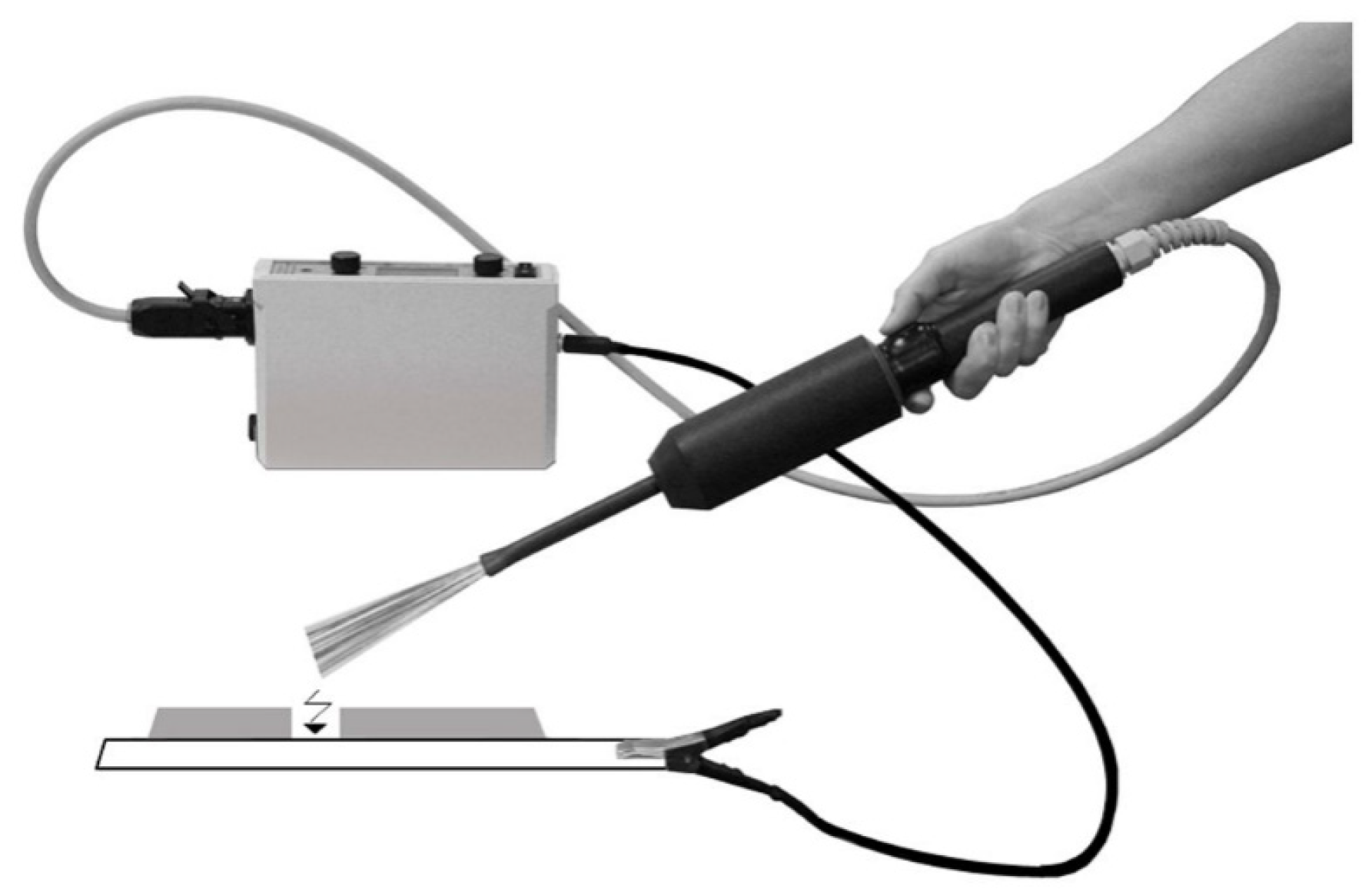
The breakdown voltage test of the electrical insulation coating is carried out on the electric spark flaw detector Corona 2M (Constanta-MSK, Moscow, Russia). The principle of its operation is to close the electrical circuit created by connecting the electrodes to the object under study and generating current by a high-voltage transformer (
Figure 1). The signal received when a defect is detected is recorded by the device, which it notifies with the help of light and sound alarms. The device is equipped with a display for digital indication of the voltage level.
3. Results and Discussion
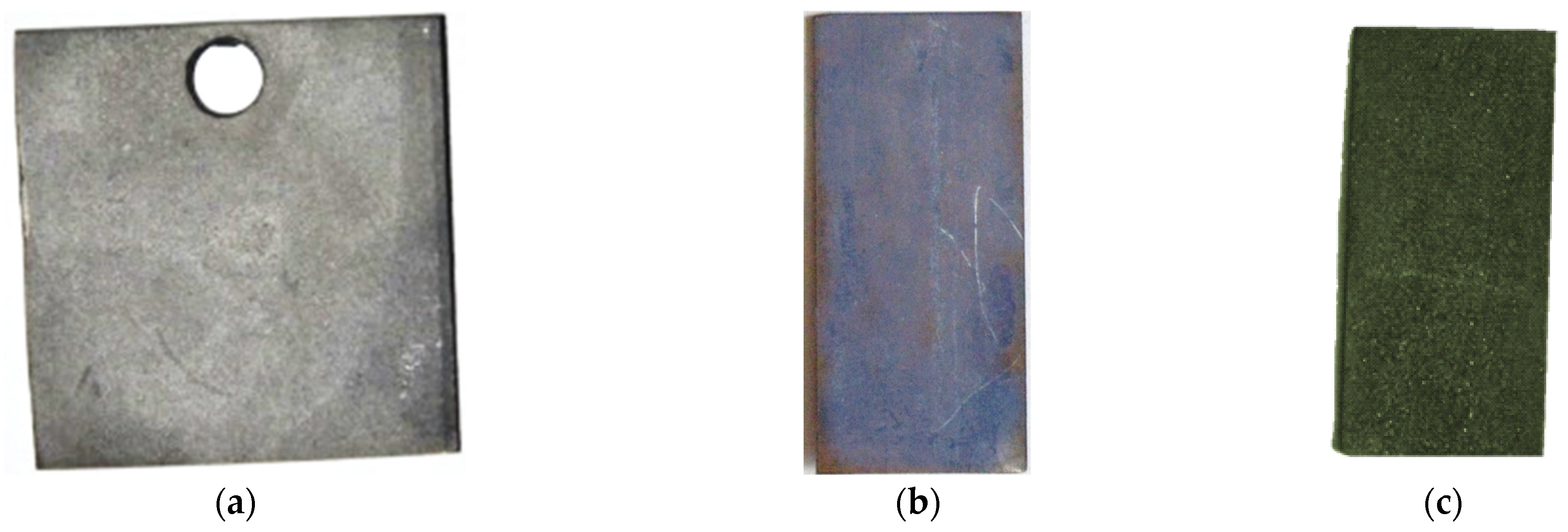
Figure 2 shows photos of modified phosphate coatings obtained by cold method on steel. Colored phosphate coatings turned out to be uneven, some areas of the steel surface remained uncovered. The green phosphate coating is coarse-grained and has a significant roughness. The blue phosphate coating turned out to be finely crystalline, but its appearance also requires improvement.
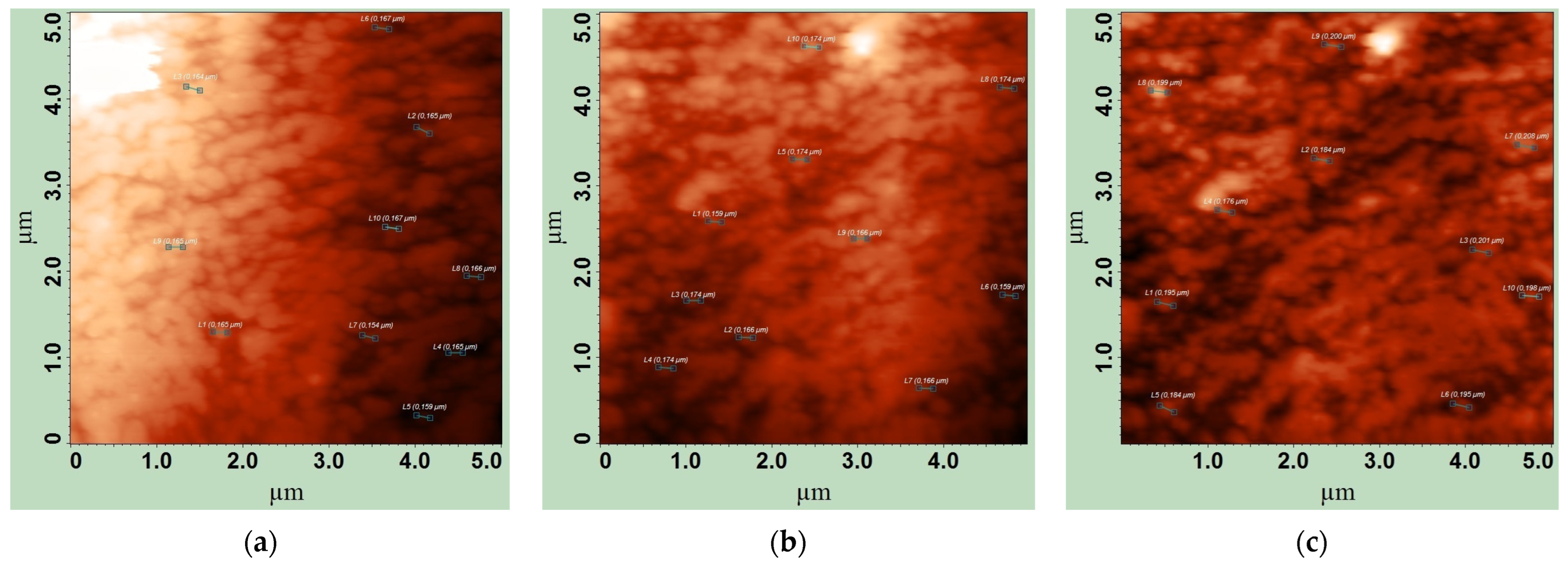
The grain size of phosphate coatings was determined from atomic force microscope images (
Figure 3). The images show that the coatings are fine-crystalline. The average grain diameter of gray film is 164 nm, for blue phosphate coating this parameter is 169 nm, for green coating is 194 nm. The grain sizes of the green coating are consistent with its appearance (
Figure 2c) and confirm the formation of a coarse-grained coating.
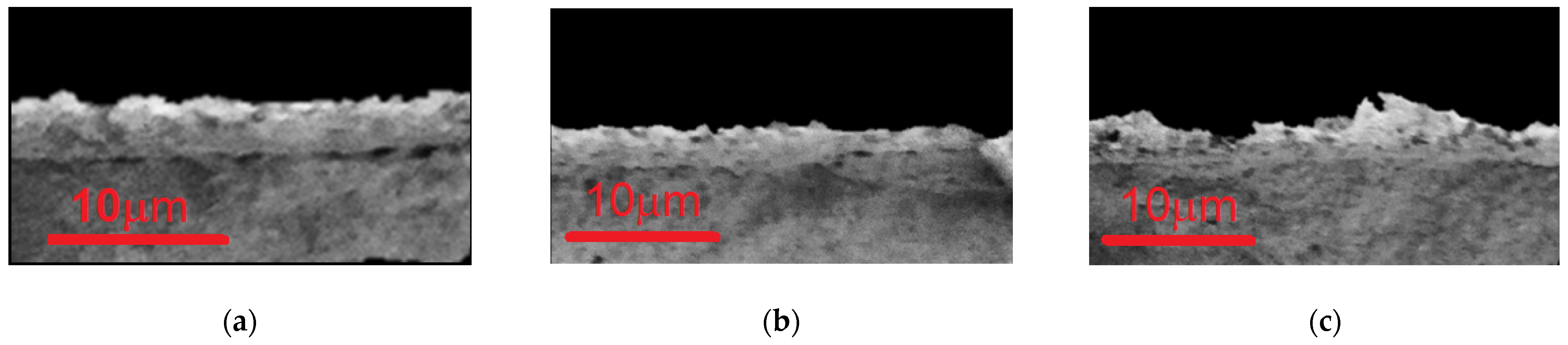
The processes of cold chemical phosphating of metals proceed with self-inhibition due to the termination of access of the phosphating solution to the metal surface. Therefore, the thickness of the resulting phosphate coatings after reaching a certain limit does not significantly increase in the future. It is possible to judge the thickness of the coatings by the cross-section sections: the thickness of the modified phosphate films is 3–4 microns (
Figure 4). Since the formation of phosphate coatings does not cause a significant change in the size of the products, phosphating can be widely used as a protective coating for fasteners, followed by impregnating them with lubricants.
Figure 4c demonstrates the uneven green coating, which is also visible in
Figure 3c due to the large number of surface darkening.
It is known that phosphate coatings can withstand short-term heating up to 400–450 °C [
24]. The results of the study of the heat resistance of phosphate coatings show (
Table 3) that with increasing temperature, the protective ability of the coatings decreases, and when heated to 300 °C, the films lose their protective properties. Colored phosphate coatings obtained in solutions with dyes have less protective properties, which is due to their uneven distribution on the surface of steel, as can be seen in
Figure 2.
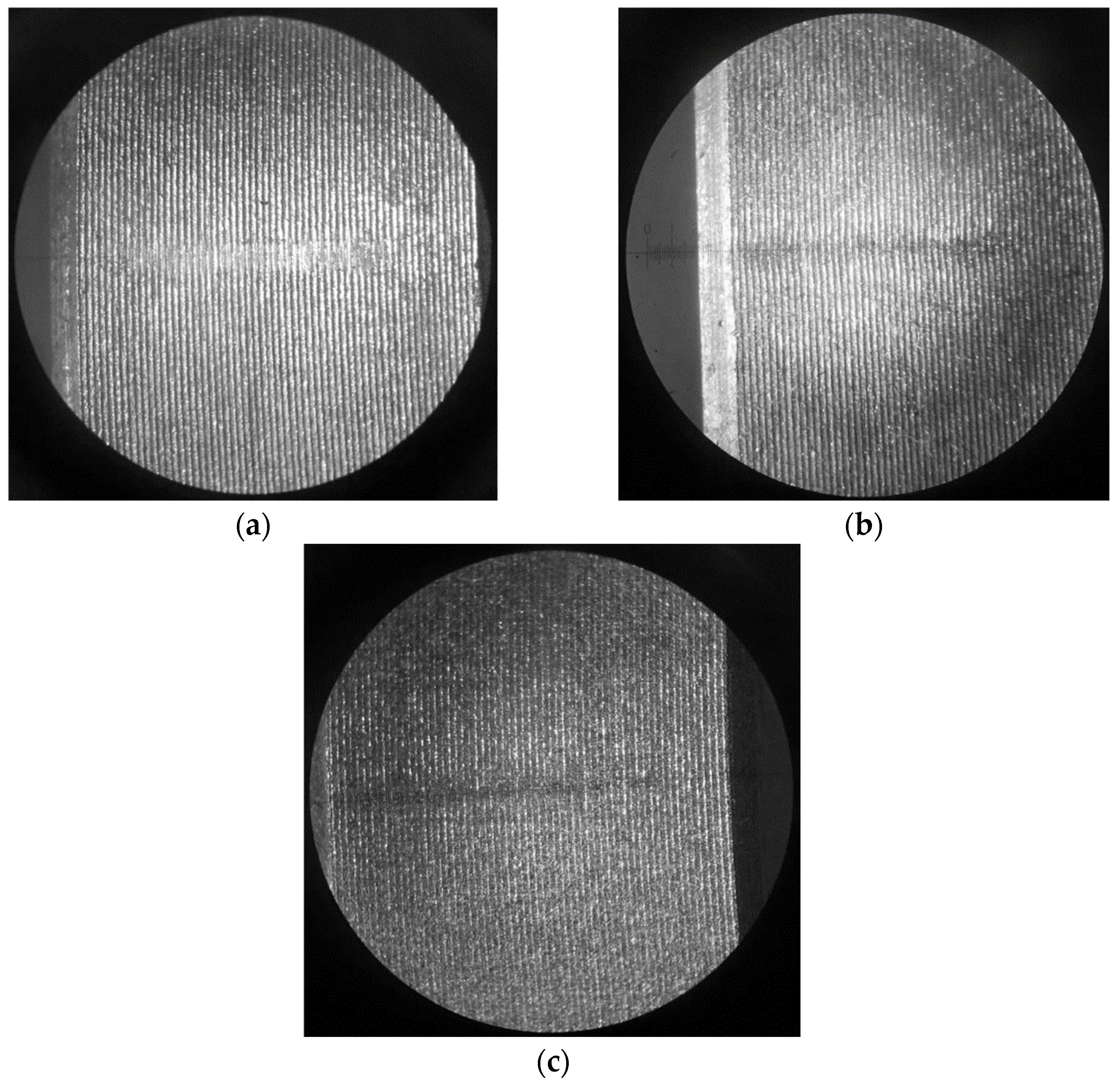
To assess the wear resistance of phosphate coatings, their tribological properties were tested and the values of the friction coefficient were determined from the obtained tribograms. The coefficient of friction of the green phosphate coating has an uneven distribution over the thickness of the coating, its values are in the range of 0.05–0.2. This difference in the values of the coefficient of friction is explained by the fact that the surface of the product has a softer phosphate coating and a higher coefficient of friction, the upper layers of the film are harder, and their coefficient of friction is lower. The area of the damaged surface was 5.4 mm
2. The coating was erased to the surface of the sample (
Figure 5a). The blue phosphate coating turned out to be the most uniform in thickness of the studied ones. The friction during the tests was stable; the value of the coefficient of friction is 0.13. The area of the damaged surface was 4.7 mm
2. The coating is not completely worn, and the metal is not visible (
Figure 5b). The modified phosphate coating is not uniform in thickness, and the friction during the tests was non-stationary. The values of the coefficient of friction are in the range of 0.1–0.15. The area of the damaged surface is 5.2 mm
2. The metal surface at the point of abrasion of the coating is not visible (
Figure 5c). Due to the low values of the coefficients of friction and heterogeneity in thickness, phosphate films obtained from cold phosphating solutions cannot be recommended as wear-resistant coatings, but they can be used to protect structural products, as well as to cover the elements of structures laid by drawing.
Depending on the processing conditions of metal surfaces or the mode of obtaining phosphate coatings, the structure of the surfaces turns out to be different. The wear resistance is influenced by the geometric shape of the microirregularities and, in particular, the nature of the structure of the crystals of phosphate coatings. Despite the fact that in the presence of phosphating accelerators, the structure of phosphate coatings becomes more finely crystalline, the strength properties of coatings often decrease. On one hand, the strength properties of crystals of insoluble phosphates change due to the distortion of the crystal lattice from the inclusion of foreign elements in it. On the other hand, the microgeometry of polycrystalline formations on the coating surface changes significantly.
Phosphates, which are part of phosphate films, have dielectric properties; therefore, the film is characterized by an electrical insulating ability. Tests to determine the breakdown stress of steel protected by phosphate coatings showed (
Table 4) that the modified phosphate films have insufficiently high electrical insulation properties, despite their fine-crystalline structure, low porosity, and uniform distribution over the metal surface [
21]. Compared with coatings obtained by hot phosphating, for which the average breakdown voltage is 250 V [
25,
26], the results are low. The lower value of the breakdown stress in phosphate coatings obtained on steel by the cold method is because they are much thinner than coatings obtained from phosphating solutions when heated.
Phosphate coatings due to their electrical insulating properties can be used to prevent the occurrence of contact or electrochemical corrosion in structures and devices made of dissimilar metals.
4. Conclusions
The conducted studies show that the modified coatings obtained by the cold method are not inferior in physical and mechanical properties compared to traditional phosphate coatings. In combination with the impregnation of oils and the application of protective and decorative paint coatings, they are a highly effective means of protecting metals from corrosion.
Modifying the compositions of cold phosphating solutions to obtain colored phosphate coatings on steel makes it possible to obtain phosphate coatings that have a small thickness but good protective properties, and improve the performance characteristics of the protected products.
Phosphate coatings can withstand short-term heating up to 100 °C; at a higher temperature, the protective ability of the coating decreases. At temperatures above 200 °C, colored phosphate coatings do not exhibit protective properties.
The wear resistance of the phosphate film is low. In places of abrasion, the coating crumbles and cracks, but it does not peel off. Therefore, it is possible to draw a conclusion about the strong adhesion of the phosphate film to steel.
The electrical insulation properties of colored phosphate coatings do not meet the requirements for electrical insulation coatings, as they are less than 300 V. The breakdown voltage value of about 200 V is related to the small thickness of the phosphate coatings produced by the cold method. The electrical insulating ability of phosphate coatings does not change with increasing temperature due to overheating of electrical equipment to 100 °C. This is enough to use phosphate films as protective and decorative.
Colored phosphate coatings are not inferior in physical and mechanical properties to films obtained from cold phosphating solutions, so it is advisable to continue research on optimizing the composition of cold color phosphating solutions.