


Abstract
This study focused on determining the conditions leading to variance in the measurements of an antenna array capable of measuring the direction of electromagnetic waves. The payload of the study is a cross-array of antennas that is able to measure direction through array beamforming and angle of arrival (AOA) technology. Starting from the modeling of satellite kinematics (in terms of the satellite’s position and attitude combined with its relative position with respect to an electromagnetic wave emitter located on Earth’s surface), this study provides the mathematical fundamentals to identify potential cases that lead to divergence in the estimation variance for the position of a signal emitter. The numerical and analytical predictions, conducted through an evaluation of the Cramér–Rao lower bound (CRLB) metrics, were on the azimuth, elevation, and broadside angles through the generation of errors in the attitude with Monte Carlo simulations. Recent advancements in the miniaturization of electronics make these studies of particular interest for a new set of technological demonstrators equipped with payloads composed of antenna arrays. Applications of interest include Earth-scanning missions, with exemplary cases of search-and-rescue operations or the spectrum monitoring of jamming in the E1/L1 band for the GNSS.
1. Introduction
The primary focus of this paper concerns a set of new-generation space missions to be designated for geolocation purposes [1,2]. Geolocation is defined as the process of determining the position of an object of interest (i.e., a signal emitter) in geographic coordinates. This operation is important for numerous civil applications, including search-and-rescue operations or the spectrum monitoring of jamming signals. An example is the set of jamming signals intended to interfere with the E1/L1 bands employed by GNSS (Global Navigation Satellite System) receivers in civil aviation.
Among the main technologies [1,2,3,4] are the AOA (angle of arrival), time difference of arrival, frequency difference of arrival, and received signal strength. This study considered the antenna array payload set employed by AOA receivers.
This study is written within the context of interactions between two subsystems of a satellite platform employed for geolocation purposes. In particular, an evaluation of the propagation of attitude errors in the attitude determination and control system (ADCS) within AOA technology is presented.
The propagation of attitude errors from the ADCS to AOA measurements happens in two concurrent forms: a direct influence on the measurement, which can be observed on the matrices of rotation, and an indirect effect on the variance of the payload. The approach of this study was mainly theoretical, and the study aimed to propose a methodological framework that can be used to evaluate this second indirect effect. In particular, there exists the possibility that the propagation of attitude errors leads to a divergence in the dispersion of AOA measurement errors.
The main purpose of this study was to determine the set of conditions that leads to such a situation.
A first explorative analysis on the topic was carried out with a triaxial antenna array and the proposal of a conceptual scheme for the compensation of the measurements [5]. This study aimed to investigate this further and demonstrate this phenomenon, first by using a simulation that employed a Monte Carlo approach, preliminary to future experimental analyses.
This paper is based on the results presented at a virtual event [6].
2. Materials and Methods
The approach of this study was mainly analytical using Monte Carlo simulations. In Section 2.1, the full mathematical model employed for the representation of the positions is reported. In Section 2.2, the indirect effect of the payload model is revealed with the conditions related to the cases of measurement divergence.
2.1. Mathematical Model of Positions
It was supposed that an emitter of electromagnetic waves E was on the surface of Earth and a receiver on a satellite platform S was in low Earth orbit (LEO).
Interferences with other signal emitters were neglected. The toy model considered in this study assumed the ideal use-case of one signal emitter and one satellite platform.
The motion of the satellite platform assumed a rigid body, with Keplerian kinematics for the translation and nadir pointing for the attitude. The motion of translation was assumed to be absolutely known (i.e., errors in position estimation were neglected and not relevant to the study). The attitude of the satellite was assumed to be in a state that would guarantee a nadir pointing; residual errors (coming from the attitude control) were assumed to have a Gaussian distribution. This model was considered both for its simplicity and because the objective of this study was to determine cases of divergence in the measurement dispersion for the payload compared to the ideal value.
This study adopted coordinate systems commonly employed in astrodynamics [7,8,9]. In particular, the following ones were employed: the perifocal (PQW); Earth-centered inertial (ECI); Earth-centered Earth-fixed (ECEF); latitude, longitude, and height (LLH); body (BRF); and orbital (ORF) coordinate systems.
The position of the signal emitter can be represented through the quantities of the geodetic latitude , longitude , and height h (LLH), as shown in (1).
The position of the satellite is generally expressed in PQW, as shown in (2), where is the true anomaly, a is the semi-major axis, and e is the eccentricity of the orbit.
Coordinate conversion happens through (3)–(6), where is the angular position of the Greenwich meridian, is the right ascension of the ascending node, i is the inclination of the orbit, and is the argument of perigee.
The operators , , and denote, respectively, the components of the vector expression between the square brackets along the directions x, y, and z.
It was supposed that the attitude of the satellite was such that the nadir pointing was maintained, while the influence of the mounting parameters were neglected, i.e., the ADCS, the center of mass, and the payload position were coincident with no rotation among the subsystems.
Attitude representation is generally in the form of Euler angles or quaternions. Both are equivalent parametrizations of the same set of variables of state; however, Euler angles are affected by the problem of the gimbal lock such that, when possible, quaternions are always preferred, despite the fact that they are less intuitive to recognize. Due to their simplicity, in this study, a parametrization in the form of Euler angles was assumed; it was also assumed that the attitude state was not in a gimbal lock situation. The set of angles , , and are, respectively, the attitude angles of the roll, pitch, and yaw, and they are employed in the rotation between the ORF coordinate system and the BRF coordinate system, as shown in (7).
2.2. Payload Model
It was supposed that the payload was composed of an antenna array capable of measuring the direction, denoted as the line of bearing (LOB), , as shown in (8).
Each antenna array can give a broadside angle .
The antenna array model used in this study was a 2D cross-antenna array made up of two linear antenna arrays along two mutual perpendicular directions. In particular, for the study, an ideal antenna array with even-spaced elements was considered. This solution was considered because at least two estimations from non-parallel directions are required to solve the ambiguity and obtain a measurement.
A Cartesian coordinate system was fixed for the array A; the measurement can also be represented in a local spherical coordinate system built from it through the azimuth and elevation angles and . In particular, for this study, the convention in (9) was adopted following [10,11,12].
Without the loss of generalization, it was assumed that the coordinate system of the payload A was coincident with BRF.
Given a cross-antenna array, it is possible to connect the two quantities and to the local azimuth and elevation angles and , as reported in (10).
Given the measurements and , it is possible to estimate the azimuth and elevation angles as in (11).
The direct influence of the ADCS can be observed in the matrices of the roll, pitch, and yaw in the conversion from the body to the orbital coordinate system of (7).
The indirect influence comes instead from the model of measurement variance. The best prediction for linear antenna arrays [13] is in the form of the Cramér–Rao lower bound (CRLB), as reported in (12), where L is the length of the array from the first to the last element of the array, M is the number of antenna elements, is the signal-to-noise ratio, f is the frequency of the signal, and c is the speed of signal propagation, which is supposed to be equal to the speed of light.
The divergence condition is , which corresponds to or, equivalently, to and with . Equivalently, the condition of divergence can be written as .
Operatively, it is or, equivalently, with for the broadside angle .
And also, or, equivalently, with for the broadside angle .
3. Results and Discussion
For demonstrative purposes, an example of a Monte Carlo simulation with a total number of simulated cases of was performed in the MATLAB 2024a environment.
The statistical simulation concerned the generation of errors in the attitude state.
The models of the signed error , , and were considered and generated.
The propagation of the attitude errors on the payload dispersion of the measurements was evaluated, considering the unsigned values of and , which were employed as metrics to denote the absolute difference between the two cases (without and with an error in the attitude state), as shown in (13).
For the errors in the attitude angles, a variance of rad2 was considered.
The signal emitter was on the surface of Earth with values of °, °, and .
The satellite was in a circular orbit with properties of km, , °, and °. Conventionally, for circular orbits, °.
The choice of the orbit size and shape fell within the set of circular LEO orbits, commonly employed for geolocation missions.
The choice of the orbit’s inclination was such that it enabled Earth’s entire surface to be scanned.
The simulations were conducted by varying the value of the true anomaly , because it is the only angular parameter that changes over time; it represents the angular position of the satellite on its orbit.
The cross-antenna array had properties of and m, which can be employed on 3U CubeSats platforms.
The number of antenna elements was determined by considering (14), where is the wavelength associated with the frequency.
In particular, a spacing value between elements of was adopted, both to avoid aliasing and to enhance the compactness of the antenna array.
A linear detector, a non-fluctuating signal with an unknown phase, and Gaussian noise were assumed; the frequency of the signal was in the E1/L1 band with MHz, a probability of detection , and a probability of false alarm . From the receiver operating characteristic (ROC) curves [14], the minimum value of resulted in dB. An additional dB was considered for unmodeled effects (e.g., the presence of the atmosphere).
Other assumptions of the study included omnidirectional transmission and isotropic propagation. Reflection, refraction, and multi-path characteristics were not considered. The speed of signal propagation was supposed to be constant and equal to the speed of light in a vacuum.
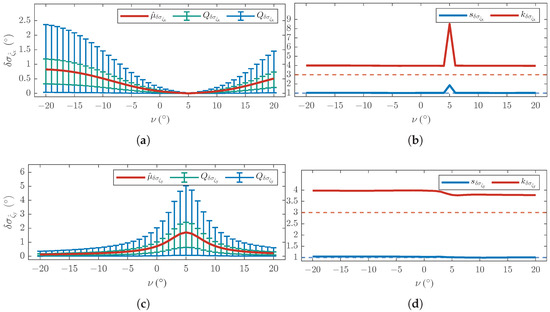
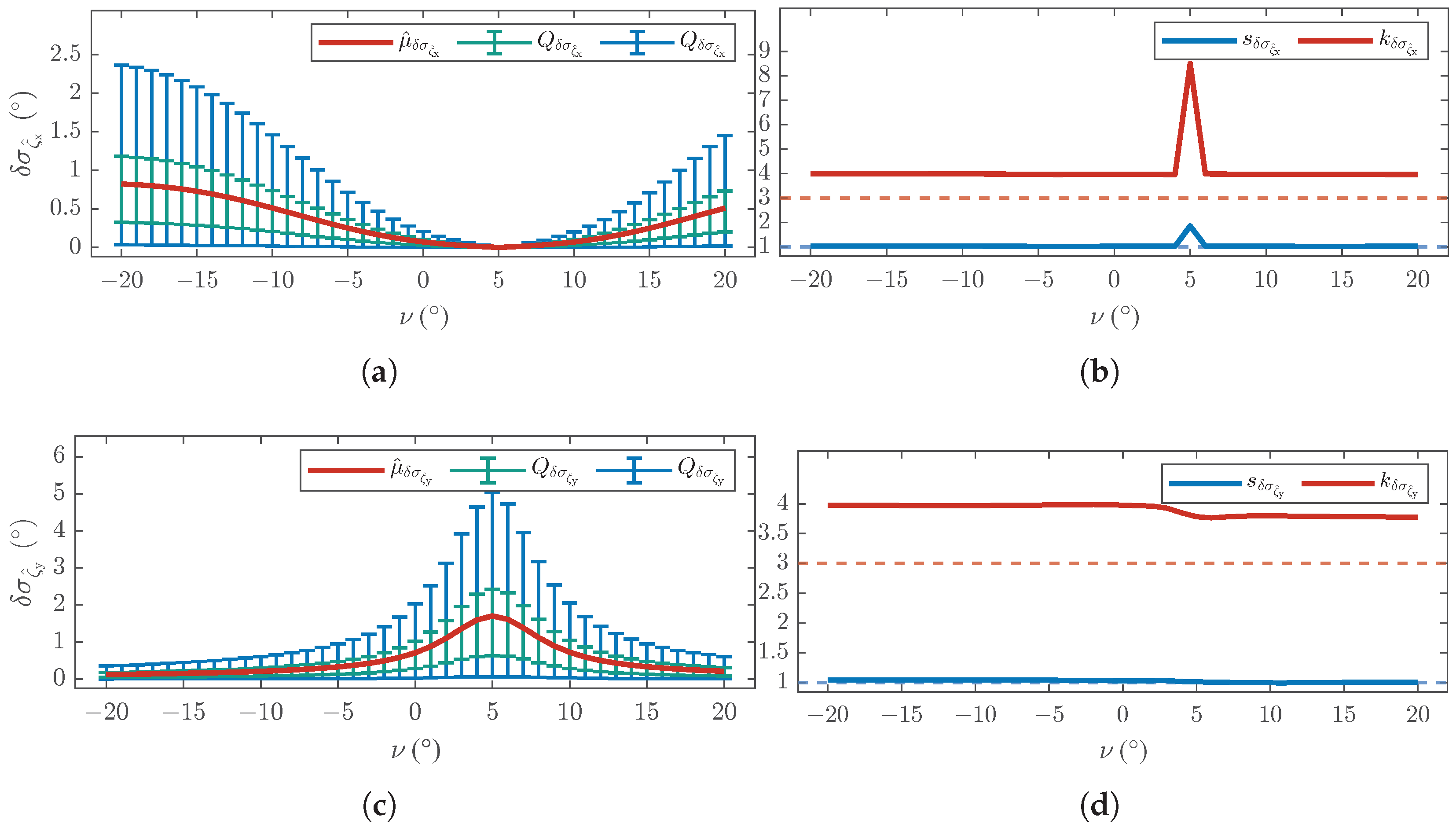
The results are presented in Figure 1. The results confirm the analytical insights, and it can be seen that, when the y axis of the antenna array tended to be aligned with the emitter position (in the correspondence of °), there was a measurement divergence, while the x axis reached its best measurement.
Figure 1.
(a) Trends of the simulated model : mean value and quantiles Q evaluated at % and %. (b) Trends of skewness s and kurtosis k for . (c) Trends of the simulated model : mean value and quantiles Q evaluated at % and %. (d) Trends of skewness s and kurtosis k for .
This can be observed by considering that, in correspondence of °, the difference in the value of the standard deviation along the y direction diverged (i.e., the attitude errors had a huge impact compared to the ideal measurement), while its orthogonal counterpart along the x direction appeared to be close to the ideal value (i.e., the value of the standard deviation predicted without the influence of attitude errors).
4. Conclusions
This study constitutes an explorative analysis to evaluate the indirect influence of the ADCS on the performance of a payload composed of antenna arrays with AOA sensing technology. In particular, from the mathematical model, it is possible to predict cases of divergence in the measurement dispersion, which can result in unwanted, unreliable measurements. Monte Carlo simulations were performed to check and confirm the predicted influence. This model could be useful for space operators, to determine a set of both satellite orbits and satellite orientations in terms of the attitude, which can be used to avoid divergence in the measurement error variance.
Considering that all the other competing sources of errors were neglected, this study can be considered an integration to complete a general model of errors for measurements with AOA technology. Other sources of error must be independently evaluated with other models and strategies.
Extensive analyses that vary other orbital parameters (e.g., the orbit radius, eccentricity) and experimental tests are left for future studies.
Author Contributions
Conceptualization: M.A., A.C. and F.D. ideated the general approach and potential applications of the study. Methodology, software, writing (original draft): M.A. developed the mathematical modelling, performed the numerical simulations, and wrote the original draft of the paper. Validation, writing (review): A.C. and F.D. performed the operations of verification and reviewing of the manuscript. Supervision: F.D., supervised the project. All authors have read and agreed to the published version of the manuscript.
Funding
This research received no external funding.
Institutional Review Board Statement
Not applicable.
Informed Consent Statement
Not applicable.
Data Availability Statement
Data sharing not applicable—no new data generated, or the article describes entirely theoretical research.
Conflicts of Interest
The authors declare no conflicts of interest.
Abbreviations
The following abbreviations are used in this manuscript:
| ADCS | Attitude Determination and Control System |
| AOA | Angle of Arrival |
| BRF | Body Reference Frame |
| ECEF | Earth-Centered Earth-Fixed |
| ECI | Earth-Centered Inertial |
| GNSS | Global Navigation Satellite System |
| LEO | Low Earth Orbit |
| LLH | Latitude, Longitude, and Height |
| LOB | Line of Bearing |
| ORF | Orbital Reference Frame |
| PQW | Perifocal Coordinate System |
| SNR | Signal-to-Noise Ratio |
References
- Poisel, R.A. Electronic Warfare Target Location Methods, 2nd ed.; Artech House: Norwood, MA, USA, 2012; Chapter 2.2; ISBN 9781608075232. [Google Scholar]
- Poisel, R.A. Introduction to Communication Electronic Warfare Systems, 2nd ed.; Artech House: Norwood, MA, USA, 2008; Chapter 8.2.6; ISBN 9781596934528. [Google Scholar]
- De Martino, A. Introduction to Modern EW Systems, 2nd ed.; Artech House: Norwood, MA, USA, 2018; Chapter 2.1; ISBN 9781630815134. [Google Scholar]
- Wiley, R.G. ELINT: The Interception and Analysis of Radar Signals, 1st ed.; Artech House: Norwood, MA, USA, 2006; Chapter 3.5.1; ISBN 1580539254. [Google Scholar]
- Asciolla, M.; Cratere, A.; Dell’Olio, F. A Compensation Strategy for Cases of Divergence in Angle of Arrival Measurements Due to Satellite Attitude. In Proceedings of the CEAS-AIDAA Conference, Turin, Italy, 1–4 December 2025. [Google Scholar]
- Asciolla, M.; Cratere, A.; Dell’Olio, F. Determination of Conditions of Divergence for Antenna Array Measurements due to Changes in Satellite Attitude. In Proceedings of the MDPI: The 6th International Electronic Conference on Applied Sciences, online, 9–11 December 2025. [Google Scholar]
- Chobotov, V.A. Orbital Mechanics, 3rd ed.; AIAA Education Series; Cambridge University Press: Reston, VA, USA, 2002; Chapter 3.5; ISBN 1-56347-537-5. [Google Scholar]
- Prussing, J.E.; Conway, B.A. Orbital Mechanics; Oxford University Press, Inc.: New York, NY, USA, 1993; Chapter 3.2; ISBN 0-19-507834-9. [Google Scholar]
- Zhu, J. Conversion of Earth-centered Earth-fixed coordinates to geodetic coordinates. IEEE Trans. Aerosp. Electron. Syst. 1994, 30, 957–961. [Google Scholar] [CrossRef] [Scilit]
- Arfken, G.B.; Weber, H.J. Mathematical Methods for Physicists, 6th ed.; Elsevier, Academic Press: Burlington, MA, USA, 2005; Chapter 2; ISBN 0-12-088584-0. [Google Scholar]
- Beard, R.W.; McLain, T.W. Small Unmanned Aircraft—Theory and Practice, 2nd ed.; Princeton University Press: Oxfordshire, UK, 2012; Chapter 2; ISBN 978-0-691-14921-9. [Google Scholar]
- Van Sickle, J. Basic GIS Coordinates, 3rd ed.; CRC Press, Taylor and Francis Group: Boca Raton, FL, USA, 2017; Chapter 1; ISBN 978-1-4987-7462-8. [Google Scholar]
- Kay, S.M. Fundamentals of Statistical Signal Processing—Estimation Theory, 1st ed.; Prentice Hall, Pearson: Upper Saddle River, NJ, USA, 1993; Chapter 3.11; ISBN 9780133457117. [Google Scholar]
- Richards, M.A.; Scheer, J.A.; Holm, W.A. Principles of Modern Radar—Vol. I: Basic Principles, 1st ed.; SciTech Publishing: Edison, NJ, USA, 2010; Chapter 15; ISBN 978-1-891121-52-4. [Google Scholar]
Disclaimer/Publisher’s Note: The statements, opinions and data contained in all publications are solely those of the individual author(s) and contributor(s) and not of MDPI and/or the editor(s). MDPI and/or the editor(s) disclaim responsibility for any injury to people or property resulting from any ideas, methods, instructions or products referred to in the content. |
© 2026 by the authors. Licensee MDPI, Basel, Switzerland. This article is an open access article distributed under the terms and conditions of the Creative Commons Attribution (CC BY) license.