Proceeding Paper

Surface Hydrophilicity of Dental Copolymer Modified with Dimethacrylates Possessing Quaternary Ammonium Groups †

by
Patryk Drejka
* and
Izabela Barszczewska-Rybarek
Department of Physical Chemistry and Technology of Polymers, Faculty of Chemistry, Silesian University of Technology, 44-100 Gliwice, Poland
*
Author to whom correspondence should be addressed.
Presented at the 6th International Electronic Conference on Applied Sciences, 9–11 December 2025.
Eng. Proc. 2026, 124(1), 16; https://doi.org/10.3390/engproc2026124016
Published: 4 February 2026
(This article belongs to the Proceedings of The 6th International Electronic Conference on Applied Sciences)

Abstract

Dental composite reconstructive materials (DCRMs) used in caries treatment possess satisfactory functional properties but lack antimicrobial activity, which may lead to secondary caries. This research aimed to modify the DCRM matrix with urethane-dimethacrylate monomers derived from cycloaliphatic and aromatic diisocyanates bearing quaternary ammonium groups. The diisocyanates used were 1,3-bis(1-isocyanato-1-methylethyl)benzene (TMXDI), isophorone diisocyanate (IPDI), dicyclohexylmethane-4,4′-diisocyanate (CHMDI), and 1,1′-methylenebis(4-isocyanatobenzene) (MDI). As a result, eight modified copolymers were obtained and tested for the surface water contact angle (WCA), water sorption (WS), and water solubility (SL). The WCA results indicated predominantly hydrophilic surfaces, while the WS and SL values were generally satisfactory.

1. Introduction

The presence of bacteria, moisture, variable temperatures, and nutrient availability in the human oral cavity creates favorable conditions for the development of oral diseases. Oral diseases constitute a major global health problem. The World Health Organization estimates that approximately 3.5 billion people worldwide are affected by oral diseases [1]. The treatment of oral diseases and the development of novel materials for oral applications require addressing numerous challenges resulting from the specific environment of the human mouth.
Dental composite reconstructive materials (DCRMs) used in caries treatment exhibit satisfactory practical properties; however, they lack antibacterial activity [2]. This deficiency may lead to the development of secondary caries, ineffective caries treatment, and degradation of the restorative material itself [3]. Research on DCRM modification primarily focuses on improving the dimethacrylate matrix [4,5,6,7,8,9]. There are two possible ways to modify the DCRM matrix. Nanoparticles of silver or titanium oxide, as well as chlorhexidine salts, are examples of approaches in which the antibacterial agent is dispersed within the polymeric matrix [5,8,9]. This solution provides satisfactory biocidal properties; however, its effectiveness is limited by the agents’ elution. This leads to decreased mechanical properties and long-term antibacterial activity [10,11]. Another possible approach to matrix modification is the incorporation of quaternary ammonium-containing compounds into the dimethacrylate network [12,13,14,15,16,17]. Such an approach eliminates the problem of reduced antibacterial activity caused by the leaching of the antibacterial agent, ensuring stable, long-term properties.
Our research team synthesized eight novel monomers based on cycloaliphatic and aromatic diisocyanates containing quaternary ammonium groups: QA8+TMXDI, QA10+TMXDI, QA8+IPDI, QA10+IPDI, QA8+CHMDI, QA10+CHMDI, QA8+MDI, and QA10+MDI [18,19]. These monomers were introduced into the liquid composition and polymerised to obtain solid copolymers. The water sorption (WS) and water solubility (SL) of copolymers modified with QA8+IPDI, QA10+IPDI, QA8+CHMDI, QA10+CHMDI, QA8+MDI, and QA10+MDI have been previously reported [19]. The present study aims to characterize the water contact angle (WCA) of all eight modified copolymers, as well as the water sorption (WS) and water solubility (SL) of copolymers containing QA8+TMXDI and QA10+TMXDI.

2. Materials and Methods

2.1. Materials

Methyl methacrylate (MMA), N-methyldiethanolamine (MDEA), octyl bromide (OB), and decyl bromide (DB) were purchased from Acros Organics (Geel, Belgium). Toluene, trichloromethane (CHCl3), and dichloromethane (CH2Cl2) were obtained from Stanlab (Lublin, Poland). Phenothiazine (PTZ), 1,3-bis(1-isocyanato-1-methylethyl)benzene (TMXDI), isophorone diisocyanate (IPDI), dicyclohexylmethane-4,4′-diisocyanate (CHMDI), 1,1′-methylenebis(4-isocyanatobenzene) (MDI), camphorquinone (CQ), urethane-dimethacrylate (UDMA), triethylene glycol dimethacrylate (TEGDMA), and N,N-dimethylaminoethyl methacrylate (DMAEMA) were purchased from Sigma-Aldrich (St. Louis, MO, USA). Bisphenol A glycerolate dimethacrylate (Bis-GMA) was obtained from Tokyo Chemical Industry (Tokyo, Japan). Dibutyltin dilaurate (DBTDL) was purchased from Fluka (Charlotte, NC, USA). Magnesium sulfate (MgSO4) and potassium carbonate (K2CO3) were purchased from Chempur (Piekary Śląskie, Poland).

2.2. Monomer Synthesis

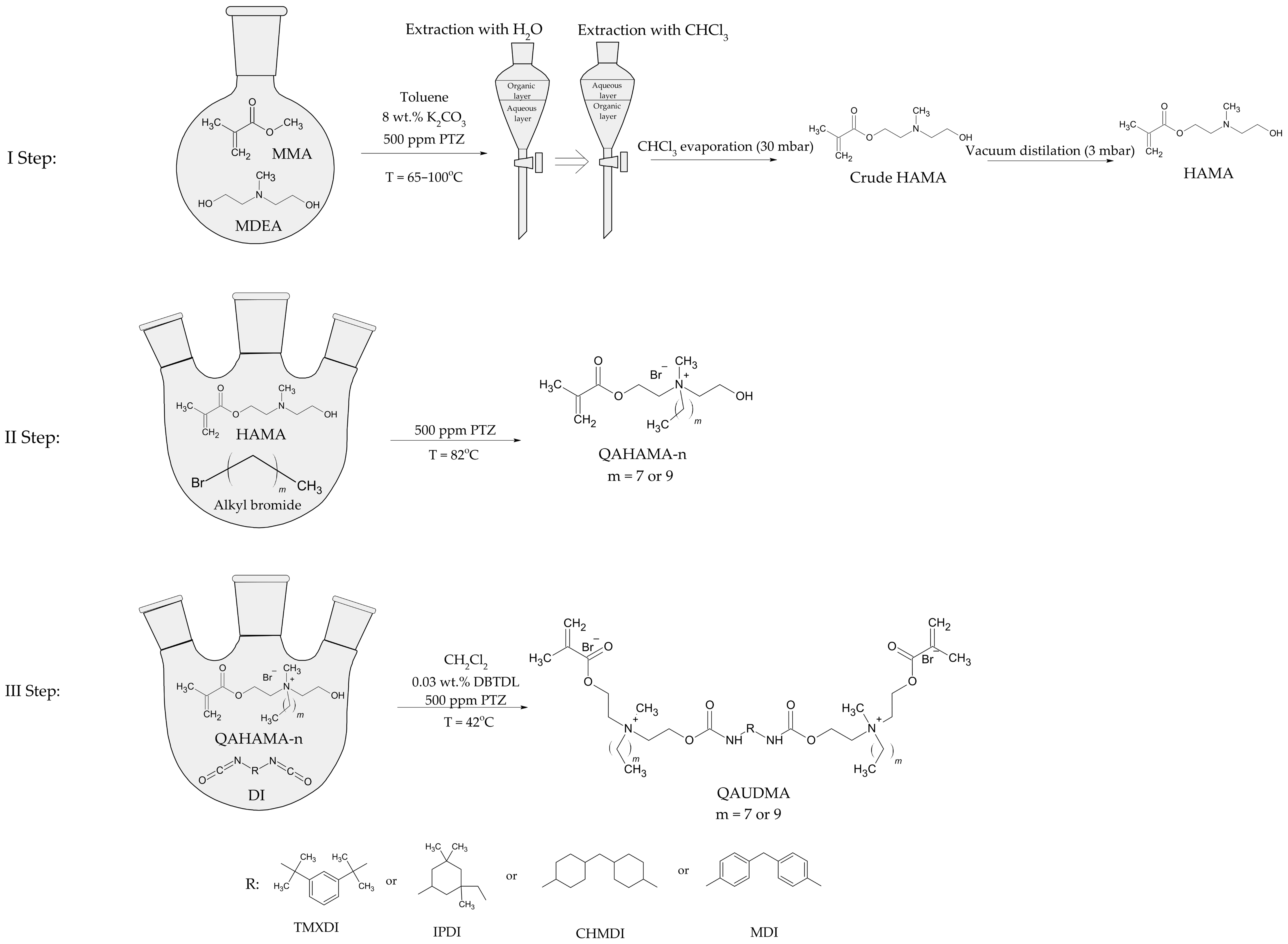
QAUDMA monomers were synthesized via a three-step process (Figure 1), as previously described in the literature [17]. The synthesis involved the transesterification of methyl methacrylate (MMA) with N-methyldiethanolamine (MDEA) at a molar ratio of 1.5:1, followed by N-alkylation of HAMA with an alkyl bromide (octyl bromide or decyl bromide) at a 1:1 molar ratio. The final step was an addition reaction of QAHAMA-n to a diisocyanate (TMXDI, IPDI, CHMDI, or MDI) at a 2:1 molar ratio. As a result, eight monomers were obtained: QA8+TMXDI, QA10+TMXDI, QA8+IPDI, QA10+IPDI, QA8+CHMDI, QA10+CHMDI, QA8+MDI, and QA10+MDI.

2.3. Copolymer Preparation

The copolymers were obtained via photopolymerization. First, eight experimental monomer compositions were prepared, each consisting of 40 wt.% QAUDMA (QA8+TMXDI, QA10+TMXDI, QA8+IPDI, QA10+IPDI, QA8+CHMDI, QA10+CHMDI, QA8+MDI, or QA10+MDI), 40 wt.% Bis-GMA, and 20 wt.% TEGDMA. The reference composition consisted of 40 wt.% UDMA, 40 wt.% Bis-GMA, and 20 wt.% TEGDMA. The initiating system comprised 0.4 wt.% camphorquinone (CQ) and 1 wt.% N,N-dimethylaminoethyl methacrylate (DMAEMA). The initiators were introduced into the monomer mixtures, which were then heated to 50 °C under mechanical stirring until complete dissolution of CQ was achieved. The liquid compositions were poured into molds and covered with polyethylene terephthalate (PET) foil. Subsequently, the compositions were irradiated at room temperature for 1 h using a UV–Vis lamp (Ultra Vitalux 300, Osram, Munich, Germany). The lamp emitted radiation in the 280–780 nm range with an exitance of 2400 mW/cm2. Prior to testing, each specimen was polished with fine-grit sandpaper.

2.4. Water Contact Angle (WCA)

The water contact angles (WCAs) of the obtained copolymers were determined using a goniometer (OCA 15EC, DataPhysics Instruments, Filderstadt, Germany). The samples were disk-shaped specimens measuring 15 mm × 1.5 mm (diameter × thickness). Measurements were performed using the sessile drop method with 4 μL of deionised water. The WCA was determined immediately after the droplet was placed on the sample surface.

2.5. Water Sorption (WS) and Water Solubility (SL)

The water sorption (WS) and solubility (SL) of the polymers were determined in accordance with ISO 4049:2019 [20]. Disk-shaped specimens with dimensions of 15 mm × 1.5 mm (diameter × thickness) were dried to a constant mass (m0) in a laboratory dryer (SLW 53 STD, POL-EKO, Wodzisław Śląski, Poland). The specimens were then immersed in deionised water at room temperature for 7 days. After this period, the samples were removed from the water, gently dried with blotting paper, and weighed to obtain mass (m1). Finally, the specimens were dried again to a constant mass (m2). An analytical balance (XP Balance, Mettler Toledo, Greifensee, Switzerland) was used for all weighing steps. The WS and SL values were calculated using the following equations:
W S μ g m m 3 = m 1 m 0 V
S L μ g m m 3 = m 0 m 2 V
The variables in the equations are defined as follows:
m0—the initial mass of the dried samples;
m1—the mass of the swollen samples;
m2—the mass of the samples after drying following immersion in water;
V—the initial volume of the dried samples.

3. Results

3.1. Water Contact Angle (WCA)

Table 1 shows the water contact angles of the synthesized QAUDMAs compared with the reference copolymer. The measured WCA values provide information on the surface wettability of the materials, which is influenced by their chemical composition and molecular structure. Differences in wettability among the tested samples indicate variations in surface properties resulting from the incorporation of QAUDMAs into the copolymer.
Five copolymers: 40(QA8+TMXDI), 40(QA8+IPDI), 40(QA10+IPDI), 40(QA8+CHMDI), and 40(QA10+CHMDI), showed lower WCA values (57.06–68.94°) compared to the reference sample, which exhibited a WCA of 74.07°. The WCA values of 40(QA10+TMXDI) and 40(QA8+MDI), 71.18° and 73.43°, respectively, were comparable to that of 40(UDMA). Only the surface of 40(QA10+MDI) showed lower hydrophilicity compared to 40(UDMA), with a WCA of 87.50° versus 74.07°, respectively.

3.2. Water Sorption (WS) and Water Solubility (SL)

Table 2 presents the water sorption (WS) and water solubility (SL) results for the modified copolymers and the reference copolymer. These parameters provide insight into the interaction of the materials with water and their dimensional and chemical stability in aqueous environments. The results for 40(QA8+IPDI), 40(QA10+IPDI), 40(QA8+CHMDI), 40(QA10+CHMDI), 40(QA8+MDI), and 40(QA10+MDI) have been published previously [19].
All QAUDMA copolymers exhibited higher water sorption (WS) and water solubility (SL) compared to the reference copolymer. The WS values were at least twice those of the reference, ranging from 9.34 to 14.00 μg/mm3, whereas the WS of 40(UDMA) was 5.85 μg/mm3. Similarly, SL values were at least two times higher than those of 40(UDMA), ranging from 2.62 to 7.68 μg/mm3 compared to 1.13 μg/mm3 for the reference.

4. Discussion

As part of this study, eight copolymers modified with monomers containing quaternary ammonium groups were synthesized. The monomers were based on aromatic and cycloaliphatic diisocyanates. The modified copolymers were characterized in terms of water contact angle (WCA), water sorption (WS), and water solubility (SL).
WCA measurements were performed using deionized water. The results showed that the surfaces of both the reference and all modified copolymers were hydrophilic, with all WCA values below 90° [21]. The WCA of 40(UDMA) was 74.07°. The main factors influencing WCA were the type of diisocyanate in the modifying monomers and the length of the N-alkyl substituent. Copolymers containing monomers based on cycloaliphatic diisocyanates exhibited lower WCA values (57.06–68.94°) compared to copolymers with aromatic diisocyanates (68.08–87.50°). Regarding the N-alkyl substituent, copolymers with an 8-carbon chain showed lower WCA values than those with a 10-carbon chain. A clear example of the influence of both the diisocyanate core and the length of the N-alkyl substituent is provided by copolymers containing CHMDI and MDI cores. Both diisocyanates have similar structures—CHMDI contains two cycloaliphatic rings, while MDI contains two aromatic rings. For 40(QA8+MDI), the WCA was 73.43°, and for 40(QA10+MDI), it was 87.50°. In the case of 40(QA8+CHMDI) and 40(QA10+CHMDI), the WCA values were 65.82° and 68.94°, respectively.
All modified copolymers exhibited higher WS and SL values than the reference copolymer. The WS values of the modified copolymers ranged from 9.34 to 14.00 μg/mm3, while the WS of 40(UDMA) was 5.85 μg/mm3. The SL values of QAUDMA copolymers ranged from 2.62 to 7.68 μg/mm3, compared to 1.13 μg/mm3 for 40(UDMA). According to ISO 4049, the WS and SL of dental materials should not exceed 40 μg/mm3 and 7.5 μg/mm3, respectively [20]. Thus, the WS values of all copolymers were satisfactory, while SL values were acceptable for all copolymers except 40(QA8+MDI), which had an SL of 7.68 μg/mm3. The same factors that influenced WCA also affected WS and SL. Copolymers containing aromatic rings exhibited lower WS values (9.34–11.67 μg/mm3) compared to those with cycloaliphatic rings (11.79–14.00 μg/mm3). In contrast, SL values were higher for copolymers with aromatic diisocyanates (40(QA8+TMXDI), 40(QA10+TMXDI), 40(QA8+MDI), 40(QA10+MDI); 5.63–7.68 μg/mm3) than for those with cycloaliphatic diisocyanates (40(QA8+IPDI), 40(QA10+IPDI), 40(QA8+CHMDI), 40(QA10+CHMDI); 2.62–3.08 μg/mm3). The length of the N-alkyl substituent also influenced WS: copolymers with longer substituents exhibited lower WS values. For example, WS was 10.46 μg/mm3 for 40(QA8+TMXDI) and 9.34 μg/mm3 for 40(QA10+TMXDI).

5. Conclusions

The study aimed to modify a dental copolymer using previously synthesized and characterized monomers containing quaternary ammonium groups derived from aromatic and cycloaliphatic diisocyanates. As a result, eight novel copolymers, along with a reference copolymer, were obtained via photopolymerization. The modified copolymers were evaluated in terms of water contact angle (WCA), water sorption (WS), and water solubility (SL). WCA measurements indicated that all copolymers possessed hydrophilic surfaces. WS values were satisfactory according to ISO 4049 [20], and SL values were also within the acceptable range for all copolymers, except for one sample. The main factors influencing these properties were the type of diisocyanate used during synthesis and the length of the N-alkyl substituent. Our further research will focus on the full characterization of the properties of modified copolymers. We will determine their physicochemical properties, such as the degree of conversion, glass transition temperature, and polymerization shrinkage, as well as mechanical properties, including hardness and flexural strength. A key aspect of the modified copolymers is their potential application as a matrix for DCRM; therefore, antibacterial activity and cytotoxicity will also be evaluated. All of the above-mentioned characteristics will be published in the future as part of a much broader characterization of the copolymers.

Author Contributions

Conceptualization, I.B.-R. and P.D.; methodology, I.B.-R. and P.D.; formal analysis, P.D.; investigation, P.D.; resources, I.B.-R. and P.D.; writing—original draft preparation, I.B.-R. and P.D.; writing—review and editing, I.B.-R. and P.D.; visualization, P.D.; supervision, I.B.-R.; project administration, I.B.-R.; funding acquisition, P.D. All authors have read and agreed to the published version of the manuscript.

Funding

This work was funded by the Polish Budget Funds for Scientific Research in 2025 as core funding for research and development activities at the Silesian University of Technology—funding for young scientists, grant number: 04/040/BKM25/0314.

Institutional Review Board Statement

Not applicable.

Informed Consent Statement

Not applicable.

Data Availability Statement

Data are contained within the article.

Conflicts of Interest

The authors declare no conflicts of interest. The funders had no role in the design of the study; the collection, analyses, or interpretation of data; the writing of the manuscript; or the decision to publish the results.

References

  1. World Health Organisation. Global Oral Health Status Report: Towards Universal Health Coverage for Oral Health by 2030; World Health Organisation: Geneva, Switzerland, 2022. [Google Scholar]
  2. Zhang, N.; Melo, M.A.S.; Weir, M.D.; Reynolds, M.A.; Bai, Y.; Xu, H.H.K. Do Dental Resin Composites Accumulate More Oral Biofilms and Plaque than Amalgam and Glass Ionomer Materials? Materials 2016, 9, 888. [Google Scholar] [CrossRef] [PubMed]
  3. Eick, S.; Glockmann, E.; Brandl, B.; Pfister, W. Adherence of Streptococcus mutans to various restorative materials in a continuous flow system. J. Oral Rehabil. 2004, 31, 278–285. [Google Scholar] [CrossRef] [PubMed]
  4. Zhang, R.; Jones, M.M.; Moussa, H.; Keskar, M.; Huo, N.; Zhang, Z.; Visser, M.B.; Sabatini, C.; Swihart, M.T.; Cheng, C. Polymer–antibiotic conjugates as antibacterial additives in dental resins. Biomater. Sci. 2019, 7, 287. [Google Scholar] [CrossRef] [PubMed]
  5. Badr, S.; Abdulrahman, A.; Abdullah, A.; Essam, A.; Mohammad, Y.; Shahzeb, H. Effect of various antibacterial materials in dental composites: A systematic review. Ann. Dent. Spec. 2021, 9, 39–44. [Google Scholar]
  6. Ibrahim, M.; Garcia, I.; Kensara, A.; Balhaddad, A.; Collares, F.; Williams, M.; Ibrahim, A.; Lin, N.; Weir, M.; Xu, H.; et al. How we are assessing the developing antibacterial resin-based dental materials? A scoping review. J. Dent. 2020, 99, 103369. [Google Scholar] [CrossRef] [PubMed]
  7. Makvandi, P.; Jamaledin, R.; Jabbari, M.; Nikfarjam, N.; Borzacchiello, A. Antibacterial Quaternary Ammonium Compounds in Dental Materials: A Systematic Review. Dent. Mater. 2018, 34, 851–867. [Google Scholar] [CrossRef] [PubMed]
  8. Zhou, X.; Huang, X.; Li, M.; Peng, X.; Wang, S.; Zhou, X.; Cheng, L. Development and status of resin composite as dental restorative materials. J. Appl. Polym. Sci. 2019, 136, 48180. [Google Scholar] [CrossRef]
  9. Ferrando-Magraner, E.; Bellot-Arcís, C.; Paredes-Gallardo, V.; Almerich-Silla, J.M.; García-Sanz, V.; Fernández-Alonso, M.; Montiel-Company, J.M. Antibacterial Properties of Nanoparticles in Dental Restorative Materials. A Systematic Review and Meta-Analysis. Medicina 2020, 56, 55. [Google Scholar] [CrossRef] [PubMed]
  10. Ramburrun, P.; Pringle, N.; Dube, A.; Adam, R.; D’Souza, S.; Aucamp, M. Recent Advances in the Development of Antimicrobial and Antifouling Biocompatible Materials for Dental Applications. Materials 2021, 14, 3167. [Google Scholar] [CrossRef] [PubMed]
  11. Sun, Q.; Zhang, L.; Bai, R.; Zhuang, Z.; Zhang, Y.; Yu, T.; Peng, L.; Xin, T.; Chen, S.; Han, B. Recent Progress in Antimicrobial Strategies for Resin-Based Restoratives. Polymers 2021, 13, 1590. [Google Scholar] [CrossRef] [PubMed]
  12. Huang, L.; Yu, F.; Sun, X.; Dong, Y.; Lin, P.T.; Yu, H.H.; Xiao, Y.H.; Chai, Z.G.; Xing, X.D.; Chen, J.H. Antibacterial Activity of a Modified Unfilled Resin Containing a Novel Polymerizable Quaternary Ammonium Salt MAE-HB. Sci. Rep. 2016, 6, 33858. [Google Scholar] [CrossRef] [PubMed]
  13. Manouchehri, F.; Sadeghi, B.; Najafi, F.; Mosslemin, M.H.; Niakan, M. Synthesis and Characterization of Novel Polymerizable Bis-Quaternary Ammonium Dimethacrylate Monomers with Antibacterial Activity as an Efficient Adhesive System for Dental Restoration. Polym. Bull. 2019, 76, 1295–1315. [Google Scholar] [CrossRef]
  14. Huang, Q.T.; He, J.W.; Lin, Z.M.; Liu, F.; Lassila, L.V.J.; Vallittu, P.K. Physical and Chemical Properties of an Antimicrobial Bis-GMA Free Dental Resin with Quaternary Ammonium Dimethacrylate Monomer. J. Mech. Behav. Biomed. Mater. 2016, 56, 68–76. [Google Scholar] [CrossRef] [PubMed]
  15. Liang, X.; Söderling, E.; Liu, F.; He, J.; Lassila, L.V.J.; Vallittu, P.K. Optimizing the Concentration of Quaternary Ammonium Dimethacrylate Monomer in Bis-GMA/TEGDMA Dental Resin System for Antibacterial Activity and Mechanical Properties. J. Mater. Sci. Mater. Med. 2014, 25, 1387–1393. [Google Scholar] [CrossRef] [PubMed]
  16. Huang, Q.; Lin, Z.; Liang, X.; Liu, F.; He, J. Preparation and Characterization of Antibacterial Dental Resin with UDMQA-12. Adv. Polym. Technol. 2014, 33, 21395. [Google Scholar] [CrossRef]
  17. Chrószcz, M.W.; Barszczewska-Rybarek, I.M. Synthesis and Characterization of Novel Quaternary Ammonium Urethane-Dimethacrylate Monomers—A Pilot Study. Int. J. Mol. Sci. 2021, 22, 8842. [Google Scholar] [CrossRef] [PubMed]
  18. Drejka, P.; Chrószcz-Porębska, M.; Kazek-Kęsik, A.; Chladek, G.; Barszczewska-Rybarek, I. Chemical Modification of Dental Dimethacrylate Copolymer with Tetramethylxylylene Diisocyanate-Based Quaternary Ammonium Urethane-Dimethacrylates—Physicochemical, Mechanical, and Antibacterial Properties. Materials 2024, 17, 298. [Google Scholar] [CrossRef] [PubMed]
  19. Drejka, P.; Kula, P.; Barszczewska-Rybarek, I. Novel Quaternary Ammonium Urethane-Dimethacrylates for Copolymers with Low Water Sorption and Solubility. Molecules 2025, 30, 769. [Google Scholar] [CrossRef] [PubMed]
  20. ISO 4049:2019; Dentistry—Polymer-Based Restorative Materials. International Organization for Standardization: Geneva, Switzerland, 2019.
  21. Law, K.-Y. Definitions for Hydrophilicity, Hydrophobicity, and Superhydrophobicity: Getting the Basics Right. J. Phys. Chem. Lett. 2014, 5, 686–688. [Google Scholar] [CrossRef] [PubMed]
Figure 1. Three-step synthesis route of QAUDMA monomers.
Engproc 124 00016 g001
Table 1. Water contact angles (WCA) of QAUDMA copolymers compared with the reference copolymer.
CopolymerWCA (°)
AVGSD
Experimental copolymers
40(QA8+TMXDI)68.083.99
40(QA10+TMXDI)71.183.99
40(QA8+IPDI)57.063.25
40(QA10+IPDI)65.924.77
40(QA8+CHMDI)65.823.74
40(QA10+CHMDI)68.944.37
40(QA8+MDI)73.433.56
40(QA10+MDI)87.505.27
Reference copolymer
40(UDMA)74.072.24
Table 2. Water sorption (WS) and water solubility (SL) of QAUDMA copolymers compared with the reference copolymer.
CopolymerWS (μg/mm3)SL (μg/mm3)
AVGSDAVGSD
Experimental copolymers
40(QA8+TMXDI)10.460.685.630.57
40(QA10+TMXDI)9.340.215.870.35
40(QA8+IPDI) 114.001.612.700.29
40(QA10+IPDI) 113.181.022.620.26
40(QA8+CHMDI) 113.751.322.940.21
40(QA10+CHMDI) 111.790.143.080.20
40(QA8+MDI) 111.670.327.680.48
40(QA10+MDI) 111.630.476.610.53
Reference copolymer
409(UDMA) 15.850.491.130.04
1 Taken from [19].
Disclaimer/Publisher’s Note: The statements, opinions and data contained in all publications are solely those of the individual author(s) and contributor(s) and not of MDPI and/or the editor(s). MDPI and/or the editor(s) disclaim responsibility for any injury to people or property resulting from any ideas, methods, instructions or products referred to in the content.