Dynamic Facial Expression Recognition by Concatenation of Raw, Semi-Raw, and Distance Features †
 , , and
Abstract
1. Introduction
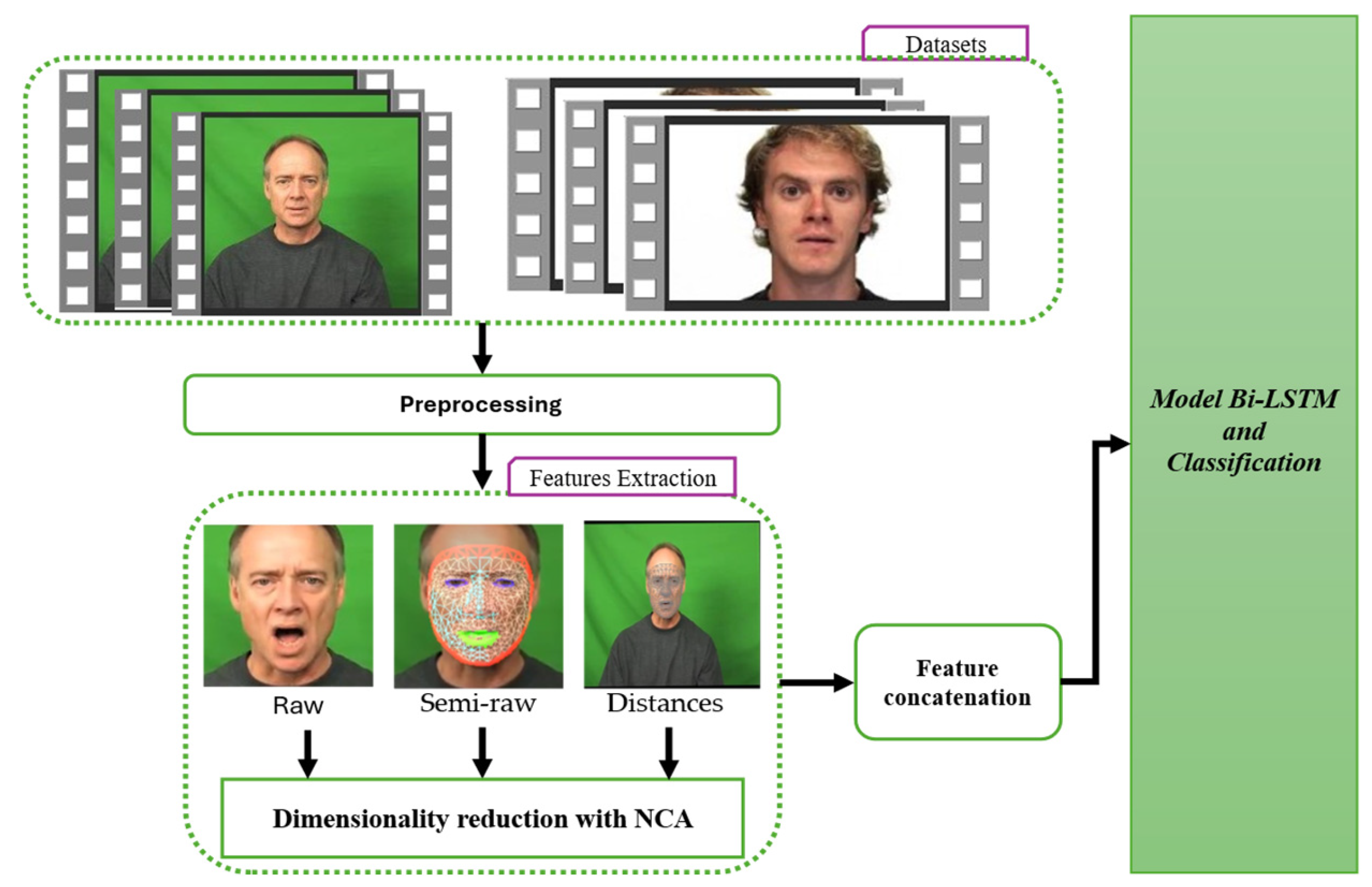
- A uniform set of 100 frames per video is selected, corresponding to the average interval of facial expression presentation across both datasets.
- A multi-stream feature extraction approach is implemented for each frame, encompassing the following: (i) the original video processed with EfficientNet-B0 (raw features); (ii) the video with FaceMesh landmarks processed with EfficientNet-B0 (semi-raw features); and (iii) specific facial landmark distances derived from FaceMesh applied to the original video (distance features). A total of 8 M parameters are used in this stage by the two CNNs.
- To address computational constraints, dimensionality reduction is applied. The raw and semi-raw feature vectors (originally 1280 dimensions per frame) are reduced to 20 dimensions using Neighborhood Component Analysis (NCA). Furthermore, a selected subset of specific landmarks is used for the distance-based features, resulting in a feature vector of size 26.
- A lightweight Bidirectional LSTM (Bi-LSTM) network is employed for the final classification on both datasets. The performance of this parameter-efficient architecture is benchmarked against state-of-the-art methods, where it is expected to demonstrate competitive performance. The Bi-LSTM classifier operates with only 8.68 M parameters.
2. Materials and Method
3. Results
Author Contributions
Funding
Institutional Review Board Statement
Informed Consent Statement
Data Availability Statement
Conflicts of Interest
References
- Ghaleb, E.; Popa, M.; Asteriadis, S. Multimodal and temporal perception of audio-visual cues for emotion recognition. In Proceedings of the 8th International Conference on Affective Computing and Intelligent Interaction (ACII), Cambridge, UK, 2–5 September 2019; pp. 552–558. [Google Scholar] [CrossRef]
- Lei, Y.; Cao, H. Audio-visual emotion recognition with preference learning based on intended and multimodal perceived labels. IEEE Trans. Affect. Comput. 2023, 14, 2954–2969. [Google Scholar] [CrossRef]
- Ghaleb, E.; Niehues, J.; Asteriadis, S. Multimodal attention-mechanism for temporal emotion recognition. In Proceedings of the 2020 IEEE International Conference on Image Processing (ICIP), Abu Dhabi, United Arab Emirates, 25–28 October 2020; IEEE: Piscataway, NJ, USA, 2020; pp. 251–255. [Google Scholar] [CrossRef]
- Sun, L.; Li, X.; Li, S.; Jin, L.; Zhao, W. SVFAP: Self-supervised video facial affect perceiver. IEEE Trans. Affect. Comput. 2025, 16, 405–422. [Google Scholar] [CrossRef]
- Cao, H.; Cooper, D.G.; Keutmann, M.K.; Gur, R.C.; Nenkova, A.; Verma, R. CREMA-D: Crowd-sourced emotional multimodal actors dataset. IEEE Trans. Affect. Comput. 2014, 5, 377–390. [Google Scholar] [CrossRef] [PubMed]
- Livingstone, S.R.; Russo, F.A. The Ryerson Audio-Visual Database of Emotional Speech and Song (RAVDESS): A dynamic, multimodal set of facial and vocal expressions in North American English. PLoS ONE 2018, 13, e0196391. [Google Scholar] [CrossRef] [PubMed]


| Class | # Videos (RAVDESS) | # Videos (CREMA-D) |
|---|---|---|
| Angry | 192 | 1271 |
| Calm | 192 | -- |
| Disgust | 192 | 1271 |
| Fearful | 192 | 1271 |
| Happy | 192 | 1271 |
| Neutral | 96 | 1087 |
| Sad | 192 | 1271 |
| Surprise | 192 | -- |
| Total | 1440 | 7442 |
| Model | Input | Hidden Neurons | Hidden Layers | Dropout Rate |
|---|---|---|---|---|
| Bi-LSTM | 66 | 512 | 2 | 0.2 |
| Method | Modality | WAR | UAR |
|---|---|---|---|
| Ghaleb et al. [1] | Audio + Video | 66.80 | - |
| Lei et al. [2] | Video | 64.76 | 64.68 |
| Ghaleb et al. [3] | Video | 51.70 | - |
| Audio + Video | 67.20 | - | |
| Proposed | Video | 58.40 | 58.25 |
| Method | Modality | WAR | UAR |
|---|---|---|---|
| Ghaleb et al. [1] | Audio + Video | 60.50 | - |
| Ghaleb et al. [3] | Video | 58.20 | - |
| Audio + Video | 76.30 | - | |
| Sun et al. [4] | Video | 75.01 | 75.15 |
| Proposed | Video | 83.00 | 82.81 |
| Method | WAR | UAR |
|---|---|---|
| Raw features | 51.34 | 51.42 |
| (Raw + distances) features | 53.83 | 53.86 |
| (Raw + distances + semi-raw) features | 58.40 | 58.25 |
| Method | WAR | UAR |
|---|---|---|
| Raw features | 70.49 | 70.39 |
| (Raw + distances) features | 75.35 | 75.28 |
| (Raw + distances + semi-raw) features | 83.00 | 82.81 |
Disclaimer/Publisher’s Note: The statements, opinions and data contained in all publications are solely those of the individual author(s) and contributor(s) and not of MDPI and/or the editor(s). MDPI and/or the editor(s) disclaim responsibility for any injury to people or property resulting from any ideas, methods, instructions or products referred to in the content. |
© 2026 by the authors. Licensee MDPI, Basel, Switzerland. This article is an open access article distributed under the terms and conditions of the Creative Commons Attribution (CC BY) license (https://creativecommons.org/licenses/by/4.0/).
Share and Cite
Sotelo-Barrales, J.; Nakano-Miyatake, M.; Mata-Mendoza, D.; Perez-Meana, H.; Escamilla-Hernandez, E. Dynamic Facial Expression Recognition by Concatenation of Raw, Semi-Raw, and Distance Features. Eng. Proc. 2026, 123, 5. https://doi.org/10.3390/engproc2026123005
Sotelo-Barrales J, Nakano-Miyatake M, Mata-Mendoza D, Perez-Meana H, Escamilla-Hernandez E. Dynamic Facial Expression Recognition by Concatenation of Raw, Semi-Raw, and Distance Features. Engineering Proceedings. 2026; 123(1):5. https://doi.org/10.3390/engproc2026123005
Chicago/Turabian StyleSotelo-Barrales, Jose, Mariko Nakano-Miyatake, David Mata-Mendoza, Hector Perez-Meana, and Enrique Escamilla-Hernandez. 2026. "Dynamic Facial Expression Recognition by Concatenation of Raw, Semi-Raw, and Distance Features" Engineering Proceedings 123, no. 1: 5. https://doi.org/10.3390/engproc2026123005
APA StyleSotelo-Barrales, J., Nakano-Miyatake, M., Mata-Mendoza, D., Perez-Meana, H., & Escamilla-Hernandez, E. (2026). Dynamic Facial Expression Recognition by Concatenation of Raw, Semi-Raw, and Distance Features. Engineering Proceedings, 123(1), 5. https://doi.org/10.3390/engproc2026123005