Proceeding Paper

An Analysis of Nonlinear Differential Equations Describing the Dynamic Behavior of an Unbalanced Rotor †
Technical University of Sofia, National Centre of Excellence “Mechatronics and Clean Technologies”, 1000 Sofia, Bulgaria
Presented at the 17th International Scientific Conference on Aerospace, Automotive, and Railway Engineering (BulTrans-2025), Sozopol, Bulgaria, 10–13 September 2025.
Eng. Proc. 2026, 121(1), 5; https://doi.org/10.3390/engproc2025121005

Published: 12 January 2026

Abstract

The present paper investigates the dynamic behavior of an unbalanced rotor mounted in a balancing machine. Differential equations of motion are derived without linearization using Lagrange equations of the second kind to determine the nonlinear nature of the system. This study proposes a method for using differential equations in balancing to determine important parameters, such as the coordinates of the center of mass and the products of inertia of the rotor. An analysis of the interactions between the periodicities of the individual terms in the differential equations is carried out in order to eliminate terms with difficult-to-determine moments of inertia.

1. Introduction

The assumption of purely linear mechanical systems can be reasonably questioned at the outset of any serious engineering analysis. Most mechanical systems are nonlinear, with the most common types of nonlinearity in mechanical engineering being geometrical nonlinearities, physical nonlinearities, structural or designed nonlinearities, unilateral constraints and friction-induced nonlinearity [1]. For example, in papers [2,3], the authors consider a linearized model, assuming from the outset that the rotation angles are small. A similar model is discussed in [4], but the equations are nonlinear, as the nonlinearity in the system is caused by contact interactions involving friction and impacts (rub–impact). There are numerous papers on rotor dynamics that account for geometric nonlinearity. Some examples can be found in [5,6]. In [5], a nonlinear model of a rotor consisting of a flexible shaft and an unbalanced rigid disc is considered. In [6], the rotor is rigid, and the point masses are additionally included. In both studies, the differential equations of motion are nonlinear, as their derivation is approached from the most general case of rigid body motion and Euler angles are used. In paper [7], the nonlinear dynamics and bifurcation behavior of a rotor supported by sliding bearings are investigated, where nonlinearity originates from the hydrodynamic forces in the bearings. There are numerous publications on nonlinear mechanical systems involving rotors modeled using the finite element method. Examples can be found in references [8,9,10]. Detailed information on linear and nonlinear rotor dynamics can be found in [11]. The book describes both the vibrations of elastic rotors with rigid disks and the vibrations of continuous rotors. Interesting models of vibrating systems that include rotors can be observed in problems concerning balancing. The literary source [12] pertains to this topic. The paper [13] presents a review of rotor balancing methods, including traditional approaches such as the influence coefficient method and modal balancing, discussing their advantages and disadvantages. It also covers new methods and current research trends in the field.
In most studies related to rotor balancing, the models consist of a balanced, symmetric basic rotor with attached point masses. This paper will not consider such a model exactly but will consider a rotor whose mass center does not lie on the axis of rotation and on which the products of inertia are not equal to zero. This paper does not cover balancing methods and principles. Instead, it focuses on a study aimed at establishing a method for determining the position of the rotor’s center of mass and the values of the products of inertia through the use of nonlinear differential equations of motion.

2. Dynamic Model and Differential Equations of Motion

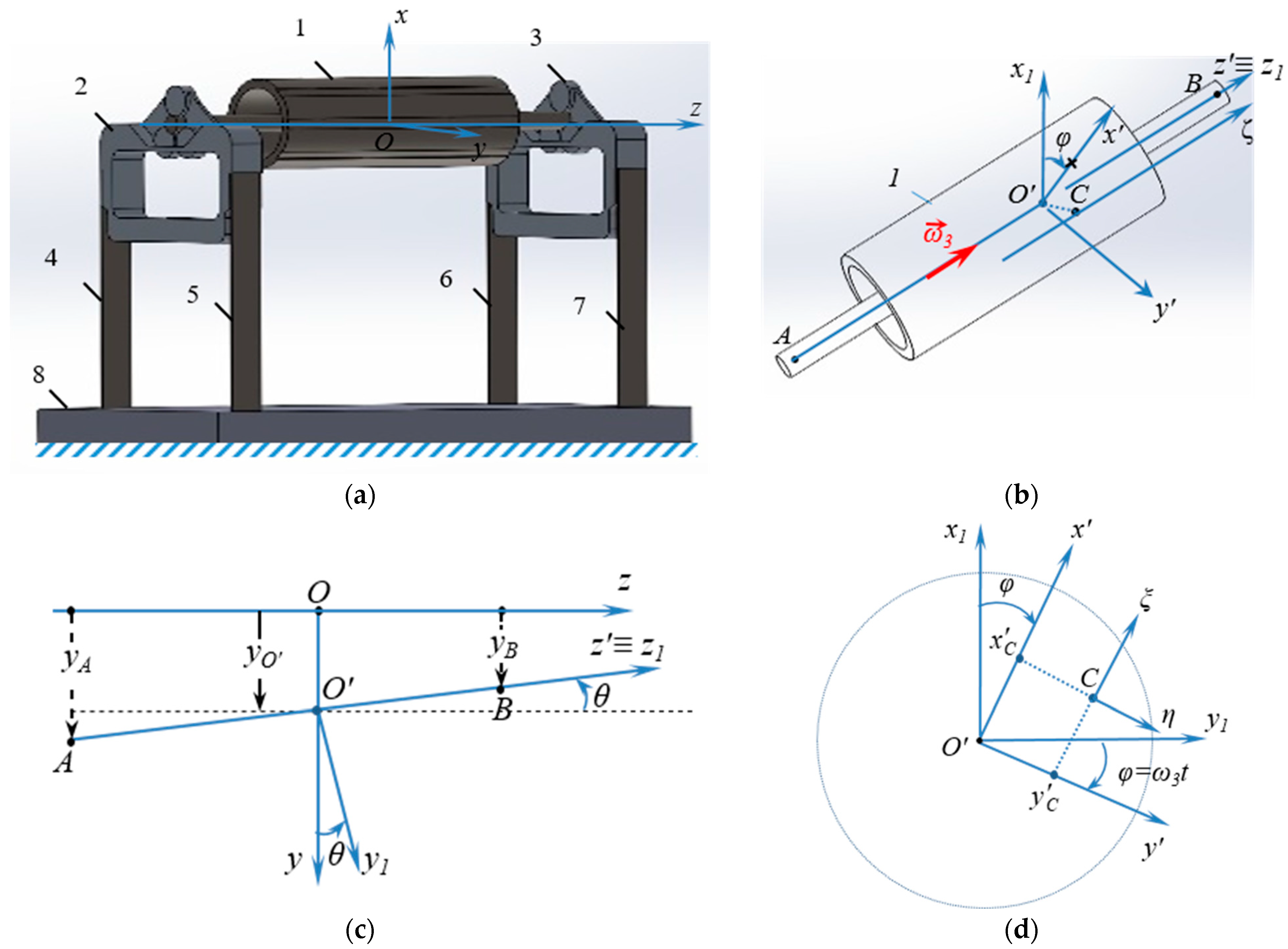
The mechanical system (Figure 1a) consists of an unbalanced rotor (1), two pedestals (2 and 3) and four beams (4, 5, 6 and 7). The beams are assumed to be massless and elastic. They are connected to a rigid base (8). The rotor drive is not modeled, and for the purposes of this study, it is assumed that the driving and resisting torque are equal, resulting in rotation at a constant angular velocity, ω3, around the z′ axis. Further details of the model can be found in Figure 1 or in [14]. Unlike in [14], in the present work, the differential equations of motion are derived using a different method and without linearization.
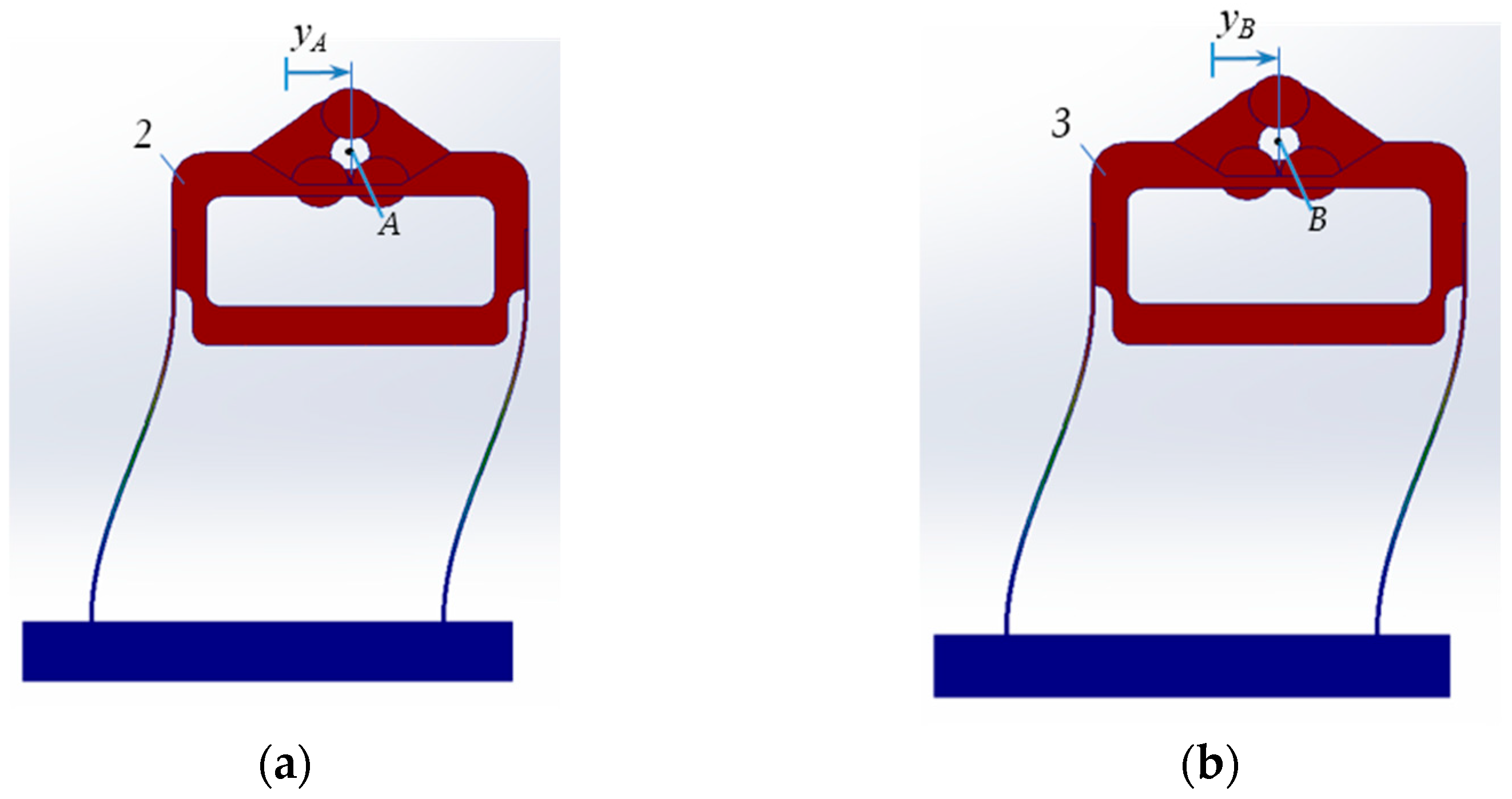
The choice of coordinate systems (Figure 1b–d) is very important for formulating the differential equations of motion. To analyze the motion, one fixed (inertial reference frame Oxyz) and three moving coordinate systems are used, two of which are rigidly attached to the rotor. The coordinate systems attached to the rotor are O′x′y′z′ and Cξηζ. Point C is the center of mass of the rotor. Axes ξ, η and ζ are parallel to axes x′, y′ and z′, respectively. Coordinate system O′x1y1z1 moves in such a way that the vertical x1 axis always remains parallel to the vertical x axis. The z′ and z1 axes coincide. Bodies 2 and 3 move translationally along the y coordinate axis, and therefore, the coordinates of points A and B along this axis are essential for describing their motion (Figure 2).
The relations between the unit vectors of the coordinate systems are
e x 1 = 1 0 0 x y z , e y 1 = 0 cos θ sin θ x y z , e z 1 = 0 sin θ cos θ x y z
e x = cos φ sin φ 0 x y z , e y = cos θ sin φ cos θ cos φ sin θ x y z , e z = sin φ sin θ sin θ cos φ cos θ x y z
e ξ = e x = cos φ sin φ cos θ sin φ sin θ x y z , e η = e y = sin φ cos φ cos θ cos φ sin θ x y z , e ζ = e z = 0 sin θ cos θ x y z
Lagrange equations of the second kind are used to determine the differential equations of motion. They are
d d t L q ˙ j L q j = Q j
where
  • qj is the j-th generalized coordinate;
  • L = TV is the Lagrangian function;
  • T is the kinetic energy of the mechanical system;
  • V is the potential energy;
  • Qj is the generalized force corresponding to the j-th generalized coordinate.
The mechanical system has two degrees of freedom and generalized coordinates are chosen, q 1 = y O and q 2 = θ .
The following kinematic relations are required to determine kinetic energy T:
r C = x C cos φ y C sin φ y O + x C sin φ cos θ + y C cos φ cos θ x C sin φ sin θ + y C cos φ sin θ x y z ,   r A =     0 y O + l A sin θ l A cos θ x y z , r B =     0 y O l B sin θ l B cos θ x y z
where
  • O A ¯ = l A ,   O B ¯ = l B are distances;
  • x C y C are coordinates of the rotor center of mass.
From the above equations, the velocity of the rotor’s center of mass, C, and the velocities of points A and B can be easily determined. For points A and B, it is valid that
y A = y O + l A sin θ y ˙ A = y ˙ O + l A θ ˙ cos θ y B = y O l B sin θ y ˙ B = y ˙ O l B θ ˙ cos θ
The angular velocity vector is determined by
ω = θ ˙ e x 1 + ω 3 = θ ˙ e x 1 + ω 3 e z
The kinetic energy of the mechanical system is determined by
T = T 1 + T 2 + T 3 = 1 2 m 1 v C 2 + 1 2 I ξ ω ξ 2 + 1 2 I η ω η 2 + 1 2 I ζ ω ζ 2 I ξ η ω ξ ω η I ξ ζ ω ξ ω ζ I η ζ ω η ω ζ + 1 2 m 2 v 2 2 + 1 2 m 3 v 3 2
After certain transformations using the relationships from Equations (3)–(5), it follows that
T = 1 2 m 1 y ˙ O 2 + 2 x C y ˙ O ω 3 cos φ cos θ 2 x C y ˙ O θ ˙ sin φ sin θ 2 y C y ˙ O ω 3 sin φ cos θ 2 y C y ˙ O θ ˙ cos φ sin θ + + 1 2 I x θ ˙ 2 cos 2 φ + 1 2 I y θ ˙ 2 sin 2 φ + 1 2 I z ω 3 2 + I x y θ ˙ 2 sin φ cos φ I x z ω 3 θ ˙ cos φ + I y z ω 3 θ ˙ sin φ + + 1 2 m 2 y ˙ O + l A θ ˙ cos θ 2 + 1 2 m 3 y ˙ O l B θ ˙ cos θ 2
This transformation is very important because the coordinates of the center of mass x C ,   y C and the products of inertia I x z ,   I y z with respect to the coordinate system O x y z are important for the analysis.
The gravitational potential energy, Vg, of the three bodies in this idealized model has no effect on the differential equations, so it will be ignored in the following analysis. To determine the elastic potential energy, Ve, of the beams (four in number), the equation for strain energy U i = 0 l M 2 d x b E I (due only to the bending moment) and Castigliano’s second theorem Δ j = U i P j are used [15]. For this transformation, it is assumed that the pedestals move translationally, and the cross-sections of the beams at their connections with the pedestals do not rotate. The deformed shape of the beams with the pedestals is shown in Figure 2. After certain transformations, the potential energy of the four elastic beams is
V e = 2 6 E I l 3 y A 2 + 2 6 E I l 3 y B 2 = 12 E I l 3 y O + l A sin θ 2 + 12 E I l 3 y O l B sin θ
where
  • l is beam length;
  • E is Young’s modulus [16];
  • I is moments of inertia of the beam cross-sections.
The generalized forces are determined from
Q j = R q ˙ j
where the dissipation function is
R v = 1 2 2 β y ˙ A 2 + 2 β y ˙ B 2 = β y ˙ O + l A θ ˙ cos θ 2 + β y ˙ O l B θ ˙ cos θ 2
In the last equation, β is the coefficient of linear (viscous) resistance.
After substituting Equations (7)–(9) into (2), the differential equations of motion are
y ¨ O 1 + m 2 m 1 + m 3 m 1 + θ ¨ m 2 m 1 l A m 3 m 1 l B cos θ θ ¨ x C sin φ + y C cos φ sin θ 2 θ ˙ ω 3 x C cos φ y C sin φ sin θ θ ˙ 2 x C sin φ + y C cos φ cos θ + θ ˙ 2 m 3 m 1 l B m 2 m 1 l A sin θ ω 3 2 x C sin φ + y C cos φ cos θ + + 2 c m 1 y ˙ O + c m 1 θ ˙ l A l B cos θ + 2 k m 1 y O + k m 1 l A l B sin θ = 0 ,
θ ¨ m 2 l A 2 cos 2 θ + m 3 l B 2 cos 2 θ + I x cos 2 φ + I y sin 2 φ + 2 I x y sin φ cos φ + y ¨ O m 2 l A m 3 l B cos θ y ¨ O m 1 x C sin φ + y C cos φ sin θ + 2 θ ˙ ω 3 I y I x sin φ cos φ + I x y cos 2 φ sin 2 φ θ ˙ 2 m 2 l A 2 + m 3 l B 2 sin θ cos θ + + c l A l B y ˙ O cos θ + c θ ˙ l A 2 + l B 2 cos 2 θ + k l A l B y O cos θ + k l A 2 + l B 2 sin θ cos θ = I x z sin φ + I y z cos φ ω 3 2
where φ = ω 3 t , c = 2 β and k = 24 E I l 3 .

3. Numerical Solution

Values of the parameters are given in Table 1.
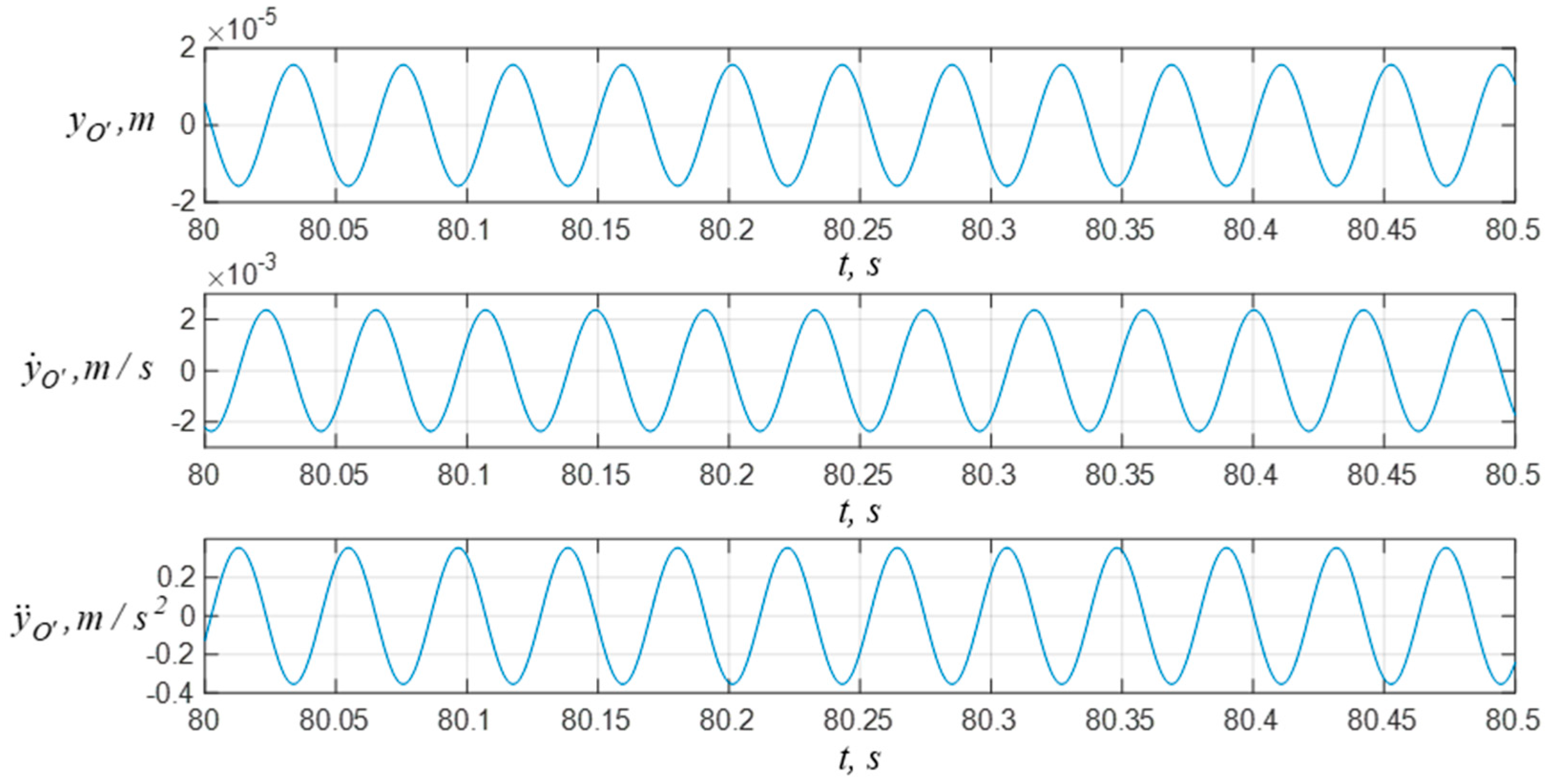
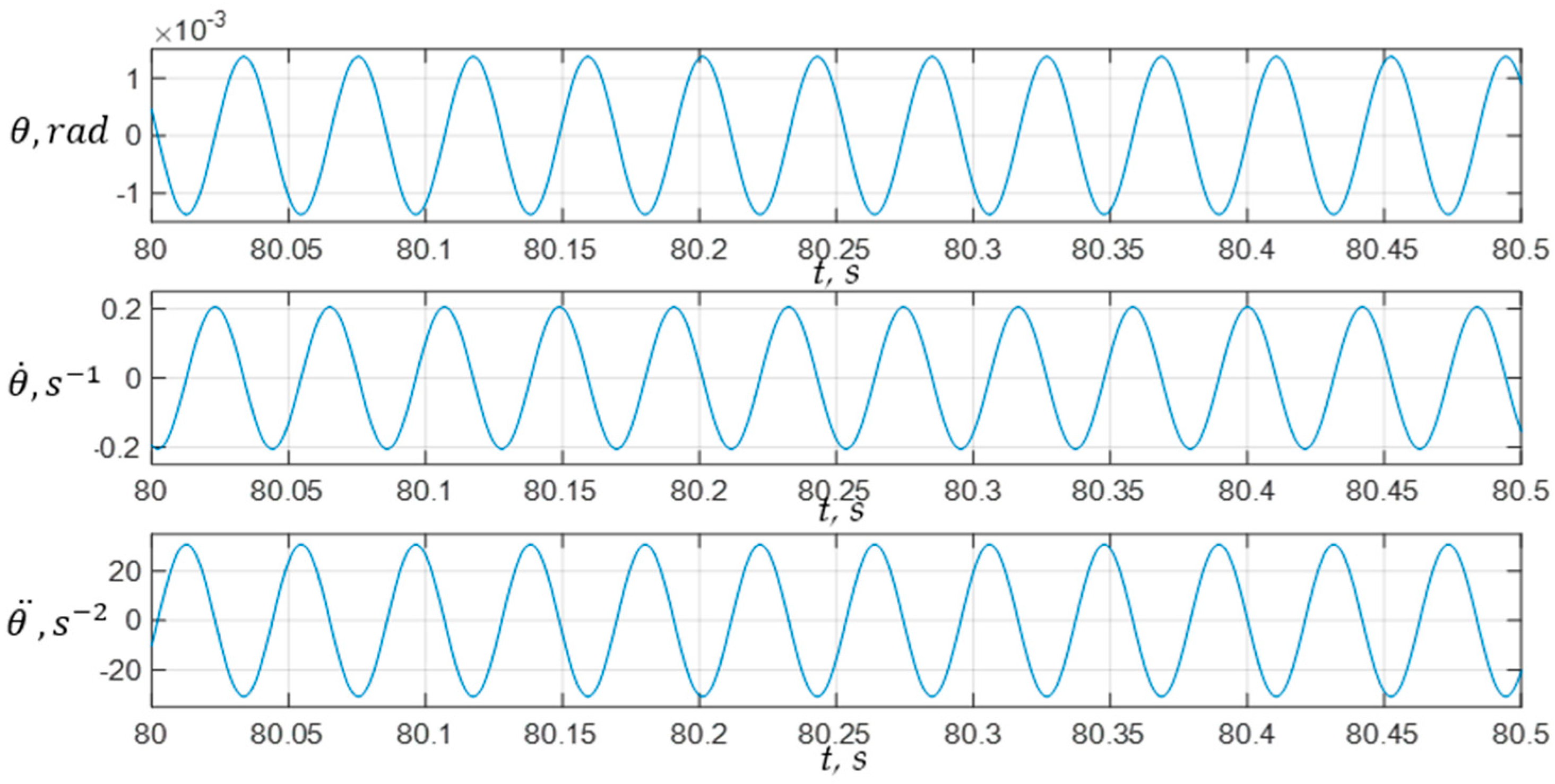
By numerically solving the differential equations, the frequencies at which the vibration amplitudes reach their maximum values can be identified, corresponding to the system’s natural frequencies. The approximate values are ωn1≈ 69.94 rad/s and ωn2 ≈ 131.62 s−1. For this reason, the angular velocity of the rotor is chosen to be ω3 = 150 rad/s.
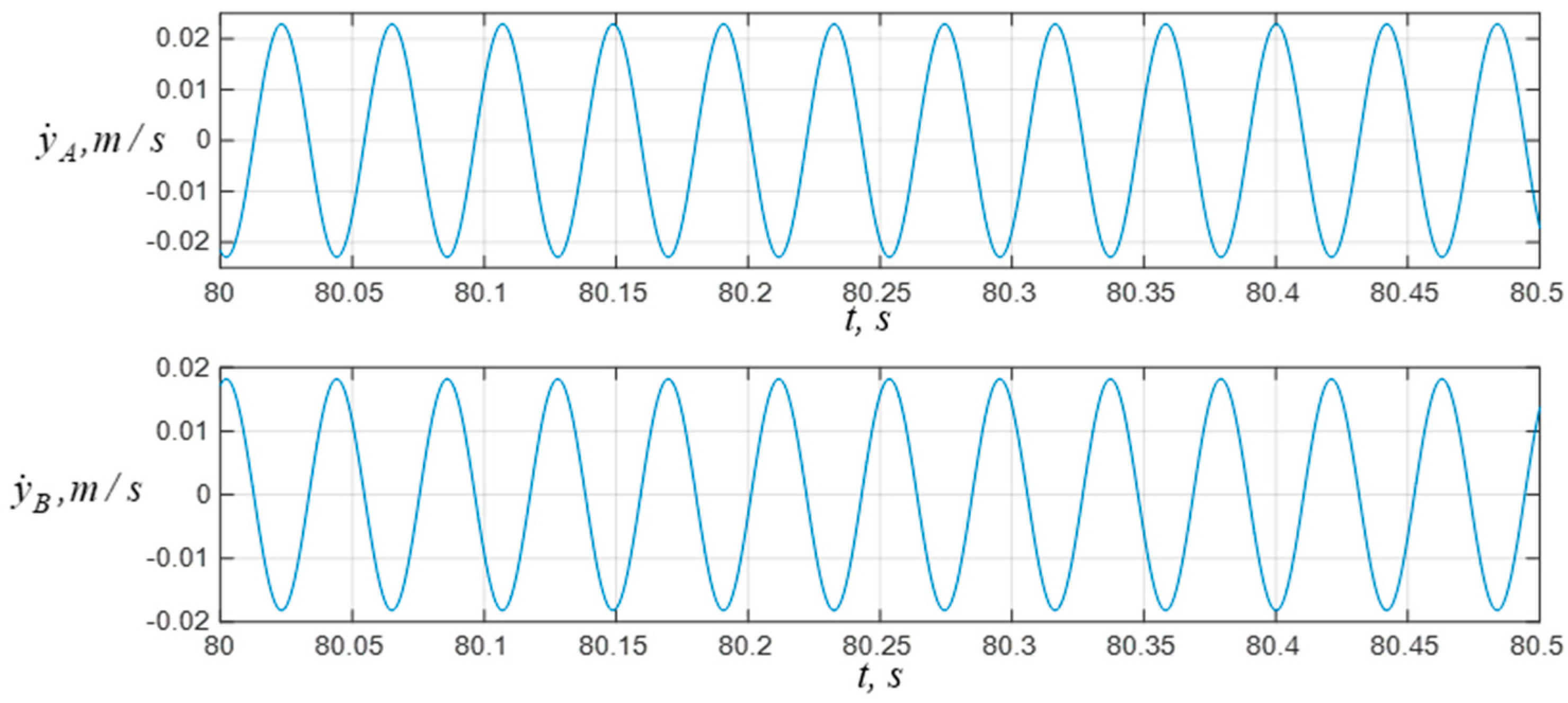
In the numerical solution, at the beginning of the simulation, apart from the forced vibrations, there are also damped free vibrations. They are not the subject of the present study, and that is why the solution is given in the interval from 80 to 80.5 s. Variations in the kinematic quantities y O , y ˙ O , y ¨ O , θ , θ ˙ , θ ¨ , y ˙ A and y ˙ B as functions of time t are shown in Figure 3, Figure 4 and Figure 5, respectively.
The numerical solutions show that the dependencies between the amplitudes and the phases of displacement, velocity, and acceleration—or, respectively, of rotation, angular velocity, and angular acceleration—are approximately similar to those in a linear system.

4. Analysis of the Differential Equations of Motion

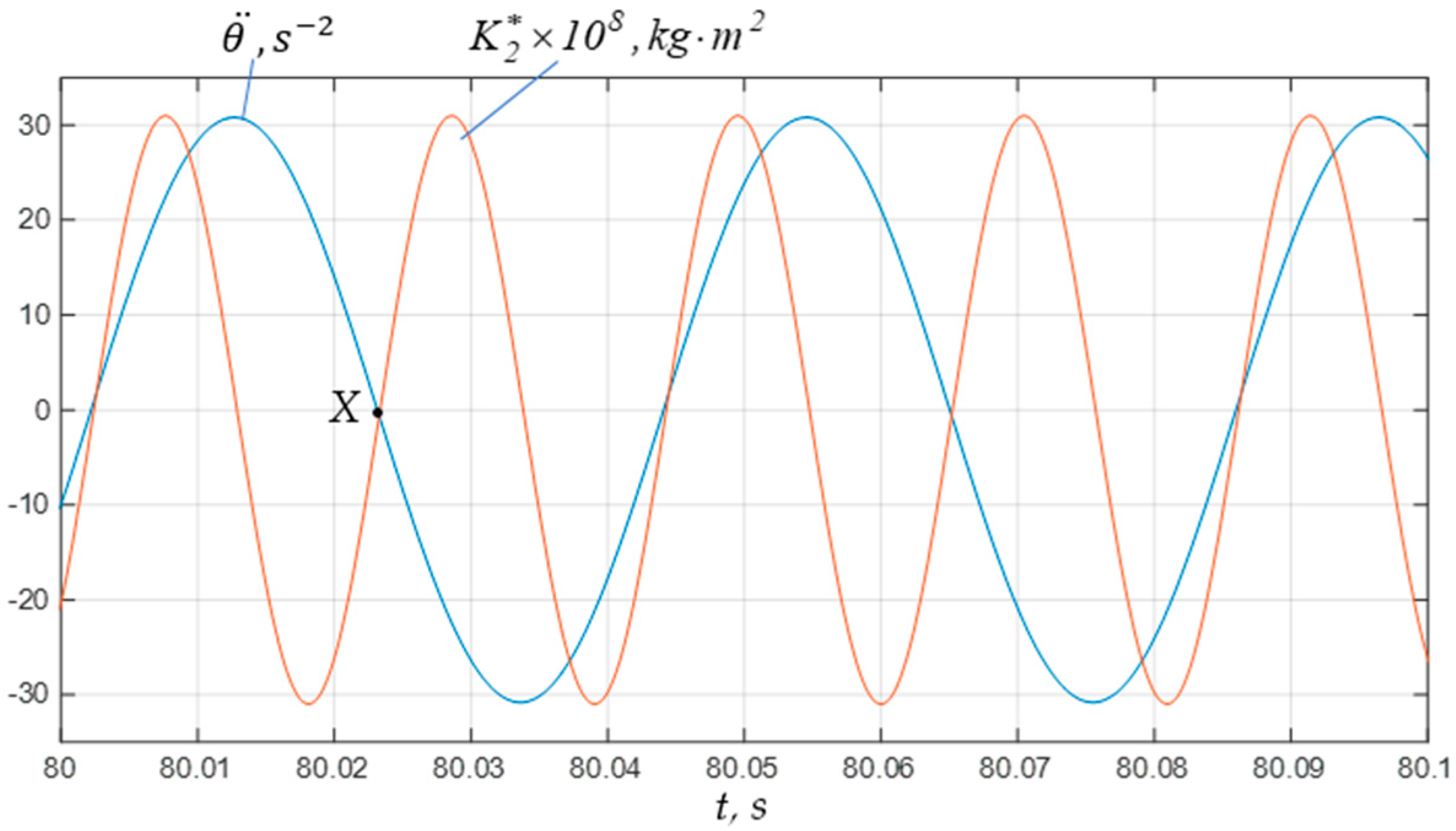
The differential equations of motion are nonlinear, and their analytical study is complicated. A key aspect of this analysis is the variation in the first and fourth terms of the second differential equation (Equation (12)). These terms are
K 1 = θ ¨ m 2 l A 2 cos 2 θ + m 3 l B 2 cos 2 θ + I x cos 2 φ + I y sin 2 φ + 2 I x y sin φ cos φ
K 2 = 2 θ ˙ ω 3 I y I x sin φ cos φ + I x y cos 2 φ sin 2 φ K 2
The two terms contain mass moments of inertia I x , I y and products of inertia I x y , which are difficult to determine experimentally. Therefore, certain points in time are sought at which both terms are minimal or equal to zero. Figure 6 shows the variation in θ ¨ and the term K 2 from Equation (14). From the figure, it is evident that at θ ¨ = 0 (point X), the term K 2 is also equal to zero. This is important for the subsequent investigations.

5. Application of Differential Equations for Rotor Balancing

In balancing, differential equations can be very useful, as they make it possible to determine the coordinates of the mass center x C , y C and the products of inertia I x z , I y z . For this purpose, the following parameters must be determined experimentally in advance: m 1 , m 2 , m 3 , l A , l B , c , k , ω 3 .
Since four unknowns are being sought, it is necessary to add two more equations. In order to easily relate them to the unknowns x C , y C , I x z and I y z , a test point mass, m t , should be added at a known location, and the differential equations of motion should be formulated once again. Equation (11) and its equivalent with an added test mass, m t , can be used to determine x C and y C . Equation (12) and its equivalent with an added test mass, m t , can be used to determine I x z and I y z .
To determine the rotation angle, φ, and the kinematic quantities from Equations (11) and (12), it is necessary to perform two measurements (with and without a test mass). Among the kinematic quantities, it is sufficient to determine y ˙ O max and θ ˙ max . This can be performed by measuring the vibrations at points A and B (Figure 1c) and then using Equation (4).

6. Conclusions

This paper presents a detailed analysis of the dynamics of an unbalanced rotor in a balancing machine. The derived differential equations of motion, determined using Lagrange equations of the second kind, clearly reflect the nonlinear nature of the system. Numerical solutions showed that the system’s behavior largely corresponds to that of a linearly oscillating system.
Based on the derived differential equations, it was established that, for given values of specific parameters of the mechanical system, supplemented by experimentally measured vibrations at two points on the rotor (points A and B), the identification of the location of the mass center and the products of inertia of the rotor can be carried out. The analysis revealed a regularity in the periodicity of specific terms in the differential equations, which enables the elimination of some of them—specifically, the terms containing unknown mass moments of inertia. The obtained results can be used for the development of new methods for the precision balancing of rotors.

Funding

This work was supported by the European Regional Development Fund under the “Research Innovation and Digitization for Smart Transformation” program 2021–2027 under Project BG16RFPR002-1.014-0006 “National Centre of Excellence Mechatronics and Clean Technologies”.

Institutional Review Board Statement

Not applicable.

Informed Consent Statement

Not applicable.

Data Availability Statement

No new data were created or analyzed in this study. Data sharing is not applicable to this article.

Conflicts of Interest

The author declares no conflicts of interest.

References

  1. Fidlin, A. Nonlinear Oscillations in Mechanical Engineering; Springer: Berlin, Germany; New York, NY, USA, 2006; pp. 1–7. [Google Scholar] [CrossRef]
  2. Sperling, L.; Merten, F.; Duckstein, H. Self-Synchronization and Automatic Balancingin Rotor Dynamics. Int. J. Rotating Mach. 2000, 6, 275–285. [Google Scholar] [CrossRef]
  3. Sperling, L.; Ryzhik, B.; Linz, C.; Duckstein, H. Simulation of Two-Plane Automatic Balancing of a Rigid Rotor. Math. Comput. Simul. 2002, 58, 351–365. [Google Scholar] [CrossRef]
  4. Zhang, X.; Yang, Y.; Deng, W.; Zhao, S.; Zhu, Q.; Ma, H.; Han, Q.; Qin, Z.; Liu, W. Vibration Energy Analysis of Rub-Impact Rotor System: Nonlinear Fault-Induced Energy Response and Transfer State. Mech. Syst. Signal Process. 2025, 236, 113035. [Google Scholar] [CrossRef]
  5. Taghipour, J.; Dardel, M.; Pashaei, M.H. Nonlinear Vibration Analysis of a Flexible Rotor Shaft with a Longitudinally Dispositioned Unbalanced Rigid Disc. Commun. Nonlinear Sci. Numer. Simul. 2021, 97, 105761. [Google Scholar] [CrossRef]
  6. Rodrigues, D.J.; Champneys, A.R.; Friswell, M.I.; Wilson, R.E. Automatic Two-Plane Balancing for Rigid Rotors. Int. J. Non-Linear Mech. 2008, 43, 527–541. [Google Scholar] [CrossRef]
  7. Sayed, H.; El-Sayed, T.A. Nonlinear Dynamics and Bifurcation Analysis of Journal Bearings Based on Second Order Stiffness and Damping Coefficients. Int. J. Non-Linear Mech. 2022, 142, 103972. [Google Scholar] [CrossRef]
  8. Dakel, M.; Baguet, S.; Dufour, R. Nonlinear Dynamics of a Support-Excited Flexible Rotor with Hydrodynamic Journal Bearings. J. Sound Vib. 2014, 333, 2774–2799. [Google Scholar] [CrossRef]
  9. Chen, L.; Wang, J.; Han, Q.; Chu, F. Nonlinear Dynamic Modeling of a Simple Flexible Rotor System Subjected to Time-Variable Base Motions. J. Sound Vib. 2017, 404, 58–83. [Google Scholar] [CrossRef]
  10. Guan, H.; Ma, H.; Chen, X.; Mu, Q.; Zeng, Y.; Chen, Y.; Wen, B.; Guo, X. Nonlinear Vibration of Rotor-Bearing System Considering Base-Motion and Bearing-Misalignment. Mech. Mach. Theory 2025, 206, 105933. [Google Scholar] [CrossRef]
  11. Yamamoto, T.; Ishida, Y.; Kirk, R.G. Linear and Nonlinear Rotordynamics: A Modern Treatment with Applications, 2nd ed.; John Wiley & Sons, Incorporated: Weinheim, Germany, 2002. [Google Scholar]
  12. Schneider, H. Rotor Balancing: Fundamentals for Systematic Processes, 1st ed.; Springer: Berlin/Heidelberg, Germany, 2023. [Google Scholar]
  13. Li, L.; Cao, S.; Li, J.; Nie, R.; Hou, L. Review of Rotor Balancing Methods. Machines 2021, 9, 89. [Google Scholar] [CrossRef]
  14. Sinapov, P. Forced Vibrations of an Elastically Supported Rigid Rotor at Different Types of Unbalance. AIP Conf. Proc. 2024, 3129, 040006. [Google Scholar] [CrossRef]
  15. Hibbeler, R.C. 14 Energy Methods, Mechanics of Materials, 8th ed.; Prentice Hall: Boston, MA, USA, 2010; p. 772. [Google Scholar]
  16. Tsonev, V.; Kuzmanov, N.; Borisov, B.; Penkov, K. System for Materials Testing at Static Loading. IOP Conf. Ser. Mater. Sci. Eng. 2019, 618, 012048. [Google Scholar] [CrossRef]
Figure 1. A dynamic model. (a) Mechanical system; (b) rotor; (c) coordinate axes in the horizontal plane; (d) coordinate axes in the vertical plane.
Engproc 121 00005 g001
Figure 2. (a) Pedestal 2; (b) Pedestal 3.
Engproc 121 00005 g002
Figure 3. Variation in y O , y ˙ O and y ¨ O as a function of time.
Engproc 121 00005 g003
Figure 4. Variation in θ , θ ˙ and θ ¨ as a function of time.
Engproc 121 00005 g004
Figure 5. Variation in y ˙ A and y ˙ B as a function of time.
Engproc 121 00005 g005
Figure 6. Comparison of the quantities θ ¨ and K 2 .
Engproc 121 00005 g006
Table 1. Values of the parameters.
ParameterValue
m11.445 kg
Ix′0.0017839818747 kg·m2
Iy′0.0017842635736 kg·m2
Ix′y′2.4396 × 10⁻⁷ kg·m2
Iy′z′−6.0812 × 10⁻⁷ kg·m2
Ix′z′−1.0533 × 10⁻⁶ kg·m2
x′C1.28 × 10−5 m
y′C7.4 × 10−6 m
k4270.7 N/m
c0.2 N·s/m
m20.145 kg
m30.145 kg
lA0.0999682 m
lB0.1000318 m
ω3150 rad/s
Disclaimer/Publisher’s Note: The statements, opinions and data contained in all publications are solely those of the individual author(s) and contributor(s) and not of MDPI and/or the editor(s). MDPI and/or the editor(s) disclaim responsibility for any injury to people or property resulting from any ideas, methods, instructions or products referred to in the content.