1. Introduction
What if, in the future, a great portion of valuable metals is not mined from the Earth, but from asteroids floating in space? This vision is no longer science fiction. The idea of mining asteroids is gaining serious attention because it can revolutionize the global economy [
1].
Currently, companies and academia are both working on asteroid resource extraction. Many scientific papers are written on this topic from idea [
2,
3,
4] to mission design [
5]. Some recent papers (published in 2024 and 2025) have mentioned the need for a new space treaty that specifically addresses asteroid resource extraction by debating on the inadequacy of current legal frameworks (Andrew J. Cannon [
6]), ethical and environmental implications (Lampkin [
7], Hein et al. [
8], and Evie Kendal [
9]), and the role of governments (Ritu S. Lauer [
10]). Similarities between asteroid mining and lunar extraction are also discussed, highlighting shortages in the legal framework that require immediate solutions (Pelton et al. [
11]).
We are also seeing more and more private businesses that invest in asteroid mining. For example, AstroForge [
12] develops technologies for extracting platinum group metals from asteroids, and Asteroid Mining Corporation [
13] uses robotic technologies to explore and mine asteroids. TransAstra [
14] is also working on optical mining.
This all points to the fact that we should expect asteroid mining to become a reality. However, we have a problem. The Outer Space Treaty does not really offer any rules on how to work in, with, or on any asteroids [
15]. We need clear laws that determine who can mine, how and when they can mine, and who owns the mines and resources they extract. This paper argues that we need a detailed legal framework for resource extraction on near-Earth asteroids that determine the ownership of resources, offer licensing for mining activities, control fair distribution of benefits, protect the space environment, and so on.
The Outer Space Treaty of 1967 leads the international legal framework for asteroid mining by stating that the exploration and use of outer space should be for the benefit of all countries, regardless of their level of economic or scientific development [
16]. The exact paragraph is [
17]:
“International cooperation in the exploration and use of outer space for peaceful purposes (hereafter “international cooperation”) shall be conducted in accordance with the provisions of international law, including the Charter of the United Nations and the Treaty on the Principles Governing the Activities of States in the Exploration and Use of Outer Space, including the Moon and Other Celestial Bodies. It shall be carried out for the benefit and in the interest of all States, irrespective of their degree of economic, social or scientific and technological development, and shall be the province of all mankind. Particular account should be taken of the needs of developing countries.”
Butkevičienė and Rabitz [
16] explain this in detail and apply it to the asteroid mining practice [
18]. Ethical environmental considerations of asteroid mining are also important [
19,
20]. As Rivkin et al. [
19] emphasize, responsible governance leads to a net positive outcome for humanity. Many papers have also discussed the importance of equity in asteroid mining [
16,
21,
22,
23,
24].
This paper offers an analysis that supports this urgent need. It shows that having legal frameworks increase resource distribution equity.
2. Where We Stand Considering Legal Framework
As mentioned before, the most distinguished legal framework is the Outer Space Treaty (OST) of 1967 [
25]. It formulates the basis of what we now call space law. According to Article I, the exploration and use of space shall benefit all mankind. Article II says no country can claim ownership of any celestial body, such as the Moon or an asteroid. Basically, countries cannot put up their flags and say, “This is ours.” Article VI makes countries responsible for the space activities of their citizens and companies. That means if a private company from one nation causes damage to another in space, that nation will be responsible for that damage. Article VIII is on the control of space objects. It means the state that sends something into space has legal control over it.
Another legal framework is the Moon Agreement of 1979. This agreement was the first treaty [
26,
27] to talk about the common heritage of mankind. It proposes that all nations share resources found on celestial bodies.
It is noteworthy that countries have begun putting their own legal frameworks in place to address space resources. The US Commercial Space Launch Competitiveness Act [
28], for example, gives US citizens the right to own resources they mine on asteroids. Luxembourg has also released its own space resources law [
29,
30,
31,
32]. It is designed to attract space mining companies because it offers ownership of resources. Other countries are also just beginning to create their own regulations, and each has a different approach to space resource development. The current legal framework has major gaps and ambiguities. For instance, the Outer Space Treaty lacks a definition of what national appropriation means with regard to asteroid resource extraction. The common heritage principle remains challenged, and no international agreement exists to show how it should be implemented.
Due to these issues, it is evident that there is a need for more precise regulations. Commercial asteroid mining was not anticipated when these laws were created; thus, they do not properly address the issue.
3. What Needs Specific Regulations?
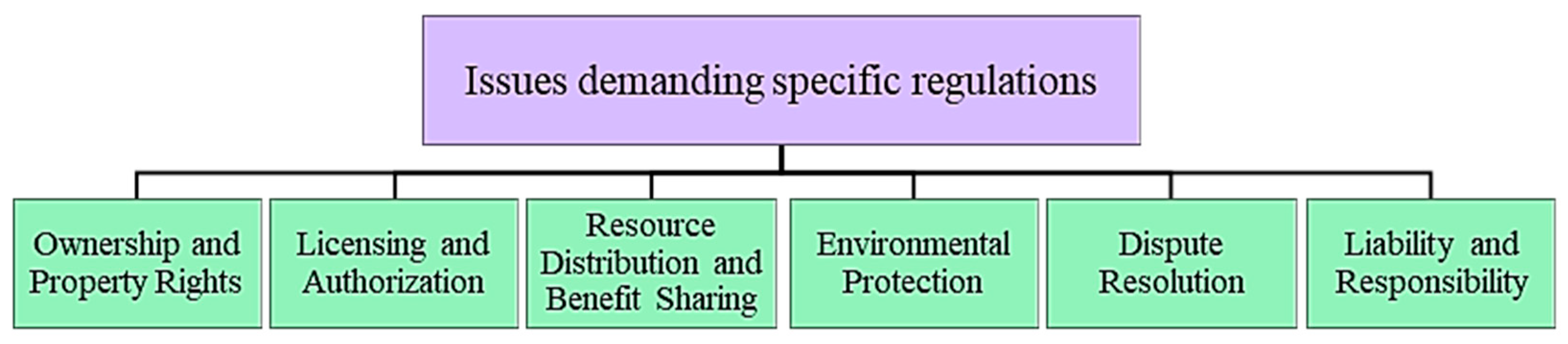
The first issue is ownership and property rights. The main dispute is over how the current rules should be interpreted. Does national appropriation mean that you cannot own the asteroid itself, but you can own the resources that you extract? Or does that mean you cannot own anything, full stop? And where does the concept of the common heritage of mankind fit into all this?
We need new models for managing ownership of resources. Should it be first-come, first-served, so whoever gets there first gets the resources? Or should there be a licensing system in which companies need to get permission? Or should there be a revenue-share system, where profits are distributed among countries? We will most likely need an international registry of asteroid resources to keep track of who is who and who is doing what. This would prevent conflicts. The other issue is licensing and authorization. If we go with a licensing system, we need clear rules for who gets a license. What criteria should companies have to meet? We also need to think about the environment. Companies should conduct environmental impact assessments before they start mining, and they should take steps to minimize any damage. Safety is important. We need standards of safety for mining operations as well as for transporting resources back to Earth. Should an international governing body be the one to hand out licenses and enforce the rules?
Other issues are resource distribution and benefit sharing. How do we ensure that asteroid mining benefits everyone, not just a handful of wealthy nations? One possibility is setting up a fund that would benefit developing nations with a portion of the profits from asteroid mining. The danger is a resource monopoly in which one company or country holds all the resources. Another matter is environmental protection. We need to take planetary protection seriously. We do not want to contaminate asteroids with Earth-based microbes, or possibly vice versa. We need regulations to minimize the environmental impact of mining operations, such as dust clouds or debris. So, who gets to be held liable if a company causes environmental harm? This needs to be worked out.
Dispute resolution is another matter. If there is a conflict between countries or companies, how do we resolve it? International courts or arbitration might be options. We need to figure out how to handle conflicting claims, like two companies claiming the same asteroid. Then comes liability and responsibility. If a mining operation causes damage, who is responsible? Who is responsible for making sure resources are safely returned to Earth? Should mining companies be required to have insurance?
Figure 1 shows the issues demanding specific regulations.
4. The Techno-Economic Analysis
We conducted a three-scenario techno-economic analysis using a financial simulation and showed the impact of setting solid legal frameworks for mining platinum from asteroids. This analysis shows how precise regulations that alleviate risks and foster investor confidence can be beneficial. In this simulation (financial model), the Mission Duration is , the Base Annual Gross Revenue Unit (), which is an arbitrary unit for all financial calculations, is assumed to be , and the CAPEX multiplier (), which is the initial investment as a proportion of total potential gross revenue over the asteroid mining mission, is set to be at 40% (). The OPEX proportion (), which is the annual operating costs as a proportion of annual gross revenue, is set at 20% (). The Base Discount Rate for Clear Frameworks (), which is the discount rate for low-risk scenarios, is set at 10% (). The High Uncertainty Discount Rate Multiplier (), which refers to how much higher the discount rate is under high uncertainty, is set at 2.5 (). The Revenue Share Percentage (), which is the percentage of gross annual revenue for benefit-sharing in Scenario 3, is set at 5% (). Our simulation uses a discounted cash flow (DCF) model to calculate the NPV for a hypothetical 10-year asteroid mining mission. The main feature uses generalized financial parameters. Cash flows are calculated yearly. Year 0 is the initial investment (CAPEX), while years 1 to are operational cash flows. The Normalized Gross Annual Revenue is , the Normalized Initial Capital Expenditure is , the Normalized Annual Operational Expenditure is , and the Normalized Annual Net Cash Flow varies by scenario.
4.1. Financial Model and Methodology
Our simulation uses the Net Present Value (NPV) method [
33]. It is a generally used method that helps you figure out if a project is worthwhile today, considering all the risk, all the money you will spend, and all the money you will earn in the future.
If the final NPV number is positive, it means that the mission is expected to bring in more value than it costs. Therefore, it is a good financial choice. If it is negative, however, it is likely not worthwhile. The NPV is calculated by using the following formula [
34].
where
is the discount rate, while the cash flow is shown by
in each year (t).
In Scenario 1— high legal uncertainty—we know that a higher risk leads to a higher discount rate, so the discount rate
. For the cash flows (
) in year 0,
, and in years 1–10,
So,
for
. Now, when it comes to the NPV Calculation for Scenario 1 (
), we have:
We can calculate the NPV for Scenario 2— clear legal framework (No Revenue Share)—the same way. This Scenario offers a stable legal environment, lower risk, no revenue sharing. Therefore, the discount rate is
. The cash flows (
) for year 0 are
and for Years 1–10,
So,
for
. Hence, the NPV Calculation (
) for Scenario 2 is as follows.
And the same method applies to Scenario 3—clear legal framework with benefit sharing. In this Scenario, we have assumed clear legal framework, lower discount rate, but including revenue sharing. The discount rate is
, the Revenue Share Percentage is
, and the cash flows (
) for year 0 are
, and for years 1–10,
, which means
. So,
for
. And the NPV Calculation for Scenario 3 (
) is as follows.
4.2. Results
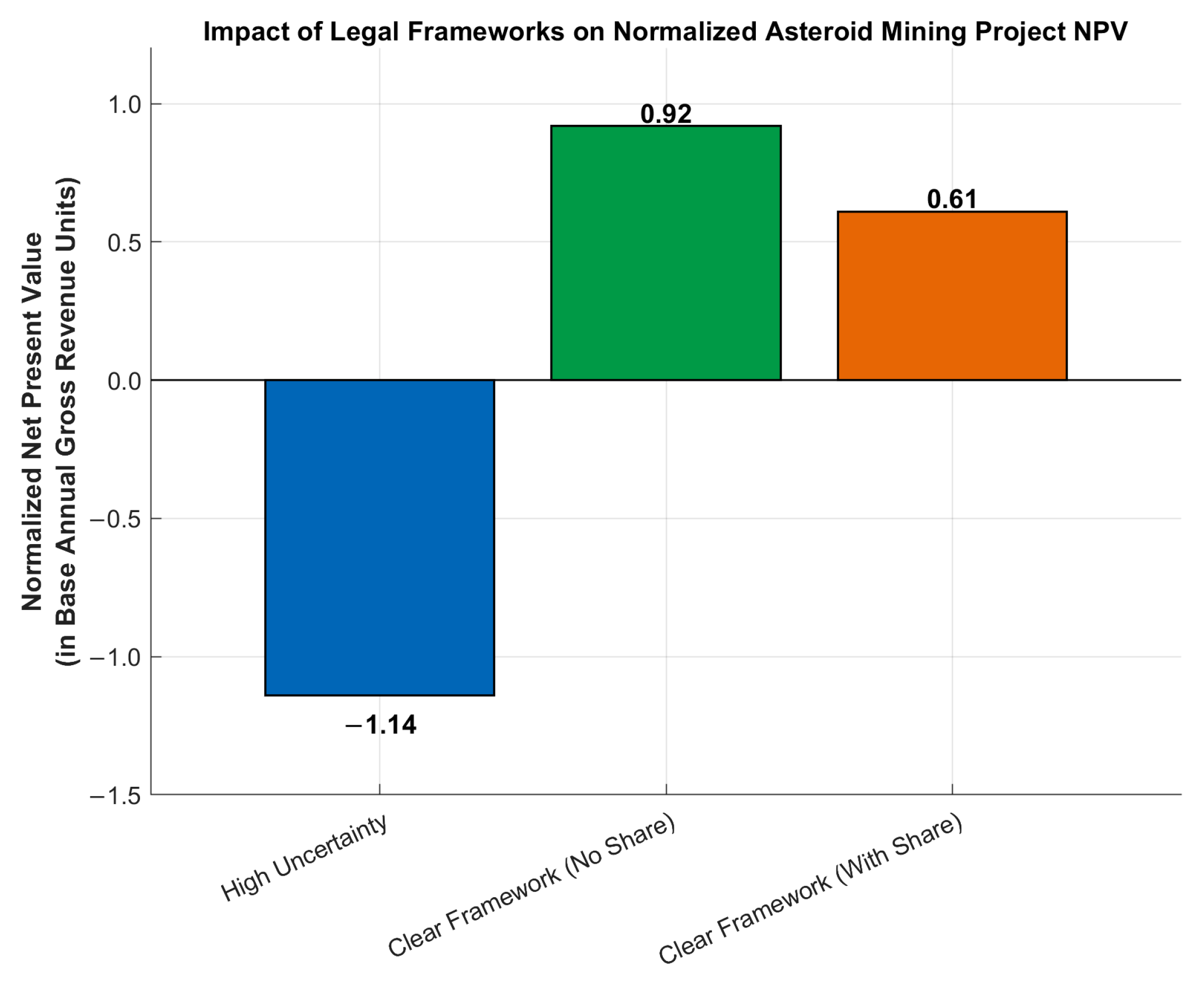
The simulation generated the Net Present Values (NPVs) for each scenario, as shown in
Table 1.
The results are presented in the following figures.
Figure 2 shows the Impact of Legal Frameworks on Asteroid Mining Project Net Present Values.
Figure 2 shows the financial progress over 10 years. It shows that under high legal uncertainty (Scenario 1), the project has a significantly negative Net Present Value (NPV) because the risks that come from a fragmented legal situation are considerable. Therefore, in the long run, the project is fundamentally uneconomical. We see that the clear legal framework (no revenue sharing) (Scenario 2) changes the project into a viable opportunity. In this Scenario, NPV is positive. This shift is because of the reduced perceived risk (modeled by a lower discount rate). However, Scenario 3 uses a 5% revenue-sharing mechanism within a clear legal framework. So, we see that the NVP is a little less than in Scenario 2. But it still maintains a positive NPV.
Figure 3 shows the Cumulative Normalized Net Present Value (NPV) over Mission Duration.
In
Figure 2, all scenarios start at −4.0 units (initial CAPEX). In Scenario 1, the Cumulative NPV stays negative. Despite positive annual cash flows, the high discount rate (25%) prevents it from recovering the initial investment. The curve in Scenario 2 rises steeply and crosses zero early. The lower discount rate (10%) helps the rapid accumulation of positive returns. The curve in Scenario 3 also rises and crosses zero, but less steeply than Scenario 2 due to reduced annual net cash flow (0.75 units). This shows that benefit sharing reduces the magnitude of returns.
4.3. Linking Legal Frameworks to Economic Outcomes
The techno-economic analysis is grounded in the legal challenges outlined in
Section 2 and
Section 3. Legal uncertainty stems from ambiguous provisions in the Outer Space Treaty and the lack of international consensus on resource ownership. It also increases perceived investment risk. This risk is modeled in our financial simulation in Scenario 1.
4.4. Model Verification
To ensure the robustness of our model, we validated its assumptions against existing studies. The CAPEX multiplier (40%) and the OPEX proportion (20%) align with estimates from Hein et al. [
4], who analyzed the cost of asteroid mining missions. Additionally, we cross-referenced our NPV results with Hein et al.’s analysis. Plus, our model’s prediction is consistent with other studies mentioned in result discussions.
5. Proposed Solutions and Recommendations
5.1. Development of a New International Agreement
There are both arguments for and against a new treaty. Arguments for this are as follows: A new treaty could provide clear, specific rules for asteroid mining and address the potential gaps in the Outer Space Treaty. It could establish an international governing body and guarantee fair benefit-sharing. Arguments against are that negotiating a new treaty can be a long, complicated process and possibly difficult to achieve among all nations. Also, some argue that the existing laws can already be interpreted and applied to asteroid mining. There are also important provisions that need to be in such an agreement. Some include clear definitions of resource ownership and property rights, a licensing system for asteroid mining activities that includes environmental and safety standards, mechanisms for equitable benefit-sharing that may include a fund for developing nations, a dispute resolution mechanism, clear rules from which liability and responsibility would be determined, and the creation of an international registry of asteroid resources.
5.2. Strengthening Existing Legal Frameworks
Instead of creating a whole new space treaty, we can also make the existing rules work better. One approach is to have experts in space law, like professors and groups that study international law, work together to explain what the old Outer Space Treaty really means when it comes to mining asteroids. They can help us understand how the old rules, written before anyone thought about asteroid mining, can still be used to guide us today. Also, countries can make their own laws that fit with the big, general rules of the Outer Space Treaty. This means each country can make specific rules for its own companies that want to mine asteroids, so everyone knows what is allowed and what is not.
Having soft laws and voluntary guidelines that are established by companies or international organizations, although not legally binding, can encourage responsible practices and also be helpful. These shared rules guarantee fairness and organization in mining activities, even without a new treaty.
5.3. The Role of Public–Private Partnerships
When it comes to asteroid mining, governments and private companies need to work together. Governments can play a big role by funding research and development of new technologies needed to mine asteroids. They can also team up with companies to create rules for things like protecting the environment and making sure mining operations are safe. Plus, governments and companies can work together to build shared databases. This would let everyone, from scientists to miners, have access to important information about asteroids, which is crucial for planning and carrying out mining missions.
Beyond just working together within countries, we also need international standards. This means groups like the United Nations, along with governments and private companies from all over the world, should work together to create common rules for asteroid mining. These standards would cover important things like how to protect the environment on asteroids, how to keep miners safe, and how to extract resources responsibly. Having these international standards would help make sure that asteroid mining is performed in a way that is fair and safe for everyone and that it benefits all of humanity.
6. Conclusions
Asteroid mining is an idea that might revolutionize industries and tackle Earth’s resource scarcity problem. Yet, its success depends on detailed and certain legal frameworks. This paper argues that the Outer Space Treaty of 1967, while foundational and helpful, does not satisfy serious issues like resource ownership, licensing, and environmental protection. Our techno-economic simulation points out that clear regulations reduce risks. Ergo, they generate positive Net Present Values, even with equitable benefit-sharing mechanisms. We propose that a new international agreement is essential to define property rights, create a licensing system, and generate a fund for developing nations, so that fair resource distribution aligns with the concept that space is mankind’s common heritage. We also argue that strengthening the current frameworks and establishing soft law guidelines will offer a balanced approach. Public–private partnerships are also important because they present technological innovation and data sharing. Ethical and environmental considerations are also discussed. And it is argued that immediate action is important, because legal ambiguities will continue to discourage investment, and without proper frameworks, such uncertainties could result in monopolization and potential environmental harm.
Author Contributions
H.A. conceptualized the study and wrote the main body of the manuscript. M.A. conceptualized the study, edited the manuscript, and analyzed the data. R.N. contributed to the statistical analysis and to revising the manuscript. R.A. provided resources and reviewed the manuscript for accuracy and quality. All authors have read and agreed to the published version of the manuscript.
Funding
This research was funded by the scientific-research project № 253CH0001-04, “Development of infrastructure and environment for aerospace education and research at TU-Sofia /INSATUS/”, under the contract with the “Research and development sector at TU-Sofia”.
Institutional Review Board Statement
Not applicable.
Informed Consent Statement
Not applicable.
Data Availability Statement
Data will be available on request.
Acknowledgments
This work was accomplished with financial support from the European Regional Development Fund within the Operational Program “Bulgarian national recovery and resilience plan”, under the procedure for direct provision of grants “Establishing of a network of re-search higher education institutions in Bulgaria”, and under Project BG-RRP-2.004-0005 “Improving the research capacity and quality to achieve intErnAtional recognition and reSilience of TU-Sofia (IDEAS)”.
Conflicts of Interest
The authors declare no conflict of interest.
References
- Azadmanesh, M.; Roshanian, J.; Hassanalian, M. On the importance of studying asteroids: A comprehensive review. Prog. Aerosp. Sci. 2023, 142, 100957. [Google Scholar] [CrossRef]
- Azadmanesh, M.; Roshanian, J.; Hassanalian, M. A Fuzzy Fast Terminal Approach for Tracking a Probe Around an Asteroid. J. Aerosp. Sci. Technol. 2022, 16, 1–10. [Google Scholar]
- Azadmanesh, M.; Roshanian, J.; Hassanalian, M. Fast Terminal Sliding Mode Control for the Soft Landing of a Space Robot on an Asteroid Considering a Barycentric Gravitational Model. J. Aerosp. Sci. Technol. 2023, 16, 66–76. [Google Scholar]
- Hein, A.M.; Matheson, R.; Fries, D. A techno-economic analysis of asteroid mining. Acta Astronaut. 2020, 168, 104–115. [Google Scholar] [CrossRef]
- Nadoushan, M.J.; Ghobadi, M.; Shafaee, M. Designing reliable detumbling mission for asteroid mining. Acta Astronaut. 2020, 174, 270–280. [Google Scholar] [CrossRef]
- Cannon, A.J. Space Mining: Why we need a new treaty and what might it look like. SSRN 2024, SSRN:5079531. [Google Scholar] [CrossRef]
- Lampkin, J.A.; McClanahan, B.W. Astronomical withdrawals: A green criminological examination of extreme energy mining on extraterrestrial objects. Crime Law Soc. Change 2024, 81, 365–384. [Google Scholar] [CrossRef]
- Hein, A.M.; Saidani, M.; Tollu, H. Exploring potential environmental benefits of asteroid mining. arXiv 2018, arXiv:1810.04749. [Google Scholar] [CrossRef]
- Kendal, E. Asteroid mining vs the carbon bubble: Ethical considerations for space resource extraction. Account. Audit. Account. J. 2024, 37, 1345–1375. [Google Scholar] [CrossRef]
- Lauer, R.S. Public-private linkages and the case of asteroid mining. Technol. Anal. Strateg. Manag. 2024, 36, 2791–2802. [Google Scholar] [CrossRef]
- Pelton, J.N.; Mishra, N.; Elia Vitoloni, M. Mining the ocean floor vs mining the Moon: What can we learn from our past experiences? Front. Space Technol. 2025, 5, 1499486. [Google Scholar] [CrossRef]
- Gialich, M.; Acain, J. ASTROFORGE. Available online: https://www.astroforge.com (accessed on 24 April 2024).
- Hunter-Scullion, M.; Founder, C. AMC. Available online: https://www.eu-startups.com/directory/asteroid-mining-corporation-ltd/ (accessed on 19 January 2026).
- Joel Sercel, F.C. TRANSASTRA. Available online: https://transastra.com (accessed on 24 April 2024).
- Shou, Z. Impact of Asteroid Mining on Global Equity Based on Two-Level Fuzzy Comprehensive Evaluation Model. Acad. J. Environ. Earth Sci. 2023, 5, 9–14. [Google Scholar] [CrossRef]
- Butkevičienė, E.; Rabitz, F. Sharing the benefits of asteroid mining. Glob. Policy 2022, 13, 247–258. [Google Scholar] [CrossRef]
- United Nations General Assembly Fifty-First Session. A/RES/51/122 Declaration on International Cooperation in the Exploration and Use of Outer Space for the Benefit and in the Interest of All States, Taking into Particular Account the Needs of Developing Countries; United Nations General Assembly: New York, NY, USA, 1996. [Google Scholar]
- Spears, L.; Martin, J.; Rotham, B. Legality of Ownership of Asteroid Mining Results in Space Based on International Law Arrangements. PIJASS 2023, 1, 11–24. [Google Scholar] [CrossRef]
- Rivkin, A.S.; Milazzo, M.; Venkatesan, A.; Frank, E.; Vidaurri, M.R.; Metzger, P.; Lewicki, C. Asteroid Resource Utilization: Ethical Concerns and Progress. arXiv 2020, arXiv:2011.03369. [Google Scholar] [CrossRef]
- Fan, T.; Pang, W.; Tan, Y. A Measuring Stick for the World: Achieving Global Equity in Asteroid Mining. Acad. J. Environ. Earth Sci. 2022, 4, 53–59. [Google Scholar] [CrossRef]
- Xu, C.; Huang, G.; Meng, Q. Study on Global Equity and Asteroid Mining. Acad. J. Eng. Technol. Sci. 2022, 5, 23–28. [Google Scholar] [CrossRef]
- Sun, H.; Zhu, J.; Xu, Y. Research on the impact of asteroid mining on global equity. arXiv 2022, arXiv:2211.02023. [Google Scholar]
- Zhou, K.; Xu, R.; Shao, T. World Equity from Stars. In Proceedings of the 2022 6th Annual International Conference on Data Science and Business Analytics (ICDSBA), Changsha, China, 14–16 October 2022; pp. 111–121. [Google Scholar]
- Dallas, J.; Raval, S.; Gaitan, J.A.; Saydam, S.; Dempster, A. Mining beyond earth for sustainable development: Will humanity benefit from resource extraction in outer space? Acta Astronaut. 2020, 167, 181–188. [Google Scholar] [CrossRef]
- United Nations General Assembly Twenty-First Session. RES 2222 (XXI) Treaty on Principles Governing the Activities of States in the Exploration and Use of Outer Space, including the Moon and Other Celestial Bodies (Outer Space Treaty); United Nations General Assembly: New York, NY, USA, 1966. [Google Scholar]
- Christol, C.Q. The 1979 moon agreement: Where is it today. J. Space Law 1999, 27, 1. [Google Scholar]
- Doyle, S.E. Using extraterrestrial resources under the Moon Agreement of 1979. J. Space Law 1998, 26, 111. [Google Scholar]
- Dodge, M. The US commercial space launch competitiveness act of 2015: Moving US space activities forward. Air Space Law 2016, 29, 3. [Google Scholar]
- Steele, J. Luxembourg and the Exploitation of Outer Space. Nottm. Law J. 2021, 29, 32. [Google Scholar]
- Calmes, B.; Schummer, L.; Gladysz-Lehmann, B. The Space Law Review: Luxembourg. 2021. Available online: https://www.arendt.com/wp-content/uploads/2024/04/2021.12_-_the_law_reviews_-_the_space_law_review_3rd_ed_-_luxembourg.pdf (accessed on 16 January 2026).
- Hofmann, M. Luxembourg space legislation. In Elgar Concise Encyclopedia of Space Law; Edward Elgar Publishing: Cheltenham, UK, 2025; pp. 199–204. [Google Scholar]
- Hofmann, M.; Blount, P.; Zarkan, L.; Salmeri, A.; Leterre, G.; Salmeri, A.; Zarkan, L. Space Legislation of Luxembourg: A Commentary; Kluwer Law International: Alphen aan den Rijn, The Netherlands, 2022. [Google Scholar]
- Shou, T. A literature review on the net present value (NPV) valuation method. In Proceedings of the 2022 2nd International Conference on Enterprise Management and Economic Development (ICEMED 2022), Dalian, China, 27–29 May 2022; pp. 826–830. [Google Scholar]
- Brealey, R.A.; Myers, S.C.; Allen, F. Principles of Corporate Finance; McGraw-hill: Columbus, OH, USA, 2014. [Google Scholar]
| Disclaimer/Publisher’s Note: The statements, opinions and data contained in all publications are solely those of the individual author(s) and contributor(s) and not of MDPI and/or the editor(s). MDPI and/or the editor(s) disclaim responsibility for any injury to people or property resulting from any ideas, methods, instructions or products referred to in the content. |