Simulating Road Networks for Medium-Size Cities: Aswan City Case Study †

Abstract
1. Introduction
2. Literature Review
2.1. Transportation Simulation Tools
2.2. MATSim Applications
3. Methodology
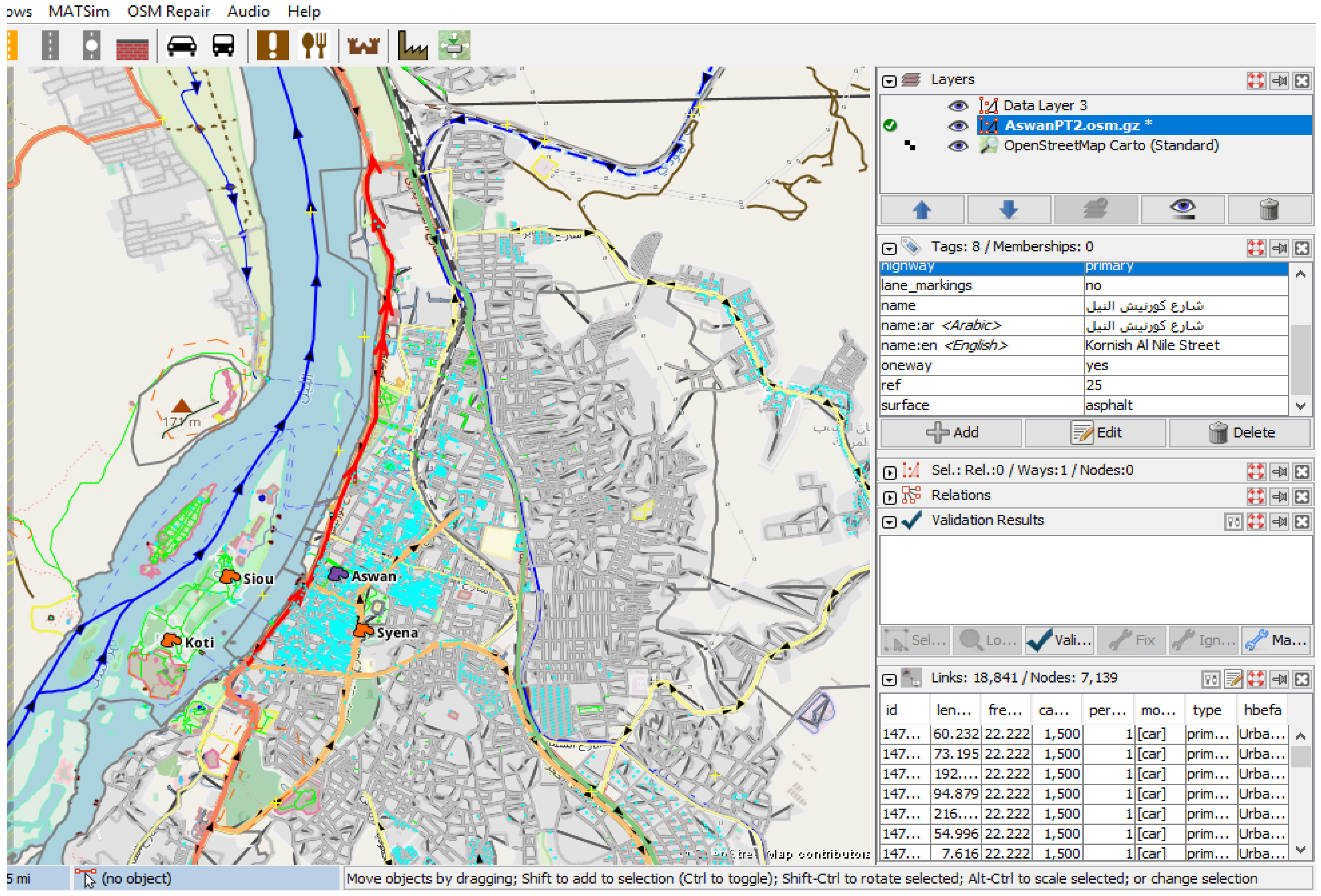
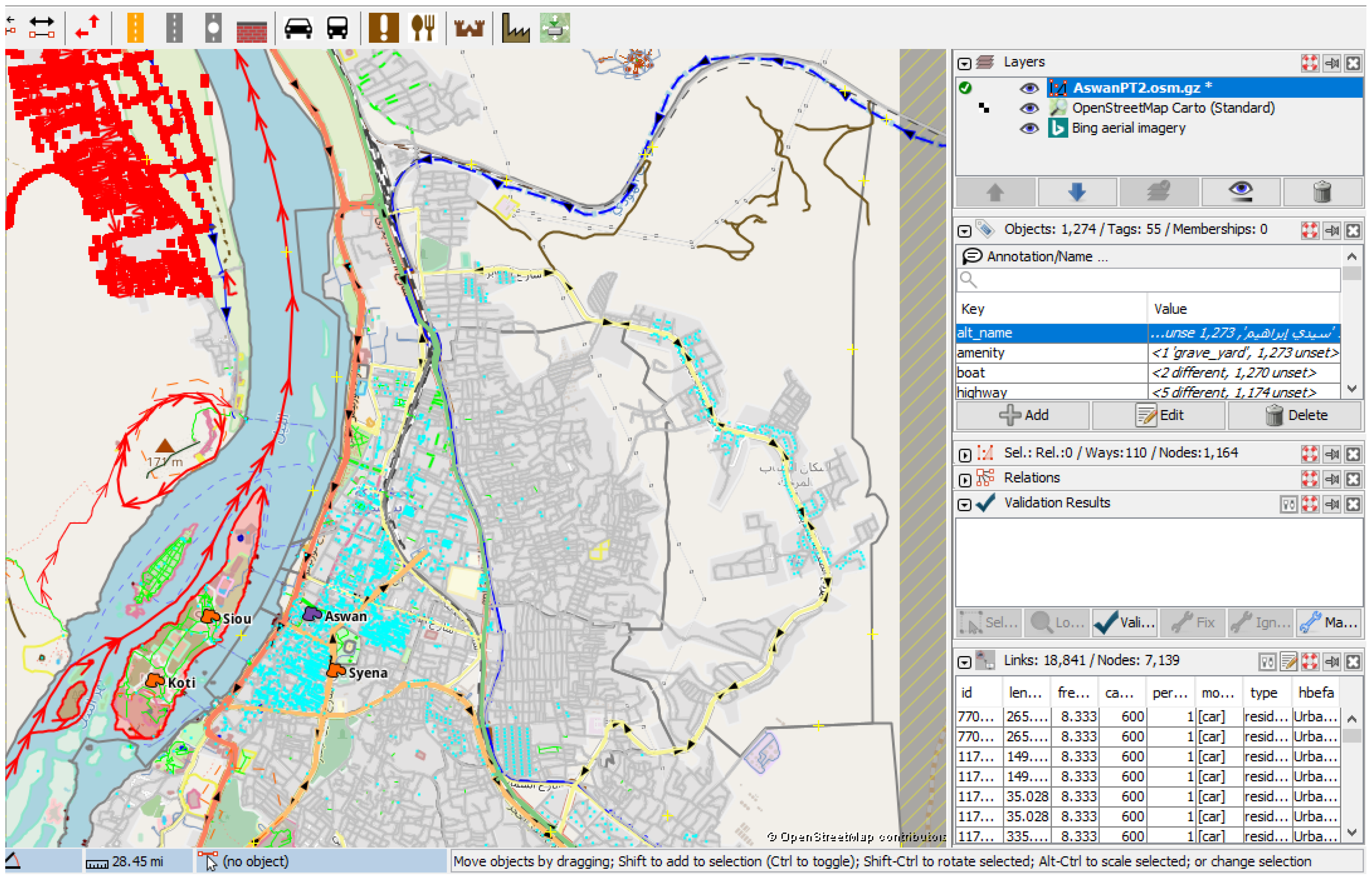
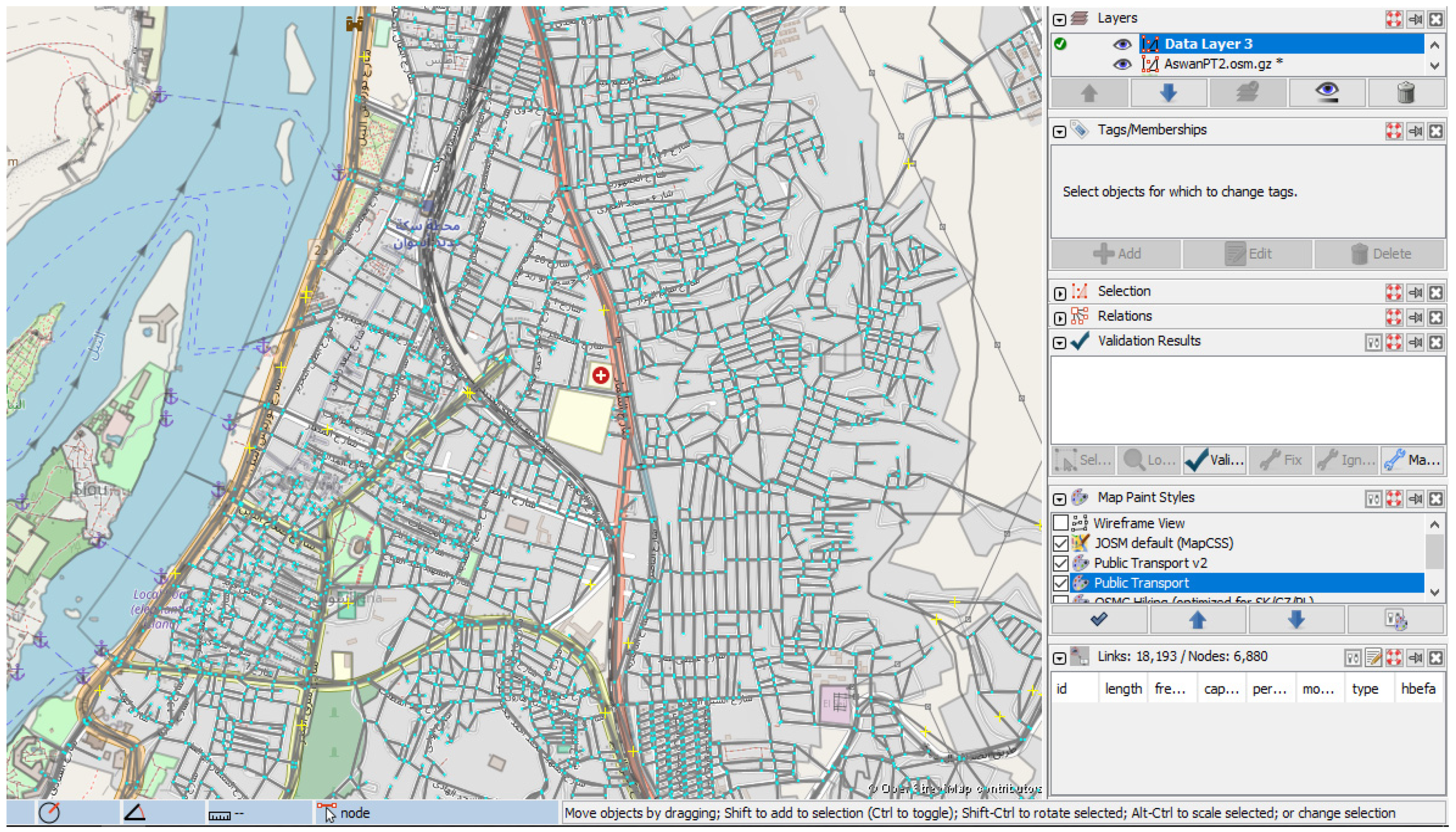
3.1. Steps to Create a Network File for the Aswan Scenario
- ID: Unique identifier for the link.
- From and to: IDs of the start and end nodes.
- Length: link length (in meters).
- Free speed: Free-flow speed (in meters per second).
- Capacity: Max vehicles per hour.
- Perm lanes: lanes count.
3.2. Steps to Create a Plan File for the Aswan Scenario
3.2.1. Origin–Destination Matrix Preparation
3.2.2. Trip Chains of Agents
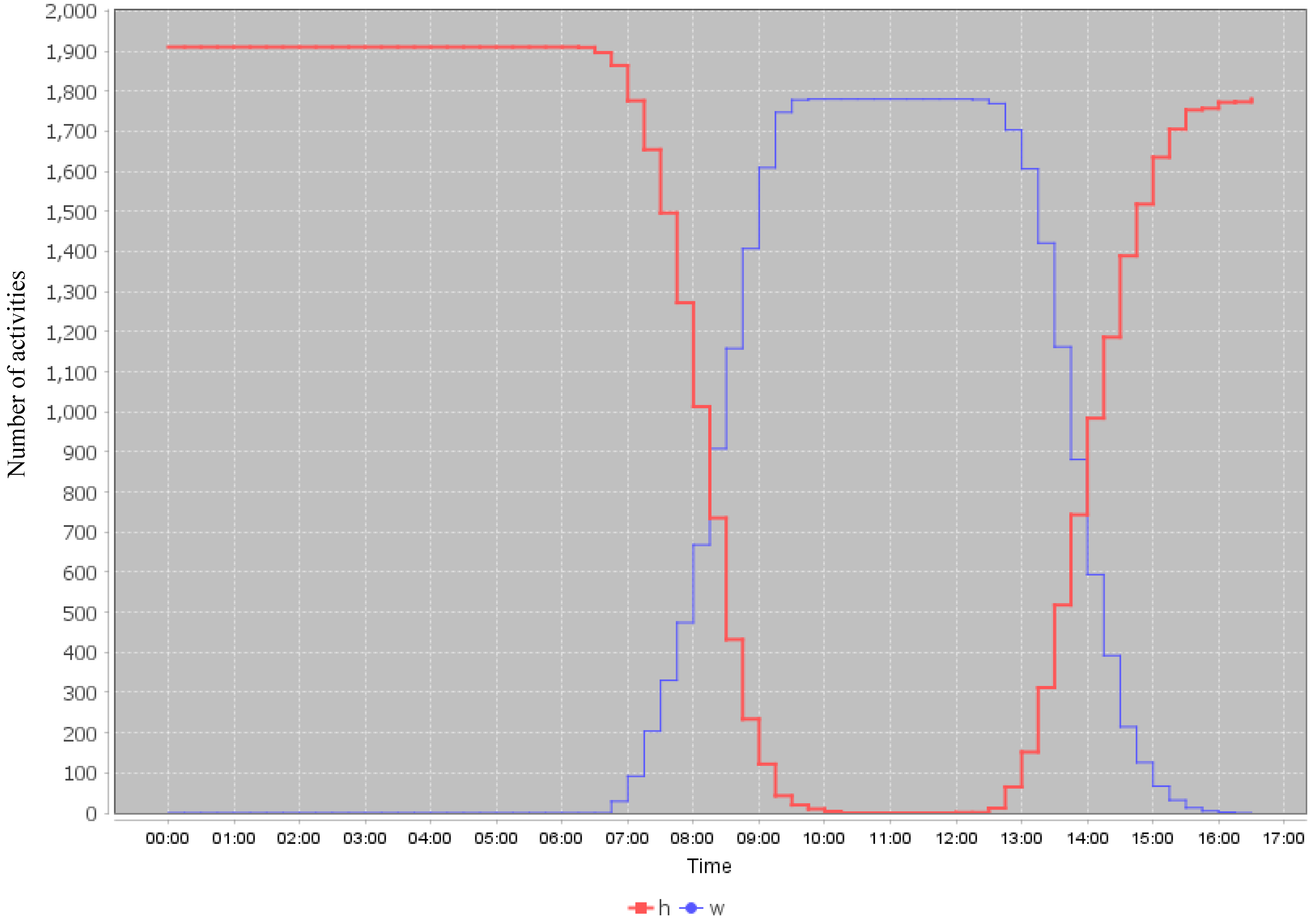
3.2.3. Activity Duration and Constraints
4. Simulation Run and Result Analysis
5. Conclusions and Future Work
Author Contributions
Funding
Institutional Review Board Statement
Informed Consent Statement
Data Availability Statement
Acknowledgments
Conflicts of Interest
References
- Barceló, J.; Casas, J. Dynamic network simulation with AIMSUN. In Simulation Approaches in Transportation Analysis: Recent Advances and Challenges; Springer: Boston, MA, USA, 2005; pp. 57–98. [Google Scholar]
- Shaaban, K.; Kim, I. Comparison of SimTraffic and VISSIM microscopic traffic simulation tools in modeling roundabouts. Procedia Comput. Sci. 2015, 52, 43–50. [Google Scholar] [CrossRef] [Scilit]
- Omar, D.H.; Hussein, S.K. Optimization of Delay at Isolated Signalized Intersection Using HCS 2010 and SIDRA Intersection 8 Software: A Case Study. Int. Rev. Civ. Eng. (IRECE) 2022, 13, 429. [Google Scholar] [CrossRef] [Scilit]
- Williams, B.M.; Khattak, A.J.; Jia, A.; Huynh, N.; Hu, H.; Liu, C.; Rouphail, N.M. Assessing Operational, Pricing, and Intelligent Transportation System Strategies for the I-40 Corridor Using DYNASMART-P (No. FHWA/NC/2009-05). 2011. Available online: https://connect.ncdot.gov/projects/research/pages/ProjDetails.aspx?ProjectID=2009-05 (accessed on 12 January 2024).
- Ozbay, K.; Bartin, B. Estimation of economic impact of VMS route guidance using microsimulation. Res. Transp. Econ. 2004, 8, 215–241. [Google Scholar] [CrossRef] [Scilit]
- Nguyen, J. Modelling Individuals for Simulating Contemporary Mobility Scenarios. Doctoral Dissertation, Edinburgh Napier University, Edinburgh, UK, 2024. [Google Scholar]
- Song, Z.; Wang, H.; Sun, J.; Tian, Y. Experimental findings with VISSIM and TransModeler for evaluating environmental and safety impacts using micro-simulations. Transp. Res. Rec. 2020, 2674, 566–580. [Google Scholar] [CrossRef] [Scilit]
- Owen, L.E.; Zhang, Y.; Rao, L.; McHale, G. Traffic flow simulation using CORSIM. In Proceedings of the 2000 Winter Simulation Conference Proceedings, Orlando, FL, USA, 10–13 December 2000; Cat. No. 00CH37165. IEEE: Piscataway, NJ, USA, 2000; Volume 2, pp. 1143–1147. [Google Scholar]
- Waraich, R.A.; Charypar, D.; Balmer, M.; Axhausen, K.W. Performance improvements for large-scale traffic simulation in MATSim. In Computational Approaches for Urban Environments; Springer: Cham, Switzerland, 2015; pp. 211–233. [Google Scholar]
- Bloomberg, L.; Dale, J. Comparison of VISSIM and CORSIM traffic simulation models on a congested network. Transp. Res. Rec. 2000, 1727, 52–60. [Google Scholar] [CrossRef] [Scilit]
- Balmer, M.; Axhausen, K.W.; Nagel, K. Agent-Based Demand-Modeling Framework for Large-Scale Microsimulations. Transp. Res. Rec. 2006, 1985, 125–134. [Google Scholar] [CrossRef]
- Horni, A.; Nagel, K.; Axhausen, K.W. Introducing matsim. In The Multi-Agent Transport Simulation MATSim; Ubiquity Press: London, UK, 2016; pp. 3–7. [Google Scholar]
- Ziemke, D.; Kaddoura, I.; Nagel, K. The MATSim Open Berlin Scenario: A multimodal agent-based transport simulation scenario based on synthetic demand modeling and open data. Procedia Comput. Sci. 2019, 151, 870–877. [Google Scholar] [CrossRef] [Scilit]
- Simoni, M.D.; Pel, A.J.; Waraich, R.A.; Hoogendoorn, S.P. Marginal cost congestion pricing based on the network fundamental diagram. Transp. Res. Part C Emerg. Technol. 2015, 56, 221–238. [Google Scholar] [CrossRef] [Scilit]
- Ilahi, A.; Balać, M.; Axhausen, K.W. Existing urban transportation in Greater Jakarta: Results of agent-based modelling. Arbeitsberichte Verk.-Und Raumplan. 2019, 1478, 1–22. [Google Scholar]
- Neumann, A.; Röder, D.; Joubert, J.W. Toward a simulation of minibuses in South Africa. J. Transp. Land Use 2015, 8, 137–154. [Google Scholar] [CrossRef] [Scilit]
- Wevell, D. Implementing Matsim Transit Simulation in a South African Context. Doctoral Dissertation, Department of Industrial Engineering, University of Pretoria, Pretoria, South Africa, 2011. [Google Scholar]
- Manser, P.; Becker, H.; Hörl, S.; Axhausen, K.W. Designing a large-scale public transport network using agent-based microsimulation. Transp. Res. Part A Policy Pract. 2020, 137, 1–15. [Google Scholar] [CrossRef] [Scilit]
- Joubert, J.W.; Vosloo, J.B. Development of a map-matching algorithm for dynamic-sampling-rate GPS signals to determine vehicle routes on a MATSim network. ORiON 2019, 35, 1–31. [Google Scholar]
- Klopp, J.M.; Cavoli, C. Mapping minibuses in Maputo and Nairobi: Engaging paratransit in transportation planning in African cities. Transp. Rev. 2019, 39, 657–676. [Google Scholar] [CrossRef] [Scilit]
- Muhammad, A.; De Risi, R.; De Luca, F.; Mori, N.; Yasuda, T.; Goda, K. Manual of Agent-Based Tsunami Evacuation Modelling Using MATSim. 2022. Available online: https://data.bris.ac.uk/datasets/333uc5aebpzfz25mhmd83yt3yk/Manual_Agent_Based%20MATSim.pdf (accessed on 12 January 2024).
- Ma, F.; Lee, J.Y. Analyzing wildfire evacuation dynamics with agent-based modeling in damaged road networks. Saf. Sci. 2025, 187, 106835. [Google Scholar] [CrossRef] [Scilit]
- Ishibashi, Y.; Akiyama, E. Predicting the impact of shared autonomous vehicles on Tokyo transportation using MATSim. In Proceedings of the 2022 IEEE International Conference on Big Data (Big Data), Osaka, Japan, 17–20 December 2022; IEEE: Piscataway, NJ, USA, 2022; pp. 3258–3265. [Google Scholar]



| Simulation Tool | Model Type | Tool Applications | Features | Example Scenario References |
|---|---|---|---|---|
| Aimsun | Microscopic, Mesoscopic, Macroscopic | Urban, Highway, Public Transit | Multi-layered simulation, AI-driven routing, traffic demand modeling | [1] |
| VISSIM | Microscopic | Urban Traffic, Public Transport | Signal control integration, high-precision driver behavior | [1] |
| SUMO | Microscopic, Mesoscopic | Urban Traffic, Highway Networks | Open-source, API integration, high scalability | [6] |
| PARAMICS | Microscopic | Urban Networks, Events | 3D visualization, real-time analysis, adaptive control | [5] |
| CORSIM | Microscopic, Macroscopic | Roadway, Freeway, Signal Operations | Focus on signal control, ramp metering, and intersection modeling | [8] |
| MATSim | Agent-based, Microscopic | Urban Mobility, Traffic Demand | Activity-based modeling, large-scale, multimodal | [9] |
| TransModeler | Microscopic, Mesoscopic, Macroscopic | Urban, Regional Transport | GIS integration, dynamic assignment, 3D visualization | [7] |
| DynaSmart-P | Mesoscopic | Corridor, Regional Traffic | Real-time traffic information, user- equilibrium modeling | [4] |
| SimTraffic | Microscopic, Mesoscopic | Intersection, Roadway Segments | Animation-focused, integrates with traffic analysis software | [2] |
| HCS+ (Highway Capacity Software) | Macroscopic | Highways, Freeways | Analytical modeling based on HCM, queue length estimation | [3] |
| VisSim | Systems Engineering, Control Systems | Vehicle Control Systems | Visual programming for control design, behavioral modeling | [10] |
| Type of Road | Capacity Veh/h | Free Speed m/s | Mode After Change |
|---|---|---|---|
| trunk | 2000 | 22.222 | Car, pt |
| primary | 1500 | 22.222 | Car, pt |
| secondary | 1000 | 16.667 | Car, pt |
| residential | 600 | 8.333 | Car, pt |
| tertiary | 600 | 12.5 | Car, pt |
| Socio-Demographic Variables | % |
|---|---|
| Age | |
| <18 | 9 |
| 18–40 | 27 |
| 40–60 | 59 |
| ≥60 | 5 |
| Gender | |
| Male | 69 |
| Female | 31 |
| Means of transport used | |
| car | 30 |
| pt | 70 |
| Is it possible to use public transportation (and temporarily give up your car) if the public transportation network is conveniently planned? | |
| Yes | 21 |
| No | 79 |
| Occupation | |
| Student | 21 |
| Office employee | 46 |
| Free actions | 28 |
| Other | 5 |
| Activity start timing | |
| 7.00 to 9.30 a.m. | 100 |
| Activity end timing | |
| 1.00 to 4.00 p.m. | 100 |
| Time taken to get to the bus stop to and from home or work | |
| 5 to 30 min | 100 |
| Do you find the following factors a reason not to use public transport to move around the city? | |
| Take a long time | 38 |
| Do not reply regularly | 22 |
| Very crowded | 20 |
| Uncomfortable public transport vehicles | 18 |
| Financially expensive | 2 |
| Repeat the journey | |
| Daily | 95 |
| Randomly | 5 |
| Using more than one means of transportation to reach the desired location | |
| Yes, I prefer | 9 |
| No, I do not prefer | 91 |
| Origin | Destination | |||||||
|---|---|---|---|---|---|---|---|---|
| Al Mawkaf | Railway Station | Al Eshara | Al Sail | Al Hakroub | Al Tamen | El Nafk | Al Mahmodia | |
| Al Mawkaf | — | 377 | 406 | 60 | ||||
| Railway Station | 550 | — | 1240 | 2254 | 510 | |||
| Al Eshara | — | 495 | ||||||
| Al Sail | 550 | 265 | 599 | — | ||||
| Al Hakroub | 48 | — | ||||||
| Al Tamen | 112 | 290 | 600 | 42 | — | 320 | ||
| El Nafk | 1059 | 404 | — | 495 | ||||
| Al Mahmodia | 421 | 20 | — | |||||
| Trip Activity | Duration | Start Time | End Time |
|---|---|---|---|
| Home | 12 h | always open | always open |
| Work | 9 h | 7:00 a.m. | 6 p.m. |
Disclaimer/Publisher’s Note: The statements, opinions and data contained in all publications are solely those of the individual author(s) and contributor(s) and not of MDPI and/or the editor(s). MDPI and/or the editor(s) disclaim responsibility for any injury to people or property resulting from any ideas, methods, instructions or products referred to in the content. |
© 2026 by the authors. Licensee MDPI, Basel, Switzerland. This article is an open access article distributed under the terms and conditions of the Creative Commons Attribution (CC BY) license.
Share and Cite
Hemdan, S.; Khames, M.; Alsultan, A.; Othman, A. Simulating Road Networks for Medium-Size Cities: Aswan City Case Study. Eng. Proc. 2026, 121, 22. https://doi.org/10.3390/engproc2025121022
Hemdan S, Khames M, Alsultan A, Othman A. Simulating Road Networks for Medium-Size Cities: Aswan City Case Study. Engineering Proceedings. 2026; 121(1):22. https://doi.org/10.3390/engproc2025121022
Chicago/Turabian StyleHemdan, Seham, Mahmoud Khames, Abdulmajeed Alsultan, and Ayman Othman. 2026. "Simulating Road Networks for Medium-Size Cities: Aswan City Case Study" Engineering Proceedings 121, no. 1: 22. https://doi.org/10.3390/engproc2025121022
APA StyleHemdan, S., Khames, M., Alsultan, A., & Othman, A. (2026). Simulating Road Networks for Medium-Size Cities: Aswan City Case Study. Engineering Proceedings, 121(1), 22. https://doi.org/10.3390/engproc2025121022