
Proceeding Paper

Experimental Study of Flow Around Stepped NACA 0015 Airfoils at Low Reynolds Numbers †
1
Laboratoire d’Ingénierie des Fluides et des Systèmes, Arts et Métiers Institute of Technology, 151 bd de l’Hôpital, 75013 Paris, France
2
National Centre of Excellence “Mechatronics and Clean Technologies”, Technical University of Sofia, 1000 Sofia, Bulgaria
*
Author to whom correspondence should be addressed.
Presented at the 17th International Scientific Conference on Aerospace, Automotive, and Railway Engineering (BulTrans-2025), Sozopol, Bulgaria, 10–13 September 2025.
Eng. Proc. 2026, 121(1), 18; https://doi.org/10.3390/engproc2025121018
Published: 15 January 2026

Abstract

This study investigates the flow around Kline-Fogleman (KF) airfoils using Particle Image Velocimetry (PIV) in a wind tunnel at Reynolds number Re = 6.8 × 10⁴. Three configurations are tested: a clean NACA 0015 airfoil and two modified versions with a step on either the pressure or suction side. Velocity fields are used to calculate lift via the Kutta-Joukowski theorem. Results show that the KF airfoil with a step on the pressure side achieves a 14.8% higher maximum lift coefficient and delayed stall. In contrast, placing the step on the suction side reduces maximum lift by 4%. The KF airfoil with pressure-side step shows potential for low Reynolds number applications where higher lift and larger stall angles are required.

1. Introduction

The rapid growth of drone use in both civilian and military sectors is driven by technological advancements and the expanding applications of these devices. Small and ultra-small drones, especially quadcopters with VTOL capabilities, offer excellent maneuverability, while fixed-wing drones provide longer flight endurance and higher altitudes, making them suitable for extended missions. The performance of fixed-wing UAVs depends crucially on wing design, particularly the airfoil, where the lift-to-drag ratio (L/D) is crucial for achieving aerodynamic efficiency. Stall resistance and stable low-speed behavior are also critical under varying atmospheric conditions.
Interest in low-Reynolds airfoils began in the 1970s, resulting in numerous airfoil shapes optimized for the specific flow conditions at particular Reynolds numbers. Small drones, which operate at low Reynolds numbers, now benefit from this research. According to [1], these range are situated between Re ≈ 2 × 10⁵ and 5 × 10⁵. Carmichael [2] identifies five aerodynamic zones within the range of Re ≈ 1 × 10³–5 × 10⁵, with the lowest zones (up to Re ≈ 2 × 10⁵) being the most complex aerodynamically. Winslow [3] highlights the uncertainties in low-Re experimental data, noting that minor changes can significantly impact performance.
This study examines the unconventional Kline-Fogleman (KF) airfoil, which has shown contradictory aerodynamic results. Originating from a paper airplane concept [4], the KF airfoil has a wedge-like leading edge, a flat or slightly curved suction side, and a step on the pressure side. Tests showed high lift and stall resistance, although the mechanism is not fully understood. KF airfoils have gained interest from both model aircraft enthusiasts and researchers.
DeLaurier [5] compared KF with flat plate, NACA 0012, and cambered airfoils. Wind tunnel tests at Re ≈ 2.3 × 10⁴ showed that reducing step depth improved the lift and L/D ratio, but performance remained below that of the flat plate. Lumsdaine [6] studied KF variations at low Reynolds numbers, finding similar lift but lower L/D ratios compared to flat-plate and wedge airfoils. Inverted steps (on the suction side) improved performance at high angles of attack but did not improve overall performance.
Fertis [7] first introduced a modern KF modification with a suction-side step on a NACA 23012, which improved stall behavior, lift, and L/D by controlling flow separation. Finaish’s [8] studies at Re ≈ 5 × 10⁵ found that a pressure-side step extending 50% from mid-chord enhanced lift and L/D, although no single design was optimal. Cox [9] tested stepped RG-15 airfoils (Re ≈ 2.8 × 10⁴–1 × 10⁵) and observed lower lift and higher drag, with no stall improvement.
Kamyab Matin [10] used PIV at Re ≈ 2 × 10³, observing that steps for NACA 0024 increased the separation area and vorticity, which could enhance lift. Öztürk [11] tested various stepped configurations at Re ≈ 2 × 10⁴ and found that the standard NACA 0018 had the best L/D, while the stepped versions underperformed, though some showed potential for further optimization. Seyhan [12] concluded that partial steps on a NACA 0012 airfoil improved lift and L/D more than full steps or the unmodified airfoil.
Due to space constraints, this review excludes solely numerical studies on KF airfoils. Modeling flows at low Reynolds numbers (Re ≈ 1 × 10⁴–2.5 × 10⁴) remains difficult because of laminar separation bubbles, turbulent transition, and boundary layer phenomena. These require experimentally validated simulation methods, as conventional RANS techniques have limited accuracy for stepped airfoils [13].
This study aims to quantify the flow structure around stepped airfoils using PIV and compare their lift performance. The hypothesis is that the step location affects stall behavior through different flow control mechanisms. Three configurations are examined: a standard NACA 0015 airfoil, a stepped version with a 50% chord-length modification on the suction side, and another with a similar step on the pressure side. Velocity fields are used to calculate lift via the Kutta-Joukowski theorem. The data obtained enable comparisons of lift coefficients, stall angles, and maximum lift performance among the three airfoil configurations.

2. Test Bench and the Wind Tunnel

2.1. Wind Tunnel and Measurement Equipment

Aerodynamic measurements were performed in the wind tunnel facility at ENSAM-Paris, optimized for both force balance and PIV measurements [14]. This facility is a Prandtl-type, closed-return wind tunnel with a semi-open test section. Both lateral sides of the test section are open, allowing direct optical access for cameras without compromising image quality, which is crucial for PIV. The test section dimensions are 1.35 m (height) × 1.65 m (width) × 2.0 m (length). The area ratio between the settling chamber and the test section is approximately 12.5, resulting in a turbulence intensity of less than 0.25%.
The wind tunnel is driven by a 3-m-diameter fan powered by a 120 kW asynchronous motor. A frequency converter allows speed control in the test section between 1.5 m/s and 40 m/s. Velocity in the test section is determined from the pressure difference between the settling chamber and the nearly atmospheric test section, measured using a precision manometer FCO510 (Furness Controls Ltd., Bexhill-on-Sea, UK) with an accuracy of ±0.25% over the 10–100% full-scale range. For aerodynamic force measurements, the tunnel is equipped with a six-component balance connected to an MGCPlus data-acquisition system (HBM GmbH, Darmstadt, Germany). However, the small size of 3D-printed models reduces the accuracy of the force balance, especially at small angles of attack. Therefore, the aerodynamic characteristics of the airfoils are determined indirectly via velocity fields obtained from PIV.
The PIV system, operated using DynamicStudio 6.11 (Dantec Dynamics A/S, Skovlunde, Denmark), includes a FlowSense II 4MP (2048 × 2048) camera with a Makro-Planar T 100 mm lens (Carl Zeiss AG, Oberkochen, Germany) and a Nano-L 200-15, double-pulse Nd:YAG laser, (200 mJ; Litron Lasers Ltd., Rugby, UK). The laser sheet has a divergence angle of 30° and a thickness of 3 mm. Olive oil seeding particles are generated using a mist generator.

2.2. Wing Model

Two wing models were tested, each with a span L = 300 mm and chord c = 100 mm, yielding an aspect ratio AR = 3. This ratio is sufficient to capture the three-dimensional effects associated with flow separation over the airfoil’s upper surface [15]. The wings were fabricated using FDM 3D printing, with a surface roughness of Ra = 16 µm. The deposition direction of the printed layers follows the chordwise direction. The use of 3D-printed models enables cost-effective and rapid prototyping, with minimal impact on the accuracy of aerodynamic measurements [16].
To minimize induced drag caused by wingtip vortices, transparent plexiglass endplates (circular disks) were attached to both wing tips. Each disk has a diameter of D = 300 mm and a thickness of t = 1.5 mm, with its center positioned at one-third of the chord from the leading edge. Given the ratio of chord to disk diameter, the influence of tip vortices on the aerodynamic forces is considered negligible [15,17]. Boundary layer development on the endplates is minimal, as velocity measurements are taken near the mid-span.
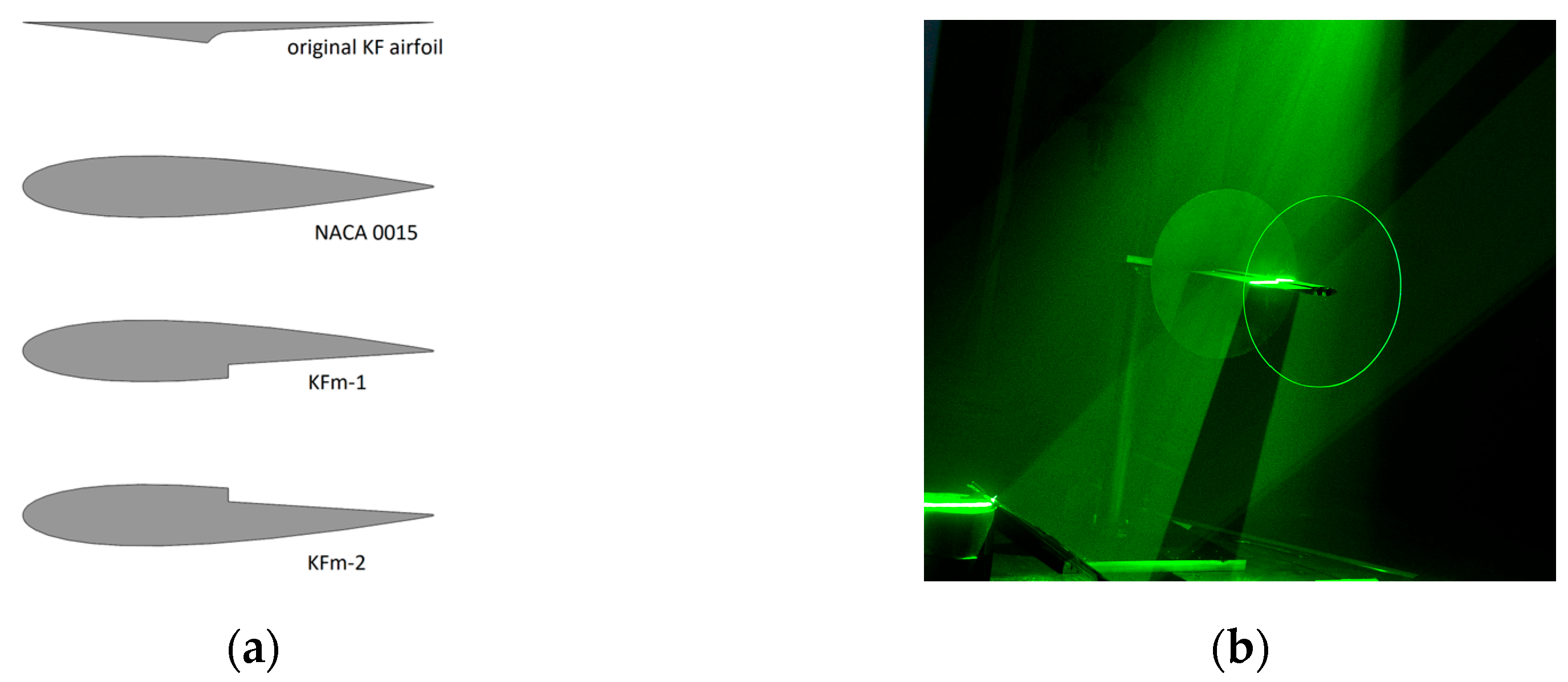
The baseline airfoil selected for this study was the symmetric NACA 0015, a widely used and well-documented airfoil in experimental aerodynamics. A modified airfoil, denoted KFm-1, was derived from the NACA 0015 by introducing a step on the pressure side at 50% of the chord length from the leading edge. The step had a depth of 3.3% of the chord (3.3 mm). From this step to the rounded trailing edge, the original curved airfoil was replaced with a straight line. This modification was based on prior studies of Kline-Fogleman (KF) airfoils, which suggest that such a step may yield improved aerodynamic performance. Because the airfoil is symmetric, a separate KFm-2 model was not required; measurements at negative angles of KFm-1 correspond directly to positive angles for KFm-2. The original KF airfoil and the three tested airfoils are shown in Figure 1a. The wing was mounted 0.6 m above the floor of the test section and 0.4 m downstream from the test-section entrance. The laser system was installed on the ceiling of the test section to illuminate the upper surface of the airfoil directly, while a floor-mounted mirror reflected the laser sheet to illuminate the lower surface, as shown in Figure 1b.

3. Methods for Calculating Lift Forces Based on the Velocity Field

3.1. Review of Control Volume Method and Method Based on Kutta-Joukowski Theorem

PIV has become indispensable in experimental aerodynamics, providing non-intrusive exploration of flow fields and enabling the estimation of aerodynamic forces. Several methods have been developed to determine lift from velocity field data, all based on classical fluid dynamics and adapted to the spatial and temporal constraints of PIV measurements. These methods are very effective at low Reynolds numbers, where aerodynamic forces are relatively small and the use of multi-component force balances is limited.
One effective method is the control volume approach introduced by [18]. The authors estimate instantaneous aerodynamic forces by integrating momentum and vorticity fluxes over a closed contour enclosing the body. This formulation eliminates the need for direct pressure measurements by reformulating the momentum equations, making it appealing for PIV-based investigations. However, the method requires accurate determination of velocity gradients and time derivatives, which can present challenges, especially in time-resolved experiments.
Van Oudheusden et al. [19] extended this method to experimental conditions. They applied it to PIV measurements around an airfoil in a wind tunnel. Their approach combines the control-volume formulation with pressure-field reconstruction derived from the momentum equations, enabling the evaluation of both steady and unsteady aerodynamic loads. Comparison with pressure-based methods showed strong agreement.
An alternative and widely used approach involves applying the Kutta-Joukowski theorem to velocity fields derived from PIV. One of the earliest examples of this method was presented by [20], who estimated circulation around a wind-turbine blade and inferred the local angle of attack using velocity fields measured near the rotating airfoil.
Lee [21] also estimated lift coefficients of a NACA 0012 airfoil and a flat plate at low Reynolds numbers using PIV velocity fields and the Kutta-Joukowski theorem. Their results showed good agreement with pressure-based lift measurements under pre-stall conditions. However, in post-stall regimes with significant flow separation, the method’s sensitivity to the shape of the integration contour limited its reliability.
Goulven [22] investigated the aerodynamic forces on a highly curved plate using time-resolved PIV. Lift coefficients were derived from circulation estimates and validated against force balance measurements, demonstrating the robustness of the method even in flows with significant separation and vortex shedding.
More recently, Olasek [23] introduced an enhanced circulation-based method based on the Kutta-Joukowski theorem. Their approach integrates velocity vectors along a closed loop around the airfoil and also considers momentum fluxes within a surrounding control volume. A significant advancement of this work is the development of a procedure for selecting integration contours, ensuring that the estimated lift remains independent of contour size and placement.
In summary, these methodologies show that correct aerodynamic force estimation can be achieved using PIV velocity fields alone, without intrusive instrumentation. While each approach has inherent limitations related to spatial resolution, temporal accuracy, and contour selection, together they form a robust toolkit for studying unsteady aerodynamics in both fundamental and applied research contexts.

3.2. Method for Calculating Circulation from PIV Velocity Field

The method used to determine the lift force on the airfoil is based on the Kutta-Joukowski theorem. For a two-dimensional case and a wing of unit span, the lift force is given by:
L = ρ V Γ
where L (N/m) is the lift force per unit span, ρ (kg/m3) is the fluid density, V   (m/s) is the freestream velocity, and Γ (m2/s) is the circulation around the airfoil.
Alternatively, the lift force can be expressed using dynamic pressure, the lift coefficient C L , and chord length c (m):
L = 1 2 ρ V 2 C L c
Thus:
C L =     2 Γ / ( c V )
The circulation Γ is computed by integrating the tangential velocity along a closed contour:
Γ = V · d s
It should be noted that PIV data is obtained in the form of rectangular matrices, where each coordinate point corresponds to velocity components along the respective axes. The spatial resolution, defined by the step sizes Δx and Δy, is constant in both the x and y directions. Thus, each grid point indexed by i, j corresponds to the values:
i , j x i , j ,   y i , j ,   u i , j ,   v i , j
To simplify the calculation of circulation from the velocity field, a rectangular integration contour is used following the method described by Dobrev [24]. The circulation is calculated using the rectangle rule as follows:
Γ = Δ x j = j s j e u i s , j Δ y i = i s i e v i , j e Δ x j = j s j e u i e , j + Δ y i = i s i e v i , j s
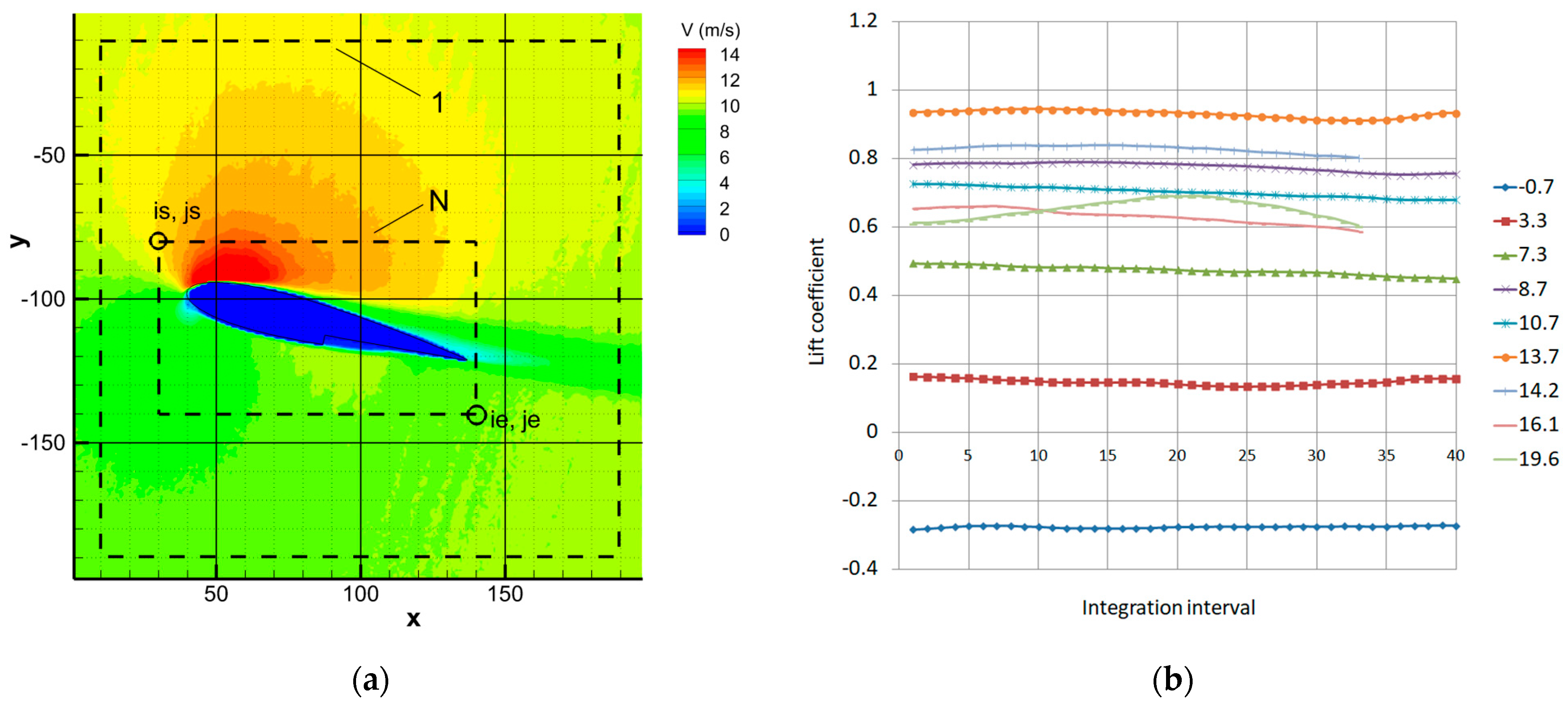
Here, the rectangular integration contour—indicated by a dashed line—is defined by the corner indices (is, js) and (ie, je).
To assess the influence of the integration contour size on the calculated circulation, the approach described by Olasek [23] is adopted. The innermost contour is selected as close to the airfoil surface as possible—without including velocity data corrupted by wall reflections or near-field optical distortions. The outermost contour is defined as broadly as feasible within the PIV field of view, considering the decreased reliability of velocity measurements near the image boundaries.
Figure 2a shows the time-averaged velocity field around the KFm-1 airfoil at its angle of maximum lift (13.7°). To obtain statistically converged values of mean lift force, a sufficiently large ensemble of instantaneous velocity snapshots is required. In this study, it was found that a sample size of 200 images ensures convergence within acceptable uncertainty margins.
The definition of the integration contour is crucial for accurately estimating lift. Figure 2b illustrates the sensitivity of the calculated lift to the integration boundary for the KFm-1 configuration. The computational domain, bounded upstream by the leading edge and downstream by the trailing edge, with vertical boundaries encompassing the suction and pressure sides, is discretized into 40 equally spaced contour levels. Here, the parameter N = 1 corresponds to the outermost contour, while N = 40 defines the contour closest to the airfoil surface.
The computed lift force varies depending on the proximity of the integration contour to the airfoil. This sensitivity is especially pronounced at angles of attack where flow separation occurs. Based on a systematic analysis across all three airfoil configurations, averaging the lift values from a sequence of contours with minimum dimensions of 1.6 times the chord length provides a reliable and consistent method to estimate the average aerodynamic force.

4. Results

Measurements were conducted at a freestream velocity of 10 m/s, corresponding to a Reynolds number of approximately 68,000. This Reynolds number is commonly studied and representative of applications such as micro-UAVs, mini-helicopters [25], and small wind turbines
The experiments involved three airfoil configurations: a standard NACA 0015, a KFm-1 variant with a step on the pressure side, and a KFm-2 variant with a step on the suction side. A separate velocity field measurement was conducted without an airfoil to verify the alignment of the camera and laser sheet with the freestream direction in the test section. The actual angle of attack was determined during post-processing, with an estimated uncertainty of ±0.25°. For each angle, 200 image pairs were acquired, which were found sufficient to provide statistical convergence in lift estimation. The field of view was approximately 200 mm × 200 mm (airfoil chord is 100 mm).
A major PIV challenge is laser reflections from the airfoil surface and non-uniform particle illumination across regions lit directly, indirectly, or both. To mitigate this, a background subtraction method proposed by Mendez [26] was implemented. This method assumes that temporally coherent background noise is concentrated in the first few POD modes, while particle signals are more broadly distributed. By removing only the dominant modes, it effectively suppresses the background while preserving the velocity information. The PIV images were pre-processed in MATLAB R2018b using this method. Post-processing was performed using Dantec DynamicStudio 6.11 with the Adaptive PIV algorithm. The interrogation started with 8 × 8 pixel windows and ended with 16 × 16 pixels, yielding velocity fields with 255 × 255 vectors and a spatial resolution of approximately 0.78 mm.
During adaptive correlation, a mask was applied over the region occupied by the airfoil, assigning zero velocity to this area. Due to photographic perspective, the airfoil (blue colour with zero velocity) in the image foreground appears slightly larger than the airfoil in the measurement plane.
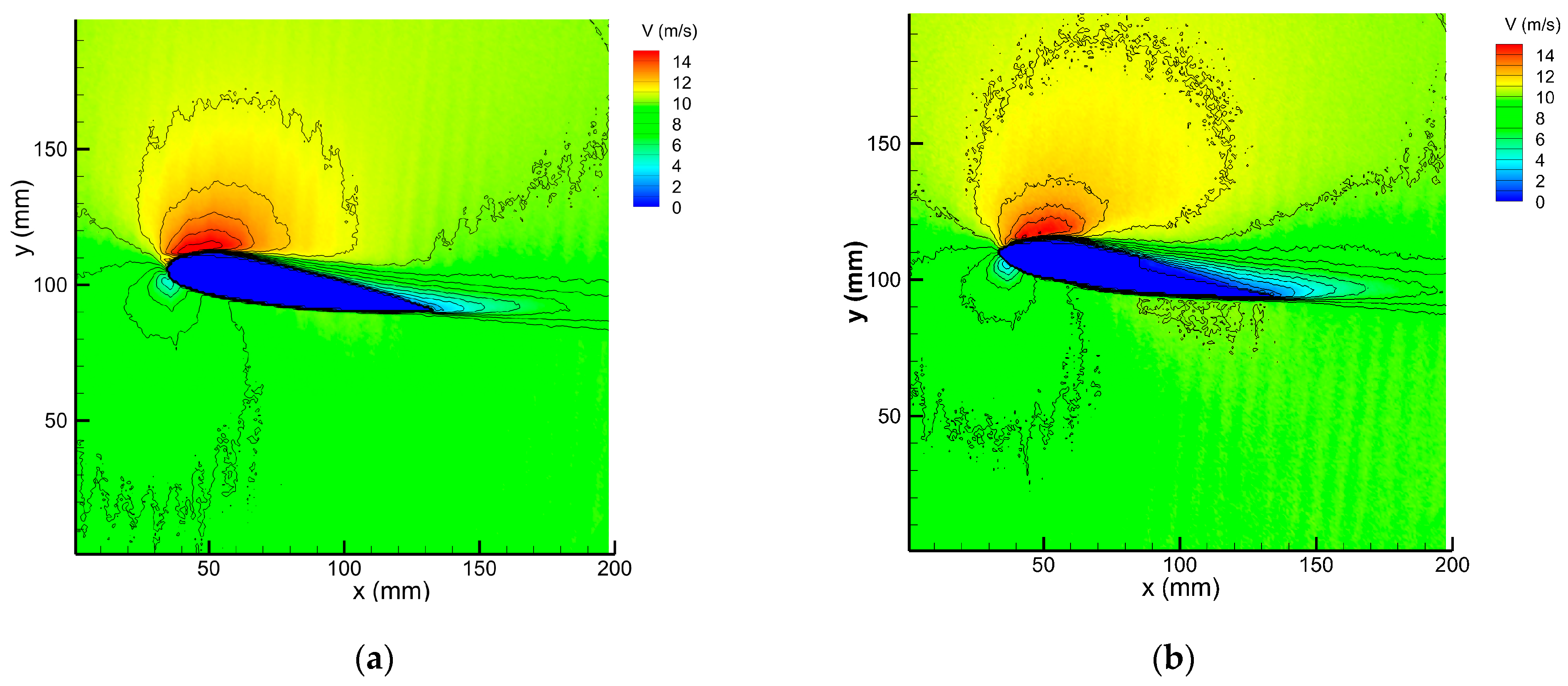
Figure 3a shows the time-averaged flow field around the NACA 0015 airfoil at its angle of maximum lift (10.9°, CL = 0.81), while Figure 3b presents the corresponding flow field for the KFm-2 airfoil at 8.5°, where it also reaches its maximum lift (CL = 0.78).
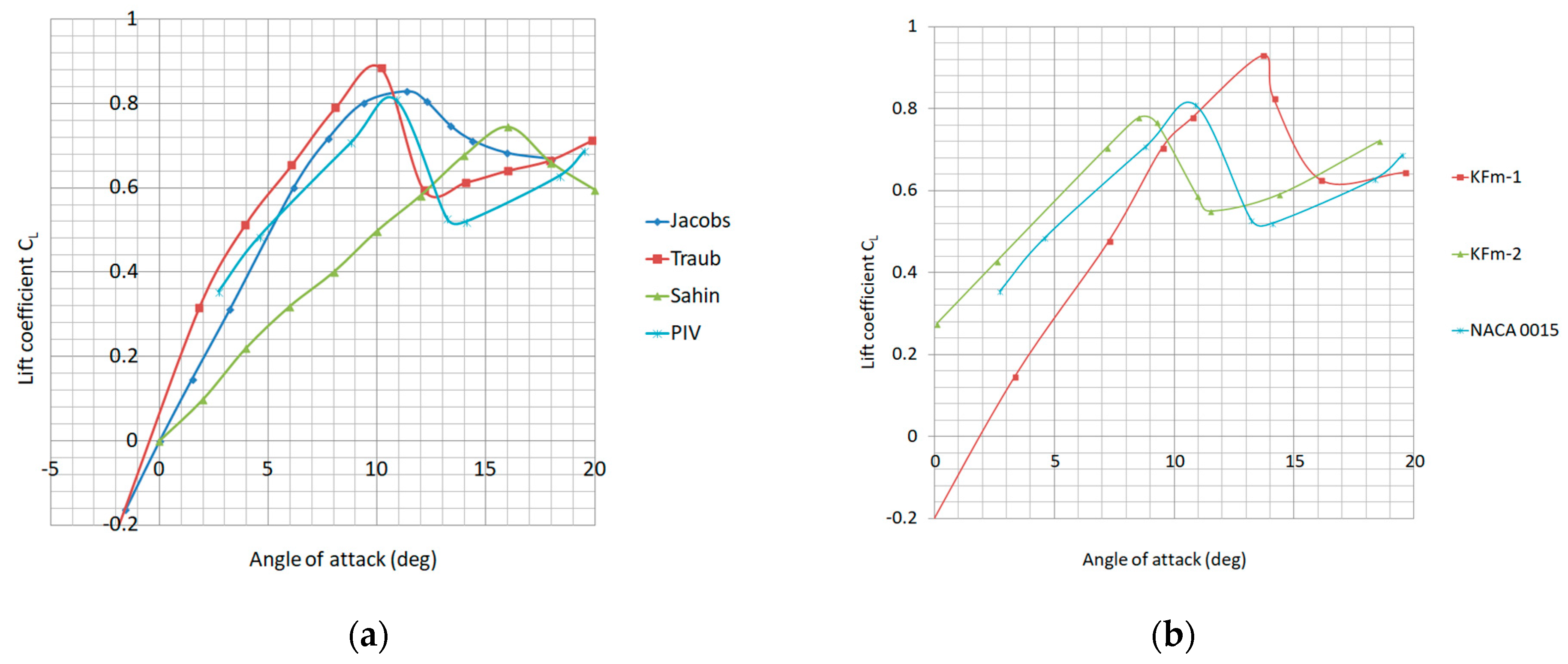
The aerodynamic characteristics obtained for the reference airfoil NACA 0015—specifically, the variation of the lift coefficient with angle of attack—were compared with previously published experimental data acquired at similar Reynolds numbers: Jacobs [27] at Re = 80 × 103, Traub [28] at Re = 60 × 103, and Sahin [29] at Re = 68.5 × 10³, Figure 4a.
As previously mentioned, discrepancies can be observed in low-Reynolds-number experiments on the same airfoil, even under similar test conditions [3]. These discrepancies are mainly due to variations in turbulence levels, surface roughness, and test section configuration. Additional influencing parameters include the degree to which the flow is made two-dimensional, such as the use of endplates to minimize tip vortex effects. When the flow separates from the airfoil, the discrepancies become more pronounced. This is primarily due to strong three-dimensional effects, such as the so-called stall cells [28].
In the case of Sahin’s study [29], a significant deviation is observed: the lift curve exhibits a much lower slope compared to the others. This behavior can be explained by the extremely small endplates used in that setup, which were insufficient to suppress tip vortex formation. The induced velocities generated by these vortices reduce the effective angle of attack, meaning that for a given geometric angle, the actual angle of attack experienced by the airfoil is considerably lower.
Figure 4b presents the calculated lift curves for all three airfoils. The tested angles of attack were: KFm-1 (−1, −0.73, 3.3, 7.3, 9.5, 10.8, 13.7, 14.2, 16.1, 19.6), KFm-2 (−2, 0.1, 2.6, 7.2, 8.5, 9.2, 11.0, 11.5, 14.4, 18.5), and NACA 0015 (1.7, 4.2, 8.8, 10.1, 10.8, 12.6, 13.1, 16.0). At the tested Reynolds numbers, the airfoils showed no lift hysteresis, with flow separation always initiating at the leading edge. The maximum lift angle was determined as the highest angle before flow separation, which was readily identified from raw flow visualization images. The corresponding maximum lift coefficients and stall angles are listed in Table 1.
Compared to the baseline airfoil NACA 0015, which has a lift coefficient of CL = 0.81 at an angle of attack of 10.9°, the airfoil with a step on the pressure side (KFm-1) exhibits a higher lift coefficient of CL = 0.93 at an angle of attack of 13.7°. At the same time, the airfoil with a step on the suction side (KFm-2) has a lower lift coefficient, CL = 0.78, at an angle of attack of 8.5°. At a Reynolds number of Re = 68 × 103, it should also be noted that at zero angle of attack, KFm-2 produces positive lift, while KFm-1 generates negative lift. The higher performance of KFm-1 is attributed to flow reattachment behind the pressure-side step, which energizes the boundary layer and delays stall. Conversely, KFm-2’s step disrupts suction-side flow, promoting earlier separation.
The question of accuracy in PIV measurements is frequently raised. Although various methodologies for error determination exist, achieving this in practice is often challenging. PIV measurements are complex and depend on numerous parameters, which is why a more pragmatic approach has been adopted in this work. In this case, the measurement of non-disturbed flow in the test section is used to determine the error. The velocity field measured by PIV is compared with that obtained from velocity measurement in the wind tunnel using Bernoulli’s equation. From this comparison, it can be concluded that the PIV velocity deviation does not exceed 1%.

5. Conclusions

A study was conducted on the lift force as a function of the angle of attack for the symmetric airfoil NACA 0015 and two modified Kline-Fogleman airfoils—KFm-1, with a step on the pressure side, and KFm-2, with a step on the suction side. For each airfoil, velocity fields were measured at six angles of attack between 0° and 18° using PIV. Based on the Kutta-Joukowski theorem, the lift force was calculated for each case, and the lift curves as a function of angle of attack were created.
The obtained lift characteristics of NACA 0015 were compared with existing experimental data at very similar Reynolds numbers. The agreement is good, with larger discrepancies observed as expected at higher angles of attack beyond the flow separation point. The comparison between the baseline and modified airfoils reveals that KFm-1 achieves higher lift than the baseline airfoil, and flow separation occurs at a higher angle of attack. In contrast, KFm-2 generates lower lift and exhibits earlier flow separation at a lower angle of attack. The study shows that pressure-side steps increase maximum lift by 15% and delay stall through controlled reattachment, whereas suction-side steps decrease lift by 4% due to flow separation. Future work should investigate the effects of Reynolds number and expand the measured flow field around the airfoils to determine the drag force as well.

Author Contributions

Conceptualization, I.D. and M.P.; methodology, I.D., M.P. and M.T.; software, I.D.; validation, I.D., M.P. and M.T.; formal analysis, F.M.; investigation, I.D. and M.P.; resources, I.D.; data curation, F.M.; writing—original draft preparation, I.D.; writing—review and editing, I.D. and M.P.; visualization, I.D.; supervision, M.P. and F.M.; project administration, M.P.; All authors have read and agreed to the published version of the manuscript.

Funding

This research was funded by European Regional Development Fund under “Research Innovation and Digitization for Smart Transformation” program 2021–2027 under the Project BG16RFPR002-1.014-0006 “National Centre of Excellence Mechatronics and Clean Technologies”.

Institutional Review Board Statement

Not applicable.

Informed Consent Statement

Not applicable.

Data Availability Statement

The data presented in this study are available on request from the corresponding author due to the size of the PIV dataset.

Conflicts of Interest

The authors declare no conflicts of interest.

References

  1. Selig, M. Low Reynolds Number Airfoil Design Lecture Notes. Available online: https://www.semanticscholar.org/paper/Low-Reynolds-Number-Airfoil-Design-Lecture-Notes-Selig/37cd6535639d5da933c5fdf293258f90bf50d7d5#citing-papers (accessed on 14 January 2026).
  2. Carmichael, B.H. Low Reynolds Number Airfoil Survey; No. NASA-CR-165803-VOL-1; National Aeronautics and Space Administration, Langley Research Center: Hampton, VA, USA, 1981. [Google Scholar]
  3. Winslow, J.; Otsuka, H.; Govindarajan, B.; Chopra, I. Basic Understanding of Airfoil Characteristics at Low Reynolds Numbers (104–105). J. Aircr. 2018, 55, 1050–1061. [Google Scholar] [CrossRef]
  4. Kline, R.L.; Fogleman, F.F. Airfoil for Aircraft; Google Patents. Available online: https://patents.google.com/patent/US3706430A/en (accessed on 14 January 2026).
  5. DeLaurier, J.; Harris, J. An Experimental Investigation of the Aerodynamic Characteristics of Stepped-Wedge Airfoils at Low Speeds. In Proceedings of the 2nd International Symposium on the Technology and Science of Low Speed and Motorless Flight, Cambridge, MA, USA, 11–13 September 1974; Massachusetts Institute of Technology: Cambridge, MA, USA, 1974; pp. 10–15. [Google Scholar]
  6. Lumsdaine, E.; Johnson, W.S.; Fletcher, L.M.; Peach, J.E. Investigation of the Kline-Fogleman Airfoil Section for Rotor Blade Applications; The University of Tennessee: Knoxville, TN, USA, 1974. [Google Scholar]
  7. Fertis, D.G. New Airfoil-Design Concept with Improved Aerodynamic Characteristics. J. Aerosp. Eng. 1994, 7, 328–339. [Google Scholar] [CrossRef]
  8. Finaish, F.; Witherspoon, S. Aerodynamic Performance of an Airfoil with Step-Induced Vortex for Lift Augmentation. J. Aerosp. Eng. 1998, 11, 9–16. [Google Scholar] [CrossRef]
  9. Cox, M.J.; Avakian, V.; Huynh, B.P. Performance of a Stepped Airfoil at Low Reynolds Numbers. In Proceedings of the 19th Australasian Fluid Mechanics Conference, Melbourne, Australia, 8–11 December 2014; RMIT University: Melbourne, Australia, 2014. [Google Scholar]
  10. Kamyab Matin, R.; Ghassemi, H.; Ebrahimi, A.; Ghasemi, B. Experimental Study of Flow Field on Stepped Airfoil at Very Low Reynolds Number. Proc. Inst. Mech. Eng. Part G J. Aerosp. Eng. 2017, 231, 1706–1717. [Google Scholar] [CrossRef]
  11. Öztürk, A.; Coban, M.; Koc, F. Experimental and Numerical Investigation of the Control of the Flow Structure on Surface Modified Airfoils. J. Appl. Fluid Mech. 2023, 16, 2381–2395. [Google Scholar] [CrossRef]
  12. Seyhan, M.; Akbıyık, H. An Experimental Investigation on the Flow Control of the Partially Stepped NACA0012 Airfoil at Low Reynolds Numbers. Ocean Eng. 2024, 306, 118068. [Google Scholar] [CrossRef]
  13. Elsayed, A.M.; Gaheen, O.A.; Elshimy, H.; Benini, E.; Aziz, M.A. Bio-Inspired Pressure Side Stepped NACA 23012 C as Wind Turbine Airfoils in Low Reynolds Number. Energy Rep. 2025, 13, 3728–3744. [Google Scholar] [CrossRef]
  14. Dobrev, I.; Massouh, F.; Danlos, A.; Todorov, M.; Punov, P. Experimental and Numerical Study of the Flow Field around a Small Car. MATEC Web Conf. 2017, 133, 02004. [Google Scholar] [CrossRef]
  15. Pelletier, A.; Mueller, T.J. Effect of Endplates on Two-Dimensional Airfoil Testing at Low Reynolds Number. J. Aircr. 2001, 38, 1056–1059. [Google Scholar] [CrossRef]
  16. Moioli, M.; Reinbold, C.; Sørensen, K.; Breitsamter, C. Investigation of Additively Manufactured Wind Tunnel Models with Integrated Pressure Taps for Vortex Flow Analysis. Aerospace 2019, 6, 113. [Google Scholar] [CrossRef]
  17. Boutilier, M.S.H.; Yarusevych, S. Effects of End Plates and Blockage on Low-Reynolds-Number Flows Over Airfoils. AIAA J. 2012, 50, 1547–1559. [Google Scholar] [CrossRef]
  18. Noca, F.; Shiels, D.; Jeon, D. A Comparison of Methods for Evaluating Time-Dependent Fluid Dynamic Forces on Bodies, Using Only Velocity Fields and Their Derivative. J. Fluids Struct. 1999, 13, 551–578. [Google Scholar] [CrossRef]
  19. van Oudheusden, B.W.; Scarano, F.; Casimiri, E.W.F. Non-Intrusive Load Characterization of an Airfoil Using PIV. Exp. Fluids 2006, 40, 988–992. [Google Scholar] [CrossRef]
  20. Smith, G.H.; Grant, I.; Liu, A.; Infield, D.; Eich, T. The Wind Tunnel Application of Particle Image Velocimetry to the Measurement of Flow over a Wind Turbine. Wind Eng. 1991, 15, 301–317. [Google Scholar]
  21. Lee, T.; Su, Y.Y. Low Reynolds Number Airfoil Aerodynamic Loads Determination via Line Integral of Velocity Obtained with Particle Image Velocimetry. Exp. Fluids 2012, 53, 1177–1190. [Google Scholar] [CrossRef]
  22. Goulven, T.; Bot, P.; Habert, B. Flow Field and Forces on a Highly Curved Plate. In Proceedings of the 13th International Symposium on Particle Image Velocimetry—ISPIV 2019, Munich, Germany, 22–24 July 2019; Universitat der Bundeswehr Munchen. pp. 1–9. [Google Scholar]
  23. Olasek, K.; Karczewski, M. Velocity Data-Based Determination of Airfoil Characteristics with Circulation and Fluid Momentum Change Methods, Including a Control Surface Size Independence Test. Exp. Fluids 2021, 62, 108. [Google Scholar] [CrossRef]
  24. Dobrev, I.; Massouh, F. Method for Extracting Airfoil Data of Rotating Blades. In Proceedings of the 3AF 46th Symposium of Applied Aerodynamics, Orléans, France, 28–30 March 2011; Association Aéronautique et Astronautique de France: Paris, France, 2011. [Google Scholar]
  25. Panayotov, F.; Dobrev, I.; Massouh, F.; Todorov, M. Experimental Study of a Helicopter Rotor Model in Hover. MATEC Web Conf. 2018, 234, 01002. [Google Scholar] [CrossRef][Green Version]
  26. Mendez, M.A.; Raiola, M.; Masullo, A.; Discetti, S.; Ianiro, A.; Theunissen, R.; Buchlin, J.-M. POD-Based Background Removal for Particle Image Velocimetry. Exp. Therm. Fluid Sci. 2017, 80, 181–192. [Google Scholar] [CrossRef]
  27. Jacobs, E.N.; Sherman, A. Airfoil Section Characteristics as Affected by Variations of the Reynolds Number. NACA Tech. Rep. 1937, 586, 227–267. [Google Scholar] [CrossRef]
  28. Traub, L.W.; Coffman, C. Efficient Low-Reynolds-Number Airfoils. J. Aircr. 2019, 56, 1987–2003. [Google Scholar] [CrossRef]
  29. Şahin, İ.; Acir, A. Numerical and Experimental Investigations of Lift and Drag Performances of NACA 0015 Wind Turbine Airfoil. Int. J. Mater. Mech. Manuf. 2015, 3, 22–25. [Google Scholar] [CrossRef]
Figure 1. (a) Original KF airfoil and three tested airfoils; (b) PIV measurement in the wind tunnel, flow from left to right.
Engproc 121 00018 g001
Figure 2. (a) Integration limits for KFm-1 airfoil at maximum lift for angle of attack of 13.7°; (b) Effect of the distance between the integration contour and the airfoil on the lift coefficient. Higher index contours are closer to the airfoil.
Engproc 121 00018 g002
Figure 3. (a) Average flow around NACA 0015 of maximum lift at an angle of 10.9°; (b) Average flow around KFm-2 airfoil of maximum lift at an angle of 8.5°.
Engproc 121 00018 g003
Figure 4. (a) Comparison of lift coefficient curves for the NACA 0015 airfoil; (b) Variation of lift coefficient with angle of attack for the tested airfoils: NACA 0015, KFm-1, and KFm-2.
Engproc 121 00018 g004
Table 1. The maximum lift coefficient and the angle of attack at which it is achieved.
AirfoilLift CoefficientAngle of Attack [°]
NACA 00150.8110.9
KFm-10.9313.7
KFm-20.788.5
Disclaimer/Publisher’s Note: The statements, opinions and data contained in all publications are solely those of the individual author(s) and contributor(s) and not of MDPI and/or the editor(s). MDPI and/or the editor(s) disclaim responsibility for any injury to people or property resulting from any ideas, methods, instructions or products referred to in the content.