1. Introduction
The shipping industry, a backbone of global trade and logistics, is simultaneously recognized as one of the most significant contributors to greenhouse gas emissions [
1]. It is estimated that international shipping accounts for approximately 2–3% of global CO
2 emissions annually, a figure projected to increase if no mitigation strategies are implemented [
2]. Consequently, the sector is under mounting pressure from regulatory bodies such as the International Maritime Organization to align with international climate targets, including those outlined in the Paris Agreement and the IMO’s Initial Strategy for GHG Reduction [
3,
4]. Decarbonization of shipping has emerged as a critical component of the broader global environmental agenda [
5]. The transition to carbon-neutral fuels represents a key pathway to achieving these goals, necessitating the development and deployment of alternative energy carriers capable of meeting the unique energy density, storage, and transport requirements of maritime operations [
6]. Among the various fuel candidates, ammonia has gained significant attention due to its zero-carbon combustion potential, compatibility with existing infrastructure, and its dual role as an energy carrier and a hydrogen derivative [
7].
Ammonia can be synthesized via various production routes, primarily categorized into “gray,” “blue,” and “green” pathways. Gray ammonia, currently the most prevalent form, is produced through steam methane reforming (SMR) of natural gas, which results in substantial CO
2 emissions [
8]. In contrast, green ammonia is produced using hydrogen generated by water electrolysis powered by renewable electricity and nitrogen extracted from the atmosphere through cryogenic separation or pressure swing adsorption. When powered by 100% renewable energy, green ammonia offers a fully carbon-neutral fuel alternative [
9]. Blue ammonia, an intermediate solution, relies on traditional production methods but incorporates carbon capture and storage (CCS) technologies to mitigate emissions. However, this study will focus only on green and gray ammonia production methods.
In considering ammonia as an alternative fuel source, the cost of production is a critical driving force for adoption. In a recent study by Tjahjono et al. [
10], a detailed techno-economic and environmental analysis of gray, blue, and green ammonia production in Indonesia was presented. The study examined the levelized cost of ammonia for each of the production methods and their environmental impact based on CO
2 emissions. Gray ammonia produced through the conventional Haber–Bosch process using natural gas had the lowest Levelized Cost of Ammonia (LCOA) at 297 USD/ton but emitted 2.73 tons of CO
2e, making it less sustainable in the long term. Its cost is highly sensitive to natural gas prices and carbon taxation. Meanwhile, blue ammonia, which is a combination of the conventional grey ammonia production process and CCUS technologies, had a moderate LCOA of 390 USD/ton. Blue ammonia cuts CO
2 emissions by 90% from grey ammonia, only emitting 0.28 tons of CO
2 per ton of ammonia. Yet, it still depends on natural gas. Finally, Green Ammonia produced using renewable energy sources was proven to be almost carbon-free but had the highest LCOA, ranging from 696 USD to 1024 USD/ton. The cost of producing green ammonia depended a lot on the cost of renewable energy and electrolyzers. Despite these higher costs, green ammonia is the most environmentally sustainable alternative. Similarly, Wang et al. [
11] presented an in-depth analysis of green ammonia production as a carrier of hydrogen to supply international energy markets, considering especially costs related to gases like ammonia and hydrogen. This resulted in the LCOA of green ammonia produced by renewable hydrogen through electrolysis at 756 AUD/ton in 2025 and 659 AUD/ton in 2030, assuming partial flexibility in the Haber–Bosch process. This partial flexibility reduces the demands on energy storage and/or oversized renewable energy capacities. Shipping ammonia is more economical, at about 0.030 AUD/ton-km, compared to hydrogen at 0.090 AUD/ton-km [
12]. Further, ammonia requires a carbon price of at least 123 AUD/ton to be cost-competitive with grey ammonia via steam methane reforming if the price of natural gas is about 6 AUD/MBtu. Without any carbon tax, green ammonia can compete with gray ammonia at natural gas prices of 13.56 AUD/ MBtu in Tennant Creek and 17.20 AUD/MBtu in Pilbara. Another factor is that the cost of storage is high, close to 600 AUD/kg for hydrogen tanks, while integration with hybrid wind–solar systems reduces dependence on battery energy storage and hydrogen tanks, which in turn lowers overall production costs.
Moreover, the HySupply Ammonia Analysis Tool, which is a Microsoft Excel-based model tool, was designed to simulate and estimate the cost associated with ammonia production via the Haber–Bosch process, powered by renewable energy sources like solar PV and wind, and using green hydrogen from electrolysis [
13]. The tool allows users to customize plant capacities and configurations, including renewable energy integration, electrolyzer efficiency, and power-balancing systems like batteries. The tool includes preloaded solar and wind data for Australia, but allows users to upload their own data for global applications. The model calculates the levelized cost of ammonia by estimating capital and operating expenses and enables project-specific cost assumptions, including economies of scale, engineering, procurement, and construction (EPC) costs. It also factors in variables such as efficiency degradation and hydrogen storage for maintaining system reliability. Unfortunately, the tool currently focuses on farm–gate ammonia production only.
Finally, a techno-economic assessment of green ammonia production with different wind and solar potentials was carried out by Campion et al. [
14], addressing the viability and cost of green ammonia production processes via renewable energy sources, namely wind and solar power. The research discusses the different electrolyzer technology alternatives for alkaline and solid oxide electrolysis, and assesses the impact of distinct electricity profiles and grid connections on ammonia production costs. The research finds that a semi-islanded setup, which combines renewable energy with grid power, reduces production costs by up to 23% compared to off-grid systems but also leads to greenhouse gas emissions similar to those of fossil fuels when using today’s electricity mix. The paper shows that using exclusively renewable electricity for green ammonia production can result in overestimated costs (up to 30%) if calculated based solely on the levelized cost of electricity (LCOE) and capacity factors. It highlights the importance of optimizing plant flexibility and using a mix of renewable energy sources to lower production costs. The study showed that off-grid green ammonia production costs can reach around 842 EUR/t, while gray ammonia costs range from 250 EUR/t to 1,500 EUR/t, depending on location and configuration. Optimal production mixes typically include photovoltaic systems with 1-axis tracking, and sometimes onshore wind turbines. Flexibility in plant operation also plays a key role in cost reduction. While using grid power can help lower costs, the carbon intensity of the grid electricity must be carefully considered.
Building upon this, comparative assessments were made between ammonia and other alternative fuels, including hydrogen, methanol, liquefied natural gas, and conventional marine diesel. Each fuel was evaluated based on multiple production methods, considering factors such as life-cycle emissions, production cost variability, energy density, and infrastructural compatibility. A key distinction was drawn between fuels derived from renewable energy and those dependent on fossil fuels, allowing for an integrated techno-economic and environmental comparison.
To support this analysis, a modeling framework was developed that estimates the cost trajectories, price volatility, and infrastructure requirements for ammonia up to 2050. The model incorporates technological learning rates, policy scenarios, investment risk parameters, and market dynamics such as supply chain development and feedstock availability. This long-term projection approach provides insights into potential investment risks and policy needs to facilitate ammonia’s adoption in the maritime sector.
This study aims to examine the economic outlook, feasibility, and market volatility of ammonia as a maritime fuel with particular emphasis on its deployment in inland waterways. Inland waterway shipping, though smaller in scale than ocean-going vessels, plays a critical role in regional logistics and is well-positioned to serve as a testbed for clean fuel integration due to shorter travel distances, fixed routes, and proximity to fueling infrastructure [
15].
2. Materials and Methods
The development of the ammonia fuel cost calculation tool represented the core of this research, aiming to evaluate the economic viability of ammonia as a marine fuel and to forecast its potential competitiveness across a range of future scenarios. The model was designed to simulate the full lifecycle of ammonia from production to storage and transport, particularly for deployment in inland waterway vessels. To build the tool, Microsoft Excel combined with Visual Basic for Applications was selected due to its broad accessibility, powerful data-handling capabilities, and the flexibility it offers for dynamic modeling, making the tool accessible to a wide range of stakeholders. Its native functions support large-scale data analysis, and the addition of VBA enhances its functionality by enabling the development of scenario-based models, user interactivity, and real-time calculations. This made Excel VBA especially suited for constructing a tool that is responsive to changes in variables such as electricity prices, carbon taxation rates, and production costs.
The central aim of the tool was to compare the long-term economic performance of ammonia with other competing marine fuels, including hydrogen, methanol, liquefied natural gas, and conventional diesel. To achieve this, the tool was structured to evaluate each fuel under two distinct production pathways: green and gray. Green production refers to processes powered entirely by renewable energy sources, such as the generation of hydrogen via electrolysis using solar or wind energy, followed by the synthesis of ammonia through the Haber–Bosch process with nitrogen captured from ambient air. This route aims to eliminate greenhouse gas emissions across the entire fuel lifecycle. In contrast, gray production relies on fossil fuels, such as steam methane reforming or natural gas, resulting in significant carbon dioxide emissions if no carbon capture and storage (CCS) systems are applied. The inclusion of both green and gray pathways allows for an integrated comparison of how fuel performance shifts across carbon-intensive and carbon-neutral futures, considering fluctuating market conditions and policy incentives.
2.1. Tool Overview
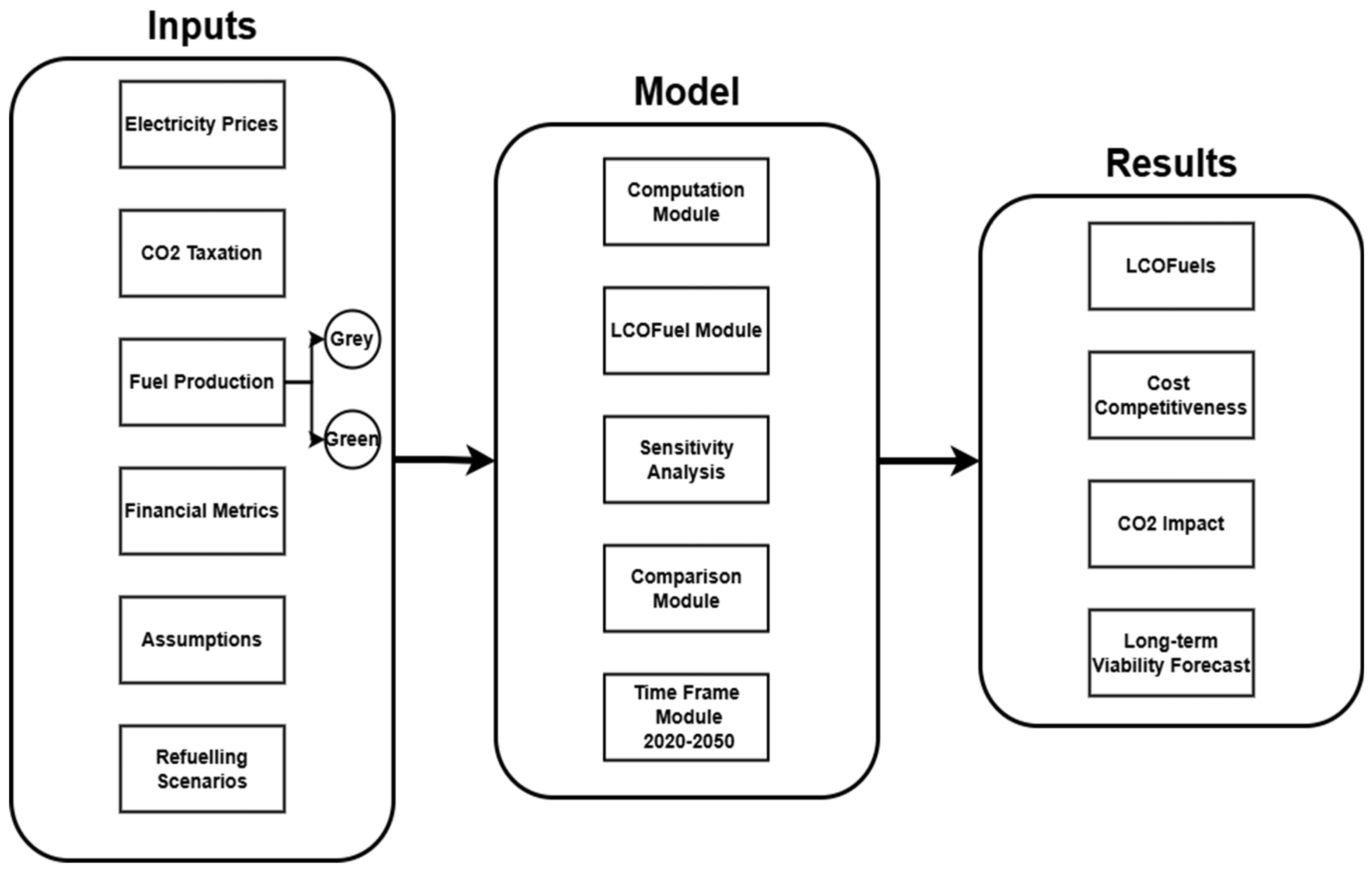
The simulation logic of the tool is structured around a modular framework that facilitates data input, calculation, and result visualization. As illustrated in
Figure 1, users can define variables such as electricity prices, natural gas prices, carbon tax rates, capital and operational expenditures, infrastructure investment requirements, and the energy intensity associated with each stage of the fuel’s lifecycle. These variables are continuously adjustable, allowing the model to simulate multiple scenarios and generate forecasts for fuel prices and market competitiveness up to the year 2050. The outputs are displayed through charts and summary tables, enabling a direct and intuitive comparison between the selected fuels. An overview diagram of the simulation tool architecture is provided in
Figure 1, demonstrating the pathway from user input to output generation and economic interpretation.
2.2. User Interface and Tool Functionality
The tool’s user interface was designed with clarity and functionality in mind. Input fields are clearly labeled, and scenario selection is guided through simple interface elements developed in VBA, allowing users to toggle between fuels, production types, and economic assumptions. Interactive buttons initiate simulations and update the model’s outputs without requiring users to understand the underlying code. This interface ensures that both technical and non-technical users can explore how different assumptions influence the economic outlook of marine fuels. The decision to use Excel VBA was particularly advantageous, as it provides transparency into the calculations and permits continuous model refinement. It bridges the gap between accessibility and complexity, enabling rapid prototyping while preserving a high degree of scientific rigor in dynamic and emerging fields such as maritime decarbonization.
2.3. Parameters for Techno-Economic Analysis
The techno-economic analysis employed data on energy consumption, CO
2 emission factors, and cost parameters associated with diverse production pathways. For green ammonia production, the Haber–Bosch process was modeled using hydrogen derived from electrolysis powered by renewable energy sources and nitrogen obtained via air separation processes. The total energy demand was assumed to be 49.40 GJ/t of NH
3, with 38.9 GJ allocated to hydrogen production and 0.40 MWh/t to nitrogen separation [
16,
17]. The CAPEX and OPEX for green ammonia synthesis facilities were estimated based on values provided by Lloyd’s Register and UMAS (2020) [
18].
Gray ammonia production through steam methane reforming (SMR) was modeled considering both direct CO
2 emissions and those arising from process energy requirements. Emission factors of 1.83 tCO
2/t of NH
3 were derived from Umwelt Bundesamt [
19]. The costs for SMR facilities were obtained from Kreidelmeyer et al. [
20], which provided CAPEX values of 300 EUR/kW and an energy efficiency of 83%.
2.4. Development of Electricity and Gas Prices
Future electricity price scenarios were adapted from Burstedde & Nicolosi [
21], with projections ranging from 26.07 EUR/MWh in 2020 to 78.52 EUR/MWh by 2050 under various policy and infrastructure assumptions. Gas prices were modeled based on the International Energy Agency’s World Energy Outlook (IEA) [
22], with upper price paths reaching 162 EUR/MWh by 2025 before stabilizing at 25 EUR/MWh by 2050.
2.5. Hydrogen Production and Storage
Hydrogen production was assessed for both green and gray pathways. Electrolysis technologies included Alkaline Electrolysis (AEL), Polymer Electrolyte Membrane (PEM), and High-Temperature Electrolysis (HTE), with CAPEX ranging from 650 EUR/kW to 2000 EUR/kW depending on the technology and year [
23]. Energy consumption varied between 37 and 73 kWh/kg H
2, influenced by electrolyzer efficiency and electricity prices [
24]. Infrastructure costs for hydrogen storage and transport were calculated using data from Esfeh et al. [
25].
2.6. Pipeline and Maritime Transport
Ammonia and hydrogen transport costs were modeled based on pipeline and maritime infrastructure requirements. Pipeline CAPEX values ranged from 1,200,000 EUR/km for small diameters to 2,800,000 EUR/km for large-scale transport, while compression costs followed an exponential trend based on throughput capacity [
25]. Maritime transport was assessed using data from Bengtsson et al. [
26] and Esfeh et al. [
25], which provided energy requirements and CAPEX for various ship types.
2.7. CO2 Emissions Analysis
Process-related CO
2 emissions were calculated for each fuel using emission factors derived from Umwelt Bundesamt (2022) and Bazzanella et al. [
27]. Additionally, the footprint of electrical energy provision was analyzed under different energy market compositions, applying emission factors for lignite, hard coal, natural gas, and oil as outlined in Burstedde & Nicolosi (2021) [
21].
2.8. Comparative Assessment of Fuels
Finally, the modeling framework integrated comparative assessments across fuels, including hydrogen, methanol, liquefied natural gas, and diesel. Life-cycle emissions, energy density, production costs, and infrastructural compatibility were evaluated to establish the relative economic and environmental performance of each fuel. Investment risks and policy scenarios were incorporated to simulate cost trajectories and market dynamics up to 2050.
3. Results and Discussion
3.1. Results
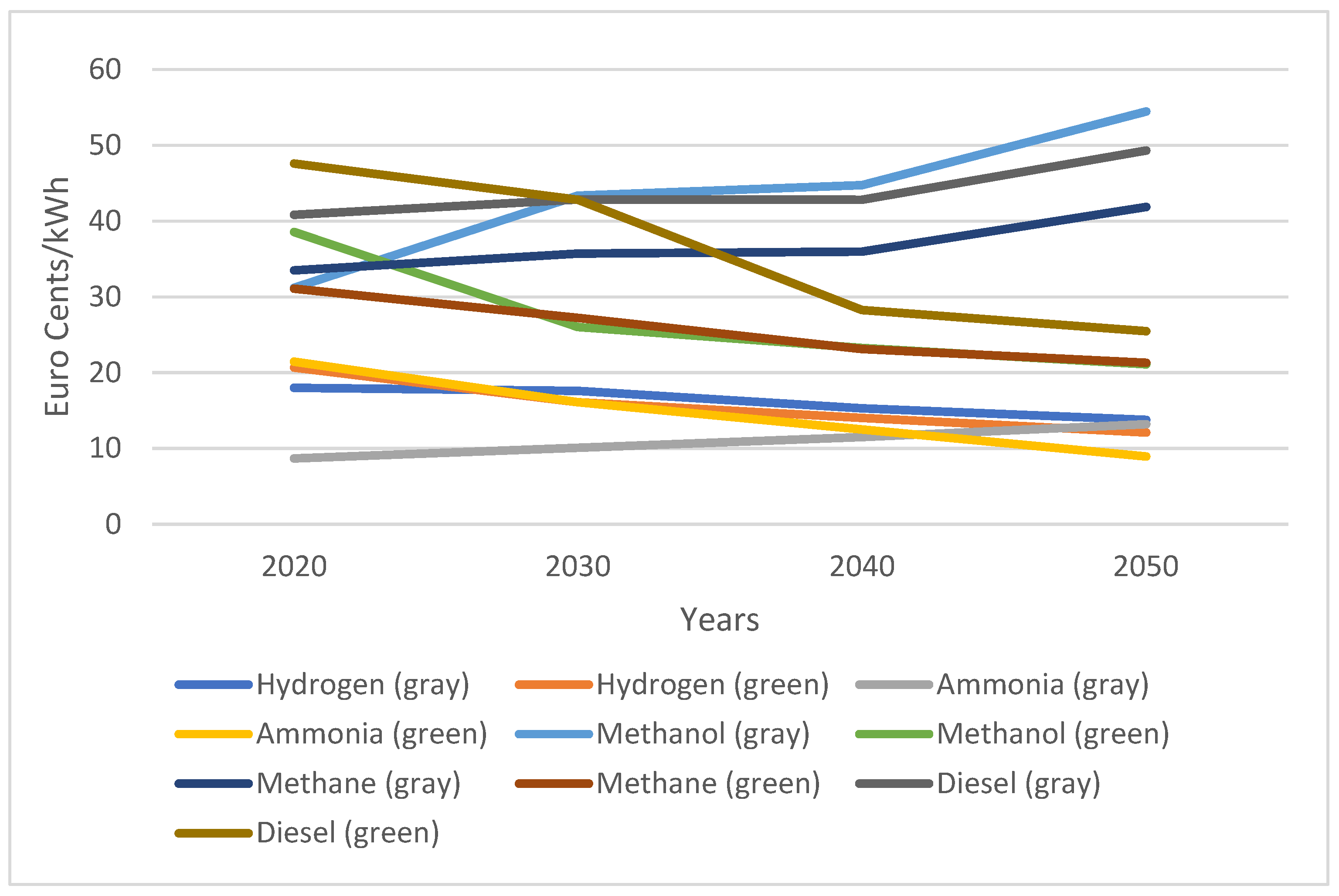
The results generated by the maritime fuel cost calculation tool provide critical insights into the long-term economic viability of ammonia in comparison to other alternative and conventional maritime fuels. The temporal evolution of fuel costs from 2020 to 2050 reveals a consistent trend toward decreasing costs for green fuels, particularly green ammonia and green hydrogen, driven by anticipated reductions in renewable electricity prices and continuous advancements in production technologies such as electrolysis and carbon capture.
As shown in
Table 1, in 2020, green ammonia was one of the most expensive fuels among the options analyzed, at 0.215 EUR/kWh, while its gray counterpart stood at 0.087 EUR/kWh. By 2050, the cost of green ammonia was projected to decrease significantly to 0.0894 EUR/kWh, approaching cost parity with several conventional fuels. A similar decline is observed for green hydrogen, which drops from 0.207 EUR/kWh in 2020 to 0.1212EUR/kWh in 2050. Although green hydrogen remains costly relative to some alternatives, its cost trajectory illustrates the impact of the improved electrolyzer efficiency and declining electricity prices assumed in the model. Nevertheless, green hydrogen’s application in maritime contexts remains limited due to challenges associated with its storage, volatility, and low volumetric energy density compared to ammonia.
Green methanol and green methane also follow similar cost-reduction pathways, with green methanol decreasing from 0.386EUR/kWh in 2020 to 0.211 EUR/kWh in 2050, and green methane falling from 0.311EUR/kWh to 0.213EUR/kWh in the same timeframe. While these trends reflect the broader effect of renewable energy improvements, it is important to note that methanol, even in its green form, typically involves unavoidable CO2 emissions during production. Consequently, ammonia retains a distinct advantage as a zero-carbon molecule, assuming production is fully renewable. On the other hand, the costs of fossil-based (gray) fuels, including gray ammonia, gray hydrogen, and gray methanol, either increase slightly or remain relatively stable over time, driven by assumptions of continued reliance on fossil inputs and incremental cost pressures, including potential carbon taxes.
Diesel and methane in their gray forms remain among the most economically competitive fuels throughout the forecast period, with gray diesel rising from 0.4086EUR/kWh in 2020 to 0.4935 EUR/kWh in 2050, and gray methane increasing from 0.3352EUR/kWh to 0.419 EUR/kWh. However, these conventional fuels face significant long-term competitive risks under carbon pricing scenarios, as their direct emissions render them susceptible to policy penalties. By contrast, the declining trend of green ammonia places it in a favorable position, particularly under scenarios involving high carbon taxation or stringent environmental regulations.
By 2050, the model predicts that green ammonia will be notably more cost-competitive, reaching a projected cost of 0.894EUR/kWh lower than gray ammonia and approaching the price range of fossil alternatives like gray diesel and methanol. This convergence in fuel prices highlights the transformative impact that carbon pricing and renewable energy advancements can have on the maritime fuel landscape. While green ammonia may still appear expensive on a per-kWh basis, its advantages in regulatory compliance, exemption from carbon taxes, and environmental performance increasingly strengthen its commercial case.
Figure 2 illustrates these comparative trajectories, emphasizing that although ammonia may not be the most economically favorable option today, its long-term potential is evident. The environmental benefits of ammonia, coupled with a steady decline in production cost, position it as a viable candidate for future maritime decarbonization strategies. The forecasted trends particularly support ammonia’s adoption in regions by implementing aggressive decarbonization policies or emissions penalties, further reinforcing its potential role as a sustainable maritime fuel.
It is important to note that the fuel prices presented above are generated using a baseline set of assumptions built into the tool, including expected reductions in electricity costs, technology learning curves, and carbon pricing evolution. For example, the cost of green ammonia is directly influenced by the price of green hydrogen, which itself depends on declining renewable electricity prices and improved electrolyzer performance. Likewise, green methanol and green methane benefit from similar structural cost reductions in their respective value chains.
However, the tool is intentionally designed to be flexible, allowing users to adjust key parameters such as electricity prices, carbon tax rates, capital expenditures, and operating costs. This customization enables the tool to simulate alternative scenarios tailored to specific geographies, policy environments, or future assumptions. As such, the presented results should be interpreted as illustrative outputs derived from a standard input set. Users are encouraged to explore additional scenarios by modifying variables to suit localized contexts or sector-specific conditions. The capacity to input alternative values enhances the robustness and practical applicability of the model for a wide range of stakeholders, including policymakers, maritime operators, and fuel suppliers.
3.2. Discussion
The results of the current study are compared with several external studies to evaluate convergence, divergence, and key assumptions regarding future fuel prices. A general trend of decreasing costs for green fuels was observed across most datasets, with differences often attributed to variations in geographic assumptions, technology readiness levels, policy incentives, and fossil fuel price projections.
In the study by Concawe and Aramco [
28], green fuel cost reductions were closely aligned with the results of this study. Gray hydrogen was projected in this study to decline from 0.207to 0.138 EUR/kWh by 2050, while the same study shows hydrogen falling from 0.2304 to 0.162EUR/kWh, confirming the general trend of capex and technology price reduction. For gray methanol, this study showed a drop from 0.3121 to 0.211 EUR/kWh, which closely aligns with Concawe and Aramc [
28], who predicted a rate of 0.183 EUR/kWh in 2050. However, gray methanol prices in this study increased significantly from 0.3857 to 0.55 EUR/kWh, whereas Concawe and Aramco showed more stable levels [
28]. This deviation is due to differences in assumed carbon taxation levels and projected fossil feedstock volatility. Diesel prices in Concawe and Aramco (2023) [
29] were also considerably lower than those in this study by 2050, where Concawe and Aramco (2023) [
28] projected 0.19 EUR/kWh, while this study calculated 0.255 EUR/kWh. While Concawe and Aramco (2023) [
28] validate the directionality of green fuel cost decline, divergences in gray fuel pricing may reflect stronger fossil policy burdens or resource constraints in this model.
The study by Kreidelmeyer et al., supported the same downward trend for green fuels [
20]. Green hydrogen declined from 0.22 to 0.16 EUR/kWh, aligning with this study’s findings of 0.18 to 0.12EUR/kWh. Likewise, green methanol fell from 0.38 to0.26 EUR/kWh in Kreidelmeyer et al. (2020) [
20], while a reduction from 0.386 to 0.211 EUR/kWh was observed in this study. Direct comparisons of green ammonia and several gray fuels were not available in (Kreidelmeyer et al. [
20], but gray diesel values at0.28 EUR/kWh in 2050 were lower than the 0.4935 EUR/kWh recorded in this study for the same year. This discrepancy may result from contradictory fossil price escalation models, carbon pricing strategies, or refinery cost projections. Kreidelmeyer et al. [
20] generally supports the green fuel findings but lacks comprehensive gray fuel data for a full evaluation.
The study by Statista (2023) provided only estimates for 2050, but useful insights were still drawn [
29]. For gray hydrogen, a price of 0.133 EUR/kWh was reported, compared to 0.138 €/kWh in this study, demonstrating strong consistency. Green ammonia was estimated at 0.0894 EUR/kWh in this study and 0.095 EUR/kWh in the Statista estimates [
29], again showing high alignment.
However, significant variance was seen in green methanol. Where the DNV estimates (2023) forecasted 0.141 EUR/kWh, the results for this study calculated 0.211 EUR/kWh, and for gray methanol [
29]. Similarly, where the DNV estimates (2023) reported 0.135 EUR/kWh, this study predicted 0.55 EUR/kWh [
29].
The sheer difference in gray methanol stems from diverging assumptions on fossil energy inflation, supply security, and carbon cost externalities. Green diesel figures from theStatista estimates were given at 0.158 EUR/kWh, which were also much lower than this study’s 0.255 EUR/kWh [
29], reflecting that more favorable projections for biofuel conversion or regional production subsidies were assumed in the Statista estimates [
29].
In another study DNV [
30], fuel costs were projected to be much lower across the board by 2050. Green methanol, projected at 0.141 EUR/kWh and green methane, at 0.143 EUR/kWh, were significantly cheaper than this study’s projections of 0.211 and 0.2131 EUR/kWh, respectively, but the relation between the two fuels can be seen in the consistent values between the two fuels. Gray methane at 0.042 EUR/kWh and gray diesel at 0.055 EUR/kWh were also well below the 2050 levels seen in this study at 0.4190 and 0.4935 EUR/kWh, respectively. These differences arise from highly optimistic cost assumptions in [
30], such as accelerated scale-up of production facilities, lower feedstock costs, or early achievement of technological learning curves. Additionally, the DNV report assumed less ambitious global emissions regulations [
30], leading to slower decarbonization transitions and reduced costs for fossil fuels. The variations suggest that while the cost direction is consistent, the magnitude of change differs due to structural and regional assumptions.
Finally, a study by Solakivi et al. [
31] focused entirely on green fuels, projecting more dramatic cost reductions than those observed in this analysis. Green hydrogen was forecast to fall from 0.225 to just 0.065 EUR/kWh, compared to a decline from 0.207 to 0.121 EUR/kWh in this study. Green ammonia declined from 0.191 to 0.065 EUR/kWh in Solakivi et al. [
31], versus 0.215 to 0.0894 EUR/kWh in this study. Likewise, green methanol and methane were projected to reach around 0.106 and 0.084 EUR/kWh, notably lower than the 0.211 and 0.213 EUR/kWh predicted in this study. Interestingly, Solakivi et al. showed a slight downward trend for green diesel [
31], which contrasts with the steady price rise observed in this study from 0.081to 0.132 EUR/kWh. The more aggressive reductions in Solakivi et al. may reflect idealized scenarios with high government support [
31], rapid innovation, and widespread electrification of fuel production. By contrast, more conservative cost-learning rates and moderate adoption scenarios were used in this study.
3.3. Sensitivity Analysis
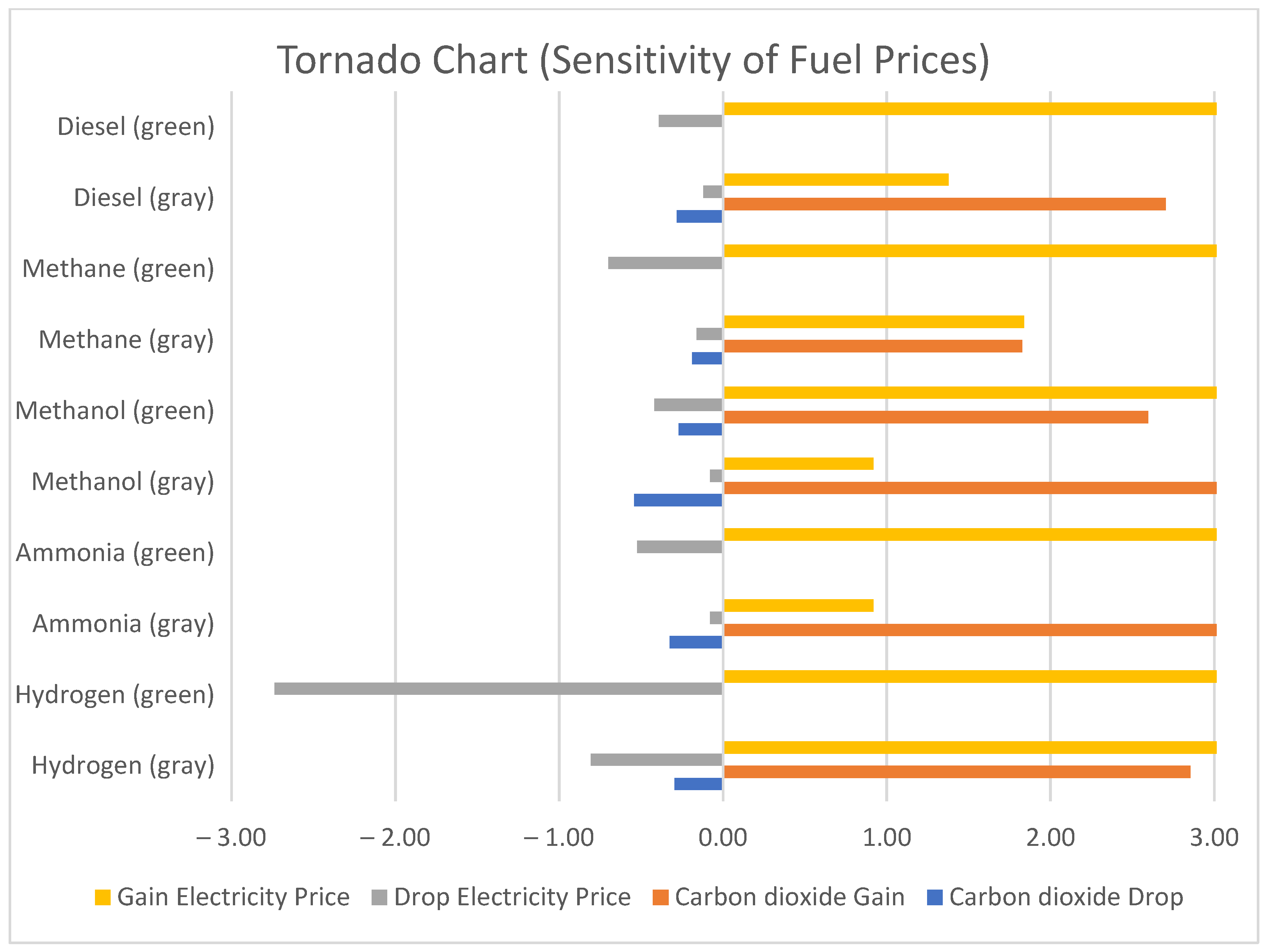
A sensitivity analysis was created and applied using a tornado chart to examine the influence of key input parameters on the modeled economics of maritime fuels. This approach involved independently varying each input variable across a defined range while keeping all others constant. The resulting impact on the final cost output was measured, and parameters producing the greatest deviations were placed at the top of the chart, allowing for a clear ranking of their relative influence. The tornado chart methodology was selected for its clarity in presenting comparative sensitivities and its ability to highlight which variables exerted the most significant pressure on the model outcomes. Through this process, the primary sources of economic uncertainty were identified, offering guidance for future data refinement and scenario planning.
The sensitivity analysis represented by
Figure 3 confirmed that electricity remains the dominant driver of Green Fuels’ price as a maritime fuel. Based on projections for 2050, electricity prices were simulated to vary between EUR 10 per megawatt-hour and EUR 100 per megawatt-hour. This variation translated into a substantial swing in the final price of green ammonia, ranging from as low as 0.0842 EUR per kWh to as high as EUR 0.1491 per kWh. The base case of EUR 0.0894 per kWh suggested a potential cost reduction of 0.0052 EUR per kWh and a potential increase of 0.0597 EUR per kWh. This outcome underscores the disproportionate sensitivity of green ammonia’s cost structure to electricity pricing, driven primarily by its reliance on energy-intensive hydrogen electrolysis.
Green methanol exhibited moderate sensitivity to electricity pricing, with modeled costs ranging from EUR 0.2069 per kWh to EUR 0.2587per kWh, reflecting a possible gain of EUR 0.0476 per kWh. This variation, while notable, is less significant compared to the electricity-driven sensitivity observed in green ammonia. While capital expenditures related to infrastructure development and retrofitting for ammonia-based propulsion were not numerically varied in this sensitivity analysis, their qualitative impact was acknowledged. These high upfront costs continue to present a barrier to adoption, although they may be mitigated over time by regulatory incentives, economies of scale, and technological advancements.
Overall, the sensitivity analysis using the tornado chart methodology demonstrated that electricity pricing remains the primary determinant of green ammonia’s competitiveness as a maritime fuel, while carbon pricing exerts a critical secondary influence, particularly in weakening the position of fossil fuel alternatives. Fuels with rigid input structures, such as green hydrogen and green diesel, may provide price stability but lack the flexibility to respond to changing market dynamics. These findings emphasize the importance of targeted policy interventions in electricity market reform and carbon pricing. Under favorable conditions, such as access to low-cost renewables and high carbon penalties, green ammonia emerges as a compelling and potentially cost-competitive zero-carbon fuel option for the shipping industry by mid-century.
4. Conclusions
This research project has focused on one of the most promising carbon-free fuels, which is ammonia. The report provides an in-depth review of its potential for shipping fuel. It has, therefore, developed a detailed calculation model for costing to assess the economic viability of ammonia in relation to other alternative fuels such as hydrogen, methanol, LNG, and diesel. This research provided a valuable insight into the long-term market dynamics of ammonia, considering “green” and “gray” production routes, and the feasibility of ammonia as a sustainable energy solution for shipping.
How promising ammonia is as a fuel that could help the shipping industry cut its ecological footprint has been emphasized. It is carbon-free if produced from renewable energy sources, which is quite enticing in the global drive to reduce greenhouse gas emissions. The findings from the study reveal that ammonia, with the aid of good policy frameworks like increasing the price of CO2, can advance and reduce costs from technologies to produce green ammonia and, therefore, lie at the core of the decarbonization of inland waterways and deep-sea shipping. This is evident as results unfold that the market viability of ammonia will increasingly depend on economic incentives brought about by global policies on climate. Undeniably, as seen in the study, by 2050, with increasing CO2 prices, fossil fuels such as LNG and diesel will no longer be economically viable to the same degree, but instead, the door will be open for renewable alternatives like green ammonia. The fact that ammonia can be stored and transported using existing infrastructure, including LPG tankers and pipelines, strengthens its position as a feasible and scalable fuel alternative within the maritime sector.
The primary objective of the study was to develop a dynamic cost calculation model in Excel that enables the user to simulate a variety of fuel production scenarios. This model allows for variation in key variables such as electricity price, capital and operational costs, and CO2 taxation, thus making it flexible enough to conduct forecasts of fuel prices in any market conditions. Therefore, the tool already has a particular value in projecting the cost implications for future scenarios for industry stakeholders, policymakers, and researchers. The detailed cost breakdown provided by the model is performed for both the production and infrastructure requirements of the ammonia refueling options and their corresponding storage solutions. In this way, this tool integrates technological, thermodynamic, and economic considerations, enabling a comprehensive look at ammonia’s potential to be a competitive maritime fuel. The possibility of simulating future developments in energy prices, where electricity prices are forecasted to range between 25.92 EUR/MWh and 88.42 EUR/MWh by 2050, provides some insight into the marketability of green ammonia compared to fossil-based fuels.
Ammonia has great potential, but the research also underlines key challenges regarding infrastructure development and technological readiness. The study further acknowledged the existing limitations on technology for ship conversion. With ammonia-based propulsion systems still at the prototype level of development, the long-term benefits accruing from reduced emissions and operating costs justify the necessary investment.
The work has demonstrated that ammonia competitiveness will be enhanced by increasing CO2 prices and reducing the cost of electricity to produce green ammonia. By 2050, increased carbon pricing will hinder fossil fuels, while the relative attractiveness of ammonia will rise. This development will also have positive spillover impacts on regional economic development, especially in regions that invest in appropriate ammonia storage, transportation, and refueling infrastructure.