Proceeding Paper

Weakly Dimension-Balanced Hamiltonian Cycle on Three-Dimensional Toroidal Mesh Graph †
Department of Computer Science & Information Engineering, National Chi Nan University, Nantou 54561, Taiwan
*
Author to whom correspondence should be addressed.
Presented at 8th International Conference on Knowledge Innovation and Invention 2025 (ICKII 2025), Fukuoka, Japan, 22–24 August 2025.
Eng. Proc. 2025, 120(1), 36; https://doi.org/10.3390/engproc2025120036
Published: 3 February 2026
(This article belongs to the Proceedings of 8th International Conference on Knowledge Innovation and Invention)

Abstract

The dimension-balanced cycle (DBC) problem is new in graph theory, with applications such as 3D stereogram reconstruction. In a graph whose edges are partitioned into k dimensions, a cycle is dimension-balanced if edge counts across dimensions differ by at most one. When such a cycle is Hamiltonian, it is called a dimension-balanced Hamiltonian cycle (DBH). Since DBHs do not always exist, a relaxed notion—the weakly dimension-balanced Hamiltonian (WDBH) cycle—was considered, allowing a difference of up to three. We prove that WDBH always exists in any 3-dimensional toroidal mesh graph Tm,n,r for all positive integers m, n, and r.

1. Introduction

The topology of interconnection networks is modeled using graphs, where vertices represent processors and edges denote the communication links between them. In this study, we follow the standard notation and definitions introduced in Ref. [1].
In a simple graph G = (V, E), a Hamiltonian path is a path that visits each vertex exactly once; a Hamiltonian cycle is a cycle that visits each vertex exactly once [2,3,4,5,6,7]. Given a graph G whose edge set is partitioned into k dimensions, denoted as E ~ = {E1(G), E2(G), …, Ek(G)}. A cycle C in G is called a dimension-balanced cycle (DBC for short) with respect to E ~ if for any pair i, j ∈ {1, 2, …, k}, the number of edges in each dimension satisfies ||Ei(C)| − |Ej(C)|| ≤ 1, where Ei(C) = E(C) ∩ Ei(G) for i ∈ {1, 2, …, k}. If such a cycle is also Hamiltonian, it is referred to as a dimension-balanced Hamiltonian cycle (DBH). If the condition is relaxed into ||Ei(C)| − |Ej(C)|| ≤ 3, then the cycle is called a weakly dimension-balanced (Hamiltonian) cycle (WDBC (WDBH) for short) with respect to E ~ .
The DBH problem has attracted increasing attention in recent years. The DBH problem was developed to address the quality issues in the construction of 3D surface scanning [8,9,10]. Notable research efforts have examined such cycles in various graph classes, including hypercube and toroidal meshes [11,12]. In 2012, Peng [11] successfully constructed DBHs for two-dimensional toroidal graphs Tm,n, and in 2018, Wu [13] extended this to the weaker version known as the weak DBH (WDBH).
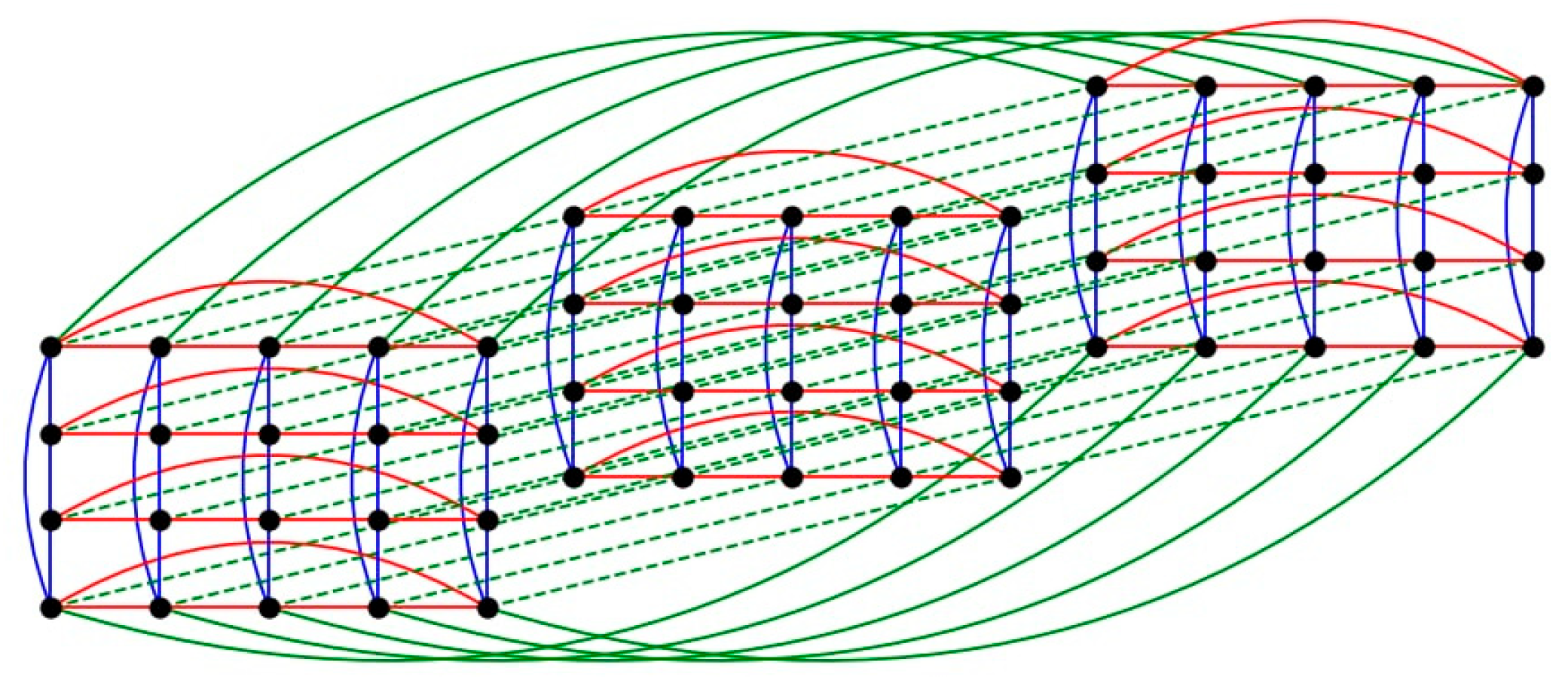
We examined the class of graphs denoted by Tm,n,r, known as 3-dimensional toroidal mesh graphs (3D toroidal mesh graphs). The vertex set of such a graph is defined as V(Tm,n,r) = {(x, y, z) | 0 ≤ x < m − 1, 0 ≤ y < n − 1, 0 ≤ z < r − 1}; the edge set is given by E(Tm,n,r) = {(x1, y1, z1)(x2, y2, z2) | (x1 = x2, y1 = y2, |z1z2| ≡ 1 (mod r)) or (x1 = x2, z1 = z2, |y1y2| ≡ 1 (mod n)) or (y1 = y2, z1 = z2, |x1x2| ≡ 1 (mod m))}. Let the partition of E(Tm,n,r) be E ~ = {E1, E2, E3}, where E1 = {(x1, y1, z1)(x2, y2, z2) | y1 = y2, z1 = z2, |x1x2| ≡ 1 (mod m)}, E2 = {(x1, y1, z1)(x2, y2, z2) | x1 = x2, z1 = z2, |y1y2| ≡ 1 (mod n)}, and E3 = {(x1, y1, z1)(x2, y2, z2) | x1 = x2, y1 = y2, |z1z2| ≡ 1 (mod r)}. For convenience in further discussions, we define the following three sets of special cross-connections: cross1 = {(0, j, k), (m − 1, j, k) | 0 ≤ j < n, 0 ≤ k < r}, cross2 = {(i, 0, k), (i, n − 1, k) | 0 ≤ i < m, 0 ≤ k < r}, and cross3 = {(i, j, 0), (i, j, r − 1) |0 ≤ i < m, 0 ≤ j < n}. An illustration of the structure of T5,4,3 is shown in Figure 1. Throughout this paper, edges of different dimensions in the figures are represented using three colors: red, blue, and green.
Building on the previous foundations, Juan et al. [14] investigated the DBH problem in 3D toroidal mesh graphs with respect to E ~ in 2019, and the rest of this problem has been solved recently [15]. However, DBHs do not always exist in arbitrary 3D toroidal graphs. Consequently, when a DBH is unattainable, the weaker form, WDBH, becomes a useful generalization. This paper aims to explore the existence conditions of WDBH cycles in 3D toroidal mesh graphs Tm,n,r with respect to E ~ , under the constraint that m, n, r ≥ 3.

2. Background Knowledge

We analyze the properties of the 3D toroidal mesh graph Tm,n,r, based on the values of m, n, and r mod 6 at first. Then, we present important results.
Let a = m mod 6, b = n mod 6, and c = r mod 6. Considering the graph’s inherent symmetry, 56 cases need to be discussed when m, n, r ≥ 3. In 2015, Peng established an important result regarding d-dimensional toroidal mesh graphs of the form Cl1 × Cl2 ×… × Cld, where each Cli is a cycle graph of length li, with 1 ≤ id. Define the function ρ(l1, l2, …, ld) as the number of odd integers in the set {l1, l2, …, ld} [11]. The function Ψ(l1, l2, …, ld) is defined as follows: if ⌊(l1l2ld)/d⌋ is even, then Ψ(l1, l2, …, ld) = (l1l2ld) mod d; else Ψ(l1, l2, …, ld) = d − ((l1l2ld) mod d). The results for the DBH problem on the 3D toroidal mesh graph Tm,n,r are as follows.
Theorem 1 
([14]). If any of m, n, or r is divisible by 3, then a DBH exists in Tm,n,r with respect to E ~ .
Theorem 2 
([15]). If m, n, r mod 3 ≠ 0 and Ψ(m, n, r) ≤ ρ(m, n, r), then a DBH exists in Tm,n,r with respect to E ~ .
Theorem 3 
([14]). If Ψ(m, n, r) > ρ(m, n, r), there does not exist DBH in Tm,n,r with respect to E ~ .
By definition, every DBH is also a WDBH. Table 1 summarizes ten specific cases of toroidal mesh graphs that have been shown not to admit DBHs. Since we are concerned with the cases where m, n, r ≥ 3, the range of a, b, and c has been restricted to {3, 4, 5, 6, 7, 8}. These cases are of particular interest, as it remains to be determined whether a WDBH exists in each of them. This issue will be examined in detail in the following section.
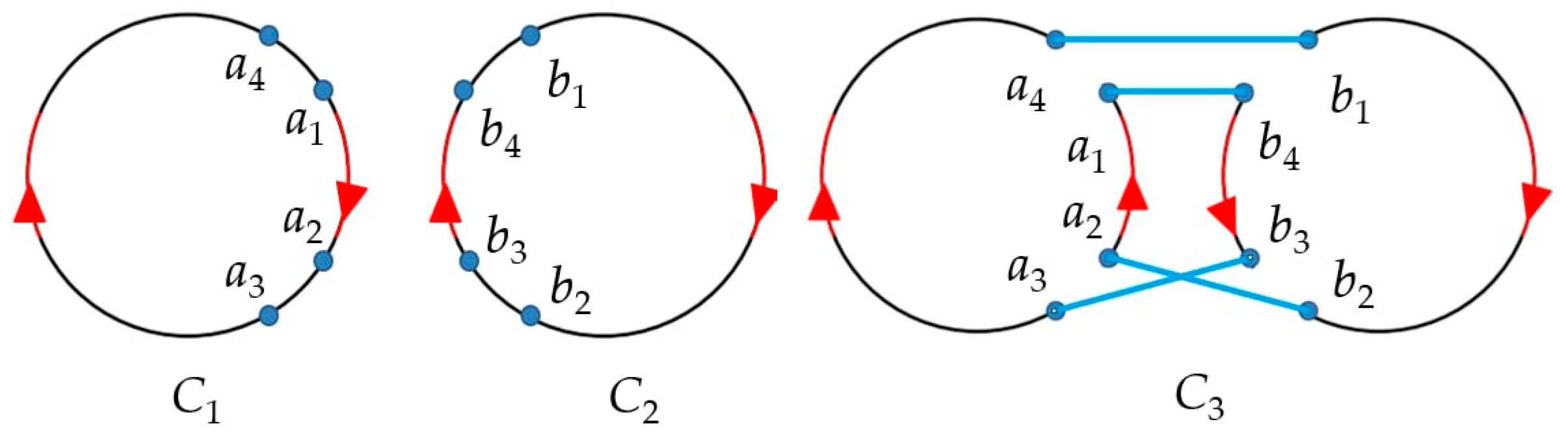
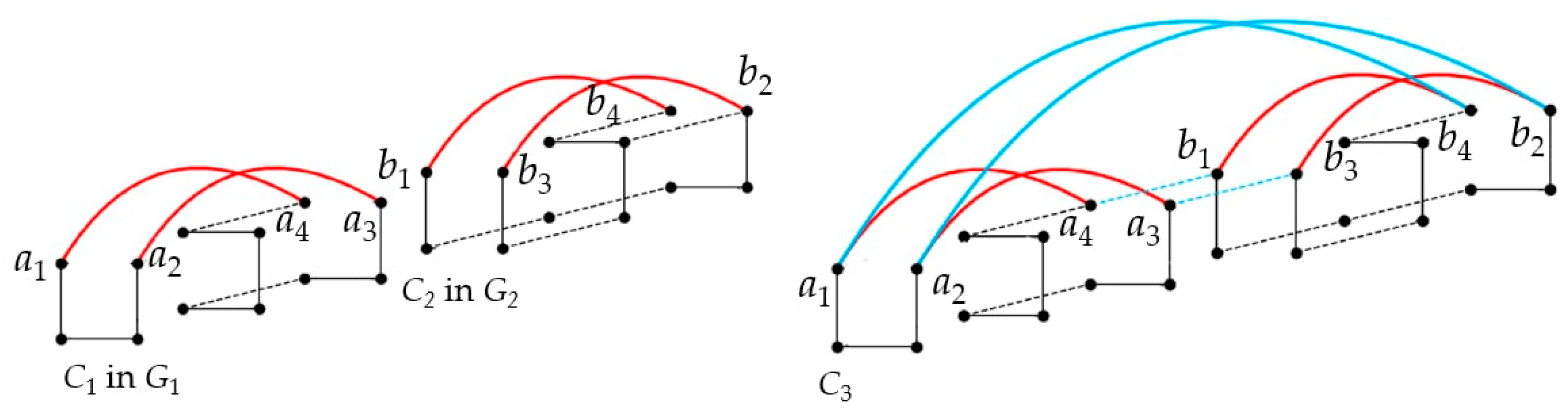
We present two lemmas that demonstrate how two cycles can be connected in this paper. Figure 2 and Figure 3 illustrate Lemma 1 and Lemma 2.
Lemma 1 
([15]). Let there be two cycles: C1 =a1, …, a2, a3, …, a4, a1, C2 =b1, …, b2, b3, …, b4, b1By removing edges a4a1, a2a3, b4b1, b2b3 and adding new edges a a1b4, b3a3, a4b1, b2a2, we form a new cycle C3 defined as C3 = a1, b4, (b4, b3)- from C2−1, b3, a3, (a3, a4)- from C1, a4, b1, (b1, b2)- from C2, b2, a2, (a2, a1)- from C1−1, a1〉.
Lemma 2 
([15]). Building on Lemma 1, assume T1 and T2 are Hamiltonian cycles in the toroidal mesh graphs G1 = Tm,n,r1 and G2 = Tm,n,r2, respectively. Suppose the edges a2a3, a4a1 lie in the cross3 direction of G1, and the edges b2b3, b2b3 lie in the cross3 direction of G2. Then, the added edges a1b4, b3a2 will also lie in the cross3 direction of the combined graph Tm,n,r1+r2.

3. Result and Discussion

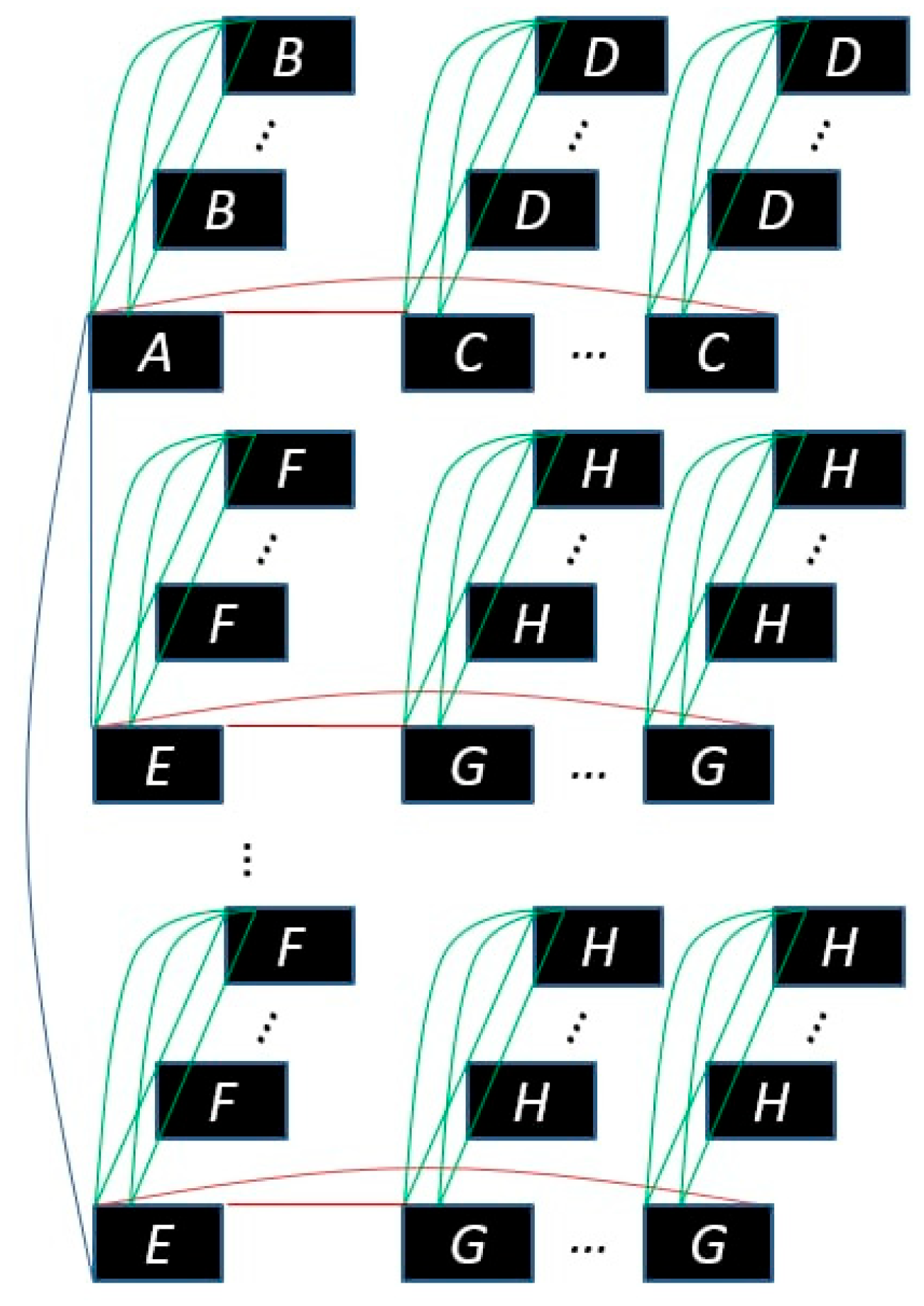
Using the modular values of n, m, and r modulo 6, the structure Tm,n,r is classified into ten distinct cases, as shown in Table 1. This section constructs the WDBH for each of the cases presented in Table 1, using the model illustrated in Figure 4. At first, we show the main idea of how to construct the WDBH for every case.
If we find one WDBH (A) and seven Hamiltonian cycles (B through H), then connecting them sequentially according to the construction method shown in Figure 4, we can cover all the various cases in Table 2.
During the extension along the first or second dimension, we remove one edge from each of the two Hamiltonian cycles in the same dimension and reconnect them using two new edges, also in the same dimension. As a result, the resulting graph remains a Hamiltonian cycle, and the number of edges in each dimension can simply be summed directly. When extending along the third dimension, a different construction is required. Specifically, we must remove two edges from each of the original Hamiltonian cycles in the third dimension and reconnect them using four edges in the third dimension. To ensure that the resulting structure remains a Hamiltonian cycle, each individual Hamiltonian cycle must satisfy the conditions specified in Lemma 2. According to Lemma 2, this guarantees that the merged graph is indeed Hamiltonian (still one cycle). In terms of edge count, the number of edges in each dimension can simply be summed directly, too.
We present the main theorem of this study as follows.
Theorem 4. 
For any m, n, or r ≥ 3, WDBH exists in Tm,n,r with respect to E ~ .
Proof. 
From the discussion in the previous section, we observe that the validity of this theorem hinges on the ten specific cases listed in Table 1, where no DBH exists. Therefore, to establish this theorem, it is sufficient to prove that each of these ten cases admits a WDBH. Following the construction framework outlined at the beginning of this section, due to space limitations and the similarity in the proof techniques across all cases, we provide a detailed proof for Case 1 only.
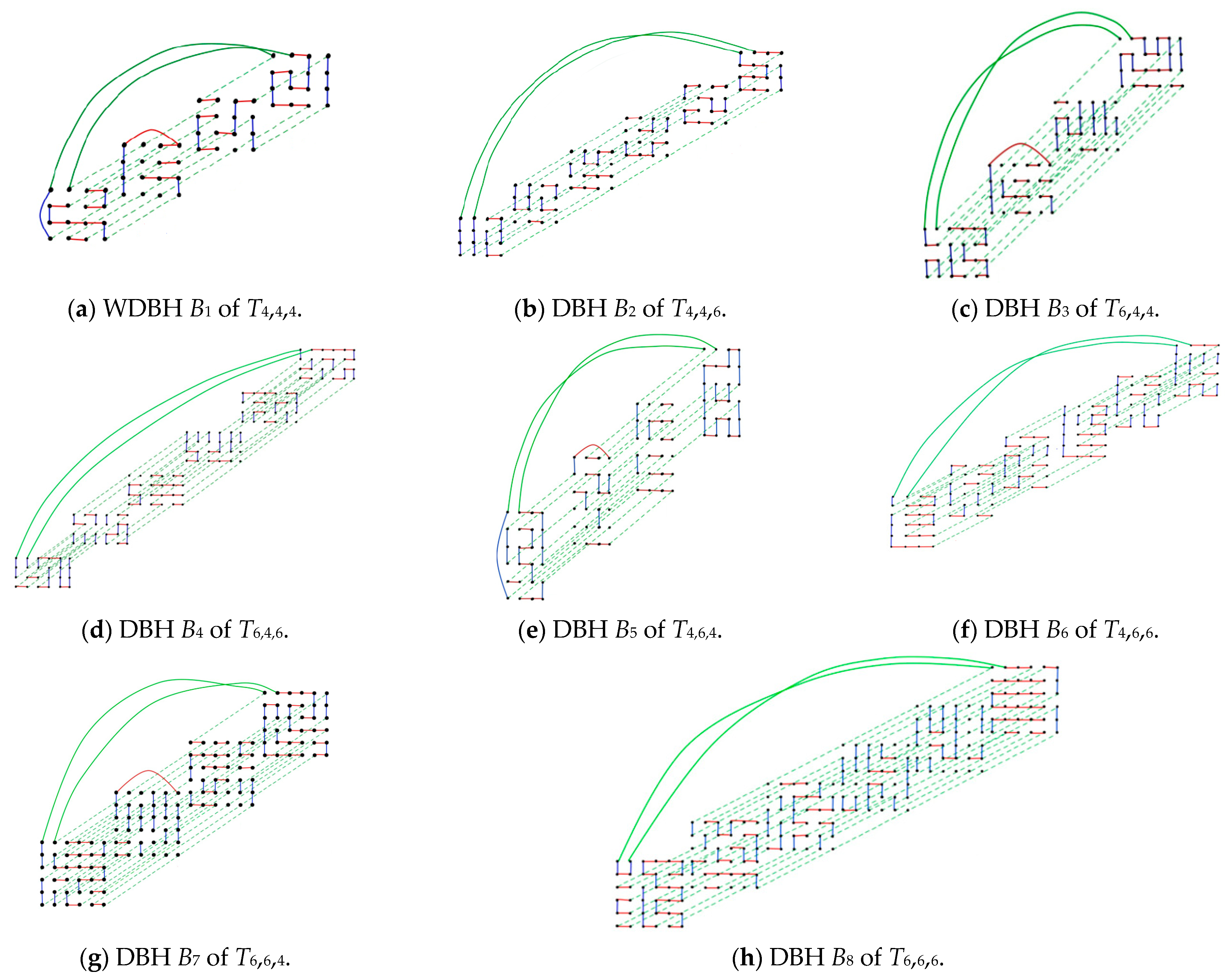
Case 1. m mod 6 = 4 and n mod 6 = 4, r mod 6 = 4. Let B1 (see Figure 5a) be a WDBH of T4,4,4. We can see that |E1(B1)| = 20, |E2(B1)| = 22, and |E3(B1)| = 22. Let B2 (see Figure 5b) be a DBH of T4,4,6, where |E1(B2)| = |E2(B2)| = |E3(B2)| = 32. After connecting B2 z times in the third dimension of B1, it forms a WDBH T1 in T4,4,(4+6z). Note that |E1(T1)| = 20 + 32z, |E2(T1)| = 22 + 32z, and |E3(T1)| = 22 − 2 + 2 + (32 − 2 + 2)z = 22 + 32z. Let B3 (see Figure 5c) be a DBH of T6,4,4 with |E1(B3)| = |E2(B3)| = |E3(B3)| = 32, connecting a DBH B4 of T6,4,6 (with |E1(B4)| = |E2(B4)| = |E3(B4)| = 48, see Figure 5d) z times to the third dimension of B3. It forms a DBH T2 in T6,4,(4+6z) with |E1(T2)| = |E2(T2)| = 32 + 48z, |E3(T2)| = 32 − 2 + 2 + (48 − 2 + 2)z = 32 + 48z. Then, connecting T2 z times to the first dimension of T1, it forms a WDBH in T(4+6x),4,(4+6z), called T3. So, |E1(T3)| = 20 + 32z − 1 + 1 + x(32 + 48z − 1 + 1) = 20 + 32z + x(32 + 48z), |E2(T3)| = |E3(T3)| = 22 + 32z + x(32 + 48z).
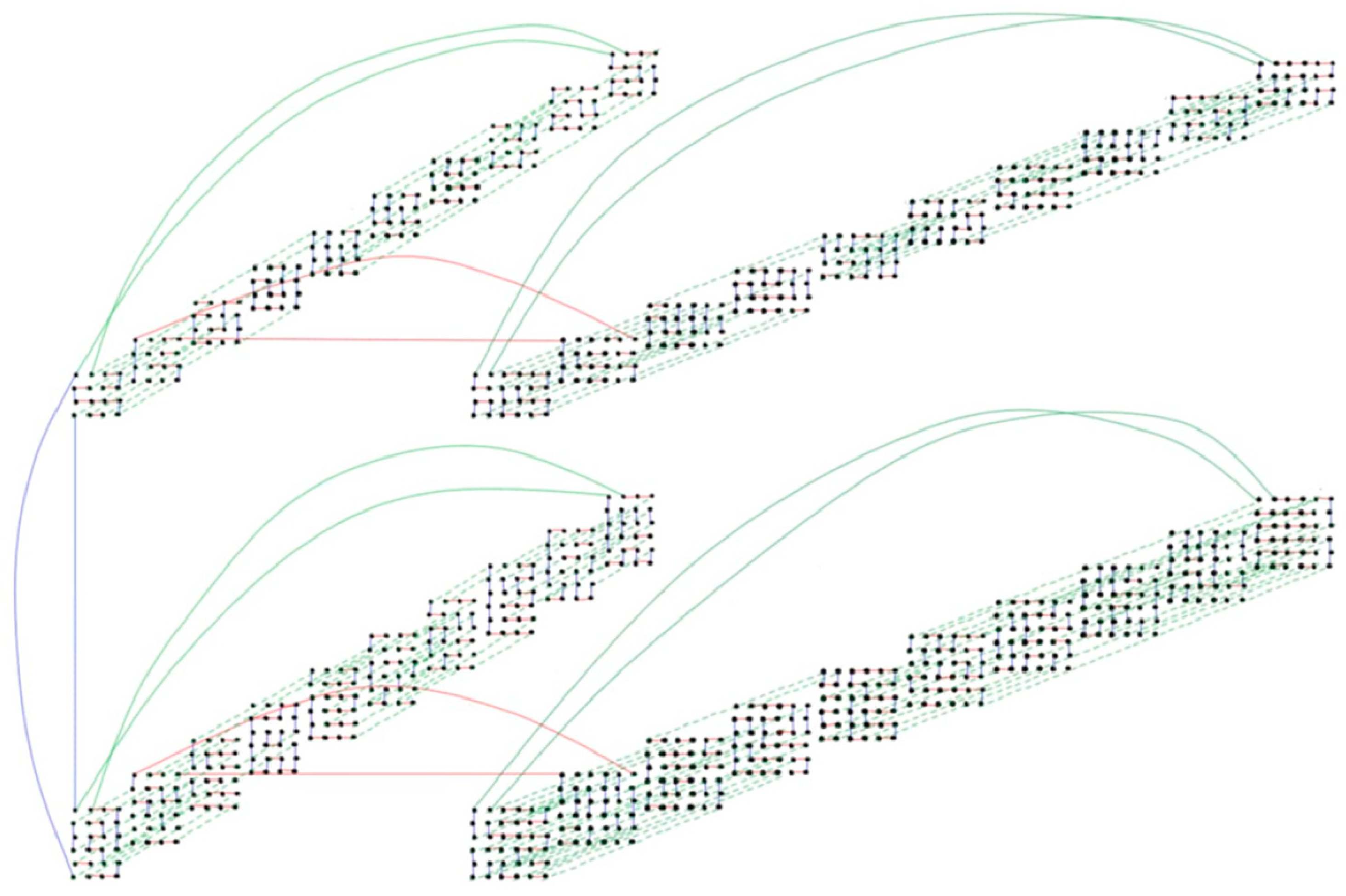
In the next stage, we need to add a DBH of T(4+4x),6,(4+6z) y times in the second dimension of T3. Again, we give a DBH B5 of T4,6,4, as Figure 5e, and connect a DBH B6 of T4,6,6 z times to the third dimension of B5. It forms a DBH T4 in T4,6,(4+6z) with |E1(T4)| = |E2(T4)| = 32 + 48z, |E3(T4)| = 32 − 2 + 2 + (48 − 2 + 2)z = 32 + 48z. Now, let B7 (see Figure 5g) be a DBH of T6,6,4, and B8 (see Figure 5h) be a DBH of T6,6,6. After connecting B8 z times in the third dimension of B7, it forms a DBH T5 in T6,6,(4+6z). Note that |E1(T5)| = |E2(T5)| = 48 + 72z, |E3(T5)| = 48 − 2 + 2 + (72 − 2 + 2)z = 48 + 72z. After connecting T5 x times to the first dimension of T4, it forms a DBH T6 of T(4+6x),6,(4+6z). Note that |E1(T6)| = 32 + 48z − 1 + 1 + x(48 + 72z − 1 + 1) = 32 + 48z + x(48 + 72z), |E2(T6)| = |E3(T6)| = 32 + 48z + x(48 + 72z). Finally, after connecting T6 y times to the second dimension of T3, it forms a WDBH T7 of T(4+6x),(4+6y),(4+6z). Note that |E1(T7)| = 20 + 32z + x(32 + 48z) + y [32 + 48z + x(48 + 72z)], |E2(T7)|= 20 + 32z + x(32 + 48z) − 1 + 1 + y [32 + 48z + x(48 + 72z) − 1 + 1] = 22 + 32z + x(32 + 48z) + y [32 + 48z + x(48 + 72z)] = |E3(T7)|. We have completed the proof of this case. Figure 6 is an illustration for x = y = z = 1, that is, T10,10,10.
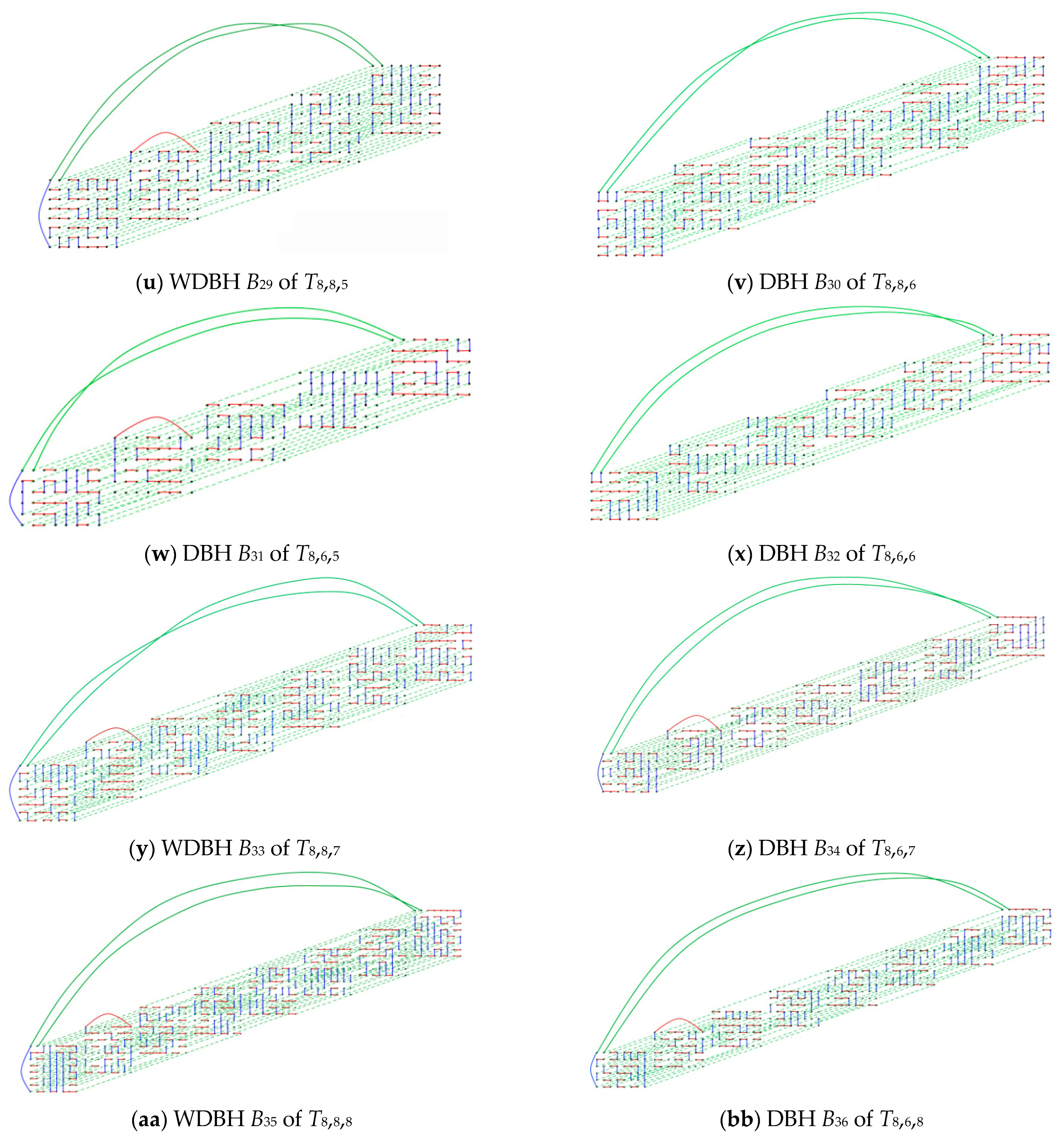
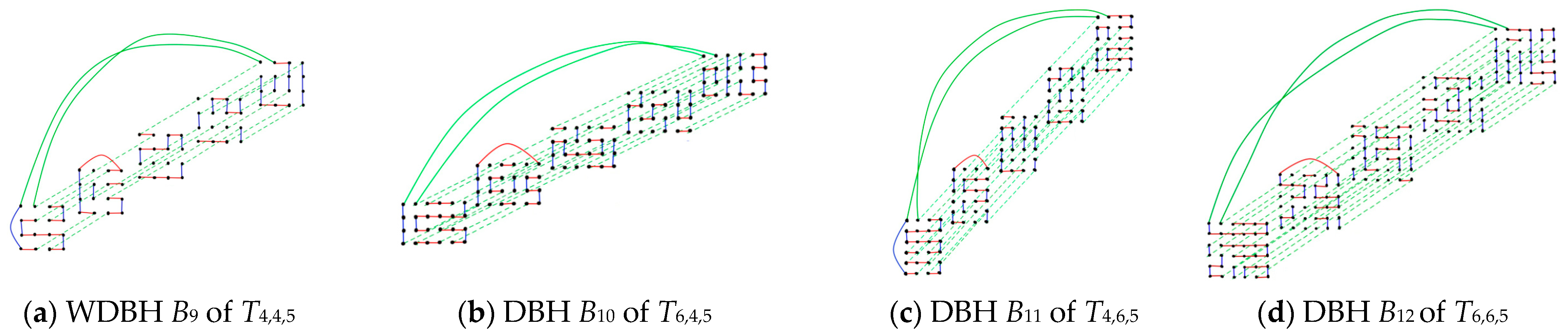
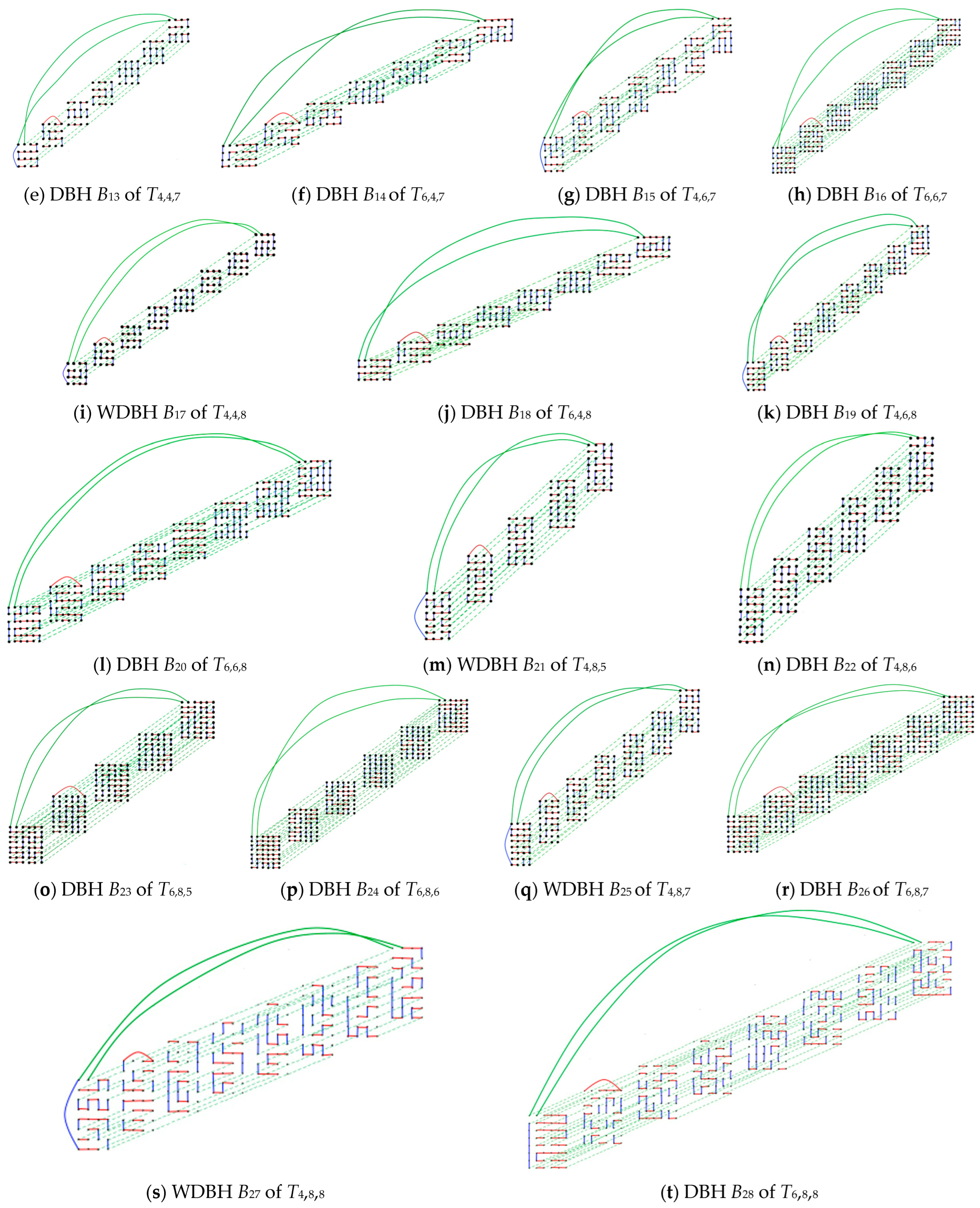
The remaining cases, involving the construction of Hamiltonian cycles on B9 through B36, is summarized in Figure 7. □

4. Conclusions

We investigate the existence of WDBHs in three-dimensional toroidal mesh graphs Tm,n,r for all m, n, r ≥ 3. We merge two Hamiltonian cycles by removing one or two edges from each and reconnecting them. When removing one edge per cycle, the new Hamiltonian cycle is straightforward to construct; when removing two edges, careful connection is essential to avoid disconnected cycles (which need to satisfy Lemma 2). We process the ten cases where DBHs are known not to exist. By applying the construction method in Figure 4 and using the B1 to B36 cycles shown in Figure 5 and Figure 7, along with Table 2, we successfully built a WDBH for each case. This confirms that a WDBH exists in every three-dimensional toroidal mesh graph. This is an important result, especially compared with the two-dimensional case, where WDBHs are known to be absent in several configurations. It raises a compelling question for future research on a higher-dimensional toroidal mesh graph with WDBH. This direction offers a promising avenue for further theoretical exploration.

Author Contributions

Conceptualization, J.S.-T.J.; methodology, C.-P.C. and J.S.-T.J.; validation, C.-P.C. and J.S.-T.J.; formal analysis, C.-P.C. and J.S.-T.J.; investigation, J.S.-T.J.; data curation, C.-P.C.; writing—original draft preparation, C.-P.C.; writing—review and editing, J.S.-T.J.; visualization, C.-P.C.; supervision, J.S.-T.J.; project administration, J.S.-T.J.; funding acquisition, J.S.-T.J. All authors have read and agreed to the published version of the manuscript.

Funding

This research and the APC were funded by Ministry of Science and Technology of the Republic of China, grant numbers NSTC 112-2115-M-260-001-MY2.

Institutional Review Board Statement

Not applicable.

Informed Consent Statement

Not applicable.

Data Availability Statement

The original contributions presented in this study are included in the article. Further inquiries can be directed to the corresponding author.

Conflicts of Interest

The authors declare no conflict of interest.

References

  1. Xu, J. Theory and Application of Graph; Kluwer Academic Publishers: Dordrecht, The Netherlands, 2013. [Google Scholar]
  2. Chvátal, V.; Erdös, P. A note on Hamiltonian circuits. Discret. Math. 1972, 2, 111–113. [Google Scholar] [CrossRef]
  3. Dimakopoulos, V.V.; Palios, L.; Poulakidas, A.S. On the Hamiltonicity of the Cartesian Product. Inform. Process. Lett. 2005, 96, 49–53. [Google Scholar] [CrossRef]
  4. Sanz-Serna, J.M.; Calvo, M.P. Numerical Hamiltonian Problems; Courier Dover Publications: New York, NY, USA, 2018. [Google Scholar]
  5. Li, R. A degree sum condition for Hamiltonian graphs. Electron. J. Math 2021, 1, 85–88. [Google Scholar]
  6. Shi, L.; Shan, S. A note on hamiltonian cycles in 4-tough (P2 ∪ kP1)-free graphs. Discret. Math. 2022, 345, 113081. [Google Scholar] [CrossRef]
  7. Antoniuk, S.; Dudek, A.; Ruciński, A. Powers of Hamiltonian cycles in randomly augmented Dirac graphs—The complete collection. J. Graph Theory 2023, 104, 811–835. [Google Scholar] [CrossRef]
  8. Salvi, J.; Pagès, J.; Batlle, J. Pattern codification strategies in structure light systems. Pattern Recognit. 2004, 37, 827–849. [Google Scholar] [CrossRef]
  9. Wang, S.-H. 3-D Surface Acquisition with Non-Uniform Albedo Using Structured Light Range Sensor. Master’s Thesis, Department of Computer Science and Information Engineering, National Chi Nan University, Nantou, Taiwan, 2007. [Google Scholar]
  10. Chin, Y.Y. Binary and M-ary Structure Light Patterns with Gray Coding Rule in Active Non-contact 3D Surface Scanning. Master’s Thesis, Department of Computer Science and Information Engineering, National Chi Nan University, Nantou, Taiwan, 2009. [Google Scholar]
  11. Peng, W.-F.; Juan, J.S.-T. The Balanced Hamiltonian Cycle on Toroidal Mesh Graphs. In Proceedings of the World Academy of Science, Engineering and Technology, Tokyo, Japan, 29–30 May 2012; Volume 65, pp. 1096–1103. [Google Scholar]
  12. Wang, H.-R. The Balanced Hamiltonian Cycle Problem. Master’s Thesis, Department of Computer Science and Information Engineering, National Chi Nan University, Nantou, Taiwan, 2011. [Google Scholar]
  13. Wu, R.-Y.; Lai, Z.-Y.; Juan, J.S.-T. The Weakly Dimension-Balanced Hamiltonian. In Proceedings of the Parallel and Distributed Processing Techniques and Applications (PDPTA’18), Luxor, Las Vegas, NV, USA, 30 July–2 August 2018; pp. 178–182. [Google Scholar]
  14. Juan, J.S.-T.; Tseng, Y.-H.; Lai, C.-S.; Lai, Z.-Y. Dimension-Balanced Hamiltonian Cycle on 3-Dimensional Toroidal Mesh Graph. In Proceedings of the International Congress on Engineering and Information (ICEAI’19), Osaka, Japan, 7–9 May 2019; pp. 47–57. [Google Scholar]
  15. Lai, C.-S. A Study of Dimension-Balanced Hamiltonian Cycle on 3-Dimensional Toroidal Mesh Graph. Master’s Thesis, Department of Computer Science and Information Engineering, National Chi Nan University, Nantou, Taiwan, 2019. [Google Scholar]
Figure 1. The structure of T5,4,3.
Engproc 120 00036 g001
Figure 2. Illustration of Lemma 1.
Engproc 120 00036 g002
Figure 3. Illustration of Lemma 2. The red edges indicate the deleted edges, while the blue edges represent the newly added edges.
Engproc 120 00036 g003
Figure 4. Construction of the WDBH model. Red, blue, and green edges represent edges of different dimensions.
Engproc 120 00036 g004
Figure 5. Construction of B1 to B8 (ah). Red, blue, and green edges represent edges of different dimensions.
Engproc 120 00036 g005
Figure 6. Constructed WDBH for T10,10,10. Red, blue, and green edges represent edges of different dimensions.
Engproc 120 00036 g006
Figure 7. Construction of B9 to B36. Red, blue, and green edges represent edges of different dimensions.
Engproc 120 00036 g007aEngproc 120 00036 g007bEngproc 120 00036 g007c
Table 1. Cases with no DBH in Tm,n,r for m, n, r ≥ 3.
CasesabcCasesabc
14446487
24457488
34478885
44489887
548510888
Table 2. Ten cases discussed in this study.
CaseA (a,b,c)B (a,b,6)C (6,b,c)D (6,b,6)E (a,6,c)F (a,6,6)G (6,6,c)H (6,6,6)
1B1 (4,4,4)B2 (4,4,6)B3 (6,4,4)B4 (6,4,6)B5 (4,6,4)B6 (4,6,6)B7 (6,6,4)B8 (6,6,6)
2B9 (4,4,5)B2B10 (6,4,5)B4B11 (4,6,5)B6B12 (6,6,5)B8
3B13 (4,4,7)B2B14 (6,4,7)B4B15 (4,6,7)B6B16 (6,6,7)B8
4B17 (4,4,8)B2B18 (6,4,8)B4B19 (4,6,8)B6B20 (6,6,8)B8
5B21 (4,8,5)B22 (4,8,6)B23 (6,8,5)B24 (6,8,6)B11B6B12B8
6B25 (4,8,7)B22B26 (6,8,7)B24B15B6B16B8
7B27 (4,8,8)B22B28 (6,8,8)B24B19B6B20B8
8B29 (8,8,5)B30 (8,8,6)B23B24B31 (8,6,5)B32 (b,6,6)B12B8
9B33 (8,8,7)B30B26B24B34 (8,6,7)B32B16B8
10B35 (8,8,8)B30B28B24B36 (8,6,8)B32B20B8
Red bold text denotes values other than 6 and indicates the main discrepancies among the different cases.
Disclaimer/Publisher’s Note: The statements, opinions and data contained in all publications are solely those of the individual author(s) and contributor(s) and not of MDPI and/or the editor(s). MDPI and/or the editor(s) disclaim responsibility for any injury to people or property resulting from any ideas, methods, instructions or products referred to in the content.