


Abstract
At present, decarbonization takes the top spot as a priority in the energy sector. The world has largely polluted its environment because of the use of non-renewable resources for electricity production. Therefore, governments worldwide are trying to reduce their reliance on highly emitted carbon fuels and utilize more renewable resources such as wind for electricity generation. There has been only a 6% utilization of Pakistan’s wind potential. Baluchistan’s NokKundi region boasts an enormous wind potential with exceptional wind velocities throughout the year. With this study, an abundance of wind potential and feasibility is explored using a complete simulation-based study of the said area. There has been a calculation of the load of the NokKundi area, and an appropriate wind farm has been designed to meet it. The HOMER software has been used to carry out a complete financial analysis for both standalone and grid-connected systems, including capital investment and running costs. An analysis of the load flow on a grid-connected system is carried out with the ETAP software. The study considers a 40 MW wind farm as a feasible alternative for meeting the load requirements of NokKundi. A complete analysis of the simulation results for both grid-connected and isolated wind farm systems concludes that the grid-connected system offers more advantages in terms of cost and smooth integration with the local grid.
1. Introduction
Alternative energy sources are clean and are climate amicable compared to nonrenewable resources. The wind is an abundant, out-of-expense, and risk-free source of energy. As global warming progresses and fuel reservoirs run low, the world faces severe problems that are driving the focus toward renewable sources of energy. By comparison to other renewable resources, wind provides the most feasible resource to meet electricity demands due to its ability to generate huge amounts of power.
In modern times, the bulk of energy needs is met by non-renewable sources of energy, such as burning fossil fuels, which pollute our environment and also rapidly deplete. Renewable energy resources, such as wind, hydro, solar, and biomass, can be considered cheap, reliable, and safe, and provide sustainable power to an ever-increasing population [1].
As of July–April 2021, according to the Economic Survey 2020–2021, hydropower generation contributed 26% more energy to the energy mix than it did last year. A further 91.66% increase in electricity generated from RLNG has been achieved, reaching 7325 MW [2]. These methods are very expensive power generation methods.
In Pakistan, as part of the China Pakistan Economic Corridor (CPEC) program, the government has started wind energy projects in collaboration with China, which will be used to generate electricity [3]. The Alternative Energy Development Board’s Rural Electrification Project for Southern Baluchistan believes that there are seven wind sites, including NokKundi, with 50% greater wind potential than that of Gharo Sindh. NokKundi is an ideal wind corridor for renewable energy generation with wind speeds nearly 12.5% higher than the average required for the project [4].
Baluchistan has a number of sites with excellent wind energy potential, including the coastal belt and NokKundi area. These areas, however, are still awaiting a thorough analysis. There are many wind corridors in the Baluchistan province with greater wind speeds than average in order to generate electricity, but Pakistan still purchases electricity from Tehran at a high cost for these areas. The analysis of wind power generation in isolated and grid-tied systems cannot only benefit the NokKundi area in meeting its demand but also contribute to Pakistan’s national power grid, alleviating its electricity shortage.
2. ETAP Load Flow Analysis
Load flow analysis for NokKundihas was carried out using ETAP software. This model consists of 20 wind turbines of 2 MW and 0.624 kV. The collection grid is 33 kV/132 KV, which is synchronized with the local grid at a point of common connection. The load flow analysis is shown in Table 1.
Table 1.
Load flow analysis.
During peak demand, NokKundi’s load varies from 5 to 18 MW. Each wind turbine has a generating power of 2 MW and a voltage of 0.62 KV, with a power factor of 85%. A 50 MVA transformer is connected to step up the voltage to 132 KV at bus 5. A transmission line is connected between bus 5 and 6 in order to synchronize this system with the local grid. Due to the fact that the selected turbine uses a doubly fed induction generator, reactive power flows back and forth based on the voltage profiles. The power factor decreases due to the presence of the inductance of lines and buses and the reactive power taken by DFIGs. However, it is compensated for by using capacitor banks at the collection grid before synchronizing to the local grid.
3. Feasibility Analysis
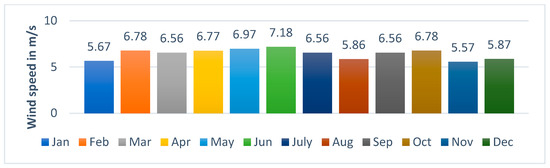
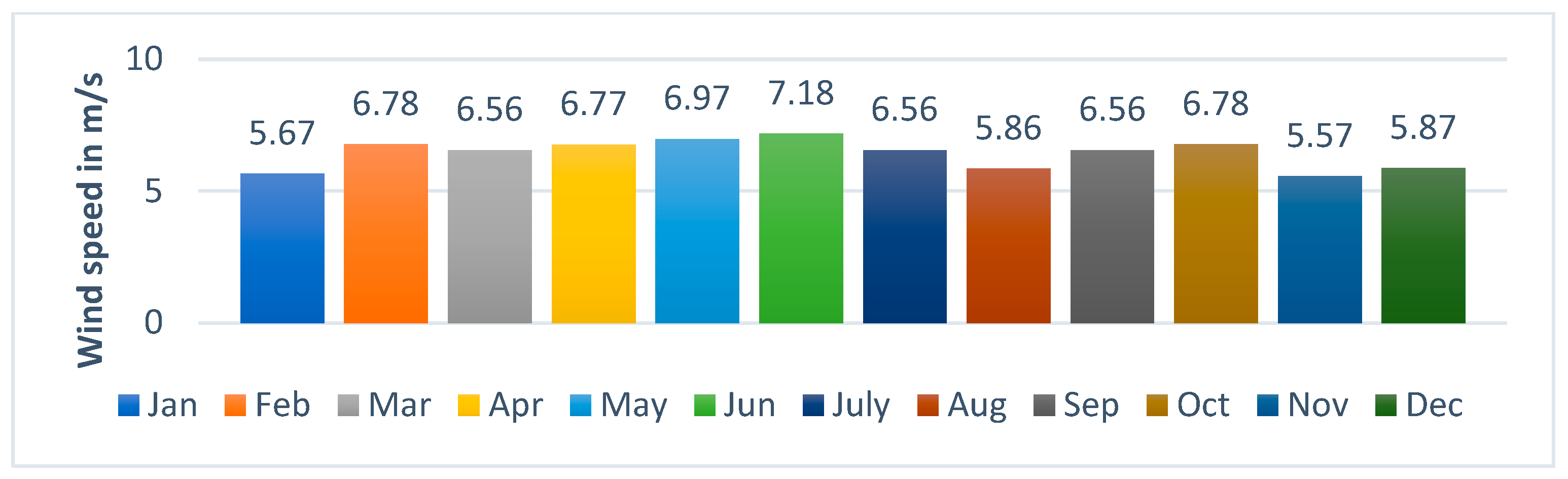
NokKundi Baluchistan’s meteorological data show that the average wind speed is 6.4 m/s at a height of about 50 m throughout the year. The data also indicate that the summer months have maximum wind speeds at around 40 kmph (11.11 m/s). The average wind velocities of NokKundiis are shown in Figure 1 below [5].
Figure 1.
Annual average wind speed at Noukundi.
Choosing wind turbines for power generation is mainly determined by wind speed. In NokKundi, the average wind velocity is 6.4 m/s. Based on the conditions of the said area, the ENERCON E82 E2, 2 MW wind turbine is an adequate choice. Wind turbines have hub heights of 50 to 80 m.
3.1. Standalone Model and Grid Tied Model, a Comparative Analysis
A standalone model and grid-tied model for the wind energy generation have been simulated in HOMER for the cost-effective analysis of the proposed model. A grid-tied network is a bi-directional distributed generation system, which facilitates the exchange of energy between the local grid and renewable power generation, while a standalone system only provides the energy to load without connecting to the grid.
3.1.1. Monthly Wind Turbine Power Output Both Systems
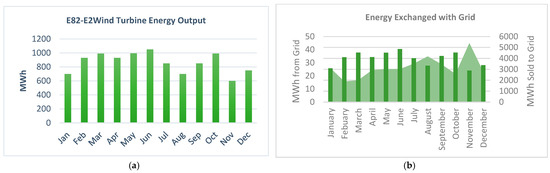
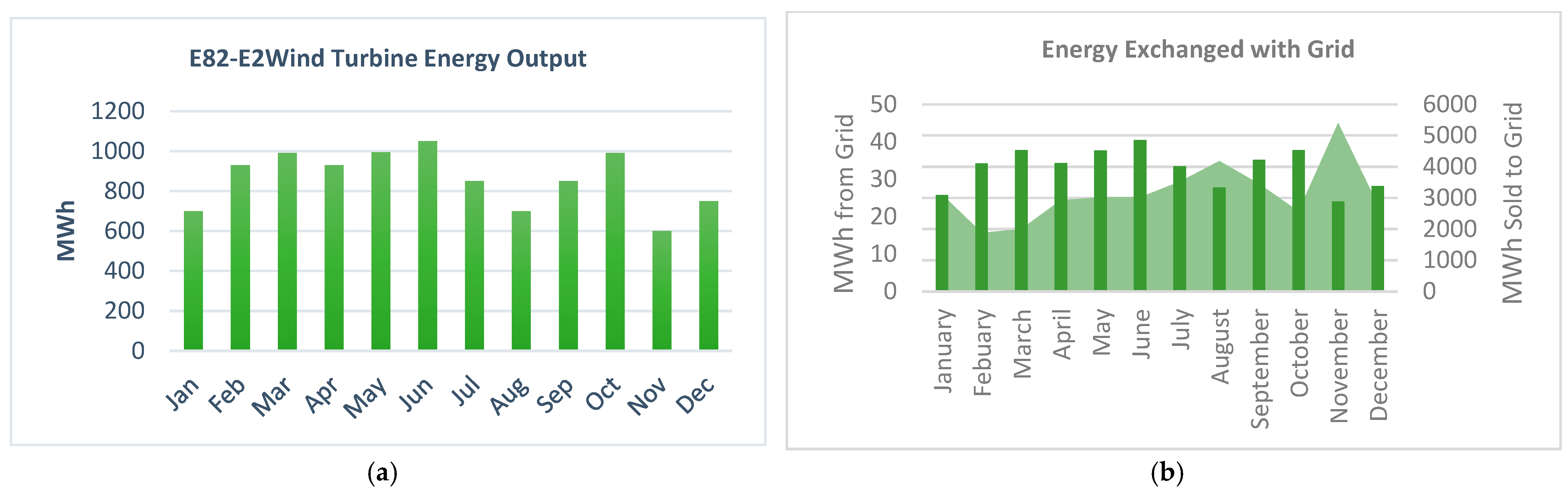
It is clear from the graph that the summer months have a greater average generation than the other months. The simulation results are given in Figure 2.
Figure 2.
(a) Energy output of the standalone system. (b) Energy exchanged between the grid-tied system and wind farm.
3.1.2. Energy Mix with Grid
A grid-tied network is a bi-directional system that makes it possible to sell excessive energy to the grid and be profitable. Furthermore, it can obtain energy from the grid in the case of high load demand or on low-wind days. The overall energy sold and purchased from the grid is shown in Table 2.
Table 2.
Energy exchange and cost comparison of both models.
From the above results, it can be summarized that the overall amount of energy purchased from the grid is 2,89,364 kwh/year, while excessive generated electricity is sold to the grid, which is 47,581,913 kwh/year to obtain a fair amount of profit for the system.
3.1.3. Comprehensive Assessment of Both Models
A comprehensive financial assessment of the grid-tied and standalone systems is shown below in Table 3.
Table 3.
Cost-benefit analysis of both models.
Grid-tied systems are more feasible and flexible than standalone wind energy generation because they exchange energy with the national grid and have reasonable profits.
4. Conclusions
The simulation results of both grid-tied and isolated wind farm systems conclude that the initial cost of the standalone and grid-tied systems is almost the same, which is $32,950,000. The cost of electricity from a standalone wind turbine is about $0.641/kwh and from a grid-tied wind turbine energy system is $0.023/kwh. When excess electricity is sold to the grid, the profit makes this system more feasible as the cost comes down to $25.350 million. The exchange of energy to the national grid and having reasonable profit makes the grid-tied system more feasible than standalone wind generation.
Author Contributions
Conceptual framework, software simulation and visualization and draft preparation have been done by M.H. and A.H.; Data collection and data analysis has been done by A.H. and S.K.; overall supervision of the research work and final review and editing has been done by S.K., M.H. and A.H. All authors have read and agreed to the published version of the manuscript.
Conflicts of Interest
The authors declare no conflict of interest.
References
- Ishfaq, S.; Ali, S.; Ali, Y. Selection of Optimum Renewable Energy Source for Energy Sector in Pakistan by Using MCDM Approach. Process Integr. Optim. Sustain. 2018, 2, 61–71. [Google Scholar] [CrossRef] [Scilit]
- The News. Available online: https://www.thenews.com.pk/print/847878-installed-capacity-to-generate-37-261-mw-power (accessed on 9 September 2021).
- Reve, Pakistan to Produce 2050 MW Wind Energy. Available online: https://www.evwind.es/2017/07/05/pakistan-to-produce-2050-mw-wind-energy/60363 (accessed on 9 September 2021).
- Tribune News. Available online: https://tribune.com.pk/story/649120/high-potential-balochistan-energy-resources-waiting-to-be-exploited (accessed on 9 September 2021).
- World Weather Online. NokKundi Monthly Climate Averages. Available online: https://www.worldweatheronline.com/nok-kundi-weather-averages/balochistan/pk.aspx (accessed on 9 September 2021).

Publisher’s Note: MDPI stays neutral with regard to jurisdictional claims in published maps and institutional affiliations. |
© 2022 by the authors. Licensee MDPI, Basel, Switzerland. This article is an open access article distributed under the terms and conditions of the Creative Commons Attribution (CC BY) license (https://creativecommons.org/licenses/by/4.0/).