


Abstract
Fiber Metal Laminates (FML), produced in both monolithic and sandwich configurations with glass-, basalt- and carbon-reinforced composites, were investigated for application in fire-resistant lithium battery boxes. Different resins, including recyclable and bio-based systems, were tested to improve sustainability; cores of recycled PET (RPET, 150 g/dm3, 10 mm) were considered. The study focused on the effect of core introduction on mechanical performance, with the dual goal of reducing weight and achieving stiffness values compliant with automotive OEM standards for lithium battery housings. Results demonstrated that sandwich structures improved stiffness up to 12-fold compared to monolithic laminates, while preserving the corrosion resistance of the outer aluminium layer and the flexural strength of the laminates after 670 h of Neutral Salt Spray (NSS) exposure.
1. Introduction
Fiber Metal Laminates (FML) represent a recognized solution for combining weight-reduction and fire resistance, although up to now production costs and closed-loop recyclability were still unsolved issues [1]: aluminium surface pretreatments have a fundamental importance in FML performance and sustainability [2]. These are the main objectives of FENICE (upscaling, KAVA9, EIT RawMaterials, www.fenice-composites.eu, 2022–2025, accessed on 1 December 2025) an EU project, funded with over 2.5 million and aiming at TRL 7, focusing on fire resistant battery boxes, for increasing safe use of current lithium-based batteries. The application demands structural optimization in terms of weight reduction and flexural strength after fire exposure and high T powder erosion (simulating lithium battery thermal runaway [3]). Another fundamental requirement for the automotive is related to resonance frequencies: to avoid resonance effects with the vibrations caused by the engine and road, the first resonance frequency must be over 30 Hz [4]. Fiber Metal Laminates (FML) with monolithic and sandwich structures including different composite layers, reinforced with glass or basalt were compared in terms of mechanical properties. The study showed that the introduction of a core structure in the lamination of FML composite materials increases the stiffness properties to fall within the standards defined by the automotive OEM for lithium battery boxes.
2. Materials and Methods
Monolithic and Sandwich composite panels (1 m2) based on Crossfire resin (https://crossfire-srl.com/en/ (accessed on 1 December 2025)) and Polyfurfuryl Alcohol (https://www.transfurans.be/products (accessed on 1 December 2025)) used to produce prepregs, starting from basalt, glass, and carbon fabrics. Composites were produced at 180 °C and, in the sandwich versions, associated with 10 mm thick cores in recycled PET, having verified it supports the processing parameters in warm press. The choice optimizes End-of-Life FML recycling, since both Crossfire resin and cores can be chemically recycled (recovering BHET, the starting material of PET) and separating the aluminium. Materials were tested applying relevant international standards (e.g., ASTM D-7249). Elium resin (Arkema, Paris, France www.arkema.com (accessed on 1 December 2025)) and infusion processing at RT were also considered. Table 1 and Table 2 present the different laminations and curing processes for the monolithic and sandwich samples, respectively, considered in this study.
Table 1.
Lay-up and curing conditions of the monolithic samples.
Table 2.
Lay-up and curing conditions of the sandwich samples.
A main advantage of Crossfire resin is showing a high adhesion to aluminium also without pretreatments, while the aluminium for FML based on PFA and Elium resin had to be sized, which is an advantage in terms of sustainability [2]. This difference is also associated with the fact that Crossfire resin is PET based, which makes it possible a chemical recycling of both the resin (and the RPET core, if present) similar to the ones which are being industrially upscaled for PET bottles.
The present study mainly focused on the evaluation of the flexural properties before and after accelerated Neutral Salt Spray ageing (NSS) and the evaluation of flexural stiffness. Table 3 and Table 4 show, for the monolithic and sandwich structure respectively, the experimental campaign carried out in terms of: sample tested, type of test performed, test conditions and international reference standard.
Table 3.
Summary of tests performed on monolithic FML samples.
Table 4.
Summary of tests performed on sandwich FML samples.
3. Results and Discussion
3.1. Flexural Strength Evaluation Before and After NSS
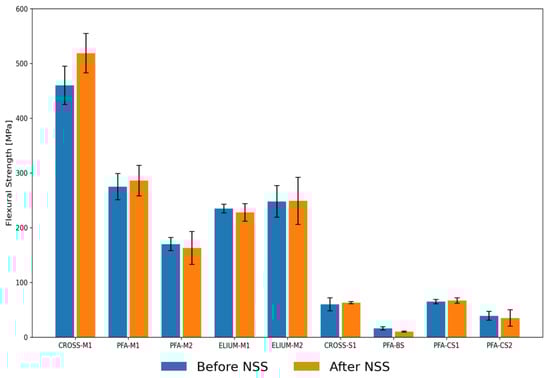
The materials used in the production of battery boxes must withstand extreme conditions, including corrosion. To assess the actual loss of performances, two mechanical campaigns were carried out before and after the NSS accelerated ageing test for both the monolithic and sandwich structures. Table 5 shows the comparison, in terms of flexural strength, for each sample before and after 670 h of NSS accelerated ageing test. All tests were performed using a 3-point bending configuration. For the monolithic samples the characterisation campaign was carried out in accordance with international standard UNI EN ISO 14125 [5]: span = 47 mm, speed = 1 mm/min; while for sandwich samples the referred international standard used for the characterisation was UNI EN 10545-4 [8]: span = 28 cm, speed = 5 mm/min. Observing the results shown in Table 5 and Figure 1, exposure to corrosive environments, by NSS accelerated ageing test, does not lead to compromised mechanical performance of the materials. In general, specimens made with Crossfire prepreg show a slightly lower Young’s Modulus than those made of PFA and Elium for both monolithic and sandwich structure. Looking, on the other hand, at the average values of flexural strength, we see two completely different trends: in the case of monolithic-structured specimens, the value obtained for the specimen made with Crossfire prepreg turns out to be at least 50% higher than the specimens made with PFA and Elium prepregs. This indicates a greater ability of the Crossfire solution to resist bending phenomena. In the case of sandwich-structured specimens, due to the presence of the RPET core that gives greater stiffness to the laminate, the flexural strength values decrease by about 80–90% compared to the monolithic-structured samples. Due to the results of these measurements, and the better residual flexural strength after fire [9], the remainder of the study focused on the Crossfire resin. This resin is also advantageous in terms of LCA (being stable and solid at room temperature, CrossPreg do not need low-temperature storage), toxicity (being VOC- and solvent-free), and end-of-life treatment, thanks to its hybrid PET-epoxy nature, which enables two recycling pathways: (1) chemical recycling for the separate recovery of reinforcement fabrics, aluminium, BHET, and epoxy oligomers, or (2) simple milling of the composite, retaining the embedded glass fibers, followed by reuse of the resulting secondary raw material in the injection molding of PET-glass automotive components.
Table 5.
Flexural strength results for FML structures, before and after NSS testing.
Figure 1.
Flexural strength (average values) of monolithic and sandwich FML specimens before (blue) and after (orange) 670 h of Neutral Salt Spray (NSS) ageing.
3.2. Flexural Stiffness and Rigidity Evaluations
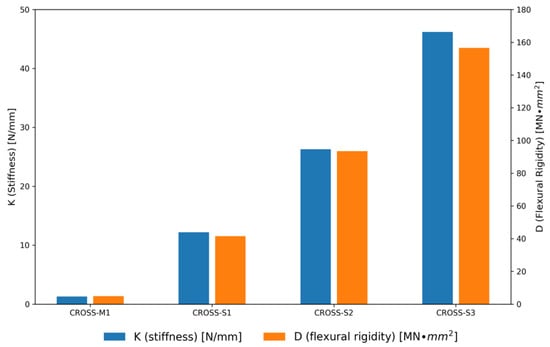
Flexural Stiffness was evaluated on Crossfire specimens to quantify the stiffness and flexural rigidity of the sandwich structures. To perform the mechanical characterisation, four specimens were prepared following the layups and the curing procedures previously presented in Table 1 and Table 2. All the mechanical tests were performed using a 4-point bending configuration in accordance with the international standard ASTM D7249 [7]. The geometrical dimensions of the sample were 75 × 600 mm with an outer span of 560 mm and an inner span of 100 mm. The results, in terms of average values of Flexural Stiffness (K, N/mm) and Flexural Rigidity (D, MN∙mm2), are reported in Table 6. Figure 2 compares the obtained results of both Flexural Stiffness and Rigidity for the four samples characterized. Flexural Stiffness (K) was evaluated through a linear regression starting from the load and displacement results of mechanical characterizations taking as reference the general equation defining this variable (Equation (1)); while Flexural Rigidity (D) was evaluated through Equation (2), in agreement with what was reported by Sadeghian et al. [10]:
Table 6.
Flexural Stiffness (K) and Flexural Rigidity (D) results for both monolithic (CROSS-M1) and sandwich (CROSS-S1, CROSS-S2, CROSS-S3) FML structures, after NSS.
Figure 2.
Comparison of Flexural Stiffness, K [N/mm] and Flexural Rigidity, D [MN∙mm2] for both monolithic and sandwich structures, made using CrossPreg-glass.
Equation (1). Flexural Stiffness [N/mm]
Equation (2). Flexural Rigidity [MN·mm2]
where Ef = Young’s modulus of the external skin [GPa]; Ec = Young’s modulus of the core [GPa]; b = width of the sample [mm]; t = thickness of each skin [mm]; c = thickness of core [mm]; d = distance between the center lines of the upper and lower skins.
The results obtained from the mechanical characterisation campaign carried out on the Crossfire-glass/PET samples with monolithic and sandwich structures, and reported in Table 6, show a clear increase in stiffness properties with respect to two factors:
- Introduction of RPET core: comparing the monolithic sample (CROSS-M1) with the sandwich-structure laminate containing a single prepreg layer between aluminum and core (CROSS-S1), the Flexural Stiffness and Rigidity values show an increase of 900% for the former (1.3 N/mm vs. 12.2 N/mm) and 850% for the latter (4.9 MN∙mm2 vs. 41.6 MN∙mm2). This behavior is due to the introduction of a rigid component in the FML lamination, namely the RPET core. The need to introduce this component concerns the need to meet the application requirements defined by the Stellantis group for the automotive application. Materials with low stiffness would, in fact, be too prone to flexural motion due to the vibrations transmitted to the battery box, risking rupture and the consequent compromise of the entire battery module [11].
- Increase in the thickness of the outer skin (number of prepreg layers): looking at the results of the three samples made with sandwich structure, it is possible to see a steady increase in the values of both Flexural Stiffness and Flexural Rigidity as the number of prepreg layers on the surface skin increases. This behavior is due to the increase in the overall thickness of the specimen. Taking Equation (2) as a reference, Flexural Rigidity (D) is proportional to the thickness of the outer skins by a factor of t3. It follows that an increase in skin thickness, has as a direct consequence an increase in the overall stiffness of the laminate.
4. Conclusions
FENICE project develops and compares innovative composites and FML for more sustainable and performing battery boxes, aiming at better fire resistance and structural lightening. The present study aimed to evaluate and validate the introduction of a core structure in the lamination of FML composite materials, for increasing the stiffness properties to fall within the standards about resonance defined by automotive OEM for battery boxes (Centro Ricerche Fiat-Stellantis, Turin, Italy, in the case of FENICE project). Experimental campaigns were carried out on monolithic and sandwich FML, reinforced using different fibers (glass, basalt, and carbon fabrics) along with bio-based or recyclable resins. For fire resistance, it is a factor of paramount importance putting a top layer of aluminium, which has to be protected from corrosion which in our case was done using sol-gel precursors [9]. Mechanical properties were measured before and after Neutral Salt Spray (NSS) accelerated aging tests, showing no degradation, meaning the flexural strength and modulus do not decrease significantly upon this treatment.
Monolithic and sandwich FML were also compared in terms of flexural strength, showing that the introduction of the core leads to increased stiffness. The tests were carried out to comply with the OEM’s request of obtaining a first resonance frequency values of not less than 30 Hz. For this purpose, the Crossfire prepregs were used to produce the required samples (one monolithic sample and three sandwich samples with increasing numbers of prepreg ply). In the case of this resin, no aluminium pretreatment was needed to achieve high adhesion between the composite and aluminium layer, which makes the production and recycling of this type of FML easier and more sustainable. Other advantages of CrossPreg (Crossfire-resin-based prepregs) include the absence of low-temperature storage requirements compared to conventional prepregs, reduced resin toxicity and environmental impact due to their VOC- and solvent-free formulation, and improved recyclability of both end-of-life components and prepreg scraps. All these advantages are a consequence of Crossfire resin unique combination of characteristics (patented by Crossfire srl, [12]) all linked to its hybrid PET-epoxy nature. In particular, FML based on CrossPreg can be chemically recycled, with processes similar to those adopted for PET recycling, enabling the separate recovery of reinforcement fabrics, aluminium, BHET, and epoxy oligomers, obtaining FML which are closed-loop recyclable (no degradation or performance reduction upon recycling).
PFA based composites are being extensively studied being an interesting biobased resin in transport applications, when fire is an issue [13,14], however the fact that water is developed upon curing makes it challenging ensuring adhesion with aluminium, so it doesn’t seem an optimal choice for FML. In the present study, C-PFA prepregs were investigated and a two steps warm press preparation was adopted, that is curing the PFA composite and then joining it to the surface aluminium, using the Crossfire resin as an interface.
Comparison of the results of the mechanical evaluations revealed that: (1) the introduction of the RPET core resulted in at least a 12-fold increase in stiffness properties compared to those identified for the monolithic sample (comparison of CROSS-M1 and CROSS-S1 samples). (2) In agreement with the equation regarding Flexural Rigidity, increasing the number of prepreg layers, which corresponds to a thickness increase of the outer skins, led to a marked increase in the stiffness properties of the composite panels. This behavior can be attributed to the exponential dependence of Flexural Rigidity, D, respect to the overall thickness of the outer skins, t, of the sandwich-structure composite material (D ∝ t3), as discussed in the article and in accordance with the basic laws.
Author Contributions
Conceptualization and methodology C.M. and E.M. Investigation and validation: M.S., G.D.A., M.M., L.L. and L.G. Data curation and draft preparation S.B. and C.V. All authors have read and agreed to the published version of the manuscript.
Funding
The research activities were cofunded by EIT Raw Materials (https://eitrawmaterials.eu/ (5 December 2025)) as part of the Fenice Project (Upscaling n° 21099, 2022-25, www.fenice-composites.eu (accessed on 1 December 2025)) with €2,460,433.00.
Institutional Review Board Statement
Not applicable.
Informed Consent Statement
Not applicable.
Data Availability Statement
The collected data were judged confidential and so are not publicly available, but it is possible to contact the corresponding author (Fenice project coordinator) for specifical requests.
Conflicts of Interest
The authors declare no conflicts of interest.
References
- Costa, R.D.F.S.; Sales-Contini, R.C.M.; Silva, F.J.G.; Sebbe, N.; Jesus, A.M.P. A critical review on FMLs: From manufacturing to sustainable processing. Metals 2023, 13, 638. [Google Scholar] [CrossRef] [Scilit]
- Caggiano, M.; Saffioti, M.R.; Rotella, G. Fiber Metal Laminates: The Role of the Metal Surface and Sustainability Aspects. J. Compos. Sci. 2025, 9, 35. [Google Scholar] [CrossRef] [Scilit]
- Ares-Elejoste, P.; Ballestero, J.; Creonti, G.; Bassi, S.; Valli, C.; Mingazzini, C. Closed-loop recyclable and fire-resistant composites for electrical car battery boxes. In Proceedings of the 20th International Symposium on Waste Management, Resource Recovery and Sustainable Landfilling, Sardinia, Italy, 13–17 October 2025; Available online: https://members.sardiniasymposium.it/pdf_sardinia2025/3733_Mingazzini.pdf (accessed on 1 December 2025).
- Harrison, M. Vehicle Refinement: Controlling Noise and Vibration in Road Vehicles; Wang, X., Ed.; Woodhead Publishing Limited: Cambridge, UK, 2010; p. 335. [Google Scholar]
- UNI EN ISO 14125; Compositi Plastici Rinforzati con Fibre—Determinazione delle Proprietà a Flessione. UNI: Milan, Italy, 2011.
- UNI EN ISO 9227; Prove di Corrosione in Atmosfere Artificiali—Prove in Nebbia Salina. UNI: Milan, Italy, 2017.
- ASTM D7249; Standard Test Method for Facesheet Properties of Sandwich Constructions by Long Beam Flexure. ASTM: West Conshohocken, PA, USA, 2020.
- UNI EN ISO 10545-4; Piastrelle di Ceramica—Parte 4: Determinazione del Modulo di Rottura e della Forza di Rottura. UNI: Milan, Italy, 2019.
- Mingazzini, C.; Leoni, E.; Bassi, S.; Delise, T.; Scafè, M.; De Aloysio, G.; Laghi, L.; Morganti, M.; Falleti, G.L. Mechanical characterizations on biobased FMLs, being developed for battery boxes, before and after ageing. J. Phys. Conf. Ser. 2024, 2692, 012012. [Google Scholar] [CrossRef] [Scilit]
- Sadeghian, P.; Hristozov, D.; Wroblewski, L. Flexural Behavior of Sandwich Panels made of FRP Composites: Synthetic and Natural Fibers. In Proceedings of the Canadian Society for Civil Engineering (CSCE) Annual Conference, London, ON, Canada, 1–4 June 2016; pp. STR-954-1–STR-954-10. [Google Scholar]
- Wu, S.; Chen, Y.; Luan, W.; Chen, H.; Huo, L.; Wang, M.; Tu, S. A review of multiscale mechanical failures in Lithium-Ion batteries: Implications for performance, lifetime and safety. Electrochem. Energy Rev. 2024, 7, 35. [Google Scholar] [CrossRef] [Scilit]
- Creonti, G. Italian Patent Application IT 102024000013807. 2024. Available online: https://www.jec-italy.events/2025/proceedings/Day-1_1500-JEC-FORUM-ITALY-Mingazzini-110625.pdf (accessed on 1 December 2025).
- Odiyi, D.C.; Sharif, T.; Choudhry, R.S.; Mallik, S.; Shah, S.Z.H. A review of advancements in synthesis, manufacturing and properties of environment friendly biobased Polyfurfuryl Alcohol Resin and its Composites. Compos. Part B Eng. 2023, 267, 111034. [Google Scholar] [CrossRef] [Scilit]
- Ofondu Chinomso Iroegbu, A.; Meijboom, R. Dual-catalyst effect on the molecular weight enhancement of polyfurfuryl alcohol resin and stability. Discov. Chem. 2025, 2, 8. [Google Scholar] [CrossRef] [Scilit]

Disclaimer/Publisher’s Note: The statements, opinions and data contained in all publications are solely those of the individual author(s) and contributor(s) and not of MDPI and/or the editor(s). MDPI and/or the editor(s) disclaim responsibility for any injury to people or property resulting from any ideas, methods, instructions or products referred to in the content. |
© 2025 by the authors. Licensee MDPI, Basel, Switzerland. This article is an open access article distributed under the terms and conditions of the Creative Commons Attribution (CC BY) license (https://creativecommons.org/licenses/by/4.0/).